- Product Description Description
- Table of Contents TOC
- List of Table & Figure LOT
- Get Free Sample PDF Sample PDF
Market Size, 2025
$15.82 BnMarket Estimate, 2026
$17.03 BnMarket Forecast, 2034
$30.76 BnCAGR, 2026–2034
7.67%Europe Recycled Plastics Market Size, Growth, Trends & Forecast (2026–2034)
The Europe recycled plastics market size was valued at USD 15.82 billion in 2025, reached USD 17.03 billion in 2026, and is projected to scale up to USD 30.76 billion by 2034, registering a compound annual growth rate (CAGR) of 7.67% during the forecast period from 2026 to 2034. Driven by the Single-Use Plastics Directive, circular-economy legislation, and the expansion of deposit-return systems, the market continues to expand significantly across packaging, automotive, and building sectors.
Key Executive Metrics (At-a-Glance)
- 2025 Base Valuation: USD 15.82 Billion
- 2026 Current Valuation: USD 17.03 Billion
- 2034 Forecast Valuation: USD 30.76 Billion
- Compound Annual Growth Rate (CAGR): 7.67% (2026–2034)
- Leading Regional Market: Germany (Premier market for collection and recycling capacity)
- Fastest-Growing Type Segment: Polypropylene (PP)
- Fastest-Growing Source Segment: Foams (Polymer foams)
- Fastest-Growing Application Segment: Building and Construction
Core Market Drivers
- Regulatory Pull: Directives like the Single-Use Plastics Directive (mandating 25% recycled content in PET bottles by 2026 and 30% across all bottles by 2030) and PPWR compelling recycled content.
- Rising Circular Content: Measurable uptick in embedded circular content, with post-consumer recycled plastics accounting for 12.6% of converted plastics in Europe.
Primary Market Restraints & Challenges
- Macro Headwinds: Demand volatility, import pressure, and weak recyclate offtake straining capacity utilization.
- Feedstock Quality: Uneven quality and mixed-polymer streams constraining the supply of food-grade rPET and high-spec rPO.
Europe Recycled Plastics Market Segmentation Highlights
| Segment Category | Largest Segment | Fastest-Growing Segment |
|---|---|---|
| By Type | Polyethylene (33.1% share, 2025) | Polypropylene (PP) |
| By Source | Bottles (Dominant share) | Foams (Polymer foams) |
| By Application | Packaging (Dominant share) | Building and Construction |
Major Industry Players Profiled
Key environmental service leaders, material technology groups, and market shapers include Veolia, MBA Polymers Inc., Borealis, Plastipak Holdings, Inc., SUEZ, Berry Europe Inc., KW Plastics, B&B Plastics Inc., B. Schoenberg & Co., Inc., Envision Plastics, Jayplas, Joe's Plastics, KK Asia (HK) Ltd., and Ultra-Poly Corporation.
Europe Recycled Plastics Market Size
The Europe recycled plastics market size was valued at USD 15.82 billion in 2025, and the market size is expected to reach USD 30.76 billion by 2034 from USD 17.03 billion in 2026. The market is growing at a CAGR of 7.67% from 2026 to 2034.

Europe’s recycled plastics ecosystem sits at the intersection of environmental policy and materials circularity. The region recycled 41% of plastic packaging waste in 2022, underscoring uneven but tangible progress, according to Eurostat. Regulation is now decisive: the Single-Use Plastics Directive requires 25% recycled content in PET beverage bottles by 2026 and 30% in all plastic bottles by 2030, while the newly adopted EU Packaging and Packaging Waste Regulation hardwires recyclability and recycled-content obligations by 2030. These forces are reshaping demand profiles across packaging, beverages, and FMCG supply chains.
MARKET DRIVERS
Regulatory pull from circular-economy law
The market’s primary demand engine is legal obligation. The Single-Use Plastics Directive compels 77% separate collection of plastic bottles by 2026 (rising to 90% by 2029) and mandates 25% recycled content in PET bottles by 2026 and 30% in all bottles by 2030, according to the European Commission. As member states expand deposit-return systems to meet these targets, converters and beverage brands are contracting long-term rPET/rPO supply to de-risk compliance.
Rising circular content in manufactured plastics
A parallel demand driver is the measurable uptick in circular content embedded in products. In 2022, post-consumer recycled plastics accounted for 12.6% of converted plastics in Europe, equivalent to 6.8 million tonnes, marking a 70% increase versus 2018, according to PlasticsEurope’s 2025 circular economy analysis. Circular plastics output (including mechanical and chemical recycling plus bio-based and bio-attributed) reached 11.7 million tonnes, or 19.7% of European plastics production in 2022, signalling structural commitments by converters to integrate recyclate into packaging, automotive components, building products, and consumer goods.
MARKET RESTRAINTS
Demand volatility and import pressure
A sharp fall in European plastics production and weak recyclate offtake have stressed operators, curbing capacity utilization and depressing prices for certain grades. Such macro headwinds can delay retooling for food-grade streams and suppress long-term contracting.
Quality constraints and collection inefficiencies
Despite progress, feedstock quality remains uneven, and mixed-polymer streams still dominate in many municipalities. The European Environment Agency notes that contamination, design complexity, and dispersion across waste streams limit yield and material value, constraining the supply of food-grade rPET and high-spec rPO.
MARKET OPPORTUNITIES
Expansion of deposit-return systems (DRS)
Scaling DRS is a high-impact opportunity to lift collection purity, stabilize rPET flows, and cut logistics leakage.
Scale-up of advanced and certified circular feedstocks
Chemical recycling and bio-attributed inputs are emerging complements to mechanical routes for hard-to-recycle streams. As certification and mass-balance accounting mature, converters gain access to drop-in resin grades for contact-sensitive and performance-critical applications, broadening end-market eligibility for recycled content and unlocking premium pricing tied to compliance credentials.
MARKET CHALLENGES
Meeting ambitious targets at speed
Execution risk is material. The PPWR’s economy-wide recyclability and recycled-content provisions compress timelines for redesign and qualification testing, especially for multilayer flexibles and contact-sensitive food packaging, raising CapEx and technical hurdles for SMEs and municipal systems. Slippage against these milestones could bottleneck supply of compliant recyclate and trigger enforcement exposure for brand owners.
Data gaps, methodology shifts, and investment uncertainty
Harmonized metrics remain a challenge. Plastics Europe points out that limited granularity on application-level flows, pre-consumer waste, and chemically recycled shares, complicating investment cases for de-inking, delamination, and depolymerization assets. These uncertainties can elevate risk premiums and delay bankable project pipelines.
REPORT COVERAGE
| REPORT METRIC | DETAILS |
| Market Size Available | 2025 to 2034 |
| Base Year | 2025 |
| Forecast Period | 2026 to 2034 |
| CAGR | 7.67% |
| Segments Covered | By Type, Source, Application, and Region |
| Various Analyses Covered | Global, Regional, & Country Level Analysis; Segment-Level Analysis; DROC; PESTLE Analysis; Porter’s Five Forces Analysis; Competitive Landscape; Analyst Overview of Investment Opportunities |
| Regions Covered | UK, France, Spain, Germany, Italy, Russia, Sweden, Denmark, Switzerland, Netherlands, Turkey, Czech Republic, Rest of Europe |
| Market Leaders Profiled | Polymers, B&B Plastics Inc., B. Schoenberg & Co., Inc., Envision Plastics, Jayplas, Joe's Plastics, KK Asia (HK) Ltd., Berry Europe Inc., MBA Polymers Inc., Plastipak Holdings, Inc., SUEZ, Ultra-Poly Corporation, Veolia and KW Plastics, and others. |
SEGMENTAL ANALYSIS
By Type Insights
The polyethylene segment held the largest share among recycled plastic types in Europe at 33.1% of the market by revenue in 2025. Its dominance stems from widespread post-consumer use in packaging, but also its favorable properties like heat resistance, clarity, and flexibility that support diverse end uses.
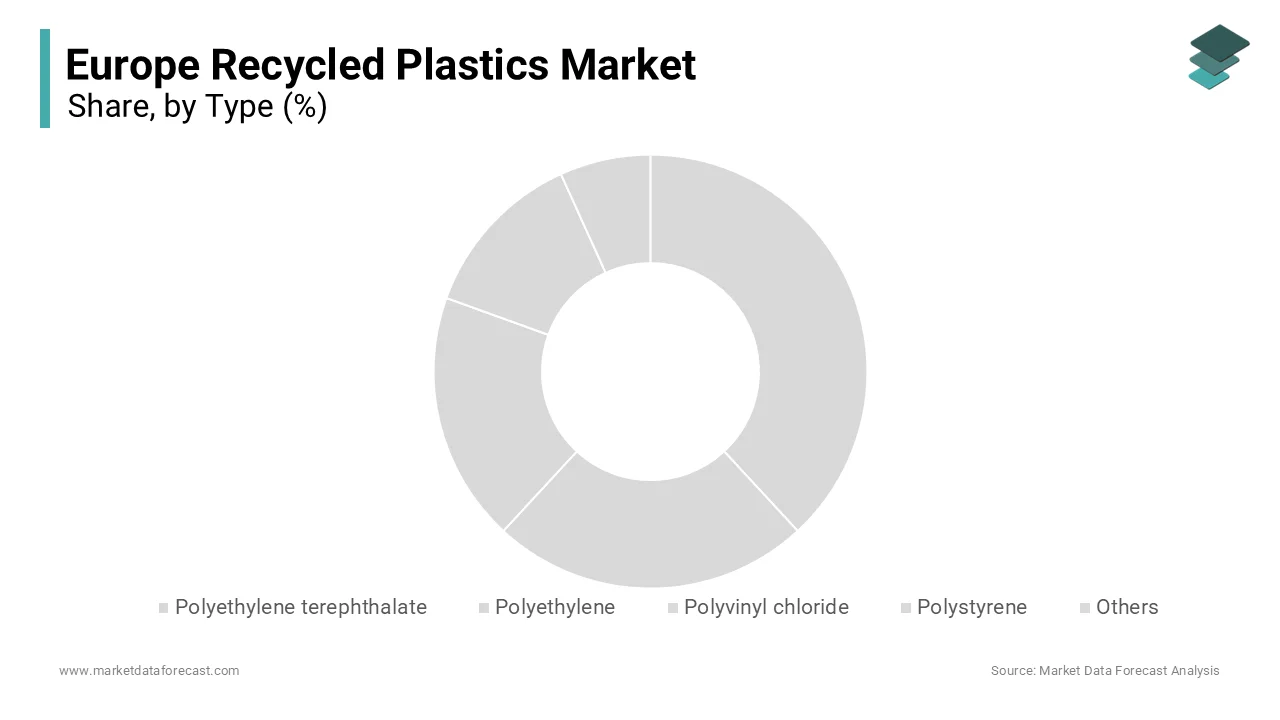
The polypropylene segment is forecast to be the fastest-growing recycled plastic type in Europe throughout the forecast period. The growth is propelled by increasing demand in applications like automotive interiors, consumer goods, and rigid packaging where PP’s durability and chemical resistance are valued. Its use in high-temperature and high-stress environments positions it well for circular applications.
By Source Insights
The plastic bottles segment dominated recycled plastic sources in Europe. It is largely driven by PET bottle collection and recycling systems. Bottles account for the greatest share in the recycled plastics market due to effective collection infrastructure and beverage industry participation.
The foams segment, especially polymer foams, is the fastest-growing source segment. These are increasingly recycled thanks to rising demand in construction, insulation, and automotive sectors. Bio-based, biodegradable foam innovations also contribute to their upward trajectory.
By Application Insights
The recycled plastics segment is most extensively used in packaging applications across Europe. Packaging remains the largest end-use segment, supported by regulations, high waste generation, and demand for sustainable material traceability and recyclability.
The building and construction sector is the fastest-growing application for recycled plastics such as rPET. Its growth is driven by demand for insulation, piping, and interior components leveraging recycled materials’ durability and lower environmental impact.
REGIONAL ANALYSIS
Germany Recycled Plastics Market Insights
Germany stood as the region’s premier market for recycled plastics and is driven by robust recycling infrastructure, strong EPR (Extended Producer Responsibility) policies, and industry adoption of circular materials. It leads in both collection volumes and recycling capacity, fueling market momentum.
France Recycled Plastics Market Insights
France plays a critical role, underpinned by governance incentives and domestic investments in recycling facilities. French policy prioritizes reducing plastic usage and boosting recycled content, stimulating both supply and demand.
United Kingdom Recycled Plastics Market Insights
The UK contributes significantly to recycled plastics demand, supported by plastic-tax frameworks and advanced chemical recycling pilots aiming to increase recyclate utilization in packaging and infrastructure applications.
Netherlands Recycled Plastics Market Insights
The Netherlands is notable for pioneering rPET utilization and packaging innovation, its companies emphasize high-grade recycled input and support mechanical and chemical recycling programs, especially in the beverage and food industries.
Spain Recycled Plastics Market Insights
In Southern Europe, Spain emerges as a growing market. Though recycling rates vary regionally, investment in recycling technology and rising packaging demand in food and beverage pathways strengthen recycled plastic deployment.
COMPETITIVE LANDSCAPE
Competition in Europe’s recycled plastics landscape is dynamic and evolving. Veterans like Veolia and Suez leverage scale and vertical integration in waste processing, while innovators like MBA Polymers advance high-value recycling through technology-heavy solutions for complex post-consumer streams. Borealis, by contrast, scales capacity through strategic acquisitions, augmenting regional compounding capabilities. Emerging players such as Plasta Group and Morssinkhof Rymoplast excel in LDPE and flexible film streams, emphasizing high-purity recyclates and closed-loop models with retail partners. Demand from packaging, construction, auto, and consumer goods continues to rise, pressuring producers to deliver consistent, food-grade, and supply-secure recycled materials. The market’s pressure points, energy costs, regulatory variability, and global trade imbalances, further intensify strategic positioning across the value chain.
KEY MARKET PLAYERS
Companies playing a notable role in the Europe recycled plastics market include
-
Polymers
-
B&B Plastics Inc.
-
B. Schoenberg & Co., Inc.
-
Envision Plastics
-
Jayplas
-
Joe's Plastics
-
KK Asia (HK) Ltd.
-
Berry Europe Inc.
-
MBA Polymers Inc.
-
Plastipak Holdings, Inc.
-
SUEZ
-
Ultra-Poly Corporation
-
Veolia
-
KW Plastics
TOP PLAYERS IN THE MARKET
Veolia is a global environmental services leader, deeply embedded in recycling infrastructure across Europe. It processes a wide array of polymers, including PET, HDPE, PP, PS, and PVC, across its waste management operations. In Asia-Pacific, Veolia operates advanced recycling plants, exporting its circular models to markets like Thailand and South Korea. Its recent focus includes digital sorting technologies and partnerships with consumer goods leaders to integrate high-quality recycled feedstocks into packaging production—for instance, supplying L’Oréal with rPET to support its global refill systems, reinforcing Veolia’s position as a cross-regional circular plastics enabler.
MBA Polymers specializes in converting post-consumer durable goods, electronics, appliances, vehicles, into high-purity recycled plastics. Its patented, highly automated sorting and separation technology powers facilities across Europe and APAC. In China and Germany, MBA has industrial-scale processing plants that reclaim complex ABS and polyolefin waste streams.
Borealis, a leading material technologies group, has significantly enhanced its recycled plastics capabilities through strategic acquisitions. In 2024, it acquired Rialti S.p.A.Through these moves, Borealis is building a robust recycled polyolefin portfolio that serves sectors like automotive, construction, and consumer goods, strengthening sustainable feedstock integration across Europe and extending to neighboring markets.
TOP STRATEGIES USED BY KEY MARKET PLAYERS
Leading European recyclers are deploying complementary strategies. Veolia integrates advanced recycling processing with global brand partnerships to ensure supply of high-quality recycled feedstock. MBA Polymers leans on patented automation and durable goods circularity, reclaiming plastics from complex waste for high-demand sectors. Borealis executes strategic consolidation via acquisitions, scaling recycled PP and polyolefin compounding. Collectively, these approaches, blend of innovation, quality-centric partnerships, and scale, underscore a multi-pronged push to deliver clean, scalable recycled plastics for circular supply chains.
RECENT HAPPENINGS IN THE MARKET
- In June 2024, MBA Polymers Europe Recycled Plastics Market launched ABS recycled products with 95% repurposed content for automotive, electronics, and construction sectors. This Europe Recycled Plastics Market rollout is anticipated to elevate circularity standards in durable-goods supply chains.
- In summer 2024, Borealis Europe Recycled Plastics Market acquired Rialti S.p.A., adding 50,000 tonnes/year of recycled PP compounding capacity. This Europe Recycled Plastics Market acquisition is anticipated to amplify its recycled PP output for multiple industrial applications.
- In April 2025, Borealis Europe Recycled Plastics Market acquired Integra Plastics AD in Bulgaria to add over 20,000 tonnes of mechanically recycled polyolefin capacity. This Europe Recycled Plastics Market expansion is anticipated to strengthen its feedstock security and regional reach.
- In early 2025, Veolia Europe Recycled Plastics Market deepened its recycled PET supply to L’Oréal’s global refill systems. This Europe Recycled Plastics Market arrangement is anticipated to integrate circular feedstocks into consumer-facing packaging.
- In February 2026, Plasta Group Europe Recycled Plastics Market began supplying 100% post-consumer LDPE film to European household waste bag producers. This Europe Recycled Plastics Market milestone is anticipated to showcase high-quality flexible recyclate deployment.
MARKET SEGMENTATION
This research report on the Europe recycled plastics market has been segmented and sub-segmented into the following categories
By Type
- Polyethylene terephthalate
- Polyethylene
- Polyvinyl chloride
- Polystyrene
- Others
By Source
- Bottles
- Bags
- Films
- Fibers
- Foams
- Others
By Application
- Packaging
- Building & construction
- Textile
- Automotive
- Electrical & electronics
- Household goods
- Agriculture
- Healthcare
- Others
By Country
- UK
- France
- Spain
- Germany
- Italy
- Russia
- Sweden
- Denmark
- Switzerland
- Netherlands
- Turkey
- Czech Republic
- Rest of Europe