- Product Description Description
- Table of Contents TOC
- List of Table & Figure LOT
- Get Free Sample PDF Sample PDF
Market Size, 2025
$299.97 MnMarket Estimate, 2026
$314.53 MnMarket Forecast, 2034
$379.91 MnCAGR, 2026–2034
4.84%Europe Red Meat Market Report Summary
The European red meat market was valued at USD 299.97 million in 2025, is estimated to reach USD 314.53 million in 2026, and is projected to grow to USD 379.91 million by 2034, expanding at a CAGR of 4.84% during the forecast period from 2026 to 2034.
The growth of the European red meat market is driven by steady consumer demand for animal protein, rising popularity of high-protein diets, and the continued importance of meat in traditional European cuisines. Expanding foodservice and hospitality sectors, along with growing demand for ready-to-cook and processed meat products, are further supporting market growth. Moreover, improvements in cold chain logistics, packaging technologies, and meat traceability systems are enhancing product safety and shelf life across the region.
Key Market Trends
- Increasing demand for premium and value-added meat products, such as marinated, portioned, and ready-to-cook cuts.
- Rising focus on sustainable and ethical meat sourcing, with emphasis on animal welfare and traceability.
- Growth of private-label meat brands across European supermarkets and hypermarkets.
- Adoption of advanced cold-chain and packaging technologies to improve freshness and reduce food waste.
- Gradual shift toward leaner and high-quality meat cuts among health-conscious consumers.
Segmental Insights
- Based on type, the pork meat segment dominated theEuropeane red meat market in 2025, accounting for 41.4% of the total market share. The segment’s leadership is supported by strong cultural preference, affordability, and wide usage in processed and traditional meat products across Europe.
- Based on distribution channel, the supermarkets and hypermarkets segment held the largest share, capturing 56.5% of the regional market in 2025. The dominance of this channel is driven by broad product availability, competitive pricing, and consumer trust in organized retail formats.
Regional Insights
The European red meat market is experiencing stable growth across major economies, supported by strong domestic consumption and well-established meat processing industries.
- Germany led the regional market in 2025, accounting for 20.9% of the total European market share, driven by high production capacity and strong retail distribution networks.
- France held a significant share due to consistent consumer demand and culinary traditions.
- Italy and the United Kingdom also contributed notably.
- Spain is expected to register healthy growth during the forecast period due to expanding foodservice demand and exports.
Competitive Landscape
The European red meat market is moderately consolidated, with global food processors and regional meat suppliers competing on product quality, safety standards, and distribution efficiency. Companies are focusing on expanding processing capacity, improving traceability systems, and launching value-added meat products to strengthen their market positions.
Prominent players in the European red meat market include
W.H. Group, JBS USA Food Company, Tyson Foods Inc., Kraft Heinz Company, Cargill, Incorporated, ConAgra Foods Inc., BRF SA, OSI Group LLC., Tönnies Group, SYSCO Corp., Smithfield Foods Inc., The Scottish Goat Meat Company, and Irish Country Meats.
Europe Red Meat Market Size
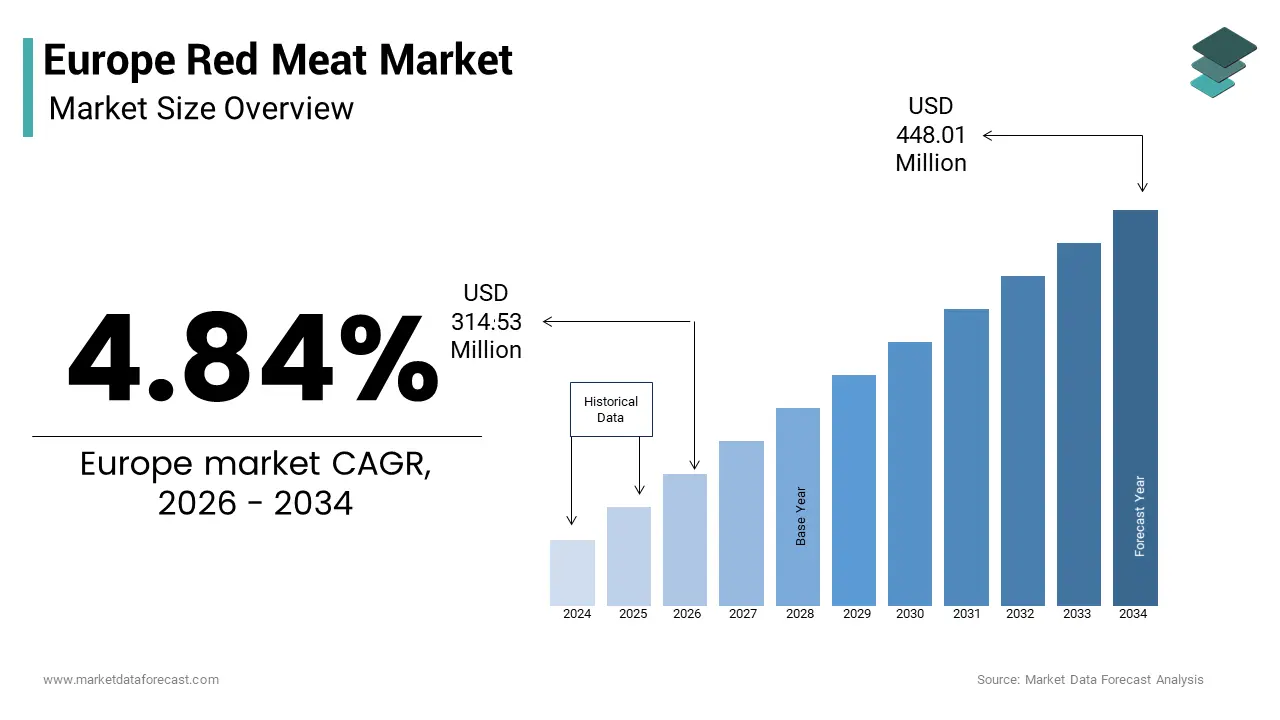
The European red meat market size was valued at USD 299.97 million in 2025 and is anticipated to reach USD 314.53 million in 2026 and USD 379.91 million by 2034, growing at a CAGR of 4.84% during the forecast period from 2026 to 2034.
Current Intr:o Definition of the European Red Meat Market
Red meat is the meat derived from mammals, primarily cattle, sheep and pigs, which are integral to the region’s dietary traditions and agricultural economy. Unlike poultry or seafood, red meat in Europe is deeply embedded in culinary heritage and rural livelihoods, yet faces mounting scrutiny due to environmental and health considerations. According to Eurostat, livestock farming occupied a majority of the European Union’s utilised agricultural area in 2024, which reflects its structural significance beyond mere commercial output. The European Food Safety Authority has emphasised stringent animal welfare and traceability protocols under Regulation EC No 853 2004, which mandate full supply chain transparency from farm to fork. Cultural patterns remain influential, as per a 2023 survey by the European Commissi,on many households in Southern and Eastern Europe consume red meat regularly, often as part of traditional dishes. However, demographic shifts are evident, with the European Environment Agency noting that per capita red meat consumption among urban residents under 35 declined between 2019 and 2024. This duality of cultural entrenchment and evolving consumer ethics defines the contemporary red meat landscape in Europe not as a static sector but as a contested interface between heritage, sustainability, and public health.
MARKET DRIVERS
Culinary Tradition and Regional Identity Sustain Steady Demand
Red meat remains a cornerstone of Europe’s gastronomic identity, with regional dishes and seasonal festivals embedding consumption in cultural continuity rather than transient preference, which is one of the key factors propelling the European red meat market. In countries like Spain, Italy, and France, traditional cured and fresh red meat products such as jamón ibérico, bistecca alla fiorentina, and confit de canard are protected under EU geographical indication schemes, which in 2024 covered over 1,200 meat-based specialities, according to the European Commission’s Directorate General for Agriculture. These designations not only preserve artisanal methods but also create economic incentives for small-scale producers. As per a 2025 study by the European Rural Development Network, regions with high concentrations of protected meat products recorded higher rural employment rates compared to non-designated areas. Furthermore, national dietary surveys reveal enduring consumption patterns. According to Italy’s National Institute of Statistics, many households purchased beef or veal monthly in 2024, often for Sunday family meals. This ritualistic consumption resists short-term health messaging because it is tied to intergenerational practices and local pride. Unlike functional food purchases, red meat in this context operates as a cultural artefact whose value transcends nutrition, reinforcing demand through social cohesion rather than marketing.
MARKET RESTRAINTS
Rising Input Costs and Feed Dependency Pressure Profitability
The economic viability of red meat production in Europe is increasingly strained by volatile feed prices and energy-intensive supply chains, which are impeding the growth of the European red meat market. As per the European Feed Manufacturers’ Federation, feed accounts for more than two-thirds of livestock production costs in the EU, with dependence on imported soy from South America exposing producers to global commodity fluctuations. In 2024, the EU imported large volumes of soybean meal primarily from Brazil and the United States,s according to Eurostat, requiring billions of euros in foreign expenditure. Concurrently, as per the European Central Bank, agricultural diesel prices remained above 2019 levels in early 2025, which is directly affecting transport and farm machinery operations. These cost pressures are amplified by regulatory compliance. According to the estimations of the European Environment Agency, implementing the Industrial Emissions Directive adds high annual costs per medium-sized cattle farm for manure management and ammonia monitoring in 2023. Small and medium producers, particularly in Eastern Europe, lack the scale to absorb these costs, which is leading to consolidation. The European Commission’s Farm to Fork Strategy further tightens margins by mandating reductions in antimicrobial use by 2030, increasing veterinary oversight expenses. Without targeted subsidies or vertical integration, many traditional farms face eroded competitiveness.
MARKET OPPORTUNITIES
Premiumization Through Traceability and Ethical Certification
European consumers are increasingly willing to pay premiums for red meat that demonstrates verifiable welfare standards, environmental stewardship, and local origin, which is a promising opportunity in the European red meat market. This trend creates a viable pathway for producers to differentiate beyond commodity pricing through certified labelling schemes. As per a 2024 consumer barometer by the European Consumer Organisation, more than half of shoppers in Germany and the Nordic countries actively seek meat bearingrecognisedd welfare or organic logos, even at higher price premiums. The EU organic label saw growth in red meat sales between 2022 and 2024, according to the European Commission’s Organic Farming Statistics. Moreover, digital traceability is gaining traction. In France, the “Label Rouge” system now integrates QR codes that disclose farm location, feed composition, and slaughter date, a feature that boosted consumer trust in a 2025 IFOP survey. Retailers are amplifying this shift. Edeka Germany’s 2024 supplier guidelines require all private label beef to meet Tier 3 welfare criteria. This alignment between policy, consumer demand, and retail procurement enables producers who invest in transparency to capture value in a saturated market.
MARKET CHALLENGES
Stringent Climate Accountability Under the EU Green Deal
The European Union’s binding climate framework imposes unprecedented regulatory burdens on red meat production due to its disproportionate contribution to agricultural emissions, which further hinders the red meat market expansion in Europe. According to the European Environment Agency, livestock accounts for a majority of the EU’s agricultural greenhouse gas output, with enteric fermentation from ruminants contributing significantly to that total. The implementation of the Carbon Border Adjustment Mechanism and the proposed 2025 Methane Regulation will require farms to monitor and report methane emissions with potential financial penalties for non-compliance. The European Commission’s Impact Assessment for the 2024 Methane Strategy estimates that beef and sheep farmers may face compliance costs averaging thousands of euros per operation annually. Furthermore, the Nature Restoration Law mandates a reduction in livestock density in nutrient-saturated regions by 2030, affecting intensive producers in the Netherlands and Denmark. These measures signal a policy pivot from supporting production volumes to enforcing planetary boundaries. Without access to public funding for methane digesters, feed additives like 3-nitrooxypropanol, or agroecological transition support, many producers risk marginalisation in a decarbonising food system.
REPORT COVERAGE
| REPORT METRIC | DETAILS |
| Market Size Available | 2025 to 2034 |
| Base Year | 2025 |
| Forecast Period | 2026 to 2034 |
| CAGR | 4.84% |
| Segments Covered | By Type, Distribution Channel, And By Region |
| Various Analyses Covered | Global, Regional, and Country-Level Analysis; Segment-Level Analysis; DROC; PESTLE Analysis; Porter’s Five Forces Analysis; Competitive Landscape; Analyst Overview of Investment Opportunities |
| Regions Covered | UK, France, Spain, Germany, Italy, Russia, Sweden, Denmark, Switzerland, Netherlands, Turkey, the Czech Republic, and the Rest of Europe |
| Market Leaders Profiled | W.H. Group, JBS USA Food Company, Tyson Foods Inc., Kraft Heinz Company, Cargill, Incorporated, ConAgra Foods inc., BRF SA, OSI Group LLC., Tönnies Group, SYSCO Corp., Smithfield Foods Inc., The Scottish Goat Meat Company, Irish Country Meats. |
SEGMENT ANALYSIS
By Type Insights
The pork meat segment dominated the market by accounting for 41.4% of the regional market share in 2025. The dominance ofthe pork meat segment in the European market is attributed to the long-standing dietary traditions, climatic suitability for pig farming, and structural advantages in production efficiency. Pork dominates due to its deep integration into Central and Eastern European culinary practices and its cost-effectiveness relative to ruminant meats. According to Eurostat,t in 202,,4 the EU produced over 22 million metric tons of pig meat, with Germany, Spain, and Poland accounting for a majority of total output. Unlike beef, pork requires significantly less land and feed per kilogram of meat, with the European Commission’s Joint Research Centre estimating a feed conversion ratio of 2.7 for pigs compared to 6.5 for cattle. This efficiency translates into lower retail prices, making pork accessible across income groups. In countries like Hungary and Romania, traditional cured products such as szalámi and slănina are consumed regularly according to national dietary surveys compiled by the European Food Safety Authority. Moreover, pig farming aligns with existing agricultural infrastructure, particularly in regions with grain surpluses. The Czech Statistical Office reported that most domestic barley production is used for animal feed, primarily supporting swine operations. These economic and cultural synergies sustain pork’s leadership beyond mere volume.
The lamb segment is growing exponentially and is anticipated to grow at a CAGR of 7.14% over the forecast period, owing to the rising demand in both traditional consuming nations and emerging urban markets drawn to its premium positioning and cultural resonance. In the United Kingdom, the Agriculture and Horticulture Development Board noted an increase in lamb consumption in 20,24 driven by festive demand and chef-led culinary revival. Simultaneously, Mediterranean and Middle Eastern diaspora communities are expanding consumption beyond seasonal peaks. The French National Institute for Agricultural Research reported that lamb purchases among households of North African origin rose in 2024, with weekly rather than holiday-based usage becoming common. Additionally, pasture-based production systems align with EU agroecological goals. Ireland’s Teagasc agricultural agency confirmed that grass-fed lamb systems generate lower carbon dioxide equivalent per kilogram than intensive beef models. This environmental advantage, combined with protected geographical indications such as “Agneau de Sisteron” in France, enhances perceived authenticity and justifies premium pricing in conscious consumer segments.
By Distribution Channel Insights
The supermarkets and hypermarkets segment occupied the major share of 56.5% of the regional market in 2025. The daily household provisioning and scale advantages in cold chain logistics are primarily driving the dominance of supermarkets and hypermarkets segment in the European red meat market. Supermarkets and hypermarkets dominate due to their extensive refrigerated infrastructure, private label development, and ability to bundle red meat with complementary groceries. According to the European Retail Roundtable, the average European hypermarket dedicates significant space to fresh meat, with most of that allocated to red meat under controlled atmosphere packaging. This scale enables consistent supply and price stability unattainable by smaller outlets. In Germany, the top five retailers, including Edeka and Rew,e accounted for a large share of red meat sales in 2024 as per the German Federal Statistical Office. These chains leverage proprietary certification schemes such as “RSPCA Assured” or “Bio Siegel” to signal quality without relying on third-party branding. Furthermore, their loyalty programs drive repeat purchases. A 2025 NielsenIQ analysis revealed that many red meat buyers in France selected a retailer based on bundled discounts with pantry staples. The integration of butchery counters within stores also adds perceived freshness, a feature that increased red meat basket size in a 2024 Kantar consumer trial across Italy and Spain.
The online retail segment is the fastest-growing distribution channel with a CAGR of 15.5% over the forecast period, owing to the rapidly growing digital adoption, convenience, and the rise of premium curated meat boxes. As per the European Commission’s Digital Economy and Society Index, online grocery penetration reached 31% in 2024, with fresh meat being one of the fastest-accelerating categories after dairy. Startups in the UK and Germany offer traceable cuts with farm origin stories, delivery scheduling, and subscription models that appeal to time-pressed urban professionals. A 2025 survey by the European Consumer Organisation found that many online red meat buyers cited “avoiding in-store decision fatigue” as a primary motivator. Moreover, e-commerce platforms enable niche producers to bypass traditional gatekeepers. In Sweden, the online marketplace MatHem reported a significant increase in sales of Gotland lamb after onboarding small farms directly. Cold chain innovations also support expansion. The European Cold Chain Federation confirmed that electric refrigerated vans now cover most urban last-mile deliveries in Western Europe, reducing spoilage rates. This convergence of logistics, digital trust, and product storytelling fuels exponential channel growth.
COUNTRY ANALYSIS
Germany Red Meat Market Analysis
Germany led the red meat market in Europe in 2025 by holding 20.9% of the European market share. The dominance of Germany in the European market is attributed to its position as both the EU’s most populous country and its leading pork producer. The nation’s meat consumption is deeply institutionalised, with pork featured in school meals, public canteens, and regional festivals such as Oktoberfest. According to the German Federal Ministry of Food and Agriculture, domestic per capita red meat consumption stood at more than 50 kilograms in 2024, with pork accounting for the majority. The country’s integrated meat processing sector ensures consistent supply and price competitiveness. Regulatory frameworks also support stability. Germany’s Animal Welfare Act mandates minimum space allowances and bans routine tail docking in pigs, which is a policy that has driven investment in enriched housing without significantly raising consumer prices, as confirmed by the Thünen Institute in 2025. Despite growing environmental scrutiny, the government’s Protein Strategy continues to recognise meat as a core dietary component while promoting efficiency gains through precision farming and manure recycling technologies.
France Red Meat Market Analysis
France accounted for a promising share of the European red meat market in 2025. The growth of France in the European market can be credited to its strong cultural attachment to beef and lamb and a robust system of geographical indications. French cuisine elevates red meat as a centrepiece, with dishes like boeuf bourguignon and gigot d’agneau defining regional identities. The French Ministry of Agriculture reported in 2024 that a large share of beef consumed domestically carries a protected origin label such as “Bœuf Charolais” or “Blonde d’Aquitaine,” ensuring premium pricing and farmer income stability. The country is also Europe’s largest consumer of horse meat, though excluded from red meat definitions, it reflects broader meat-eating norms. Crucially, France maintains high self-sufficiency with a beef production-to-consumption ratio slightly above parity as per FranceAgriMer. Urban consumers are increasingly drawn to “short circuit” sales where farmers sell directly via AMAP networks or farm shops, which is a channel that grew in 2024, according to the National Federation of Direct Selling Farmers. This blend of terroir-driven quality and localised distribution sustains demand despite national campaigns to reduce meat intake.
Spain Red Meat Market Analysis
Spain is anticipated to grow at a healthy CAGR in the European red meat market during the forecast period, owing to its leadership in Iberian pork production and high domestic consumption of cured meats. The country is the EU’s second-largest pig producer, with millions of animals slaughtered annually,y as per Spain’s Ministry of Agriculture. The Iberian pig sector alone generated billions of euros in 2024, with acorn-fed jamón ibérico commanding premium prices in export markets. This segment thrives on strict Denominación de Origen regulations that control breeding, feeding, anageingng processes. Beyond luxury products, everyday consumption remains robust. The Spanish Agency for Food Safety and Nutrition found that many households purchase red meat several times weekly, with chorizo and lomo embuchado staples in pantries. Southern regions also exhibit strong goat and lamb traditions, particularly during Easter and Christmas. Andalusia’s goat meat production rose in 2024 due to rising demand from North African communities. Spain’s advantage lies in its dual capacity to serve mass markets and high-end gourmet segments simultaneously.
Italy Red Meat Market Analysis
Italy held a notable share of the European red meat market in 2025. The artisanal meat processing heritage and regional diversity in red meat preferences are driving the Italian market growth. While overall consumption has declined slightly among younger demographics, traditional cured beef and pork products remain culturally indispensable. According to Italy’s National Institute of Statistics, bresaola and bistecca alla fiorentina maintain strong regional loyalty, with Tuscany and Lombardy reporting per capita beef consumption above the national average. The country is also a major producer of lamb, particularly in Sardinia,nia where pastoral systems support millions of sheep. According to the Italian Ministry of Agricultural Policies, in 2024, most lamb sold domestically carries a Protected Designation of Origin label, enhancing traceability and value. Urban innovation is also emerging. Milan and Rome have seen a surge in “macellerie di quartiere,” neighbourhood butcher shops offering organic cuts and cooking advice, a trend that increases speciality store sales in 2024 as per Federconsumatori. This fusion of heritage craftsmanship and modern retail adaptation underpins Italy’s resilient market position.
United Kingdom Red Meat Market Analysis
The United Kingdom is estimated to register a steady CAGR in the European red meat market during the forecast period. The UK market is marked by post-Brexit trade realignment and strong lamb consumption. Despite declining beef intake, UK households continue to prioritise lamb, especially during holidays, with Easter accounting for a significant share of annual sales as per the Agriculture and Horticulture Development Board. The country is largely self-sufficient in lamb production, with Welsh and Scottish hill farms forming the backbone of supply. Post-Brexit, the UK has redirected exports from the EU to Gulf states, where demand for high-welfare British lamb grew in 2024, according to the Department for Environment, Food and Rural Affairs. Domestically, retailers like Tesco and Sainsbury’s have launched “British Red Tractor” certified meat lines that guarantee origin and welfare standards, a move that increased consumer trust in a 2025 YouGov survey. Although plant-based alternatives are gaining traction, red meat remains embedded in national identity, particularly through Sunday roasts and pub culture, ensuring sustained baseline demand even amid health messaging.
COMPETITIVE LANDSCAPE
Competition in thEuropeanpe red meat market is shaped by a dual dynamic of consolidation among large integrators and resilience of regional artisanal producers. Major processors compete on scale, traceability, ty and regulatory compliance while leveraging private label partnerships with dominant retailers. Simultaneously, our small and medium enterprises thrivcapitalisingng on protected geographical indications and direct-to-consumer models that emphasise heritage and terroir. The regulatory environment acts as both a barrier and a catalyst,t with the EU’s Farm to Fork Strategy pressuring cost structures while creating premium opportunities for certified sustainable meat. Price competition remains intense, especially in areas where margin pressure from feed costs drives efficiency innovation. However, brand loyalty is increasingly anchored in ethical credentials rather than cost. Cross-border order trade complexities post Brexit and evolving import rules for non-EU meat further segment the competitive landscape. Ultimately, the market rewards players who balance economic viability with demonstrable environmental and welfare accountability.
KEY MARKET PLAYERS
A few of the market players in the European red meat market are
- W.H. Group,
- JBS USA Food Company,
- Vion Food Group
- Danish Crown
- Tyson Foods Inc.,
- Kraft Heinz Company,
- Cargill,
- Incorporated,
- ConAgra Foods Inc.,
- BRF SA,
- OSI Group LLC.
- Tönnies Group,
- SYSCO Corp.,
- Smithfield Foods Inc.,
- The Scottish Goat Meat Company,
- Irish Country Meats.
Top Players In The Market
- JBS Europe operates as a pivotal force in the European red meat sector with a strong emphasis on integrated beef and lamb processing across the UK, Ireland,d and Continental Europe. The company supplies both retail and food service channels with a focus on certified, sustainable, and traceable products. In 2024, JBS Europe expanded iits carbon-neutralbeef linee,e certified by the Carbon TTrustand invested iblockchain-enableded traceability for its lamb supply chain originating from Scottish and Welsh farms. These initiatives reinforce its positioning as a technologically advanced and environmentally accountable supplier aligned with EU regulatory trajectories and consumer expectations.
- Vion Food Group is a leading European producer of pork and beef headquartered in the Netherlands with extensive operations in Germany and Belgium. The company has prioritised animal welfare innovation and circular economy practices across its value chain. In 202,5 Vion launched its “Pig Farmers Pact”, committing to phasing out routine tail docking and farrowing crates by 2027 in collaboration with over 1 200 contracted farms. It also upgraded its slaughter facilities with real-time ammonia emission monitoring systems to comply with the EU’s Industrial Emissions Directive. These actions demonstrate a strategic alignment with both policy mandates and ethical consumerism.
- Danish Crown is a cooperative owned by thousands of Danish pig farmers and ranks among Europe’s most influential pork exporters. The company combines scale with sustainability by implementing mandatory climate declarations for all product lines. In 2024, Danish Crown introduced a digital “farm to fodashboardboar,d allowing retailers to track individual batch emissions,n s water usage, and welfare scores. It also partnered with Aarhus University to deploy feed additives that reduce enteric methane by up to 15%. These science-based initiatives enhance its credibility in markets increasingly governed by environmental due diligence laws such as the EU Deforestation Regulation and Green Public Procurement criteria.
Top Strategies Used by the Key Market Participants
Key players in the European red meat market pursue vertical integration to control quality and ensure supply chain transparency from farm to retail. They invest heavily in sustainability certifications and emissions tracking to comply with tightening EU environmental regulations. Companies strengthen farmer partnerships through cooperatives or long-term contracts that incentivise welfare and climate-friendly practices. Innovation in alternative feeds and manure management reduces environmental footprints while maintaining productivity. Brand differentiation is achieved through geographical indication labels, organic certification, and digital traceability tools. Strategic alignment with public health guidelines helps mitigate negative perceptions by promoting portion control and lean cuts. Export diversification beyond the EU reduces dependency on regional demand fluctuations. Lastlyy firms engage in policy dialogue to shape forthcoming legislation on antimicrobial use, methane reporting, ng and land use.
MARKET SEGMENTATION
This research report on the European red meat market is segmented and sub-segmented into the following categories.
By Type
- Beef
- Veal
- Mutton
- Pork
- Lamb
- Goat
By Distribution Channel
- Supermarkets/Hypermarkets
- Convenient Stores
- Specialty Stores
- Online Retail
By Country
- UK
- France
- Spain
- Germany
- Italy
- Russia
- Sweden
- Denmark
- Switzerland
- Netherlands
- Turkey
- Czech Republic
- Rest of Europe