- Product Description Description
- Table of Contents TOC
- List of Table & Figure LOT
- Get Free Sample PDF Sample PDF
Market Size, 2025
$7.25 BnMarket Estimate, 2026
$7.93 BnMarket Forecast, 2034
$16.21 BnCAGR, 2026–2034
9.35%Executive Summary: Europe Refractories Market
- Market Scope: European market analysis covering forms, product categories, alkalinity types, end-use industries, and country landscapes.
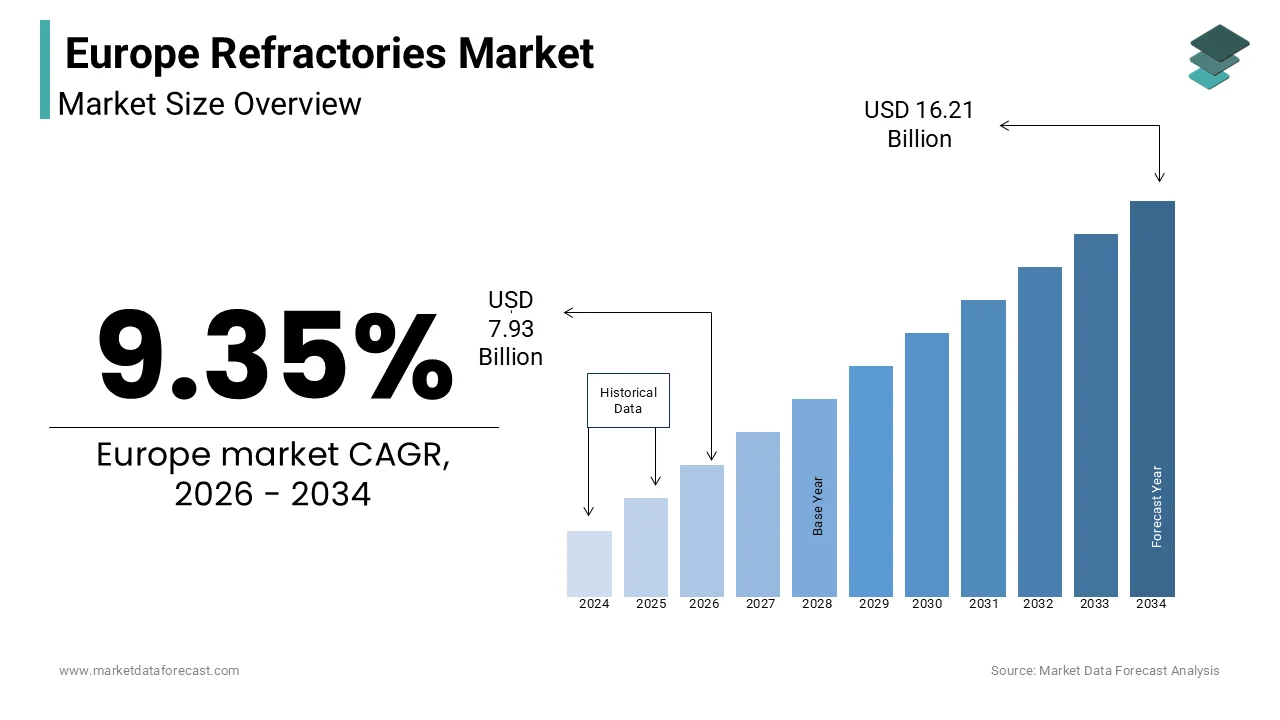
- Market Valuation: Valued at USD 7.25 billion (2025), estimated at USD 7.93 billion (2026), and projected to reach USD 16.21 billion by 2034, growing at a robust CAGR of 9.35% (2026–2034).
- Primary Growth Drivers: High regional heavy-industrial output (EU producing ~129 million tonnes of crude steel in 2025 requiring 9–14 kg of refractories per tonne, and >150 million tonnes of annual clinker), alongside pressing circular economy demands (>400,000 tonnes of spent refractories generated annually, with <30% recycled in 2023).
Key Market Segment Metrics (2026–2034)
| Category | Leading Segment (2025 Position) | Fastest-Growing Segment |
|---|---|---|
| By Form | Bricks & Shaped Segment (53.4% share) | Monolithic & Unshaped (7.12% CAGR) |
| By Product | Non-Clay Refractories (leading share across high-temp applications) | — |
| By Alkalinity | Basic Refractories (major share) | Acidic & Neutral Refractories (7.44% CAGR) |
| By End Use Industry | Iron & Steel (largest share) | Cement Industry (8.04% CAGR) |
| By Country | Germany (25.5% share; ~32M tonnes crude steel and >50 cement plants) | — |
Major Market Players & Market Structure
Market Structure: Highly competitive landscape centering on high-temperature material performance, environmental compliance, proprietary formulations, digital monitoring, and closed-loop recycling. Industry participants are heavily focused on chrome-free bricks, nano-enhanced castables, embedded predictive sensors, and spent-refractory recycling to meet industrial decarbonization standards.
Key Companies: Vesuvius, Shinagawa Refractories, Krosaki Harima, HarbisonWalker International, Chosun Refractories, Saint-Gobain Gyproc, RHI Magnesita, Imerys, Morgan Advanced Materials, and CoorsTek.
Europe Refractories Market Size
The Europe refractories market size was valued at USD 7.25 billion in 2025 and is projected to reach USD 16.21 billion by 2034 from USD 7.93 billion in 2026, growing at a CAGR of 9.35%.
Refractories are heat resistant materials engineered to withstand extreme temperatures, chemical corrosion and mechanical stress in high-temperature industrial processes. In Europe, these materials are indispensable in sectors such as steelmaking, non-ferrous metals, cement, glass and petrochemicals, where operational integrity above 1,000 degrees Celsius is non-negotiable. The European Union produced around 129 million tonnes of crude steel in 2025, which is requiring significant volumes of refractory linings annually to maintain blast furnace, ladle and tundish efficiency. The European cement industry that produces over 150 million tonnes of clinker output annually, similarly depends on alumina and magnesia-based refractories for kiln durability. Industrial processes contribute nearly one-fifth of the EU’s total CO2 emissions, which is prompting regulatory pressure to extend refractory lifespan and reduce relining frequency. The European Commission’s Industrial Emissions Directive further mandates thermal efficiency improvements in high temperature plants, indirectly boosting demand for advanced monolithic and precast refractories that minimize heat loss. With aging industrial infrastructure across Germany, Italy and Poland undergoing modernization and with circular economy principles shaping raw material sourcing, the Europe refractories market is evolving toward performance driven, low carbon solutions that balance operational resilience with environmental compliance.
MARKET DRIVERS
Modernization of Steel and Cement Infrastructure Is Sustaining Refractory Demand
The ongoing modernization of Europe’s heavy industrial base, particularly in steel and cement is a critical demand driver for advanced refractories, which is majorly propelling the European refractories market growth. Over 60% of the EU’s electric arc furnace capacity was commissioned before 2005 and these aging units are now undergoing thermal system overhauls to meet efficiency benchmarks under the EU Emissions Trading System. Each EAF relining cycle consumes significant volumes of refractories per tonne of steel with high purity magnesia carbon bricks increasingly specified for slag resistance and thermal shock performance. Similarly, the European cement sector is replacing wet process kilns with dry pre-calciner systems, which operate at 1,450 degrees Celsius and demand high alumina and silicon carbide-based linings. Germany invested billions of euros in steel plant upgrades in 2025, which is directly translating into refractory procurement for furnace roofs, tapping zones and slag lines. In Poland, the cement producer Grupa Ożarów completed a kiln modernization in late 2025, which is specifying low cement castables to extend campaign life. These capital-intensive retrofits that are driven by both regulatory compliance and energy cost pressures ensure consistent and technically sophisticated refractory demand across Central and Eastern Europe.
Regulatory Push for Energy Efficiency and Emission Reduction Is Elevating Performance Requirements
Stringent EU regulations targeting industrial energy consumption and emissions are reshaping refractory specifications toward high efficiency and longevity, which is further contributing to the refractories market growth in Europe. The Industrial Emissions Directive requires integrated pollution prevention and control permits for all large combustion and high temperature installations, which is effectively compelling operators to minimize heat loss and maximize thermal insulation. Refractory linings play a critical role in heat retention in steel ladles, which is making material selection a direct lever for CO2 abatement. Consequently, monolithic refractories with nano engineered additives and low thermal conductivity are gaining traction; for instance, advanced castables can reduce energy loss compared to conventional formulations. In the glass industry, which emits over 14 million tonnes of CO2 annually in the EU, oxy fuel furnaces now require zirconia enriched fused cast refractories capable of withstanding 1,600 degrees Celsius for extended periods. These performance mandates are shifting procurement from volume based to value based, where lifecycle cost outweighs initial price. This regulatory induced evolution is accelerating the adoption of premium shaped and unshaped refractories across energy intensive sectors throughout Europe.
MARKET RESTRAINTS
Stringent Environmental Regulations Increase Compliance Costs for Refractory Producers
The European Union’s tightening environmental legislation imposes significant operational and financial burdens on refractory manufacturers, particularly concerning raw material sourcing and emissions from production kilns, which is hindering the refractories market growth in Europe. The REACH regulation restricts the use of chromium VI compounds, compelling producers to reformulate magnesia chrome bricks toward chrome free alternatives that often underperform in corrosive environments. Many traditional refractory formulations required reformulation in recent years to comply with substance authorization thresholds. Additionally, the EU Industrial Emissions Directive mandates Best Available Techniques for sintering and firing processes, which is requiring investments in afterburners and electrostatic precipitators that can add significantly to capital expenditure per production line. In Italy, a major refractory hub, several small and medium producers ceased operations in 2025 due to inability to finance required emission control retrofits. These regulatory hurdles disproportionately affect regional manufacturers lacking scale, which is leading to supply chain consolidation and reduced material diversity, ultimately constraining end user choice and innovation in niche high temperature applications.
Volatility in Raw Material Availability and Pricing Disrupts Supply Chains
The persistent supply chain instability due to its dependence on imported critical raw materials, whose availability and pricing are subject to geopolitical and trade policy shifts, which is further hampering the regional market expansion. The European Commission’s 2023 list of Critical Raw Materials includes magnesia, bauxite and graphite with a significant share of magnesia sourced from China and Turkey. In 2025 Turkish export restrictions on dead burned magnesia, which is triggered by domestic steel demand surges and caused European spot prices to rise sharply within six months. Similarly, EU sanctions on Russian graphite following the Ukraine conflict eliminated a key source of high purity carbon additives, which is forcing producers to secure alternatives from Brazil or Mozambique at higher landed costs. This volatility complicates long term pricing agreements with industrial clients and increases inventory holding risks. Furthermore, the EU’s Carbon Border Adjustment Mechanism now imposes embedded carbon costs on imported raw materials, adding another layer of unpredictability. These structural supply vulnerabilities undermine production planning and margin stability, particularly for specialty refractories requiring consistent mineral chemistry.
MARKET OPPORTUNITIES
Circular Economy Initiatives Are Unlocking Secondary Raw Material Streams
The European Union’s Circular Economy Action Plan is creating new opportunities for refractory producers to incorporate recycled content and reduce reliance on virgin minerals. Over 400,000 tonnes of spent refractories from steel plants are generated annually in the EU, of which less than 30% were recycled in 2023. New processing technologies now enable the recovery of high purity alumina and magnesia from used linings for reuse in lower temperature applications such as ladle covers and tundish coatings. In 2025 RHI Magnesita launched a closed loop recycling facility in Germany that processes thousands of tonnes of post-consumer refractories per year, which is producing secondary aggregates that meet ISO 11055 standards. Similarly, the French cement group Vicat has partnered with Imerys to trial recycled refractory bricks as kiln feed additives, which is reducing virgin clay consumption. The European Commission’s 2026 target of 50% industrial material recycling provides further impetus with refractory take back schemes now integrated into service contracts across Germany and the Benelux region. This shift not only lowers embodied carbon but also insulates producers from primary raw material volatility.
Growth in Waste to Energy and Biomass Thermal Plants Is Creating New Application Areas
The expansion of Europe’s waste to energy and biomass combustion infrastructure is opening novel demand channels for specialized refractories resistant to alkali corrosion and thermal cycling, which is another major opportunity for the European refractories market. The EU generated over 220 million tonnes of municipal solid waste in 2025 with around 28% processed in incineration plants equipped with energy recovery, which is an up from 24% in 2020. These facilities operate at 850 to 1,100 degrees Celsius and expose linings to highly corrosive chlorine and potassium vapors that degrade conventional fireclay bricks within 18 months. Advanced silicon carbide and alumina zirconia refractories now offer campaign lives exceeding five years, which is driving specification upgrades. In Sweden, which diverts nearly all household waste from landfills, the new Stockholm Exergi plant commissioned in March 2026 uses monolithic linings with recycled content to withstand aggressive flue gas chemistry. Similarly, Denmark’s Amager Bakke facility retrofitted its combustion chamber in late 2025 with precast panels designed for rapid replacement during maintenance outages. As the EU targets 65% municipal waste recycling by 2035, refractory demand in this niche segment is projected to grow steadily and also demanding materials engineered for chemical resilience over raw temperature resistance.
MARKET CHALLENGES
Skilled Labor Shortage Impedes Installation and Maintenance of Advanced Refractory Systems
The declining availability of skilled refractory installers across Europe poses a significant operational challenge, particularly as next generation monolithic and precast systems require precise placement and curing protocols, which is one of the major challenges to the refractories market in Europe. The average age of industrial bricklayers in Germany and Italy exceeds 50 with only a limited number of new apprentices entering refractory trades annually across the EU. This shortage is exacerbated by the complexity of modern installations; for example, self-flowing castables used in steel ladles demand real time moisture monitoring and controlled drying ramps to prevent explosive spalling. In 2025, a major outage at an ArcelorMittal plant in Ghent was traced to improper curing of a tundish lining by an undertrained crew, which is resulting in a production halt. Manufacturers are responding with robotic installation systems, but these require significant capital and are not yet viable for small scale applications. Without a coordinated vocational training initiative, the gap between advanced refractory design and on-site execution will persist, increasing lifecycle costs and safety risks.
Energy Intensity of Refractory Manufacturing Conflicts with Decarbonization Goals
The production of sintered and fused refractories is inherently energy intensive, which is creating tension with Europe’s net zero industrial roadmap and further challenging the expansion of the European market. Firing magnesia bricks in tunnel kilns typically consumes 3.5 to 4.2 gigajoules per tonne with most of the energy derived from natural gas, which is a dependency that clashes with EU methane reduction targets. Refractory plants emitted significant volumes of CO2 annually in 2025, which is placing them under scrutiny in national climate action plans. Electrification of kilns remains technically challenging due to the need for sustained temperatures above 1,700 degrees Celsius as
current electric arc and plasma solutions increase production costs substantially. In France, the refractory producer Imerys suspended expansion of its aluminum oxide facility in 2025 after national grid constraints limited access to low carbon electricity. Meanwhile, the EU’s Carbon Border Adjustment Mechanism penalizes high embedded carbon imports, yet domestic producers struggle to decarbonize without breakthrough technologies. This paradox creates strategic uncertainty and investment hesitation across the European refractory value chain.
REPORT COVERAGE
| REPORT METRIC | DETAILS |
| Market Size Available | 2025 to 2034 |
| Base Year | 2025 |
| Forecast Period | 2026 to 2034 |
| CAGR | 9.35% |
| Segments Covered | By Form, Product, Alkalinity, End Use Industry, and Region |
| Various Analyses Covered | Global, Regional, & Country Level Analysis; Segment-Level Analysis; DROC, PESTLE Analysis; Porter’s Five Forces Analysis; Competitive Landscape; Analyst Overview of Investment Opportunities |
| Regions Covered | UK, France, Spain, Germany, Italy, Russia, Sweden, Denmark, Switzerland, Netherlands, Turkey, and the Czech Republic |
| Market Leaders Profiled | Vesuvius, Shinagawa Refractories, Krosaki Harima, HarbisonWalker International, Chosun Refractories, Saint-Gobain Gyproc, RHI Magnesita, Imerys, Morgan Advanced Materials, and CoorsTek |
SEGMENTAL ANALYSIS
By Form Insights
The bricks and shaped segment commanded for a 53.4% Europe refractories market share in 2025 owing to its established role in high integrity applications such as blast furnace hearths, coke oven walls and glass tank checkers. These preformed units offer dimensional stability and predictable performance under sustained thermal loads exceeding 1,500 degrees Celsius. In Germany and Poland, a majority of blast furnace linings still rely on carbon bonded alumina silicate bricks due to their resistance to iron penetration and minimal creep deformation. The segment’s dominance is further attributed to the decades of engineering data correlating brick composition with campaign life, which is critical for asset-intensive industries where unplanned outages cost upwards of 1 million euros per day. Additionally, shaped refractories are easier to inspect and replace in modular sections, which is a practical advantage in older European plants lacking robotic installation infrastructure. Shaped product demand remained stable through 2025 despite energy cost pressures, which is indicating their irreplaceable function in core metallurgical zones where monolithic alternatives have yet to prove long term reliability.
The monolithic and unshaped segment is expected to record a CAGR of 7.12% over the forecast period in the European refractories market due to its adaptability in maintenance-intensive and retrofit applications. These castable gunning mixes and ramming masses enable rapid repairs without full relining, which is a critical advantage in Europe’s aging industrial base where furnace availability directly impacts carbon cost exposure under the EU Emissions Trading System. In the cement sector, low cement castable are increasingly used for burner pipe and inlet zone repairs, which is helping reduce downtime compared to brick replacement. In the steel sector, self-flowing alumina magnesia castable are specified for ladle slag lines due to their superior crack resistance during thermal cycling. Technological advances also play a role as RHI Magnesita’s 2025 launch of a nano dispersed alumina sol bond system eliminates cement content entirely, which is enhancing corrosion resistance while cutting curing time. This combination of operational agility, material innovation and alignment with lean maintenance philosophies is accelerating monolithic adoption across secondary and tertiary high temperature processes.
By Product Insights
The non-clay segment occupied the leading share of the European refractories market in 2025. The dominance of the non-clay segment in the European market is attributed to their essential use in high performance applications where purity thermal stability and chemical inertness are non-negotiable. These include magnesia carbon bricks in steel ladles, silicon carbide in aluminum smelters and high alumina castables in cement kilns, which all engineered to exceed the 1,300-degree Celsius service limit of traditional fireclay products. The EU’s non-ferrous metal output grew in 2025, which is driven by aluminum demand for electric vehicles and directly increased consumption of chromia free alumina zirconia refractories in holding furnaces. Similarly, the European glass industry melted over 30 million tonnes of cullet in 2025, which is relying on fused cast AZS bricks for tank superstructures due to their low glass contamination risk. Regulatory pressure also favors non-clay materials as the EU’s Industrial Emissions Directive penalizes processes with high particulate loss and high purity monolithics generate less dust during installation than clay based alternatives. This performance and compliance edge ensures non-clay products remain central to Europe’s high temperature industrial ecosystem.
By Alkalinity Insights
The basic refractories segment captured the major share of the European refractories market in 2025. The dominance of the basic refractories segment in the European market is primarily driven by their irreplaceable role in steelmaking where high basicity slags dominate the refining environment. Magnesia and dolomite-based linings are chemically compatible with CaO rich slags, which is preventing corrosive dissolution that would rapidly degrade acidic silica bricks. Over 150 million tonnes of crude steel produced in 2025 required basic refractories for ladles, converters and electric arc furnaces with each tonne consuming significant volumes of magnesia carbon or magnesia chrome free bricks. The shift toward higher scrap utilization in EAFs has intensified slag basicity, which is further cementing demand for MgO rich formulations. Additionally, environmental regulations have accelerated the phase out of chrome containing basic bricks, which is spurring innovation in chrome free magnesia spinel and magnesia carbon alternatives that now constitute the majority of new ladle installations in Germany and Italy. This alignment with both metallurgical necessity and regulatory evolution ensures basic refractories remain the cornerstone of Europe’s primary metals sector.
The acidic and neutral segment is predicted to register a CAGR of 7.44% over the forecast period in the European market owing to the expansion in glass ceramics and non-ferrous applications where silica zircon and alumina silicate refractories offer superior performance. The European container glass industry which produced 28 million tonnes of glass in 2025 as per FEVE relies on silica bricks for crown and superstructure zones due to their minimal thermal expansion at 1,500 degrees Celsius ensuring structural integrity over decade long campaigns. Similarly, the aluminum sector’s shift toward larger holding furnaces operating at 750 to 800 degrees Celsius has increased demand for neutral high alumina and mullite based castables that resist metal penetration without reacting with fluxes. In the ceramics industry, tunnel kilns firing sanitaryware and tiles at 1,250 degrees Celsius exclusively use fireclay and andalusite bricks for their thermal shock resistance and cost efficiency. As per the European Ceramic Industry Federation, ceramic production volumes rose by 4.3% in 2025 driven by construction recovery in Southern Europe directly boosting acidic refractory orders. This diversification across stable high temperature sectors contributes to the growth of the acidic and neutral segment in the European refractories market.
By End Use Industry Insights
The iron and steel segment had the largest share of the European refractories market in 2025 due to its status as the continent’s most thermally intensive and refractory dependent industry. Each tonne of crude steel produced requires between 9 and 14 kilograms of refractories across blast furnaces, basic oxygen converters and continuous casting systems. According to World Steel Association data, the EU produced around 129 million tonnes of crude steel in 2025EUROMETAL with electric arc furnaces accounting for a growing share of production as part of the region’s decarbonization strategy. The push for decarbonization further intensifies refractory use; hydrogen-based direct reduced iron pilot plants in Sweden operate at high reduction temperatures requiring specialized linings resistant to hydrogen embrittlement. Moreover, the EU’s Carbon Border Adjustment Mechanism incentivizes longer campaign life to reduce per tonne CO2 intensity, which is driving adoption of premium chrome-free basic bricks. This combination of volume intensity, process complexity and regulatory pressure ensures iron and steel remains the undisputed core of the European refractories market.
The cement segment is predicted to register the fastest CAGR of 8.04% over the forecast period in the European market owing to the kiln modernization alternative fuel integration and emission compliance mandates. European cement plants now coprocess an average of 58% alternative fuels as per CEMBUREAU 2025 data, introducing highly corrosive chlorine, alkali and sulfur compounds that degrade conventional fireclay linings within 12 months. This has triggered a shift toward highalumina lowcement castables and silicon carbide bricks in critical zones such as burning and transition areas, extending campaign life from 18 to over 30 months. In Germany, Heidelberg Materials reported kiln relines in 2025 as part of its sustainability initiatives, highlighting the use of advanced aluminabased aggregates to improve energy efficiency. Additionally, the EU Industrial Emissions Directive sets strict efficiency and emissions requirements for clinker kilns, which is driving adoption of advanced monolithic systems. These technical and regulatory drivers are transforming cement from a traditional refractory user into a highgrowth niche for performanceengineered materials.
REGIONAL ANALYSIS
Germany Market Analysis
Germany led the refractories market in Europe in 2025 by holding 25.5% of the European market share. Germany is serving as the continent’s primary hub for steel cement and chemical manufacturing. Germany produced around 32 million tonnes of crude steel in 2025 according to the German Steel Federation and operates more than 50 cement plants that collectively consume significant volumes of refractories annually. This industrial density is matched by engineering excellence as German firms such as RHI Magnesita and SaintGobain’s German subsidiary lead in developing chromefree magnesia spinel bricks and lowcement castables tailored for EAF and kiln applications. The federal government’s Industrial Decarbonization Strategy allocated 1.2 billion euros in 2025 for hightemperature process upgrades directly benefiting refractory modernization. Furthermore, Germany’s dual vocational education system ensures a steady pipeline of skilled installers mitigating labour shortages seen elsewhere. This ecosystem of demand, innovation, policy and workforce stability cements Germany’s position as the market’s technological and commercial nucleus.
Italy Market Analysis
Italy held a substantial share of the European refractories market in 2025. The growth of Italy in the European market is attributed to its dense concentration of steel mini mills glass furnaces and ceramic kilns. Italy’s steel sector produced around 21 million tonnes of crude steel in 2025 as per Federacciai with electric arc furnaces accounting for more than 80% of production and requiring frequent relining of tap holes and slag zones. Simultaneously, Italy remains Europe’s largest ceramic tile producer, manufacturing over 400 million square meters in 2025 according to Confindustria Ceramica, which is driving steady demand for fireclay and silicon carbide refractories in roller hearth kilns. Environmental compliance is accelerating upgrades as the Italian Ministry of Ecological Transition mandated in 2023 that all industrial furnaces reduce particulate emissions significantly by 2026, spurring adoption of precast monolithics that minimize installation dust. Domestic producers like Refratechnik Italia have responded with alkaliresistant alumina zirconia castables for glass regenerators. This blend of traditional industry, modernization pressure and local material science capability sustains Italy’s strong market presence.
France Market Analysis
France is predicted to account for a prominent share of the Europe refractories market over the forecast period owing to the balanced demand from steel cement non ferrous metals and nuclear glass vitrification facilities. France’s steel output reached around 13 million tonnes in 2025 per World Steel Association with significant growth in EAF capacity supporting automotive and aerospace supply chains. The cement sector led by Vicat and Hoffmann Green Cement is pioneering lowclinker formulations that operate at higher kiln temperatures necessitating advanced aluminabased linings. Notably, France’s nuclear industry uses specialized borosilicate glass melters to immobilize highlevel radioactive waste, which is a process requiring platinumlined fused cast AZS refractories resistant to extreme corrosion; the La Hague facility processed over 1,000 tonnes of waste glass in 2025, requiring substantial volumes of premium refractories. Public investment through France 2030 has allocated 300 million euros for industrial decarbonization including refractory retrofits at ArcelorMittal Dunkirk. This unique mix of conventional and hightech applications ensures France’s continued relevance in the market.
Spain Market Analysis
Spain is expected to exhibit a healthy CAGR in the European refractories market over the forecast period due to the recovery in construction steel and glass sectors following post pandemic rebound. Spain produced around 14 million tonnes of crude steel in 2025 according to the Spanish Steel Association with notable expansion in minimill capacity near Bilbao and Valencia. The glass industry also grew, recording about 3.7 million tonnes of container and flat glass output as per ANFEVI 2025 data, supporting demand for silica and fused cast refractories. Spain’s push for a circular economy has increased alternative fuel use in cement kilns to nearly 50%, accelerating wear on traditional linings and driving adoption of silicon carbidebased monolithics. In 2025, the Spanish government approved the National Strategy for Industrial Decarbonization, which includes tax credits for refractory systems that reduce thermal loss. Companies like Calimax and Refractarios de Castilla are collaborating with universities to develop lowcarbon alumina aggregates from bauxite residue. This emerging innovation ecosystem coupled with industrial revival is positioning Spain as a growth corridor in Southern Europe.
Poland Market Analysis
Poland is another notable market for refractories in Europe. The growth of Poland in the European market can be credited to its position as one of the EU’s leading steel producers with crude steel output of around 7 million tonnes in 2025 according to the Polish Steel Association. The country’s reliance on coalbased blast furnaces at ArcelorMittal Poland and Huta Częstochowa ensures sustained demand for carbonbonded alumina silicate bricks and ramming masses for hearth zones. Simultaneously, Poland’s cement industry led by Holcim Poland and CRH operates 18 integrated plants that consume tens of thousands of tonnes of refractories annually with growing use of alternative fuels increasing corrosion rates. The Polish government’s Responsible Development Strategy allocated 600 million euros in 2025 for industrial modernization including refractory upgrades to meet EU emission standards. Domestic producer RHI Magnesita Třinec supplies a majority share of local magnesia carbon bricks, while partnerships with Czech research institutes are advancing chromefree formulations. This combination of heavy industry scale, regulatory alignment and regional supply chain integration solidifies Poland’s position as Central Europe’s refractory stronghold.
COMPETITIVE LANDSCAPE
KEY MARKET PLAYERS
Some of the notable key players in the Europe refractories market are
- Vesuvius
- Shinagawa Refractories
- Krosaki Harima
- HarbisonWalker International
- Chosun Refractories
- Saint-Gobain Gyproc
- RHI Magnesita
- Imerys
- Morgan Advanced Materials
- CoorsTek
TOP STRATEGIES USED BY THE KEY MARKET PLAYERS
Key players in the Europe refractories market focus on product innovation through advanced material formulations such as chrome free bricks and nano enhanced castables to meet stringent environmental and performance standards. They actively invest in circular economy initiatives by establishing spent refractory collection and reprocessing systems to recover alumina magnesia and silica for secondary use. Strategic partnerships with industrial customers and industry associations enable co development of application specific solutions aligned with decarbonization roadmaps. Companies are also integrating digital technologies including embedded sensors and predictive analytics to offer performance based service contracts. Additionally they expand technical service capabilities across regional markets to support proper installation and extend lining life reinforcing customer retention and brand loyalty in a highly specialized industrial segment.
COMPETITION OVERVIEW
The Europe refractories market features a competitive landscape dominated by technologically advanced multinational corporations alongside specialized regional manufacturers. Competition is not primarily price based but centers on material performance longevity and compliance with evolving environmental regulations such as the Industrial Emissions Directive and EU Emissions Trading System. Leading players differentiate through proprietary formulations digital monitoring tools and closed loop recycling systems that enhance total cost of ownership for end users. Regional producers maintain niche relevance by offering customized solutions for legacy equipment and local raw material compatibility. Barriers to entry remain high due to stringent quality certifications capital intensity of production and the need for deep metallurgical or process engineering expertise. Collaboration is common as refractory suppliers work closely with steel cement and glass producers to co engineer linings that support specific operational and sustainability targets. This dynamic fosters continuous innovation but limits disruptive competition resulting in a stable yet evolving market structure shaped by industrial policy and process intensification.
TOP PLAYERS IN THE MARKET
- RHI Magnesita is a leading force in the Europe refractories market with a strong legacy in developing high performance basic and monolithic refractories for steel and cement industries. The company supplies advanced chrome free magnesia spinel bricks and alumina magnesia castables to major integrated plants across Germany Italy and Poland. In 2025 RHI Magnesita inaugurated a state of the art recycling facility in Ratingen Germany capable of processing 25,000 tonnes of spent refractories annually into secondary aggregates for reuse in tundish and ladle applications. The company also launched its SmartLinings digital monitoring platform which uses embedded sensors to predict lining wear in real time. These initiatives reinforce its global leadership in sustainable and data driven refractory solutions while deepening its integration with European industrial decarbonization goals.
- Saint Gobain plays a pivotal role in the Europe refractories market through its high purity alumina silica and zirconia based products serving glass non ferrous metals and ceramics sectors. Its fused cast AZS refractories are specified in over 60% of Europe’s container glass furnaces due to their exceptional corrosion resistance and low glass contamination. In early 2026 the company introduced a new generation of low cement castables with nano dispersed sol gel binders that reduce thermal conductivity by 12% compared to conventional formulations. Saint Gobain also expanded its technical service network across Southern Europe in 2025 offering on site installation support and lifecycle analytics. These actions enhance its value proposition beyond material supply positioning the company as a solutions partner in high temperature process optimization across global markets.
- Imerys Refractories is a key supplier of clay based and high alumina refractories tailored for cement ceramics and foundry applications across Europe. The company leverages its vertically integrated bauxite and kaolin mining operations to ensure raw material consistency and traceability. In late 2025 Imerys commissioned a new production line in Vaudagne France dedicated to low carbon monolithic refractories incorporating up to 30% recycled content from post industrial waste streams. The company also partnered with CEMBUREAU to develop standardized testing protocols for refractory performance under high alternative fuel conditions. These efforts align its product portfolio with EU circular economy and emissions reduction mandates while strengthening its technical credibility. Imerys continues to invest in vocational training programs to address installer shortages further embedding its solutions within Europe’s industrial maintenance ecosystem.
Europe Refractories Market News
- In March 2025 RHI Magnesita NV opened a spent refractory recycling plant in Ratingen Germany capable of processing 25,000 tonnes annually to produce secondary aggregates and strengthen the Europe refractories market presence
- In June 2025 Saint Gobain launched a new line of nano sol gel bonded low cement castables that reduce thermal conductivity by 12% for cement and steel applications and reinforce the Europe refractories market leadership
- In October 2025 Imerys Refractories inaugurated a low carbon monolithic production line in Vaudagne France incorporating up to 30% recycled content to support circular economy mandates and expand the Europe refractories market footprint
- In January 2026 RHI Magnesita NV rolled out its SmartLinings digital monitoring platform with embedded sensors for real time wear prediction in steel ladles enhancing service offerings and solidifying the Europe refractories market position
- In November 2025 Saint Gobain expanded its technical service network across Spain Italy and Greece to provide on site installation support and lifecycle analytics thereby deepening customer integration and strengthening the Europe refractories market presence
MARKET SEGMENTATION
This research report on the Europe refractories market has been segmented and sub-segmented based on categories.
By Form
- Bricks & Shaped
- Monolithic & Unshaped
By Product
- Clay
- Non-Cla
By Alkalinity
- Acidic & Neutral
- Basic
By End Use Industry
- Iron & Steel
- Non-Ferrous Metals
- Glass
- Cement
- Others
By Country
- UK
- France
- Spain
- Germany
- Italy
- Russia
- Sweden
- Denmark
- Switzerland
- Netherlands
- Turkey
- Czech Republic
- Rest of Europe