- Product Description Description
- Table of Contents TOC
- List of Table & Figure LOT
- Get Free Sample PDF Sample PDF
Europe Regenerative Agriculture Market Size
The europe regenerative agriculture market size was valued at USD 3657.85 million in 2024 and is anticipated to reach USD 4720.91 million in 2025 from USD 14752.75 million by 2033, growing at a CAGR of 16.40% during the forecast period from 2025 to 2033.
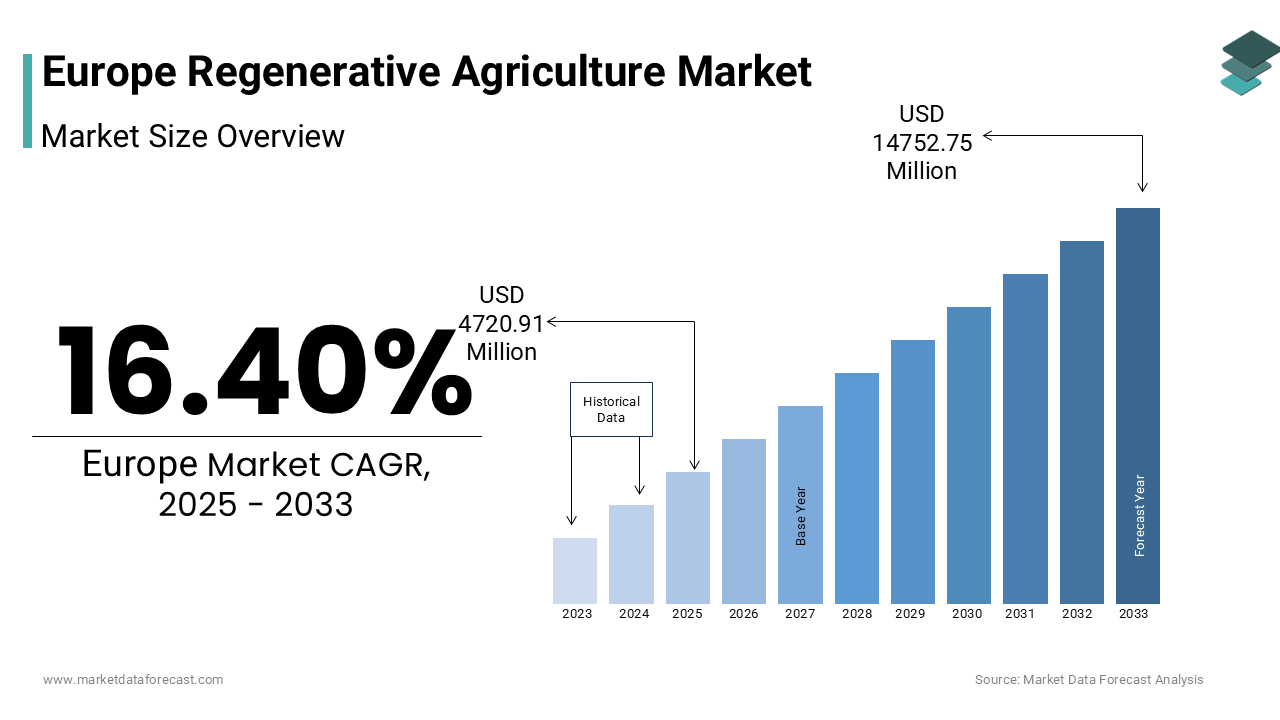
Regenerative agriculture is a paradigm shift from conventional farming toward systems that actively restore soil health, enhance biodiversity, and sequester atmospheric carbon. Unlike sustainability which seeks to minimize harm, regenerative practices aim to reverse ecosystem degradation through methods such as cover cropping, reduced tillage, crop rotation, and integration of livestock. The Farm to Fork Strategy under the European Green Deal indicates this transition by committing to reducing the use and risk of chemical pesticides by 50% by 2030, which is also the target for increasing organic farmland to 25% of total agricultural area by 2030. According to Eurostat, approximately 10.5% of the EU’s utilised agricultural area was under organic cultivation in 2022. Furthermore, according to the European Commission, over 60% of European soils are considered unhealthy due to degradation, which creates both urgency and fertile ground for regenerative adoption. This systemic reorientation is not merely agronomic but also cultural and policy-driven, which is positioning Europe at the forefront of a global movement to align food production with planetary boundaries while maintaining productivity.
MARKET DRIVERS
Soil Degradation and Erosion as a Catalyst for Regenerative Adoption
Persistent soil degradation across Europe has emerged as a primary driver compelling the shift toward regenerative agriculture, which is primarily driving the growth of the European regenerative agriculture market. According to the European Environment Agency, around 25% of the European Union’s land area is affected by soil erosion, with an estimated 970 million tonnes of soil lost annually due to water erosion alone. This loss compromises agricultural productivity and threatens food security, as fertile topsoil takes centuries to regenerate yet is being depleted at alarming rates. In Mediterranean regions such as Spain, Italy and Greece, erosion rates exceed 10 tonnes per hectare per year, which is far surpassing the natural formation rate of 1 tonne per hectare per year. Additionally, according to the Joint Research Centre of the European Commission, 45% of EU soils exhibit low or very low organic carbon content, which is directly undermining their fertility and water retention capacity. Conventional monoculture and excessive tillage exacerbate these issues, prompting policymakers and farmers alike to explore alternatives. According to long-term field trials conducted by the Thünen Institute in Germany, regenerative systems that incorporate cover crops, agroforestry, and minimal disturbance have demonstrated the capacity to increase soil organic carbon by 0.4 to 1% annually. This tangible restoration of soil capital not only enhances resilience to climate variability but also aligns with the EU Soil Health Law proposal, slated for legislative adoption in 2023, which is mandating measurable soil improvement targets. Consequently, the urgency to reverse land degradation is transforming regenerative agriculture from a niche practice into a central pillar of Europe’s agrarian future.
Policy Alignment and Public Funding as an Adoption Accelerant
The aggressive policy framework of the European Union provides a powerful structural impetus for regenerative agriculture, which is further boosting the regional market expansion. According to the Common Agricultural Policy 2023–2027 reform, roughly €387 billion is allocated for the 2023-2027 period with at least 40% of its budget earmarked for climate and environmental objectives. The European Commission states this includes direct payments linked to eco-schemes incentivising practices such as nitrogen-fixing legumes, maintenance of permanent grassland and reduced reliance on synthetic inputs. Under the Farm to Fork Strategy, one objective is a 20% reduction in fertiliser use by 2030, thereby encouraging nutrient cycling via regenerative methods. Additionally, under Horizon Europe, funding is being directed towards agroecology and soil-health research. National governments such as those of France (via its Ecophyto Plan) and Germany (via its National Strategy on Biological Diversity) are embedding regenerative-principles into subsidy structures. Crucially, the EU Carbon Removals Certification Framework (CRCF) adopted in 2024 and these establishes a standardised methodology for verifying soil-carbon sequestration that enable farmers to monetise ecosystem services. According to the European Court of Auditors, public-funding mechanisms remain the single most influential factor in farmer willingness to adopt long-term environmental practices, especially given the initial yield variability often associated with transition periods. Thus, the convergence of binding policy targets, dedicated financial instruments and scientific validation is transforming regenerative agriculture from a niche practice into an economically viable and policy-supported mainstream pathway.
MARKET RESTRAINTS
High Transition Costs and Financial Risk Deter Widespread Uptake
The elevated transition costs and associated financial risk are primarily impeding the growth of the regenerative agriculture market in Europe. Converting from conventional systems requires upfront investment in new equipment, training, and often lower yields during the initial three to five year transition phase. According to a 2023 study by the Organic Research Centre in the United Kingdom, average transition costs range from €300 to €600 per hectare, which is primarily driven by cover-crop establishment, soil testing and altered machinery needs. Moreover, as per the European Commission’s Farm Accountancy Data Network, over 60% of EU farms operate on narrow profit margins below 10%, leaving little fiscal room for experimentation. Access to capital remains uneven while large agribusinesses can absorb short-term losses, small and medium-sized holdings, which constitute approximately 95% of EU farms, often lack collateral for loans. Insurance and credit mechanisms rarely account for regenerative practices with most agricultural finance still benchmarked against conventional productivity metrics. Even where subsidies exist, uptake is inconsistent. Only 18% of eligible farmers participated in eco-schemes during the 2023 pilot phase in Italy according to ISMEA, which is citing bureaucratic complexity and delayed payments. Without guaranteed price premiums or robust risk-mitigation tools such as crop insurance tailored to regenerative systems, many farmers remain reluctant to disrupt established workflows. This financial vulnerability is particularly acute in Eastern Europe where average farm incomes are about 40% below the EU median. Until transition support becomes more accessible, timely and decoupled from administrative burdens, the economic risk will continue to constrain scalability across the continent.
Knowledge Gaps and Technical Capacity Limitations
The widespread lack of localized knowledge and on the ground technical support are further hampering the regional market expansion. Regenerative systems are inherently context specific, requiring deep understanding of regional soils, climates, and cropping histories. However, only a minority of agricultural extension services across the EU offer structured training in regenerative techniques. In some countries, there is a pronounced urban-rural divide in this knowledge infrastructure. Furthermore, many farmers attempting regenerative transitions report significant uncertainty in managing weed pressure and nitrogen availability without synthetic inputs. This knowledge deficit is exacerbated by the fragmentation of best-practices while successful case-studies exist in regions like Brittany or Emilia-Romagna, which is a replication that is hindered by the absence of standardised yet adaptable protocols. Digital advisory tools remain under-utilised with only a small portion of EU farmers regularly using precision-agriculture or decision-support platforms that could facilitate regenerative management. Academic curricula also lag with fewer than a third of EU agricultural-degree programmes include mandatory modules on soil health or agroecology. Without a coordinated investment in farmer-to-farmer networks, region-specific demonstration farms, and updated vocational training, the technical complexity of regenerative systems will remain a formidable barrier, particularly for older generations of farmers less inclined toward experimental approaches.
MARKET OPPORTUNITIES
Growing Consumer Demand for Climate Positive Food
Rising consumer awareness and preference for environmentally responsible food products present a significant opportunity for regenerative agriculture in Europe. Many EU consumers report that they take the environmental impact of food production into account when making purchases and a significant share express willingness to pay extra for products certified as beneficial for the climate. This sentiment is increasingly reflected in market action with major retailers launching dedicated lines of products from farms applying regenerative practices. Third-party verification systems are emerging to build credible links between on-farm practices and consumer trust. In one market test in France, a bread labelled “regeneratively grown” achieved higher sales than conventionally equivalent loaves. This demand-pull is particularly strong among younger consumers who are more likely than older cohorts to recognise and value regenerative claims. As food companies face tighter reporting requirements for supply-chain emissions, sourcing from regenerative systems offers a tangible leverage point. Thus, the alignment of ethical consumption, corporate climate strategy and transparent labelling is creating a market-driven incentive structure that complements policy support and help regenerative agriculture move from niche appeal toward broader commercial viability.
Integration with Carbon Markets and Ecosystem Service Payments
The maturation of voluntary and compliance carbon markets in Europe opens a transformative revenue stream for regenerative agriculture, which is another potential opportunity for the European regenerative agriculture market. Under the EU’s Carbon Removal Certification Framework, farmers can now generate verifiable carbon credits through soil carbon sequestration with removals validated using ISO aligned methodologies. Early pilot projects in some EU countries have demonstrated the potential for soil carbon sequestration on arable land, which is translating into modest additional earnings for farmers under voluntary carbon-market conditions. Beyond carbon, the EU Biodiversity Strategy for 2030 introduces payments for ecosystem services such as pollination, water filtration and habitat creation, all of which are enhanced by regenerative agricultural practices. In one EU member state a national “green payment” scheme compensates farmers for maintaining biodiversity-enhancing features such as flower strips and hedgerows. Private-sector initiatives have begun offering upfront payments tied to verified carbon-sequestration performance under multi-year contracts. According to a recent analysis, if scaled across a significant portion of EU arable land, carbon-farming techniques could make a non-negligible contribution to agricultural GHG mitigation. Crucially, these mechanisms offer farmers revenue streams less directly tied to yield performance, helping to reduce financial risk. As carbon-accounting standards become more harmonised and corporate buyers seek high-integrity off-take arrangements, regenerative agriculture is positioned to become a key component of Europe’s nature-based climate-solutions economy.
MARKET CHALLENGES
Inconsistent Measurement and Verification Protocols
The credibility and scalability of regenerative agriculture in Europe is the absence of harmonized measurement and verification protocols for outcomes such as soil carbon sequestration and biodiversity gain, which is a significant challenge to the growth of the regional market. While the EU’s Carbon Removal Certification Framework provides a foundational structure, its implementation remains inconsistent across member states due to varying soil types, climatic zones, and monitoring capacities. According to recent assessments by the Joint Research Centre, measurement uncertainty for soil-organic-carbon (SOC) can be significant when relying on standard sampling methods, which discourages confidence in credit validity. Remote-sensing and modelling tools, though promising, lack comprehensive ground-truth validation at scale. This ambiguity discourages many corporate offtakers and farmers alike. As per surveys, a majority of agribusinesses hesitate to invest in regenerative supply chains due to concerns about data reliability. Furthermore, biodiversity metrics remain largely qualitative. The absence of universally accepted indicators for pollinator health or microbial diversity complicates impact assessment. Inconsistencies also arise in defining what constitutes “regenerative”, with some certification schemes emphasising tillage reduction while others prioritise livestock integration. Without standardised, cost-effective and auditable metrics that reflect both ecological outcomes and farm-level feasibility, the market risks fragmentation, greenwashing and loss of stakeholder trust. Addressing this requires coordinated investment in digital monitoring infrastructure, open data platforms and cross-national calibration studies to ensure scientific rigour and commercial integrity.
Fragmented Supply Chains and Lack of Market Infrastructure
The structural fragmentation of Europe’s agricultural supply chains poses a major operational challenge to the commercialization of regenerative products. Unlike commodity crops traded through established global channels, regenerative outputs often lack dedicated aggregation, processing, and distribution pathways. The European Commission ’s Agricultural Markets Task Force has indicated that a large proportion of EU farms sell through intermediaries or cooperatives that are not equipped to segregate or trace produce from regenerative systems. This anonymity in the supply-chain prevents price differentiation and erodes the incentive for farmers. For example, while demand for regenerative wheat is rising among artisanal bakers in Germany and France, only a very small minority of mills currently have separate storage or cleaning lines designed to avoid commingling with conventional grain. Contract-farming models linked to regenerative production remain under-developed. Only a modest share of EU food processors has direct sourcing agreements with regenerative farms. This gap is particularly pronounced for perishable goods like vegetables or dairy, where cold-chain logistics require tight coordination rarely present in decentralised systems. Moreover, existing labelling regulations under the Unfair Trading Practices Directive do not yet recognise “regenerative” as a protected or standardised term, which is opening the door to misleading claims and market confusion. Until infrastructure evolves to support identity-preserved supply chains from field to shelf, regenerative agriculture is likely to struggle to capture its full economic value, which is limiting its appeal to all but the most mission-driven producers and buyers.
REPORT COVERAGE
| REPORT METRIC | DETAILS |
| Market Size Available | 2024 to 2033 |
| Base Year | 2024 |
| Forecast Period | 2025 to 2033 |
| Segments Covered | By Practice , Application and Region |
| Various Analyses Covered | Global, Regional & Country Level Analysis, Segment-Level Analysis, DROC, PESTLE Analysis, Porter’s Five Forces Analysis, Competitive Landscape, Analyst Overview on Investment Opportunities |
| Regions Covered | United Kingdom, France, Spain, Germany, Italy, Russia, Sweden, Denmark, Switzerland, the Netherlands, Turkey, and the Czech Republic. |
| Market Leaders Profiled | Nestlé S.A., Danone S.A., Unilever PLC, General Mills Inc., Cargill Incorporated, Agreena A/S, Soil Capital Ltd, Grounded, Indigo Ag Inc., Continuum Ag, CIBO Technologies, Alter Eco Americas Inc., Ecorobotix SA, and Vayda. |
SEGMENTAL ANALYSIS
By Practice Insights
The no-till and pasture cropping segment accounted for 31.3% of the regional market share in 2024. The dominance of the no-till and pasture cropping segment in the European market is primarily driven by strong policy integration and measurable agronomic benefits. The European Union’s Common Agricultural Policy explicitly rewards reduced soil disturbance through eco scheme payments with over 15 member states including Germany, France, and Poland offering direct financial incentives for no-till adoption. Farms practising continuous no-till typically show reductions in diesel consumption and soil erosion compared to conventional tillage systems and field trials in Germany suggest that no-till combined with cover crops can lead to modest annual increases in soil organic carbon. The practice aligns with broader EU targets to cut fertiliser use, as undisturbed soils enhance microbial activity and nutrient-cycling efficiency. Equipment manufacturers have developed seed-drills and other implements compatible with residue-laden fields, which is helping reduce technical barriers. These combined policy, environmental and technological enablers have made no-till and pasture-cropping important components of Europe’s regenerative-agriculture transition.
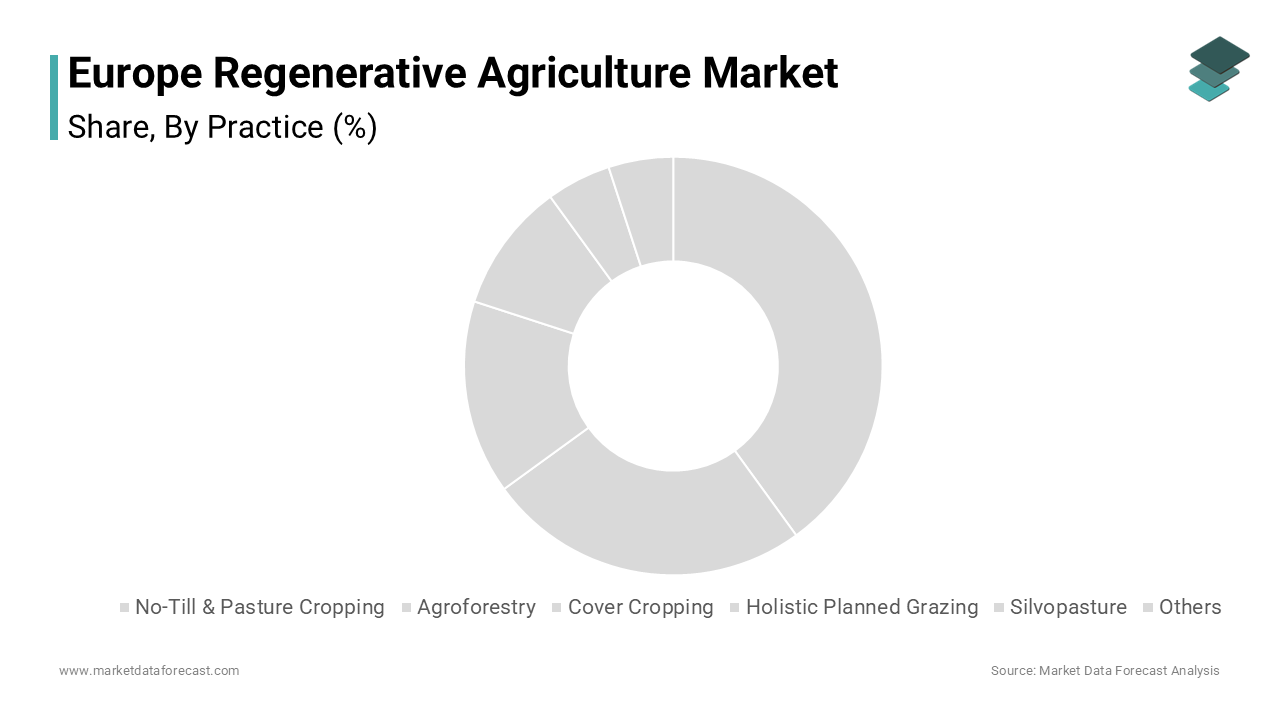
The agroforestry segment is anticipated to register the fastest CAGR of 13.3% over the forecast period in the European regenerative agriculture market due to its dual capacity to deliver climate mitigation and biodiversity co benefits within a single land use system. According to the EU Biodiversity Strategy for 2030, at least 10% of agricultural area in the EU should be under high-diversity landscape features by 2030, which is promoting the integration of hedgerows, tree rows and similar agroforestry-relevant features. In France, the National Agroforestry Plan aims to expand tree-and-hedge components on farmland, supported by government subsidies. In Germany, new eco-schemes provide annual payments per hectare for agroforestry management on arable land and permanent grassland. Scientific literature further supports agroforestry. Meta-analyses show that silvoarable and silvopastoral systems can enhance biodiversity and contribute to carbon sequestration at measurable rates. Rising corporate interest also plays a role with some major food-and-beverage companies are beginning to incorporate agroforestry criteria in their sustainable sourcing frameworks. As carbon-farming and landscape-resilience become stronger policy priorities, the agroforestry segment positions it for strong growth.
By Application Insights
The soil and crop management segment commanded 42.4% of the European regenerative agriculture market in 2024. The growth of the soil and crop management segment is primarily driven by the foundational role of soil health in regenerative systems and its direct linkage to policy compliance and yield stability. According to the EU’s soil strategy, the proposed Soil Monitoring and Resilience Directive aims to ensure that all soils in Member States are in a healthy condition by 2050, which will include monitoring frameworks and sustainable soil-management obligations. As per the on-farm studies from research institutes such as the Thünen Institute, integrated soil and crop-management practices involving cover crops, compost application and diversified rotations deliver improved water-use efficiency and more stable yields during drought years. Digital agriculture tools such as satellite sensing, drones and variable-rate application are increasingly adopted across EU farms, whichis supporting more efficient amendment use and soil-regeneration efforts. Additionally, the European Innovation Partnership for Agricultural Productivity and Sustainability has been supporting operational groups and demonstration projects focused on soil regeneration and sustainable land-use. With soil degradation costing the EU tens of billions of euros each year in lost productivity and ecosystem-service value, investment in soil and crop management is both an agronomic and economic imperative, reinforcing its strategic importance.
The biodiversity-focused applications segment is estimated to register the fastest CAGR of 15.4% over the forecast period in the European market. This surge is propelled by the binding targets of the EU Nature Restoration Regulation, which mandates restoration measures to cover at least 20% of the EU’s land and sea areas by 2030 and ultimately all ecosystems in need of restoration by 2050. According to the European Environment Agency, some 81% of habitat assessments at EU level are in an unfavourable (poor or bad) conservation status, which underlines the urgent demand for on-farm biodiversity interventions such as flower strips, beetle banks and pollinator corridors. Financial mechanisms are scaling. For example, some Member States are developing schemes that pay per-hectare for biodiversity enhancements and rural-development funds are being directed increasingly towards ecological focus-areas. Corporate accountability is another catalyst. Under the Corporate Sustainability Reporting Directive, large companies will be required to disclose information on their ecosystem-impacts, which is incentivizing supply-chain investments in biodiversity verification. According to the studies, farms implementing structured biodiversity plans report measurable improvements in beneficial insect populations, pest-reduction and lower pesticide dependency. With biodiversity increasingly recognised as a pillar of food-system resilience, this application segment is poised for sustained growth.
REGIONAL ANALYSIS
Germany Regenerative Agriculture Market Analysis
Germany dominated the regenerative agriculture market in Europe with 20.8% of the regional market share in 2024. The dominating position of Germany in Europe is driven by robust policy alignment, scientific infrastructure, and farmer cooperatives. Germany’s National Strategy on Biological Diversity, together with amendments to the Fertilizer Ordinance, reflects a growing focus on limiting synthetic inputs and promoting organic-matter recycling in agriculture. According to reports, a rising share of farms are adopting multiple regenerative practices aided by policy support and service-networks of agricultural cooperatives. The federal government has earmarked substantial funds for soil-health programmes, including support for monitoring soil carbon and reduced-tillage machinery. Institutions such as the Thünen Institute and the University of Hohenheim are publishing protocols and guidance on regenerative cereal systems and soil-carbon enhancement. Germany’s agricultural sector also benefits from a strong cooperative network that offers bundled inputs, advisory services and adoption support, which is helping reduce the barriers to transition. With around 11% of its agricultural area under organic management (according to 2023 Eurostat data) and growing interest from food-processing companies in regeneratively-sourced ingredients, Germany’s integrated approach positions it among the frontrunners in sustainable agriculture in Europe.
France Regenerative Agriculture Market Analysis
France occupied the second major share of the European regenerative agriculture market in 2024. The growth of the French market is majorly attributed to its aggressive national strategies and farmer centric subsidy models. France’s Ecophyto Plan III and its involvement in the 4 per 1000 initiative launched at COP21 reflect its formal commitment to enhancing soil-carbon stocks and advancing agroecological transitions in agriculture. France’s Ministry of Agriculture reports a growing number of agro-ecological transition contracts across the country, with annual payments per hectare to support these changes. The country is also expanding agroforestry via national tree-planting schemes and the High Environmental Value (HVE) farm-certification scheme is increasingly used by producers to obtain market differentiation around sustainability. Large retail chains are responding to rising consumer demand for soil-health and regenerative-agriculture credentials, and French agricultural extension services and EU-research partnerships support broader systemic rollout of sustainable practices. Together, these elements illustrate how France is advancing a policy-driven, coordinated approach to sustainability in agriculture.
United Kingdom Regenerative Agriculture Market Analysis
The United Kingdom is predicted to account for a substantial share of the European regenerative agriculture market during the forecast period. The Environmental Land Management scheme shifts farm-support towards payments for public goods, backed by a farming budget of around £2.4 billion per year under the agricultural transition. According to DEFRA, a large share of new agri-environment agreements now include soil-health and regenerative practices. The Sustainable Farming Incentive offers per-hectare payments for actions such as cover cropping, reduced tillage and other soil-health measures. Research from institutions such as Rothamsted Research indicate that regenerative farming methods on arable land can lead to measurable increases in soil organic matter over time. Private investment is also emerging; organisations such as the Soil Association and Triodos Bank have announced funding vehicles aimed at supporting regenerative agriculture. With strong consumer interest in climate-positive food and active NGO advocacy, the UK is positioning itself as a dynamic test-bed for scalable regenerative farming models.
Spain Regenerative Agriculture Market Analysis
Spain is predicted to exhibit a prominent CAGR in the European regenerative agriculture market over the forecast period owing to the rapid adoption that is heavily motivated by climate resilience needs in its semi-arid regions. Persistent droughts are motivating farmers to adopt water-conserving practices. The Spanish Ministry of Agriculture notes increasing uptake of no-till and minimum-tillage systems, especially in regions such as Castilla La Mancha and Andalusia, which help reduce evaporation and improve soil infiltration. In Spain’s large olive-grove sector (over 2.5 million ha), trials indicate that adopting regenerative practices can improve soil-moisture retention and resilience. The country’s CAP-strategic plan allocates a substantial portion of its budget to eco-schemes emphasising cover crops, organic amendments and conservation farming. Agricultural cooperatives are also intensifying regeneration commitments with their olive-grower members to align with sustainability and EU-ecosystem-regulation requirements. With desertification and drought posing real threats across much of Spain, the shift toward regenerative agriculture is emerging as both an adaptation strategy and a sustainability imperative.
Netherlands Regenerative Agriculture Market Analysis
The Netherlands is projected to hold a notable share of the European regenerative agriculture market during the forecast period due to its integration of digital innovation with regenerative principles despite high land use intensity. As one of the world’s most productive agricultural exporters, the Dutch prioritize input efficiency and circularity. According to Wageningen University & Research and related studies, a growing share of Dutch dairy and arable farms are adopting digital nutrient-mapping tools (including satellite or drone-based systems) to optimise compost and manure application and build soil carbon. The National Growth Fund has committed substantial investment in the “Re-Ge-NL” regenerative agriculture programme, which is supporting AI-driven decision tools and mechanisation innovations. Membership certification schemes such as “On the Way to Planet Proof” are gaining traction across Dutch farmland and include soil health metrics among their criteria. The Netherlands’ dense cooperative structure led by companies such as FrieslandCampina and Agrifirm facilitates bundling of inputs, services and advisory support, which is enabling faster scaling of regenerative systems. With tightening ammonia and nitrogen-emissions regulations in sensitive zones, regenerative systems are emerging as a viable pathway to maintain productivity within ecological constraints, reinforcing the Netherlands’ role as a high-tech pioneer of regenerative agriculture.
COMPETITIVE LANDSCAPE
Competition in the Europe regenerative agriculture market is characterized by dynamic collaboration rather than direct rivalry as participants operate across complementary niches including input supply digital services certification and off take agreements. Large agribusinesses like Bayer and Yara leverage existing distribution networks to embed regenerative protocols within their product ecosystems while specialized firms such as Indigo Ag focus on market creation and carbon monetization. Nonprofit organizations and research institutions also influence the landscape by setting standards and validating practices. The absence of standardized metrics creates both opportunity and fragmentation allowing early movers to establish proprietary methodologies. New entrants face moderate barriers due to regulatory complexity and the need for localized agronomic knowledge yet the market remains open to innovation especially in data verification and farmer financing. Overall the competitive environment favors integrated players who combine technical assistance financial de risk mechanisms and credible measurement to deliver end to end regenerative solutions aligned with EU climate and biodiversity mandates.
KEY MARKET PLAYERS
Some of the companies that are playing a dominating role in the Europe Regenerative Agriculture Market include
- Nestlé S.A.
- Danone S.A.
- Unilever PLC
- General Mills, Inc.
- Cargill Incorporated
- Agreena A/S
- Soil Capital Ltd
- Grounded
- Indigo Ag, Inc.
- Continuum Ag
- CIBO Technologie
- Alter Eco Americas, Inc.
- Ecorobotix SA
- Vayda
Top Players in the Market
Bayer AG
Bayer AG actively advances regenerative agriculture across Europe through its Carbon Initiative which enables farmers to adopt climate smart practices while generating verified carbon credits. The company provides digital agronomic tools via its Climate FieldView platform to monitor soil health and optimize input use. In 2023 Bayer expanded partnerships with European food companies and cooperatives to create end to end regenerative supply chains for wheat and oilseed rape. It also launched pilot programs in Germany and France offering technical support and upfront payments for carbon sequestration. These actions reinforce Bayer’s role as an enabler of scalable regenerative transitions linking on farm practices with corporate sustainability goals across the global food value chain.
Indigo Ag
Indigo Ag has established a strong foothold in Europe by connecting farmers with premium buyers through its regenerative grain marketplace. The company verifies on farm practices using satellite imagery and soil sampling ensuring traceability and credibility. In 2024 Indigo expanded operations into Spain and Poland facilitating contracts for regeneratively grown barley and rye. It collaborates with millers and brewers to create demand pull for verified crops. Indigo’s proprietary carbon program offers guaranteed payments per tonne of CO2 sequestered providing financial predictability during transition. Its integrated approach of measurement verification and market access positions it as a key infrastructure provider in Europe’s regenerative ecosystem with growing influence in North America and Latin America.
Yara International
Yara International supports regenerative agriculture by shifting from synthetic fertilizer dependency toward nutrient cycling and soil health. The company’s Atmo Zero initiative promotes precision nitrogen management combined with organic amendments to reduce emissions. In 2023 Yara launched the N Sensor ALS 2 in Europe a real time crop sensing tool that cuts nitrogen use by up to 20 percent while maintaining yields. It partners with dairy cooperatives in the Netherlands and France to integrate slurry and digestate into regenerative nutrient plans. Yara also contributes to EU funded projects on circular bioeconomy demonstrating its strategic pivot from input supplier to sustainability solutions provider with global applicability especially in high input farming regions.
Top Strategies Used by the Key Market Participants
Key players in the Europe regenerative agriculture market predominantly employ four core strategies to strengthen their foothold. First they form strategic partnerships with food processors cooperatives and retailers to create verified supply chains that ensure price premiums for farmers. Second they invest heavily in digital monitoring tools using satellite imagery soil sensors and AI to quantify outcomes like carbon sequestration and biodiversity gain. Third they offer financial incentives including upfront payments guaranteed carbon credits and transition support to reduce farmer risk. Fourth they actively participate in policy shaping by contributing data and pilot results to inform EU regulations such as the Carbon Removal Certification Framework. These integrated strategies blend technology finance and collaboration to drive scalable adoption while enhancing brand credibility and market relevance across the agricultural value chain.
MARKET SEGMENTATION
The research report on the erurope regenerative agriculture market has been segmented and sub-segmented based on categories.
By Practice
- No-Till & Pasture Cropping
- Agroforestry
- Cover Cropping
- Holistic Planned Grazing
- Silvopasture
- Others
By Application
- Soil & Crop Management
- Biodiversity-Focused Applications
- Carbon Sequestration
- Nutrient Cycling
- Water Management
- Landscape Restoration
- Ecosystem Resilience Enhancement
By Country
- UK
- France
- Spain
- German
- Italy
- Russia
- Sweden
- Denmark
- Switzerland
- Netherlands
- Turkey
- Czech Republic
- Rest of Europe