- Product Description Description
- Table of Contents TOC
- List of Table & Figure LOT
- Get Free Sample PDF Sample PDF
Market Size, 2025
$56.64 BnMarket Estimate, 2026
$63.67 BnMarket Forecast, 2034
$162.36 BnCAGR, 2026–2034
12.41%Europe Remittance Market Report Summary
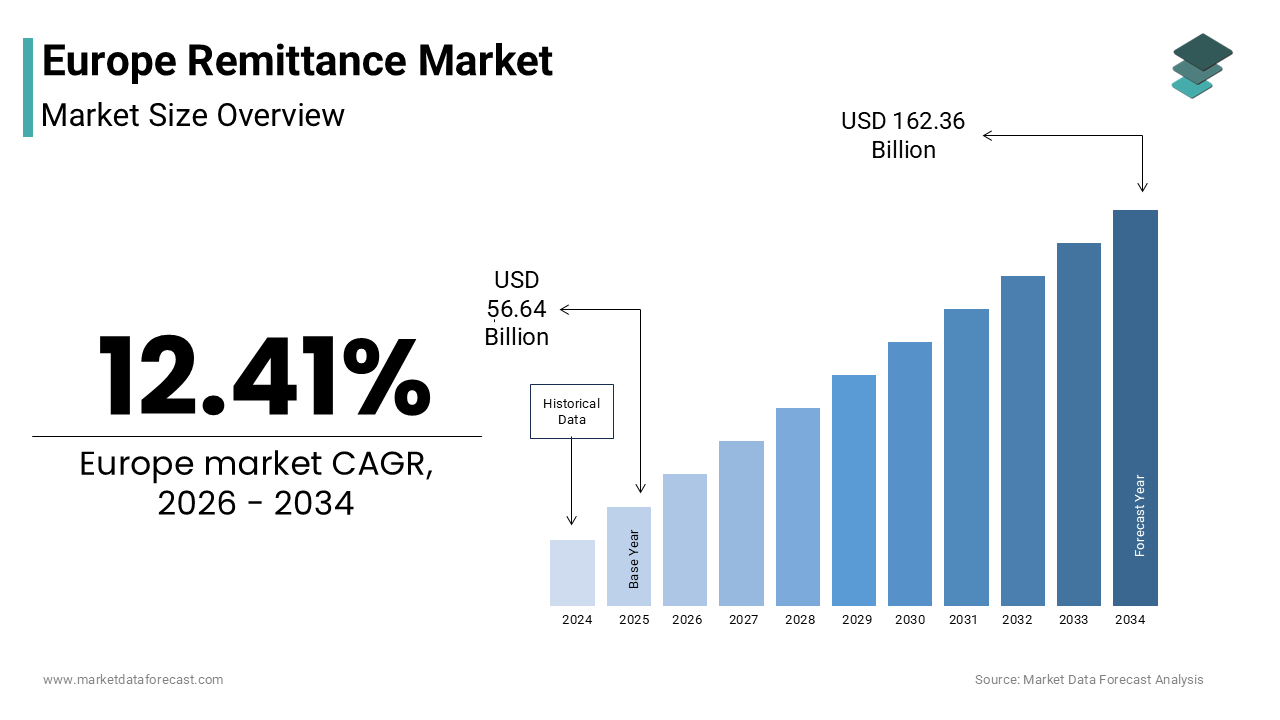
The Europe remittance market was valued at USD 56.64 billion in 2025, is estimated to reach USD 63.67 billion in 2026, and is projected to reach USD 162.36 billion by 2034, growing at a CAGR of 12.41% during the forecast period from 2026 to 2034. The growth of the Europe remittance market is driven by the expanding migrant population, rising cross-border personal transfers, and regulatory initiatives promoting faster and lower-cost payments across the region. Increasing adoption of digital remittance platforms, integration with instant payment infrastructure, and advancements in financial inclusion programs are further accelerating market expansion. Moreover, partnerships with digital identity solutions, expansion of mobile money ecosystems, and evolving EU payment regulations are reshaping remittances from traditional cash-based transfers into transparent, real-time digital financial services.
Key Market Trends
-
Rapid shift from traditional cash transfers toward mobile-first and digital remittance platforms across Europe.
-
Growing adoption of SEPA Instant and real-time payment rails enabling faster cross-border settlements.
-
Rising role of fintech companies offering low-cost, transparent remittance solutions to migrant communities.
-
Increasing integration of eKYC and digital identity frameworks is improving onboarding and compliance processes.
-
Expansion of remittance services beyond personal use into freelancer payments and micro-commercial transfers.
Segmental Insights
- Based on type, the outward remittance segment held the largest share of 90.3% of the Europe remittance market in 2025. The dominance of this segment is attributed to Europe’s status as a major migration destination, with millions of residents sending funds to families across Africa, Asia, and Eastern Europe.
- Based on the transfer channel, the online platforms segment accounted for 53.5% of the Europe remittance market share in 2025, supported by lower transaction costs, faster settlement times, and strong adoption of mobile banking and fintech applications.
- Based on end-user, the personal remittance segment led the Europe remittance market with a 90.5% share in 2025, driven by household support transfers covering education, healthcare, housing, and essential living expenses in recipient countries.
Regional Insights
The Europe remittance market shows strong growth across major economies supported by large diaspora populations, digital payment innovation, and supportive regulatory frameworks.
-
Germany was the largest contributor, accounting for 27.4% of the Europe remittance market share in 2025, driven by its significant immigrant population, strong fintech ecosystem, and high outbound remittance flows to Turkey and Eastern Europe.
-
France remains a key hub for remittances to Sub-Saharan Africa and North Africa due to strong diaspora connections and digital wallet integration.
-
The United Kingdom continues to expand through advanced fintech innovation, regulatory sandboxes, and growing digital remittance adoption despite post-Brexit market dynamics.
-
Spain and Italy are emerging as important corridors connecting Europe with Latin America, North Africa, and Eastern Europe, supported by seasonal labor migration and evolving digital payment infrastructures.
Competitive Landscape
The Europe remittance market is characterized by intense competition between digital fintech platforms and traditional money transfer operators, each leveraging different strengths to capture diverse customer segments. Leading companies are focusing on reducing fees, improving transaction speed, expanding digital onboarding, and strengthening partnerships with mobile money providers and global payment networks. Strategic alignment with EU regulations such as PSD2, the Instant Payments Regulation, and anti-money laundering frameworks is enabling providers to enhance transparency and scalability across international corridors. Prominent players in the Europe remittance market include Western Union GmbH, Wise Payments Ltd, Revolut Ltd, Xoom Corporation, MoneyGram International, Inc., WorldRemit Ltd, Ria Money Transfer, Inc., OFX Payments UK Ltd, CurrencyFair Ltd, and NetRemit Ltd.
Europe Remittance Market Size
The europe remittance market size was valued at USD 56.64 billion in 2025 and is anticipated to reach USD 63.67 billion in 2026 from USD 162.36 billion by 2034, growing at a CAGR of 12.41% during the forecast period from 2026 to 2034.
Remittance encompasses the cross-border transfer of personal funds by migrants, expatriates, and diaspora communities residing in European countries to recipients in origin nations, primarily in Africa, Asia, Eastern Europe, and Latin America. Unlike commercial payments, these transactions are driven by familial obligations, emergency support, and long-term household financing, which is forming a critical lifeline for millions of households globally. According to Eurostat, more than 4.6 million residence permits were issued to non-EU citizens in the EU in 2024, which highlights the scale of immigration and supports Europe’s role as a major remittance source, along with its status as a hub for seasonal and contract labor. As per the European Central Bank, payment statistics show extensive use of cross border transfers and international personal transactions across the EU, with flows heavily concentrated from Germany, France, the UK, and Italy. These remittances are facilitated through a mix of traditional money transfer operators, banks, post offices, and an expanding array of digital platforms compliant with the EU’s stringent anti money laundering and consumer protection frameworks under the Payment Services Directive 2 and the forthcoming Instant Payments Regulation. As financial inclusion and digital identity initiatives advance across the continent, the remittance landscape is evolving from cash-based corridors to real time, low cost, and transparent digital channels.
MARKET DRIVERS
Large and Growing Immigrant Population Sending Regular Household Support
Europe’s expanding immigrant population serves as the primary engine of remittance outflows, with millions of residents routinely sending funds to sustain families in their countries of origin, which is a major factor driving the growth of the European remittance market. According to Eurostat, 29 million non‑EU citizens resided in the European Union on 1 January 2024, representing 6.4% of the EU population. These communities include significant concentrations from Morocco, Turkey, Ukraine, India, and Pakistan, and they maintain strong transnational ties. As per the World Bank, remittances from migrants in Europe remain a major source of household support for families abroad, with Sub‑Saharan Africa alone receiving 57.6 billion US dollars in remittances in 2024. Germany hosts one of the largest Turkish diaspora populations in Europe, and remittances to Turkey are consistently recorded in the Central Bank of Turkey’s balance of payments statistics. France also has large Sub‑Saharan African communities, and remittances from Europe contribute significantly to flows into countries such as Senegal, Côte d’Ivoire, and the Democratic Republic of Congo according to World Bank bilateral remittance data. Seasonal agricultural workers in Spain and Italy form a substantial part of the labor force, with Eurofound noting that agriculture in these countries is heavily dependent on migrant seasonal workers. This deep demographic and socio‑economic embeddedness ensure consistent and growing transaction volume irrespective of macroeconomic fluctuations.
Regulatory Push for Faster and Cheaper Cross Border Payments Under EU Digital Finance Agenda
The European Union’s strategic commitment to reducing remittance costs and settlement times is accelerating market modernization and user adoption, which is further boosting the remittance market expansion in Europe. According to the European Commission, the 2023 Action Plan on Remittances set a target to reduce average fees to below 2% by 2026. The EU Instant Payments Regulation (Regulation (EU) 2024/886), adopted in March 2024, requires payment service providers to enable real‑time euro transfers available 24/7 with end‑to‑end delivery within 10 seconds, a framework now being extended to international corridors via partnerships with non‑EU countries. As per the European Central Bank, instant payments are being rolled out across the EU, though adoption rates are still developing and not yet at 90%. The European Commission has also allocated funding under the Digital Europe Programme to support interoperability between EU payment systems and those in recipient countries. These initiatives reduce reliance on high‑cost legacy operators and empower digital fintechs to offer lower‑cost remittance services. With over 70 licensed payment institutions now offering cross‑border remittance services in the EU, regulatory tailwinds are transforming remittances from a costly necessity into an inclusive and efficient financial service.
MARKET RESTRAINTS
Persistent High Transaction Costs on Key Corridors Despite Regulatory Efforts
Despite EU policy interventions, average remittance fees on major corridors remain significantly above the 2% target, which is constraining volume and pushing users toward informal channels and impeding the growth of the European remittance market. According to the World Bank’s Remittance Prices Worldwide database, Sub‑Saharan Africa remained the most expensive region to send money to in 2024, with average costs of 8.37% in Q2 2024. Costs to South Asia and Eastern Europe also remain above the EU’s 2% target. The Central Bank of Nigeria issued new guidelines in January 2024 for international money transfer services, which is indicating ongoing challenges with foreign exchange liquidity and transaction taxes. These structural frictions keep fees elevated and push some migrants toward informal channels. According to the European Consumer Organisation, many surveyed migrants in 2024 cited cost as the primary reason for using unregulated hawala or cash courier services, undermining transparency and consumer protection. Until recipient country reforms and deeper liquidity pools reduce structural friction, the EU’s cost reduction goals will remain partially unmet, limiting the formal market’s reach.
Stringent Identity Verification and Transaction Monitoring Requirements
Europe’s rigorous anti‑money laundering and counter‑terrorist financing framework imposes significant friction on remittance users, particularly the unbanked and those lacking formal identification, which is further hampering the regional market expansion. Under the EU’s 6th Anti‑Money Laundering Directive, all cross‑border transfers above 1000 euros require full customer due diligence including government‑issued ID, biometric verification, and proof of address. Even below this threshold, operators must collect phone numbers and national ID numbers in most member states as per guidelines from the European Banking Authority. For Europe’s undocumented or irregular migrants, estimated by the European Migration Network to be in the millions, these requirements create barriers. Studies note that complex KYC processes often discourage first‑time remittance senders, leading to transaction abandonment. Additionally, real‑time transaction monitoring systems often flag low‑value repetitive transfers as suspicious, precisely the pattern of typical remittance behavior, triggering delays and account freezes. While essential for financial integrity, these measures inadvertently exclude vulnerable populations and drive activity underground, contradicting the EU’s financial inclusion objectives.
MARKET OPPORTUNITIES
Integration with SEPA Instant and Cross Border Payment Rail Expansion
The integration of remittance services with the Single Euro Payments Area Instant scheme and emerging cross‑border payment rails presents a transformative opportunity for the European remittance market. According to the European Commission, the 2024 Instant Payments Regulation (Regulation (EU) 2024/886) mandates real‑time domestic euro transfers and encourages bilateral agreements with non‑EU payment systems. In 2024, the Eurosystem announced interoperability initiatives with non‑EU partners, including Nigeria’s NIBSS and Morocco’s Bank Al‑Maghrib, to enable faster euro‑to‑local currency settlement. As per the European Central Bank, pilot corridors using instant payment infrastructure demonstrated significant reductions in delivery times compared to traditional settlement, moving from multi‑day transfers to near‑real‑time transactions. Fintechs such as Wise and WorldRemit now offer SEPA Instant‑funded remittances where users pay in euros via bank transfer and recipients receive Naira or Dirhams within minutes. The European Investment Bank has highlighted that broader deployment of instant payment rails across priority corridors could generate substantial savings for migrants by reducing fees and foreign exchange losses. As the EU extends this infrastructure through its Global Gateway initiative, remittances are expected to shift from batch‑processed transactions to seamless instant payments embedded in everyday digital banking.
Partnerships with Digital Identity and eKYC Platforms to Expand Inclusion
Collaboration with EU digital identity frameworks and electronic Know Your Customer platforms offers a pathway to onboard previously excluded migrant populations while maintaining compliance, which is another promising opportunity in the European remittance market. The European Digital Identity Wallet regulation, set for full implementation by 2026, will allow third‑country nationals to store verified credentials such as residence permits, work contracts, and utility bills in a secure digital format recognized across all member states. Pilot projects in Spain and Sweden in 2024 enabled migrants from Morocco and Ukraine to open remittance accounts using national eID schemes linked to EU digital wallets. Companies such as Azimo and Remitly partnered with providers like Onfido and IDnow to deploy AI‑powered eKYC solutions that accept non‑EU documents, including consular IDs and asylum registration cards. The European Commission’s Digital Europe Programme funded initiatives such as MigrantID, which supported identity verification for thousands of diaspora members in 2024. These integrations reduce verification time significantly and improve approval rates for first‑time users. By leveraging trusted digital identity infrastructure, the remittance market can achieve both regulatory rigor and financial inclusion, unlocking a vast underserved user base.
MARKET CHALLENGES
Vulnerability to Geopolitical and Macroeconomic Shocks in Recipient Countries
Europe’s remittance outflows are highly exposed to instability in destination economies where currency devaluation, capital controls, and banking crises disrupt delivery and erode value, which is a major challenge to the European remittance market growth. In 2024, the Lebanese pound lost a large share of its official value, triggering defaults among money transfer operators who could not access foreign exchange to complete payouts, as documented by the Banque du Liban. Similarly, Nigeria’s multiple exchange rate system and foreign currency shortages created remittance backlogs according to the Central Bank of Nigeria. Political unrest also creates operational paralysis; the 2023 Sudan conflict halted formal remittance flows for months, stranding critical support for millions of internally displaced persons as reported by the International Organization for Migration. Even when transfers are completed, recipients often face steep losses due to parallel market exchange rates, receiving substantially less value than the sent amount. These systemic risks are beyond the control of EU‑based providers yet directly impact user trust and transaction reliability.
Fragmented Licensing and Compliance Requirements Across Member States
Despite EU‑level directives, remittance providers face a fragmented national regulatory landscape that complicates pan‑European scaling and increases operational costs, which is further challenging the expansion of the European remittance market. As per the European Supervisory Authorities’ 2024 convergence report, many member states still require separate payment institution licenses for cross‑border remittance services, while some impose additional local anti‑money‑laundering officer mandates. A study by the European Remittance Association in 2024 found that licensing costs for a single operator averaged hundreds of thousands of euros annually across the EU, with approval timelines varying widely between countries. Furthermore, national data localization laws in countries such as France and Germany require transaction records to be stored on domestic servers, adding infrastructure complexity. Until the EU harmonizes licensing under a true passporting regime, as proposed in the 2025 Financial Services Review, startups and smaller players will struggle to compete, limiting innovation and consumer choice in a market that serves some of Europe’s most vulnerable residents.
REPORT COVERAGE
| REPORT METRIC | DETAILS |
| Market Size Available | 2025 to 2034 |
| Base Year | 2025 |
| Forecast Period | 2026 to 2034 |
| CAGR | 12.41% |
| Segments Covered | By Type, Mode of Transfer, Transfer, End-user and Region |
| Various Analyses Covered | Regional & Country Level Analysis, Segment-Level Analysis, DROC, PESTLE Analysis, Porter’s Five Forces Analysis, Competitive Landscape, Analyst Overview on Investment Opportunities |
| Countries Covered | UK, France, Spain, Germany, Italy, Russia, Sweden, Denmark, Switzerland, the Netherlands, Turkey, the Czech Republic, and the Rest of Europe. |
| Market Leaders Profiled | Western Union GmbH, Wise Payments Ltd, Revolut Ltd, Xoom Corporation, MoneyGram International, Inc., WorldRemit Ltd, Ria Money Transfer, Inc., OFX Payments UK Ltd, CurrencyFair Ltd, and NetRemit Ltd. |
SEGMENTAL ANALYSIS
By Type Insights
The outward remittance segment held the highest share of 90.3% of the European market in 2025. The dominance of outward segment in the European market is driven by Europe’s role as a net sender of personal funds to origin countries, driven by its large immigrant population. According to Eurostat, 29 million non‑EU citizens resided in the EU in 2024, which is representing 6.4% of the EU population, with many maintaining regular financial ties to families in Africa, Asia, and Eastern Europe. Germany consistently ranks among the largest remittance‑sending countries in Europe, with billions of euros sent abroad annually according to the Deutsche Bundesbank. France also contributes significant remittance flows to Sub‑Saharan Africa and the Maghreb region as per the Bank of France. These outflows represent essential household financing as indicated by the International Fund for Agricultural Development. Europe’s strong labor market, with high employment among third‑country nationals, according to Eurofound, sustains consistent income generation and remittance capacity. Unlike inward flows, which are minimal due to limited European emigration, the outward segment is structurally anchored in Europe’s demographic and economic reality as a destination for global migration.
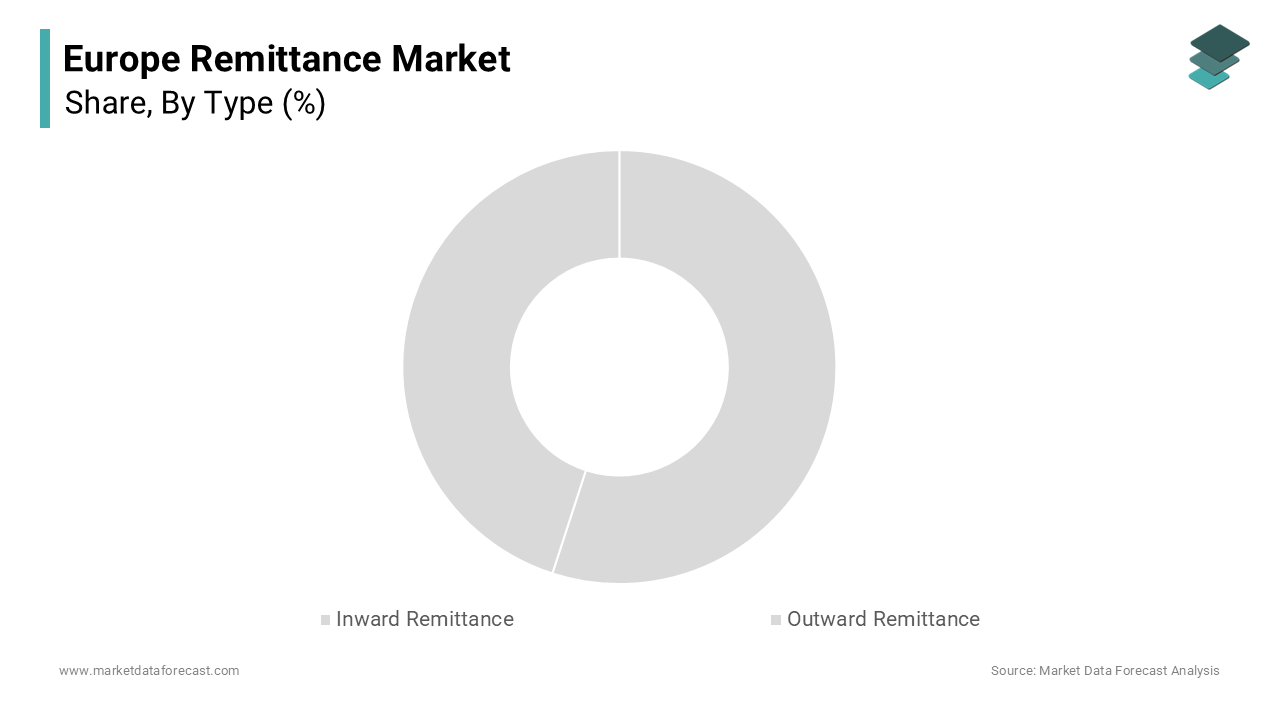
The inward remittance segment is the fastest growing segment in the Europe remittance market and is expected to record a CAGR of 7.4% over the forecast period owing to the rising European emigration for education, remote work, and retirement, particularly to non‑EU countries with lower costs of living. According to OECD data, millions of EU citizens reside outside Europe, with significant communities in the United States, Canada, Australia, and Southeast Asia. British retirees in Spain and Portugal often receive pension and family support from adult children in the UK, while young professionals in Berlin and Amsterdam send funds to aging parents in rural Greece and Bulgaria. According to the European Central Bank, growth in inward euro remittances in 2024, partly driven by Ukrainian refugees receiving support from relatives abroad. Additionally, Eurostat notes that millions of EU citizens hold dual nationality, facilitating reverse gifting and emergency transfers. Though still small in absolute volume, this segment is accelerating due to demographic aging, global mobility, and digital payment accessibility, gradually transforming Europe from a pure sender to a modest receiver in the global remittance ecosystem.
By Transfer Channel Insights
The online platforms segment led the market by holding 53.5% of the European market share in 2025. The growth of the online platforms segment in the European market is driven by their ability to offer lower fees, faster settlement, and seamless user experience compared to traditional channels. Fintechs such as Wise, WorldRemit, and Remitly leverage SEPA Instant and correspondent banking relationships to deliver cross‑border transfers at average fees below the global average of 6.1%, as per the World Bank. As per the European Consumer Organisation, strong digital adoption among younger migrants, with a majority using mobile apps for remittance transactions. The European Commission’s 2023 regulatory sandbox enabled platforms to integrate national digital identity systems such as France’s ANTS and Estonia’s eResidency, allowing real‑time verification without physical documentation. With over 90 million smartphone users in the EU and rising financial literacy among migrant communities, online platforms have become the default channel for cost‑conscious and tech‑savvy remitters.
By End‑User Insights
The personal segment dominated the market by commanding for 90.5% of the European market share in 2025. The growth of the personal segment in the European market is driven by the household‑oriented nature of remittance flows, where migrants send funds to support family members in origin countries. These transactions are characterized by small average values and high frequency, often monthly or biweekly, as documented by the European Central Bank’s transaction analytics. The primary purposes include food, clothing, education, healthcare, and housing, with the International Fund for Agricultural Development estimating that a majority of remittances in Sub‑Saharan Africa and South Asia directly fund basic household consumption. Europe’s large non‑EU resident population maintains these lifelines through deeply ingrained cultural and familial obligations. Unlike commercial payments, which follow corporate cycles, personal remittances exhibit resilience during economic downturns as migrants prioritize family support over discretionary spending. This socio‑economic embeddedness ensures that the personal segment remains the core and defining characteristic of the European remittance landscape.
The commercial segment is the fastest growing end‑user category in the Europe remittance market and is predicted to witness a CAGR of 8.84% over the forecast period due to the rise of micro‑entrepreneurs and cross‑border freelancers who use remittance channels for business payments previously handled through formal trade finance. According to Eurofound, millions of EU‑based freelancers now serve clients in emerging markets, with many receiving payments via personal remittance platforms due to lower barriers than business banking. Small importers in countries such as Senegal and Vietnam also pay European suppliers through services like Wise for orders under 5000 euros, avoiding complex letters of credit. The European Central Bank noted growth in business‑labeled remittances in 2024, particularly from digital nomads and e‑commerce sellers using platforms that blend personal and commercial features. Regulatory clarity under PSD2 allows payment institutions to serve micro‑businesses without full banking licenses, further accelerating adoption. As the gig economy and micro‑trade expand, commercial remittances are evolving from an anomaly to a structured niche, redefining the boundaries of personal payment infrastructure.
REGIONAL ANALYSIS
Germany Remittance Market Analysis
Germany held the leading position in the European remittance market in 2025 by accounting for 27.4% of the European market share. The country’s position is defined by its massive immigrant population. According to Eurostat, 12.3 million foreign‑born residents lived in Germany in 2024, including one of the largest Turkish diaspora communities in Europe. Germany consistently records tens of billions of euros in outward remittances annually, with major corridors to Turkey, Poland, Romania, and Italy. The Turkish corridor remains one of the strongest, reflecting deep familial and economic ties. Germany’s robust banking infrastructure and early adoption of SEPA Instant have enabled fintechs such as Wise and PayPal to capture a significant share of digital remittance volume. The Federal Financial Supervisory Authority maintains strict but clear licensing for payment institutions, fostering a competitive yet compliant market. With hundreds of thousands of new migrants arriving annually under labor and humanitarian schemes, Germany’s remittance outflows are structurally embedded and projected to grow steadily.
France Remittance Market Analysis
France captured the second largest share of the European remittance market in 2025. The country serves as the primary European conduit to Sub‑Saharan Africa and North Africa due to historical, linguistic, and colonial ties. According to INSEE, millions of residents of African origin live in France, sending billions of euros annually to Senegal, Côte d’Ivoire, Mali, Morocco, and Algeria. The Bank of France reported that a majority of these flows now occur through digital channels, with mobile wallet providers such as Orange Money and Wave gaining traction. France’s regulatory environment is supportive; the Autorité de Contrôle Prudentiel et de Résolution streamlined licensing for remittance startups in 2023, reducing approval timelines. Additionally, the French Development Agency partners with fintechs to subsidize fees on humanitarian corridors. With hundreds of thousands of new migrants from Africa arriving each year and strong diaspora networks, France’s role as Europe’s African remittance gateway remains unchallenged.
United Kingdom Remittance Market Analysis
The United Kingdom is predicted to grow at a promising CAGR in the European remittance market during the forecast period. Despite Brexit, the UK maintains a highly diverse migrant population, including large South Asian, Eastern European, and African communities. UK residents send billions of euros abroad annually, primarily to India, Pakistan, Nigeria, and Poland. The UK is a global leader in digital remittance innovation, with London‑based Wise processing a significant share of UK outflows at fees well below the global average. The Financial Conduct Authority’s regulatory sandbox has enabled rapid fintech scaling while maintaining strong consumer protection. Post‑Brexit, the UK strengthened bilateral payment agreements with India and Nigeria, facilitating direct settlement and bypassing correspondent banks. With the majority of remittances now digital and a thriving ecosystem of neobanks, the UK combines diaspora scale with technological edge to sustain its high influence in Europe’s remittance landscape.
Spain Remittance Market Analysis
Spain is estimated to account for a notable share of the European remittance market during the forecast period. The country’s remittance flows are split between Latin America and North Africa due to geographic proximity. According to Spain’s National Statistics Institute, millions of Latin American and North African residents live in Spain, sending billions of euros annually to their home countries. The Bank of Spain reported that mobile money adoption in recipient countries has dramatically increased digital uptake, with a majority of flows now processed via apps such as WorldRemit and Sendwave. Spain’s seasonal agricultural sector employs large numbers of undocumented migrants who rely on informal networks but are gradually migrating to regulated digital channels due to new ID verification options. With Madrid and Barcelona serving as key diaspora hubs, Spain’s remittance market reflects the dual south‑south and south‑north migration dynamics of the Mediterranean.
Italy Remittance Market Analysis
Italy is predicted to register a healthy CAGR in the European remittance market during the forecast period. The country’s flows are heavily oriented toward Eastern Europe and the Balkans due to labor migration patterns. According to ISTAT, millions of residents from Romania, Ukraine, Moldova, and Albania live in Italy, sending billions of euros annually. The Ukrainian corridor grew significantly in 2024 following the extension of temporary protection status for refugees. Italy’s remittance infrastructure is evolving from reliance on post offices and banks toward digital adoption. Poste Italiane’s partnership with Ria Money Transfer now enables instant mobile payouts to Romania and Ukraine. The Bank of Italy introduced simplified KYC for seasonal workers in 2023, allowing remittance accounts with only a work contract and municipal residence certificate. With hundreds of thousands of new migrants arriving annually, primarily from Eastern Europe, and strong informal networks gradually formalizing, Italy’s position as a Balkan remittance nexus is strengthening through regulatory pragmatism and corridor specialization.
COMPETITIVE LANDSCAPE
The Europe remittance market features intense rivalry between agile digital fintechs and established legacy operators each leveraging distinct advantages. Fintechs like Wise and WorldRemit dominate through low fees real time settlement and mobile first design appealing to younger tech literate migrants. In contrast Western Union and MoneyGram retain relevance via vast physical networks that serve cash dependent and older demographics particularly in Southern and Eastern Europe. Competition is increasingly shaped by regulatory compliance as the EU enforces stringent anti money laundering and consumer protection rules under PSD2 and the Instant Payments Regulation. Barriers to entry remain moderate due to licensing complexity but digital infrastructure and API based banking have lowered operational thresholds for specialized players. Price transparency and corridor coverage are key differentiators with winners offering sub 2% fees and same day delivery to high volume destinations. The market is consolidating around platforms that combine regulatory rigor digital seamlessness and inclusive access creating a dynamic yet challenging environment for sustained leadership.
KEY MARKET PLAYERS
Some of the companies that are playing a dominating role in the Europe Remittance Market include
- Western Union GmbH
- Wise Payments Ltd
- Revolut Ltd
- Xoom Corporation
- MoneyGram International, Inc.
- WorldRemit Ltd
- Ria Money Transfer, Inc.
- OFX Payments UK Ltd
- CurrencyFair Ltd
- NetRemit Ltd
Top Players in the Market
Wise (formerly TransferWise)
Wise is a UK headquartered fintech company and a global leader in cross border payments with a dominant footprint across the European remittance market. The company leverages its proprietary multi-currency account infrastructure and real time mid-market exchange rates to offer transparent low-cost transfers to over 80 countries. In Europe Wise processes billions of euros annually from migrants in Germany France and the UK to recipients in Africa Asia and Eastern Europe. In 2024 Wise integrated its platform with SEPA Instant enabling near real time euro funding and expanded direct local payout corridors to Nigeria Pakistan and Morocco through partnerships with domestic banking switches. The company also launched a dedicated migrant onboarding flow compliant with EU digital identity standards allowing users to verify using national eIDs. Through continuous infrastructure investment and regulatory alignment Wise has redefined user expectations for speed cost and transparency in European remittances.
WorldRemit
WorldRemit is a London based digital remittance provider specializing in mobile first cross border payments with strong penetration in European African and Asian corridors. The company serves Europe’s large diaspora communities by enabling instant mobile wallet cash and bank deposits in over 130 countries. In 2023 WorldRemit deepened its integration with Orange Money Wave and M Pesa to offer sub 1.5% fees on key corridors from France Spain and Italy to West and East Africa. In 2024 the company introduced a biometric eKYC solution compliant with the EU’s 6th Anti Money Laundering Directive that accepts consular IDs and asylum registration documents significantly expanding access for undocumented migrants. WorldRemit also partnered with the International Organization for Migration to facilitate humanitarian cash transfers to conflict affected regions. By prioritizing mobile accessibility inclusive verification and humanitarian use cases WorldRemit strengthens its position as a socially responsible and technologically agile remittance provider in Europe.
Western Union
Western Union is a US based global money transfer operator with an extensive physical and digital presence across Europe serving both traditional and evolving customer needs. The company operates over 80000 agent locations in the EU including post offices banks and retail outlets providing critical access for cash-based users. In response to digital disruption Western Union has aggressively modernized its European operations by launching real time bank transfers via its WU app and integrating with national instant payment systems. In 2024 the company enabled SEPA Instant funding across 18 EU countries and reduced average fees on major corridors by 22% through direct settlement agreements with central banks in Turkey Nigeria and the Philippines. Western Union also enhanced its compliance infrastructure to support EU digital identity wallets and introduced multilingual customer support for 25 migrant languages. By blending its unmatched physical network with digital innovation Western Union maintains relevance across diverse user segments in Europe’s evolving remittance ecosystem.
Top Strategies Used by the Key Market Participants
Key players in the Europe remittance market are leveraging SEPA Instant and bilateral payment rail integrations to enable real time cross border settlement and reduce reliance on correspondent banks. Companies are adopting inclusive electronic Know Your Customer solutions that accept non-traditional identification documents to onboard undocumented migrants while maintaining anti money laundering compliance. Strategic partnerships with mobile money operators and national payment switches in recipient countries expand last mile delivery and lower costs. Firms are also embedding remittance services into neobank and digital wallet ecosystems to capture recurring user behavior. Additionally, providers are aligning with EU digital identity frameworks and regulatory sandboxes to ensure compliance while enhancing user experience. These strategies collectively address cost speed accessibility and trust—the four pillars of modern remittance competitiveness in Europe.
MARKET SEGMENTATION
This research report on the Europe Remittance Market has been segmented and sub-segmented based on the following categories.
By Type
- Inward Remittance
- Outward Remittance
By Mode of Transfer
- Digital
- Traditional
By Transfer
- Channel Bank Transfer
- Money Transfer
- Operators Online Platforms
By End-User
- Personal
- Commercial
By Country
- UK
- France
- Spain
- Germany
- Italy
- Russia
- Sweden
- Denmark
- Switzerland
- Netherlands
- Turkey
- Czech Republic
- Rest of Europe