- Product Description Description
- Table of Contents TOC
- List of Table & Figure LOT
- Get Free Sample PDF Sample PDF
Market Size, 2025
$3.06 BnMarket Estimate, 2026
$3.28 BnMarket Forecast, 2034
$5.71 BnCAGR, 2026–2034
7.18%Europe Rental Housing Market Report Summary
The Europe rental housing market was valued at USD 3.06 billion in 2025 and is estimated to reach USD 3.28 billion in 2026, and is projected to reach USD 5.71 billion by 2034, growing at a CAGR of 7.18% during the forecast period. The growth of the Europe rental housing market is driven by increasing urbanization, rising housing costs, and changing lifestyle preferences that favor flexible living arrangements. A growing number of young professionals, students, and migrant populations are choosing rental housing due to affordability and mobility advantages compared to home ownership. In addition, the expansion of metropolitan job markets, increasing demand for professionally managed rental communities, and the development of modern residential complexes with improved amenities are further supporting the growth of the rental housing sector across Europe.
Key Market Trends
- Increasing urban migration and rising housing prices encouraging more individuals and families to opt for rental housing solutions.
- Growing demand for professionally managed rental communities offering modern amenities and improved living standards.
- Rising mobility among young professionals and students supporting the expansion of flexible housing options.
- Expansion of large residential property management companies increasing the supply of structured rental housing developments.
- Increasing investments in residential real estate and build to rent housing projects across major European cities.
Segmental Insights
- Based on type, the society based housing segment accounted for 65.5% of the Europe rental housing market share in 2025. The segment’s dominance is attributed to the growing preference for residential communities that offer enhanced security, shared facilities, and organized property management services.
- Based on property type, the unfurnished properties segment held 56.5% of the Europe rental housing market share in 2025. The popularity of unfurnished rental units is driven by tenants seeking flexibility to personalize living spaces and reduce rental costs associated with furnished accommodations.
- Based on location, the metro locations segment captured 68.8% of the Europe rental housing market share in 2025. Major metropolitan areas attract a high concentration of working professionals, students, and expatriates, leading to strong demand for rental housing in urban centers.
Regional Insights
- The Europe rental housing market is experiencing steady expansion across several countries driven by urban population growth, rising housing demand, and expanding employment opportunities in major cities.
- Germany stood as the largest and most mature rental housing market in Europe, accounting for 23.5% of the regional market share. The country’s strong rental culture, well established property management sector, and high proportion of renters compared to homeowners contribute to the dominance of Germany in the European rental housing landscape.
- Other European countries are also witnessing increasing investments in rental housing developments to address growing urban housing demand and improve residential infrastructure.
Competitive Landscape
The Europe rental housing market features several prominent real estate companies and residential property management firms focusing on expanding rental housing portfolios and improving tenant services. Companies are investing in modern residential developments, digital property management platforms, and sustainable housing solutions to enhance tenant experience and operational efficiency. Strategic acquisitions, portfolio expansions, and long term residential investments are helping market participants strengthen their presence across Europe. Key companies operating in the Europe rental housing market include Vonovia SE, LEG Immobilien AG, Heimstaden Bostad AB, TAG Immobilien AG, and Grand City Properties S.A.
 Download Free Sample Report
Europe Rental Housing Market Size
The Europe rental housing market size was valued at USD 3.06 billion in 2025 and is projected to reach USD 5.71 billion by 2034 from USD 3.28 billion in 2026, growing at a CAGR of 7.18%.
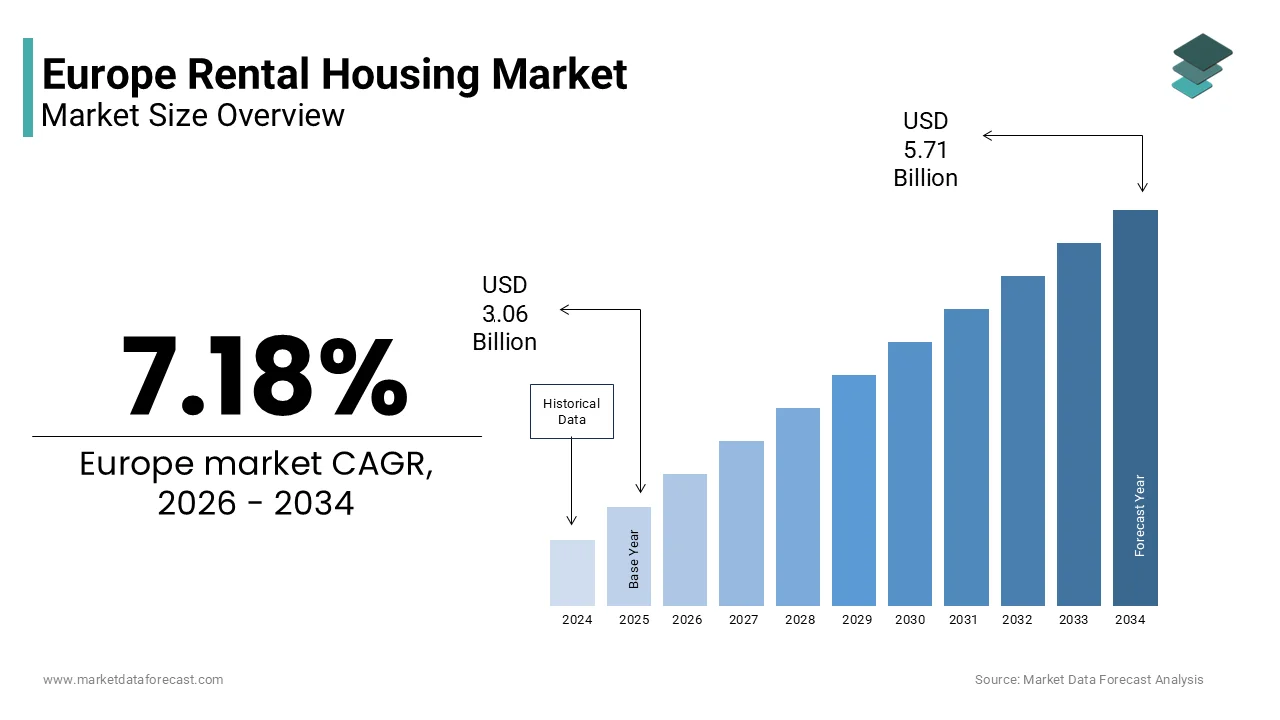
Rental housing constitutes a vital segment of the continental residential real estate landscape, encompassing the leasing of dwellings ranging from single-family homes to multi-unit apartment complexes by private landlords, institutional investors, and social housing providers. This sector serves as the primary accommodation solution for a significant portion of the population who are unable or unwilling to purchase property due to economic constraints or lifestyle preferences. The structural importance of renting has intensified as demographic shifts and urbanization reshape living patterns across the region. According to Eurostat, a significant portion of the European Union population resides in rented accommodations, with the share being much higher in major metropolitan hubs. Furthermore, as per the European Commission, household formation rates are outpacing the construction of new owner-occupied units, which is driving reliance on the rental stock. According to the Organisation for Economic Cooperation and Development, the average age of first-time home buyers has risen in several member states, extending the duration individuals remain in the rental market. This market functions not merely as a temporary stopgap but as a long-term housing strategy for millions, underpinned by evolving tenancy laws, rent control mechanisms, and a growing institutional focus on build to rent developments that prioritize stability and quality for a diverse tenant base.
MARKET DRIVERS
Surging Urbanization and Concentration of Employment Opportunities
The relentless migration of populations toward major urban centers in search of employment and educational prospects is primarily driving the expansion of the European rental housing market. Cities act as economic engines, attracting young professionals, students, and migrants who require flexible housing solutions close to their workplaces and universities. According to the European Commission, a large majority of the EU population lives in urban areas and this share is expected to grow further in the coming decades, creating sustained pressure on city center housing stocks. This concentration is particularly acute in capital cities where job growth is most dynamic. As per Eurostat, unemployment rates in rural areas are often higher compared to urban zones, which is compelling workforce mobility toward metropolitan regions where rental availability is the only viable entry point into the housing market. The density of higher education institutions further amplifies this trend, with millions of students relocating annually. According to the European Students Union, student mobility within the Erasmus program and domestic university transfers generates significant demand for short to medium term rental contracts each year. Consequently, the inability of suburban or rural homeownership to meet the proximity needs of the modern workforce ensures that urban rental markets remain perpetually tight.
Escalating Property Prices and Mortgage Affordability Crises
The exponential rise in residential property values coupled with soaring mortgage interest rates has fundamentally altered the tenure preference of millions of Europeans, which is forcing a shift from ownership aspirations to long-term renting and contributing to the rental housing market growth in Europe. As house prices have decoupled from income growth in many regions, the barrier to entry for first-time buyers has become insurmountable without substantial parental wealth. According to the European Central Bank, house prices in the euro area have risen considerably over the last decade while wages grew at a slower pace, which is severely impacting affordability. Furthermore, the recent surge in interest rates to combat inflation has drastically increased monthly mortgage repayments. As per Eurofound, the proportion of household income required to service a new mortgage has reached historic highs in several countries, pricing out a large segment of the middle class. This financial reality has extended the renting phase of life significantly. According to the Organisation for Economic Co-operation and Development, the average age of first-time buyers has climbed steadily, meaning individuals remain in the rental market for much longer than previous generations. For many, renting is no longer a transitional stage but a permanent necessity driven by the difficulty of securing a loan.
MARKET RESTRAINTS
Stringent Rent Control Regulations and Tenant Protection Laws
The implementation of rigorous rent control measures and extensive tenant protection legislation across numerous European jurisdictions are hindering the growth of the European rental housing market. Governments frequently intervene to cap rent increases and make eviction processes arduous to protect tenants from displacement, but these policies often discourage private landlords from entering or remaining in the market. According to the European Commission, while such measures provide short-term relief for tenants, they can lead to a reduction in the quality and quantity of available rental units over time. In cities like Berlin and Paris, strict rent caps limit the potential yield for investors, making alternative asset classes more attractive. As per the European Property Federation, restrictive eviction laws in countries such as Sweden and the Netherlands have led to a phenomenon where landlords withdraw properties from the long-term rental market to convert them into short-term holiday lets or sell them outright. The legal complexity and time required to regain possession of a property increase the perceived risk of lending to tenants. This regulatory environment stifles the development of new purpose-built rental projects because institutional investors demand predictable returns and legal certainty. Consequently, the very regulations designed to protect tenants often result in a shrinking supply of formal rental housing.
Chronic Shortage of New Housing Construction and Supply Bottlenecks
A persistent deficit in the construction of new residential units relative to population growth serves as a formidable restraint on the Europe rental housing market and creating a structural imbalance that fuels excessive rent inflation and limits choice. The industry faces a multitude of headwinds including labor shortages, soaring material costs, and complex planning permission processes that delay project completion for years. According to Eurostat, housing completion rates in the European Union have stagnated or declined in several major economies in recent years, which is failing to keep pace with the formation of new households. According to the European Construction Industry Federation, the cost of building materials has increased significantly, rendering many marginal projects financially unviable for developers. Furthermore, the bureaucratic labyrinth of obtaining zoning approvals in dense urban areas can add years to the development timeline. As per the European Bank for Reconstruction and Development, the annual shortfall in housing production across Europe is estimated to be substantial, a gap that accumulates over time to create a massive deficit. This lack of new supply means that the existing rental stock bears the full brunt of demand, leading to overcrowding and the subdivision of apartments which degrades living standards. Without a significant acceleration in construction activity, the market remains constrained, which is preventing the natural equilibrium where increased supply would moderate rents and improve availability for renters.
MARKET OPPORTUNITIES
Expansion of Institutional Build-to-Rent Developments
The emergence and rapid scaling of institutional Build-to-Rent (BTR) schemes present a promising opportunity for the Europe rental housing market by introducing professional management, high-quality amenities, and long-term stability to the sector. Unlike traditional private landlords who may offer fragmented and inconsistent service, institutional investors develop entire communities specifically designed for renting, addressing the chronic shortage of premium rental stock. According to the European Investment Bank, the BTR sector has been identified as a key area for financing, with institutional capital bridging the gap left by retreating small-scale landlords. As per JLL, the volume of BTR transactions in Europe has grown significantly, with large investments deployed in markets like Germany, Spain, and the United Kingdom to construct new units. These developments often include co-working spaces, gyms, and concierge services, appealing to the modern urbanite who values lifestyle and convenience. The professionalization of the sector also brings greater transparency and standardized leases, reducing friction for tenants. Furthermore, the long-term investment horizon of pension funds and insurance companies aligns well with the need for stable housing supply, as they are less likely to sell assets during market downturns compared to individual owners. This shift towards institutional ownership promises to elevate the standard of rental living, providing a viable alternative to homeownership for a generation that prioritizes flexibility and community over asset accumulation.
Digitalization and Proptech Integration for Operational Efficiency
The widespread adoption of property technology (Proptech) and digital platforms offers a significant opportunity in the Europe rental housing market. Digital tools facilitate every aspect of the rental lifecycle, from virtual viewings and automated tenant screening to online rent collection and predictive maintenance, reducing administrative burdens and costs for landlords. According to the European Commission's Digital Single Market strategy, the uptake of such technologies is encouraged to improve cross-border investment and transparency. As per Eurostat, a large majority of individuals now use the internet to search for housing, making digital presence mandatory for market participation. Innovative startups are leveraging artificial intelligence to match tenants with properties more accurately and using blockchain for secure, transparent lease agreements that reduce fraud. Furthermore, smart home technologies integrated into rental units allow for real-time monitoring of energy usage and security, appealing to environmentally conscious tenants and lowering utility bills. According to the European Proptech Forum, digitized portfolios attract more institutional capital due to the availability of granular data on performance and occupancy. This technological evolution enables the scaling of rental management, allowing single entities to manage thousands of units efficiently. By reducing friction and increasing trust, digitalization expands the addressable market and improves the overall efficiency of housing allocation across the continent.
MARKET CHALLENGES
Prevalence of Informal Rentals and Tax Evasion
The persistence of a large informal or "black market" rental sector poses a significant challenge to the Europe rental housing market, which is undermining regulatory efforts, distorting price signals, and depriving governments of tax revenue. In many Southern and Eastern European countries, a substantial portion of rental transactions occurs off the books, with cash payments and verbal agreements that bypass legal protections and taxation. According to the European Commission, the shadow economy in the housing sector remains significant, with many leases unregistered, making it difficult for authorities to enforce rent controls or safety standards. As per Eurostat, tax gaps related to housing income are considerable in several member states, which is incentivizing landlords to operate informally to avoid high income tax rates and social security contributions. This lack of regulation leaves tenants vulnerable to exploitation, with no legal recourse in case of disputes or unsafe living conditions. Furthermore, the existence of a large informal market skews official statistics, making it challenging for policymakers to accurately assess supply and demand dynamics or plan effective housing strategies. The difficulty in detecting these transactions, combined with lenient enforcement in some jurisdictions, perpetuates a cycle where compliant landlords face higher effective costs than their informal competitors. Addressing this issue requires complex administrative reforms and incentives for regularization, which have proven politically and practically difficult to implement effectively across diverse national contexts.
Gentrification and Socio-Economic Displacement of Residents
The intensifying process of gentrification in major European cities presents a profound social challenge, where rising rental values and property renovations force long-term, lower-income residents out of their neighbourhoods, which is leading to social fragmentation and segregation. As investors pour capital into upgrading housing stock to attract higher-paying tenants, the character of communities changes rapidly, often erasing local culture and displacing vulnerable populations. According to the European Foundation for the Improvement of Living and Working Conditions, gentrification is accelerating in cities like London, Lisbon, and Barcelona, where rental prices have risen sharply, far outpacing local wage growth. As per the European Social Survey, the fear of displacement is a primary source of anxiety for working-class families in urban centers, leading to longer commutes and reduced access to essential services as they are pushed to the periphery. This dynamic creates "superstar cities" accessible only to the wealthy, while essential workers such as teachers and nurses can no longer afford to live near their workplaces. The social cohesion of neighbourhoods deteriorates as mixed-income communities are replaced by homogenous affluent enclaves. Policymakers struggle to balance the need for urban regeneration and investment with the imperative of social inclusion, as strict rent controls can stifle development while laissez-faire approaches accelerate displacement. This tension threatens the social fabric of European cities and challenges the notion of housing as a fundamental right rather than a commodity.
REPORT COVERAGE
| REPORT METRIC | DETAILS |
| Market Size Available | 2025 to 2034 |
| Base Year | 2025 |
| Forecast Period | 2026 to 2034 |
| CAGR | 7.18% |
| Segments Covered | By Type, Property Type, Locations, and Region |
| Various Analyses Covered | Global, Regional, & Country Level Analysis; Segment-Level Analysis; DROC, PESTLE Analysis; Porter’s Five Forces Analysis; Competitive Landscape; Analyst Overview of Investment Opportunities |
| Regions Covered | UK, France, Spain, Germany, Italy, Russia, Sweden, Denmark, Switzerland, Netherlands, Turkey, and the Czech Republic |
| Market Leaders Profiled | Vonovia SE, LEG Immobilien AG, Heimstaden Bostad AB, TAG Immobilien AG, and Grand City Properties S.A |
SEGMENTAL ANALYSIS
By Type Insights
The society-based housing segment led the market by accounting for the 65.5% of the European market share in 2025. The growth of society-based housing segment in the European market is driven by the high population density in European urban centers where land scarcity necessitates vertical living solutions and the historical and architectural evolution of European cities that favor multi-unit dwellings over sprawling single-family homes. According to Eurostat, a large proportion of the population in the European Union resides in flats or apartments, a trend that is even more pronounced in capital cities like Paris and Madrid where space is at a premium. Furthermore, the economic efficiency of managing multiple units within a single complex attracts institutional investors and professional landlords. As per the European Property Federation, operational costs per unit in large residential societies are lower due to economies of scale in maintenance, security, and utilities management compared to scattered standalone properties. The availability of shared amenities such as gyms, gardens, and co-working spaces within these societies also aligns with the lifestyle preferences of modern urban renters who value community and convenience. This structural preference for high-density living ensures that society-based housing remains the backbone of the rental market across the continent.
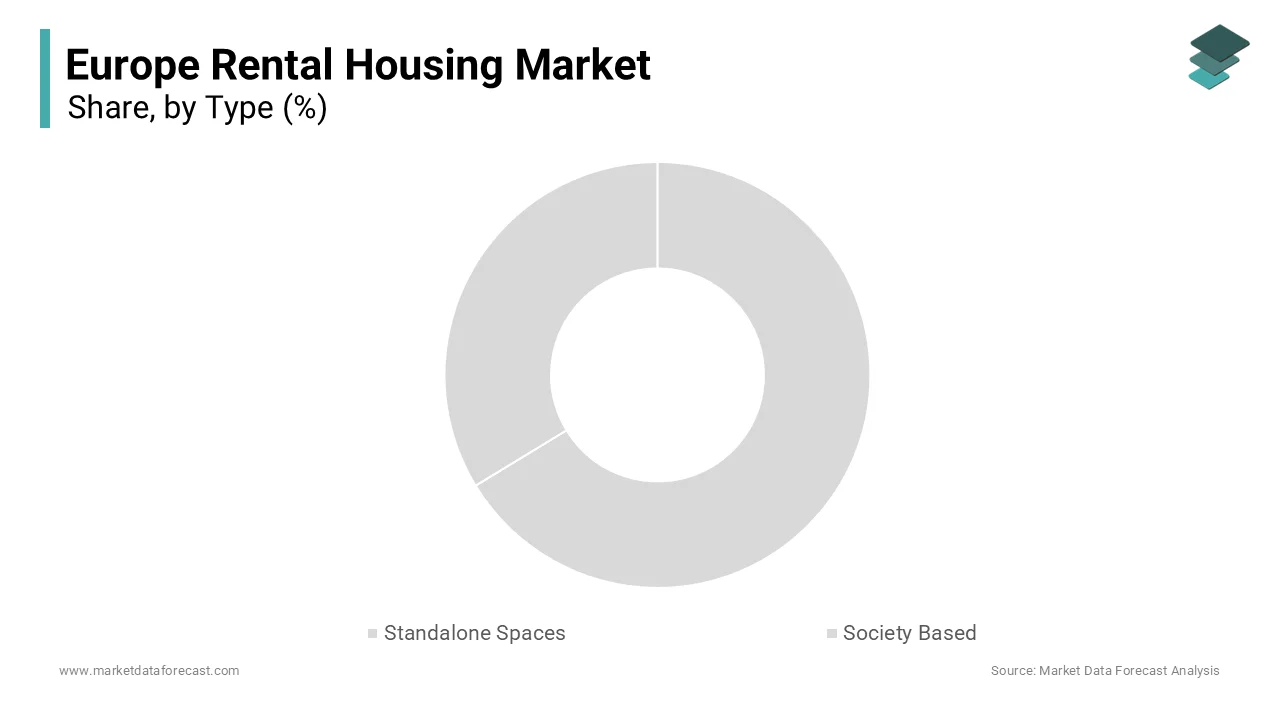
On the other hand, the standalone spaces segment is anticipated to register a promising CAGR of 7.4% over the forecast period in the European market due to the post-pandemic shift in lifestyle preferences where tenants increasingly seek larger living areas, private outdoor spaces, and separation from neighbours. The rise of remote work that has decoupled employment location from physical office presence that allow families to move away from crowded city centers to suburban or semi-rural areas is further boosting the expansion of the standalone segment in the European market. According to the European Foundation for the Improvement of Living and Working Conditions, the demand for home offices and gardens has surged, with many remote workers prioritizing extra space over proximity to work. Secondly, the desire for privacy and reduced health risks associated with shared building facilities has made standalone properties more attractive. As per Eurofound, surveys show declining willingness among households with children to live in high-density apartment blocks, driving a migration towards detached rentals. Developers are responding by converting older commercial properties or developing new low-density communities on the outskirts of major metros. This trend represents a fundamental rethinking of residential needs, positioning standalone spaces as the most dynamic growth area in the rental sector.
By Property Type Insights
The unfurnished properties segment held the dominant position in the Europe rental housing market by property type by holding 56.5% of the regional market share. This prevalence is deeply rooted in cultural norms and legal frameworks across many European nations where tenants prefer to personalize their living spaces with their own furniture and decor. The long-term nature of tenancies in countries like Germany and Sweden, where renters often stay in the same property for decades, which is making it logical to invest in their own furnishings is also contributing to the rapid growth of the unfurnished properties segment in the European market. According to the European Consumer Organisation, in Northern and Central Europe renting is viewed as a stable long-term housing solution rather than a transient phase, encouraging tenants to treat the property as their own home. Furthermore, landlord liability and maintenance issues associated with providing furniture discourage many property owners from offering furnished units. As per the European Landlord Association, wear and tear on provided furniture increases management costs and dispute frequencies, leading many landlords to opt for unfurnished leases to minimize operational headaches. Additionally, the higher upfront cost for landlords to furnish entire apartments acts as a barrier, particularly for small-scale individual landlords who dominate the market. This combination of tenant preference for customization and landlord desire for reduced liability ensures that unfurnished properties remain the standard offering in the European rental landscape.
The fully furnished properties segment is emerging as the fastest growing segment and is expected to register a CAGR of 10.3% over the forecast period due to the increasing mobility of the workforce, the rise of the gig economy and the surging demand from young professionals, expatriates, and digital nomads who require ready-to-live solutions for short to medium term stays. According to the European Commission, labor mobility within the EU has increased, creating a vast market for hassle-free accommodation. As per Eurostat, the number of people aged 25 to 34 living in rented accommodation has risen, and this demographic strongly prefers the flexibility and convenience of fully furnished units that eliminate the cost and effort of buying and moving furniture. Secondly, the growth of the student population and international education exchanges fuels demand for turnkey housing. According to the European Students Union, student mobility programs generate significant demand for furnished units. Landlords are responding to this lucrative segment by furnishing properties to command higher yields and reduce vacancy periods. The ability to charge a premium for the convenience of immediate occupancy makes this segment highly attractive for investors, driving rapid expansion in major university cities and business hubs.
By Locations Insights
The metro locations segment continued to dominate the Europe rental housing market in 2025 by capturing 68.8% of the regional market share. This supremacy is majorly driven by the concentration of economic opportunities, educational institutions, and cultural amenities within major metropolitan areas that attract a constant influx of residents. The agglomeration effect where jobs, particularly in high-value sectors like finance, technology, and creative industries are clustered in city centers, this factor is also aiding the expansion of the metro locations segment in the European market. According to Eurostat, gross domestic product per capita in metropolitan regions is typically higher than in non-metro areas, drawing workers who must rent due to high purchase prices. Furthermore, the extensive public transportation networks in European metros make car-free living viable, increasing the appeal of central rental properties. As per the European Environment Agency, the push for sustainable urban mobility has led to improved transit connectivity, making metro living more convenient and desirable for the environmentally conscious younger generation. The density of universities and hospitals in these zones also creates a perpetual demand from students and medical staff. According to the European Urban Initiative, despite high rents, vacancy rates in major cities like London, Paris, and Berlin remain low due to this insatiable demand. The sheer volume of transactions and the premium pricing in these hubs ensure that metro locations remain the engine of the rental market.
The non-metro locations segment is witnessing the fastest growth and is expected to showcase a CAGR of 8.14% over the forecast period. The widespread adoption of remote work models that have liberated employees from the necessity of daily commuting is propelling the growth of the non-metro locations segment in the European market. According to the European Foundation for the Improvement of Living and Working Conditions, a significant portion of the European workforce now engages in some form of remote work, enabling them to seek affordable and spacious housing in smaller towns and rural areas. Secondly, the "flight to quality" trend sees families prioritizing larger homes and access to nature over urban proximity. As per Eurofound, the cost-of-living crisis has accelerated this migration, with renters seeking lower rental yields in non-metro areas where their income goes further. Local governments in these regions are also incentivizing relocation through digital nomad visas and tax breaks to revitalize depopulating areas. According to the European Rural Parliament, interest in rural living has resurged, supported by improvements in broadband infrastructure that make remote work feasible anywhere. This decentralization of demand is opening up new markets for landlords and developers in previously overlooked regions, which is driving rapid growth in the non-metro rental segment.
REGIONAL ANALYSIS
Germany Rental Housing Market Analysis
Germany stood as the largest and most mature rental housing market in Europe by holding 23.5% of the regional market share. The German market is distinguished by a unique culture where renting is a lifelong choice for a majority of the population. The high degree of tenant protection, rent control mechanisms, a robust social housing sector and the historical preference for renting over owning are primarily driving the dominance of Germany in the European market. According to Eurostat, a significant proportion of German households reside in rented accommodations, with the share being even higher in major cities. The stringent regulatory framework, including the "Mietpreisbremse" or rent brake, aims to keep housing affordable but also influences investment dynamics. As per the Federal Institute for Research on Building, Urban Affairs and Spatial Development, demand for rental housing continues to outstrip supply due to strong urbanization and immigration flows. The presence of large institutional landlords and cooperative housing associations ensures a professionalized market structure. Furthermore, the high transaction costs and taxes associated with buying property in Germany reinforce the attractiveness of renting. This deep-rooted rental culture, combined with a chronic shortage of new construction, cements Germany's position as the cornerstone of the European rental landscape.
United Kingdom Rental Housing Market Analysis
The United Kingdom occupied the second largest position in the European market in 2025. The UK market is defined by a dynamic and highly liquid private rental sector that serves as a critical buffer for housing affordability. The recent legislative changes, shifting tax policies affecting landlords and the severe shortage of affordable homeownership options that has forced a growing number of households into the rental market are a few of the key factors driving the UK rental housing market. According to the Office for National Statistics, the proportion of private renters has increased significantly over the last two decades. The concentration of high-paying jobs in London and the South East drives intense demand in these regions, pushing rents upward. As per the Resolution Foundation, the cost of renting has become a significant burden for low and middle-income families, sparking political debate and regulatory intervention. The introduction of stricter energy efficiency standards and the removal of tax relief on mortgage interest have altered the supply side, leading some landlords to exit the market. Despite these challenges, the fundamental imbalance between supply and demand keeps the UK rental market vibrant and essential for millions of workers and students.
France Rental Housing Market Analysis
France is predicted to witness a promising CAGR in the European rental housing market during the forecast period owing to a strong tradition of state intervention and a comprehensive social housing system. The "Loi ALUR" and other regulatory measures that provide extensive security of tenure for tenants and cap rent increases in tense urban areas are propelling the French market expansion. According to the National Institute of Statistics and Economic Studies, a considerable proportion of French households are renters, with many residing in social housing managed by public bodies. The concentration of economic activity in Paris and its surrounding region creates a hyper-competitive rental environment where demand exceeds supply. The French government's push for energy renovation of rental properties is also reshaping the market, forcing landlords to upgrade units or face restrictions on leasing. As per the Ministry of Ecological Transition, a large number of rental units are classified as energy inefficient, driving a wave of renovations and potential rent adjustments. The blend of private and public rental stock, coupled with rigorous tenant protections, creates a stable yet complex market that plays a pivotal role in the European housing ecosystem.
Spain Rental Housing Market Analysis
Spain is estimated to account for a notable share of the European rental housing market during the forecast period owing to a historically low rental rate that is undergoing a structural transformation towards higher renting participation and a shift from an ownership-centric model to a more balanced tenure mix, driven by economic necessity and changing demographics. A major driving factor is the difficulty young people face in accessing mortgages due to high unemployment rates and precarious job contracts. According to the Spanish National Institute of Statistics, rental participation has climbed steadily in recent years, particularly among younger demographics. The boom in tourism has also impacted the rental market, with many properties converted to short-term holiday lets, reducing long-term supply and driving up prices in coastal and city center areas. The government has responded with new housing laws aimed at curbing speculative rents and increasing the supply of affordable housing. The influx of international digital nomads and expatriates seeking sun and lifestyle further fuels demand in key cities like Barcelona and Valencia. This convergence of domestic pressure and international demand positions Spain as a high-growth market with significant volatility.
Italy Rental Housing Market Analysis
Italy is estimated to register a healthy CAGR in the European rental housing market during the forecast period owing to a fragmented rental landscape dominated by small private landlords and a significant informal sector. The stagnation of wages and the high cost of property entry that delays homeownership and extends the rental phase of life is also propelling the Italian market expansion. According to the Italian National Institute of Statistics, rental contracts have increased, particularly in university cities like Milan and Bologna where student populations drive consistent demand. The government offers tax incentives for landlords who register contracts and agree to capped rents, aiming to bring the large shadow market into the formal economy. As per the European Central Bank, rental yields in major Italian cities are becoming increasingly attractive to investors compared to other asset classes. The slow but steady professionalization of the market, along with initiatives to boost student housing and social rentals, is gradually modernizing the sector. While challenges remain regarding bureaucracy and tax compliance, Italy's rental market is gaining importance as a crucial component of the national housing strategy.
COMPETITIVE LANDSCAPE
The competition within the Europe rental housing market is characterized by a fragmented landscape comprising large institutional investors, regional cooperatives, and numerous small-scale private landlords who vie for dominance through location and service quality. Major incumbents leverage their extensive capital reserves to acquire prime assets in city centers and undertake large-scale redevelopment projects that smaller players cannot afford. However, the emergence of proptech startups has disrupted traditional dynamics by offering streamlined management tools and direct-to-consumer rental platforms that appeal to younger demographics. Regulatory fragmentation across European nations creates a complex battlefield where local knowledge and compliance expertise serve as significant competitive advantages. Companies are increasingly competing on the quality of living environments and sustainability credentials rather than price alone due to rent control measures. The race to integrate green technologies and provide flexible lease terms has become a defining feature of the landscape. This environment fosters continuous evolution as providers strive to balance profitability with the growing consumer expectation for affordable, high-quality, and eco-friendly housing solutions across diverse urban and rural settings.
KEY MARKET PLAYERS
Some of the notable key players in the Europe rental housing market are
- Vonovia SE
- LEG Immobilien AG
- Heimstaden Bostad AB
- TAG Immobilien AG
- Grand City Properties S.A.
Top Players in the Market
- Vonovia SE stands as a preeminent force in the Europe rental housing landscape, managing a vast portfolio of residential units primarily across Germany, Sweden, and Austria. The company contributes significantly to the global market by setting benchmarks for sustainable property management and large-scale urban development projects. Recently, Vonovia has strengthened its position by accelerating its renovation programs to improve energy efficiency and reduce carbon emissions in alignment with European climate goals. The firm actively invests in digital technologies to streamline tenant services and optimize maintenance operations through data-driven insights. By forging strategic partnerships with construction firms and technology providers, Vonovia ensures its properties meet modern living standards while maintaining affordability. These initiatives underscore a commitment to leading the industry transformation, ensuring resilience against regulatory changes while maintaining operational excellence throughout its extensive international operations.
- Deutsche Wohnen SE operates as a dominant entity in the Europe rental housing sector, renowned for its extensive portfolio of high-quality residential properties in major German metropolitan areas. Globally, the company influences market trends by pioneering integrated living concepts that combine affordable housing with community-focused amenities and services. Recent actions to solidify its market standing include the expansion of its service offerings to include comprehensive property management solutions and digital tenant platforms. Deutsche Wohnen has also invested heavily in sustainable building practices, aiming to achieve climate neutrality across its portfolio within the next two decades. The group frequently collaborates with municipal authorities to develop mixed-use neighborhoods that address urban housing shortages. These moves demonstrate a commitment to evolving from a mere landlord to a proactive community partner, addressing the growing demand for stable and accessible housing solutions throughout the European continent.
Top Strategies Used by Key Market Participants
Key players in the Europe rental housing market primarily employ strategies centered on portfolio diversification and sustainable renovation to maintain competitiveness. Landlords are aggressively investing in energy efficiency upgrades to comply with stringent environmental regulations and reduce operational costs for tenants. Another prevalent strategy involves leveraging digital platforms to enhance tenant experiences through automated rent collection, maintenance requests, and virtual viewings. Companies are also focusing on expanding their presence in high-growth metropolitan areas where demand consistently outstrips supply. Acquisition of smaller local portfolios allows providers to achieve economies of scale and strengthen their market footprint effectively. Furthermore, partnerships with technology firms enable the integration of smart home features that attract modern renters. These collective efforts aim to shift the business model from passive asset holding to active property management, ensuring long-term value creation and tenant retention in a highly regulated environment.
MARKET SEGMENTATION
This research report on the European rental housing market has been segmented and sub-segmented based on categories.
By Type
- Standalone Spaces
- Society Based
By Property Type
- Fully Furnished
- Semi Furnished
- Unfurnished
By Location
- Metro
- Non Metro
By Country
- UK
- France
- Spain
- Germany
- Italy
- Russia
- Sweden
- Denmark
- Switzerland
- Netherlands
- Turkey
- Czech Republic
- Rest of Europe