- Product Description Description
- Table of Contents TOC
- List of Table & Figure LOT
- Get Free Sample PDF Sample PDF
Europe Risk Management Market Size
The Europe Risk Management Market size was valued at USD 4.87 billion in 2024 and is anticipated to reach USD 5.46 billion in 2025 from USD 13.72 billion by 2033, growing at a CAGR of 12.21% during the forecast period from 2025 to 2033.
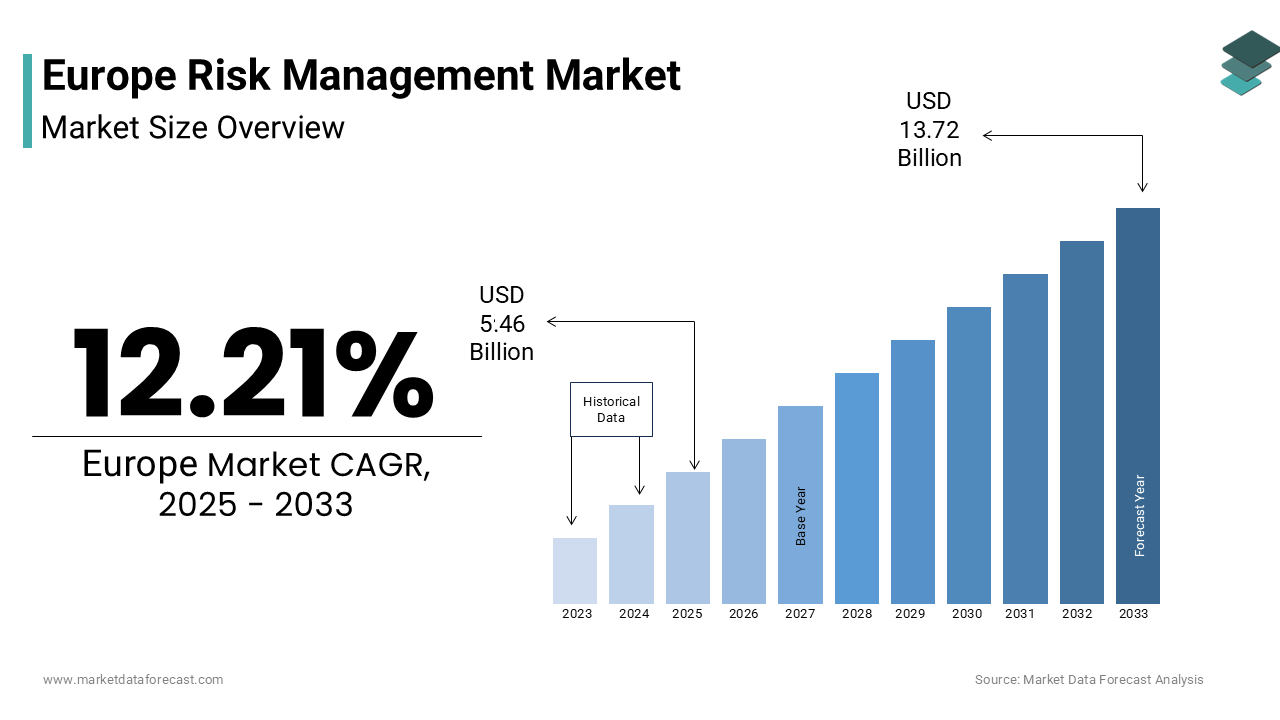
The risk management is an integrated frameworks, software platforms, and advisory services designed to identify, assess, mitigate, and monitor strategic, operational, financial, cyber, and compliance risks across public and private sectors. According to the European Central Bank, over 80% of significant institutions in the Eurozone reported heightened operational risk exposure in 2023 due to cyber threats third party dependencies and climate related disruptions. Regulatory mandates such as the Corporate Sustainability Reporting Directive, Digital Operational Resilience Act, and Network and Information Systems Directive now require structured risk governance with board level accountability.
MARKET DRIVERS
Stringent EU Regulatory Frameworks Mandating Integrated Risk Governance
The proliferation of binding European Union regulations requiring systematic risk identification and disclosure for risk management adoption is propelling the growth of Europe risk management market. The Digital Operational Resilience Act, which took full effect in 2025 compels over 22000 financial entities to implement comprehensive ICT risk management frameworks including threat led penetration testing third party risk monitoring and incident reporting. Similarly, the Corporate Sustainability Reporting Directive mandates that 50000 large and listed companies disclose climate and human rights risk assessments across their value chains with limited assurance by auditors. The European Securities and Markets Authority has also issued guidelines requiring investment firms to integrate ESG risks into client risk profiles. This regulatory web transforms risk management from optional best practice into a legal obligation enforced through financial penalties and market access restrictions driving systematic investment in governance platforms and expert advisory services across sectors.
Escalating Cyber and Third Party Supply Chain Threats
Europe’s deep digital integration and just in time supply chains have amplified exposure to cyber intrusions and supplier failures creating urgent demand for advanced risk management solutions. This factor is another attribute that is prompting the growth of the Europe risk management market. According to the European Union Agency for Cybersecurity, ransomware attacks on European organizations increased by 45% in 2023 with the healthcare and energy sectors most targeted. As per the European Supply Chain Institute, 68% of manufacturers experienced at least one critical supplier disruption in 2023 due to geopolitical events or financial instability. Firms are deploying AI powered third party risk platforms that continuously monitor supplier cyber posture financial health and geopolitical exposure.
MARKET RESTRAINTS
Fragmented National Interpretations of EU Risk Regulations
The inconsistent national implementation of risk management requirements creates compliance complexity and operational inefficiency for multinational organizations, which is restricting the growth of Europe risk management market. According to the European Corporate Governance Institute, member states have adopted over 30 distinct interpretations of the Corporate Sustainability Reporting Directive’s risk disclosure provisions leading to divergent data collection methodologies and assurance expectations. In Germany, the Federal Financial Supervisory Authority mandates detailed climate scenario analysis, while in Italy the focus remains on financial contagion risks. Similarly, under the Digital Operational Resilience Act supervisory authorities in France and Spain require on premises audit logs whereas Nordic regulators accept cloud based attestations.
Limited Integration Between Operational and Strategic Risk Functions
Many European organizations continue to manage operational cyber and strategic risks in organizational silos preventing holistic risk visibility and enterprise level decision making. The limited integration between operational and strategic risk functions are limiting the growth of Euorpe risk management market. According to a 2023 study by the European Risk Management Association, only 38% of large European firms have unified risk taxonomies that connect IT security incidents to financial exposure or reputational impact. Audit committees often receive fragmented reports from separate cyber compliance and treasury functions delaying coordinated response. This disconnect is exacerbated by legacy governance structures where chief risk officers report separately from chief information security officers and chief sustainability officers. Without a common risk language and centralized data architecture organizations cannot model cascading failures or allocate resources efficiently.
MARKET OPPORTUNITIES
Convergence of ESG and Enterprise Risk Management Frameworks
The integration of environmental social and governance risks into core enterprise risk management for holistic resilience and value creation is a significant opportunity for the growth of Europe risk management market. As per the European Insurance and Occupational Pensions Authority, over 90% of insurers now incorporate physical and transition climate risks into their Own Risk and Solvency Assessments. Companies like Allianz and AXA have developed integrated risk platforms that map ESG exposures to financial capital and operational continuity. This convergence enables organizations to move beyond siloed ESG reporting toward dynamic risk informed strategy where sustainability becomes a lens for long term value protection. Vendors offering unified GRC ESG and operational risk modules are well positioned to capture this high value integration wave.
Adoption of Artificial Intelligence for Predictive and Real Time Risk Intelligence
The leveraging artificial intelligence to shift from historical reporting to predictive and adaptive risk governance is creating new opportunities for the growth of Europe risk management market. Machine learning models now analyze satellite imagery news feeds and financial statements to forecast supplier insolvencies geopolitical disruptions or climate hazards weeks in advance. Deutsche Bank’s AI platform monitors 50000 global suppliers in real time flagging financial distress with 89% accuracy as validated by internal audits. Similarly, the European Medicines Agency uses natural language processing to scan adverse event reports for emerging drug safety risks. The Digital Operational Resilience Act encourages such innovation by allowing AI based threat detection as long as explainability and human oversight are maintained.
MARKET CHALLENGES
Shortage of Cross Disciplinary Risk Management Talent
The deficit of professionals, who combine expertise in cybersecurity finance sustainability and regulatory compliance to manage interconnected modern risks, which is a key challenge for the growth of Europe risk management market. According to the European Commission’s Pact for Skills fewer than 12000 certified risk professionals in the EU possess the multidisciplinary competencies required by the Digital Operational Resilience Act and Corporate Sustainability Reporting Directive. A 2024 survey by the European Federation of Accountants found that 67% of chief risk officers report difficulty recruiting staff who can interpret climate scenario models and translate them into capital planning. Universities offer risk management programs but few integrate cyber governance ESG and financial risk into a unified curriculum. This talent gap forces organizations to rely on external consultants increasing costs and reducing ownership.
Data Privacy and Sovereignty Constraints on Risk Analytics Platform
The consolidation of sensitive risk data ranging from employee misconduct records to supplier financials and cyber incident logs into centralized platforms conflicts, which is also degrading the growth of Europe risk management market. According to the European Data Protection Board, over 60% of risk management software vendors store data in non EU jurisdictions triggering General Data Protection Regulation compliance risks. The Digital Operational Resilience Act requires incident data sharing with national authorities yet many firms hesitate due to confidentiality concerns. In 2023 the French Data Protection Authority fined a multinational 2 million euros for transferring third party risk assessments to a US based cloud provider without adequacy safeguards. Additionally, the EU Cyber Resilience Act mandates vulnerability disclosure which could expose proprietary risk methodologies.
REPORT COVERAGE
| REPORT METRIC | DETAILS |
| Market Size Available | 2024 to 2033 |
| Base Year | 2024 |
| Forecast Period | 2025 to 2033 |
| Segments Covered | By Component, Deployment Mode, Enterprise Size, Industry Vertical and Region |
| Various Analyses Covered | Global, Regional, & Country Level Analysis; Segment-Level Analysis; DROC, PESTLE Analysis; Porter’s Five Forces Analysis; Competitive Landscape; Analyst Overview of Investment Opportunities |
| Regions Covered | United Kingdom (UK), France, Spain, Germany, Italy, Russia, Sweden, Denmark, Switzerland, the Netherlands, Turkey, the Czech Republic, and the Rest of Europe. |
| Market Leaders Profiled | MetricStream, SAP SE, Swiss GRC, NAVEX Global, Corporater, SAI Global, GBTEC, Riskonnect, Enablon, Resolver, SafetyCulture, Fusion Risk Management, SAS Institute Inc., BearingPoint, EY, and KPMG. |
SEGMENTAL ANALYSIS
By Component Insights
The services segment was the largest and held a dominant share of the Europe risk management market in 2024 with the complexity of regulatory compliance, the need for human expertise in interpreting systemic risks, and the bespoke nature of enterprise risk frameworks. According to the European Risk Management Association, over 70% of large European firms engage external consultants for gap assessments under the Digital Operational Resilience Act and Corporate Sustainability Reporting Directive due to internal resource constraints. Audit and advisory firms like EY PwC and KPMG have expanded their risk practices by 25% annually since 2021 to meet demand.
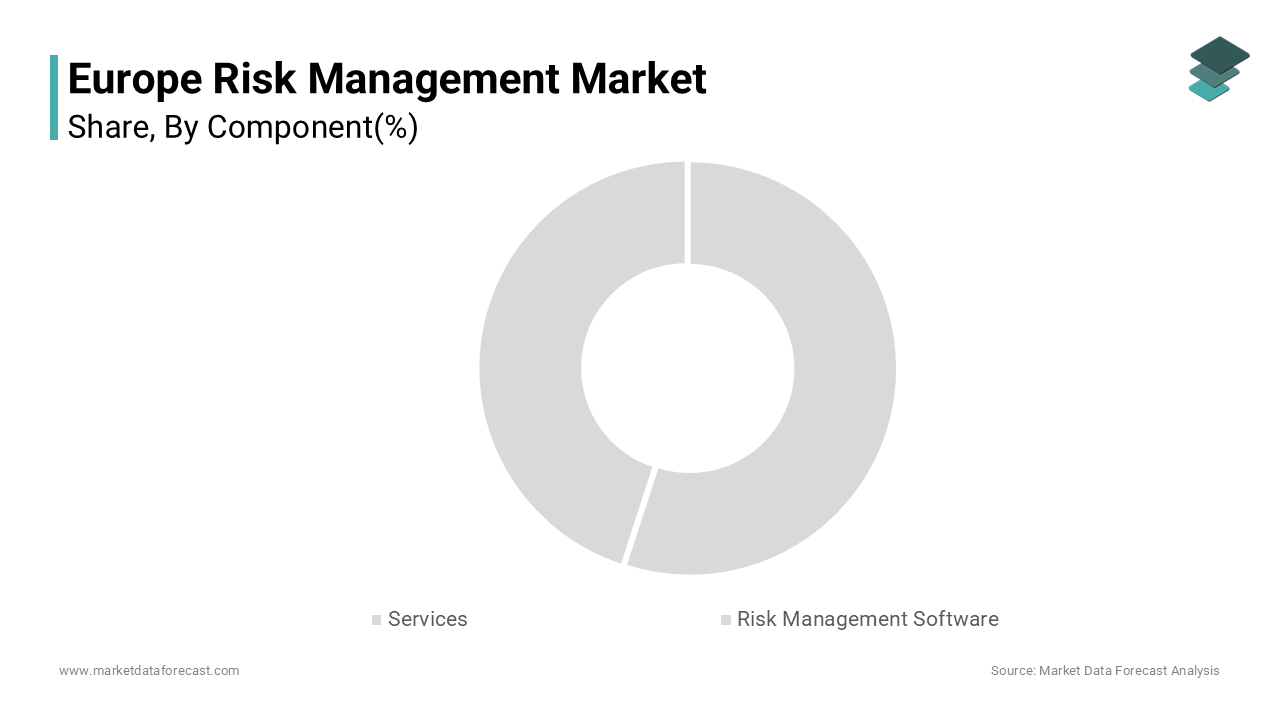
The risk management software segment is lucratively growing with an anticipated CAGR of 18.9% throughout the forecast period with the need for real time monitoring, integrated data aggregation, and audit ready reporting under escalating regulatory demands. Vendors like ServiceNow MetricStream and SAI Global now offer pre-configured modules aligned with European Sustainability Reporting Standards and NIS2 requirements enabling automated control testing and board level dashboards.
By Deployment Mode Insights
The cloud-based deployment segment held a prominent share of the Europe risk management market share in 2024 due to its scalability, automatic regulatory updates, and alignment with Europe’s data sovereignty initiatives. The Digital Operational Resilience Act encourages cloud solutions that offer real time threat intelligence and centralized logging across geographically dispersed operations. According to the European Data Protection Board, over 85% of new risk management software contracts in 2023 specified EU hosted cloud infrastructure to comply with General Data Protection Regulation restrictions on cross border data transfers. Leading vendors operate data centers exclusively in Frankfurt Dublin and Amsterdam ensuring data residency. The European Commission’s GAIA-X initiative further certifies cloud providers meeting European standards for interoperability and security.
The on-premises risk management software segment is likely to grow with an expected CAGR of 11.3% throughout the forecast period with heightened data sensitivity in highly regulated sectors. According to the European Banking Authority, over 60% of systemically important banks require on premises deployment for core risk modules to meet operational resilience guidelines under the Digital Operational Resilience Act. Similarly, national energy utilities in France and defense contractors in Germany host risk platforms internally to protect critical infrastructure data classified under the NIS2 Directive. Vendors like SAP and IBM now offer hybrid risk suites that combine on premises core systems with secure cloud extensions for reporting.
By Enterprise Size Insights
The large enterprises segment was the largest and held a significant share of the Europe risk management market in 2024 due to their direct exposure to stringent regulatory mandates and complex operational footprints. The Digital Operational Resilience Act applies to over 22000 significant financial entities while the Corporate Sustainability Reporting Directive covers approximately 50000 large and listed companies. Multinationals like Siemens TotalEnergies and Unilever manage thousands of suppliers across jurisdictions requiring AI driven monitoring platforms. The European Commission’s Public Procurement Directive also mandates risk based due diligence for contracts above 5 million euros further driving adoption. Large firms possess the budgets internal compliance teams and board level risk committees to justify comprehensive investments.
The small and medium sized enterprises segment is estimated to grow with an estimated CAGR of 21.4% throughout the forecast period with the phased extension of the Corporate Sustainability Reporting Directive to listed SMEs starting in 2026 and the cascading risk requirements from large corporate supply chains. Additionally, 78% of European manufacturers report that their large customers now mandate third party risk assessments as a condition of contract renewal as per the European Supply Chain Institute. Vendors like Resolver and LogicManager have launched tiered offerings with pre-configured templates audit trails and regulatory guidance accessible via monthly subscriptions. The European Investment Fund has allocated 180 million euros to support digital risk tools for SMEs through its InnovFin program.
By Industry Vertical Insights
The BFSI sector was the largest by holding 32.4% of the Europe risk management market share in 2024 due to its early and rigorous exposure to financial cybersecurity and operational resilience regulations. The Digital Operational Resilience Act directly regulates over 22000 financial entities requiring comprehensive ICT risk frameworks incident reporting and third-party oversight. According to the European Banking Authority, non-compliance carries fines of up to 10% of annual turnover creating strong enforcement pressure. The European Central Bank’s stress tests now include climate risk and cyber resilience scenarios compelling banks to integrate ESG and cyber risk into capital planning. Insurance firms are similarly bound by the Solvency II delegated acts mandating Own Risk and Solvency Assessments updated annually. This dense regulatory ecosystem combined with high financial stakes ensures BFSI remains the most advanced and intensive adopter of risk management solutions in Europe.
The healthcare vertical segment is likely to grow with an estimated CAGR of 23.6% throughout the forecast period from heightened cyber threats patient safety mandates and new EU regulations on medical device cybersecurity. According to the European Union Agency for Cybersecurity, ransomware attacks on European hospitals increased by 62% in 2023 with the average breach costing 4.8 million euros as reported by the European Health Management Association. The Medical Devices Regulation now requires manufacturers to implement post market surveillance systems that continuously monitor device safety and cybersecurity vulnerabilities. Additionally, the Network and Information Systems Directive 2 designates major hospitals as essential entities mandating risk-based security measures and incident reporting. In Germany and France, national health authorities have launched mandatory risk assessment frameworks for digital health records and telemedicine platforms.
REGIONAL ANALYSIS
Germany Risk Management Market Analysis
Germany was the top performer of the Europe risk management market by holding 24.3% of share in 2024 with its industrial complexity stringent regulatory enforcement and leadership in financial supervision. The German Federal Financial Supervisory Authority implements some of Europe’s strictest risk governance rules requiring banks to conduct bi-annual cyber stress tests and maintain detailed third party risk registers. As per the German Federal Ministry of Economic Affairs, over 15000 large companies fall under the Corporate Sustainability Reporting Directive with additional national requirements under the Supply Chain Due Diligence Act mandating human rights and environmental risk assessments across global operations. The country’s Mittelstand sector comprising over 350000 small and medium enterprises is rapidly adopting risk platforms to maintain eligibility in corporate supply chains like those of Siemens and BMW. Domestic vendors like GRC Solutions and RiskMethods offer German language platforms with pre configured compliance rules.
The United Kingdom Risk Management Market Analysis
The United Kingdom risk management market growth is likely to be driven by the post Brexit regulatory autonomy mature financial markets and proactive cyber resilience frameworks. As per the Financial Conduct Authority, over 1400 premium listed companies must now integrate climate and cyber risks into their viability statements with board level sign off. London’s financial ecosystem managing over 9 trillion pounds in assets demands granular risk data from portfolio companies with firms like Legal and General linking executive compensation to risk culture metrics. UK headquartered vendors like SAI Global and Resolver have gained global traction by offering multilingual platforms that reconcile EU UK and global standards.
France Risk Management Market Analysis
France risk management market growth is likely to grow with its centralized regulatory approach national security imperatives and state led industrial oversight. The French Prudential Supervision and Resolution Authority mandates that all systemically important banks implement advanced operational risk frameworks with real time monitoring of critical third parties. The National Agency for the Security of Information Systems enforces strict cyber risk rules for energy transport and defense sectors under the Military Programming Law. Paris based risk consultancies like Mazars and Kea Partners have developed sector specific methodologies for aerospace nuclear and luxury goods supply chains. Additionally, France’s Green Tech Fund provides grants covering up to 50% of risk software costs for SMEs in strategic sectors.
COMPETITIVE LANDSCAPE
Competition in the Europe risk management market is defined by a dynamic interplay between global enterprise software giants specialized GRC vendors and professional services firms each targeting distinct layers of the compliance and resilience value chain. SAP and ServiceNow dominate through ERP and workflow integration while MetricStream and OneTrust focus on deep domain capabilities in third party and ESG risk. Meanwhile the Big Four audit firms leverage advisory relationships to embed their proprietary risk tools within client governance structures. The market is highly fragmented with over 150 vendors but consolidation is accelerating as regulatory complexity favors scalable integrated solutions. Differentiation hinges on regulatory precision data automation and board level reporting rather than generic risk features. National preferences also shape competition with German and French firms favoring local language support and domestic compliance logic. As enforcement of the Digital Operational Resilience Act and Corporate Sustainability Reporting Directive intensifies the market rewards vendors who combine technical compliance with operational utility enabling organizations not just to report but to act on risk intelligence.
KEY MARKET PLAYERS
Some of the companies that are playing a dominating role in the europe risk management market include
- MetricStream
- SAP SE
- Swiss GRC
- NAVEX Global
- Corporater
- SAI Global
- GBTEC
- Riskonnect
- Enablon
- Resolver
- SafetyCulture
- Fusion Risk Management
- SAS Institute Inc.
- BearingPoint
- EY
- KPMG
Top Players in the Market
SAP S
SAP SE is a foundational force in the Europe risk management market through its integrated GRC and enterprise risk management solutions embedded within its core ERP and cloud platforms. The company enables organizations to unify financial operational cyber and compliance risks within a single data architecture ensuring real time visibility and audit readiness. It also launched a dedicated risk data exchange for supply chains enabling continuous monitoring of supplier cyber and ESG performance. These innovations reinforce SAP’s global leadership in enterprise risk governance while addressing Europe’s unique regulatory and data sovereignty requirements.
ServiceNow Inc
ServiceNow Inc significantly shapes the Europe risk management market via its cloud based Integrated Risk Management platform that connects IT security compliance and enterprise risk workflows through a unified workflow engine. The company focuses on automating risk assessments incident response and control testing for highly regulated sectors including finance healthcare and energy. It also expanded its European data centers in France and the Netherlands to ensure full General Data Protection Regulation compliance.
MetricStream Inc
MetricStream Inc plays a pivotal role in the Europe risk management market by offering specialized governance risk and compliance solutions with deep capabilities in third party risk ESG risk and regulatory compliance. The company serves global financial institutions industrial firms and public sector entities requiring auditable risk frameworks across jurisdictions. It also partnered with European audit firms to develop assurance templates compliant with the European Financial Reporting Advisory Group’s sustainability standards. These initiatives position MetricStream as a trusted enabler of proactive resilient and board level risk governance for European enterprises facing escalating systemic threats.
Top Strategies Used by the Key Market Participants
Key players in the Europe risk management market prioritize regulatory pre configuration by embedding Digital Operational Resilience Act NIS2 and Corporate Sustainability Reporting Directive requirements directly into their platforms to ensure automatic compliance. They invest in EU based cloud infrastructure to guarantee data residency and General Data Protection Regulation alignment. Companies pursue deep integration with enterprise resource planning and third party ecosystems to automate risk data collection and eliminate manual entry. Strategic partnerships with audit firms regulators and industry associations enhance credibility and accelerate adoption. Additionally, they offer modular scalable solutions tailored for both large enterprises and listed small and medium enterprises to capture the full spectrum of mandated entities. These strategies collectively address Europe’s unique blend of legal stringency data privacy and operational complexity.
MARKET SEGMENTATION
The research report on the Europe Risk Management Market has been segmented and sub-segmented based on categories.
By Component
- Services
- Risk Management Software
By Deployment Mode
- Cloud-based
- On-premises
By Enterprise Size
- Large Enterprises
- Small and Medium-sized Enterprises (SMEs)
By Industry Vertical
- BFSI
- Healthcare
By Country
-
UK
-
France
-
Spain
-
Germany
-
Italy
-
Russia
-
Sweden
-
Denmark
-
Switzerland
-
Netherlands
-
Turkey
-
Czech Republic
-
Rest of Europe