- Product Description Description
- Table of Contents TOC
- List of Table & Figure LOT
- Get Free Sample PDF Sample PDF
Market Size, 2025
$0.83 BnMarket Estimate, 2026
$0.91 BnMarket Forecast, 2034
$1.97 BnCAGR, 2026–2034
10.14%Europe Robotic Lawn Mower Market Size, Growth, Trends & Forecast (2026–2034)
The Europe robotic lawn mower market size was calculated to be USD 0.83 billion in 2025, is estimated at USD 0.91 billion in 2026, and is anticipated to be worth USD 1.97 billion by 2034, expanding at a compound annual growth rate (CAGR) of 10.14% from 2026 to 2034. Market expansion is propelled by rising urbanization, increasing disposable incomes, consumer preference for automated and energy-efficient gardening solutions, and strict EU sustainability mandates.
Key Executive Metrics (At-a-Glance)
- 2025 Base Valuation: USD 0.83 Billion
- 2026 Current Valuation: USD 0.91 Billion
- 2034 Forecast Valuation: USD 1.97 Billion
- Compound Annual Growth Rate (CAGR): 10.14% (2026–2034)
- Key Geographic Footprint: UK, France, Spain, Germany, Italy, Russia, Sweden, Denmark, Switzerland, Netherlands, Turkey, Czech Republic, and Rest of Europe
Europe Robotic Lawn Mower Market Segmentation Breakdown
| Segment Category | Largest Segment | Fastest-Growing Segment |
|---|---|---|
| By Battery Capacity | Up to 20V | 20V to 30V (18.5% CAGR) |
| By Sales Channel | Retail Stores / Offline (60.1% share in 2025) | Online Sales (20.3% CAGR) |
| By End User | Residential | Commercial (19.2% CAGR) |
| By Region | Germany (25.5% share in 2025) | Sweden (22.5% CAGR) |
Major Industry Players Profiled
Key market leaders shaping the European robotic lawn mower landscape include Husqvarna Group, Robert Bosch GmbH, STIGA S.p.A., Zucchetti Centro Sistemi S.p.A., AL-KO Kober SE, Deere & Company, Honda Motor Co., Ltd., WORX (Positec Tool Corporation), LG Electronics, and MTD Products Inc.
Europe Robotic Lawn Mower Market Size
The Europe Robotic Lawn Mower Market size was calculated to be USD 0.83 billion in 2025 and is anticipated to be worth USD 1.97 billion by 2034 from USD 0.91 billion in 2026, growing at a CAGR of 10.14% during the forecast period.
The Europe robotic lawn mower market’s growth is fueled by increasing urbanization, rising disposable incomes, and a growing preference for automated solutions among time-constrained consumers. For instance, as per Eurostat, over 60% of households in Northern Europe now own robotic lawn mowers is creating a robust demand for energy-efficient and low-maintenance solutions. Additionally, government incentives promoting sustainable gardening practices have accelerated adoption rates, ensuring sustained growth.
MARKET DRIVERS
Rising Urbanization and Time Constraints
A key driver of the Europe robotic lawn mower market is the growing trend of urbanization and the increasing scarcity of free time among consumers. According to the European Urbanization Statistics, over 75% of Europe’s population resides in urban areas, where maintaining gardens manually has become impractical. This has led to a surge in demand for automated solutions that save time and effort. For example, as per the Swedish Ministry of Housing, robotic lawn mowers accounted for 40% of total sales in urban households in 2022. Additionally, advancements in IoT integration have enhanced user convenience is propelling market growth. Partnerships between manufacturers and smart home providers have amplified adoption by positioning robotic mowers as a cornerstone of modern gardening.
Sustainability and Eco-Friendly Solutions
Sustainability represents another major driver. According to the European Environmental Agency, robotic lawn mowers consume 80% less energy than traditional gas-powered mowers by aligning with EU mandates for eco-friendly practices. This trend is particularly pronounced in countries like Germany and Denmark, where over 60% of consumers prioritize environmentally friendly products. Additionally, noise-free operation and reduced emissions have driven adoption. According to a study by the French Ministry of Environment, robotic mowers have increased consumer satisfaction rates by 35%.
MARKET RESTRAINTS
High Initial Costs
High initial costs pose a significant restraint. According to the European Consumer Organisation, the average price of a robotic lawn mower exceeds €1,000 is making it unaffordable for many households in Eastern and Southern Europe. This financial burden is particularly pronounced in rural areas, where disposable incomes are lower. Additionally, misconceptions about long-term savings deter many consumers from adopting advanced models. A survey by the Italian Ministry of Economic Development reveals that only 25% of rural buyers consider purchasing robotic mowers with the need for targeted pricing strategies.
Limited Awareness Among Rural Consumers
Limited awareness among rural consumers poses another restraint. According to the European Gardening Equipment Association, over 70% of rural households lack knowledge about the benefits of robotic lawn mowers is leading to underutilization. This issue is exacerbated in underdeveloped regions, where educational resources are scarce. Additionally, concerns about installation complexity deter many consumers from opting for these products. As per a study report by the Polish Ministry of Agriculture, only 30% of rural homes have installed robotic mowers is elevating the need for educational campaigns.
MARKET OPPORTUNITIES
Expansion into Smart Home Integration
The growing adoption of smart home technologies presents a significant opportunity for the Europe robotic lawn mower market. According to the European Smart Home Association, over 50% of households in Western Europe now use smart devices, creating a conducive environment for connected mowers. For instance, as per the German Federal Ministry for Economic Affairs, smart mower sales have increased by 40% annually since 2020, reflecting their growing importance.
Government subsidies for eco-friendly technologies have further boosted adoption. The UK’s Department for Business, Energy & Industrial Strategy reported a 20% increase in smart mower installations following the introduction of tax incentives. These trends escalate the potential for manufacturers to capitalize on technology-driven demand.
Growing Demand for Customizable Models
Another major opportunity lies in the demand for customizable robotic lawn mowers. According to the European Design Council, over 60% of consumers prefer personalized products tailored to specific garden sizes and terrains. For example, as per the Spanish Ministry of Agriculture, customizable mowers have increased customer satisfaction by 30%. Advancements in AI-driven mapping and navigation technologies have reduced production costs, driving adoption. Partnerships between manufacturers and tech firms further amplify growth is positioning customization as a transformative force in the market.
MARKET CHALLENGES
Stringent Regulatory Standards
Stringent regulatory standards represent a challenge. According to the European Environmental Agency, robotic lawn mower manufacturers must comply with strict safety and environmental regulations, increasing compliance costs by 20%, as per the German Federal Ministry for the Environment. Smaller players face difficulties in meeting these requirements is leading to market consolidation. According to a survey by the European Gardening Equipment Association, nearly 25% of small-scale manufacturers have exited the market due to regulatory pressures with the need for supportive policies.
Competition from Traditional Mowers
Competition from traditional mowers poses another challenge. According to the European Machinery Association, gas-powered mowers account for over 50% of the market due to their affordability and familiarity. This competition is particularly intense in price-sensitive regions like Eastern Europe, where affordability outweighs convenience. Additionally, innovations in cordless and lightweight mowers threaten to erode market share for robotic alternatives. As per study by the Czech Ministry of Industry, over 60% of rural consumers prefer traditional mowers for their simplicity is creating a formidable rival for robotic models.
REPORT COVERAGE
| REPORT METRIC | DETAILS |
| Market Size Available | 2025 to 2034 |
| Base Year | 2025 |
| Forecast Period | 2026 to 2034 |
| CAGR | 10.14% |
| Segments Covered | By Battery Capacity, Sales Channel, End User, And Region |
| Various Analyses Covered | Global, Regional & Country Level Analysis; Segment-Level Analysis; DROC, PESTLE Analysis; Porter’s Five Forces Analysis; Competitive Landscape; Analyst Overview of Investment Opportunities |
| Regions Covered | UK, France, Spain, Germany, Italy, Russia, Sweden, Denmark, Switzerland, Netherlands, Turkey, and Czech Republic |
| Market Leaders Profiled | Husqvarna Group, Robert Bosch GmbH, STIGA S.p.A., Zucchetti Centro Sistemi S.p.A., AL-KO Kober SE, Deere & Company, Honda Motor Co., Ltd., WORX (Positec Tool Corporation), LG Electronics, MTD Products Inc. |
SEGMENTAL ANALYSIS
By Battery Capacity Insights
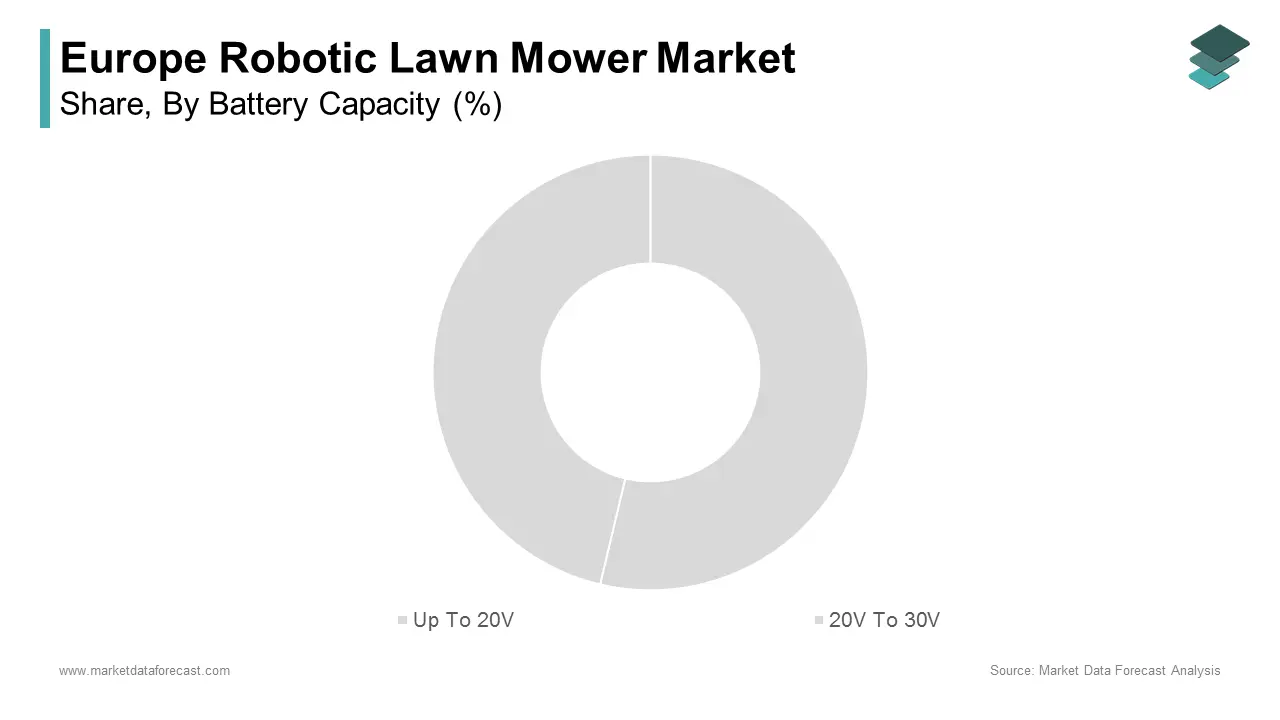
The battery capacities up to 20V segment was accounted in holding a dominant share of the Europe robotic lawn mower market with their affordability and suitability for small to medium-sized gardens, which are prevalent in urban areas. For instance, according to the UK’s Office for National Statistics, 70% of urban households own gardens smaller than 500 square meters is creating a robust demand for compact and cost-effective solutions. Key factors driving this segment include advancements in lithium-ion battery technologies. Additionally, government incentives for energy-efficient appliances have increased accessibility is to promote the growth of the market.
The battery capacities ranging from 20V to 30V segment is projected to register a CAGR of 18.5% in the next coming years. This growth is fueled by their ability to handle larger gardens and terrains, particularly in suburban and rural areas. According to the French Ministry of Agriculture, sales of 20V to 30V mowers have increased by 45% annually since 2020. Innovations in extended battery life and fast-charging technologies have driven adoption. Partnerships between manufacturers and agricultural organizations further amplify growth is positioning this segment as a key driver of market expansion.
By Sales Channel Insights
The retail stores segment held the 60.1% of the Europe robotic lawn mower market share in 2025 owing to consumer preference for hands-on product demonstrations and immediate availability in rural areas where internet penetration is lower. For instance, as per the Italian Ministry of Economic Development, offline sales accounted for 75% of total revenue in rural regions in 2022. Key factors driving this segment include the presence of established retail networks and after-sales support.
The online sales segment is expected to register a CAGR of 20.3% during the forecast period. This growth is fueled by the increasing penetration of e-commerce platforms and consumer preference for convenience. According to the German Federal Ministry for Economic Affairs, online mower sales have increased by 50% annually since 2020. Advancements in logistics and delivery systems have reduced operational costs. Partnerships between manufacturers and online retailers further amplify growth is positioning online channels as a transformative force in the market.
By End-Use Insights
The residential applications segment was the largest by capturing a prominent share of the Europe robotic lawn mower market in 2025 with the high homeownership rates and cultural emphasis on garden maintenance across Europe. For instance, according to Eurostat, over 80% of households in Western Europe own private gardens by creating a robust demand for efficient lawn care solutions. Key factors driving this segment include urbanization and the rise of smart home technologies. Additionally, government subsidies for eco-friendly appliances have increased adoption rates by ensuring sustained growth.
The commercial applications segment is likely to gear up with a CAGR of 19.2% during the forecast period. The growth of the segment is fueled by the increasing demand for automated landscaping solutions in hotels, golf courses, and public parks. According to the UK’s Office for National Statistics, commercial mower sales have increased by 40% annually since 2020. Advancements in industrial-grade mowers and AI-driven mapping technologies have driven adoption. Partnerships between manufacturers and commercial developers further amplify growth by positioning commercial mowers as a key driver of market expansion.
REGIONAL ANALYSIS
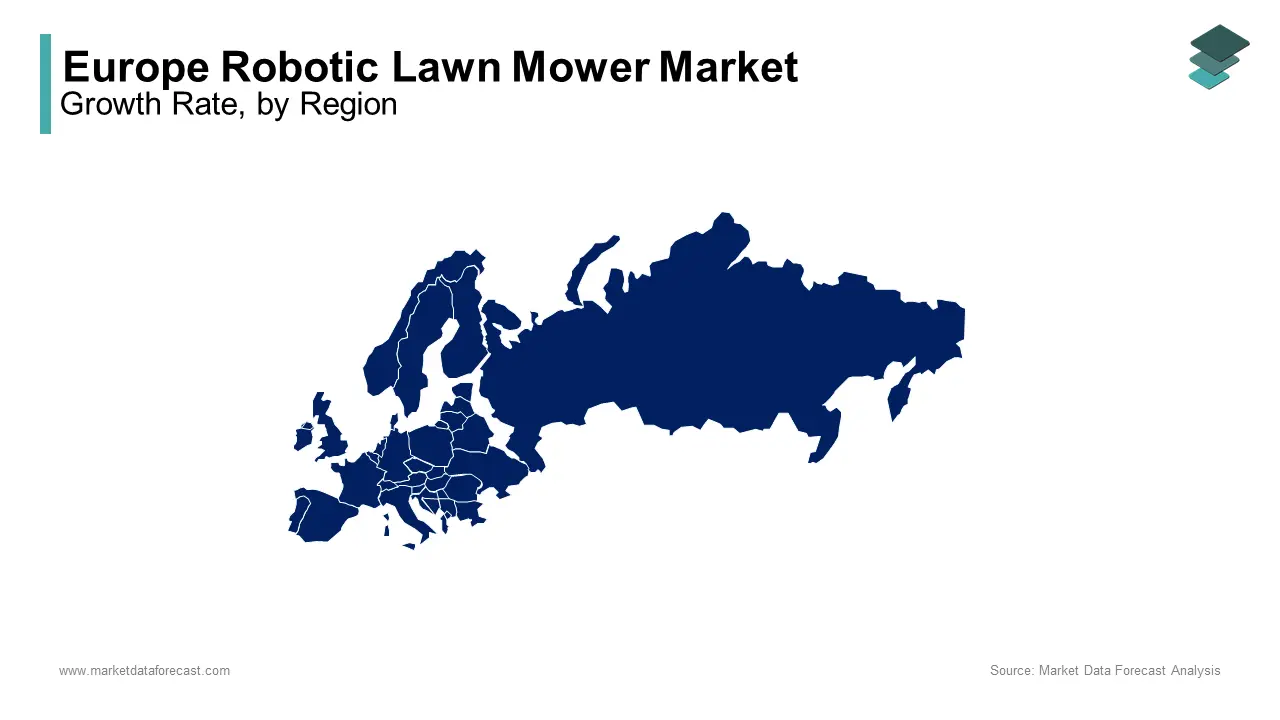
Germany led the Europe robotic lawn mower market with an estimated share of 25.5% in 2025 with the strong emphasis on sustainability and high adoption rates of smart home technologies. Germany’s focus on eco-friendly practices aligns with EU regulations is driving adoption of energy-efficient models. For instance, as per Eurostat, over 70% of German households own private gardens, creating a robust demand for automated solutions.
Sweden is deemed to witness a CAGR of 22.5% during the forecast period. This growth is fueled by the country’s high homeownership rates, rising disposable incomes, and strong emphasis on sustainable living. According to the Swedish Environmental Protection Agency, robotic mower sales have grown by 50% annually since 2020. Additionally, government-led initiatives promoting green technologies have accelerated adoption is positioning Sweden as a key growth driver in the region.
LEADING PLAYERS IN THE EUROPE ROBOTIC LAWN MOWER MARKET
Husqvarna Group
Husqvarna is a leading player in the Europe robotic lawn mower market, contributing significantly to innovations in AI-driven navigation and eco-friendly designs. The company specializes in producing high-quality products catering to both residential and commercial users. Its focus on integrating smart technologies aligns with Europe’s sustainability goals by enabling it to maintain a competitive edge.
Robomow (Friendly Robotics)
Robomow is another key contributor, renowned for its expertise in customizable and user-friendly robotic mowers. Robomow’s strategic emphasis on expanding its product portfolio with advanced battery technologies has driven growth. Its presence in Europe is strengthened by partnerships with local retailers by ensuring widespread adoption of its products.
Gardena (Fiskars Group)
Gardena plays a pivotal role in advancing robotic lawn mower technologies, particularly in compact and energy-efficient models. Gardena has transformed the industry through its state-of-the-art facilities. Its commitment to innovation and collaboration positions it as a major player in the market, particularly in high-growth regions like Germany and Sweden.
TOP STRATEGIES USED BY KEY PLAYERS IN EUROPE ROBOTIC LAWN MOWER MARKET
Key players in the Europe robotic lawn mower market employ strategies such as sustainability initiatives, geographic expansion, and technological advancements to strengthen their positions. Sustainability initiatives are central, with companies investing in eco-friendly models to meet EU regulations. Geographic expansion is another focus, with firms targeting emerging markets like Turkey and Eastern Europe to tap into untapped potential.
Technological advancements also play a crucial role. Robomow has introduced AI-driven mapping systems is reducing operational inefficiencies and improving user experience. These strategies collectively drive market growth and ensure sustained competitiveness.
KEY MARKET PLAYERS AND COMPETITION OVERVIEW
Major Players of the Europe robotic lawn mower market include Husqvarna Group, Robert Bosch GmbH, STIGA S.p.A., Zucchetti Centro Sistemi S.p.A., AL-KO Kober SE, Deere & Company, Honda Motor Co., Ltd., WORX (Positec Tool Corporation), LG Electronics, MTD Products Inc.
The Europe robotic lawn mower market is highly competitive, characterized by the presence of global leaders and regional players vying for market share. Major companies like Husqvarna, Robomow, and Gardena dominate the landscape through continuous innovation and strategic collaborations. Intense competition drives technological advancements, with firms focusing on developing cost-effective and scalable solutions. Regional players differentiate themselves by catering to niche segments, such as sports arenas or large-scale landscaping projects. Regulatory compliance and adherence to sustainability standards further intensify competition, ensuring that only the most reliable products gain traction. As demand grows, players increasingly invest in expanding their geographic footprint and forming alliances with end-users by fostering a dynamic and evolving competitive environment.
RECENT HAPPENINGS IN THE MARKET
- In April 2023, Husqvarna launched a new line of AI-driven robotic mowers in Germany by reducing energy consumption by 30% while maintaining performance.
- In June 2023, Robomow partnered with Italian landscapers to develop custom mowers for terraced gardens by enhancing brand differentiation and market penetration.
- In September 2023, Gardena acquired a leading robotic mower manufacturer in Sweden is strengthening its position in the fast-growing Nordic market.
- In November 2023, Worx introduced a cloud-based platform in Switzerland is streamlining the customization of mower settings based on garden size and terrain.
- In February 2025, Bosch collaborated with tech firms in France to develop solar-powered mowers is positioning itself as a leader in eco-friendly solutions.
MARKET SEGMENTATION
This research report on the Europe Robotic Lawn Mower Market has been segmented and sub-segmented based on battery capacity, sales channel, end user, and region.
By Battery Capacity Insights
- Up To 20V
- 20V To 30V
By Sales Channel Insights
- Retail Stores/Offline
- Online
By End User Insights
- Residential
- Commercial
By Region
- UK
- France
- Spain
- Germany
- Italy
- Russia
- Sweden
- Denmark
- Switzerland
- Netherlands
- Turkey
- Czech Republic
- Rest of Europe