Europe Rubber Market Size, Share, Trends, & Growth Forecast Report By Type (Natural, Synthetic), Application, and Country (UK, France, Spain, Germany, Italy, Russia, Sweden, Denmark, Switzerland, Netherlands, Turkey, Czech Republic and Rest of Europe), Industry Analysis From 2025 to 2033
Europe Rubber Market Report Summary
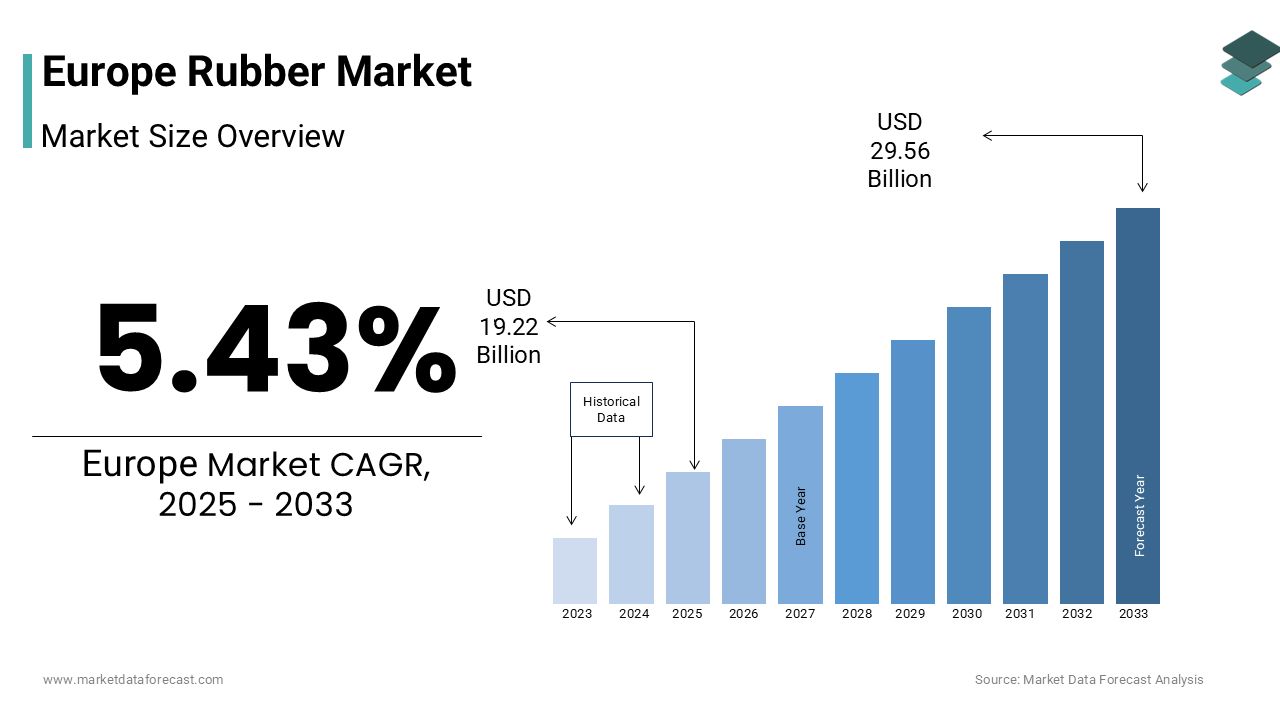
The European rubber market was valued at USD 16.05 billion in 2024, is estimated to reach USD 19.22 billion in 2025, and is projected to reach USD 29.56 billion by 2033, growing at a CAGR of 5.43% during the forecast period. The growth of the European rubber market is driven by the rising demand from the automotive industry, expanding applications in industrial goods, and the increasing adoption of synthetic rubber for performance-critical applications. Furthermore, advancements in material science, growth in tire manufacturing, and the rising focus on sustainability and recycling are key trends shaping the market.
Key Market Trends
- Increasing adoption of synthetic rubber due to superior durability, flexibility, and temperature resistance.
- Rising demand for eco-friendly and bio-based rubber materials driven by sustainability initiatives across Europe.
- Growing investment in rubber recycling technologies to promote a circular economy.
- Expansion of automotive production and replacement tire demand, supporting steady consumption growth.
- Adoption of high-performance rubber compounds in electric vehicles, aerospace, and industrial manufacturing.
Segmental Insights
- Based on type, the synthetic rubber segment accounted for a significant share of the Europe rubber market in 2024. Its dominance stems from its widespread use in tire manufacturing, industrial seals, hoses, and conveyor belts, offering consistent quality and performance compared to natural rubber. The demand for synthetic variants like styrene-butadiene rubber (SBR) and butadiene rubber (BR) continues to rise with increasing automotive production.
- Based on application, the tire segment was dominant in the Europe rubber market in 2024. The segment’s growth is supported by rising passenger car sales, commercial vehicle production, and tire replacement needs. Moreover, the region’s focus on high-performance, durable, and fuel-efficient tires has strengthened rubber demand among leading tire manufacturers.
Regional Insights
The Europe rubber market exhibits strong regional dynamics supported by a well-established automotive base and industrial infrastructure.
- Germany was the largest contributor to the Europe rubber market, holding 24.2% share in 2024, driven by its dominant automotive manufacturing sector, robust tire production facilities, and technological advancements in material engineering.
- France and Italy are witnessing steady growth due to increasing demand for rubber components in automotive, footwear, and industrial applications.
- The United Kingdom continues to see moderate expansion with growth in tire replacement and aftermarket demand.
- Eastern Europe, led by Poland and the Czech Republic, is emerging as a fast-growing market due to expanding automotive assembly plants and foreign investments in rubber processing facilities.
Competitive Landscape
The European rubber market is moderately consolidated, with major players focusing on product innovation, sustainable sourcing, and advanced rubber formulations to meet the demands of diverse end-use industries. Companies are also investing in rubber recycling technologies and green tire production to align with environmental regulations. Major companies operating in the Europe rubber market include Michelin, LANXESS AG, Trinseo S.A., Synthos S.A., Goodyear Tire & Rubber Company, Bridgestone Corporation, Versalis S.p.A., Hexpol AB, and Zeon Corporation.
Europe Rubber Market Size
The europe rubber market size was valued at USD 16.05 billion in 2024 and is anticipated to reach USD 19.22 billion in 2025 from USD 29.56 billion by 2033, growing at a CAGR of 5.43% during the forecast period from 2025 to 2033.
The rubber in this context serves as a elastomeric material valued for its resilience tensile strength and vibration damping properties. The region imports nearly all of its natural rubber, which is primarily from Southeast Asia. Meanwhile synthetic rubber production is concentrated in Germany France and Italy leveraging petrochemical feedstocks from integrated refineries. The European Chemicals Agency enforces rigorous restrictions on polycyclic aromatic hydrocarbons and nitrosamines in rubber articles under REACH regulation which shapes formulation standards across the value chain.
MARKET DRIVERS
Expansion of Electric Vehicle Production Drives Specialty Rubber Demand
The rapid scaling of electric vehicle manufacturing across Europe has intensified demand for high performance synthetic rubber compounds engineered for unique EV requirements, which is driving the growth of Europe rubber market. Germany alone hosts 14 EV assembly plants which consumed over 180000 metric tons of ethylene propylene diene monomer rubber in 2024 according to the German Rubber Society.
Growth in Renewable Energy Infrastructure Requires Weather Resistant Elastomers
The Europe’s accelerated deployment of wind and solar power infrastructure has created sustained demand for weather resistant rubber used in seals gaskets and cable insulation, which is additionally fuelling the growth of Europe rubber market. Offshore wind turbines alone utilize more than 200 kilograms of specialized rubber per unit for nacelle seals tower joints and subsea cable protection as stated by the European Wind Energy Association.
MARKET RESTRAINTS
Stringent REACH Regulations Limit Use of Conventional Rubber Additives
The European Union’s Registration Evaluation Authorisation and Restriction of Chemicals framework imposes severe restrictions on substances commonly used in rubber compounding including certain phthalates aromatic oils and accelerators like MBT. Small and medium-sized compounders face disproportionate challenges as they lack resources for extensive toxicological testing required for substance registration.
Dependence on Imported Natural Rubber Creates Supply Vulnerability
Europe’s complete reliance on imported natural rubber by sourcing over 99% from Thailand Indonesia and Vietnam is hindering the growth of Europe rubber market. Additionally climate change intensifies disease pressure on Hevea trees with South American Leaf Blight threatening to spread from Latin America to Southeast Asia potentially disrupting 30% of global supply as warned by the Food and Agriculture Organization. Europe’s lack of domestic cultivation or strategic stockpiles leaves manufacturers vulnerable to price volatility which surged by 41 % in 2022 during pandemic induced logistics bottlenecks.
MARKET OPPORTUNITIES
Development of Bio Based Synthetic Rubber Reduces Fossil Dependency
The emergence of bio based synthetic rubber derived from renewable feedstocks to decouple Europe’s rubber supply from fossil resources is attributed to fuel the growth of Europe rubber market in coming years. Companies like Arlanxeo and Versalis have commercialized solution styrene butadiene rubber using bio butadiene sourced from sugarcane ethanol. Tire manufacturers including Michelin and Continental have integrated these materials into premium EV tires meeting EU Ecolabel criteria.
Circular Economy Initiatives Enable High Quality Rubber Recycling
Europe’s push toward a circular economy is unlocking advanced recycling technologies that transform end of life rubber, particularly tires into high value secondary raw materials, which is augmented to escalate the growth of Europe rubber market. Similarly, Germany’s Federal Ministry for Economic Affairs funded the ReRubber project which uses supercritical CO2 to break sulfur crosslinks enabling infinite recyclability without downcycling. These innovations allow recycled rubber to re enter high performance applications such as automotive seals and railway pads rather than being limited to playground surfaces or asphalt.
MARKET CHALLENGES
Labor Shortages in Specialized Rubber Compounding Impede Innovation
A critical shortage of skilled technicians and chemists in rubber compounding and testing is constraining product development and quality control across European manufacturing. The European Rubber Society estimates a deficit of over 4500 trained rubber technologists by 2027 due to aging workforce and declining vocational enrollment. This gap is particularly acute in formulation laboratories where expertise in polymer rheology filler dispersion and cure kinetics is essential for developing EV and aerospace grade compounds.
Energy Intensity of Rubber Processing Increases Operational Costs
The rubber manufacturing process like mixing extrusion and vulcanization is highly energy intensive requiring sustained temperatures between 140 and 180 degrees Celsius. Many plants lack capital to retrofit electric heating systems or integrate waste heat recovery due to thin margins. Consequently, several facilities in Italy and Poland reduced operating hours or shifted production to lower energy jurisdictions. This energy vulnerability not only erodes competitiveness but also complicates compliance with the EU Industrial Emissions Directive which mandates continuous emission monitoring and efficiency upgrades.
REPORT COVERAGE
| REPORT METRIC | DETAILS |
| Market Size Available | 2024 to 2033 |
| Base Year | 2024 |
| Forecast Period | 2025 to 2033 |
| Segments Covered | By Type, Application, and Region. |
| Various Analyses Covered | Global, Regional, & Country Level Analysis; Segment-Level Analysis, Drivers, Restraints, Opportunities, Challenges, PESTLE Analysis, Porter’s Five Forces Analysis, Competitive Landscape, Analyst Overview of Investment Opportunities |
| Regions Covered | North America, Europe, Asia Pacific, Latin America, Middle East, and Africa |
| Key Market Players | Continental AG, Michelin, LANXESS AG, Trinseo S.A., Synthos S.A., Goodyear Tire & Rubber Company, Bridgestone Corporation, Versalis S.p.A., Hexpol AB, and Zeon Corporation. |
SEGMENTAL ANALYSIS
By Type Insights
The synthetic rubber segment was accounted in holding a significant share of the Europe rubber market in 2024 with its tunable properties consistent supply and alignment with industrial performance requirements. Synthetic rubber formulations such as styrene butadiene rubber ethylene propylene diene monomer and nitrile rubber offer precise control over tensile strength oil resistance and thermal stability that essential attributes for modern engineering. Europe’s mature petrochemical sector provides a stable feedstock base for synthetic rubber production. Additionally, the European Commission’s Industrial Strategy supports cluster development such as the Chemelot Campus in the Netherlands where rubber producers co locate with chemical suppliers to optimize energy and waste exchange.
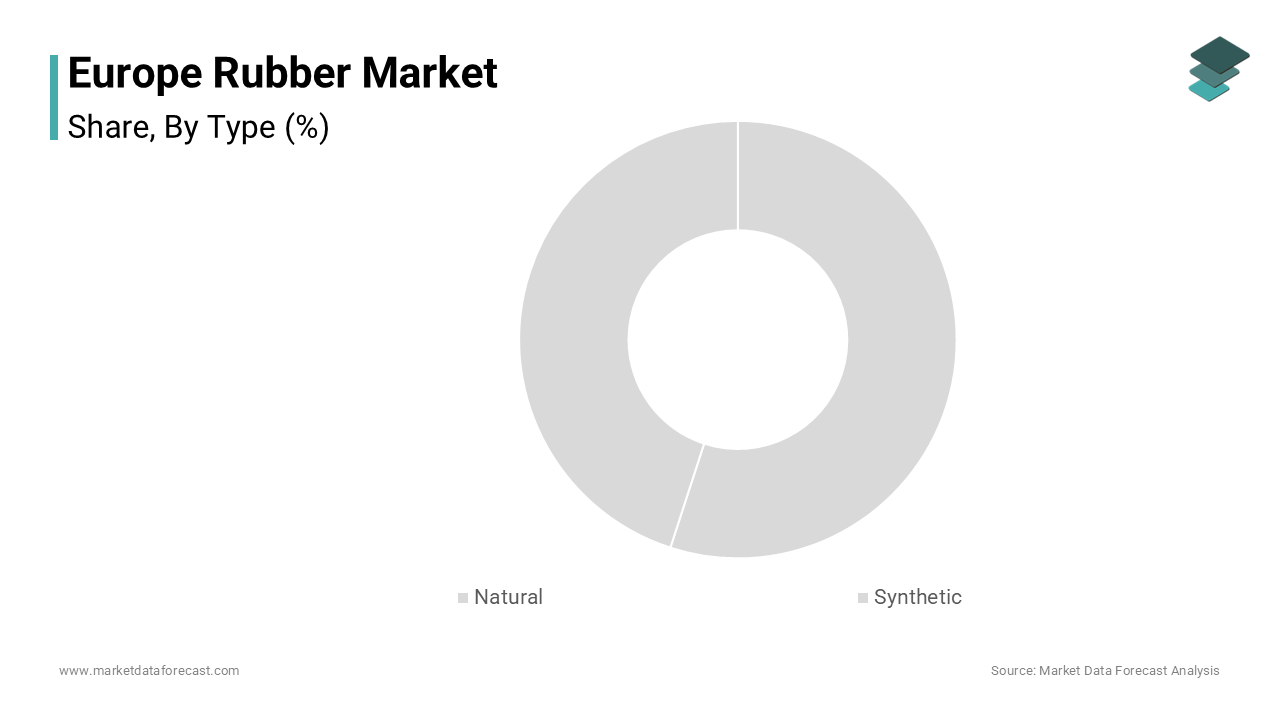
The natural rubber segment is lucratively growing with an expected CAGR of 4.1% from 2025 to 2033. Natural rubber exhibits unmatched resilience and low rolling resistance making it irreplaceable in aircraft and premium truck tire treads. EU policies increasingly favor renewable materials in manufactured goods. Additionally, the EU Deforestation Regulation mandates traceability of natural rubber imports ensuring ethical sourcing which has spurred partnerships between European brands and certified plantations in Côte d’Ivoire. These developments transform natural rubber from a commodity into a certified sustainable input driving premium adoption.
By Application Insights
The tire segment was the dominant in the Europe rubber market share in 2024. A single passenger car tire contains 7 to 8 kilograms of rubber with commercial truck tires using up to 70 kilograms. EU tire labeling regulations require minimum wet grip and rolling resistance ratings which directly influence rubber compound design. The upcoming Euro 7 emissions standards will further tighten particulate limits from tire abrasion prompting use of high purity synthetic and natural rubber blends. This regulatory feedback loop ensures continuous rubber consumption tied to compliance rather than discretionary choice.
The non-tire automotive segment is lucratively growing at a CAGR of 6.3% in next coming years. Electric vehicles require 30 to 40 additional rubber components compared to internal combustion models including battery pack seals motor gaskets and high voltage cable insulation. Automakers increasingly use rubber based acoustic insulation to offset the absence of engine noise in EVs.
REGIONAL ANALYSIS
Germany Rubber Market Analysis
Germany was the largest contributor of the Europe rubber market with 24.2% of share in 2024 with its integrated automotive and chemical industries which drive high volume consumption and advanced material development. Germany’s Fraunhofer Institute for Structural Durability and System Reliability conducts cutting edge research on rubber fatigue and recycling which informs EU standards.
France Rubber Market Analysis
France was positioned second with 16.2% of the Europe rubber market share in 2024 with its strong tire manufacturing base and renewable energy infrastructure. The government’s France 2030 investment plan has allocated 1.2 billion euros to green materials including bio based rubber derived from dandelion roots through partnerships with the National Institute for Agricultural Research.
Italy Rubber Market Analysis
Italy rubber market growth is anticipated to grow with its specialization in high performance industrial and footwear applications. The Emilia Romagna region hosts a cluster of rubber compounders supplying Ferrari Lamborghini and Ducati with vibration control systems engineered for extreme performance.
United Kingdom Rubber Market Analysis
The United Kingdom rubber market growth is driven by aerospace defense and specialty chemical sectors. Rolls Royce and BAE Systems use high temperature resistant silicone and fluororubber in jet engines and avionics with each aircraft requiring over 500 kilograms of specialized elastomers as confirmed by the UK Aerospace Technology Institute. Additionally, the Faraday Battery Challenge funds rubber based battery sealing solutions for electric vehicles reinforcing cross sectoral demand.
COMPETITIVE LANDSCAPE
The Europe rubber market features intense competition among integrated chemical giants specialized compounders and global tire manufacturers each vying for dominance through technological differentiation and sustainability leadership. Large players leverage scale and vertical integration to control feedstock costs and secure long term automotive contracts while niche producers compete on formulation expertise for high performance applications in aerospace rail and medical devices. Regulatory compliance acts as both a barrier and a catalyst as REACH EU Ecolabel and deforestation rules favor companies with robust stewardship systems. The shift toward electric mobility and circularity has intensified innovation in bio based and recyclable rubber grades. Competition is further shaped by energy costs with energy intensive producers under pressure to decarbonize.
KEY MARKET PLAYERS
A few of the major companies in the europe rubber market include
- AG, Michelin
- LANXESS AG
- Trinseo S.A.
- Synthos S.A.
- Goodyear Tire & Rubber Company
- Bridgestone Corporation
- Versalis S.p.A.
- Hexpol AB
- Zeon Corporation.
Top Players in the Europe Rubber Market
Arlanxeo Holding GmbH
Arlanxeo Holding GmbH is a leading synthetic rubber producer headquartered in the Netherlands with deep integration across Europe’s automotive and industrial sectors. The company supplies high performance elastomers including neodymium polybutadiene and solution styrene butadiene rubber to major tire and component manufacturers. It also expanded its sustainability program by achieving ISCC Plus certification for bio based butadiene production at its German facility.
Michelin Group
Michelin Group exerts significant influence in the Europe rubber market through its vertically integrated tire manufacturing and material science capabilities. Beyond tire production the company develops specialty rubber compounds for aerospace industrial and mobility applications. These actions strengthen Michelin’s position as a steward of resource efficiency and performance innovation across global rubber value chains.
Lanxess AG
Lanxess AG plays a pivotal role in the Europe rubber market through its advanced specialty chemicals and synthetic rubber portfolio including high viscosity neodymium polybutadiene and ethylene propylene diene monomer grades. The company serves automotive construction and electrical industries with formulations engineered for extreme durability and thermal stability. In early 2024 Lanxess partnered with the Fraunhofer Institute to develop halogen free flame retardant rubber for electric vehicle battery enclosures compliant with EU safety standards. It also achieved full traceability of its butadiene feedstock through blockchain enabled supply chain monitoring. These moves enhance product differentiation and regulatory compliance reinforcing Lanxess’s global standing in high value elastomer solutions.
Top Strategies Used by the Key Market Participants
Key players in the Europe rubber market prioritize sustainability by developing bio based feedstocks achieving circular certifications and scaling tire recycling technologies. They invest heavily in R and D to formulate specialty elastomers tailored for electric vehicles renewable energy infrastructure and aerospace applications. Strategic partnerships with automotive OEMs research institutes and certification bodies ensure compliance with evolving EU regulations such as REACH and the Ecodesign Directive. Companies also integrate digital traceability systems to guarantee raw material provenance and meet deforestation free import requirements.
MARKET SEGMENTATION
This research report on the europe rubber market has been segmented based on the following categories.
By Type
- Natural
- Synthetic
By Application
- Tire
- Non-Tire Automotive
- Footwear
- Industrial Goods
- Others
By Country
- UK
- France
- Spain
- Germany
- Italy
- Russia
- Sweden
- Denmark
- Switzerland
- Netherlands
- Turkey
- Czech Republic
- Rest of Europe
Frequently Asked Questions
What is the Europe Rubber Market?
The Europe Rubber Market involves the production, consumption, and trade of natural and synthetic rubber used across various industries such as automotive, construction, and industrial manufacturing.
What are the key drivers of the Europe Rubber Market?
Growth in automobile production, increasing demand for electric vehicles (EVs), and expansion of construction and manufacturing activities are major market drivers.
Which countries lead the rubber market in Europe?
Germany, France, Italy, the United Kingdom, and Spain are major markets due to their strong automotive and manufacturing bases.
What challenges does the Europe Rubber Market face?
The market faces price volatility of natural rubber, environmental regulations, and competition from bio-based alternatives.
What is the growth outlook for the Europe Rubber Market?
The market is expected to grow steadily due to demand from EVs, renewable energy sectors, and advancements in rubber processing technologies.
What are the major trends shaping the Europe Rubber Market?
Key trends include bio-based rubber innovation, rubber recycling, automation in production, and shift toward green mobility.
Access the study in MULTIPLE FORMATS
Purchase options starting from
$ 2000
Didn’t find what you’re looking for?
TALK TO OUR ANALYST TEAM
Need something within your budget?
NO WORRIES! WE GOT YOU COVERED!
Call us on: +1 888 702 9696 (U.S Toll Free)
Write to us: sales@marketdataforecast.com