- Product Description Description
- Table of Contents TOC
- List of Table & Figure LOT
- Get Free Sample PDF Sample PDF
Market Size, 2025
$129.75 BnMarket Estimate, 2026
$145.54 BnMarket Forecast, 2034
$364.75 BnCAGR, 2026–2034
12.17%Europe Software-as-a-Service (SaaS)-based HRM Market Size
The Europe Software-as-a-Service (SaaS)-based Human Resource Management (HRM) Market was worth USD 129.75 billion in 2025. The European market is projected to reach USD 364.75 billion by 2034 from USD 145.54 billion in 2026, rising at a CAGR of 12.17% from 2026 to 2034.
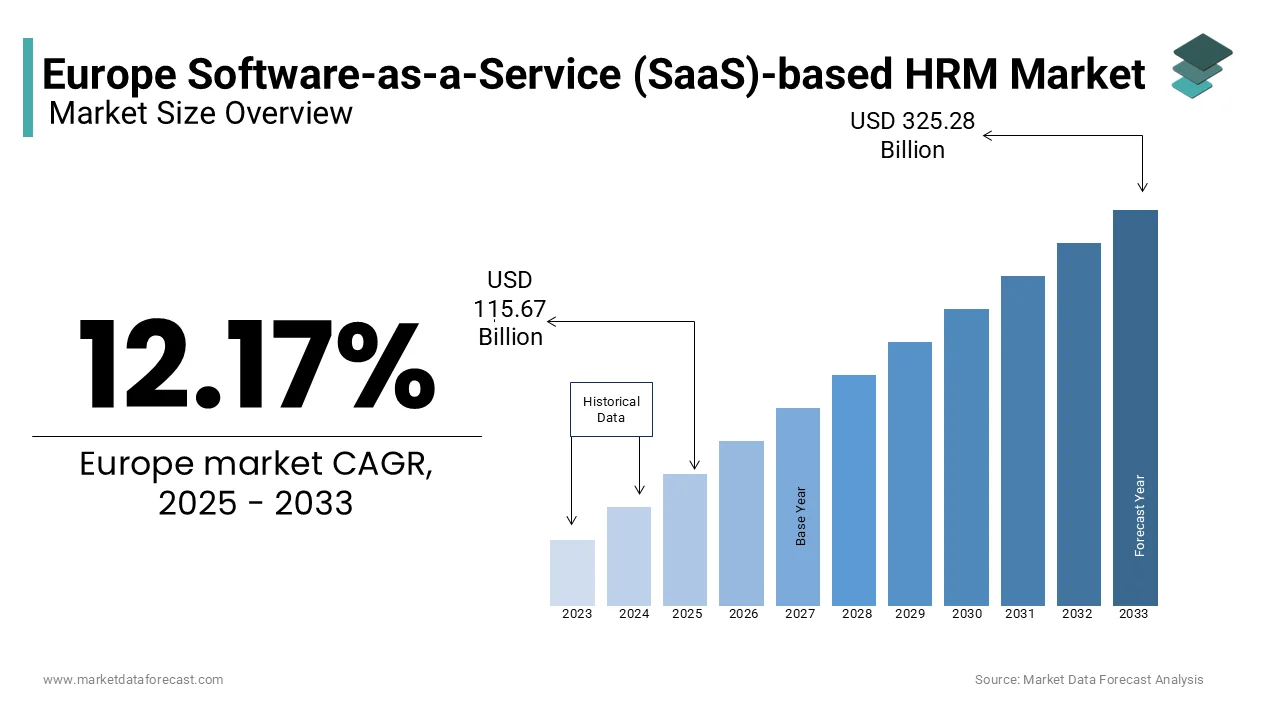
The Software-as-a-Service (SaaS)-based HRM market is a rapidly evolving segment within the broader HR technology ecosystem, driven by the increasing demand for scalable, cost-effective, and cloud-based solutions. SaaS-based HRM platforms enable organizations to streamline core HR functions such as payroll, talent management, and compliance while ensuring real-time data accessibility and enhanced employee engagement. According to Eurostat, over 60% of European businesses have adopted cloud-based HR solutions, with the market valued at approximately EUR 5 billion in 2023. The European Investment Bank highlights that the SaaS-based HRM market is projected to grow at a compound annual growth rate (CAGR) of 14% through 2030, fueled by digital transformation initiatives and the rise of remote work models. As industries across Europe embrace automation and data-driven decision-making, SaaS-based HRM has become indispensable for achieving operational efficiency and workforce agility.
MARKET DRIVERS
Remote and Hybrid Work Accelerating SaaS-Based HRM Adoption in Europe
The growing adoption of remote and hybrid work models is a major driver of the Europe SaaS-based HRM market. Eurostat reports that over 40% of European employees now work remotely at least part-time, creating a pressing need for tools that facilitate seamless workforce management and collaboration. The European Foundation for the Improvement of Living and Working Conditions highlights that remote work has increased operational complexities, such as managing employee performance, tracking productivity, and ensuring compliance with labor laws. Organizations are turning to SaaS-based HRM solutions to address these challenges, with cloud platforms enabling real-time collaboration, data analytics, and employee self-service portals. Furthermore, the European Commission notes that industries like IT, finance, and healthcare have seen a 35% increase in SaaS-based HRM adoption since 2020, underscoring its role in supporting flexible work environments.
Rising Focus on Regulatory Compliance and Data Security
Another key driver is the increasing emphasis on regulatory compliance and data security. The European Union Agency for Cybersecurity (ENISA) reports that non-compliance with GDPR can result in fines of up to EUR 20 million or 4% of global annual turnover, prompting organizations to adopt secure and compliant HRM solutions. The European Labour Authority highlights that over 70% of large enterprises prioritize SaaS-based HRM platforms due to their ability to automate compliance tracking, manage employee data securely, and ensure adherence to labor regulations. Additionally, advancements in AI and machine learning have enhanced SaaS-based HRM capabilities, enabling predictive analytics for workforce planning and talent management. These innovations not only reduce administrative burdens but also improve decision-making, making SaaS-based HRM a vital tool for modern businesses.
MARKET RESTRAINTS
High Implementation and Subscription Costs Limiting SME Adoption
One significant restraint is the high cost of implementation and subscription fees, which limits adoption among small and medium-sized enterprises (SMEs). Eurostat reports that nearly 45% of SMEs in Europe cite budget constraints as a primary barrier to adopting advanced SaaS-based HRM solutions. While subscription-based pricing models reduce upfront costs, ongoing expenses for customization, integration, and training can be prohibitive, particularly for smaller organizations with limited IT budgets. The European Investment Bank highlights that the total cost of ownership for SaaS-based HRM can exceed EUR 50,000 annually for mid-sized businesses, deterring widespread adoption. Additionally, the complexity of integrating SaaS-based HRM with legacy systems often leads to additional expenses, further exacerbating financial challenges. These barriers hinder market growth, particularly in regions with lower economic development.
Resistance to Change and Limited Technical Expertise Among Workforce
Another restraint is the resistance to change and lack of technical expertise among end-users. The European Centre for the Development of Vocational Training reports that over 50% of employees in traditional industries, such as manufacturing and retail, exhibit reluctance to adopt new technologies due to fear of job displacement or unfamiliarity with digital tools. This resistance is compounded by a skills gap, with Eurostat estimating that only 35% of the European workforce possesses advanced digital literacy. Furthermore, inadequate training programs and insufficient support from vendors often lead to underutilization of SaaS-based HRM features, reducing its effectiveness. These cultural and educational barriers slow down the pace of adoption, limiting the market’s potential to achieve widespread penetration across all sectors.
MARKET OPPORTUNITIES
AI and Predictive Analytics Transforming HRM Solutions
The integration of artificial intelligence (AI) and predictive analytics presents a significant opportunity for the Europe SaaS-based HRM market. The European Investment Bank reports that AI-driven HRM solutions are projected to grow at a CAGR of 18% through 2030, driven by their ability to enhance workforce planning, talent acquisition, and employee engagement. These platforms leverage machine learning algorithms to forecast staffing needs, identify skill gaps, and optimize recruitment processes, enabling organizations to achieve greater efficiency. The European Commission highlights that industries like healthcare and BFSI are increasingly adopting AI-enabled HRM to address labor shortages and improve retention rates. Additionally, predictive analytics helps reduce turnover by identifying patterns in employee behavior and satisfaction. This technological advancement positions AI-integrated HRM as a transformative force, offering innovative solutions to modern workforce challenges.
Expanding SaaS-Based HRM Solutions for SMEs
Another promising opportunity lies in the expansion of SaaS-based HRM solutions tailored for small and medium-sized enterprises (SMEs). Eurostat reports that SMEs account for over 99% of all businesses in Europe, yet their adoption of SaaS-based HRM remains below 40%. The European Small Business Alliance highlights that affordable, scalable, and user-friendly HRM platforms could unlock significant growth potential in this underserved segment. Cloud-based solutions, which eliminate the need for extensive on-premise infrastructure, are particularly appealing to SMEs seeking cost-effective options. Furthermore, the rise of subscription-based pricing models has made SaaS-based HRM more accessible, enabling smaller organizations to benefit from advanced features without upfront costs. By addressing the unique needs of SMEs, HRM providers can tap into a vast and largely untapped market, driving innovation and inclusivity.
MARKET CHALLENGES
Data Privacy and Cybersecurity Risks in SaaS-Based HRM Platforms
One major challenge is the growing concern over data privacy and cybersecurity risks associated with SaaS-based HRM platforms. The European Union Agency for Cybersecurity (ENISA) reports a 40% increase in cyberattacks targeting HR and workforce management systems over the past two years, with attackers exploiting vulnerabilities to access sensitive employee data. Non-compliance with GDPR can result in fines of up to EUR 20 million or 4% of global annual turnover, as stated by the European Commission. Organizations face significant pressure to ensure robust data protection measures, which often require additional investments in cybersecurity infrastructure. Furthermore, Eurostat highlights that over 60% of businesses struggle to align their HRM systems with GDPR standards, creating hesitancy among potential adopters. These challenges not only increase operational risks but also undermine trust in SaaS-based HRM solutions, slowing market growth.
Integration Challenges with Legacy Enterprise Systems
Another significant challenge is the complexity of integrating SaaS-based HRM with existing enterprise systems, such as ERP and CRM platforms. The European Investment Bank notes that over 50% of organizations report difficulties in achieving seamless interoperability between SaaS-based HRM and legacy systems, leading to inefficiencies and higher costs. This issue is particularly pronounced in cross-border projects, where varying standards and protocols hinder data sharing and collaboration. The European Commission’s Digital Transformation Monitor emphasizes that integration challenges disproportionately affect large enterprises with complex IT ecosystems. Additionally, the absence of unified industry standards exacerbates the problem, leaving organizations reliant on proprietary solutions. These technical barriers not only slow down adoption but also limit the scalability of SaaS-based HRM deployments across industries.
REPORT COVERAGE
| REPORT METRIC | DETAILS |
| Market Size Available | 2025 to 2034 |
| Base Year | 2025 |
| Forecast Period | 2026 to 2034 |
| Segments Covered | By Deployment, Application, and Country. |
| Various Analyses Covered | Global, Regional, and Country-Level Analysis, Segment-Level Analysis, Drivers, Restraints, Opportunities, Challenges; PESTLE Analysis; Porter’s Five Forces Analysis, Competitive Landscape, Analyst Overview of Investment Opportunities |
| Countries Covered | UK, France, Spain, Germany, Italy, Russia, Sweden, Denmark, Switzerland, Netherlands, Turkey, Czech Republic, and the Rest of Europe. |
| Market Leaders Profiled | Talentsoft SA, Cezanne HR Ltd., CloudPay, Inc., Oracle Corporation, Benrekia.com, SAP SE, Kronos, Inc., Ceridian HCM, Inc., ADP, LLC, Ascentis Corporation, The Ultimate Software Group, Inc., Ascentis, Halogen Software Inc., Workday Inc., Kenexa Corp., and Apprenda. |
SEGMENTAL ANALYSIS
By Deployment Insights
Payroll dominates the Europe SaaS-based HRM market, holding approximately 35% of the market share, as reported by Eurostat. Its leadership stems from the critical need for accurate and compliant payroll processing, particularly in light of stringent labor laws and tax regulations. The European Labour Authority highlights that over 70% of organizations rely on SaaS-based payroll solutions to automate calculations, ensure timely payments, and reduce errors. Its importance lies in providing scalable and secure payroll management, making it indispensable for businesses of all sizes.
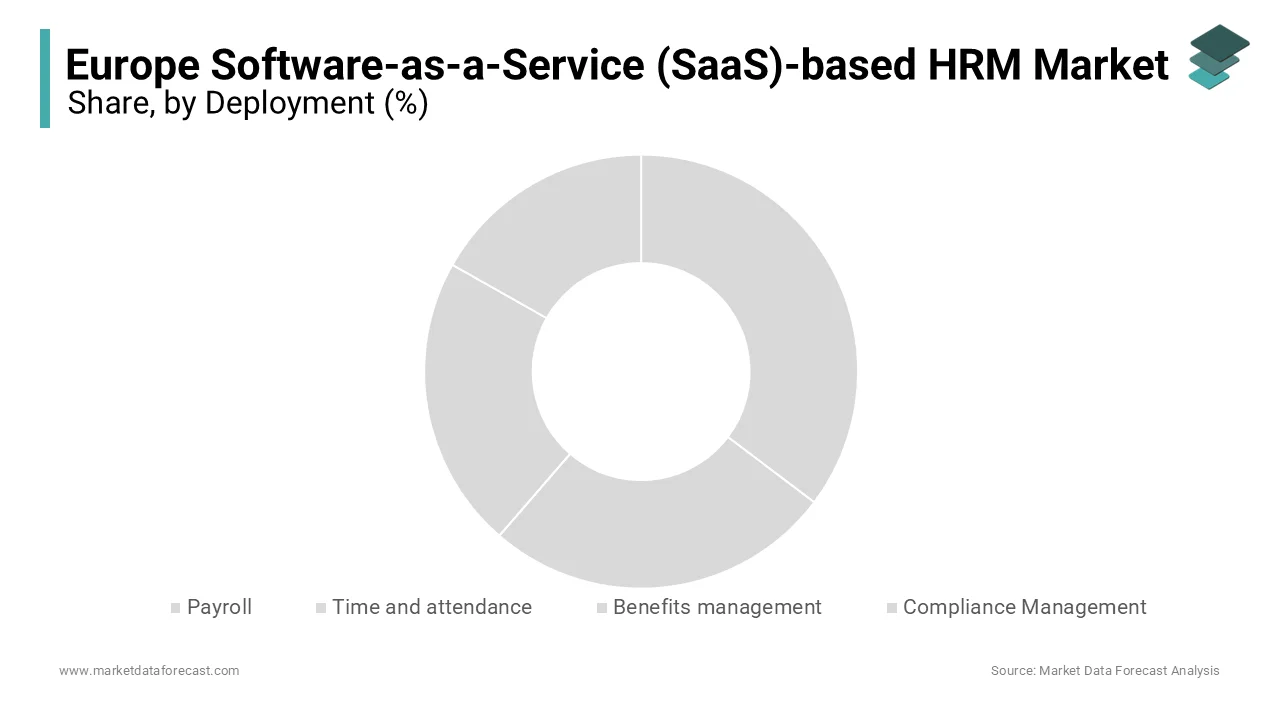
Compliance management is the fastest-growing segment, with a CAGR of 16%, according to the European Investment Bank. This growth is driven by the increasing complexity of labor regulations, such as GDPR and the EU Working Time Directive, which require robust compliance tracking. Eurostat reports that over 60% of organizations are investing in SaaS-based compliance tools to mitigate risks and avoid penalties. Its importance lies in ensuring regulatory adherence and reducing legal liabilities, positioning it as a key driver of innovation in the market.
By Application Insights
BFSI holds the largest share of the Europe SaaS-based HRM market, accounting for approximately 25% of the market, as per the European Banking Authority. Its dominance is attributed to the sector’s high employee count, complex compliance requirements, and the need for advanced talent management solutions. Eurostat highlights that over 70% of banks and financial institutions have adopted SaaS-based HRM to streamline operations and ensure data security. Its importance lies in addressing the unique HR challenges of the BFSI sector, making it a cornerstone of the market.
Healthcare is the fastest-growing segment, with a CAGR of 18%, according to the European Health and Digital Executive Agency. This growth is fueled by the increasing demand for workforce optimization, patient safety, and compliance with labor laws. Eurostat reports that over 60% of hospitals and clinics are leveraging SaaS-based HRM to manage complex workforce structures and reduce burnout. Its importance lies in enabling agility and resilience in a rapidly evolving industry.
COUNTRY-LEVEL ANALYSIS
Germany Software-as-a-Service (SaaS)-based HRM Market Analysis
Germany leads the Europe SaaS-based HRM market, holding a 25% share and a CAGR of 15%, as reported by the German Federal Ministry for Economic Affairs and Climate Action. Its leadership is driven by the country’s strong industrial base, with over 40% of European manufacturing hubs relying on SaaS-based HRM for workforce optimization. The European Investment Bank highlights that Germany’s emphasis on Industry 4.0 and digital transformation has accelerated HRM adoption. Its robust infrastructure and focus on innovation further solidify its position as a market leader.
United Kingdom Software-as-a-Service (SaaS)-based HRM Market Analysis
The UK ranks second, with a 20% market share and a CAGR of 14%, according to the UK Department for Digital, Culture, Media & Sport. The UK’s leadership is fueled by its rapid adoption of cloud-based HRM solutions, driven by the growing emphasis on remote work and digitalization. The British Chambers of Commerce reports that over 60% of businesses in the UK have upgraded their HR systems to enhance productivity and compliance. London’s status as a global financial hub has also spurred demand for advanced HRM in sectors like BFSI and retail.
France Software-as-a-Service (SaaS)-based HRM Market Analysis
France holds the third position, with a 15% market share and a CAGR of 13%, as highlighted by the French Ministry of Labour. The country’s focus on improving public services and enhancing workforce efficiency has significantly boosted HRM adoption. The European Commission reports that France’s investment in smart city technologies and digital transformation initiatives has created a strong demand for AI-integrated HRM platforms. Additionally, stringent labor laws have encouraged organizations to adopt compliant and scalable solutions, positioning France as a key contributor to the market.
KEY MARKET PLAYERS
The major players in the Europe Software-as-a-Service (SaaS)-based Human Resource Management (HRM) Market include Talentsoft SA, Cezanne HR Ltd., CloudPay, Inc., Oracle Corporation, Benrekia.com, SAP SE, Kronos, Inc., Ceridian HCM, Inc., ADP, LLC, Ascentis Corporation, The Ultimate Software Group, Inc., Ascentis, Halogen Software Inc., Workday Inc., Kenexa Corp., and Apprenda.
MARKET SEGMENTATION
This research report on the Europe Software-as-a-Service (SaaS)-based HRM Market is segmented and sub-segmented into the following categories.
By Deployment
- Payroll
- Time and attendance
- Benefits management
- Compliance Management
By Application
- IT and Telecom
- Manufacturing
- Healthcare
- Banking, Financial Services & Insurance (BFSI)
- Others (Government, Logistics, Etc.)
By Country
- UK
- France
- Spain
- Germany
- Italy
- Russia
- Sweden
- Denmark
- Switzerland
- Netherlands
- Turkey
- Czech Republic
- Rest of Europe