- Product Description Description
- Table of Contents TOC
- List of Table & Figure LOT
- Get Free Sample PDF Sample PDF
Market Size, 2025
$2.87 BnMarket Estimate, 2026
$3.23 BnMarket Forecast, 2034
$8.30 BnCAGR, 2026–2034
12.53%Europe Sandboxing Market Report Summary
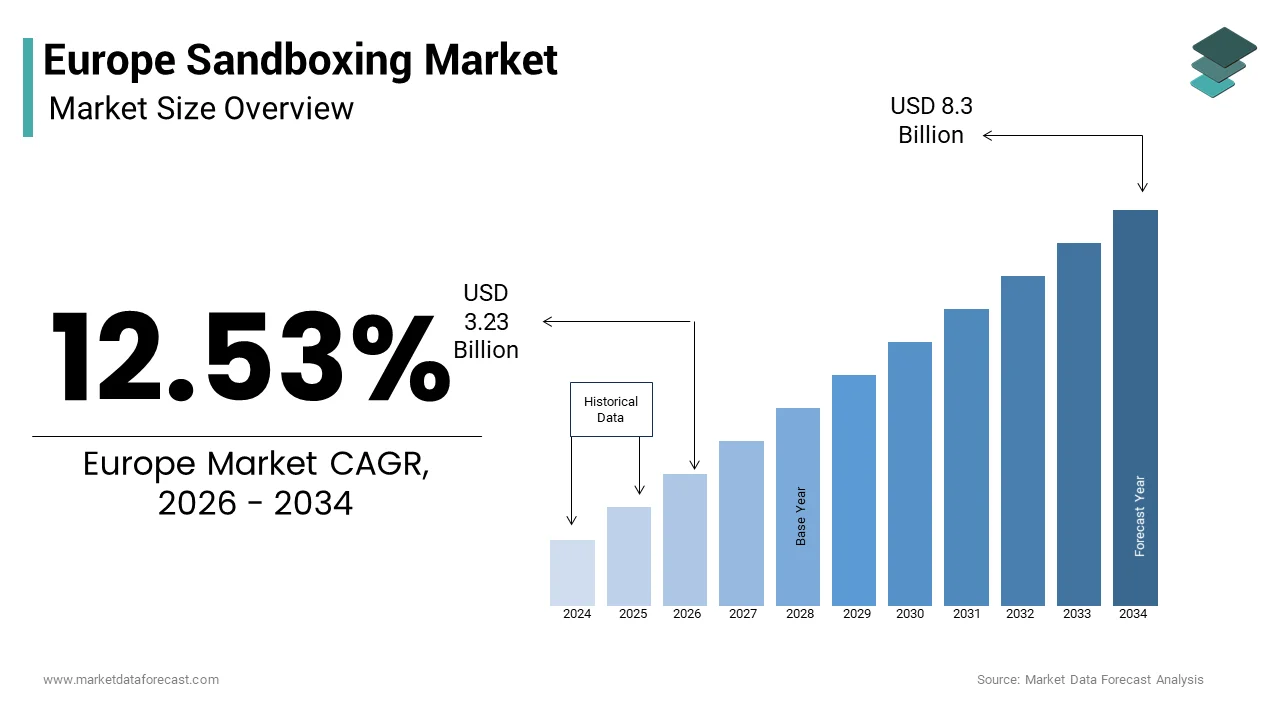
The Europe sandboxing market was valued at USD 2.87 billion in 2025 and is estimated to reach USD 3.23 billion in 2026, further expanding to USD 8.30 billion by 2034, growing at a CAGR of 12.53% during the forecast period from 2026 to 2034. The market growth is primarily driven by the rising frequency of cyberattacks, increasing demand for advanced threat detection technologies, and growing adoption of cloud-based cybersecurity solutions across enterprises. Sandboxing technology enables organizations to analyze suspicious files, applications, and network behavior in isolated environments, helping prevent malware, ransomware, and zero-day threats from affecting critical systems. Additionally, strict data protection regulations and increasing digital transformation across industries are further accelerating the adoption of sandboxing solutions across Europe.
Key Market Trends
- Growing demand for advanced threat detection systems capable of identifying sophisticated malware and zero-day cyber threats.
- Increasing cybersecurity investments across enterprises to safeguard critical digital infrastructure and sensitive business data.
- Expansion of cloud-based sandboxing solutions enabling scalable and flexible security architectures.
- Rising adoption of artificial intelligence and machine learning to enhance threat analysis and automated malware detection.
- Strengthening cybersecurity regulations and compliance requirements across European industries and government sectors.
Segmental Insights
By Type
The solution segment dominated the Europe sandboxing market in 2025. The strong demand for sandboxing solutions is driven by the need for real-time threat detection, malware analysis, and proactive cybersecurity defense mechanisms across enterprise networks and digital platforms.
By Organization Size
The large-scale enterprises segment led the market in 2025 due to higher cybersecurity budgets, complex IT infrastructures, and greater exposure to sophisticated cyber threats. Large organizations are increasingly adopting advanced sandboxing technologies to protect critical data and maintain operational security.
By End User
The Banking, Financial Services, and Insurance (BFSI) segment accounted for the majority share of the Europe sandboxing market in 2025. The dominance of this segment is attributed to the growing need to protect financial systems, digital transactions, and sensitive customer information from cyberattacks and fraud attempts.
Regional Insights
The Europe sandboxing market is experiencing steady growth as countries strengthen their cybersecurity frameworks and digital infrastructure protection strategies.
- Germany was the largest contributor, accounting for 24.6% of the Europe sandboxing market share in 2025, supported by strong enterprise cybersecurity investments and advanced digital infrastructure.
- The United Kingdom followed with 18.1% market share in 2025, driven by the country’s rapidly expanding fintech ecosystem and strong focus on cybersecurity innovation.
- France holds a significant position due to state-led cybersecurity initiatives and a rapidly growing digital economy, encouraging the adoption of advanced threat protection technologies.
- Italy is witnessing steady growth as the country focuses on modernizing public administration and accelerating digital transformation across its manufacturing sector.
- The Netherlands is expected to experience notable expansion over the forecast period, supported by its advanced digital ecosystem and increasing cybersecurity awareness among enterprises.
Competitive Landscape
The Europe sandboxing market is characterized by strong competition among global cybersecurity vendors focusing on advanced threat intelligence, AI-driven malware detection, and integrated security platforms. Companies are increasingly investing in cloud-based sandboxing solutions, automated threat analysis tools, and strategic partnerships to enhance their cybersecurity offerings and expand their presence across European markets.
Prominent players in the Europe sandboxing market include Cisco Systems, Fortinet, CrowdStrike Holdings Inc., Juniper Networks, Palo Alto Networks, and Sophos.
Europe Sandboxing Market Size
The Europe sandboxing market size was valued at USD 2.87 billion in 2025 and is anticipated to reach USD 3.23 billion in 2026 to reach from USD 8.3 billion by 2034, growing at a CAGR of 12.53% during the forecast period from 2026 to 2034.
Current Introduction of the Europe Sandboxing Market
Conceptual Framework and Cybersecurity Resilience Context
Sandboxing is a security mechanism that isolates a specific application or process in a restricted environment. This defensive mechanism serves as a cornerstone for modern threat intelligence enabling organizations to detect zero-day exploits and advanced persistent threats that bypass traditional signature based defenses. The operational urgency for such isolation technologies intensifies as European entities navigate an increasingly hostile digital terrain characterized by sophisticated ransomware and state sponsored espionage. The EU is experiencing a consistent, rapid increase in significant, large-scale cyber incidents targeting critical infrastructure, often driven by ransomware and organized criminal groups, according to ENISA. As per Eurostat more than half of European enterprises now utilize cloud computing services which inherently expands the attack surface and necessitates robust isolation protocols to prevent lateral movement within hybrid environments. The convergence of stringent regulatory mandates under the Network and Information Security Directive and the proliferation of remote work models establishes sandboxing as an indispensable component of enterprise security architecture. This discipline transcends simple malware analysis by incorporating behavioral heuristics automated detonation chambers and real time threat feeding to fortify the digital sovereignty of the European continent against evolving adversarial tactics.
PRIMARY MARKET DRIVERS
Escalating Sophistication of Zero Day Exploits and Ransomware
European industries are increasingly adopting advanced sandboxing solutions, which is among the key drivers of the Europe sandboxing market. This widespread shift is driven by the constant evolution of polymorphic ransomware and zero-day exploits. The European threat landscape is experiencing a high volume of ransomware attacks and data breaches, with attackers increasingly utilizing techniques that evade traditional, signature-based detection. Sandboxing provides the necessary isolated environment to detonate these suspicious files and observe their malicious payload execution without compromising production systems. As per Microsoft Security intelligence identity based attacks surged thirty two percent in the first half of 2025 with many utilizing novel obfuscation techniques that only behavioral analysis within a sandbox can uncover. European financial institutions and healthcare providers face heightened exposure due to the sensitivity of their data assets making the ability to identify unknown threats before they infiltrate the network a non negotiable requirement. While DDoS attacks are prevalent, phishing and credential theft remain the primary methods for gaining initial access to systems. Organizations therefore prioritize sandboxing platforms that offer deep inspection capabilities and automated threat intelligence sharing to counter these rapidly mutating attack vectors. The integration of sandboxing into email gateways and web proxies further amplifies its utility by stopping threats at the perimeter.
Stringent Regulatory Compliance Mandates Under NIS2 and GDPR
Stringent data protection and cybersecurity regulations across the region create a non-negotiable mandate, which further propels the expansion of the Europe sandboxing market. This necessitates the deployment of sophisticated sandboxing technologies to ensure organizational resilience and data integrity. GDPR enforcement actions are imposing substantial penalties, forcing organizations to strengthen their defensive posture. Sandboxing acts as a critical control measure by preventing data exfiltration attempts and ransomware encryption before they can impact personal data repositories thereby mitigating compliance risks. As per the Network and Information Security Directive 2 essential and important entities are obligated to implement technical measures that safeguard system integrity including advanced threat detection and incident response capabilities. The directive explicitly requires organizations to manage supply chain security risks which sandboxing addresses by vetting third party software updates and external code integrations in isolated environments. European financial institutions additionally prepare for Digital Operational Resilience Act enforcement which mandates comprehensive testing of ICT systems including the simulation of cyber attacks to verify defense efficacy. Organizations therefore invest in sandboxing platforms that provide audit ready reporting and automated policy enforcement to satisfy regulatory examiners. The convergence of multiple regulatory frameworks creates a compounding effect where sandboxing becomes a central pillar of enterprise risk management rather than an optional security enhancement.
PRIMARY MARKET RESTRAINTS
High Resource Consumption and Performance Latency Issues
Deep packet inspection and virtual machine emulation create substantial computational overhead, which restrains the growth of the Europe sandboxing market. This introduces significant performance friction when implementing comprehensive sandboxing solutions. Growing European cybersecurity investments, particularly in software, are increasingly focused on replacing or managing legacy systems to support advanced, real-time security analysis. Many organizations operate hybrid environments combining on premises mainframes and contemporary cloud platforms where the resource intensity of spinning up isolated environments for every suspicious file can bottleneck network throughput. Cloud computing adoption among EU enterprises continues to increase, yet substantial disparities in technology adoption exist between large enterprises and SMEs, impacting the speed of adopting advanced security measures. Sandboxing deployments often necessitate dedicated hardware appliances or significant cloud compute allocation that extend implementation timelines and increase total cost of ownership. The scarcity of cybersecurity professionals with expertise in optimizing sandbox configurations further delays project execution as organizations struggle to balance security depth with operational efficiency. While overall digital skills among EU citizens are increasing, a significant segment of the population still lacks the proficiency needed for advanced digital tasks, exacerbating the shortage of skilled personnel for managing complex security tools. These performance constraints discourage small and medium enterprises from pursuing comprehensive sandboxing strategies despite recognized security benefits leading to fragmented defense postures.
Advanced Evasion Techniques Bypassing Isolation Mechanisms
Threat actors are developing sophisticated evasion techniques specifically designed to detect and bypass sandbox environments, which hampers the expansion of the Europe sandboxing market. This development acts as a significant restraint on the effectiveness of current market solutions. European cyber adversaries are reducing their breakout times while increasing the use of evasion tactics designed to detect and bypass virtualized and monitored environments. The collaborative, cross-border nature of modern cyber threats necessitates security defenses that can adapt dynamically to evolving tactics rather than relying on static security measures. Modern malware can identify specific artifacts of sandboxing such as mouse movement patterns process lists or network configurations and alter its behavior to appear benign thereby escaping detection. This cat and mouse game forces vendors to constantly update their emulation engines which can lag behind the rapid innovation cycles of criminal syndicates. The complexity of multi stage attacks where the initial payload is harmless and only downloads the malicious component after a delay further complicates static and dynamic analysis within standard timeframes. Despite increased investment in digital transformation and security, the sophistication of evasion techniques means that organizations must adopt a layered, multi-faceted approach to security rather than relying on one solution. These limitations create skepticism among some buyers regarding the return on investment for standalone sandboxing products driving a preference for integrated platforms that may dilute specialized capabilities.
PRIMARY MARKET OPPORTUNITIES
Integration of Artificial Intelligence for Behavioral Heuristics
The incorporation of artificial intelligence and machine learning into sandboxing platforms unlocks transformative predictive capabilities, which is predicted to boost the growth of the Europe sandboxing market. These capabilities address the limitations of traditional signature and rule-based detection methods. According to the European Commission artificial intelligence adoption in business is expected to revolutionize productivity with cybersecurity identified as a high impact use case for anomaly detection and automated response. AI driven sandboxing solutions can analyze vast datasets of behavioral patterns to detect subtle indicators of compromise that human analysts might miss such as unusual registry modifications or network call sequences. Organizations leveraging artificial intelligence for cybersecurity are improving their efficiency in threat detection and reducing the time required to contain potential incidents. Machine learning algorithms continuously learn from new attack vectors to refine their detection models enabling the identification of previously unknown malware families without manual intervention. The ability to correlate sandbox findings with global threat intelligence feeds in real time enhances the accuracy of verdicts and reduces false positives. Furthermore generative AI features enable security teams to simulate potential attack scenarios within the sandbox to proactively test defense configurations. Organizations that leverage these intelligent capabilities gain a significant competitive advantage by transforming sandboxing from a reactive analysis tool into a proactive threat hunting engine capable of navigating complex attack landscapes with agility.
Expansion of Cloud Native Sandboxing for Hybrid Environments
The accelerating migration of European workloads to cloud environments generates substantial demand for cloud-native sandboxing capabilities, which is anticipated to fuel the expansion of the Europe sandboxing market. These capabilities must be able to scale dynamically with elastic infrastructure needs. According to Eurostat fifty two point seven four percent of EU enterprises utilized paid cloud computing services in 2025 with large enterprises demonstrating eighty four point six seven percent adoption rates creating a vast surface area for potential exploitation. Cloud platforms introduce dynamic ephemeral resources and distributed identity stores that traditional on premises sandboxing tools cannot effectively govern or protect. As per the European Commission cloud computing represents a strategic enabler for productivity yet requires adapted security controls to manage threat isolation across software infrastructure and platform as a service models. Sandboxing vendors that offer native integration with major cloud providers enable organizations to enforce consistent security policies regardless of workload location or scale. The emergence of serverless computing and container orchestration further amplifies the need for lightweight micro sandboxes that can inspect code snippets and functions in milliseconds. Nordic countries demonstrate high rates of cloud adoption, positioning them as advanced markets for specialized security solutions. Organizations that implement cloud native sandboxing gain operational agility while maintaining security posture during digital transformation initiatives opening new revenue streams for vendors.
PRIMARY MARKET CHALLENGES
Shortage of Skilled Cybersecurity Professionals for Operations
The persistent deficit of cybersecurity professionals across the region impedes the effective deployment and management of advanced sandboxing systems, which challenges the growth of the Europe sandboxing market. This shortage ultimately leads to the underutilization of critical security assets. EU digital skill levels are increasing but, despite substantial investment, are currently progressing at a rate that risks missing the target for 2030. Sandboxing requires specialized expertise in malware analysis threat hunting and incident response that remains scarce in the European labor market. European organizations are struggling to find employees with the right skillset, leading to vacancies and high demand for retraining across sectors. The complexity of modern sandboxing platforms demands continuous training and certification that many organizations cannot sustain given resource limitations. There is a significant, growing shortage of cybersecurity professionals in the EU, with an increase in the talent gap reported in 2024. This talent shortage forces security teams to prioritize reactive incident response over proactive threat analysis increasing organizational vulnerability to undetected breaches. The competition for qualified personnel between public and private sectors further exacerbates recruitment challenges particularly in critical infrastructure domains where sandboxing operations carry heightened importance.
Complexity of Integrating Disparate Security Ecosystems
The proliferation of overlapping and sometimes conflicting cybersecurity tools across European jurisdictions creates operational complexity for seamless sandboxing integration and data correlation, which in turn hinders the expansion of the Europe sandboxing market. According to the Cyber Resilience Act compliance deadlines for vulnerability reporting and secure development practices vary by product category creating uncertainty for vendors and adopters attempting to unify their security stacks. As per the European Data Protection Board GDPR enforcement approaches differ among national authorities leading to inconsistent interpretation of data handling requirements within sandbox environments. The Network and Information Security Directive 2 establishes baseline security obligations yet member states retain discretion in implementation details that affect sandboxing specifications and data retention policies. The regulatory landscape is becoming increasingly complex, forcing organizations to adopt, sophisticated tools to manage,, and comply with, multiple, overlapping, and stringent, security-focused frameworks. This regulatory fragmentation increases the cost and complexity of sandboxing deployments particularly for multinational enterprises operating across multiple European markets. The absence of harmonized technical standards for threat intelligence sharing and automated response workflows forces organizations to customize integrations for each jurisdiction. New regulatory standards are tightening, security requirements, for, networked, and, wireless, devices, necessitating, more, rigorous, validation, and, testing, methodologies. These complexities delay deployment timelines and increase the risk of configuration errors despite substantial security investments.
REPORT COVERAGE
| REPORT METRIC | DETAILS |
| Market Size Available | 2025 to 2034 |
| Base Year | 2025 |
| Forecast Period | 2026 to 2034 |
| CAGR | 12.53% |
| Segments Covered | By Type, Organization, Deployment, System Device, Application, End-User, and Country |
| Various Analyses Covered | Global, Regional, and Country Level Analysis, Segment-Level Analysis; DROC, PESTLE Analysis; Porter’s Five Forces Analysis; Competitive Landscape; Analyst Overview of Investment Opportunities |
| Regions Covered | UK, France, Spain, Germany, Italy, Russia, Sweden, Denmark, Switzerland, Netherlands, Turkey, the Czech Republic, and the Rest of Europe |
| Market Leaders Profiled | Cisco Systems, Fortinet, Crowd Strike Holdings Inc, Juniper Networks, Palo Alto Networks, Sophos |
SEGMENTAL ANALYSIS
By Type Insights
The solution segment dominated the Europe sandboxing market in 2025. The dominance of the segment is driven by the immediate need for automated malware analysis engines that can operate independently or as part of a broader security stack. This growth occurred as organizations prioritized acquiring core software platforms and hardware appliances to establish foundational threat detection capabilities. A further reason for this growth is the urgent requirement for autonomous systems capable of detecting zero day threats without human intervention across European digital infrastructure. According to the European Union Agency for Cybersecurity the volume of new malware variants targeting European entities has increased exponentially with thousands of unique samples generated daily necessitating high throughput automated analysis tools. As per Microsoft Security intelligence identity based attacks surged significantly in recent periods with many utilizing novel obfuscation techniques that only behavioral analysis within dedicated solution environments can uncover effectively. European financial institutions and healthcare providers face heightened exposure due to the sensitivity of their data assets making the ability to identify unknown threats before they infiltrate the network a non negotiable requirement. The ENISA Threat Landscape report confirms that while distributed denial of service attacks remain prevalent credential abuse and malware delivery via email attachments constitute the foundational techniques enabling persistent access which solutions are designed to intercept. Organizations therefore prioritize purchasing robust sandboxing software that offers deep inspection capabilities and automated threat intelligence sharing to counter these rapidly mutating attack vectors. The integration of these solutions into email gateways and web proxies further amplifies their utility by stopping threats at the perimeter ensuring continuous protection. Stringent data protection and cybersecurity regulations across Europe create a non negotiable mandate for the deployment of sophisticated sandboxing solutions to ensure organizational resilience and data integrity. GDPR fines have shown a substantial upward trend, compelling organizations to adopt proactive, advanced threat detection technologies to prevent data breaches. Sandboxing acts as a critical control measure by preventing data exfiltration attempts and ransomware encryption before they can impact personal data repositories thereby mitigating compliance risks effectively. As per the Network and Information Security Directive 2 essential and important entities are obligated to implement technical measures that safeguard system integrity including advanced threat detection capabilities provided by dedicated solutions. The directive explicitly requires organizations to manage supply chain security risks which sandboxing solutions address by vetting third party software updates and external code integrations in isolated environments. European financial institutions additionally prepare for Digital Operational Resilience Act enforcement which mandates comprehensive testing of ICT systems including the simulation of cyber attacks to verify defense efficacy using specialized tools. Organizations therefore invest heavily in sandboxing platforms that provide audit ready reporting and automated policy enforcement to satisfy regulatory examiners. The convergence of multiple regulatory frameworks creates a compounding effect where sandboxing solutions become a central pillar of enterprise risk management rather than an optional security enhancement.
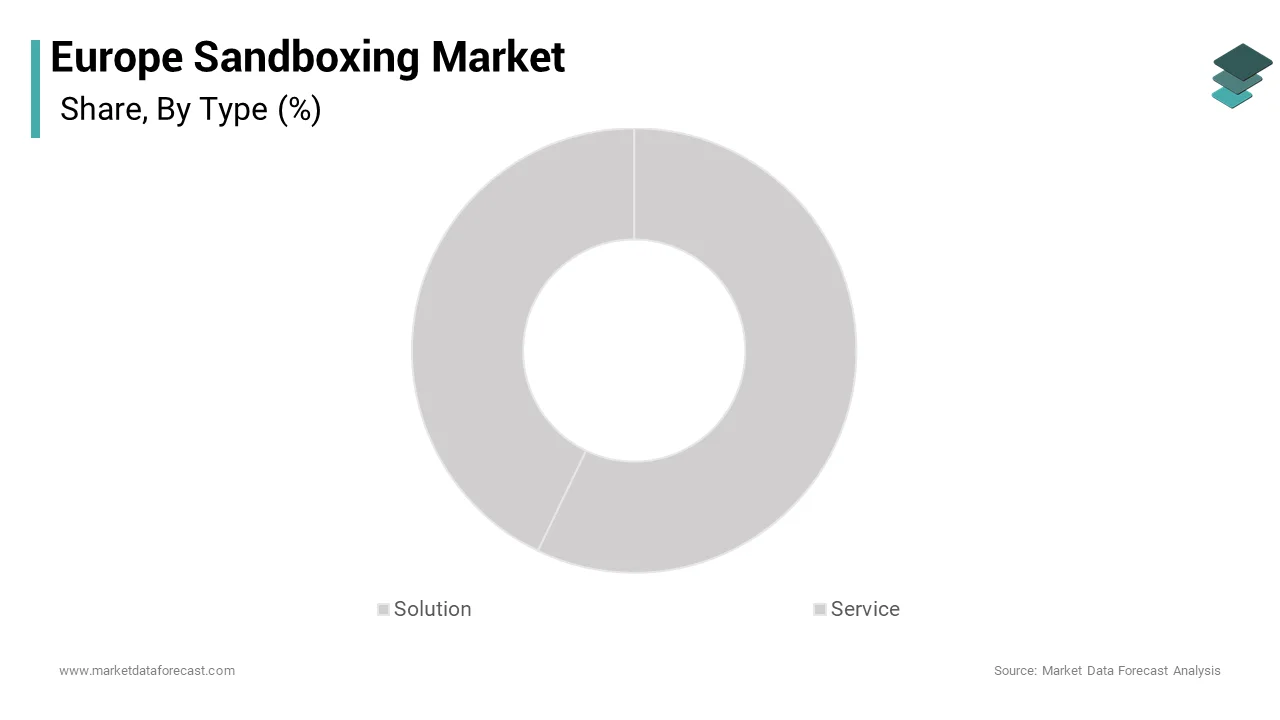
The service segment is likely to experience the fastest CAGR of 22.4% between 2026 and 2034 due to the acute shortage of skilled personnel and the complexity of managing advanced threat landscapes. The persistent deficit of cybersecurity professionals across Europe impedes the effective deployment and management of advanced sandboxing systems leading to a surge in demand for managed services and professional consulting. The European Union is significantly behind its 2030 goal for basic digital competency, requiring massive improvements in training to close the talent gap. Sandboxing requires specialized expertise in malware analysis threat hunting and incident response that remains scarce in the European labor market forcing organizations to outsource these functions. A significant portion of the European workforce holds roles that do not align with their current skill sets, creating operational challenges in security teams. The complexity of modern sandboxing platforms demands continuous training and certification that many organizations cannot sustain given resource limitations. Advanced digital competencies required for cybersecurity remain low. This talent shortage forces security teams to rely on external service providers who can offer expert configuration continuous monitoring and rapid incident response capabilities. The competition for qualified personnel between public and private sectors further exacerbates recruitment challenges particularly in critical infrastructure domains where sandboxing operations carry heightened importance driving the rapid expansion of the service segment. The proliferation of overlapping and sometimes conflicting cybersecurity tools across European jurisdictions creates operational complexity for seamless sandboxing integration driving the need for specialized professional services. The phased enforcement of the Cyber Resilience Act causes compliance challenges for manufacturers needing to update security, documentation, and reporting processes. Inconsistent enforcement of data protection regulations across national borders necessitates specialized legal and technical consultation for compliance. The Network and Information Security Directive 2 establishes baseline security obligations yet member states retain discretion in implementation details that affect sandboxing specifications and data retention policies requiring customized integration strategies. European companies face increasing complexity in meeting multiple regulatory requirements, often requiring specialized external expertise to manage compliance. This regulatory fragmentation increases the cost and complexity of sandboxing deployments particularly for multinational enterprises operating across multiple European markets. The absence of harmonized technical standards for threat intelligence sharing and automated response workflows forces organizations to hire experts to customize integrations for each jurisdiction. These complexities delay deployment timelines and increase the risk of configuration errors despite substantial security investments fueling the growth of the service sector.
By Organization Size Insights
The large scale enterprises segment led the Europe sandboxing market in 2025. The leading position of the segment is attributed to the sheer volume of data traffic and the critical nature of assets requiring protection. This shows the massive attack surface complex IT infrastructures and stringent compliance burdens faced by major corporations and government bodies. The vast and heterogeneous IT environments characteristic of large European corporations create an expansive attack surface that necessitates comprehensive sandboxing coverage to protect high value intellectual property and customer data. Large European enterprises continue to drive the majority of regional cybersecurity spending to defend against advanced and organized digital threats. Adoption of cloud services among large European enterprises has accelerated significantly, exceeding a vast majority, which subsequently increases the need for sophisticated security measures to prevent breaches from spreading across their IT infrastructure. The convergence of stringent regulatory mandates under the Network and Information Security Directive and the proliferation of remote work models establishes sandboxing as an indispensable component of enterprise security architecture for these giants. Large organizations often serve as primary targets for ransomware gangs seeking substantial payouts making the ability to detect and contain threats before encryption occurs a matter of business continuity. The scale of operations means that even a minor breach can result in catastrophic financial and reputational damage justifying the significant capital expenditure required for enterprise grade sandboxing solutions. Large scale enterprises in Europe face a disproportionate burden of regulatory compliance which drives their dominance in the sandboxing market as they seek to avoid massive fines and legal repercussions. Regulatory bodies are increasingly focusing enforcement actions on large multinational corporations, resulting in significant fines and compelling organizations to strengthen their data protection measures. Sandboxing serves as a critical evidence generation tool allowing large firms to demonstrate due diligence in threat prevention and incident response during regulatory audits. The directive explicitly requires organizations to manage supply chain security risks which large enterprises address by deploying sandboxing to vet third party software updates and external code integrations extensively. European financial institutions additionally prepare for Digital Operational Resilience Act enforcement which mandates comprehensive testing of ICT systems including the simulation of cyber attacks to verify defense efficacy. Large organizations possess the financial resources to invest in premium sandboxing platforms that provide audit ready reporting and automated policy enforcement to satisfy regulatory examiners. The convergence of multiple regulatory frameworks creates a compounding effect where sandboxing becomes a central pillar of enterprise risk management for large entities rather than an optional security enhancement.
The small and medium scale enterprises segment is on the rise and is expected to be the fastest growing segment in the market by witnessing a CAGR of 23.8% during the forecast period owing to the democratization of security technologies and the rising targeting of smaller businesses by cybercriminals. The shifting focus of cybercriminals toward small and medium sized enterprises as softer targets with weaker defenses is catalyzing rapid adoption of affordable sandboxing solutions across this segment. The realization that no organization is too small to be targeted has prompted a cultural shift where business leaders prioritize cybersecurity investments previously reserved for corporate giants. Sandboxing vendors have responded by developing scaled down cost effective versions of their platforms specifically tailored to the budget constraints and technical capabilities of smaller firms. The availability of cloud based sandboxing services with subscription pricing models has lowered the barrier to entry allowing small businesses to access enterprise grade threat detection without heavy upfront capital expenditure. The growing awareness of supply chain risks where a compromised small vendor can jeopardize entire networks has further accelerated adoption as larger partners mandate security standards from their suppliers. This combination of increased threat exposure and improved accessibility drives the exceptional growth rate of the small and medium enterprise segment. The emergence of cloud native sandboxing solutions and managed security service providers has democratized access to advanced threat detection for small and medium sized enterprises fueling rapid market expansion. According to Eurostat fifty two point seven four percent of EU enterprises utilized paid cloud computing services in 2025 with small and medium businesses increasingly leveraging these platforms to overcome internal IT limitations. Cloud platforms introduce dynamic ephemeral resources that traditional on premises sandboxing tools cannot effectively govern or protect yet cloud based services offer scalable pay as you go models ideal for smaller budgets. Sandboxing vendors that offer native integration with major cloud providers enable small organizations to enforce consistent security policies regardless of workload location or scale without managing complex hardware. The emergence of serverless computing and container orchestration further amplifies the need for lightweight micro sandboxes that can inspect code snippets and functions in milliseconds which are now accessible via service subscriptions. Nordic countries continue to lead in European cloud adoption, with high rates of utilization driving the demand for advanced, flexible cloud solutions. Organizations that implement cloud native sandboxing gain operational agility while maintaining security posture during digital transformation initiatives opening new revenue streams for vendors serving the small business sector.
By End User Insights
The Banking Financial Services and Insurance (BFSI) segment held the majority share of the Europe sandboxing market in 2025. The supremacy of the segment is credited to the critical need to protect transactional integrity and customer trust. This reflects the industry's extreme sensitivity to data breaches financial fraud and stringent regulatory oversight. The dense web of financial regulations across Europe creates a non negotiable mandate for BFSI institutions to deploy advanced sandboxing technologies to prevent fraud and ensure operational resilience. Financial institutions are expected to implement robust customer authentication and access controls, a process that can be supported by analyzing potentially malicious files to protect system integrity. The regulatory environment requires that security measures, particularly those related to threat detection, undergo regular testing. This requirement for regular testing is designed to ensure that organizations can maintain operational stability during potential disruptions. Sandboxing serves as a tool within the broader strategy of evaluating and enhancing security measures. The guidelines suggest a proactive approach to identifying and mitigating threats that might compromise user credentials or system security. Non compliance with these regulations can result in massive fines loss of banking licenses and irreparable reputational damage which motivates banks to invest heavily in top tier sandboxing solutions. The necessity to segregate duties between developers testers and production administrators is strictly enforced to prevent fraud and errors in financial reporting. Furthermore the General Data Protection Regulation imposes heavy penalties for mishandling personal financial data making robust access governance and threat prevention a legal imperative rather than a technical choice. Financial institutions also face pressure from international standards such as PCI DSS which require tight control over cardholder data environments. These overlapping regulatory requirements create a non negotiable demand for sophisticated sandboxing tools that can provide the necessary audit trails and enforcement mechanisms to satisfy examiners and stakeholders alike. The status of the BFSI sector as the most lucrative target for cybercriminals drives unprecedented investment in sandboxing protection across Europe to counter advanced persistent threats and ransomware. Privileged identities serve as the master keys to these crown jewels making them the primary objective for advanced persistent threats and organized crime syndicates who use malware delivered via email or web downloads. Banks recognize that traditional perimeter defenses are insufficient against attackers who have already gained a foothold inside the network via phishing or third party vulnerabilities. Consequently they deploy layered sandboxing strategies that include behavioral analytics to detect subtle signs of account compromise and malware execution. The fear of systemic risk where the failure of one major bank could destabilize the entire financial ecosystem further justifies the high levels of spending in this sector. This constant arms race between defenders and attackers ensures that the BFSI segment remains the largest consumer of sandboxing technologies in Europe.
The Healthcare segment is expected to exhibit a noteworthy CAGR of 25.2% over the forecast period. The rapid expansion of the segment is propelled by the digitization of patient records and the critical need to protect life saving medical devices from cyber threats. The rapid transition to electronic health records and telemedicine platforms across Europe has expanded the attack surface for healthcare providers making them prime targets for ransomware gangs who exploit the critical nature of medical services. Sandboxing provides a critical defense layer by analyzing suspicious email attachments and download links commonly used to deliver ransomware to hospital systems before they can execute. The inability to afford downtime due to system lockdowns forces healthcare administrators to invest proactively in threat detection technologies that can stop attacks instantly. The sensitivity of patient data also subjects healthcare providers to strict GDPR penalties for breaches further incentivizing the adoption of advanced security measures. The convergence of increased digital reliance and heightened criminal interest drives the exceptional growth rate of the healthcare segment in the sandboxing market. The proliferation of Internet of Medical Things including connected infusion pumps pacemakers and imaging systems introduces unique vulnerabilities that require specialized sandboxing solutions to ensure patient safety and device integrity. Sandboxing allows healthcare IT teams to safely analyze firmware updates and software patches for these devices before deployment ensuring they do not contain malicious code. The complexity of medical device ecosystems where legacy equipment coexists with modern networked systems creates significant challenges for traditional security tools making behavioral analysis within sandboxes essential. The potential liability and reputational damage from a compromised medical device far exceeds the cost of implementing robust detection systems. As hospitals continue to integrate smart devices into clinical workflows the demand for sandboxing solutions capable of securing these endpoints will accelerate rapidly making healthcare the fastest growing end user segment.
COUNTRY ANALYSIS
Germany Sandboxing Market Analysis
Germany was the top performer in the Europe sandboxing market and accounted for a 24.6% share in 2025. The dominance of the German market is driven by its robust industrial base stringent data protection culture and leadership in cybersecurity innovation. The country's position is supported by its status as the largest economy in Europe with a high concentration of automotive manufacturing and engineering firms that are prime targets for intellectual property theft. Official German security assessments indicate that digital threats against the nation's industrial base are at an all-time high, triggering major legislative and technical shifts to bolster national self-reliance in security. Data from the primary German digital association shows that domestic firms are rapidly growing their security budgets to adopt advanced defensive technologies in direct response to persistent threats from international intelligence agencies and criminal networks. The implementation of the IT Security Act 2.0 has further mandated that operators of critical infrastructure adopt state of the art security measures including sophisticated threat detection systems. German organisations are known for their meticulous approach to compliance and risk management often exceeding minimum regulatory requirements to ensure absolute data integrity. The strong presence of global technology vendors and a mature ecosystem of local cybersecurity firms provide ample support for deployment and innovation. Furthermore the cultural emphasis on privacy and data protection aligns perfectly with the core value proposition of sandboxing solutions. These factors combine to make Germany the most significant and influential market for sandboxing technologies in the European region.
United Kingdom Sandboxing Market Analysis
The United Kingdom followed closely in the Europe sandboxing market and captured a 18.1% share in 2025. The expansion of the UK market is propelled by a highly developed financial services sector and proactive government security initiatives. The UK market is distinguished by its early adoption of zero trust architectures and its role as a global hub for fintech innovation which demands cutting edge threat detection capabilities. Security assessments from the UK's lead technical authority show that domestic infrastructure and public departments are under constant digital assault, necessitating the adoption of advanced isolation technologies to maintain operational integrity. Central government funding is being directed into multi-year programs designed to harden the nation's most vital technical systems and ensure that third-party vendors meet strict security standards. The departure from the European Union has led to the development of distinct regulatory frameworks which impose rigorous security obligations on businesses to protect data and systems. London's status as a leading global financial center means that banks and insurance companies headquartered there set high standards for threat governance that ripple through the entire sector. The presence of a vibrant startup ecosystem focused on cybersecurity also drives innovation and competition among solution providers. Additionally the UK's strong academic institutions produce a steady stream of cybersecurity talent although shortages persist driving demand for managed services. These dynamics ensure that the UK remains a pivotal and high growth market for sandboxing solutions in Europe.
France Sandboxing Market Analysis
France maintains a significant position in the Europe sandboxing market due to strong state led cybersecurity initiatives and a thriving digital economy. The French market is also fueled by the government's aggressive push for technological sovereignty and the protection of national interests against foreign cyber threats. French national security directives are mandating that providers of essential services implement deep-layered technical defenses to identify and isolate malicious software before it can impact national infrastructure. Economic data shows that businesses across France are rapidly shifting their operations to online platforms and cloud-based services, a move that is simultaneously driving market growth and increasing the complexity of the environments that security teams must now defend. The France 2030 investment plan allocates substantial funds to bolstering cybersecurity capabilities and fostering the growth of domestic security champions who develop innovative sandboxing solutions. French organisations particularly in the energy aerospace and defense sectors are highly sensitive to espionage risks and therefore prioritize advanced access controls and threat detection to safeguard sensitive information. The General Directorate for Enterprise supports the development of trusted cloud offerings which integrate seamlessly with sandboxing frameworks to ensure data remains under French jurisdiction. Furthermore the cultural emphasis on centralized control and regulation facilitates the rapid dissemination of security best practices across industries. These strategic priorities position France as a key growth engine and a critical market for sandboxing vendors operating in Europe.
Italy Sandboxing Market Analysis
Italy witnessed a steady growth in the Europe sandboxing market owing to the modernization of its public administration and the digital transformation of its manufacturing sector. The Italian market sees a surge in cybersecurity investments following several high profile ransomware attacks that exposed vulnerabilities in critical infrastructure and healthcare systems. The Next Generation EU recovery funds have provided a significant boost to Italy's digital infrastructure projects enabling public sector bodies to upgrade their legacy security systems with modern sandboxing platforms. The banking sector in Italy is also undergoing consolidation and digitalization leading to increased demand for integrated threat control solutions that can manage merged IT environments efficiently. Italian regulators are becoming more assertive in enforcing GDPR compliance resulting in higher awareness of the risks associated with unmanaged malware threats. The growing recognition of cybersecurity as a strategic enabler rather than a cost center is shifting budget allocations toward advanced security technologies. These trends indicate a maturing market with substantial potential for future growth in sandboxing adoption.
Netherlands Sandboxing Market Analysis
The Netherlands is anticipated to expand in the Europe sandboxing market over the forecast period by leveraging its status as a major digital gateway and logistics hub for the continent. The Dutch market is distinguished by its exceptionally high internet penetration rates and the presence of numerous multinational corporations that use the country as their European headquarters. The Dutch government actively promotes public private partnerships to enhance national cybersecurity resilience encouraging the sharing of threat intelligence and best practices among industry players. Rotterdam and Amsterdam serve as critical logistics nodes where the convergence of operational technology and information technology creates unique challenges for threat management that drive specialized solution adoption. The Netherlands also benefits from a highly skilled workforce and a supportive regulatory environment that fosters innovation in cybersecurity technologies. The presence of major data centers and cloud regions operated by hyperscalers further concentrates the need for robust sandboxing to protect vast amounts of transiting data. These factors combine to make the Netherlands a disproportionately influential and dynamic market for sandboxing solutions relative to its population size.
COMPETITIVE LANDSCAPE
The competition in the Europe sandboxing market is intensely fierce characterized by a dynamic mix of established global giants and agile specialized vendors vying for dominance in a rapidly evolving technological landscape. Market participants constantly differentiate themselves through superior detection accuracy and the ability to analyze complex evasion techniques used by sophisticated threat actors targeting European infrastructure. The presence of stringent data sovereignty laws and privacy mandates across European nations forces companies to continuously adapt their offerings to ensure full compliance which serves as a significant barrier to entry for smaller or less resourced competitors. Large corporations leverage their extensive partner networks and brand reputation to secure long term contracts with major financial institutions and government entities while niche players focus on specific industry verticals or unique technical capabilities to carve out profitable segments. Price competition remains moderate as buyers prioritize detection efficacy and integration capabilities over cost savings given the catastrophic potential of successful cyber attacks. The market witnesses frequent mergers and acquisitions as larger entities seek to absorb innovative startups to enhance their artificial intelligence algorithms and expand their geographic footprint within the diverse European region. Continuous innovation in automation and response orchestration remains the primary battleground for gaining a competitive edge.
KEY MARKET PLAYERS
- Cisco Systems
- Fortinet
- CrowdStrike Holdings Inc
- Juniper Networks
- Palo Alto Networks
- Sophos
Top Players In The Market
- Palo Alto Networks stands as a global leader in cybersecurity with its WildFire sandboxing service serving as a critical component for threat prevention across European enterprises. The company leverages massive scale to analyze millions of files daily providing real time intelligence that protects organizations from zero day exploits and advanced malware. Recently Palo Alto Networks has intensified its focus on cloud native security by integrating deep sandboxing capabilities directly into its Prisma Cloud platform to secure hybrid environments prevalent in Europe. The organization actively collaborates with European regulatory bodies to ensure its platforms meet stringent compliance standards such as NIS2 and GDPR. Their continuous investment in artificial intelligence enables automated threat detection and response which is vital for protecting European financial and government sectors. Palo Alto Networks maintains a robust partner ecosystem across Europe to facilitate localized deployment ensuring customers receive expert guidance during complex digital transformations and security upgrades.
- CrowdStrike operates as a major force in the endpoint security sector delivering cloud native sandboxing through its Falcon Insight X module that provides deep visibility into suspicious file behavior. The company serves a vast array of European organizations by offering scalable solutions that address the unique challenges of remote work and distributed IT environments found across the continent. In recent developments CrowdStrike has expanded its threat intelligence services by incorporating advanced sandboxing data to enhance its adversary tracking capabilities specifically for European threat actors. They have also strengthened their presence in the region by establishing dedicated cloud regions to ensure data sovereignty and low latency performance for local clients. The firm frequently engages in strategic partnerships with European managed security service providers to extend its reach into the small and medium enterprise segment. CrowdStrike prioritizes research and development to incorporate behavioral analytics into its core products enabling proactive identification of fileless attacks and lateral movement within European networks.
- Fortinet has emerged as a significant innovator in the network security domain offering integrated sandboxing capabilities through its FortiSandbox solution that works seamlessly with its widespread firewall deployments. The company focuses on delivering high performance threat inspection tailored to the needs of service providers and large enterprises which resonate strongly with European market requirements for speed and reliability. Fortinet recently introduced enhanced artificial intelligence driven analysis features specifically designed to detect evasive malware targeting European critical infrastructure and industrial control systems. Their commitment to open standards and extensive application programming interface connectivity allows for easy integration with diverse European legacy systems and modern cloud platforms alike. The organization actively participates in European cybersecurity forums to share threat intelligence and best practices fostering a collaborative defense posture against evolving cyber threats. Fortinet continues to expand its local presence by hiring regional experts and establishing dedicated support centers to ensure high quality service delivery across multiple European languages and time zones.
Top Strategies Used By Key Market Participants
Key players in the Europe sandboxing market primarily employ aggressive acquisition strategies to consolidate emerging technologies such as artificial intelligence and machine learning while rapidly expanding their threat intelligence portfolios. Companies frequently invest heavily in research and development to integrate cloud native architectures that enable scalable real time analysis of suspicious files across distributed European networks. Strategic partnerships with major cloud service providers and local European system integrators allow vendors to embed their sandboxing solutions deeply into existing customer infrastructure and ensure seamless deployment. Vendors also focus on achieving rigorous compliance certifications to align with stringent European regulations such as GDPR and NIS2 thereby building trust with highly regulated industries. Another prevalent strategy involves transitioning from perpetual licensing to subscription based cloud models which lowers entry barriers for small and medium enterprises and ensures recurring revenue streams. Furthermore leading firms actively engage in extensive threat intelligence sharing communities to enhance collective defense capabilities and accelerate the detection of new zero day exploits targeting the region.
MARKET SEGMENTATION
This research report on the Europe sandboxing market is segmented and sub-segmented into the following categories.
By Type
- Solution
- Service
By Organization Size
- SME
- Large Enterprises
By Deployment
- On Premises
- Cloud
By System/Device
- Mobile Based
- PC Based
By Application
- Network Security
- Data Protection
- Safety Web Browsing
- Application Security
- Others
By End Use Industry
- BFSI
- Government
- Retail
- Healthcare
- IT and Telecom
- Education
- Others
By Country
- UK
- France
- Spain
- Germany
- Italy
- Russia
- Sweden
- Denmark
- Switzerland
- Netherlands
- Turkey
- Czech Republic
- Rest of Europe