- Product Description Description
- Table of Contents TOC
- List of Table & Figure LOT
- Get Free Sample PDF Sample PDF
Market Size, 2025
$2.86 BnMarket Estimate, 2026
$3.02 BnMarket Forecast, 2034
$4.71 BnCAGR, 2026–2034
5.69%Europe Sapphire Market Report Summary
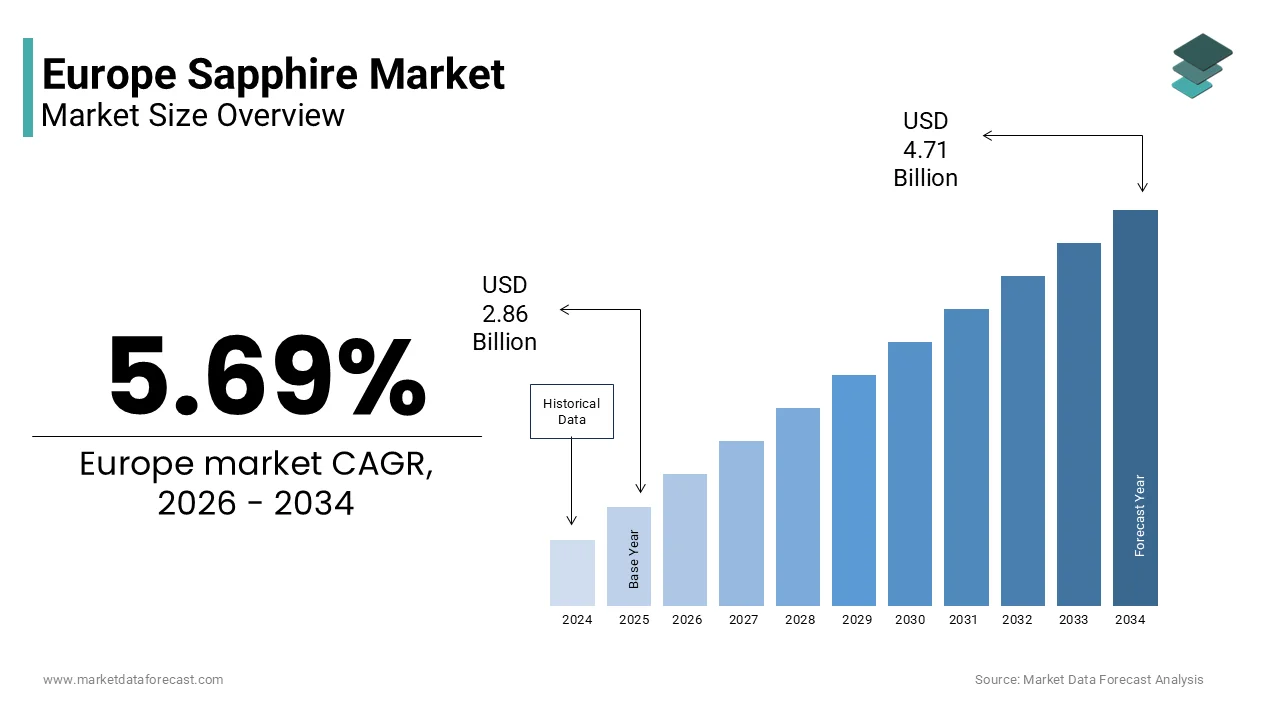
The Europe sapphire market was valued at USD 2.86 billion in 2025, is estimated to reach USD 3.02 billion in 2026, and is projected to reach USD 4.71 billion by 2034, growing at a CAGR of 5.69% during the forecast period. Market growth is driven by increasing demand for high performance materials in electronics, optics, and energy applications. Sapphire is widely used due to its superior hardness, thermal stability, and optical transparency, making it essential for semiconductors, LED substrates, and protective components. The expansion of advanced electronics, renewable energy systems, and industrial applications is further supporting steady market growth across Europe.
Key Market Trends
- Rising demand for sapphire in semiconductor and LED applications is driving market growth.
- Increasing adoption of durable and high performance materials in electronics is boosting demand.
- Growing use of sapphire in renewable energy and optical applications is supporting market expansion.
- Advancements in synthetic sapphire production are improving cost efficiency and scalability.
- Expansion of industrial and high precision applications is enhancing market opportunities.
Segmental Insights
- Based on form, the wafers segment was the largest and held 44.7% of the Europe sapphire market share in 2025. This dominance is attributed to its extensive use in semiconductor manufacturing, LED substrates, and electronic components.
- Based on type, the synthetic sapphire segment accounted for 97.1% of the Europe sapphire market share in 2025. The segment’s growth is driven by its cost effectiveness, uniform quality, and scalability compared to natural sapphire.
- Based on end use industry, the electronics and energy segment held the major share of the Europe sapphire market in 2025, supported by increasing demand for advanced electronic devices and energy efficient technologies.
Regional Insights
- The Europe sapphire market is experiencing steady growth across key countries, supported by advancements in electronics and industrial applications.
- Germany was the largest contributor, accounting for 25.6% of the Europe sapphire market share in 2025, driven by strong industrial base, advanced manufacturing capabilities, and high demand for semiconductor and optical materials.
Competitive Landscape
The Europe sapphire market is moderately competitive, with key players focusing on technological advancements, product quality, and expansion of production capabilities to strengthen their market position. Companies are investing in synthetic sapphire production, precision manufacturing, and application specific innovations. Prominent players in the Europe sapphire market include Rubicon Technology, Monocrystal, Kyocera Corporation, Saint Gobain, GT Advanced Technologies, Namiki Precision Jewel Co Ltd, Fraunhofer Gesellschaft, DK Aztec Co Ltd, ACME Electronics Corporation, and Sapphire Technology Co Ltd.
Europe Sapphire Market Size
The Europe sapphire market size was valued at USD 2.86 billion in 2025 and is projected to reach USD 4.71 billion by 2034 from USD 3.02 billion in 2026, growing at a CAGR of 5.69%.
The European sapphire market involves the creation and sale of synthetic crystals known for their extreme durability and clarity. This specialized sector primarily serves high technology industries including semiconductor manufacturing consumer electronics aerospace and luxury watchmaking. Synthetic sapphire is predominantly produced through methods such as the Kyropoulos method or heat exchanger method to ensure high purity and structural integrity. The market is characterized by a strong demand for precision engineered components that can withstand extreme environments. As per the German Federal Ministry for Economic Affairs and Climate Action the European semiconductor industry saw a major boost in 2024 when partners including TSMC and Bosch finalized a joint investment exceeding 10 billion euros for a new state of the art fabrication facility in Dresden. This investment underscores the strategic importance of reliable material supplies for advanced chip manufacturing. Furthermore the European Union’s Chips Act aims to double the region’s global market share in semiconductors to 20% by 2030 thereby driving sustained demand for high quality substrate materials. The luxury goods sector also contributes significantly with Switzerland and France being key hubs for high end timepieces that utilize sapphire crystal for watch faces due to its scratch resistance. According to the Federation of the Swiss Watch Industry the export value of Swiss watches reached approximately 26 billion Swiss francs in 2024 with the majority of luxury units utilizing sapphire glass. The market is further influenced by advancements in light emitting diode technology where sapphire serves as a primary substrate. The interplay between technological innovation regulatory support for semiconductor sovereignty and enduring luxury trends defines the current landscape of the Europe sapphire market.
MARKET DRIVERS
Expansion of Semiconductor Manufacturing Capabilities
The growth of the semiconductor sector is a key catalyst for the European sapphire market as these substrates are vital for creating specific circuits and light-emitting diodes. Sapphire is highly valued for its electrical insulation properties, thermal conductivity, and lattice match with gallium nitride, which is essential for power electronics and radio frequency devices. As per Spherical Insights, the European semiconductor manufacturing equipment market was valued at 23.05 billion sapphirears in 2024, reflecting increased capital expenditure by chipmakers. This growth is directly linked to the establishment of new fabrication plants across Germany, France, and Italy under the strategic framework of the European Chips Act. These facilities require substantial quantities of high purity sapphire wafers for specialized applications, such as silicon on sapphire technology, which offers superior performance in harsh environments. The demand for electric vehicles and 5G infrastructure further accelerates the need for efficient power management chips that often utilize sapphire based substrates. Sapphire’s ability to withstand high temperatures and voltages makes it indispensable for these advanced applications. Additionally, the miniaturization of electronic components drives the requirement for thinner and more precise sapphire wafers. Manufacturers are investing in advanced polishing and cutting technologies to meet these stringent specifications. The strategic push for technological sovereignty in Europe ensures long term demand for sapphire materials. This sustained industrial activity provides a stable foundation for market growth and encourages local sourcing initiatives.
Resilience of the Luxury Watchmaking Industry
The consistent strength of high end watch manufacturing is a major driver for the European sapphire market because the material is the standard choice for watch crystals. Sapphire glass is renowned for its exceptional hardness rating of 9 on the Mohs scale, making it virtually scratch proof and ideal for preserving the aesthetic integrity of high end timepieces. Switzerland and France are the epicentres of this industry with major brands, such as Rolex, Patek Philippe, and Cartier, relying exclusively on sapphire for their premium collections. As per the Federation of the Swiss Watch Industry, Swiss watch exports were valued at 25.5 billion Swiss francs in 2025, demonstrating robust global demand despite minor market contractions. This strong performance translates into consistent procurement of high quality synthetic sapphire blanks and finished crystals. The trend towards larger watch cases and complex designs has increased the volume of sapphire required per unit. Furthermore, the growing appreciation for mechanical watches among younger consumers in emerging markets supports continued production growth. According to Morgan Stanley and WatchCharts, secondary market prices for luxury watches rose by 4.9% in 2025, indicating a meaningful recovery in higher value segments where sapphire is standard. The durability and clarity of sapphire enhance the perceived value of these products, justifying its widespread adoption. Manufacturers are also innovating with anti-reflective coatings and intricate shapes to differentiate their offerings. The enduring appeal of luxury goods in Europe ensures a steady and predictable demand stream for sapphire producers. This segment provides high margin opportunities due to the stringent quality requirements and brand prestige associated with the material.
MARKET RESTRAINTS
High Production Costs and Energy Intensity
The significant energy and financial requirements of producing synthetic sapphire is a major hurdle for the European market. The growth of large single crystals requires prolonged heating periods at temperatures exceeding 2000 degrees Celsius, which consumes substantial amounts of electricity. As per BusinessEurope, industrial electricity prices in the European Union reached 0.199 euros per kWh in 2024, which is significantly higher than the 0.075 euros per kWh seen in the United States. This elevated cost structure impacts the competitiveness of European manufacturers compared to producers in regions with lower energy costs, such as Asia. The Kyropoulos and heat exchanger methods used for crystal growth are particularly energy intensive, requiring precise temperature control over several days. Additionally, the post growth processing steps, including slicing, grinding, and polishing, involve expensive diamond tools and skilled labor. According to industry cost structures, the combination of raw materials and energy can account for more than 40% of the total production expense for sapphire wafers. These financial pressures limit the ability of companies to invest in expansion or research and development. Small and medium sized enterprises are particularly vulnerable to these cost fluctuations, which can erode profit margins. The transition to renewable energy sources, while environmentally beneficial, often involves upfront infrastructure investments that further strain budgets. Consequently, manufacturers face challenges in maintaining price competitiveness in the global market. This economic burden acts as a barrier to entry for new players and restricts the scaling of existing operations. The need for cost efficient production methods remains a critical issue for the industry.
Complexity of Precision Machining and Processing
The technical difficulty of shaping and finishing sapphire is a notable barrier for the European market because the material is both extremely hard and brittle. Shaping sapphire into specific forms, such as wafers, lenses, or watch crystals, requires specialized equipment and advanced technical expertise. The machining process generates significant heat and stress, which can lead to micro cracks and surface defects if not carefully managed. Achieving the required surface roughness and parallelism for semiconductor applications demands multiple stages of lapping and polishing using diamond slurries. This labor intensive process extends production lead times and limits throughput. The shortage of skilled technicians capable of operating sophisticated machining centers further exacerbates the challenge. According to McKinsey, 63% of European employers identify skills gaps, particularly in technology design and engineering, as the biggest barrier to business transformation through 2030. Additionally, the wear and tear on diamond tools used for cutting sapphire adds to operational expenses. Any deviation in process parameters can result in rejected batches, which is costly given the high value of the raw material. The inability to rapidly scale production in response to demand spikes restricts market flexibility. Manufacturers must continuously invest in automation and process optimization to improve efficiency. These technical hurdles constrain the widespread adoption of sapphire in cost sensitive applications. The balance between quality and productivity remains a persistent operational challenge.
MARKET OPPORTUNITIES
Adoption in Aerospace and Defense Optics
The use of sapphire in the aerospace and defense sectors is expanding because the material offers unmatched optical and mechanical performance, which is a notable opportunity for the European sapphire market. Sapphire windows and domes are essential for protecting sensitive sensors, cameras, and infrared systems in aircraft, missiles, and satellites. The material’s ability to transmit light across a wide spectrum, from ultraviolet to mid-infrared, makes it ideal for various sensing applications. As per the European Defence Agency, total defense expenditure by EU Member States reached 343 billion euros in 2024, which represents a 19% increase from the previous year. This increase in funding supports the development of advanced surveillance and guidance systems, which rely on high-performance optical components. The growing number of satellite launches for communication and earth observation also drives demand for durable sapphire covers, which can withstand space radiation and micrometeoroid impacts. For instance, the demand for space launch services in Europe is growing rapidly and this trend is expected to fuel further in the coming years. Sapphire’s resistance to abrasion and chemical corrosion ensures long-term reliability in harsh environments. Manufacturers are developing larger and thicker sapphire components to meet the needs of next-generation aerospace platforms. The strategic importance of sovereign defense capabilities encourages local sourcing of critical materials. This trend benefits European sapphire producers, who can offer secure and compliant supply chains. The integration of sapphire in unmanned aerial vehicles and autonomous systems further expands potential applications. These diverse aerospace and defense needs create a robust growth avenue for the market.
Integration in Medical Device Components
The inclusion of sapphire in medical instruments is a significant growth area for the European market due to the material's durability and biological safety. Sapphire is increasingly used in surgical instruments, endoscopes, and implantable devices due to its inert nature and resistance to sterilization processes. The material’s smooth surface reduces friction and tissue trauma during minimally invasive procedures, enhancing patient outcomes. As per MedTech Europe, the European medical technology market was valued at approximately 170 billion euros in 2024, with a steady growth trajectory supported by an aging population. The demand for advanced diagnostic and therapeutic tools is rising as hospitals adopt newer technologies for better precision. Sapphire lenses and windows are critical for high-resolution imaging systems used in laparoscopy and robotics. The ability of sapphire to withstand repeated autoclaving without degradation makes it a preferred choice for reusable instruments. According to regulatory updates, the European Union’s Medical Device Regulation emphasizes safety and performance standards, which favor high-quality materials like sapphire. Manufacturers are collaborating with medical device companies to develop customized sapphire components that meet specific clinical requirements. The trend towards outpatient surgeries and home healthcare devices also creates new application areas. Sapphire’s aesthetic appeal and premium perception add value to consumer health products. The focus on infection control and durability aligns with hospital procurement priorities. These factors position sapphire as a key material in the evolving medical technology landscape. The opportunity to expand into this high-value sector diversifies revenue streams for producers.
MARKET CHALLENGES
Supply Chain Vulnerability and Raw Material Sourcing
The European sapphire market faces challenges due to its dependence on imported raw materials and potential supply chain disruptions. Although synthetic sapphire is manufactured locally, the primary raw material, high-purity aluminum oxide, which is often sourced from limited global suppliers. Geopolitical instability and trade restrictions can disrupt the flow of these essential inputs, affecting production schedules. For instance, China currently controls over 65% of the global supply of aluminum hydroxide, which serves as the primary feedstock for high-purity alumina. This dependence exposes manufacturers to price volatility and logistical bottlenecks. The recent disruptions in global shipping lanes have led to increased freight costs and longer lead times for raw material deliveries. According to shipping and logistics reports, average lead times for specialized industrial materials increased by approximately 20% in 2024, which is impacting just-in-time manufacturing models. Additionally, the lack of diversified sourcing options limits the bargaining power of European buyers. Any disruption in the supplying countries due to natural disasters or political issues can have cascading effects on the sapphire industry. The strategic push for resource autonomy in Europe highlights the need for secure supply chains, but establishing local alumina refining capacity is capital-intensive. Companies must maintain higher inventory levels to mitigate risks, which ties up working capital. The uncertainty surrounding raw material availability complicates long-term planning and investment decisions. Ensuring a stable and cost-effective supply of high-purity alumina remains a critical challenge for market participants.
Intense Competition from Alternative Substrate Materials
The sapphire market in Europe is facing tough competition from other materials like silicon carbide and gallium nitride on silicon. These alternatives offer comparable or superior performance characteristics for certain semiconductor applications at potentially lower costs. Silicon carbide, for instance, provides higher thermal conductivity and breakdown voltage, making it attractive for high-power electric vehicle applications. For instance, the demand for silicon carbide semiconductor materials and devices in Europe is on the rise and is expected to grow exponentially in the next few years. This shift in preference threatens the market share of sapphire in power electronics. Gallium nitride on silicon substrates also gains traction, due to the established infrastructure and lower manufacturing costs of silicon wafers. The ability to leverage existing silicon fabrication facilities reduces capital expenditure for chipmakers. According to technical cost assessments, the processing cycle times for silicon-on-sapphire wafers can be nearly 32% longer than conventional substrates, and yield variability can affect approximately 28% of production batches. This economic advantage drives adoption in cost-sensitive consumer electronics. Sapphire manufacturers must continuously innovate to justify their premium pricing through enhanced performance or unique features. The rapid pace of technological change requires significant investment in research and development to stay competitive. Failure to adapt to emerging material trends can result in obsolescence. The presence of well-funded competitors in the alternative materials space intensifies the pressure on sapphire producers. Maintaining relevance in a dynamic technological landscape is a persistent challenge for the regional market.
REPORT COVERAGE
| REPORT METRIC | DETAILS |
| Market Size Available | 2025 to 2034 |
| Base Year | 2025 |
| Forecast Period | 2026 to 2034 |
| CAGR | 5.69% |
| Segments Covered | By Form, Type, End Use Industry, and Region |
| Various Analyses Covered | Global, Regional, & Country Level Analysis; Segment-Level Analysis; DROC, PESTLE Analysis; Porter’s Five Forces Analysis; Competitive Landscape; Analyst Overview of Investment Opportunities |
| Regions Covered | UK, France, Spain, Germany, Italy, Russia, Sweden, Denmark, Switzerland, Netherlands, Turkey, and the Czech Republic |
| Market Leaders Profiled | Rubicon Technology, Monocrystal, Kyocera Corporation, Saint-Gobain, GT Advanced Technologies, Namiki Precision Jewel Co., Ltd., Fraunhofer-Gesellschaft, DK Aztec Co., Ltd., ACME Electronics Corporation, and Sapphire Technology Co., Ltd |
SEGMENTAL ANALYSIS
By Form Insights
The wafers segment dominated the market by holding 44.7% of the regional market share in 2025. The growth of the wafers segment in the European market is primarily attributed to the extensive use of sapphire wafers as substrates in the semiconductor and light-emitting diode industries. Sapphire wafers provide an ideal lattice match for gallium nitride, which is crucial for producing high-efficiency LEDs and power electronics. The European push towards energy-efficient lighting and advanced semiconductor manufacturing has significantly boosted the demand for these precision-engineered components. For instance, the global sapphire technology market was valued at USD 4.88 in 2024, with the substrate wafer segment holding the largest revenue share of over 42% due to widespread use in high-performance opto-semiconductors. The automotive sector’s transition to electric vehicles further accelerates this demand, as sapphire-based semiconductors are essential for power management systems. For instance, electric vehicle sales in Europe reached approximately 3.2 million units in 2024 and are projected to grow significantly as the region builds robust semiconductor supply chains. Additionally, the miniaturization of electronic devices necessitates thinner and higher-quality wafers, which European manufacturers are increasingly capable of producing. The strategic importance of semiconductor sovereignty under the European Chips Act ensures sustained investment in wafer production capabilities. This regulatory support, combined with technological advancements, solidifies the leading position of the wafers segment in the regional market.
However, the sheets segment is projected to be the fastest-growing category in the Europe sapphire market and record a CAGR of 9.1% over the forecast period owing to the increasing adoption of sapphire sheets in consumer electronics protective covers and luxury watch crystals. Sapphire sheets offer unparalleled scratch resistance and optical clarity, making them ideal for high-end smartphone screens and premium timepieces. The luxury goods sector in Europe, particularly in Switzerland and France, is a major consumer of sapphire sheets for watch faces. As per the Federation of the Swiss Watch Industry, Swiss watch exports reached approximately 26 billion Swiss francs in 2024, with the majority of luxury units utilizing sapphire glass. This strong performance drives consistent demand for high-quality sapphire sheets. Additionally, the smartphone industry is exploring sapphire covers for camera lenses and display protection to enhance durability. The trend towards larger and more expensive smartphones supports the adoption of premium materials like sapphire. According to mobile market data, more than 41 million high-end smartphones with a list price of 800 sapphirears or higher were sold in Europe in 2024, representing a record high for the premium segment. Manufacturers are investing in larger-format sapphire sheet production to meet these evolving needs. The ability to produce thin and large sheets with minimal defects is key to capturing this growth. The combination of luxury demand and consumer electronics innovation positions the sheets segment for exceptional expansion.
By Type Insights
The synthetic sapphire segment led the market with 97.1% of the regional market share in 2025. The overwhelming dominance is driven by the ability to produce sapphire with consistent purity, size, and optical properties required for industrial applications. Natural sapphire is rare, and often contains impurities that make it unsuitable for high-technology uses such as semiconductor substrates and precision optics. Synthetic sapphire can be manufactured in large boules and cut into specific shapes and sizes with high precision. For instance, Europe held an 19.4% share of the global synthetic sapphire market in 2025, where industrial and aerospace demand remains a key structural driver for high-purity substrates. The cost-effectiveness of synthetic production compared to mining and processing natural stones also favors its adoption. The established manufacturing infrastructure in Europe for crystal growth supports this dominance. Companies utilize advanced methods like the Kyropoulos process to produce high-quality crystals efficiently. According to sapphire technology research, the demand for 6-inch and 8-inch sapphire wafers grew by 18% year-over-year in 2024, as manufacturers improved efficiency to match the needs of high-volume semiconductor producers. This improvement reduces waste and lowers costs, making synthetic sapphire even more attractive. The scalability of synthetic production allows manufacturers to meet the growing demand from various industries. Natural sapphire is largely confined to the jewelry market, which represents a small fraction of the overall sapphire consumption in terms of industrial value. The strategic focus on technological applications ensures that synthetic sapphire remains the primary type in the market.
On the other side, the natural sapphire segment is estimated to grow at a CAGR of 7.2% over the forecast period due to the rising demand for natural gemstones in the luxury jewelry and investment sectors. Consumers are increasingly valuing the rarity and authenticity of natural sapphires, particularly those with unique colors and origins. The European market for colored gemstones is robust, with France and the United Kingdom being key hubs for high-end jewelry trade. For instance, the European jewelry market was valued at USD 90.63 in 2025, with growth increasingly driven by the rising need for personalization and unique bespoke designs. The trend towards ethical sourcing and transparency also benefits natural sapphire suppliers, who can provide certified origin information. Blockchain technology is being used to track the journey of natural sapphires from mine to market, enhancing consumer confidence. For instance, natural gemstones are expected to maintain a CAGR of 5.5% as consumers increasingly prioritize sustainable values and authentic materials. This shift in consumer behavior supports the growth of the natural segment. Additionally, the investment potential of rare natural sapphires attracts collectors and investors. Auction houses in Europe regularly report record prices for exceptional stones. The limited supply of high-quality natural sapphires creates scarcity value, which drives price appreciation. These factors combine to create a dynamic and growing market for natural sapphire despite its smaller overall volume.
By End Use Industry Insights
The electronics and energy segment had the major share of the European sapphire market in 2025 due to the widespread use of sapphire in light-emitting diodes, consumer electronics, and solar energy applications. Sapphire substrates are essential for producing high-efficiency LEDs, which are the standard for lighting in Europe. The region’s commitment to energy efficiency and carbon reduction supports the continued adoption of LED technology. As per the revised EU Mercury Regulation published in 2024, the European Union has implemented a strict timeline to ban the manufacturing and export of several mainstream mercury-containing lamps by the end of 2025 and 2026, ensuring near-universal transition to LED sources. This regulatory push ensures steady demand for sapphire wafers. Additionally, the consumer electronics sector utilizes sapphire for camera lenses and protective covers in smartphones and wearables. The premiumization of mobile devices drives the use of durable materials like sapphire. According to recent mobile market data, sales of high-end smartphones priced above 800 sapphirears reached a record high in Europe in 2024, with premium models increasingly adopting sapphire glass and titanium components for enhanced durability. The solar energy sector also contributes through the use of sapphire in certain photovoltaic technologies. The integration of sapphire in various electronic and energy applications creates a broad and stable demand base. The technological necessity of sapphire in these high-volume industries secures its leading position. Continuous innovation in electronics further expands the scope of sapphire usage.
On the other hand, the semiconductor equipment segment is the most rapidly expanding end-use category for sapphire in Europe and is predicted to register a CAGR of 10.5% over the forecast period owing to the strategic expansion of semiconductor manufacturing capacity in Europe under the Chips Act. New fabrication plants require advanced equipment and components, many of which utilize sapphire for its thermal and electrical properties. Sapphire is used in wafer handling systems, inspection windows, and specialized sensors within semiconductor tools. As per official European Commission updates, the European Chips Act has mobilized more than 80 billion euros in public and private investments for semiconductor manufacturing and research as of early 2025, nearly double the original 43 billion euro target. This substantial investment drives the construction of new facilities and the procurement of related equipment. The need for high purity and precision in semiconductor manufacturing favors sapphire components. The focus on developing mature nodes for automotive and industrial applications also increases equipment demand. According to regional market reports, the European semiconductor manufacturing equipment market was valued at over 23 billion sapphirears in 2024 and is projected to experience sustained growth as local fabrication capacity expands. This growth trajectory directly benefits suppliers of sapphire-based components. The localization of supply chains reduces dependency on imports and enhances security. The technological complexity of new fabs requires innovative materials solutions. Sapphire’s unique properties make it indispensable for next-generation manufacturing tools. These factors position the semiconductor equipment segment for exceptional expansion.
REGIONAL ANALYSIS
Germany Sapphire Market Analysis
Germany remained the primary hub for the European sapphire market and held 25.6% of the European market share in 2025. The country’s dominant position is attributed to its strong automotive and semiconductor industries, which are major consumers of sapphire components. Germany is a leader in electric vehicle production and semiconductor manufacturing, driving demand for sapphire wafers and substrates. As per the German Association of the Automotive Industry, domestic passenger car production reached approximately 4.1 million units in 2024, with roughly 20% of new registrations consisting of electric or plug-in hybrid vehicles. These vehicles require numerous semiconductor chips, many of which utilize sapphire technology. The presence of major semiconductor equipment manufacturers in Germany also contributes to market growth. The government’s support for the European Chips Act has led to significant investments in local fabrication facilities. According to the European Commission, the European Chips Act has mobilized over 80 billion euros in total investments for semiconductor manufacturing and research as of 2025, with Germany serving as a central recipient for major new projects. This funding stimulates demand for sapphire based materials. The country’s strong engineering base supports the development of advanced sapphire applications. Research institutions are actively working on improving sapphire processing techniques. As per innovation reports, Germany files the highest number of patents related to sapphire applications in Europe. The focus on industrial automation and Industry 4.0 also drives demand for durable sensors and optics. These factors collectively sustain Germany’s leading position in the sapphire market.
Switzerland Sapphire Market Analysis
Switzerland had the second largest share of the European sapphire market in 2025 due to its world renowned luxury watchmaking industry, which is the primary consumer of sapphire sheets for watch crystals. Swiss brands, such as Rolex and Patek Philippe, set the global standard for high end timepieces. As per the Federation of the Swiss Watch Industry, Swiss watch exports were valued at approximately 26 billion Swiss francs in 2024, with the resilient high-end segment ensuring that most luxury units continue to feature sapphire glass. This consistent demand drives the local sapphire processing industry. Switzerland is home to specialized companies that cut and polish sapphire to exacting standards. The precision and quality of Swiss sapphire components are unmatched globally. The industry’s focus on innovation leads to the development of new shapes and coatings for sapphire crystals. For instance, the demand for anti-reflective coated sapphire has grown by 10% annually. The luxury sector’s resilience ensures stable market conditions. Additionally, the presence of high tech medical device manufacturers in Switzerland contributes to demand for sapphire optics. The country’s reputation for quality and precision attracts international clients. These factors maintain Switzerland’s strong position in the regional market.
France Sapphire Market Analysis
France holds a prominent share of the Europe sapphire market owing to its luxury goods sector, particularly jewelry and watches, as well as its growing aerospace industry. France is a major hub for high end jewelry where natural sapphires are highly valued. The country is also home to leading aerospace companies that use sapphire for optical systems in satellites and aircraft. The European space program relies on French expertise in satellite manufacturing. According to recent aerospace flight logs, France successfully supported the inaugural commercial flight of the Ariane 6 rocket in early 2025, which delivered advanced reconnaissance satellites containing sapphire components into orbit. The government’s support for the space sector encourages innovation in materials. Additionally, France has a growing semiconductor research community that explores sapphire applications. The country’s strong cultural heritage in luxury and technology creates a unique market dynamic. The demand for both natural and synthetic sapphire is balanced. The presence of skilled craftsmen and engineers supports high value added activities. These factors contribute to France’s significant share in the sapphire market.
United Kingdom Sapphire Market Analysis
The United Kingdom is projected to witness a healthy CAGR in the European sapphire market over the forecast period owing to its strong financial services sector, which supports investment in rare gemstones, and its advanced defense industry. London is a global center for gemstone trading and auctions where natural sapphires are frequently bought and sold. For instance, the UK gemstone market reached a value of 911.4 million sapphirears in 2024, with sapphire remaining one of the primary high-end categories behind diamonds. This trading activity drives market visibility and liquidity. The defense sector utilizes sapphire for infrared domes and sensor windows in military aircraft and missiles. The UK’s increased defense spending supports this demand. According to the UK Parliament, the national defense budget reached 60.2 billion pounds for the 2024/25 financial year, with a significant allocation toward capital equipment and advanced technology. This funding enables the procurement of advanced systems containing sapphire components. The country also has a growing technology sector that explores sapphire in electronics. Research universities are investigating new applications for sapphire in quantum computing and photonics. The combination of financial strength and technological innovation maintains the UK’s prominent position. The post Brexit regulatory environment has encouraged local sourcing initiatives. These factors sustain the UK’s role in the European sapphire market.
Italy Sapphire Market Analysis
Italy is anticipated to account for a notable share of the European sapphire market over the forecast period due to its luxury jewelry and fashion industries, as well as its manufacturing sector. Italy is known for its exquisite jewelry designs, which often incorporate natural sapphires. The country has a strong tradition of goldsmithing and gem setting. The demand for high quality natural sapphires is robust among domestic and international buyers. Additionally, Italy has a growing machinery manufacturing sector that produces equipment for various industries. Some of this equipment utilizes sapphire components for wear resistance. The country’s focus on design and aesthetics extends to technical applications. Italian companies are innovating in the processing of sapphire for decorative and functional purposes. The tourism sector also contributes to sales of sapphire jewelry. The combination of artistic heritage and industrial capability defines the Italian market. The government’s support for Made in Italy brands enhances global recognition. These factors ensure Italy’s continued presence in the European sapphire landscape.
COMPETITIVE LANDSCAPE
The competition in the Europe sapphire market is characterized by a mix of specialized material producers and diversified industrial conglomerates. Market participants compete primarily on product quality technical expertise and supply chain reliability. The high barriers to entry due to capital intensive manufacturing and complex processing technologies limit the number of domestic players. However international companies with local presence exert significant influence through established distribution networks. Competition is intensifying around sustainability credentials with firms vying to offer low carbon footprint products. Intellectual property related to crystal growth and machining processes is a crucial competitive asset. Partnerships between European manufacturers and Asian suppliers are common to secure raw materials while maintaining local value addition. The race to develop larger and defect free crystals creates a dynamic environment. Price sensitivity varies by application with luxury sectors less affected than industrial segments. Customers prioritize consistent quality and timely delivery over lowest cost. The interplay between technological leadership and operational efficiency shapes the strategic decisions of all participants. Regulatory compliance and environmental standards further differentiate competitors. Overall the market remains consolidated among key players who possess the necessary scale and expertise.
KEY MARKET PLAYERS
Some of the notable key players in the Europe sapphire market are
- Rubicon Technology
- Monocrystal
- Kyocera Corporation
- Saint-Gobain
- GT Advanced Technologies
- Namiki Precision Jewel Co., Ltd.
- Fraunhofer-Gesellschaft
- DK Aztec Co., Ltd.
- ACME Electronics Corporation
- Sapphire Technology Co., Ltd.
Top Players in the Market
- Rubicon Technology is a leading manufacturer of high purity sapphire crystals and components with a significant presence in the European market. The company specializes in producing large diameter sapphire boules and wafers used in semiconductor and optical applications. Rubicon contributes to the global market by supplying critical materials for light emitting diode production and consumer electronics. Recently the company has strengthened its position by investing in advanced crystal growth technologies that improve yield and reduce energy consumption. These innovations align with European sustainability goals and enhance cost competitiveness. Rubicon also collaborates with local distributors to ensure timely delivery and technical support for European clients. By focusing on quality consistency and customer service Rubicon maintains a strong reputation among industrial users. The company’s commitment to research and development enables it to meet the evolving specifications of high tech industries. This strategic focus on technological excellence and operational efficiency solidifies its role as a key supplier in the Europe sapphire market.
- Saint Gobain is a multinational corporation with a diverse portfolio including advanced materials such as synthetic sapphire. The company leverages its extensive manufacturing network to produce sapphire components for aerospace defense and medical applications in Europe. Saint Gobain contributes to the global market by providing specialized optical solutions that require extreme durability and transparency. Recent actions to strengthen its market position include the expansion of its precision machining facilities in France to handle larger sapphire formats. This investment allows the company to serve the growing demand from the semiconductor equipment sector. Saint Gobain also emphasizes sustainable production practices reducing the environmental impact of its operations. The company actively partners with research institutions to develop new sapphire applications in photonics and sensors. By integrating vertical capabilities from raw material processing to finished components Saint Gobain offers comprehensive solutions. Its strong brand recognition and technical expertise ensure a competitive edge in the premium segment of the Europe sapphire market.
- Kyocera Corporation is a major player in the advanced ceramics industry with a strong footprint in the Europe sapphire market. The company produces high quality sapphire substrates and windows for various industrial and electronic applications. Kyocera contributes to the global market by delivering reliable components for semiconductor manufacturing and optical systems. In Europe the company has strengthened its position by establishing closer collaborations with automotive and electronics manufacturers. Recent initiatives include the development of customized sapphire solutions for electric vehicle sensors and power modules. Kyocera also invests in automation to enhance production efficiency and product consistency. The company’s focus on innovation drives the creation of new sapphire based products that meet stringent performance requirements. By leveraging its global supply chain and local expertise Kyocera ensures reliable availability of materials for European customers. Its commitment to quality and customer satisfaction reinforces its standing as a trusted partner in the region. Kyocera’s strategic alignment with industry trends supports sustained growth in the Europe sapphire market.
Top Strategies Used by the Key Market Participants
Key players in the Europe sapphire market primarily employ vertical integration and technological innovation to maintain competitive advantage. Companies invest heavily in research and development to improve crystal growth techniques and reduce production costs. This focus on efficiency helps mitigate the impact of high energy prices in Europe. Strategic partnerships with end users in semiconductor and aerospace industries enable customized product development and long term supply agreements. Expansion of local processing facilities reduces dependency on imports and enhances supply chain security. Sustainability initiatives are increasingly central to corporate strategies with firms adopting renewable energy and recycling programs. Compliance with environmental regulations drives these green efforts. Geographic diversification of sourcing ensures stability against geopolitical risks. Digitalization of manufacturing processes improves quality control and traceability. These multifaceted strategies collectively strengthen market positions and drive long term growth in the competitive landscape.
MARKET SEGMENTATION
This research report on the European sapphire market has been segmented and sub-segmented based on categories.
By Form
- Sapphire Boules
- Wafers
- Sheets
By Type
- Synthetic
- Natural
By End Use Industry
- Aerospace and Defense
- Medical
- Semiconductor Equipment
- Electronics and Energy
- Others
By Country
- UK
- France
- Spain
- Germany
- Italy
- Russia
- Sweden
- Denmark
- Switzerland
- Netherlands
- Turkey
- Czech Republic
- Rest of Europe