- Product Description Description
- Table of Contents TOC
- List of Table & Figure LOT
- Get Free Sample PDF Sample PDF
Europe Satellite Internet Market Size
The europe satellite internet market size was valued at USD 3.08 billion in 2024 and is anticipated to reach USD 3.51 billion in 2025 from USD 10.00 billion by 2033, growing at a CAGR of 14.00% during the forecast period from 2025 to 2033.
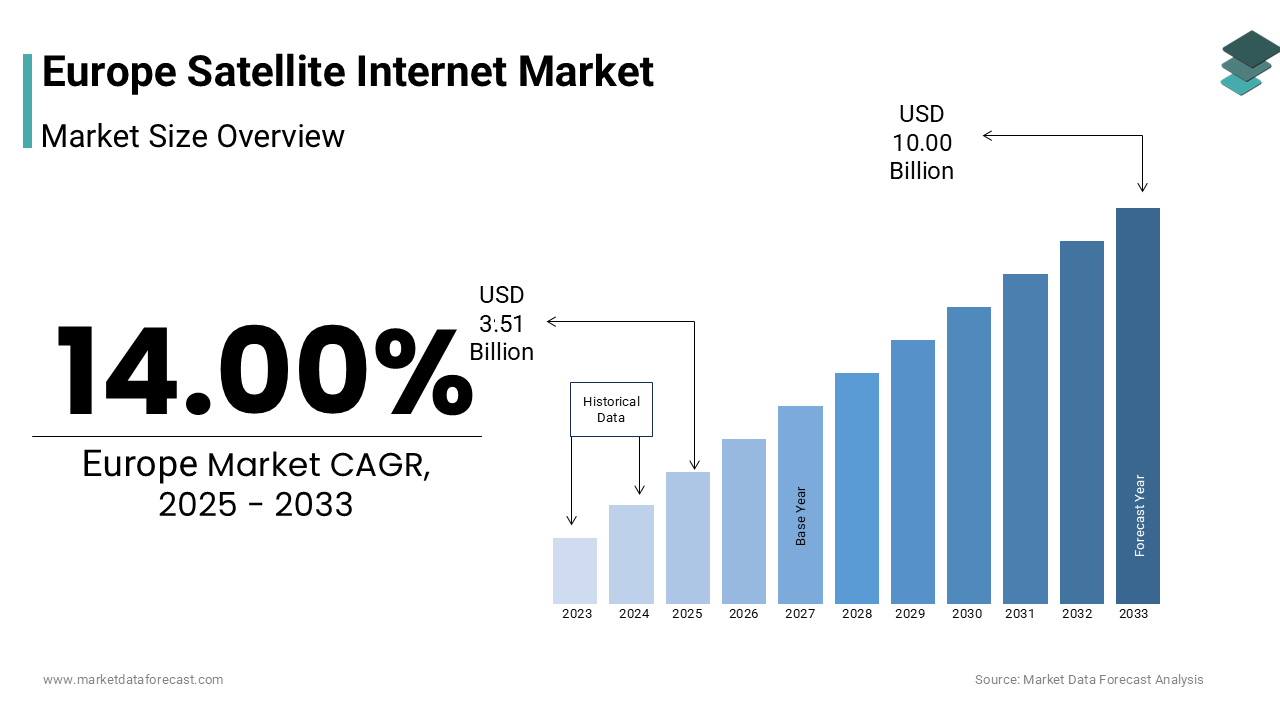
Satellite internet is the broadband connectivity delivered via geostationary, medium Earth orbit, or low Earth orbit satellites to end users across residential, enterprise, maritime, aviation, and governmental sectors. Unlike terrestrial networks reliant on fiber or cellular infrastructure, satellite internet provides ubiquitous coverage, which is making it essential for remote communities, mobile platforms, and critical backup services. The European satellite internet landscape is undergoing transformation with the advent of high-throughput low Earth orbit constellations offering latency below 50 milliseconds and speeds exceeding 100 Mbps. According to the European Space Agency, the majority of unmet demand for broadband in Europe is forecast to be in rural regions. According to Eurostat, 94 % of all households in the EU had access to the internet in 2024. According to the European Commission’s Digital Decade Policy Programme, by 2030 all households in the EU should be covered by a gigabit-capable network and all populated areas by 5G connectivity. With the EU actively supporting sovereign space initiatives like IRIS² and fostering regulatory frameworks for spectrum allocation, satellite internet has evolved from a niche alternative to a strategic pillar of Europe’s digital sovereignty and inclusion agenda.
MARKET DRIVERS
Digital Inclusion Mandates and the Rural Connectivity Gap
The binding digital inclusion targets of the European Union are a primary driver for satellite internet adoption, particularly in geographically isolated or sparsely populated regions where fiber rollout is economically unviable, which is majorly propelling the growth of the European satellite internet market. The Digital Decade Compass requires that all EU households have access to gigabit networks by 2030, yet vast areas in Eastern and Northern Europe remain underserved. According to the European Commission, connecting the most remote rural areas via fiber would require significantly higher investment than urban deployments. Satellite internet offers a near-term solution with deployment timelines under six months versus five to seven years for terrestrial alternatives. According to the National Authority for Management and Regulation in Communications, over 1.2 million households in mountainous regions of Romania, such as the Carpathians, lack access to fixed broadband. In Sweden, many northern municipalities continue to rely on satellite as their primary form of internet access. National broadband schemes in Finland and Ireland now include satellite as an eligible technology under public subsidy programs, which is accelerating terminal distribution and service uptake in areas where digital exclusion impedes education, healthcare, and economic participation.
Rising Demand from Mobility and Critical Infrastructure Sectors
The non-residential demand from maritime, aviation, and public safety sectors requiring uninterrupted, mobile broadband connectivity across Europe’s extensive transport corridors and exclusive economic zones is further boosting the expansion of the satellite internet market in Europe. According to the European Maritime Safety Agency, over 12,000 commercial vessels operate in EU waters annually with mandatory International Maritime Organization regulations requiring real-time tracking and crew welfare connectivity. According to the European Union Aviation Safety Agency, all new commercial aircraft registered in the EU must support in-flight internet for operational communications, which is driving adoption of low-latency satellite solutions. Additionally, emergency services are integrating satellite failover into critical infrastructure, which is enhancing resilience. Germany’s Federal Office of Civil Protection deployed satellite terminals to over 200 fire and rescue stations in 2024 following a nationwide fiber outage that disrupted emergency response. According to the European Union Agency for Railways, satellite connectivity is a key enabler for the digitalization of cross-border freight corridors under the Shift2Rail initiative. This institutional and mobility-driven demand, less sensitive to consumer price fluctuations and provides stable revenue streams and validates satellite internet as a resilient backbone for Europe’s transport and public safety ecosystems.
MARKET RESTRAINTS
Regulatory Fragmentation in Spectrum and Licensing
The national divergence in spectrum allocation and ground station licensing remains a significant restraint on satellite internet deployment across Europe, which is majorly impeding the regional market growth. Low Earth orbit constellations require dense networks of gateway Earth stations to offload data, yet member states apply inconsistent rules for frequency use, antenna placement, and environmental impact assessments. According to the European Conference of Postal and Telecommunications Administrations, operators face up to 18 separate national authorisation processes to deploy gateways across the EU with approval timelines ranging from three months in the Netherlands to over two years in Italy. In France, the National Frequency Agency imposes strict power density limits on Ka-band transmissions near protected radio-astronomy sites, which is forcing network redesigns. Similarly, in Germany the Federal Network Agency requires individual permits for each user terminal in certain regions that discourages mass residential adoption. This regulatory patchwork increases operational complexity and delays service rollout, which is undermining the economies of scale that constellations depend on. Without harmonised EU spectrum policy under the Electronic Communications Code, satellite providers cannot fully leverage continental coverage potential, which is limiting service availability and price competitiveness in a market increasingly defined by seamless cross-border connectivity.
High Terminal Costs and Consumer Affordability Barriers
The upfront cost of user terminals remains a critical barrier to mass adoption of satellite internet in Europe, particularly among price sensitive rural households, which is further hindering the growth of the satellite internet market. While monthly service fees have declined, the hardware required to access low Earth orbit networks typically costs between 400 and 600 euros. According to the European Consumer Organisation, spending on satellite-internet hardware can represent over 15% of average monthly disposable income in countries like Bulgaria and Greece, which is making it unaffordable without subsidies. Even in wealthier nations, adoption is constrained. According to a 2024 survey by Germany’s Federal Ministry for Digital and Transport, 68% of rural residents cited terminal cost as the main reason for not subscribing to satellite broadband. Although some operators offer financing, few national broadband schemes fully cover hardware expenses and only Finland and Portugal include terminal reimbursement in their rural connectivity grants. Without scalable manufacturing or public–private co-funding models, the hardware bottleneck prevents satellite internet from achieving the penetration needed to meet the Digital Decade Policy Programme targets, especially when competing against subsidised fibre or 5G fixed-wireless alternatives that require no customer-premises-equipment investment.
MARKET OPPORTUNITIES
Integration with EU’s IRIS² Secure Communication Program
The European Union’s IRIS² program presents a major opportunity to embed commercial satellite internet providers into a sovereign, secure, and interoperable government backed network, which is a promising opportunity for the European satellite internet market. According to the IRIS² programme of the European Commission, a hybrid multi-orbital constellation of satellites is planned to be deployed by 2027 with service rollout to governmental, defence, and critical infrastructure users while enabling commercial service layering. The programme’s funding model includes a contribution of €2.4 billion from the EU budget and European Space Agency toward satellites and associated infrastructure. In 2024, the European Defence Agency issued a call for industry to develop dual-use user terminals capable of switching between public broadband and secure IRIS² channels during emergencies. This convergence allows commercial operators to amortise terminal costs across civilian and public sectors. Companies such as Airbus Defence and Space and Thales Alenia Space are already developing IRIS²-compatible user equipment, with pilot deployments planned in Alpine and Baltic border regions. By embedding satellite internet within Europe’s strategic autonomy framework, IRIS² transforms the market from a consumer utility into a dual-use digital infrastructure asset with long-term institutional backing.
Expansion into Precision Agriculture and Remote Monitoring
Satellite internet is unlocking high value applications in Europe’s agricultural and environmental sectors by enabling real time data connectivity in remote fields, forests, and waterways where terrestrial networks are absent. According to the European Environment Agency, a significant portion of the EU’s agricultural land lies more than 5 km from fibre infrastructure, which is limiting adoption of precision-farming tools. Satellite connectivity now allows automated irrigation systems, soil-moisture sensors, and drone-based crop-health monitors to transmit data continuously. In Spain, the Spanish Ministry of Agriculture reported olive farms in Andalusia using satellite-linked sensors reduced water consumption by 22 % during drought conditions. Similarly, Finland’s Finnish Forest Centre deployed satellite-connected wildfire cameras across Lapland, which is cutting detection time from hours to minutes. The European Space Agency’s IAP programme has funded agritech startups since 2022 that rely on low-latency satellite links for autonomous-machinery coordination. As the Common Agricultural Policy increasingly ties subsidies to digital-sustainability metrics, satellite internet becomes an enabler of compliance and efficiency, which is creating a B2B revenue stream less dependent on residential price sensitivity and more aligned with Europe’s green and digital-transition priorities.
MARKET CHALLENGES
Orbital Congestion and Space Debris Mitigation Requirements
The rapid deployment of low Earth orbit constellations has intensified concerns over orbital congestion and collision risks, which is leading to stricter European regulatory requirements that increase operational complexity and cost for satellite internet providers and is considered as one of the major challenges to the European market growth. According to the European Space Agency’s Space Debris Office, the number of active satellites in low Earth orbit has grown significantly between 2020 and 2024. The EU’s space traffic management initiative mandates that satellites launched after 2025 must be capable of collision avoidance and de-orbiting at end of life. Compliance requires onboard propulsion, enhanced telemetry, and continuous monitoring. Moreover, operators must now submit detailed conjunction assessment data to national space agencies, which is delaying launch schedules. These measures while essential for long-term sustainability but is a disadvantage to the smaller constellations and raise barriers to entry, which is potentially reducing competitive diversity in the European market and concentrating supply among a few well-capitalised players capable of meeting stringent safety protocols.
Dependence on Non-European Satellite Constellations
The growing dependency on non-European low Earth orbit constellations, which is creating strategic vulnerabilities related to data sovereignty, supply chain control and geopolitical risk is further challenging the expansion of the European satellite internet market. According to the European Commission’s 2024 Connectivity Report, over 90 % of active satellite-internet subscribers in the EU use services from US-based providers, whose ground infrastructure and data-routing may fall outside European jurisdiction. This raise concerns under the General Data Protection Regulation regarding the handling of user metadata and location data. Furthermore, export controls or geopolitical tensions could restrict terminal shipments or spectrum access, which is a risk highlighted during the 2022 semiconductor shortages that delayed European user-equipment deliveries. The EU’s push for digital sovereignty through IRIS² aims to counter this, but sovereign alternatives are not expected to offer commercial broadband before 2028. Until then, Europe remains dependent on foreign systems for a critical digital utility, undermining its strategic-autonomy goals and exposing consumers and institutions to extraterritorial regulatory and security uncertainties that could disrupt service continuity or data governance in sensitive sectors.
REPORT COVERAGE
| REPORT METRIC | DETAILS |
| Market Size Available | 2024 to 2033 |
| Base Year | 2024 |
| Forecast Period | 2025 to 2033 |
| Segments Covered | By Frequency, Industry and Region |
| Various Analyses Covered | Global, Regional & Country Level Analysis, Segment-Level Analysis, DROC, PESTLE Analysis, Porter’s Five Forces Analysis, Competitive Landscape, Analyst Overview on Investment Opportunities |
| Regions Covered | United Kingdom, France, Spain, Germany, Italy, Russia, Sweden, Denmark, Switzerland, the Netherlands, Turkey, and the Czech Republic. |
| Market Leaders Profiled | SpaceX (Starlink), OneWeb, SES S.A., Eutelsat Communications, Viasat Inc., Hughes Network Systems (HughesNet), Telesat, Hispasat, Skylink (Skylink Services), and Iridium Communications. |
SEGMENTAL ANALYSIS
By Frequency Band Insights
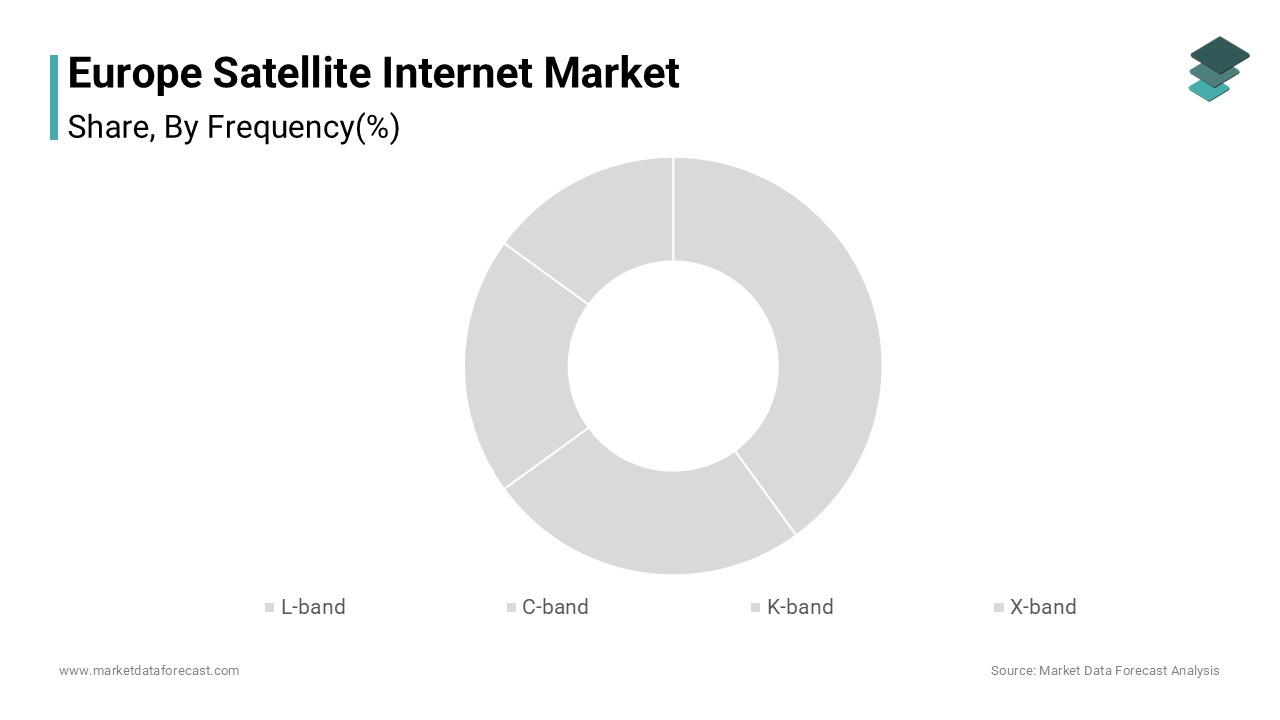
The K-band segment accounted for the most significant share of the European satellite internet market in 2024. The growth of the K-band segment is majorly driven by its optimal balance of bandwidth capacity, antenna size, and cost efficiency, which is making it the preferred choice for both consumer broadband and enterprise mobility services across the continent. The dominance of the K-band segment in the European market is also attributed to the widespread adoption of high throughput satellites operating in Ka band that enable spot beam technology to reuse frequencies across multiple geographic zones, which is dramatically increasing data capacity. According to the European Space Agency, many new commercial broadband satellites deployed for European coverage are using the Ka-band owing to its higher throughput. The frequency-bandography from ESA confirms that Ka-band is ideal for high-throughput broadband services. The European Aviation Safety Agency has emphasised the importance of real-time aircraft connectivity for operational safety, and Ku and Ka-band terminals are widely used on commercial airliners in Europe. Market-analyst data show Ku-band commanding almost half of the connected aircraft segment in 2024, with Ka-band poised to grow. In the maritime sector, Ku and Ka services are increasingly adopted for crew-welfare and vessel monitoring in Europe, driven by regulatory and operational demand. The maturity of Europe’s satellite-terminal manufacturing has helped reduce hardware costs and fostered uptake in rural French and Spanish markets where terrestrial alternatives remain limited.
REGIONAL ANALYSIS
United Kingdom Satellite Internet Market Analysis
The United Kingdom dominated the satellite internet market in Europe in 2024. The dominating position of the Uk in the European market is primarily driven by its extensive maritime and aviation sectors, proactive regulatory environment, and early adoption of low Earth orbit services. The country serves as a strategic gateway for satellite operators targeting Northwest Europe. According to the European Commission’s 2024 Connectivity Report, over 90 % of active satellite-internet subscribers in the EU use services from US-based providers, whose ground infrastructure and data-routing may fall outside European jurisdiction.
Germany occupied the second largest share of the European satellite internet market in 2024. The growth of the German market can be credited to its industrial base, rural connectivity gaps, and strategic investments in secure satellite communications. Germany prioritizes satellite internet as a resilience layer for critical infrastructure and digital sovereignty. According to Germany’s federal telecommunications regulator, a significant number of households in Bavaria and the Eastern states lack access to fixed broadband above 30 Mbps, creating sustained demand for satellite alternatives. The country’s civil-protection agency has deployed satellite terminals to emergency services following a nationwide fibre outage that disrupted emergency response. In the industrial sector, Deutsche Bahn uses satellite links to monitor remote rail infrastructure across the Alpine corridor, which is ensuring operational continuity where cellular coverage is absent. Germany co-leads the EU’s IRIS² programme with ground-segment hubs planned in Bavaria and Lower Saxony. This dual focus on civil resilience and strategic autonomy positions Germany as a cornerstone of Europe’s institutional satellite-internet adoption.
France Satellite Internet Market Analysis
France is anticipated to account for a prominent share of the Europe satellite internet market during the forecast period due to its sovereign space capabilities, extensive overseas territories, and strong maritime connectivity needs. France leverages satellite internet to maintain digital cohesion across its global footprint. France’s spectrum regulator allocated priority Ka-band spectrum in recent years for services covering rural communes and overseas departments, where undersea cable infrastructure is particularly vulnerable. A notable share of households in mountainous regions depend on satellite for primary internet access. The French Navy operates numerous vessels equipped with X-band and Ku-band satellite terminals for secure communications. In 2024, the national space agency launched a public–private initiative to subsidise satellite terminals for agricultural cooperatives in drought-prone regions, enabling precision irrigation. A major French aerospace company headquartered in Toulouse supplies user equipment to many European countries, reinforcing France’s role as a manufacturing and innovation hub. This integration of territorial continuity, defence readiness, and industrial policy ensures France’s sustained leadership in the European satellite internet landscape.
Italy Satellite Internet Market Analysis
Italy is expected to register a notable CAGR in the European satellite internet market during the forecast period. The geographic diversity, tourism infrastructure demands, and seismic resilience planning are majorly driving the satellite internet market growth in Italy. The country’s complex terrain and island geography make satellite a practical necessity in many regions. According to Italy’s national communications regulator, a significant number of households in Sicily, Sardinia and the Apennine regions lack access to reliable fixed-broadband services, relying instead on satellite alternatives for education and remote work. The country’s civil-protection authority has mandated that emergency response centres in seismic zones maintain satellite-based backup connectivity following recent disruptions to terrestrial networks. The tourism sector in remote agritourism and mountain-lodge regions is increasingly using satellite internet to support digital guest services. Additionally, Italy’s large merchant-marine fleet supports demand for satellite services. A domestic aerospace joint-venture headquartered in Rome supplies ground-segment support to multiple satellite constellations, reinforcing Italy’s local technical capacity. These intertwined geographic, institutional, and economic factors position Italy as a high-necessity market with stable long-term demand.
Sweden Satellite Internet Market Analysis
Sweden is estimated to hold a noteworthy share of the Europe satellite internet market during the forecast period due to its vast northern territories, environmental monitoring needs, and commitment to digital equity in sparsely populated regions. The country exemplifies how satellite enables inclusion in extreme latitudes. According to the Swedish Post and Telecom Authority, 31 percent of households north of the 60th parallel use satellite as their primary internet connection due to permafrost and forest density that impede fiber deployment. The Swedish Forest Agency operates over 200 satellite connected wildfire detection cameras across Lapland, which is reducing response time by 70% as per the Ministry of Rural Affairs. In 2024 the Swedish Transport Administration began installing satellite terminals on remote Arctic highways to support autonomous snow clearing and traveler information systems. Additionally, Sweden co-hosts the Esrange Space Center in Kiruna, a key ground station for polar orbiting constellations serving European users. The Swedish Space Corporation reported a 50 percent increase in satellite data downlink contracts in 2024, which is reflecting growing institutional reliance. With 93 percent of its land classified as low population density by Eurostat, Sweden’s geography ensures satellite internet remains indispensable for both civil and scientific missions, anchoring its top five position in the European market.
COMPETITIVE LANDSCAPE
The Europe satellite internet market features a dynamic competitive landscape shaped by global constellations European institutional initiatives and regional telecom partnerships. While US based low Earth orbit providers initially dominated consumer uptake, European operators like SES Eutelsat and emerging IRIS² aligned entities are gaining ground through sovereign infrastructure and policy alignment. Competition is increasingly defined by integration capabilities rather than raw bandwidth—firms that offer hybrid solutions combining satellite with 5G fiber and cloud services win institutional contracts. Regulatory compliance data localization and cybersecurity certification have become as critical as technical performance. The market is also bifurcating between mass market residential services which remain price sensitive and high value institutional segments where reliability and sovereignty drive procurement. With the EU prioritizing digital autonomy competition is shifting from pure service provision to ecosystem integration making partnerships with national telecoms defense agencies and cloud providers essential for sustained relevance in this strategically vital sector.
KEY MARKET PLAYERS
Some of the companies that are playing a dominating role in the europe satellite internet market include
- SpaceX (Starlink)
- OneWeb
- SES S.A.
- Eutelsat Communications
- Viasat Inc.
- Hughes Network Systems (HughesNet)
- Telesat
- Hispasat
- Skylink (Skylink Services)
- Iridium Communications
Top Players in the Market
SES S.A.
SES S.A. is a Luxembourg based global satellite operator with a commanding presence in the Europe satellite internet market through its dual fleet of geostationary and medium Earth orbit satellites. The company provides high capacity connectivity across Ku and Ka bands serving governments maritime fleets aviation networks and rural broadband users. SES has strengthened its position by integrating its O3b mPOWER medium Earth orbit constellation with geostationary assets to deliver low latency services under 150 milliseconds. In recent actions the company partnered with the European Commission to support the IRIS² secure communications program and launched dedicated beams over the Baltic and Mediterranean to enhance maritime coverage. SES also collaborated with national postal and telecom regulators in Germany and Portugal to subsidize user terminals for remote schools and healthcare centers reinforcing its role in Europe’s digital inclusion agenda through resilient and sovereign satellite infrastructure.
OneWeb
OneWeb is a low Earth orbit satellite broadband provider with significant operational scale across Europe following its acquisition by the UK government and Bharti Global. The company delivers global coverage with over 600 satellites in orbit enabling latency below 50 milliseconds and symmetrical speeds suited for enterprise and institutional users. OneWeb has deepened its European footprint by establishing gateway stations in Italy Spain and the UK and securing spectrum licenses in all 27 EU member states. Recently the company signed strategic agreements with Airbus and BT to integrate its services into secure government communications and rural broadband programs. OneWeb also launched a maritime terminal portfolio in 2024 tailored for North Sea offshore energy vessels and Baltic Sea ferries. Its alignment with European defense and resilience initiatives including participation in NATO connectivity trials has positioned it as a key non terrestrial network partner in Europe’s evolving digital infrastructure landscape.
Eutelsat Group
Eutelsat Group is a Paris headquartered satellite operator that has transformed into a hybrid connectivity provider through its merger with OneWeb and expansion of its Konnect Europe Ka band broadband service. The company leverages its extensive geostationary fleet over Europe Africa and the Middle East to deliver consumer and government satellite internet with local customer support in over 15 European countries. Eutelsat has reinforced its market role by launching the Eutelsat Quantum—a software defined satellite enabling real time beam shaping for dynamic coverage over disaster zones and transport corridors. In 2024 the company began commercial service for its IRIS² precursor terminals and partnered with Orange and Deutsche Telekom to bundle satellite backup with terrestrial broadband for rural SMEs. Its focus on interoperability between geostationary low Earth orbit and 5G networks aligns with EU policies on network resilience making Eutelsat a strategic enabler of multi layered connectivity across the continent.
Top Strategies Used by the Key Market Participants
Leading companies in the Europe satellite internet market pursue multi orbit strategies combining geostationary medium Earth orbit and low Earth orbit satellites to optimize coverage latency and capacity. They actively engage in public private partnerships with national governments and the European Commission to align with digital inclusion and security objectives. Firms invest in localized ground infrastructure including gateway stations and user terminal assembly to meet EU content and data sovereignty requirements. Strategic bundling with terrestrial telecom operators enhances last mile distribution and customer acquisition. Additionally players prioritize dual use terminal development that supports both commercial broadband and secure institutional communications under programs like IRIS² ensuring long term institutional demand and regulatory favor in Europe’s evolving connectivity ecosystem.
MARKET SEGMENTATION
The research report on the europe satellite internet market has been segmented and sub-segmented based on categories.
By Frequency
- L-band
- C-band
- K-band
- X-band
By Industry
- Energy & Utility
- Government and Public Sector
- Transport & Cargo
- Maritime
- Military
- Corporates/Enterprises
- Media & Broadcasting
- Other Industries
By Country
- UK
- France
- Spain
- Germany
- Italy
- Russia
- Sweden
- Denmark
- Switzerland
- Netherlands
- Turkey
- Czech Republic
- Rest of Europe