- Product Description Description
- Table of Contents TOC
- List of Table & Figure LOT
- Get Free Sample PDF Sample PDF
Market Size, 2025
$0.28 BnMarket Estimate, 2026
$0.30 BnMarket Forecast, 2034
$0.47 BnCAGR, 2026–2034
5.95%Executive Summary: Europe Sauna Market
- Market Scope: Comprehensive regional analysis tracking traditional, infrared, and electric sauna systems across residential and commercial applications in major European country-level markets.
- Market Valuation: Valued at USD 0.28 billion in 2025, reaching USD 0.30 billion in 2026, and projected to expand to USD 0.47 billion by 2034, growing at a steady CAGR of 5.95% during the forecast period (2026–2034).
- Primary Growth Drivers: Deep cultural entrenchment and habitual usage in Nordic and Baltic societies, coupled with the rising integration of thermal therapy into preventive health and clinical rehabilitation frameworks. Key restraints include high installation/operational costs in urban residential settings and a lack of harmonized safety and performance standards across EU member states.
Key Market Segment Metrics (2026–2034)
| Category | Leading Segment (2025 Position) | Fastest-Growing Segment |
|---|---|---|
| By Product | Traditional Sauna (held the largest share of 42.6% in 2025, driven by cultural continuity and the authentic löyly experience) | Infrared Sauna (expected to exhibit a noteworthy CAGR of 18.7% due to urban space efficiency and lower energy use) |
| By Application | Residential (dominated by capturing a substantial share in 2025, propelled by private domestic rituals and home wellness investments) | Commercial (predicted to witness the highest CAGR of 15.2% driven by professionalized thermal therapy in hospitality and wellness clubs) |
| By Region | Finland (outperformed with a 28.6% share in 2025, anchored by national identity, mandatory inclusion codes, and deep cultural habit) | Germany (second-largest player with 19.5% share) alongside the Netherlands and Sweden expanding via urban wellness trends |
Major Market Players & Market Structure
Market Structure: Defined by a dual dynamic between heritage-driven Nordic manufacturers commanding cultural authority and engineering-focused Central European players competing on precision technology and smart integrations.
Key Companies: Harvia, TylöHelo, KLAFS, Sauna360, EOS Saunatechnik, SAWO, Narvi, Fintec, Almost Heaven Saunas, Lesnina, Saunas.com, Baltresto, and Superior Saunas.
Europe Sauna Market Size
The Europe sauna market size was calculated at USD 0.28 billion in 2025 and is anticipated to reach USD 0.47 billion by 2034, from USD 0.30 billion in 2026, growing at a CAGR of 5.95% during the forecast period.
A sauna is a room or building designed for dry or wet heat sessions to induce sweating, relaxation, and detoxification. Rooted in deep cultural traditions, particularly in Nordic and Baltic nations, the sauna is not merely a wellness amenity but a social and ritual practice embedded in daily life. In recent years, this heritage has converged with a broader European wellness movement emphasizing preventive health, mental resilience, and holistic self-care. According to sources, there is widespread and regular sauna use across the Nordic and Baltic regions of Europe. Beyond the North, the sauna is gaining traction in Western and Southern Europe as urban consumers seek sanctuary from digital saturation and chronic stress. Adults in Western European countries are increasingly acknowledging the benefits of thermal therapies, such as sauna bathing, for managing sleep issues and anxiety. European Union health strategies and regulatory frameworks are increasingly supportive of non-pharmacological interventions, which legitimizes thermal wellness as a complementary approach to public health. This fusion of cultural legacy, scientific validation, and lifestyle evolution positions the European sauna market as a unique intersection of tradition, innovation, and health consciousness.
MARKET DRIVERS
Deep Cultural Entrenchment in Nordic and Baltic Societies
Sauna culture in Northern Europe transcends recreation and functions as a communal ritual integral to family life, social bonding, and seasonal tradition, which drives the growth of the Europe sauna market. Moreover, in Estonia, the sauna holds spiritual and historical significance. In Sweden and Latvia, sauna sessions are standard in weekend routines and often integrated into summer cottage life, with local municipalities operating public sauna facilities in cities like Stockholm and Riga. This cultural embedding ensures a consistent baseline demand independent of wellness trends. Unlike in emerging markets, where sauna adoption requires consumer education, in Northern Europe, the behavior is already habitual, making product replacement, upgrades, and modernization the primary drivers. This deep-rooted practice provides a stable foundation upon which innovation, such as smart controls or hybrid infrared systems, can layer without needing to create demand from scratch.
Rising Integration of Sauna Use in Preventive Health Frameworks
European healthcare systems are increasingly acknowledging thermal therapy as a non-invasive complementary intervention for chronic conditions and mental well-being, which is accelerating the expansion of the Europe sauna market. Scientific validation plays a pivotal role in clinical studies demonstrating benefits such as improved cardiovascular function, reduced muscle recovery time, and modulation of cortisol levels. As per a study, Regular, frequent sauna use is associated with a reduced risk of developing hypertension among middle-aged adults. This evidence has influenced policy. Statutory health insurance systems in Germany are increasingly covering sauna sessions for the rehabilitation of patients with musculoskeletal disorders. Similarly, French health research institutions are exploring and implementing thermal bathing as a potential treatment modality within clinical programs for managing depression. This medical and policy-level recognition transforms the sauna from a luxury into a legitimate wellness tool supported by institutional credibility.
MARKET RESTRAINTS
High Installation and Operational Costs in Urban Residential Settings
The adoption of private saunas in urban Europe is significantly constrained by space limitations, energy expenses, and complex building regulations, which restrict the growth of the Europe sauna market. Most modern apartments in cities like Paris, Berlin, or Barcelona lack the structural capacity for traditional sauna installation, which requires dedicated ventilation, fireproofing, and moisture-resistant finishes. Apart from these, electricity costs for electric saunas remain a deterrent. Infrared saunas offer lower energy use but still require some voltage circuits not standard in older buildings. Building codes further complicate matters as many municipalities classify saunas as wet rooms requiring permits, drainage, and insulation upgrades. These barriers relegate private sauna ownership largely to single-family homes in suburban or rural areas, limiting mass market penetration in high-density urban centers where wellness demand is otherwise strongest. Consequently, the market remains skewed toward commercial or semi-public models rather than widespread household adoption.
Lack of Harmonized Safety and Performance Standards Across EU Member States
The absence of a unified European standard for sauna equipment safety, energy efficiency, and electromagnetic emissions constrains the expansion of the Europe sauna market. This creates market fragmentation and consumer uncertainty. Finland and Sweden enforce specific national norms for saunas, but Italy and Spain rely on more general electrical appliance regulations that don't account for sauna-specific dangers regarding temperature, ventilation, and fire resistance. This regulatory gap allows substandard imports, particularly from non-EU manufacturers, to enter the market with minimal oversight. Furthermore, the lack of standardized energy labeling prevents consumers from comparing efficiency across models, undermining the EU’s Green Deal objectives. This inconsistent landscape erodes trust, inhibits cross-border trade, and delays mainstream adoption among safety-conscious middle-class households who view the sauna as a long-term health investment rather than a discretionary purchase.
MARKET OPPORTUNITIES
Expansion into Smart Home and Wellness Ecosystem Integration
The integration of sauna systems with smart home platforms creates a major opportunity for the growth of the Europe sauna market. This integration gives a significant opportunity to modernize the user experience and attract tech-savvy wellness consumers across Europe. Leading manufacturers are embedding IoT connectivity, allowing users to preheat cabins via smartphone app, monitor heart rate variability during a session, and sync ambient lighting with circadian rhythms. This convergence enables data-driven wellness where sauna usage is logged alongside sleep nutrition and activity metrics in unified health dashboards. Companies have launched partnerships with European health tech firms to correlate thermal exposure. Moreover, voice control via Alexa or Google Assistant removes operational friction for older users, enhancing accessibility. Manufacturers can appeal to a new generation, one that prioritizes personalization, quantification, and seamless integration over mere tradition, by evolving the sauna from a static cabin into a responsive health node within the digital home ecosystem.
Growth of Hybrid Wellness Facilities Combining Sauna with Cryotherapy and Meditation
A new wave of premium wellness centers across Europe is redefining thermal therapy by integrating saunas into multimodal recovery journeys that include cryotherapy, floatation, and guided meditation, and is setting up new prospects for the expansion of the Europe sauna market. This holistic approach caters to urban professionals seeking comprehensive stress resilience and performance optimization rather than isolated heat exposure.. Scientific backing enhances credibility. These centers often partner with corporate wellness programs, driving recurring B2B revenue. Moreover, architectural innovation allows compact urban footprints with modular cabin designs that fit into repurposed retail or office spaces. This model transforms the sauna from a standalone amenity into a gateway for premium experiential wellness, which creates new revenue streams and expands the addressable market beyond residential and traditional spa segments.
MARKET CHALLENGES
Energy Consumption and Environmental Impact of Traditional Sauna Systems
The high energy intensity of conventional electric and wood-fired saunas conflicts with Europe’s aggressive climate neutrality goals, posing a challenge for the growth of the Europe sauna market. In countries with carbon-intensive grids, this translates to significant CO2 emissions undermining the wellness sector’s sustainability claims. Even in Nordic nations, where hydro or nuclear power dominates, consumer perception is shifting. Wood-fired saunas, though renewable, raise concerns over particulate emissions. Manufacturers face pressure to innovate, but face technical trade-offs. Lower temperature infrared models reduce energy use yet fail to replicate the authentic löyly experience valued by traditionalists. The industry risks appearing extravagant, not green, in Europe's growing eco-conscious marketplace, until viable low-carbon heating options, such as geothermal or hydrogen-powered saunas, become mainstream.
Shortage of Skilled Installers and Service Technicians
Lack of qualified personnel capable of safely installing and maintaining modern thermal systems, particularly as technology complexity grows, hinders the expansion of the Europe sauna market. Traditional carpenters and electricians often lack training in sauna-specific requirements such as vapor barriers heat heat-resistant wiring, and ventilation dynamics, leading to safety hazards or performance issues. This shortage is exacerbated by the retirement of master builders in Finland and Estonia. Meanwhile, new entrants require certification in both electrical safety and thermal dynamics, a dual competency rarely covered in vocational curricula. A lack of standardized skill development will widen the divide between product innovation and effective deployment, ultimately restricting market reach and increasing the risk exposure for property developers and manufacturers.
REPORT COVERAGE
| REPORT METRIC | DETAILS |
| Market Size Available | 2025 to 2034 |
| Base Year | 2025 |
| Forecast Period | 2026 to 2034 |
| CAGR | 5.95% |
| Segments Covered | By Product, Application, and Region |
| Various Analyses Covered | Global, Regional & Country Level Analysis; Segment-Level Analysis; DROC, PESTLE Analysis; Porter’s Five Forces Analysis; Competitive Landscape; Analyst Overview of Investment Opportunities |
| Regions Covered | UK, France, Spain, Germany, Italy, Russia, Sweden, Denmark, Switzerland, Netherlands, Turkey, and the Czech Republic |
| Market Leaders Profiled | Harvia, TylöHelo, KLAFS, Sauna360, EOS Saunatechnik, SAWO, Narvi, Fintec, Almost Heaven Saunas, Lesnina, Saunas.com, Baltresto, And Superior Saunas |
SEGMENTAL ANALYSIS
By Product Insights
The traditional sauna segment was the largest share of 42.6% of the Europe sauna market in 2025. The growth of the traditional sauna segment is attributed to its deep roots in cultural continuity, particularly in the Nordic and Baltic regions, where wood-lined heated cabins using stone stoves define the authentic experience. The segment also thrives on intergenerational practice with households viewing sauna ownership as a non-negotiable element of domestic architecture. The emotional and ritual value of löyly, the burst of steam created by pouring water on hot stones, is irreplaceable for core users who associate infrared or electric alternatives with clinical detachment. Furthermore, traditional saunas maintain higher resale value. This fusion of cultural identity, regulatory reinforcement, and property economics ensures the traditional sauna remains the bedrock of the European market despite technological alternatives.
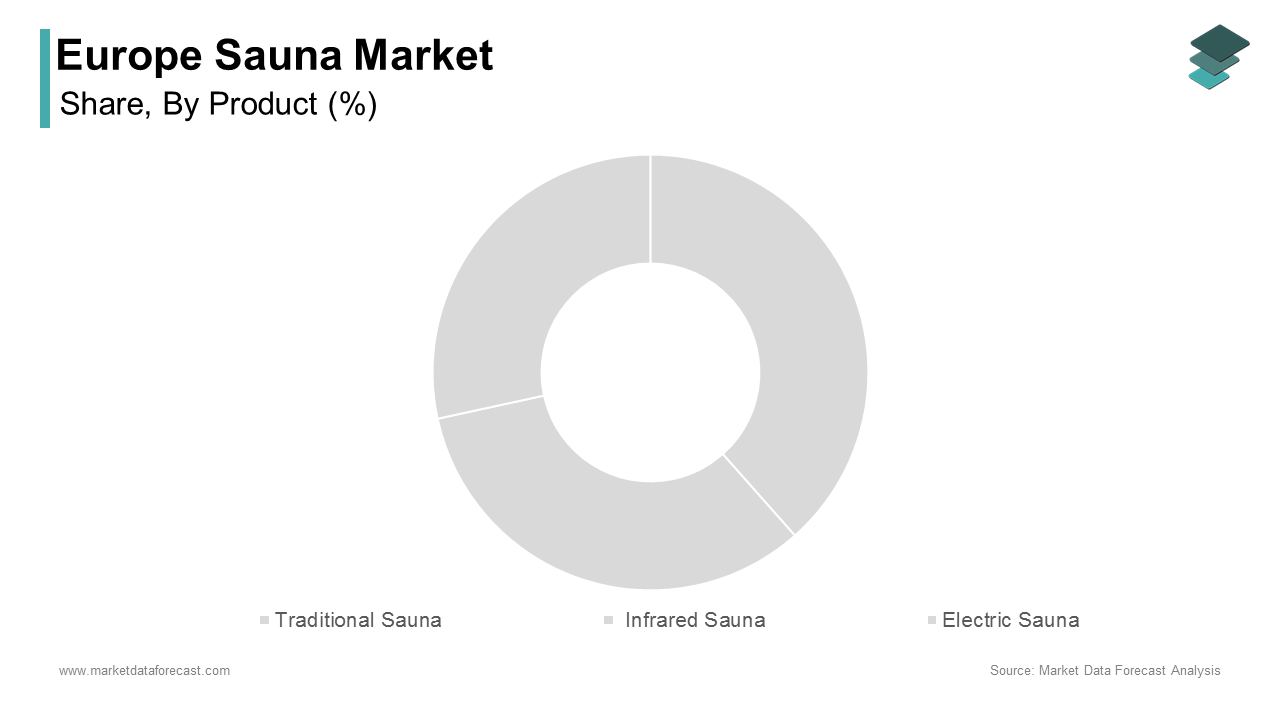
The infrared sauna segment is expected to exhibit a noteworthy CAGR of 18.7% from 2026 to 2034 due to its alignment with urban wellness lifestyles, where space efficiency, lower energy use, and perceived health benefits outweigh ritual authenticity. Infrared systems operate at 45 to 60 degrees Celsius compared to 80 to 100 degrees in traditional saunas, making them more accessible to heat-sensitive users, including older adults and those with cardiovascular concerns. Clinical validation further fuels adoption. Manufacturers have partnered with European physiotherapy networks to offer prescribed infrared sessions covered under complementary care plans in Switzerland and Austria. Apart from these, the rise of at-home recovery culture among fitness enthusiasts creates a performance-driven demand stream distinct from traditional leisure use.
By Application Insights
The residential application segment dominated the Europe sauna market by capturing a substantial share in 2025. The dominance of the residential application segment is propelled by the sauna’s status as a private domestic ritual rather than a public luxury, particularly in Northern Europe, where home ownership and single-family housing enable structural integration. In Finland, for example, the vast majority of sauna sessions occur in private residences, as there are approximately 3.2 million saunas for a population of 5.5 million, which equates to nearly one sauna per household. The trend is reinforced by rising home wellness investments, with European households spending notable euros on wellness upgrades during renovations. Post-pandemic preferences for at-home self-care have further accelerated adoption. Apart from these, new construction standards in countries like Sweden and Estonia increasingly include sauna rough-ins as default specifications, reducing incremental costs. The emotional dimension also matters; families view the home sauna as a digital detox zone, fostering presence and connection in an era of screen saturation. This confluence of cultural habit, housing typology, and lifestyle shift solidifies residential use as the market’s anchor.
The commercial application segment is predicted to witness the highest CAGR of 15.2% from 2026 to 2034, owing to the professionalization of thermal therapy in hospitality healthcare and corporate wellness. Luxury hotels across Europe now treat saunas as essential amenities, with a share of five-star properties featuring dedicated thermal suites, as per sources. Beyond tourism, the integration of saunas into medical and fitness ecosystems is transformative. Corporate wellness is another accelerant. Wellness clubs, particularly those in urban areas and the premium segment, are increasingly investing in and emphasizing thermal facilities (such as saunas, hydrotherapy pools, and cold plunges) as a key strategy for enhancing the member experience and improving long-term retention. There is a growing consumer preference for holistic, natural, and social wellness experiences, and amenities that cater to relaxation and recovery are proving more effective at building member loyalty than basic fitness offerings alone. These institutional endorsements shift the sauna from discretionary indulgence to evidence-based health infrastructure, expanding its functional relevance and revenue sustainability beyond private leisure.
REGIONAL ANALYSIS
Finland Sauna Market Analysis
Finland outperformed other regions in the Europe sauna market and held a 28.6% share in 2025. The sauna’s constitutional role in daily life and national identity drives the growth of the sauna in Finland. Sauna practice in Finland is universal and an integral part of the national culture and daily life, so much so that having access to one is considered a necessity rather than a luxury. New building codes mandate sauna inclusion in all single-family homes, and most apartment complexes feature shared facilities. The market is further propelled by high replacement demand as families upgrade wood-fired stoves to smart electric models while preserving cabin authenticity. Public policy reinforces usage with municipal saunas operating in parks, community centers, and even Parliament buildings. Cultural exports like the Finnish Sauna Society’s global advocacy and UNESCO recognition of smoke sauna traditions sustain both domestic pride and international demand for Finnish-made systems. This ecosystem of regulation, habit, and craftsmanship ensures Finland remains the spiritual and commercial epicenter of European sauna culture with minimal marketing required to sustain consumption.
Germany Sauna Market Analysis
Germany was the second-largest player in the Europe sauna market and captured a 19.5% share in 2025. The prominence of the German market is due to strong demand in both residential wellness and clinical rehabilitation sectors. Unlike Nordic nations, where sauna use is cultural, in Germany, it is framed as a health intervention supported by scientific validation and partial insurance coverage. Moreover, the residential sector is growing among affluent homeowners in Bavaria and Baden-Württemberg, where saunas are standard in new luxury builds. Manufacturers benefit from Germany’s engineering reputation, producing high-precision control systems exported across Europe. This dual engine of medical legitimacy and engineering excellence positions Germany as the continent’s innovation and adoption hub beyond heritage regions.
Sweden Sauna Market Analysis
Sweden is moving ahead steadfastly in the Europe sauna market and is fueled by summer cottage culture and progressive urban wellness integration. The tradition of bastu, Swedish for sauna, is central to weekend life, with a portion of households owning a countryside cabin that includes a sauna, as per research. This seasonal rhythm drives consistent demand for durable outdoor and wood-fired models. In cities, Stockholm and Gothenburg are witnessing a surge in compact electric and infrared units tailored to apartment living. Public health initiatives also play a role. Companies like TyloHelo leverage Sweden’s design ethos to export minimalist aesthetic cabins across Western Europe. The blend of rustic tradition and metropolitan adaptation makes Sweden a unique bridge between heritage and modernity in the sauna landscape.
Estonia Sauna Market Analysis
Estonia is growing moderately in the Europe sauna market owing to the preservation of ancient smoke sauna traditions and strong rural adoption. There is a shift towards increased visibility and official recognition for traditional cultural practices following their inscription on the UNESCO Intangible Cultural Heritage list. This cultural mandate ensures baseline demand for handcrafted wooden cabins and traditional stoves. Simultaneously, Tallinn’s tech-savvy urban population is adopting smart electric saunas with IoT features, creating a dual market dynamic. This synergy of heritage protection and digital modernization allows Estonia to punch above its population weight in both authenticity and innovation.
Netherlands Sauna Market Analysis
The Netherlands is predicted to expand in the Europe sauna market from 2026 to 2034 due to urban wellness trends and sustainable housing integration. Dutch consumers prioritize space-efficient infrared and compact electric models suitable for high-density living, with a share of installations occurring in apartments under 80 square meters, according to research. The country’s dominance in circular construction has spurred demand for saunas built from reclaimed wood and low-emission finishes, aligning with the national Green Building Protocol. Wellness real estate developers like AM and Steers frequently include sauna rooms as premium features in new builds targeting health-conscious professionals in Amsterdam and Utrecht. Apart from these, the Netherlands serves as a distribution and innovation hub for pan-European sauna brands testing smart home integrations. This focus on urban applicability, sustainability, and technological interoperability positions the Netherlands as a forward-looking market shaping sauna adoption in non-traditional European regions.
COMPETITION OVERVIEW
Competition in the Europe sauna market is characterized by a dual dynamic between heritage-driven Nordic manufacturers and engineering-focused Central European players. Finnish and Swedish brands leverage cultural authority and authenticity to command premium positioning, while German and Dutch companies compete on precision technology, space optimization, and integration with smart home ecosystems. The market features both artisanal small-scale producers serving local traditions and large vertically integrated firms targeting pan-European distribution. Innovation is not limited to hardware but extends to service models, including digital design tools, certified installer networks, and wellness program partnerships. Regulatory compliance, particularly around energy efficiency, fire safety, and emissions, acts as both a barrier and a differentiator, favoring established players with robust R&D capabilities. The expansion of demand into new territories means competition is more and more centered on flexible urban compatibility, a strong sustainability profile, and the challenge of translating ritual into mass-market wellness solutions while preserving the integrity of experience.
KEY MARKET PLAYERS
A few major players of the Europe sauna market include
- Harvia
- TylöHelo
- KLAFS
- Sauna360
- EOS Saunatechnik
- SAWO
- Narvi
- Fintec
- Almost Heaven Saunas
- Lesnina
- Saunas.com
- Baltresto
- Superior Saunas
Top Strategies Used by the Key Market Participants
Key players in the Europe sauna market prioritize cultural authenticity by preserving traditional design elements while integrating modern safety and efficiency standards. They invest in smart technology, including app-based controls, voice compatibility, and energy monitoring to appeal to urban consumers. Strategic partnerships with architects, interior designers, and wellness clinics enhance product integration into residential and commercial projects. Companies also emphasize sustainability through FSC-certified wood low low-emission heaters, and circular design principles aligned with EU Green Deal objectives. Additionally, they expand service offerings with digital configurators, installation certification programs, and after-sales maintenance to differentiate in a competitive landscape.
Leading Players in the Europe Sauna Market
Harvia Oyj
Harvia Oyj is a Finnish leader in sauna solutions with a legacy spanning over seven decades and a strong presence across residential and commercial segments in Europe. The company designs and manufactures heater cabins and control systems that blend Nordic tradition with modern technology. Harvia has strengthened its position by investing in smart sauna ecosystems, including app-controlled heating and voice-activated ambient settings compatible with European smart home standards. Its global contribution lies in exporting authentic Finnish sauna culture through premium product engineering and partnerships with luxury hospitality brands worldwide, reinforcing Europe’s leadership in thermal wellness innovation.
Klafs GmbH & Co KG
Klafs is a German premium sauna and spa manufacturer renowned for its architectural integration and bespoke wellness room solutions. Operating across high-end residential hotels and medical spas, the company combines German engineering with minimalist design to create immersive thermal environments. Klafs has recently enhanced its offering by developing hybrid wellness cabins that merge traditional sauna, infrared, and chromotherapy in a single unit tailored to urban European spaces. It also launched a digital configurator tool enabling architects and interior designers to visualize custom sauna installations in real time. Globally, Klafs sets benchmarks for luxury wellness infrastructure, influencing spa design standards in North America and Asia through its emphasis on precision craftsmanship and therapeutic functionality.
TylöHelo Group
TylöHelo Group, a Swedish-Finnish entity formed through the merger of Tylö and Helo, is a major force in the Europe sauna market, offering a comprehensive portfolio from mass market to luxury segments. The company leverages dual heritage to serve both traditional wood-fired sauna enthusiasts and modern infrared adopters. It has reinforced its competitiveness by standardizing IoT-enabled control panels across its product lines and achieving EPD environmental product declarations for over 80 percent of its cabins. TylöHelo actively collaborates with European universities on thermal health research and supplies sauna systems to public rehabilitation centers in Germany and the Nordic countries. Its global impact stems from scalable manufacturing and a balanced brand portfolio that adapts cultural authenticity to diverse international wellness expectations.
MARKET SEGMENTATION
This research report on the Europe sauna market has been segmented and sub-segmented based on product, application, and region.
By Product
- Traditional Sauna
- Infrared Sauna
- Electric Sauna
By Application
- Residential
- Commercial
By Region
- UK
- France
- Spain
- Germany
- Italy
- Russia
- Sweden
- Denmark
- Switzerland
- Netherlands
- Turkey
- Czech Republic
- Rest of Europe