- Product Description Description
- Table of Contents TOC
- List of Table & Figure LOT
- Get Free Sample PDF Sample PDF
Market Size, 2025
$12.72 BnMarket Estimate, 2026
$14.61 BnMarket Forecast, 2034
$44.38 BnCAGR, 2026–2034
14.90%Europe Security Robots Market Report Summary
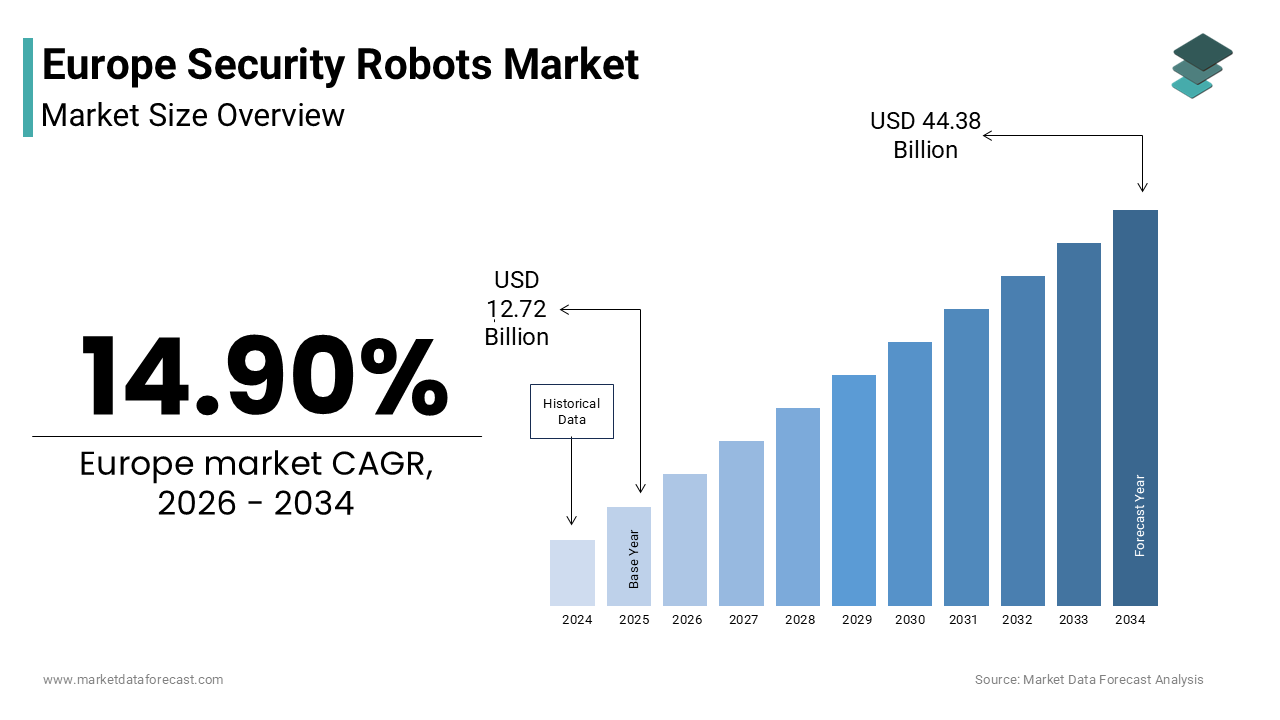
The Europe security robots market was valued at USD 12.72 billion in 2025, is anticipated to reach USD 14.61 billion in 2026, and is projected to reach USD 44.38 billion by 2034, growing at a CAGR of 14.90% during the forecast period from 2026 to 2034. The growth of the Europe security robots market is driven by rising urban crime concerns, increasing focus on critical infrastructure protection, and the growing adoption of AI-powered surveillance technologies. The expansion of smart city initiatives, border security modernization programs, and defense automation strategies is further supporting market growth. Moreover, advancements in autonomous robotics, sensor technologies, and 5G connectivity are accelerating the deployment of intelligent security systems across public and private environments.
Key Market Trends
- Increasing adoption of AI-enabled autonomous security robots for real-time surveillance and threat detection.
- Growing deployment of robots across critical infrastructure sites such as airports, energy facilities, and transportation hubs.
- Rising integration of security robots with smart city platforms and centralized command systems.
- Expanding use of UAVs (drones) for border surveillance and wide-area monitoring.
- Strong focus on GDPR-compliant security solutions and ethical AI-based monitoring systems across Europe.
Segmental Insights
- Based on type, the Unmanned Ground Vehicle (UGV) segment dominated the market by accounting for 62.5% share in 2025, supported by its versatility in indoor and outdoor surveillance, ability to carry advanced sensors, and suitability for continuous patrolling.
- Based on end user, the defense & military segment held the largest share of 48.5% in 2025, driven by increasing investments in autonomous defense systems, border monitoring, and protection of sensitive installations.
- The commercial segment is expected to register the fastest growth, supported by rising adoption across smart buildings, logistics hubs, corporate campuses, and retail infrastructure.
Regional Insights
The Europe security robots market is witnessing strong growth across major economies, supported by defense modernization, smart infrastructure investments, and heightened security regulations.
- Germany led the market by accounting for 18.7% of the share in 2025, driven by strong industrial security requirements, critical infrastructure protection mandates, and a well-developed robotics ecosystem.
- France accounted for 15.3% of the market share in 2025, supported by high demand from nuclear facilities, defense operations, and centralized public security initiatives.
- The United Kingdom continues to experience strong adoption due to counter-terrorism priorities, port security modernization, and government-backed investments in autonomous systems.
- Italy is emerging as a key growth market driven by coastal surveillance needs, migration monitoring, and infrastructure security upgrades.
- Sweden is witnessing growing adoption supported by ethical AI frameworks, advanced digital governance, and early deployment of autonomous monitoring technologies.
Competitive Landscape
The Europe security robots market is characterized by rapid technological innovation, increasing collaboration between defense agencies and technology providers, and growing focus on ethical and GDPR-compliant deployments. Leading players are investing in AI-based perception systems, autonomous navigation capabilities, secure data processing, and multi-robot coordination platforms to strengthen their market presence. Strategic partnerships with government bodies, critical infrastructure operators, and smart city authorities are becoming central to competitive differentiation. Prominent players in the Europe security robots market include Knightscope, Inc., SMP Robotics Systems Corp., Cobalt Robotics, Inc., Securitas AB, ABB Ltd., Bosch Security Systems, Thales Group, Hexagon AB, DJI Technology Co., Ltd., and Stanley Robotics.
Europe Security Robots Market Size
The Europe Security Robots Market size was valued at USD 12.72 billion in 2025 and is anticipated to reach USD 14.61 billion in 2026 from USD 44.38 billion by 2034, growing at a CAGR of 14.90% during the forecast period from 2026 to 2034.
Security robots are autonomous or semi-autonomous systems that perform tasks such as perimeter surveillance, thermal imaging, license plate recognition, and real-time threat detection in environments including airports, critical infrastructure sites, corporate campuses, and urban centers. The robots are a convergence of robotics, artificial intelligence, and advanced sensor technologies deployed to enhance physical security across public and private domains.
The 2025 Europol terrorism report indicates that evolving, decentralized threats in Europe are driving a demand for advanced, technology-driven security solutions. Simultaneously, the European Commission is pushing for smart, secure digital infrastructure in urban areas, leading to greater adoption of automated security technologies to complement traditional security measures. The deployment of these systems operates within a stringent regulatory context shaped by the General Data Protection Regulation which governs data collection processing and storage thereby influencing robot design and operational protocols. Security robots are evolving into strategic, multi-layered components in Europe’s defense landscape, offering persistent, autonomous surveillance that reduces human risk while enhancing situational awareness amid complex, and evolving threats.
MARKET DRIVERS
Escalating Urban Crime Rates and the Demand for Intelligent Surveillance Systems
Rising urban crime across European metropolitan areas has become a key driver for adopting intelligent robotic surveillance, which in turn contributes to the growth of the Europe security robots market. Eurostat pointed out in 2024 that property-related offenses in the EU surged following the pandemic; specifically, thefts increased by 4.8% and burglaries by 4.2% in 2023. Residents in EU cities are now more than three times more likely to perceive crime in their area compared to those in rural regions. The United Nations Office on Drugs and Crime (UNODC) emphasized in its 2024 assessments that while homicide rates remained stable, drug-related offenses and trafficking continue to challenge Western Europe, with justice interventions increasingly targeting top-level actors in illicit markets. In response cities and businesses are shifting from passive CCTV systems to mobile autonomous platforms capable of active patrolling and real time anomaly detection. Amsterdam and Barcelona, recognized as global smart city benchmarks, have prioritized IoT and real-time analytics for urban management. While the European Innovation Partnership on Smart Cities and Communities (EIP-SCC) validates these digital strategies, current focus areas involve cybersecurity for critical infrastructure and smart waste management rather than robotic street patrols. These robots integrate thermal cameras automatic number plate recognition and live communication links with law enforcement enabling predictive and proactive security operations. This transition reflects a broader strategic realignment toward dynamic intelligent systems that address the limitations of static monitoring in densely populated and rapidly changing urban landscapes.
Regulatory Emphasis on Critical Infrastructure Protection
The region’s reinforced legal framework for safeguarding critical infrastructure has substantially elevated demand for robotic security solutions in energy transport and utilities sectors. This acts as a major accelerator of the Europe security robots market. The EU’s Critical Entities Resilience Directive (CER) entered into full application on October 18, 2024, requiring Member States to establish national strategies by January 2026 and formally identify critical entities by July 17, 2026. Regulatory oversight will eventually cover entities across 11 key sectors, including energy and transport, to safeguard the internal market from physical and hybrid threats. Traditional human patrols and fixed cameras prove insufficient for such expansive and often remote sites prompting operators to invest in autonomous robots. Energy leaders like EDF are increasingly deploying quadruped and wheeled robots in nuclear facilities to improve inspection frequency and safety. Current pilot programs demonstrate that these autonomous systems can reduce manual labor intensity and improve the detection of equipment defects. Wide-scale adoption in gas storage remains in pilot stages. However, the trend toward autonomous perimeter surveillance is accelerating as operators seek to meet the enhanced physical security requirements mandated by new national transposition acts. These deployments are not merely technological upgrades but regulatory necessities aligning with the EU’s resilience doctrine that prioritizes technology enabled defense against hybrid and physical threats.
MARKET RESTRAINTS
High Initial Investment and Total Cost of Ownership
Acquiring and maintaining security robots involves a substantial financial burden, which hampers the growth of the Europe security robots market. This cost remains a primary barrier to widespread adoption, particularly among small and medium enterprises and smaller municipalities. The acquisition and maintenance of sophisticated, fully autonomous outdoor security robots involving high-level AI, 5G connectivity, and continuous surveillance capabilities represent a substantial, high-cost investment for companies.
This cost structure is prohibitive for the vast majority of European businesses. The prevalence of small and medium-sized enterprises in the European Union, many of which operate with limited security budgets, creates a significant financial barrier to the adoption of advanced, high-cost autonomous security technology. Public sector limitations are equally stark. The implementation of autonomous security systems in smaller European cities is significantly constrained, as local authorities prioritize essential, competing public expenditures, such as healthcare, education, and housing, over advanced technological infrastructure. The absence of accessible financial mechanisms, government incentives, or modular leasing structures restricts market participation to major corporations and state-backed operators, thereby impeding volume-driven economies of scale and limiting market democratization.
Public Skepticism and Ethical Concerns Regarding Autonomous Surveillance
Deep-rooted public apprehension about privacy erosion, algorithmic bias, and the militarization of public space significantly constrains deployment in civic environments, which further hinders the expansion of the Europe security robots market. European citizens widely express significant concerns and public opposition to the use of autonomous systems, such as surveillance robots equipped with biometric identification capabilities, in public areas. The European Data Protection Supervisor has issued multiple advisories warning that unregulated robotic surveillance may contravene Article 5 of the General Data Protection Regulation which requires data minimization and clear purpose limitation.Real world backlash has already occurred. Public and civil liberties groups' opposition to the use of robotic patrol systems, driven by concerns over potential mass surveillance and discriminatory profiling, has led to the suspension of pilot programs in major cities like New York City. Extensive governmental research has consistently shown that many facial recognition algorithms demonstrate significant performance disparities, with substantially elevated error rates for women and ethnic minorities compared to other demographic groups. The European Parliament’s Committee on Civil Liberties has since advocated for a temporary ban on autonomous surveillance robots in public areas until binding ethical standards are established. These social and legal headwinds create reputational and compliance risks that deter municipalities and private operators from scaling deployments.
MARKET OPPORTUNITIES
Integration with Smart City Ecosystems
The region’s accelerating smart city transformation offers a high potential corridor for embedding security robots within integrated urban operating systems, which is likely to fuel the growth of the Europe security robots market. As per sources, a significant share of EU cities with large number of populations are building unified digital platforms that converge traffic management environmental monitoring and public safety functions. Security robots equipped with 5G edge computing and standardized APIs can serve as mobile data nodes within these ecosystems, feeding real time video environmental readings and threat alerts into central command centers. Pioneering examples already exist. Robotic security deployments in urban environments are increasingly integrated with municipal monitoring systems, utilizing artificial intelligence to differentiate between actual threats and false positives. The coupling of autonomous robots with infrastructure technologies like smart lighting and access control systems has demonstrated efficiency improvements in addressing security incidents within industrial zones. Municipalities across Europe are fostering collaboration to align autonomous security technologies with regional digital sovereignty and sustainability goals. There is a trend toward moving away from isolated security units in favor of interconnected robotic platforms that function as components of a broader, responsive urban management system.
Defense and Border Security Modernization Programs
The region’s strategic pivot toward border integrity and defense modernization is opening specialized applications for these robots, and thereby provides new opportunities for the Europe security robots market. These tools are designed for high-risk environments. European nations are increasing investments in defense modernization, with a notable portion of new procurement dedicated to autonomous surveillance technologies. Border security operations are incorporating a greater number of unmanned ground and aerial systems along external boundaries. These robotic platforms are being utilized for surveillance, allowing for more rapid response times by personnel. Trials involving automated sentries equipped with advanced sensors are underway in specific regions, particularly along eastern borders. The deployment of these technologies is contributing to reduced physical strain on personnel involved in border monitoring. Hybrid threats, including drone incursions and cyber physical sabotage, are growing more sophisticated. Security robots offer a persistent low risk surveillance layer that complements traditional forces thereby establishing a high value niche within Europe’s evolving security doctrine.
MARKET CHALLENGES
Interoperability Gaps Across Legacy Security Infrastructure
The lack of seamless integration between modern security robots and the region’s fragmented legacy security systems is a major technical barrier to the Europe security robots market. Most airports industrial sites and transportation hubs operate on heterogeneous architectures comprising analog cameras proprietary access control panels and outdated alarm systems often installed decades ago. A limited adoption of digitized and API-enabled security frameworks among infrastructure operators can hinder direct data exchange with autonomous systems. The lack of standardized communication protocols may necessitate the development of specialized middleware to bridge legacy hardware and modern robotics. Technical discrepancies between security networks and autonomous units could result in extended integration timelines for operational validation. Current infrastructural limitations might require significant financial investments to ensure compatibility between robotic patrols and existing detection systems. Moreover, the absence of EU wide communication standards for robotic data, such as uniform video codecs or command protocols, results in operational silos that impede coordinated threat response. Security robots will remain underutilized in environments requiring unified situational awareness until the upcoming EU Cyber Resilience Act mandates base interoperability standards.
Limited Autonomy in Complex and Dynamic Environments
Limitations in navigating and interpreting unstructured or highly dynamic settings, despite progress in AI and sensor fusion, constrain the expansion of the Europe security robots market. Real world scenarios such as crowded railway stations protest gatherings or adverse weather conditions expose gaps in perception planning and decision making. According to a study, commercial security robots failed to navigate safely in a portion of trials conducted in indoor public spaces with notable pedestrian densities per 1000 square meters. Environmental factors further degrade performance. Additionally current AI models often misinterpret benign behaviors, such as someone sitting on a bench, as potential threats resulting in elevated false positive rates that undermine operational trust. Absent advancements in context-aware reasoning, robust sensor calibration, and edge-based deep learning, these systems will remain confined to controlled or semi-controlled environments, hindering their scalability across Europe’s diverse and unpredictable operational terrains.
REPORT COVERAGE
| REPORT METRIC | DETAILS |
| Market Size Available | 2025 to 2034 |
| Base Year | 2025 |
| Forecast Period | 2026 to 2034 |
| CAGR | 14.90% |
| Segments Covered | By Type, End-User and Country |
| Various Analyses Covered | Regional & Country Level Analysis, Segment-Level Analysis, DROC, PESTLE Analysis, Porter’s Five Forces Analysis, Competitive Landscape, Analyst Overview on Investment Opportunities |
| Countries Covered | UK, France, Spain, Germany, Italy, Russia, Sweden, Denmark, Switzerland, the Netherlands, Turkey, the Czech Republic, and the Rest of Europe. |
| Market Leaders Profiled | Knightscope, Inc., SMP Robotics Systems Corp., Cobalt Robotics, Inc., Securitas AB, ABB Ltd., Bosch Security Systems, Thales Group, Hexagon AB, DJI Technology Co., Ltd., and Stanley Robotics. |
SEGMENTAL ANALYSIS
By Type Insights
The Unmanned Ground Vehicle (UGV) segment dominated the Europe security robots market by accounting for a 62.5% share in 2025. The dominance of the UGV segment is attributed to the versatility operational endurance and physical interaction capabilities of ground based robots in both indoor and outdoor security applications. Unlike aerial or underwater systems UGVs can carry heavier payloads integrate with access control systems and navigate complex terrestrial environments such as airports warehouses and urban streets. UGVs are extensively used for perimeter surveillance and inspection in energy transport and utility sectors where persistent ground level monitoring is essential. Critical infrastructure sites across Europe, encompassing energy and transportation, necessitate continuous physical security. European gas storage facilities are increasingly integrating autonomous vehicles for security patrols and leak detection. These technologies are employed for routine monitoring and identifying potential infrastructure problems. These robots reduce human exposure to hazardous zones while improving inspection frequency, as per research. The fixed nature of these installations favors wheeled or tracked UGVs that operate reliably over long shifts without recharging constraints that limit UAV endurance. Indoor environments such as data centers shopping malls and corporate headquarters demand discreet non-intrusive yet persistent surveillance, conditions where UGVs excel. As per sources, a notable share of security breaches in European commercial buildings originated from internal or tailgating incidents rather than external attacks. UGVs equipped with RFID badge readers biometric scanners and AI powered behavior analytics can patrol corridors after hours verifying access anomalies in real time. In Germany, a portion of Fortune 500 companies now deploy indoor UGVs for night patrols according to the German Chamber of Commerce and Industry significantly reducing unauthorized access incidents over several months.
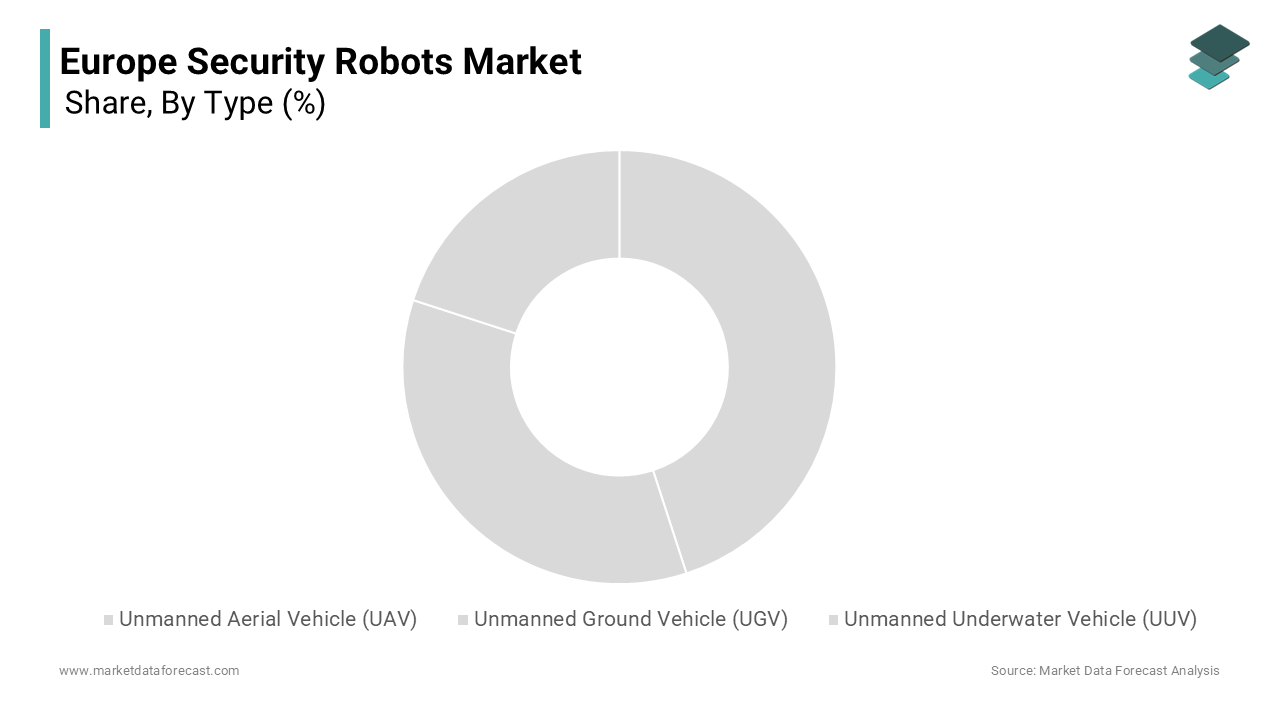
The Unmanned Aerial Vehicle (UAV) segment is predicted to witness the highest CAGR of 24.3% between 2026 and 2034 due to technological miniaturization regulatory adaptations and rising demand for wide area situational awareness. UAVs offer unmatched vantage points for monitoring Europe’s extensive land and maritime borders. Aerial surveillance platforms are utilized for monitoring external EU border areas. The deployment of unmanned systems has become a component of maritime border monitoring strategies. Operational reports suggest that unmanned aerial vehicles contribute to identifying unauthorized border crossings in the Central Mediterranean region. Data indicates a variance in detection capabilities when comparing aerial surveillance to ground-based monitoring methods. The ability to deploy drones rapidly during surge events such as migrant boat arrivals or smuggling attempts makes them indispensable. Countries like Greece and Italy have acquired VTOL (vertical take off and landing) UAVs with 12-hour endurance and infrared capabilities enabling 24 7 monitoring of remote coastal areas previously inaccessible to human patrols. The rollout of 5G networks across Europe has eliminated latency barriers that previously hindered UAV responsiveness. Coverage data indicates a substantial portion of European urban and suburban areas now have access to high-performance cellular networks. The widespread availability of these networks facilitates advanced, low-latency communication capabilities, such as high-definition video streaming, secure data transmission, and the coordination of multiple devices. Public safety entities are increasingly utilizing connected unmanned aerial vehicles to support surveillance and operational oversight during large-scale events. The integration of these communication technologies into law enforcement operations can improve situational awareness and shorten the time required for threat assessment. This deployment demonstrates a practical application of enhanced connectivity in strengthening real-time, centralized command and control functions. Such capabilities are driving adoption not only in defense but also in event security and critical infrastructure protection across the continent.
By End User Insights
The defense & military segment holds the majority share of 48.5% of the Europe security robots market in 2025. The prominence of the defense & military segment is driven by Europe’s strategic realignment toward autonomous defense capabilities amid escalating geopolitical tensions and hybrid warfare threats. International defense strategies have begun to formally recognize autonomous technologies and robotics as essential tools for compensating for personnel deficits and improving operational endurance. Member nations are increasing their acquisition of unmanned systems to perform critical tasks such as intelligence gathering, hazard neutralization, and site protection. Financial resources are being directed toward the development and integration of unmanned ground platforms to modernize existing military infrastructures. Geographic priorities are shifting, with a notable concentration of unmanned hardware being stationed in regions that serve as primary boundary zones. National defense organizations are confirming a steady increase in the volume of robotic units intended for monitoring sensitive territorial edges. These systems reduce soldier exposure to direct threats while maintaining persistent surveillance, a priority in regions facing drone incursions and sabotage attempts. European armed forces are retrofitting bases with robotic security to protect sensitive assets and simulate realistic threat environments during training. Multiple military sites have begun employing autonomous robots for nighttime security tasks. This adoption has reduced the time needed to respond to security events. Unmanned ground vehicles are also being used in training simulations to represent opposing forces, enhancing realism while protecting personnel. There is a general trend toward incorporating automated technologies into regular military procedures in the region.
The commercial segment is estimated to register the fastest CAGR of 26.1% over the forecast period owing to rising asset protection needs and smart building integration. Organized retail crime and cargo theft have reached critical levels across Europe. There is a observed trend of criminal networks increasingly targeting European supply chains, leading to a rise in the value of stolen goods. In response, logistics hubs and high-end retail locations are integrating security robots to enhance protection measures. These deployments include Unmanned Ground Vehicles (UGVs) for monitoring large container terminals and indoor robots in luxury retail settings to monitor premises after hours. The utilization of automated patrolling technology appears linked to a reduction in cargo tampering incidents and is being employed to deter theft in the luxury retail sector. Updated European building regulations for large commercial structures now necessitate the integration of advanced, automated management systems that incorporate security features. This shift in regulatory requirements has encouraged the inclusion of robotic technologies within building designs. Specific standards within European markets are evolving to officially recognize and incorporate autonomous patrols into certified smart building frameworks. Recent evaluations of new office developments in major commercial hubs indicate that security robotics are becoming a common feature in initial building specifications. These systems interface with HVAC lighting and access control creating holistic environments where robots serve as mobile security and data collection nodes, which transforms them from optional add ons to core infrastructure components.
REGIONAL ANALYSIS
Germany Security Robots Market Analysis
Germany led the Europe security robots market by accounting for a 18.7% share in 2025. The supremacy of the German market is driven by its advanced industrial base, strong defense posture, and stringent critical infrastructure regulations. Germany hosts numerous major chemical and energy sites designated under the EU’s Critical Entities Resilience Directive requiring enhanced physical protection. Site monitoring and perimeter surveillance operations are increasingly incorporating unmanned ground vehicles. The deployment of these automated systems is expanding to cover both external boundaries and interior areas. Defense initiatives are shifting to prioritize the integration of autonomous technologies, and specific robotic platforms are being utilized to enhance the security of military installations. The nation’s robust robotics ecosystem featuring companies like Rheinmetall and Magazino further accelerates innovation and domestic deployment. Coupled with significant nationwide 5G coverage Germany maintains a sustained advantage in both adoption and development of security robotics.
France Security Robots Market Analysis
France was the second largest country in the Europe security robots market by holding a 15.3% share in 2025. The expansion of the Franch market is fuelled by its centralized security doctrine and nuclear infrastructure needs. France operates 56 nuclear reactors the most in Europe requiring round the clock physical protection. Nuclear facility operators are increasing the integration of autonomous robots for inspections in response to safety directives. Municipal authorities are adopting robotic patrols in urban areas, including transit hubs, to address security concerns in public spaces. AI-equipped surveillance technology is being deployed to mitigate vandalism within public transport infrastructure. Defense authorities are investing in battlefield unmanned ground vehicles, reflecting a trend toward adopting robotics in both civilian and military contexts.
United Kingdom Security Robots Market Analysis
The United Kingdom continues to be a significant player in the Europe security robots market due to its focus on counter terrorism and port security. Following the 2023 Integrated Review Refresh the UK prioritized autonomous systems for homeland defense. Infrastructure protection guidelines now emphasize comprehensive, multi-layered security measures for a wide range of critical sites, including energy, data, and transportation hubs. Autonomous unmanned ground vehicles are being utilized for perimeter surveillance and security coverage over large industrial areas like container terminals. The deployment of autonomous vehicles in logistical areas has been linked to a reduction in cargo theft and improved security monitoring. Law enforcement agencies in major cities are testing unmanned aerial vehicles to enhance their ability to detect irregularities in crowded environments. Aerial surveillance technology is demonstrating potential in improving the speed and efficiency of crowd monitoring compared to traditional, fixed, or stationary camera systems. The UK’s departure from the EU has not diminished its commitment. Instead, it has accelerated domestic robotics investment with Innovate UK funding many security robot startups.
Italy Security Robots Market Analysis
Italy grew steadily in the Europe security robots market owing to its extensive coastline and rising migration pressures. It’s significant kilometres of coastline faces persistent maritime security challenges. Increasing pressure at maritime borders has led to the expanded deployment of aerial and ground-based unmanned systems for coastal surveillance. National strategic planning emphasizes significant financial commitments toward unmanned maritime and ground technologies, including specialized underwater systems for infrastructure inspection. Commercial sectors are integrating unmanned ground vehicles into routine operational safety protocols to mitigate risks in high-traffic transportation hubs. Regional policy shifts are moving toward the mandatory automation of security frameworks within large-scale public infrastructure. There is a broader trend of unmanned technology transitioning from specialized defense applications into standardized urban and civil security roles.
Sweden Security Robots Market Analysis
Sweden is likely to expand in the European market from 2026 to 2034 due to its early adoption of ethical AI driven robotics in both defense and civil domains. National guidelines are driving critical infrastructure operators toward adopting automated monitoring systems. Energy operators are deploying autonomous ground vehicles in northern hydroelectric facilities, resulting in a reduction of personnel entering hazardous areas during winter conditions. Security requirements for defensive postures are increasing the utilization of autonomous ground vehicles for base protection along coastal regions. Governance frameworks for artificial intelligence are requiring independent audits of robotics in the public sector to ensure ethical and unbiased operation. This regulatory clarity has attracted companies like Boston Dynamics to pilot ethical security robots in Stockholm creating a trusted deployment model that other EU nations are beginning to emulate.
COMPETITIVE LANDSCAPE
The competition in the Europe security robots market is characterized by a dynamic interplay between established defense conglomerates agile technology startups and global robotics innovators. Incumbents leverage decades of security integration experience and government certifications while newcomers differentiate through artificial intelligence modularity and rapid deployment models. The market lacks a single dominant vendor instead featuring regional specialization where companies tailor solutions to national regulatory frameworks operational doctrines and threat landscapes. Intense competition drives continuous innovation in areas such as ethical AI sensor fusion and multi robot coordination. However fragmentation in standards interoperability and public acceptance creates both barriers and opportunities. As a result firms focus on building ecosystems rather than standalone products forging alliances across telecommunications energy and smart city domains to embed security robots into broader digital infrastructure while navigating Europe’s complex legal and societal expectations around autonomous surveillance.
KEY MARKET PLAYERS
Some of the companies that are playing a dominating role in the Europe Security Robots Market include
- Knightscope, Inc.
- SMP Robotics Systems Corp.
- Cobalt Robotics, Inc.
- Securitas AB
- ABB Ltd.
- Bosch Security Systems
- Thales Group
- Hexagon AB
- DJI Technology Co., Ltd.
- Stanley Robotics
Top Players in the Market
Thales Group
Thales Group is a pivotal contributor to the Europe security robots market with deep integration across defense homeland security and critical infrastructure segments. The company develops autonomous ground and aerial systems equipped with encrypted communication multispectral sensors and AI driven threat detection. It also partnered with French nuclear operator Orano to deploy radiation hardened UGVs for facility inspection. These initiatives reinforce Thales’s role in advancing secure interoperable robotic solutions aligned with EU regulatory and operational standards while extending its technological influence globally particularly in NATO aligned countries.
Boston Dynamics
Boston Dynamics has established a distinctive presence in Europe through its agile quadruped robot Spot which is widely adopted for industrial inspection and public safety applications. The company actively collaborates with European energy firms transportation authorities and research institutions to customize Spot for site specific security tasks including thermal anomaly detection perimeter patrols and confined space navigation. Its facility supports real time data processing compliant with GDPR and enables rapid adaptation to regional security protocols. Through these actions Boston Dynamics strengthens its foothold in high value civil security sectors across Western and Northern Europe.
Rheinmetall AG
Rheinmetall AG plays a critical role in the Europe security robots market by supplying advanced unmanned ground vehicles for military and critical national infrastructure protection. The company’s Mission Master family of UGVs performs reconnaissance logistics support and surveillance for armed forces across Germany Sweden and the Baltic states. It also expanded its partnership with the German Federal Office of Bundeswehr Equipment to test robotic swarm coordination in hybrid threat environments. These developments underscore Rheinmetall’s commitment to embedding autonomy into Europe’s defense architecture while exporting validated systems to allied nations beyond the continent.
Top Strategies Used by the Key Market Participants
Key players in the Europe security robots market primarily pursue three core strategies to reinforce their position. First they prioritize strategic partnerships with government agencies energy operators and defense ministries to co develop mission specific robotic solutions aligned with regional security mandates. Second they invest heavily in research and development to integrate artificial intelligence edge computing and secure 5G connectivity ensuring compliance with Europe’s stringent data privacy and cybersecurity regulations. Third they establish localized integration and support centers across Western and Northern Europe to accelerate deployment provide real time maintenance and customize algorithms for urban industrial and border environments. These strategies collectively enhance operational reliability foster regulatory trust and deepen client relationships across public and private sectors.
RECENT MARKET DEVELOPMENTS
- In March 2024 Thales Group partnered with the French Ministry of Armed Forces to deploy next generation Watchkeeper X unmanned aerial vehicles for alpine border surveillance enhancing real time threat detection capabilities in remote regions and reinforcing its commitment to European defense autonomy.
- In November 2024 Boston Dynamics inaugurated a European robotics integration and AI training center in Eindhoven Netherlands to support civil security clients with GDPR compliant data processing localized algorithm development and rapid deployment of Spot robots across energy and transportation sectors.
- In January 2025 Rheinmetall AG unveiled the Mission Master SENTRY variant featuring autonomous perimeter defense electronic countermeasures and night vision systems tailored for military bases and critical infrastructure sites in collaboration with Sweden’s Defense Materiel Administration.
- In July 2024 Thales and Orano launched a joint pilot program deploying radiation hardened unmanned ground vehicles at the Tricastin nuclear site in France marking a significant advancement in robotic inspection for high risk industrial environments under strict nuclear safety oversight.
- In September 2024 Boston Dynamics signed a framework agreement with Germany’s Federal Police to supply customized Spot robots equipped with license plate recognition and thermal imaging for pilot deployment in major railway hubs as part of a national initiative to modernize public transport security.
MARKET SEGMENTATION
This europe security robots market research report is segmented and sub-segmented into the following categories.
By Type
- Unmanned Aerial Vehicle (UAV)
- Unmanned Ground Vehicle (UGV)
- Unmanned Underwater Vehicle (UUV)
By End User
- Defense & Military
- Commercial
- Residential
- Others
By Country
- UK
- France
- Spain
- Germany
- Italy
- Russia
- Sweden
- Denmark
- Switzerland
- Netherlands
- Turkey
- Czech Republic
- Rest of Europe