- Product Description Description
- Table of Contents TOC
- List of Table & Figure LOT
- Get Free Sample PDF Sample PDF
Europe Service Robotics Market Size
The europe service robotics market size was valued at USD 6.37 billion in 2024 and is anticipated to reach USD 7.55 billion in 2025 from USD 29.34 billion by 2033, growing at a CAGR of 18.49% during the forecast period from 2025 to 2033.
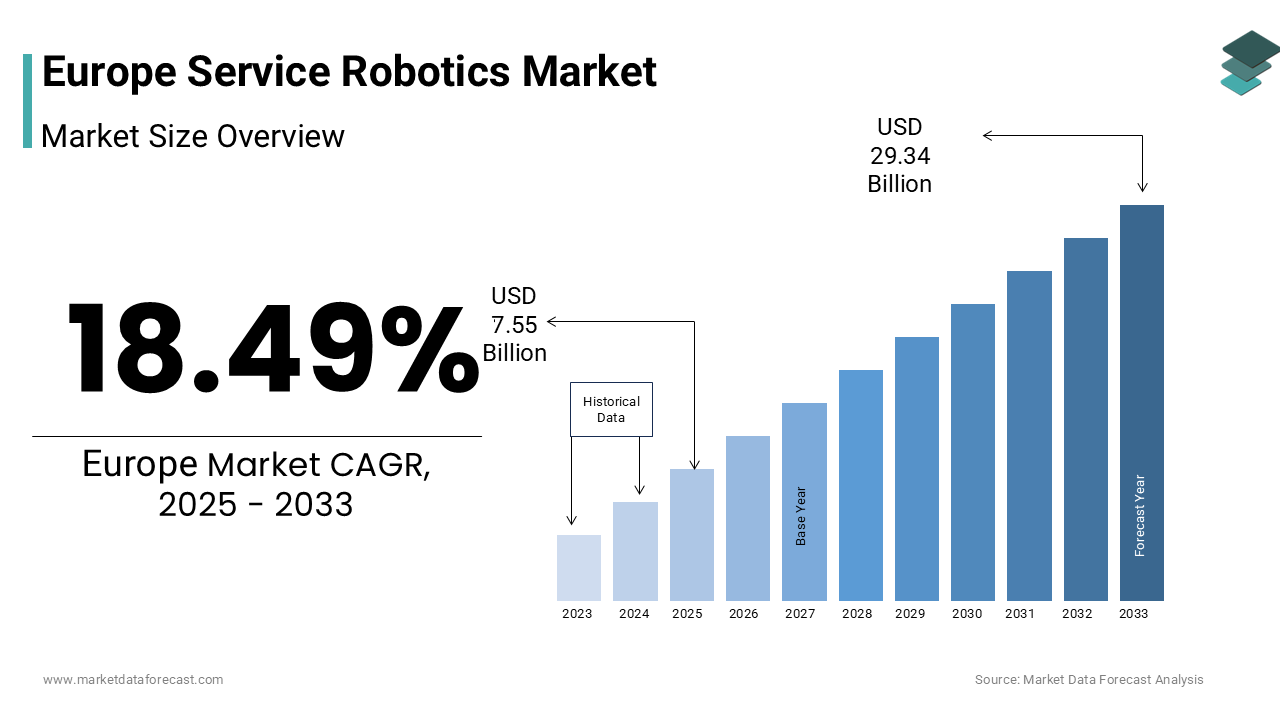
The service robotics autonomous or semi-autonomous machines are designed to perform useful tasks for humans in non-industrial environments, including healthcare assistance, logistics, hospitality, agriculture, and domestic settings. According to Eurostat, service robots were deployed across European Union member states in professional and personal settings by the end of 2024. As per the European Commission’s Digital Europe Programme, national innovation hubs received dedicated funding in 2024 to pilot robotics solutions in public healthcare and municipal services.
MARKET DRIVERS
Accelerating Adoption of Logistics and Delivery Robots in Urban Healthcare Infrastructure
Hospitals and clinics across Europe are increasingly deploying autonomous mobile robots to address staffing shortages and infection control demands, establishing healthcare logistics as a core growth vector, which is driving the growth of Europe service robotics market. According to the German Hospital Association, many university hospitals in Germany utilized delivery robots for transporting lab samples, medications, and linens by the end of 2024, thereby reducing human courier movements by an average of 22 KMs per facility daily. In the Netherlands, the National Institute for Public Health and the Environment reported that some hospitals implemented UV disinfection and supply transport robots during 2024 as part of its post pandemic resilience strategy. France’s Ministry of Health is increasing investment on its “Hospital of Tomorrow” initiative to subsidize robotic intralogistics in 120 public hospitals, with priority given to solutions compliant with EU cybersecurity standards.
Integration of Agricultural Service Robots to Address Labor Scarcity and Sustainability Mandates
The Europe’s agricultural sector is turning to robotic solutions to counter chronic labor shortages and comply with the EU’s Farm to Fork Strategy, which mandates a 50 % reduction in pesticide use by 2030. This factor is gearing up the growth of Europe service robotics market. According to the European Commission’s Directorate General for Agriculture, autonomous weeding and harvesting robots were operational on EU farms in 2024 in France, Spain, and Italy. The Common Agricultural Policy’s 2023–2027 framework explicitly includes robotics under its digital transition funding pillar, with over 210 million euros disbursed in 2024 for on farm automation.
MARKET RESTRAINTS
Stringent Regulatory Classification Under the EU Artificial Intelligence Act
The European Union’s Artificial Intelligence Act imposes significant compliance burdens on service robotics developers, particularly for systems deemed high risk. The growing stringent rules and regulations especially by government authorities is significantly inhibiting the growth of Europe service robotics market. Any robot performing tasks in healthcare, education, or advanced infrastructure that influences safety or fundamental rights falls under high-risk categorization, requiring rigorous conformity assessments, human oversight mechanisms, and transparency documentation. Furthermore, the European Data Protection Supervisor emphasized in 2024 that robots collecting biometric or behavioral data must adhere to GDPR Article 9, complicating data collection for machine learning.
Limited Interoperability and Fragmented Technical Standards Across Member States
The absence of harmonized communication protocols and safety standards impedes seamless deployment of service robots is also to hamper the growth of Europe service robotics market. According to the European Committee for Standardization, only 3 of 12 proposed technical specifications for mobile service robots achieved full harmonization under the Machinery Regulation by 2024. For instance, a logistics robot certified in Germany under VDE standards required additional modifications to operate in Italian hospitals due to differing electromagnetic compatibility thresholds. Similarly, the European Federation of Public Service Unions reported that countries maintain distinct human robot interaction guidelines for public sector deployments by complicating pan European tenders.
MARKET OPPORTUNITIES
Expansion of Municipal Robotics Programs for Urban Sustainability and Public Services
The European cities are emerging as strategic adopters of service robotics to modernize public infrastructure and meet Green Deal objectives, which is likely to pose new opportunities for the growth of Europe service robotics market. Similarly, Barcelona integrated solar powered cleaning robots in high footfall zones in water usage for street washing as confirmed by the municipal sustainability office.
Rise of Robotics as a Service Models in Hospitality and Retail Sectors
The hospitality and retail industries in Europe are increasingly adopting Robotics as a Service to overcome high upfront costs and operational uncertainty. The German Hotel and Restaurant Association reported that over 1200 hotels subscribed to cloud managed robot fleets in 2024, with average monthly fees ranging from 800 to 1500 euros per unit. This model transfers maintenance, software updates, and performance guarantees to vendors by lowering adoption barriers. Companies like Relay Robotics and SoftBank Robotics Europe expanded their RaaS offerings in 2024 with dynamic pricing tied to usage intensity and seasonal demand.
MARKET CHALLENGES
Persistent Public Skepticism and Ethical Concerns Regarding Human Replacement
The European consumers and workers remain wary of service robots displacing human roles, particularly in care and service sectors. The growing ethical concerns regarding human replacement is ascribed to pose a challenge for the growth of Europe service robotics market. According to the survey on automation conducted in early 2024, 58 % of EU citizens expressed discomfort with robots performing eldercare tasks by citing concerns about emotional detachment and loss of human dignity. Labor unions have amplified these concerns, which is opposing the deployment of customer service robots in public administration, leading to parliamentary debates in Belgium and Austria.
High Total Cost of Ownership Due to Maintenance and Downtime in Unstructured Environments
The service robots operating in real world European settings frequently incur elevated operational costs due to environmental unpredictability and limited self-diagnostics is also degrading the growth of Europe service robotics market. According to a study, the average annual maintenance cost for a hospital logistics robot in Germany was 12400 euros. In hospitality, the European Hotel Technology Council found that deployed concierge robots experienced weekly navigation failures due to dynamic obstacles like luggage carts or temporary signage, requiring manual resets. Battery degradation in cold climates further compounds expenses.
REPORT COVERAGE
| REPORT METRIC | DETAILS |
| Market Size Available | 2024 to 2033 |
| Base Year | 2024 |
| Forecast Period | 2025 to 2033 |
| Segments Covered | By Type, Application and Region |
| Various Analyses Covered | Global, Regional & Country Level Analysis, Segment-Level Analysis, DROC, PESTLE Analysis, Porter’s Five Forces Analysis, Competitive Landscape, Analyst Overview of Investment Opportunities |
| Regions Covered | UK, France, Spain, Germany, Italy, Russia, Sweden, Denmark, Switzerland, the Netherlands, Turkey, the Czech Republic, and the Rest of Europe |
| Market Leaders Profiled | KUKA AG, iRobot Corporation, SoftBank Robotics Group, PAL Robotics, Starship Technologies, Robotnik Automation, and ABB Ltd. |
SEGMENTAL ANALYSIS
By Type Insights
The professional service robotics segment held a dominant share of the Europe service robotics market in 2024 with large scale institutional deployments across healthcare, logistics, agriculture, and public infrastructure, where robots deliver measurable operational efficiency and compliance with labor and sustainability mandates. According to the European Hospital and Healthcare Employers’ Association, some tertiary care hospitals in the EU utilized autonomous logistics or disinfection robots by the end of 2024, with Germany and the Netherlands achieving near universal adoption in university hospitals. The European Commission’s Digital Europe Programme allocated 210 million euros in 2024 specifically for professional robotics pilots in municipal services, including waste management and elderly support.
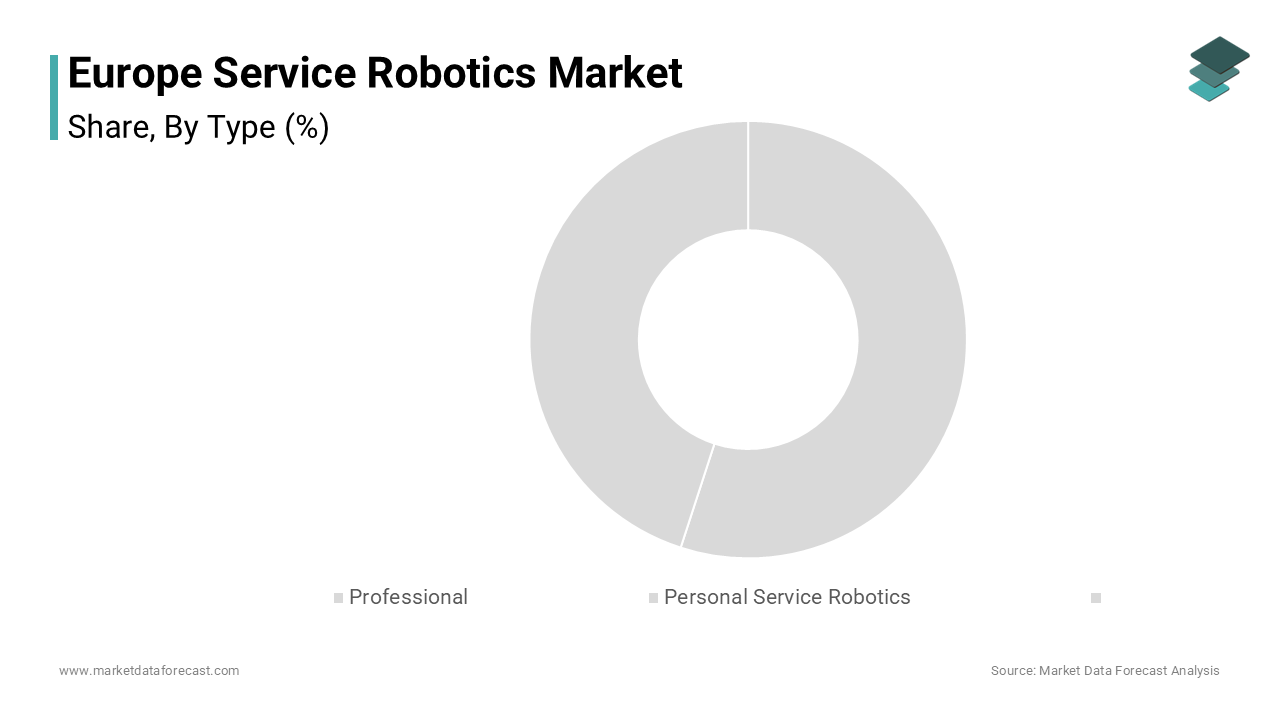
The personal service robotics segment is projected to expand at a CAGR of 18.6% throughout the forecast period from rising disposable incomes, aging demographics, and the emergence of affordable, user friendly domestic robots. Many households with members over 65 owned at least one assistive domestic robot in 2024 with independent living initiatives. Advances in voice integration and AI based navigation, such as iRobot’s 2024 launch of GDPR compliant mapping have further lowered usability barriers.
By Application Insights
The industrial and commercial application segment was accounted in holding a significant share of Europe service robotics market in 2024 with the continent’s emphasis on productivity, labor optimization, and regulatory compliance in institutional settings. According to the European Centre for Disease Prevention and Control, 63 % of acute care facilities in France, Germany, and Sweden integrated delivery robots for pharmacy and lab transport by 2024, thereby reducing internal courier labor by an average of 18 hours per week per facility. Another factor boosting the growth of segment is the adoption of agricultural robots to meet EU environmental targets. As per the European Commission’s Farm to Fork dashboard, over 9500 robotic weeding and harvesting units operated on EU farms in 2024 by enabling a 37% average reduction in herbicide use on participating plots.
The domestic application segment is projected to grow with a CAGR of 19.2% throughout the forecast period with the proliferation of smart home ecosystems and targeted solutions for aging populations. The integration of service robots into national aging in place strategies is also enhancing the growth of the segment. Municipalities distributed over 12000 subsidized companion and reminder robots to elderly residents in 2024 under “Tech for Independence” program, with user satisfaction rates exceeding 76%. The consumer electronics retailers across Europe have expanded robotics aisles. The increase in domestic robot sales in 2024, led by robotic mops with AI based floor recognition.
REGIONAL ANALYSIS
Germany was the top performer in the European service robotics market with a 24.3% share in 2024 owing to its engineering excellence, robust healthcare infrastructure, and strong public investment in automation. The country is also a manufacturing hub for European robotics firms. Additionally, the Fraunhofer Institute launched a national interoperability testbed in 2024 to standardize communication protocols between robots and building management systems. Germany’s combination of industrial capability, institutional demand, and technical standardization cements its role as the continent’s robotics nucleus.
France was ranked second by capturing 17.8 % of Europe service robotics market share in 2024 with its centralized innovation policy and aggressive deployment in public healthcare and agriculture. As per the French Ministry of Higher Education and Research, 32 regional robotics innovation clusters receive investments to develop service robots for eldercare and farm automation.
The United Kingdom service robotics market growth is ascribed to bolster with its dynamic startup ecosystem and progressive regulatory sandbox for AI enabled robotics. Nearly, 47 service robotics startups secured public funding in 2024, with 19 focused on healthcare assistance and mental wellbeing. Additionally, the UK’s departure from the EU has allowed faster certification pathways. The Medicines and Healthcare products Regulatory Agency approved three new care robots under its AI Software as a Medical Device route in 2024.
Italy service robotics market growth is propelled by its aging population and pioneering use of social robots in eldercare. The Ministry of Health’s 2024 “Robotics for Longevity” initiative funded 89 municipal projects deploying companion robots in senior residences, reaching over 15000 users. The luxury hospitality groups like Marriott Italia adopted concierge robots in high end resorts, which is blending technological novelty with service tradition.
COMPETITIVE LANDSCAPE
The Europe service robotics market features a dynamic mix of global industrial automation leaders, specialized European startups, and agile Nordic innovators. Competition is less about hardware specifications and more about regulatory readiness, ethical design, and integration depth within public and institutional workflows. Large firms like ABB leverage scale and service networks, while niche players such as Blue Ocean Robotics differentiate through clinical validation and certification leadership. Consequently, collaboration with national health authorities, standardization bodies, and local integrators has become essential. Trust, compliance, and contextual relevance now outweigh pure technical capability as competitive differentiators.
KEY MARKET PLAYERS
A few of the major companies in the europe service robotics market include
- KUKA AG
- iRobot Corporation
- SoftBank Robotics Group
- PAL Robotics
- Starship Technologies
- Robotnik Automation
- ABB Ltd.
Top Players in the Europe Service Robotics Market
ABB Ltd
ABB Ltd plays a pivotal role in the Europe service robotics market through its collaborative robots and autonomous mobile platforms tailored for healthcare and logistics applications. While globally renowned for industrial automation, ABB has strategically expanded its YuMi and GoFa cobot lines into European hospitals and laboratories for tasks such as sample handling and sterile transport. The company also aligned its European robotics software stack with the EU’s Cybersecurity Act, ensuring compliance with high risk AI system requirements. These initiatives underscore ABB’s shift toward human centric, regulated service environments while leveraging its global engineering infrastructure.
SoftBank Robotics Europe
SoftBank Robotics Europe is a key contributor to the continent’s service robotics landscape, primarily through its humanoid and semi autonomous platforms like Pepper and Whiz. The company focuses on retail, hospitality, and eldercare sectors across Western and Southern Europe, offering multilingual interaction capabilities tailored to regional linguistic diversity. In early 2024, SoftBank Robotics Europe launched a GDPR compliant data processing architecture for its robots, enabling on device AI inference without cloud dependency with an adaptation for healthcare and public sector clients. It also collaborated with France’s Caisse des Dépôts to deploy companion robots in 45 municipal senior residences, emphasizing emotional engagement and routine support. These moves reinforce its commitment to ethical, localized deployment within Europe’s stringent regulatory framework.
Blue Ocean Robotics
Blue Ocean Robotics is a Danish innovator specializing in professional service robots for disinfection, logistics, and elderly assistance, with strong traction across Nordic and German markets. Its UVD Robots and GoBe robots are widely adopted in European hospitals and care homes for autonomous UV disinfection and medication delivery. The firm also established a pan European training academy in Copenhagen to certify technicians and end users on safe robot operation. This focus on regulatory leadership, clinical validation, and workforce enablement positions Blue Ocean as a trusted partner in mission critical service robotics.
Top Strategies Used by the Key Market Participants
Key players in the Europe service robotics market prioritize regulatory compliance by aligning products with the EU Artificial Intelligence Act and Machinery Regulation through certified safety architectures and data governance. They form strategic partnerships with public institutions such as hospitals, municipalities, and agricultural cooperatives to anchor deployments in policy driven use cases. Companies invest in localized R&D hubs to adapt language, navigation, and interaction models to regional contexts. They increasingly adopt Robotics as a Service models to lower entry barriers for small and medium enterprises. Additionally, firms pursue vertical integration by developing proprietary AI software stacks that operate within EU data residency requirements to ensure trust and scalability.
MARKET SEGMENTATION
This research report on the Europe service robotics market has been segmented based on the following categories.
By Type
- Professional
- Personal Service Robotics
By Application
- Domestic
- Industrial/Commercial
By Country
- UK
- France
- Spain
- Germany
- Italy
- Russia
- Sweden
- Denmark
- Switzerland
- Netherlands
- Turkey
- Czech Republic
- Rest of Europe