- Product Description Description
- Table of Contents TOC
- List of Table & Figure LOT
- Get Free Sample PDF Sample PDF
Market Size, 2025
$90.51 BnMarket Estimate, 2026
$103.56 BnMarket Forecast, 2034
$303.94 BnCAGR, 2026–2034
14.41%Europe Shared Mobility Market Report Summary
The Europe shared mobility market was valued at USD 90.51 billion in 2025, is anticipated to reach USD 103.56 billion in 2026, and is projected to reach USD 303.94 billion by 2034, growing at a CAGR of 14.41% during the forecast period from 2026 to 2034. The growth of the Europe shared mobility market is driven by rapid urbanization, rising demand for flexible, on-demand transportation, and stringent policies aimed at reducing private vehicle ownership and carbon emissions. Increasing adoption of ride-hailing, car sharing, bike sharing, and electric scooter services, along with the expansion of low-emission zones and smart city initiatives, is further accelerating market growth. Moreover, the integration of shared mobility with public transit systems through Mobility-as-a-Service (MaaS) platforms is strengthening user adoption and reshaping Europe’s urban transportation ecosystem.
Key Market Trends
-
Rising preference for shared mobility as a substitute for private car ownership in dense urban areas.
-
Rapid electrification of shared fleets, supported by EU emission regulations and zero-emission city zones.
-
Increasing deployment of Mobility-as-a-Service (MaaS) platforms integrating public transport, bikes, scooters, and ride-hailing.
-
Growing adoption of corporate mobility budgets, replacing traditional company car programs.
-
Expansion of micro-mobility solutions such as e-bikes and e-scooters for first- and last-mile connectivity.
Segmental Insights
- Based on Service model, the car sharing segment held the largest share of the Europe shared mobility market in 2025, supported by high urban car ownership costs, limited parking availability, and growing corporate adoption of pooled vehicle access.
- The bike sharing segment is expected to grow at a significant rate, driven by large-scale investments in cycling infrastructure, rising adoption of electric-assisted bicycles, and strong policy support for low-carbon transport.
- Based on channel, the online segment dominated the market in 2025, as mobile applications have become the primary interface for booking, payments, navigation, and multimodal trip planning.
- Based on vehicle type, the cars segment accounted for the largest share, due to their suitability for longer trips, group travel, and professional use, while the two-wheelers segment is projected to witness the fastest growth, supported by urban access privileges and lower operating costs.
Regional Insights
The Europe shared mobility market is experiencing robust growth across major economies, supported by strong digital infrastructure, urban sustainability policies, and public-private collaboration.
- Germany was the leading market, driven by high smartphone penetration, extensive shared mobility infrastructure, and strong regulatory backing for electric fleets.
- France followed closely, supported by aggressive urban modal-shift policies, national mandates for shared mobility planning, and government subsidies for micro-mobility adoption.
- The United Kingdom continues to show strong growth, fueled by expansion of ultra-low emission zones, integration of shared mobility with ride-hailing platforms, and rising corporate adoption.
- Italy is witnessing rapid expansion, particularly in two-wheeler sharing, due to restrictions on private cars in historic city centers and EU-funded urban mobility initiatives.
- The Netherlands remains a key growth market, supported by its cycling-first urban planning, high electrification of bike-sharing fleets, and sustained public investment in micro-mobility infrastructure.
Competitive Landscape
The Europe shared mobility market is characterized by intense competition among global technology companies, automotive OEM-backed platforms, and regional mobility startups. Market participants compete on fleet electrification, multimodal integration, regulatory compliance, and user experience optimization. Leading companies are increasingly focusing on data-driven fleet management, AI-enabled demand forecasting, and strategic partnerships with municipalities and public transit authorities. Consolidation and collaboration are shaping the competitive environment, as operators seek scalability, profitability, and long-term regulatory alignment across fragmented European markets.Prominent players in the Europe shared mobility market include Uber Technologies, Inc., Bolt Technology OÜ, Free Now, Cabify España S.L.U., Gett, BlaBlaCar, Free2Move, Share Now GmbH, Lime, TIER-Dott, and Voi Technology.
 Download Free Sample Report
Europe Shared Mobility Market Size
The Europe shared mobility market size was valued at USD 90.51 billion in 2025 and is anticipated to reach USD 103.56 billion in 2026 from USD 303.94 billion by 2034, growing at a CAGR of 14.41% during the forecast period from 2026 to 2034.

The shared mobility is a broad spectrum of digitally enabled, short term transportation services that allow users to access vehicles, including cars, bicycles, and electric scooters without ownership. These services operate on demand or through reservation models and are increasingly integrated with public transit to form multimodal urban mobility ecosystems. As of early 2026, over 750 cities in the European Union with populations exceeding 50,000 host at least one regulated shared mobility service, according to Eurostat. Urban policy across the bloc has shifted decisively toward reducing private car dependency, with cities like Paris, Berlin, and Amsterdam dedicating more than 40% of street space to non-private vehicle use, as per sources.
MARKET DRIVERS
Urbanization Intensifies Demand for Flexible Mobility Solutions
The accelerating urban concentration is fundamentally reshaping transportation behavior and strengthening the case for shared mobility, which is driving the growth of Europe shared mobility market. By 2025, 78% of the EU’s population resided in urban areas, a figure projected to exceed 80% by 2030 according to Eurostat. Cities such as Madrid, Stockholm, and Brussels have recorded annual population growth above 1.2% over the past five years, placing unsustainable strain on parking capacity and road networks. Over 65% of all urban trips in Europe cover less than five kilometers by making them ideally suited for shared micro mobility or short-term car access, as per study. In response, municipal authorities increasingly view shared mobility as a congestion mitigation tool. For instance, the European Urban Mobility Observatory found that in cities with populations above 250,000, shared vehicles achieve 8 to 12 user trips per day more than double the utilization in smaller towns. This scale effect not only lowers per trip costs but also enhances service reliability, thereby reinforcing user adoption and public sector collaboration.
Stringent Emission Regulations Accelerate Electrification of Shared Fleets
The EU’s rigorous emissions policy framework for the adoption of zero emission shared mobility fleets is accelerating the growth of Europe shared mobility market. Under finalized Euro 7 standards, all new passenger cars registered in the EU must be effectively zero emission by 2035, as mandated by the European Commission. Shared mobility operators benefit disproportionately from this transition due to centralized fleet control, which simplifies procurement, charging logistics, and maintenance. As of 2025, 68% of car sharing vehicles in Germany, France, and the Netherlands were fully electric, according to the European Alternative Fuels Observatory. Moreover, 257 European cities have implemented low or zero emission zones, with 73 covering entire urban cores, affecting over 120 million residents, per the European Environment Agency. In Oslo and Copenhagen, internal combustion engine vehicles are barred from city centers, effectively mandating electric shared transport. The International Council on Clean Transportation confirms that electric vehicles in shared fleets incur 30 to 40% lower lifetime maintenance costs, improving unit economics while advancing climate goals.
MARKET RESTRAINTS
Fragmented Regulatory Frameworks Impede Cross Border Scalability
The shared mobility remains subject to highly divergent local regulations is restraining the growth of Europe shared mobility market. Vehicle classification, speed limits, parking rights, and operational permits vary not only by country but often by municipality. For example, e-scooters are limited to 20 km/h in Germany, but allowed up to 25 km/h in France, while Belgium prohibits sidewalk riding entirely, according to the European Transport Safety Council. Car sharing operators face similar inconsistencies, Vienna provides reserved on street parking, whereas Warsaw offers none. A 2024 analysis by the Urban Mobility Observatory revealed that startups allocate up to 35% of initial capital to regulatory compliance rather than technology or user experience. Consequently, only 12% of shared mobility providers operate in more than five EU countries, as stated by the European Shared Mobility Association. This regulatory balkanization stifles innovation, inflates market entry costs, and prevents the emergence of truly integrated European mobility networks.
Persistent Safety and Liability Concerns Erode Public Trust
The safety incidents involving shared micro mobility vehicles continue to dampen consumer confidence, particularly among older and risk averse is additionally restricting the growth of Europe shared mobility market. The European Injury Database recorded a 22% increase in non-fatal injuries linked to shared e scooters between 2022 and 2024, with over 12,000 incidents reported across 15 major EU cities. The European Transport Safety Council attributes this rise to insufficient cycling infrastructure and inconsistent safety standards. Compounding the issue, liability remains legally ambiguous, many jurisdictions lack clarity on whether responsibility for accidents lies with the rider, operator, or municipality. A 2025 survey by the European Consumer Organisation found that 58% of non users cite safety as their primary reason for avoiding shared bikes or scooters. High profile incidents, such as a 2023 fatality in Lisbon caused by brake failure, amplify public skepticism. Operators are responding with enhanced diagnostics and geofencing, but these measures increase per vehicle costs by 15 to 20%, as per some reports.
MARKET OPPORTUNITIES
Integration with Public Transit Unlocks Seamless Multimodal Journeys
The emergence of shared mobility with public transportation networks offers a high value opportunity to close first and last mile gaps and boost overall system efficiency. The integration with public transit unlocks seamless multimodal journeys is creating new opportunities for the growth of Europe shared mobility market. As of 2025, more than 45 European cities, including Helsinki, Lyon, and Hamburg offer Mobility as a Service platforms that unify ticketing, routing, and payment, across buses, trains, bikes, and ride pools, according to the European Mobility Observatory. The International Association of Public Transport estimates that first and last mile challenges account for nearly 30% of missed public transit connections. In Milan, a 2024 study demonstrated that bike sharing stations within 300 meters of metro stops increased public transport ridership by 11%. The European Commission’s Sustainable and Smart Mobility Strategy has allocated 2.8 billion euros through 2027 to support such interoperable ecosystems. Furthermore, 64% of urban Europeans indicate willingness to use shared mobility if it is reliably connected to public transit, per a Eurobarometer survey, signaling strong latent demand for integrated solutions.
Corporate Mobility Budgets Shift Toward Sustainable Alternatives
A systemic reallocation of corporate transportation spending is opening a robust B2B channel for shared mobility providers. The corporate mobility budgets shift toward sustainable alternatives is also elevating the growth of Europe shared mobility market. Under the EU’s Corporate Sustainability Reporting Directive, over 12,000 large and mid-cap companies must now disclose and reduce transport emissions. This has prompted firms to replace traditional company cars with flexible mobility budgets. According to a 2025 survey by the European Business Aviation Association, 42% of EU headquartered multinationals have reduced or eliminated car allowances in favor of mobility wallets that include car sharing, ride hailing, and rail. Companies like Siemens and Novo Nordisk now allocate more than 60% of employee mobility budgets to shared and public options. Shared mobility platforms are responding with B2B dashboards that track carbon savings and ensure duty of care compliance. Free2Move and Sixt Share reported 35% year on year growth in corporate users in 2025, with trip frequency 2.3 times higher than individual consumers, signaling durable revenue potential.
MARKET CHALLENGES
Profitability Remains Elusive Amid High Operational Overheads
The struggle to achieve sustainable profitability due to structural cost inefficiencies is one of the challenges for the growth of Europe shared mobility market. Vehicle maintenance, fleet redistribution, and charging consume up to 55% of total operating expenses, according to a 2025 benchmarking report by the European Shared Mobility Association. In dense urban centers, rebalancing idle vehicles requires 20 to 30% of daily staff hours, as vehicles accumulate in low demand zones overnight. Although average trip prices rose by 12% since 2023 due to inflation and regulatory fees, user acquisition costs remain high at 28 euros per new customer, per the European Urban Mobility Observatory. Asset utilization is suboptimal car sharing vehicles average only 4.2 revenue generating hours per day, well below the 8 hour threshold needed for breakeven, according to the International Transport Forum. Scooter sharing faces even steeper hurdles, with median vehicle lifespans of just 7 months due to vandalism and mechanical wear.
Data Privacy and Algorithmic Transparency Trigger Regulatory Scrutiny
The extensive data collection practices inherent to shared mobility platforms have attracted heightened regulatory attention under Europe’s stringent privacy laws. The data privacy and algorithmic transparency trigger regulatory scrutiny is additionally to degrade the growth of Europe shared mobility market. Apps routinely gather geolocation, trip history, payment details, and behavioral patterns often compiling over 200 data points per session, according to the study. While this enables personalization, it also creates compliance risk under the General Data Protection Regulation, which requires explicit consent and data minimization. In 2024, France’s CNIL imposed a 50 million euro fine on a ride hailing firm for covertly tracking users post trip to build psychographic profiles. Similarly, the Dutch Data Protection Authority launched probes into scooter operators for sharing anonymized trip data with advertisers without adequate disclosure. The European Commission’s 2025 Digital Mobility Package proposes mandatory algorithmic audits for platforms that influence public space allocation. Moreover, opaque pricing and vehicle allocation algorithms have sparked concerns about “mobility redlining,” where low income neighborhoods receive fewer vehicles or higher fares, further complicating market legitimacy.
REPORT COVERAGE
| REPORT METRIC | DETAILS |
| Market Size Available | 2025 to 2034 |
| Base Year | 2025 |
| Forecast Period | 2026 to 2034 |
| CAGR | 14.41% |
| Segments Covered | By Service Model, Channel, Vehicle and Region |
| Various Analyses Covered | Regional & Country Level Analysis, Segment-Level Analysis, DROC, PESTLE Analysis, Porter’s Five Forces Analysis, Competitive Landscape, Analyst Overview on Investment Opportunities |
| Countries Covered | UK, France, Spain, Germany, Italy, Russia, Sweden, Denmark, Switzerland, the Netherlands, Turkey, the Czech Republic, and the Rest of Europe. |
| Market Leaders Profiled | Uber Technologies, Bolt Technology, Free Now, Cabify, Gett, BlaBlaCar, Free2move, Share Now, Lime, Bird, TIER-Dott, and Voi Technology. |
SEGMENTAL ANALYSIS
By Service Model Insights
The car sharing segment was accounted in holding 38.2% of the Europe shared mobility market share in 2025. European cities impose steep financial and spatial penalties on private car ownership, making short term access more rational than ownership. In cities like Amsterdam and Copenhagen, annual car ownership costs, including parking permits insurance and congestion charges exceed 6000 euros per vehicle, as reported by the International Transport Forum. Moreover, 65% of European urban households live in apartments with no private parking, per Eurostat, rendering car ownership impractical. Car sharing operators, such as StattAuto and Cambio have capitalized on this by offering hourly rentals with integrated insurance and fuel, thereby reducing user costs by up to 50% compared to ownership. Fleet electrification further strengthens the proposition with 72% of car sharing vehicles in Western Europe now electric with municipal zero emission mandates and user environmental preferences. Car sharing has uniquely penetrated the B2B segment, where companies increasingly replace company cars with pooled mobility access. Under the EU Corporate Sustainability Reporting Directive over 12000 firms must now track and cut transport emissions, accelerating adoption. A 2025 European Business Aviation Association survey found that 48% of German and Dutch multinationals now provide employees with car sharing credits instead of leased vehicles. Partnerships with automakers like Volkswagen’s WeShare and Stellantis’ Free2Move have enabled rapid fleet deployment with standardized maintenance and telematics. As a result, corporate users generate 3.8 times more monthly trips than individual subscribers, according to the European Shared Mobility Association, thereby ensuring stable recurring revenue and high asset utilization that other models struggle to match.
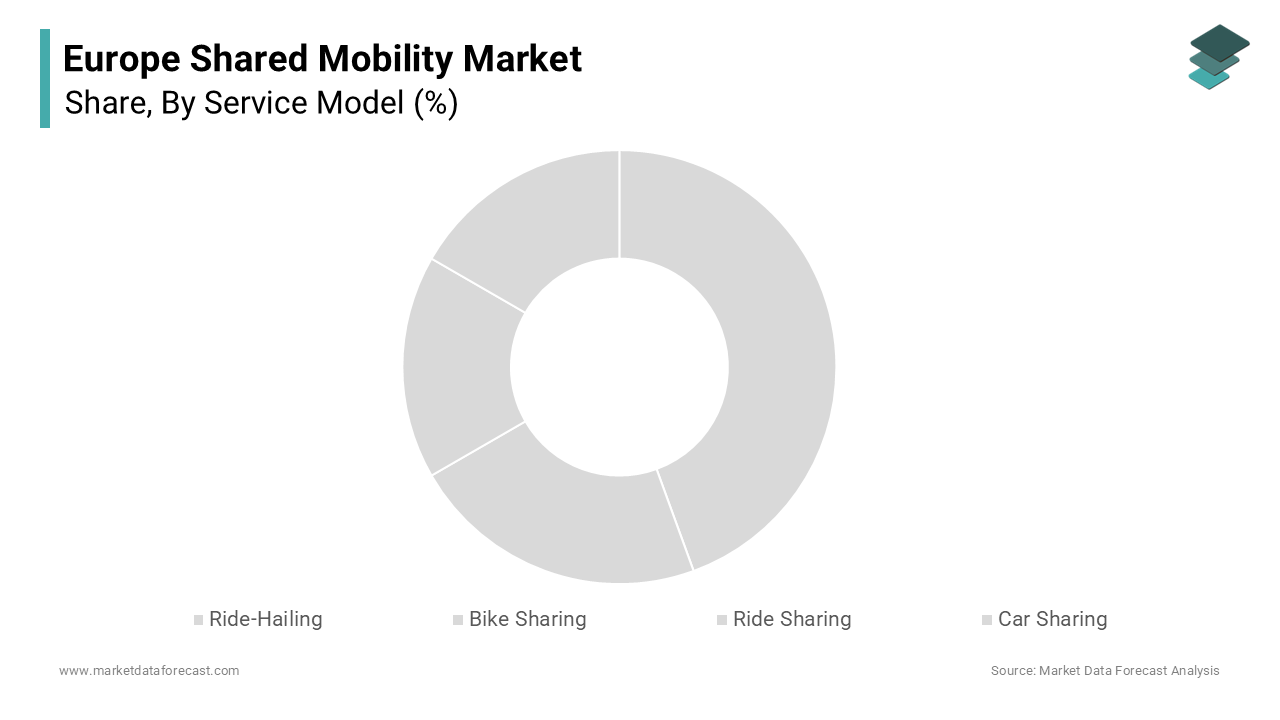
The bike sharing segment is projected to grow with an anticipated CAGR of 14.2% from 2026 to 2034. European cities have dramatically expanded protected cycling infrastructure, directly boosting bike sharing viability. Between 2020 and 2025, the EU added over 12000 kilometers of segregated bike lanes, with Paris alone converting 70 kilometers of car lanes into cycling corridors, according to the reports. This infrastructure reduces accident risk and increases trip comfort, leading to higher adoption. In cities with dedicated lanes bike sharing ridership grows 2.3 times faster than in those without, per the International Transport Forum. The European Commission’s Urban Mobility Framework allocates 1.2 billion euros annually through 2027 specifically for micro mobility infrastructure, ensuring continued expansion. The shift from mechanical to electric assisted bikes has broadened appeal beyond core cycling demographics. E-bikes now constitute 68% of all shared bicycles in Europe, up from 32% in 2020, according to the European Bicycle Market Monitor. These vehicles reduce effort on inclines and over distances beyond 3 kilometers, attracting older users and those in hilly cities like Lisbon and Bergen. Average trip distance has increased from 2.1 to 3.4 kilometers since electrification scaled by enhancing utility for commuting and errands.
By Channel Insights
The online channel segment held a significant share of the Europe shared mobility market in 2025. Mobile technology has become the universal interface for urban mobility in Europe. As of 2025, smartphone penetration exceeds 89% across EU urban populations, thereby enabling real time vehicle location booking and payment through a single app. Unlike offline kiosks or call centers, online platforms support dynamic pricing route optimization and multimodal integration features critical to modern user expectations. A 2024 Eurobarometer survey found that 82% of shared mobility users consider app responsiveness and integrated fare calculation essential to their choice of provider. This digital expectation has rendered offline channels functionally obsolete except in niche contexts such as tourist bike rentals in smaller towns. Online platforms leverage behavioral data to tailor services, increasing engagement and lifetime value. Machine learning models predict demand hotspots recommend multimodal routes and offer loyalty incentives based on individual patterns. Moreover, app based digital wallets allow seamless top ups and cross service credits, reducing payment friction.
The online channel segment is deemed to grow at a CAGR of 12.8% from 2026 to 2034. Cities across Europe are deploying integrated Mobility as a Service ecosystems, where a single app aggregates public transit car sharing scooters and ride hailing. Helsinki’s Whim and Berlin’s Jelbi now serve over 1.2 million combined users, according to the survey. These platforms create stickiness by offering monthly subscriptions that include unlimited shared trips by reducing user churn. This bundling strategy transforms shared mobility from transactional to habitual usage. The pandemic permanently shifted user preferences toward touch free interactions. Operators responded by removing all offline payment options and phasing out physical docking terminals in favor of GPS based free floating models. Consequently, offline channel revenue has declined by 42% since 2022, accelerating the online segment’s growth trajectory.
By Vehicle Insights
The Cars segment was the largest by occupying 52.3% of the Europe shared mobility market share in 2024. While micro mobility excels for short trips, cars remain essential for journeys exceeding 5 kilometers or involving multiple passengers. In European cities, 34% of shared mobility trips cover distances between 5 and 15 kilometers, as per the International Transport Forum with a range impractical for bikes or scooters. Families and professionals frequently require luggage space child seats or climate control features only cars provide. In Germany and France, over 58% of car sharing trips occur during weekends or holidays for leisure or intercity travel with a use case untouched by two wheelers, as per some reports. This functional differentiation ensures cars retain premium pricing and higher per trip revenue. Major European automakers have vertically integrated into car sharing, ensuring consistent vehicle supply and brand alignment. These OEM backed fleets benefit from preferential procurement direct service networks and over the air software updates that reduce downtime.
The two wheelers segment is expected to grow at a fastest CAGR of 15.1% from 2025 to 2033. European cities are increasingly restricting motorized vehicles in urban cores but explicitly exempting electric bikes and scooters. Of the 257 low emission zones in Europe 212 permit two wheelers unrestricted access while banning cars, according to the European Environment Agency. In Paris, all internal combustion vehicles were banned from the city center in 2024 but e-bikes and scooters remain fully operational. This regulatory asymmetry funnels demand toward two wheelers particularly for first and last mile connections. Two wheelers require significantly less investment per unit than cars, approximately 1200 euros for an e-scooter versus 28000 euros for an electric car, according to the International Council on Clean Transportation. This allows operators to scale quickly in response to demand spikes or policy changes.
REGIONAL ANALYSIS
Germany Shared Mobility Market Analysis
Germany was the outperformer of the Europe shared mobility market by holding 19.2% of share in 2024 owing to its advanced digital infrastructure dense urban centers and strong regulatory support for sustainable transport. The country hosts over 80 shared mobility operators including OEM backed platforms like WeShare and Free2Move. The nationwide expansion of Mobility Hubs integrated stations combining car sharing bikes scooters and transit, now numbering over 320 across major cities. Additionally, Germany’s strict CO2 fleet targets have pushed automakers to invest heavily in shared electric fleets with 74% of car sharing vehicles now fully electric. High smartphone penetration at 91% and strong public trust in digital services further enable seamless adoption. Municipal policies also favor shared models with cities like Hamburg reserving over 5000 on street parking spots exclusively for car sharing, reducing operational friction and enhancing user convenience.
France Shared Mobility Market Analysis
France was positioned second by accounting for 16.3% of the Europe shared mobility market share in 2024 with the Paris’s aggressive modal shift policies and national support for micro mobility. The French capital has eliminated over 70000 private parking spaces since 2020 and converted 70 kilometers of roads into cycling lanes, according to the Paris Urban Planning Agency. Nationally France mandates that all cities with populations above 100000 develop shared mobility plans by 2026 under the Loi Climat legislation. The government also provides subsidies covering up to 50% of e bike sharing procurement costs for municipalities, as confirmed by the French Ministry of Ecological Transition.
United Kingdom Shared Mobility Market Analysis
The United Kingdom shared mobility market growth is expected to grow with London serving as the primary growth engine. Transport for London reports that shared mobility trips grew by 28% in 2025 driven by the expansion of the Ultra Low Emission Zone, which now covers the entire Greater London area. Uber’s integration of bike and scooter options alongside its ride hailing service has created a dominant multimodal platform with over 3 million monthly users. The UK also leads in data driven fleet management with operators using AI powered rebalancing to reduce idle time by 22%, according to the UK Department for Transport. Corporate adoption is also strong with 39% of FTSE 100 firms offering shared mobility benefits, accelerating B2B revenue streams.
Italy Shared Mobility Market Analysis
Italy shared mobility market growth is propelled with its rapid adoption of two wheeler sharing in historic city centers, where cars are restricted. Cities like Rome, Florence, and Milan have banned private vehicles in medieval cores but allow electric scooters and bikes, thereby creating a captive market for micro mobility. Milan’s Area B congestion zone covers 90 square kilometers and permits only zero emission shared vehicles. This policy has driven e scooter trips to surpass 2 million per month in the city alone. Nationally Italy benefits from EU Recovery Fund allocations with 1.2 billion euros earmarked for urban mobility innovation through 2026, as confirmed by the Italian Ministry of Infrastructure.
Netherlands Shared Mobility Market Analysis
The Netherlands shared mobility market growth is likely to grow with the cycling culture and policy foresight to dominate bike sharing. Amsterdam and Utrecht have implemented “bicycle first” urban planning where shared bikes receive priority at traffic signals and docking stations. The national government’s 2025 Urban Mobility Pact allocates 300 million euros annually to expand e bike sharing in secondary cities like Groningen and Eindhoven. The Netherlands leads Europe in shared bike electrification with 81% of fleets now e-assisted by enabling longer commutes and higher utilization.
COMPETITIVE LANDSCAPE
Competition in the Europe shared mobility market is intensely dynamic characterized by rapid technological adaptation regulatory navigation and strategic consolidation. Major players compete not only on price and coverage but also on sustainability credentials service integration and user experience design. The market features a mix of global tech giants automotive OEMs and agile startups each leveraging distinct advantages such as fleet ownership digital ecosystems or hyperlocal operational knowledge. Regulatory fragmentation across cities necessitates customized approaches increasing entry barriers for new players while favoring those with established compliance frameworks. Price sensitivity among users drives continuous innovation in pricing models including subscriptions bundles and loyalty programs. At the same time, public sector collaboration has become a critical competitive differentiator as cities increasingly dictate terms through permits infrastructure access and emission requirements shaping the market’s long term structure.
KEY MARKET PLAYERS
Some of the companies that are playing a dominating role in the Europe shared mobility market include
- Uber Technologies, Inc.
- DiDi Global Inc.
- Gett
- Grab Holdings Inc.
- Bolt Technology OÜ
- Careem
- Cabify España S.L.U.
- Lyft, Inc.
- Free Now
- Zimride
- Share Now GmbH
- Deutsche Bahn Connect GmbH
- GT Gettaxi (UK) Limited
- Ola Cabs
Top Players in the Market
Bolt Technology
Bolt Technology is a leading European mobility platform offering ride hailing car sharing and micromobility services across more than 45 countries. Headquartered in Tallinn the company has significantly expanded its shared mobility footprint by integrating multimodal options into a single app enhancing user convenience and trip efficiency. In 2025, Bolt launched a fully electric car sharing service in Paris and Berlin aligning with municipal zero emission mandates. The company also introduced AI driven dynamic pricing and real time fleet rebalancing to improve vehicle availability. Bolt’s investment in in house safety protocols and driver training programs has reinforced trust among urban commuters and public authorities alike strengthening its operational resilience, across diverse European regulatory environments.
Uber Technologies
Uber Technologies maintains a strong presence in the Europe shared mobility market through its ride hailing UberX and multimodal offerings including JUMP bikes and scooters. The company has strategically pivoted toward sustainability by committing to a fully zero emission mobility platform in Europe by 2030. In 2024 Uber deepened integration with public transit in cities like London and Amsterdam allowing users to plan and pay for combined trips via its app. It also partnered with local micro mobility operators to expand last mile connectivity without direct fleet ownership. Uber’s
Free2Move
Free2Move a mobility brand of Stellantis operates car sharing and ride hailing services across major European cities including Paris Berlin and Madrid. The company leverages its automotive parentage to deploy standardized electric fleets with seamless maintenance and telematics integration. In early 2025 Free2Move launched a corporate mobility platform offering businesses customizable mobility budgets and real time CO2 tracking to comply with EU sustainability reporting rules. It also introduced subscription-based car sharing bundles with insurance and charging included.
Top Strategies Used by the Key Market Participants
Key players in the Europe shared mobility market primarily employ multimodal integration to enhance user retention by combining ride hailing car sharing and micromobility within unified digital platforms. They pursue strategic partnerships with municipal authorities and public transit agencies to gain preferential access to infrastructure and regulatory support. Electrification of fleets is another core strategy aligned with EU climate mandates and urban zero emission zones. Companies also invest heavily in data driven operations including AI powered demand forecasting and dynamic rebalancing to optimize asset utilization. Lastly, they target corporate clients through tailored B2B mobility solutions that support enterprise sustainability goals and ensure recurring revenue streams.
MARKET SEGMENTATION
This research report on the europe shared mobility market has been segmented and sub-segmented based on following categories.
By Service Model
- Ride-Hailing
- Bike Sharing
- Ride Sharing
- Car Sharing
- Others
By Channel
- Online
- Offline
By Vehicle
- Car
- Two-wheelers
- Others
By Country
- UK
- France
- Spain
- Germany
- Italy
- Russia
- Sweden
- Denmark
- Switzerland
- Netherlands
- Turkey
- Czech Republic
- Rest of Europe