- Product Description Description
- Table of Contents TOC
- List of Table & Figure LOT
- Get Free Sample PDF Sample PDF
Market Size, 2025
$0.73 BnMarket Estimate, 2026
$0.81 BnMarket Forecast, 2034
$1.79 BnCAGR, 2026–2034
10.42%Europe Shore Power Market Report Summary
The Europe shore power market was valued at USD 0.73 billion in 2025, is estimated to reach USD 0.81 billion in 2026, and is projected to reach USD 1.79 billion by 2034, growing at a CAGR of 10.42% during the forecast period from 2026 to 2034. The growth of the Europe shore power market is driven by stringent environmental regulations, increasing efforts to reduce emissions from maritime transport, and rising investments in sustainable port infrastructure. Growing deployment of shore-side electricity systems at commercial ports, expanding adoption of cold ironing technologies by cruise and container vessels, and increasing government funding for port electrification are further fueling market growth. Moreover, the integration of renewable energy sources with shore power infrastructure, advancements in smart grid technologies, and the modernization of European ports are supporting the expansion of the Europe shore power market.
Key Market Trends
-
Rising implementation of shore power infrastructure to reduce greenhouse gas emissions and improve air quality at European ports.
-
Increasing government funding and policy support for port electrification under the European Green Deal and Alternative Fuels Infrastructure Regulation.
-
Growing integration of renewable energy sources and battery storage systems with shore power infrastructure.
-
Rising adoption of automated and smart shore power connection systems to improve operational efficiency and vessel compatibility.
-
Expansion of shore power facilities across major container terminals, cruise ports, and short-sea shipping corridors throughout Europe.
Segmental Insights
- Based on type, the shoreside segment was the largest and held a significant share of the Europe shore power market in 2024. The segment’s dominance is attributed to increasing investments by port authorities in electrical substations, cable management systems, and high-voltage shore connection infrastructure, supported by favorable government funding and regulatory mandates aimed at reducing emissions from berthed vessels.
- Based on connection, the new installation segment accounted for 60.8% of the Europe shore power market share in 2024. The dominance of this segment stems from expanding greenfield port development projects, integration of shore power systems into newly constructed terminals, increasing public investments in sustainable maritime infrastructure, and growing adoption of standardized electrical connection systems across European ports. Meanwhile, the retrofit segment is witnessing rapid growth as existing ports and vessels are upgraded to comply with evolving environmental regulations.
Regional Insights
The Europe shore power market is witnessing strong growth across major economies, supported by stringent emission regulations, increasing investments in green port infrastructure, and the rapid modernization of maritime transportation.
- Germany was the largest contributor, accounting for 23.2% of the Europe shore power market share in 2024, driven by its strong maritime infrastructure, significant public investment in port electrification, early implementation of shore power regulations, and the presence of leading technology providers.
- The Netherlands continues to perform strongly, led by the Port of Rotterdam's large-scale shore power deployment, extensive logistics infrastructure, and strong government support for sustainable port operations.
- Sweden remains a key market owing to its renewable electricity generation, extensive electrification of ferry terminals, strong environmental policies, and widespread adoption of shore power across domestic shipping routes.
- France is witnessing notable growth due to increasing investments in cruise terminal electrification, government incentives supporting port decarbonization, and expanding implementation of cold ironing technologies.
- Denmark is also emerging as a major market, supported by its renewable energy leadership, electrification of major ferry ports, growing investments in sustainable maritime transport, and integration of offshore wind power with port infrastructure.
-
Competitive Landscape
The Europe shore power market is characterized by the presence of leading electrical equipment manufacturers, maritime technology providers, and port infrastructure specialists competing through technological innovation, strategic collaborations, and sustainable energy solutions. Leading companies are focusing on developing high-voltage shore connection systems, expanding digital energy management capabilities, integrating renewable energy with shore-side electricity infrastructure, and strengthening partnerships with port authorities and shipping operators. Continuous investments in smart grid technologies, automated connection systems, and standardized shore power solutions are further strengthening competition across the Europe shore power market. Prominent players in the Europe shore power market include ABB Ltd., Siemens AG, Schneider Electric SE, Cavotec SA, Wärtsilä Corporation, Danfoss A/S, Stemmann-Technik (Conductix-Wampfler Group), ABB Marine & Ports, PowerCon AS, and Port of Rotterdam / Port Authorities.
Europe Shore Power Market Size
The Europe shore power market size was valued at USD 0.73 billion in 2025 and is anticipated to reach USD 0.81 billion in 2026 from USD 1.79 billion by 2034, growing at a CAGR of 10.42% during the forecast period from 2026 to 2034.
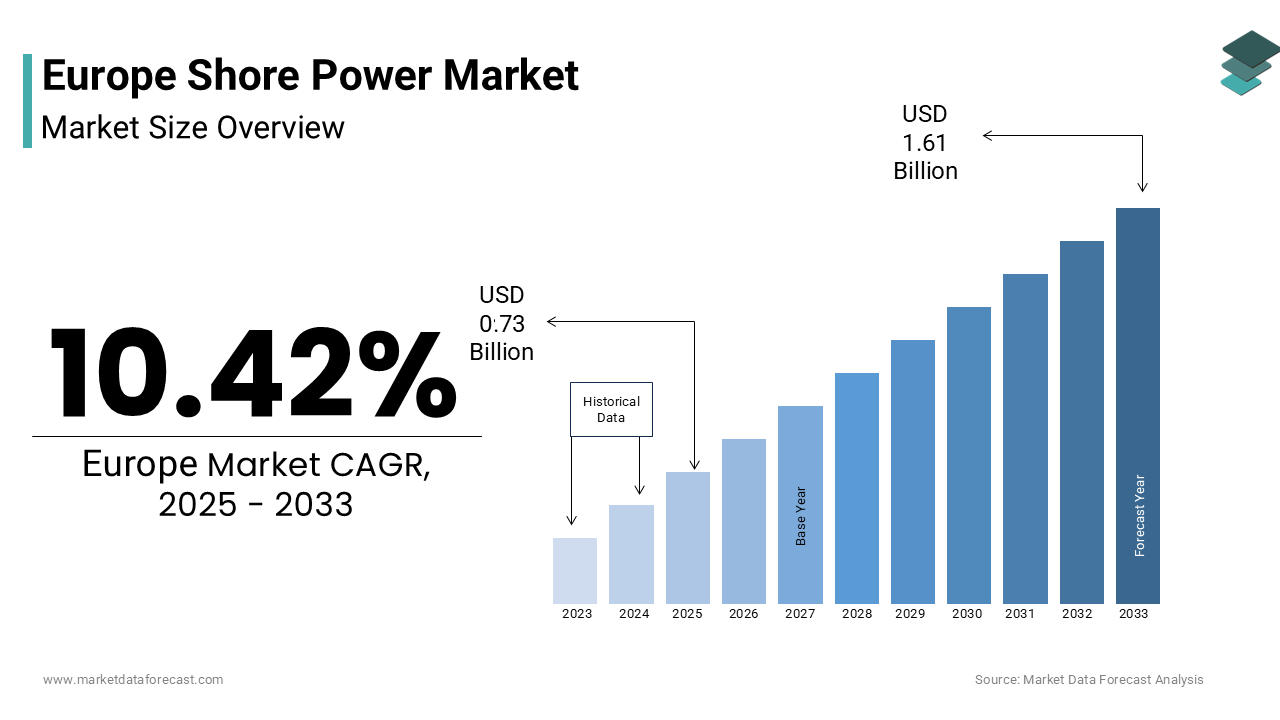
Shore power is also known as cold ironing and is the provision of electrical power from onshore infrastructure to berthed vessels that enabling them to switch off their auxiliary diesel engines while docked. This technology plays a pivotal role in curbing maritime emissions in port areas, aligning with Europe’s stringent environmental and air quality mandates. Maritime transport contributes significantly to air pollution in EU port cities with nitrogen oxide and particulate matter emissions posing major challenges. With over 1,200 commercial seaports in Europe handling more than 3.4 billion tonnes of goods annually, the pressure to mitigate localized pollution has intensified. For instance, Europe’s cruise ships emit more sulphur oxides than one billion cars, which indicates the scale of emissions from the sector. In response, the European Union’s Alternative Fuels Infrastructure Regulation mandates the installation of shore-side electricity supply at major EU ports by 2030 for passenger and container vessels. These regulatory imperatives, coupled with growing public sensitivity to urban air quality, have positioned shore power as a non-negotiable element of sustainable port modernization across the continent.
MARKET DRIVERS
Stringent EU Environmental Regulations Are Accelerating Shore Power Adoption
The comprehensive legislative framework of the European Union to combat air pollution and greenhouse gas emissions serves as a primary catalyst for shore power deployment, which is one of the major factors propelling the European shore power market. Directive 2010/75/EU on industrial emissions includes large combustion plants and ports are increasingly categorized under this scope due to vessel emissions while at berth. The FuelEU Maritime initiative mandates a 2% reduction in the greenhouse gas intensity of maritime fuels by 2025 and an 80% reduction by 2050. Shore power enables compliance by eliminating onboard fossil fuel combustion during port calls. Ships at berth in EU ports account for a significant share of total shipping emissions within the bloc. In 2023, the European Parliament reinforced requirements under the Alternative Fuels Infrastructure Regulation, obliging all EU member states to equip designated ports with shore-side electricity by 2030 for container and passenger ships exceeding 5,000 gross tonnages. Furthermore, cities like Gothenburg and Rotterdam have implemented local port dues incentives, which is offering notable discounts for vessels using shore power. These regulatory and fiscal mechanisms collectively create a compelling economic and legal impetus for port authorities and shipping lines to invest in shore power infrastructure, which is transforming compliance from a cost burden into a strategic environmental asset.
Port Electrification Initiatives Backed by Public and Private Funding Are Driving Infrastructure Expansion
The rapid modernization of European port infrastructure is being propelled by substantial co-investment from both public institutions and private stakeholders, which is creating fertile ground for shore power system deployment and further boosting the regional market growth. The Connecting Europe Facility, the EU’s key funding instrument for trans-European transport networks, which allocated billions of euros in 2023 specifically for sustainable port infrastructure with shore power projects receiving priority consideration. In parallel, national governments have launched complementary schemes as Germany’s Maritime Green Shipping program committed significant funding in 2024 to support cold ironing installations in Hamburg and Bremerhaven. Similarly, the Swedish Transport Administration disbursed millions of euros in 2023 to equip ferry terminals with shore-side electricity. These investments are not isolated but embedded within broader decarbonization roadmaps. For instance, the Port of Antwerp-Bruges has pledged to achieve carbon neutrality by 2050 and has already installed shore power at short-sea shipping berths handling roll-on/roll-off traffic. According to the European Sea Ports Organisation, dozens of European ports now offer shore power at one or more terminals with container and cruise segments leading adoption. This coordinated funding ecosystem reduces the capital risk for terminal operators and accelerates the technical standardization necessary for interoperability across maritime corridors.
MARKET RESTRAINTS
High Capital Expenditure and Complex Grid Integration Pose Significant Entry Barriers
The deployment of shore power infrastructure entails considerable upfront investment and intricate coordination with national grid operators, which collectively constrain market penetration particularly in smaller and medium-sized ports. A typical high-voltage shore connection system for a single cruise or container berth requires significant investment, which is depending on distance from the grid substation, required voltage conversion and vessel compatibility needs. Many European ports cite capital cost as the foremost obstacle to shore power adoption. Beyond hardware expenses, grid reinforcement is often necessary as many port areas were not originally designed to handle the additional megawatt loads typical of large vessels at berth. For example, upgrading grid capacity to support shore power at the Port of Barcelona has been estimated to require substantial investment in transmission infrastructure in Spain. Moreover, the return on investment remains uncertain due to inconsistent vessel uptake and limited tariff structures that fail to reflect the environmental externality benefits. These financial and technical complexities disproportionately affect regional ports with lower traffic volumes, thereby creating a two-tier system where only major hubs can afford electrification, which is exacerbating regional disparities in emission reduction efforts.
Lack of Technical Standardization Across Vessel and Port Interfaces Hinders Interoperability
The absence of uniform technical and operational standards for shore power systems across European ports and vessel fleets significantly impedes seamless adoption and utilization, which is further impeding the regional market growth. While the International Electrotechnical Commission standard IEC/IEEE 80005 defines voltage, frequency and connector specifications, practical implementation varies widely. As per a 2023 study, a relatively small share of newly built European-flagged container ships is equipped with standardized shore power connection points compatible with major EU port configurations. Cruise ships face even greater heterogeneity as vessels operated by different lines may require customized cable management systems, voltage converters or communication protocols to interface with shore-side equipment. This fragmentation leads to underutilization, despite shore power being available at multiple cruise terminals in Hamburg , actual usage rates in 2024 remained limited due to equipment incompatibility and procedural delays. Furthermore, retrofits for existing vessels can cost hundreds of thousands of euros per ship and often require dry-docking, which many owners avoid without regulatory compulsion. Until harmonized standards are mandated across both port infrastructure and vessel design, the efficiency and scalability of shore power across Europe’s maritime network will remain compromised.
MARKET OPPORTUNITIES
Expansion of Short Sea Shipping Corridors Offers Untapped Shore Power Potential
The European Commission’s renewed focus on short sea shipping as a sustainable alternative to road freight is a strategic opportunity for shore power deployment along densely trafficked inland and coastal routes. Short sea shipping accounts for nearly 40% of all intra-EU seaborne cargo. Ferries and roll-on/roll-off vessels operating on fixed routes between ports such as Helsinki-Tallinn, Marseille-Genoa and Kiel-Göteborg make frequent port calls maximizing the emission reduction impact per shore power installation. Short sea shipping volumes in the EU have continued to grow, driven by modal shift policies under the European Green Deal. Unlike deep-sea container ships that may call at a European port only once per month, short-sea vessels offer consistent and predictable demand for cold ironing, improving the economic viability of infrastructure investment. The Nordic Region’s Green Shipping Program has already identified ferry routes as priority candidates for shore power with pilot projects showing significant reductions in local NOx emissions during port stays. With the EU’s Trans-European Transport Network designating short sea shipping motorways by 2030, coordinated shore power rollout along these corridors could yield disproportionate environmental benefits relative to capital outlay, particularly in urban waterfront zones where air quality compliance is most urgent.
Integration with Renewable Energy Microgrids Enhances Decarbonization Impact
The convergence of shore power with localized renewable energy generation and smart grid technologies offers a lucrative opportunity to amplify the carbon reduction benefits of port electrification. Rather than drawing solely from the national grid, ports can deploy on-site solar photovoltaic arrays, wind turbines or battery storage systems to power shore connections with near-zero emission energy. The Port of Rotterdam’s “Greenport” initiative, operational since 2023, integrates renewable energy infrastructure including a solar farm and a large-scale battery system that supplies clean electricity to shore-side connections at the Maasvlakte terminal. Renewable energy accounted for around 44% of EU power generation in 2023 and this share is projected to exceed 60% by 2030. By co-locating shore power with renewables, ports can achieve significant lifecycle emission reductions compared to diesel auxiliary engines. Additionally, advanced load management software enables ports to optimize energy dispatch during peak vessel occupancy, which is reducing strain on the main grid and lowering electricity procurement costs. The European Investment Bank has earmarked substantial funding under its Clean Urban Transport Facility specifically for hybrid shore power–renewable projects, which is signaling strong institutional support for this integrated approach. This synergy not only enhances environmental performance but also positions ports as energy hubs within regional circular economies.
MARKET CHALLENGES
Divergent National Regulatory Timelines Delay Harmonized Market Development
The uneven pace of regulatory implementation across European Union member states creates operational uncertainty and delays cohesive market scaling for shore power, which is a significant challenge to the European shore power market. Although the Alternative Fuels Infrastructure Regulation sets a 2025 deadline for shore-side electricity at core network ports, national transposition into domestic law varies significantly. Only a portion of EU member states have fully integrated the shore power mandate into national legislation, while others have missed transposition deadlines. This fragmentation results in inconsistent compliance expectations for shipping operators navigating multiple jurisdictions. For example, a container vessel calling at ports in Germany, France and Poland may face mandatory shore power use in Hamburg, voluntary adoption in Le Havre and no infrastructure in Gdansk. Such unpredictability discourages fleet-wide investments in shore power compatibility. Moreover, financial support mechanisms differ widely; while Norway offers capital grants through its Enova program, Portugal provides no dedicated subsidies, which is leading to stark disparities in deployment rates. This regulatory asymmetry undermines the EU’s objective of a level playing field and inhibits the creation of a truly integrated shore power market across maritime corridors.
Limited Vessel Retrofit Uptake Constrains Utilization of Existing Infrastructure
Despite growing shore power availability at European terminals, underutilization persists due to the slow pace of vessel retrofits and the economic disincentives facing shipowners, which is further challenging the expansion of the European market. For instance, only one in five required onshore power connections was installed or contracted in the ports studied, which is indicating low readiness across key European hubs. The primary deterrent is the high retrofit cost that range from several hundred thousand to over one million euros per vessel and includes electrical hardware and structural modifications for cable handling and safety systems. With global shipping margins remaining tight following post‑pandemic volatility, many operators deprioritize non‑mandatory upgrades. Even when infrastructure is available, equipment incompatibility and procedural issues are frequently cited as major causes of berth delays. Furthermore, short turnaround windows during port calls deter crews from initiating complex power transfer procedures. Without binding retrofit mandates or robust financial incentives tied to port call frequency, the demand side of the shore power equation remains critically underdeveloped, which is rendering newly installed systems economically inefficient and environmentally underperforming.
REPORT COVERAGE
| REPORT METRIC | DETAILS |
| Market Size Available | 2025 to 2034 |
| Base Year | 2025 |
| Forecast Period | 2026 to 2034 |
| Segments Covered | By Type, Connection and Region |
| Various Analyses Covered | Global, Regional & Country Level Analysis, Segment-Level Analysis, Drivers, Restraints, Opportunities, Challenges, PESTLE Analysis, Porter’s Five Forces Analysis, Competitive Landscape, Analyst Overview of Investment Opportunities |
| Regions Covered | United Kingdom (UK), France, Spain, Germany, Italy, Russia, Sweden, Denmark, Switzerland, the Netherlands, Turkey, the Czech Republic, and the Rest of Europe. |
| Market Leaders Profiled | ABB Ltd., Siemens AG, Schneider Electric SE, Cavotec SA, Wärtsilä Corporation, Danfoss A/S, Stemmann-Technik (Conductix-Wampfler Group), ABB Marine & Ports, PowerCon AS, and the Port of Rotterdam/Port Authorities. |
SEGMENTAL ANALYSIS
By Type Insights
The shoreside segment dominated the European shore power market by holding the major share of the European market in 2025. The dominance of the shoreside infrastructure segment in the regional market is attributed to the centralized nature of port modernization mandates and the fact that regulatory obligations under the EU’s Alternative Fuels Infrastructure Regulation fall primarily on port authorities rather than shipowners. A significant share of funding for shore power between 2020 and 2024 was directed toward onshore electrical substations, cable corridors and high‑voltage connection points and 58% of surveyed European ports now report offering onshore power supply at one or more berths. Shoreside infrastructure is also more scalable, which is a single installation can service multiple vessels over time, making it a cost‑efficient focal point for public investment. The Port of Rotterdam invested tens of millions of euros in shoreside systems by 2024, which is enabling compatibility with both container and cruise terminals and attracting dedicated financing and project support from institutions such as the European Investment Bank. Furthermore, national energy regulators often classify shoreside power as grid extension projects, which can qualify them for transmission infrastructure subsidies that are typically unavailable to maritime operators. This asymmetric policy support has cemented shoreside infrastructure as the foundational enabler of cold ironing across Europe with port‑led deployment continuing to outpace vessel‑side readiness.
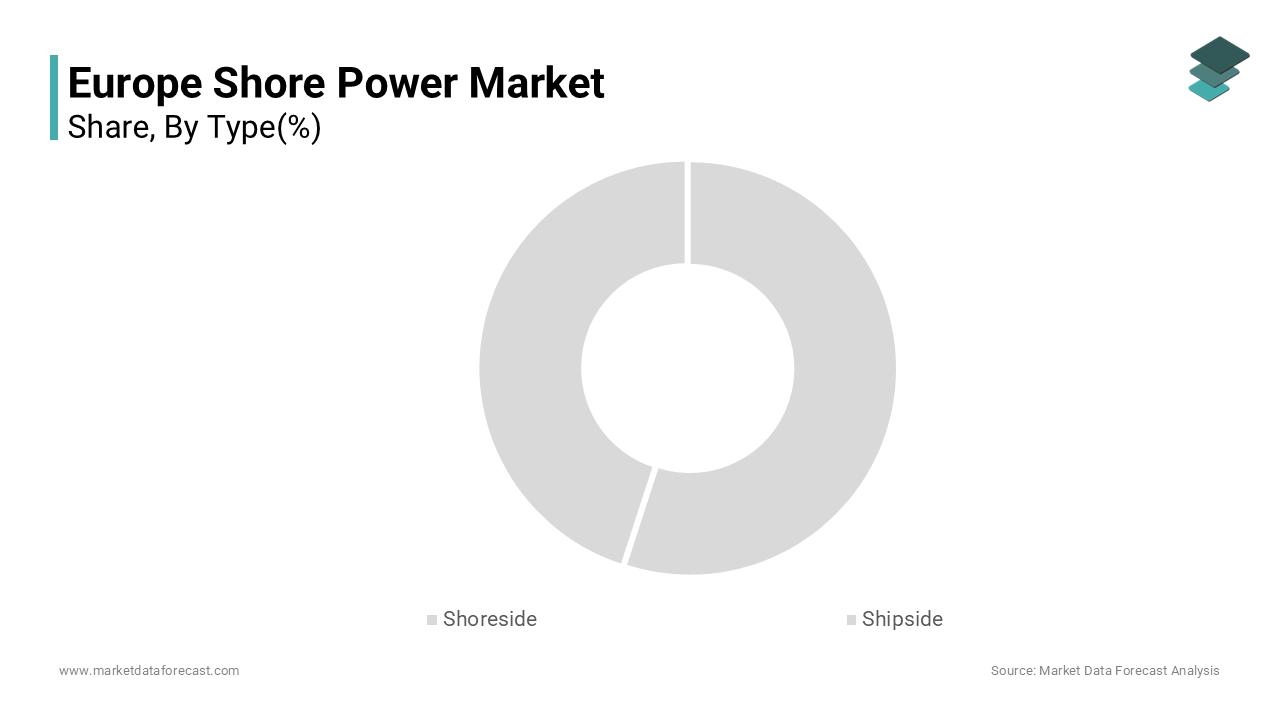
The shipside segment is the fastest growing segment and is anticipated to register a promising CAGR of 14.4% over the forecast period owing to the tightening enforcement of FuelEU Maritime and the emergence of mandatory retrofit clauses in vessel charter agreements. Major cruise operators such as MSC and Costa Cruises have publicly emphasized commitments to equip their newbuilds with shore power connectivity in recent sustainability disclosures, which is reflecting a broader industry push toward at‑berth electrification. Additionally, classification societies like DNV have introduced class rules and guidance for shore power connections, which is making shore power readiness an increasingly prominent factor in design and compliance discussions from the keel‑laying stage onward. For instance, a growing share of new ship orders specified as shore power‑ready between 2021 and 2024, which is reflecting demand from European operators and ports for integrated shoreside power reception systems. The rising cost of EU Emissions Trading System allowances further incentivizes shipowners to minimise auxiliary engine use while berthed and to consider shore power or other at‑berth emission reduction measures. Unlike shoreside assets, which are location bound, shipside investments yield operational flexibility across global ports, which is enhancing their strategic value in an increasingly regulated maritime landscape.
By Connection Insights
The new installation segment led the market by holding 60.8% of the regional market share in 2024. The growth of the new installation segment is primarily driven by the greenfield port developments and terminal expansions provide a structurally optimal environment for integrating high-voltage shore connections during initial construction. Over recent years, a significant share of new shore power capacity has been embedded within newly built quay walls or terminal masterplans, which is avoiding the engineering complexities of retrofitting aging infrastructure. Ports such as the Maasvlakte II in Rotterdam and the JadeWeserPort in Germany were designed from inception with underground cable ducts and dedicated substations for shore power, which is reducing lifetime costs compared to retrofits. Additionally, EU cohesion funds have prioritized new sustainable infrastructure in developing maritime regions with billions of euros disbursed in 2023 to support integrated shore power in newly constructed terminals across Eastern and Southern Europe. The alignment of shore power with broader port digitalization and automation initiatives further favors new builds, where systems can be holistically engineered rather than patched onto legacy layouts. This structural advantage ensures new installations remain the preferred pathway for scalable and future‑proof shore power deployment.
The retrofit segment is predicted to expand at a CAGR of 17.7% over the forecast period in the European shore power market. The urgent compliance pressures and the operational reality that much of Europe’s existing vessel fleet and terminal stock predates shore power mandates are fuelling the growth of the retrofit segment in the European market. For instance, hundreds of berths across EU ports require retrofitted shore connections to meet the 2025 Alternative Fuels Infrastructure Regulation deadline, which is creating immediate demand for modular and adaptable solutions. In Germany, federal maritime authorities allocated significant funding in 2024 specifically for retrofitting older ferry and cruise terminals in Kiel, Rostock and Warnemünde. On the vessel side, cruise companies are accelerating dry-dock retrofits as Carnival Corporation reported completing shore power retrofits on a portion of its fleet by end 2024 with each conversion taking an average of around two weeks in dry dock. Technological advancements are also reducing retrofit barriers as ABB’s compact containerized shore-to-ship power units can now be deployed without major quay reconstruction, which is cutting project timelines substantially. This convergence of regulatory urgency, financial support and engineering innovation is transforming retrofit from a stopgap measure into a high-growth segment central to Europe’s near-term decarbonization timeline.
REGIONAL ANALYSIS
Germany Shore Power Market Analysis
Germany dominated the shore power market in Europe in 2024 by accounting for 23.2% of the regional market share. The dominance of Germany in the European market is attributed to its dual role as a major shipping hub and a leader in industrial decarbonization policy. Germany’s maritime strategy, updated in 2023, mandates shore power availability at all major commercial and passenger terminals by 2026, ahead of the EU baseline. This accelerated timeline has spurred investment in ports such as Hamburg, which activated shore power at cruise berths in 2024 capable of supplying 11 kilovolts to vessels. According to the German Federal Ministry for Digital and Transport, hundreds of millions of euros in public grants were approved in 2024 for shore power projects, among the highest levels in Europe. The presence of engineering giants like Siemens Energy and ABB also ensures rapid deployment of standardized, high‑efficiency systems. Furthermore, Germany’s Energiewende policy links port electrification to national renewable energy goals with Hamburg’s shore power grid sourcing a majority of its electricity from offshore wind. This integrated approach positions Germany not just as a market leader but as a technical benchmark for the continent.
Netherlands Shore Power Market Analysis
The Netherlands occupied a substantial share of the Europe shore power market in 2024. The growth of Netherlands in the European market is driven by its status as Europe’s premier logistics gateway through the Port of Rotterdam, which is the continent’s largest by cargo volume. Rotterdam’s Shore Power Roadmap targets full shore-side electricity coverage for all deep-sea container and cruise terminals by 2028 with multiple berths already operational as of early 2025. According to the Port of Rotterdam Authority, shore power usage at its cruise terminal reduced CO2 emissions significantly in 2024. The Dutch government complements this through the National Growth Fund, which allocated hundreds of millions of euros in 2023 for smart port infrastructure, including adaptive frequency converters to handle diverse vessel requirements. The Netherlands also leads in cross-border coordination; its North Sea Ports alliance with Belgium ensures technical harmonization of shore power systems across Antwerp, Ghent and Zeeland. Additionally, Dutch grid operator TenneT has developed dynamic load-balancing protocols that allow shore power to draw from battery buffers during peak hours, minimizing strain on the national grid. These systemic innovations make the Netherlands a model of scalable, interoperable shore power deployment.
Sweden Shore Power Market Analysis
Sweden is a prominent market for shore power in Europe. The aggressive focus of Sweden on electrifying short sea and domestic ferry routes are propelling the shore power market in Sweden. The Swedish Transport Administration’s National Strategy for Electric Ports, launched in 2022, aims to equip all public ferry terminals with shore power by 2027. By 2024, a majority of Sweden’s major ferry ports had operational cold ironing systems, including the high-frequency Stockholm. Åland corridor, which sees dozens of weekly sailings. Shore power adoption on domestic routes has already reduced harmful emissions, contributing to improved air quality. The country’s abundant hydropower ensures that shore power delivers near-zero lifecycle emissions. Public-private partnerships have also accelerated uptake; the Green Coastal Shipping Program, co-funded by the EU and Swedish industry, has committed substantial funding to vessel and port electrification since 2023. This holistic integration of clean energy, targeted policy and frequent vessel turnover has made Sweden a leader in short-sea shore power implementation across Northern Europe.
France Shore Power Market Analysis
France is anticipated to account for a notable share of the European market over the forecast period owing to the stringent enforcement of port emission zones and strong alignment with EU Green Deal objectives. The French Energy and Climate Law of 2019 includes provisions encouraging ports with high passenger volumes to provide shore power by 2025, which is directly affecting major hubs like Marseille and Le Havre. The France 2030 investment plan has allocated significant funding to support shore‑side infrastructure at a set of strategic ports. Marseille’s cruise terminal, one of France’s busiest, activated its first shore power berth in early 2025, which is expected to deliver substantial annual CO₂ and air‑quality benefits. France also offers reductions in environmental port dues for vessels using shore power, which is creating direct economic incentives. Moreover, the national grid operator RTE has prioritized port grid upgrades along the Mediterranean and Atlantic coasts to ensure reliable high‑capacity supply. This combination of legal measures, targeted funding, economic incentives and grid readiness is consolidating France’s position as a Mediterranean leader in maritime electrification.
Denmark Shore Power Market Analysis
Denmark is projected to account for a notable share of the Europe shore power market during the forecast period owing to its high per-port adoption rate despite limited geographic scale. Denmark has set national targets for shore power availability by 2026 for major ferry and cruise terminals, including Copenhagen, Frederikshavn and Esbjerg. Many newbuild ferries contracted by public operators since 2022 have been specified with shipside shore power systems. The Copenhagen Malmö Port joint venture, which handles around 1.2 million cruise passengers annually, which reported high shore power utilization after completing terminal retrofits in 2023. The integrated energy‑maritime planning is further boosting the Denmark market expansion as shore power systems are increasingly linked to offshore wind generation and national green‑energy grids, which is supporting a high share of renewable supply during vessel berthing. The Danish government has allocated significant funding since 2023 for port electrification with matching contributions from operators such as DFDS. This coordinated, renewables‑integrated model allows Denmark to achieve outsized emission reductions relative to its port size, which is reinforcing its role as a policy and technical innovator in the Nordic maritime ecosystem.
COMPETITIVE LANDSCAPE
The Europe shore power market features intense yet specialized competition among industrial technology leaders and maritime infrastructure specialists. While global players like ABB and Siemens Energy leverage their power grid expertise to dominate high voltage segment design and delivery, niche innovators such as Cavotec focus on automated connection mechanisms and vessel interface standardization. Competition is not primarily price based but centers on technical reliability grid compatibility and speed of deployment. Regulatory alignment acts as both a barrier and a strategic differentiator with companies that integrate real time compliance reporting gaining favor among port operators. Collaboration is equally critical as most projects require joint execution between equipment suppliers port authorities and national energy agencies. This ecosystem driven landscape fosters co innovation but limits dominance by any single entity resulting in a dynamic and evolving competitive environment shaped by policy timelines and port specific operational needs.
KEY MARKET PLAYERS
Some of the companies that are playing a dominating role in the Europe shore power market include
- ABB Ltd.
- Siemens AG
- Schneider Electric SE
- Cavotec SA
- Wärtsilä Corporation
- Danfoss A/S
- Stemmann-Technik (Conductix-Wampfler Group)
- ABB Marine & Ports
- PowerCon AS
- Port of Rotterdam / Port Authorities
Top Players in the Market
ABB Ltd
ABB is a pivotal contributor to the Europe shore power market through its integrated shore-to-ship power solutions that enable ports to supply clean grid electricity to berthed vessels. The company has deployed its Onboard and Onshore Power Connection Systems across major European hubs including Gothenburg, Hamburg and Rotterdam. In 2024 ABB partnered with the Port of Antwerp-Bruges to deliver a fully automated shore power system for short sea shipping terminals supporting the port’s carbon neutrality goals. The company continues to enhance its offering with digital monitoring platforms that optimize energy flow and ensure seamless vessel-grid synchronization reinforcing its technological leadership in sustainable marine infrastructure across global markets.
Siemens Energy AG
Siemens Energy plays a critical role in advancing shore power adoption by providing high voltage shore connection systems tailored for cruise and container terminals. Its solutions are operational in key European ports such as Marseille and Kiel enabling ships to shut down diesel generators while docked. In early 2025 Siemens Energy collaborated with German grid operator Tennet to develop smart grid interfaces that stabilize port electricity demand during peak vessel occupancy. The company also launched a modular shore power substation design in 2024 reducing installation time by up to forty%. These innovations underscore Siemens Energy’s commitment to scalable and grid compatible marine electrification on a global scale.
Cavotec SA
Cavotec is a specialist in automated shore power connection technologies that reduce manual handling and improve safety during vessel berthing. Its MoorMaster automated mooring and shore power systems are installed in over twenty European ports including Copenhagen and Barcelona. In late 2024 Cavotec introduced a new frequency conversion unit that enables compatibility between non standardized vessel power requirements and local grid output. The company also secured a contract with the Port of Oslo to upgrade all cruise terminals with its next generation plug system by mid 2025. Cavotec’s focus on interoperability and automation positions it as a key enabler of seamless cold ironing operations across international maritime corridors.
Top Strategies Used by the Key Market Participants
Key players in the Europe shore power market prioritize strategic partnerships with port authorities and grid operators to co develop integrated electrification infrastructure. They invest heavily in research and development to enhance system interoperability and reduce installation complexity. Companies are increasingly embedding digital twin and remote monitoring capabilities into their solutions to optimize energy management. Another core strategy involves aligning product roadmaps with EU regulatory milestones such as the Alternative Fuels Infrastructure Regulation to ensure compliance readiness. Additionally firms pursue targeted acquisitions of niche technology providers to expand their engineering capabilities and accelerate time to market for modular shore power systems across diverse port environments.
MARKET SEGMENTATION
The research report on the europe shore power market has been segmented and sub-segmented based on categories.
By Type
- Shoreside
- Shipside
By Connection
- New Installation
- Retrofit
By Country
- UK
- France
- Spain
- Germany
- Italy
- Russia
- Sweden
- Denmark
- Switzerland
- Netherlands
- Turkey
- Czech Republic
- Rest of Europe