- Product Description Description
- Table of Contents TOC
- List of Table & Figure LOT
- Get Free Sample PDF Sample PDF
Europe Single Cell Analysis Market Size
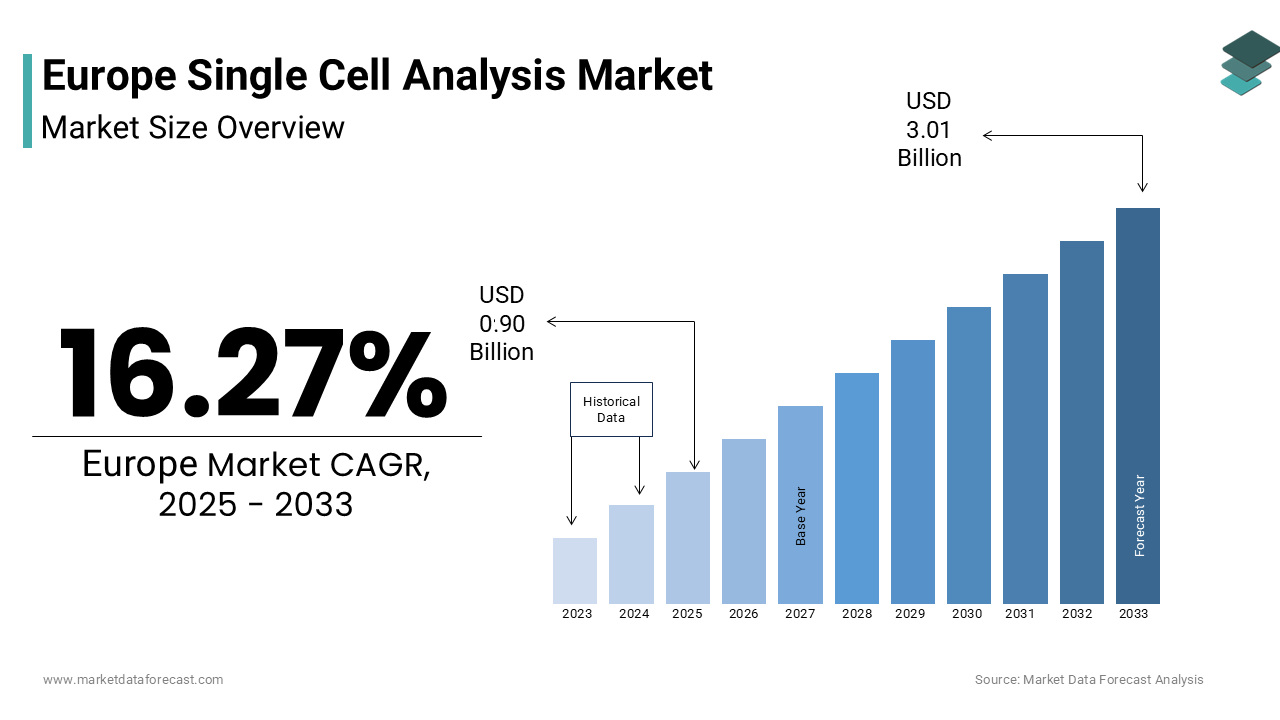
The europe single cell analysis market size was valued at USD 0.77 billion in 2024 and is anticipated to reach USD 0.90 billion in 2025 from USD 3.01 billion by 2033, growing at a CAGR of 16.27% during the forecast period from 2025 to 2033.
Single cell analysis is a suite of advanced genomic proteomic and transcriptomic technologies that enable the characterization of individual cells within complex biological systems rather than relying on bulk tissue averages. According to the European Commission, over 120000 researchers were employed in biotechnology related fields across the European Union in 2024, many engaged in high resolution cellular studies. This scientific momentum is further accelerated by national genomics strategies such as France’s Plan France Médecine Génomique 2025 and the UK’s Life Sciences Vision which embed single cell technologies into clinical translation roadmaps. These foundational investments position Europe at the forefront of cellular resolution science despite infrastructural and cost related constraints.
MARKET DRIVERS
Expanding Integration of Single Cell Technologies in Oncology Research
The deepening application of single cell analysis in oncology is a major driving factor for the growth of the Europe single cell analysis market. Cancer’s inherent cellular diversity necessitates tools capable of dissecting tumor microenvironments at single cell resolution to identify rare subpopulations driving resistance and metastasis. According to the International Agency for Research on Cancer, over 3.9 million new cancer cases were diagnosed in Europe in 2024, creating urgent demand for precision oncology tools. European research consortia such as the Human Tumor Atlas Network Europe have standardized single cell RNA sequencing across 18 institutions to map intra tumor heterogeneity in lung breast and colorectal cancers. The Karolinska Institute in Sweden reported in 2024 that single cell T cell receptor sequencing enabled the identification of clonal expansion patterns predictive of immunotherapy response in melanoma patients. Furthermore, the EU funded CANCER-ID project validated single cell circulating tumor cell enumeration as a liquid biopsy endpoint now adopted in five national clinical trial protocols.
Rising Public and Private Investment in Advanced Genomics Infrastructure
The sustained financial commitment to next generation life sciences infrastructure with the deployment of single cell analysis platforms in both academic and clinical settings is additionally to leverage the growth of Europe single cell analysis market. The European Union’s Horizon Europe program is investing specifically in digital health and omics technologies, according to the European Commission’s annual implementation report. National initiatives further amplify this support, where Germany’s National Decade Against Cancer committed 700 million euros through 2025 to single cell and spatial omics core facilities at institutions like the Max Delbrück Center. Private funding also plays a role with venture capital investments in European single cell start-ups exceeding 480 million euros in 2024. This multi layered funding ecosystem enables not only technology acquisition but also talent development and cross institutional data sharing frameworks essential for scalable single cell research.
MARKET RESTRAINTS
High Instrumentation and Operational Costs Limit Broad Accessibility
The substantial financial and operational barriers are specific factors hampering the growth of the Europe single cell analysis market. A typical commercial single cell sequencing platform requires an initial capital outlay of 300000 to 600000 euros for instrumentation alone according to procurement data from major European research universities. These costs are often prohibitive for smaller hospitals and mid-tier universities particularly in Southern and Eastern Europe where research budgets remain constrained. According to Eurostat, public expenditure on research and development in countries like Italy and Poland stood at just 1.4 and 1.3% of GDP respectively in 2024 well below the EU target of 3%. Even in wealthier nations core facility utilization rates rarely exceed 60% due to complex sample preparation workflows and the scarcity of trained bioinformaticians. The European Molecular Biology Organization noted in 2024 that over 70% of surveyed labs cited cost as the primary obstacle to routine single cell implementation.
Lack of Standardized Analytical Frameworks and Data Interoperability
The absence of universally accepted protocols for data generation processing and interpretation poses a significant restraint on the reproducibility and clinical translation of single cell studies in Europe. While platforms from multiple vendors enable cell isolation and sequencing the resulting data formats annotation standards and quality metrics vary widely. According to the European Life Science Infrastructure for Biological Information fewer than 30% of single cell studies published by European institutions in 2024 used common metadata schemas such as the Human Cell Atlas Data Coordination Platform standards. This fragmentation impedes meta analyses and cross cohort validation essential for biomarker discovery. Furthermore, the European Medicines Agency has not yet issued formal guidance on the use of single cell derived endpoints in regulatory submissions creating uncertainty for diagnostic developers. As per the European Federation of Pharmaceutical Industries and Associations, only two single cell based companion diagnostics have entered validation pathways in the EU as of 2025 due to analytical validation hurdles. The computational burden is equally challenging with a single experiment generating terabytes of data requiring high performance computing resources unavailable in most clinical settings.
MARKET OPPORTUNITIES
Adoption in Immuno Oncology and Cell Therapy Development
The expanding role of single cell analysis in immuno oncology and advanced cell therapy development is primarily to pose new opportunities for the growth of the Europe single cell analysis market. Single cell multi omics enables simultaneous profiling of T cell receptor clonality surface markers and cytokine secretion at single cell resolution ensuring product consistency. The Paul Ehrlich Institute mandated in 2024 that all academic cell therapy submissions include single cell characterization data for lot release. Similarly, in immuno oncology the identification of exhausted T cell subsets and myeloid derived suppressor cells via single cell RNA sequencing is guiding combination therapy design. As per the German Cancer Consortium, single cell profiling of tumor infiltrating lymphocytes influenced treatment decisions in phase II melanoma trials in 2024. The European Commission’s Innovative Health Initiative has committed to invest 2.4 billion Euros through 2027 to integrate single cell analytics into cell therapy manufacturing quality control. This regulatory scientific and funding alignment positions single cell analysis as a cornerstone of Europe’s advanced therapy ecosystem.
Integration with Spatial Biology and Digital Pathology Platforms
The integration of single cell analysis with spatial transcriptomics and digital pathology is unlocking transformative opportunities in tissue context preservation and clinical diagnostics is another attribute enhancing the growth of Europe single cell analysis market. Unlike dissociative single cell methods spatial platforms retain the anatomical coordinates of individual cells within tissue sections enabling researchers to map cellular neighborhoods and signaling gradients. According to the European Society of Pathology, over 120 pathology departments in Western Europe have piloted spatial omics workflows since 2023 with single cell resolution data overlaid on whole slide images. The EU funded SPATIALX consortium launched in January 2025 aims to standardize multimodal tissue atlases across 10 countries using integrated single cell spatial pipelines. Furthermore, digital pathology vendors like Philips and Sectra are embedding single cell derived biomarker layers into their diagnostic platforms enhancing pathologist decision support.
MARKET CHALLENGES
Shortage of Skilled Personnel in Computational Biology and Multi Omics Integration
The shortage of professionals trained in both wet lab single cell techniques and advanced computational analysis is likely to be a challenging factor for the growth of Europe single cell analysis market. While instrumentation access is improving the ability to design experiments process massive datasets and interpret biological meaning remains limited. Academic curricula have been slow to adapt with only 18 European universities offering dedicated master’s programs in computational genomics, as per the European University Association. This skills gap is particularly acute in Southern and Eastern Europe where brain drain to North American and Swiss institutions continues. Even large pharmaceutical companies face internal bottlenecks with cross functional teams struggling to align biological questions with analytical pipelines.
Regulatory Uncertainty in Clinical Validation and Diagnostic Use
The absence of clear regulatory pathways for single cell derived diagnostics and biomarkers is a significant barrier to clinical adoption, which is also to hamper the growth of the Europe single cell analysis market. While research use is well established the transition to in vitro diagnostic or companion diagnostic status remains ambiguous under the EU In Vitro Diagnostic Regulation framework. According to the European Medicines Agency no single cell based assay has yet received CE IVD marking for oncology applications as of early 2025 due to challenges in analytical validation reproducibility and clinical utility demonstration. The decentralized nature of healthcare systems further complicates multi center validation with differing requirements across Germany France and Italy delaying harmonized evidence generation. As per the European Federation of Biotechnology diagnostic developers cite the lack of reference materials and proficiency testing programs for single cell workflows as a major hurdle. A 2024 survey by the European Diagnostic Manufacturers Association found that 78% of members delayed single cell diagnostic launches due to regulatory uncertainty. Until the European Commission and notified bodies issue specific guidance on validation criteria for high dimensional single cell endpoints the clinical implementation of these powerful technologies will remain fragmented and largely confined to exploratory research settings.
REPORT COVERAGE
| REPORT METRIC | DETAILS |
| Market Size Available | 2024 to 2033 |
| Base Year | 2024 |
| Forecast Period | 2025 to 2033 |
| Segments Covered | By Cells, Products, Technique , Application and Region |
| Various Analyses Covered | Global, Regional, & Country Level Analysis; Segment-Level Analysis; DROC, PESTLE Analysis; Porter’s Five Forces Analysis; Competitive Landscape; Analyst Overview of Investment Opportunities |
| Regions Covered | North America, Europe, APAC, Latin America, Middle East & Africa |
| Market Leaders Profiled | Merck KGaA, Becton, Dickinson and Company, Promega Corporation, Danaher Corporation, General Electric Company, Thermo Fisher Scientific, Miltenyi Biotec, Illumina, Bio-Rad Laboratories, Fluidigm Corporation, NanoString Technologies, Agilent Technologies, Abcam Plc, NuGEN Technologies Inc., LumaCyte, PluriSelect Life Science UG & Co. KG, Sysmex Partec, Bio-Techne Corporation, Promega Corporation, 10x Genomics, WaferGen Bio-systems, Bruker, and Fluxion Bioscience. |
SEGMENTAL ANALYSIS
By Cells Insights
The human cells segment was accounted in holding a dominant share of the Europe single cell analysis market in 2024 with the intensifying focus on precision medicine and human disease mechanisms across the region’s clinical and academic research ecosystems. The European Union’s flagship initiatives, such as the 1+ Million Genomes project aim to enable cross border access to genomic and health data from over one million EU citizens by 2025 facilitating large scale single cell studies in oncology neurology, and immunology. As per the European Society of Human Genetics, more than 85% of publicly funded single cell projects in Europe in 2024 used primary human samples derived from blood tumor biopsies or organoids. National biobanks further amplify this trend with the UK Biobank alone releasing single cell RNA sequencing data from 50000 human donors in late 2024. Additionally, the European Medicines Agency’s adaptive pathways for advanced therapy medicinal products require deep cellular characterization of human cell based therapeutics reinforcing the centrality of human cell analysis.
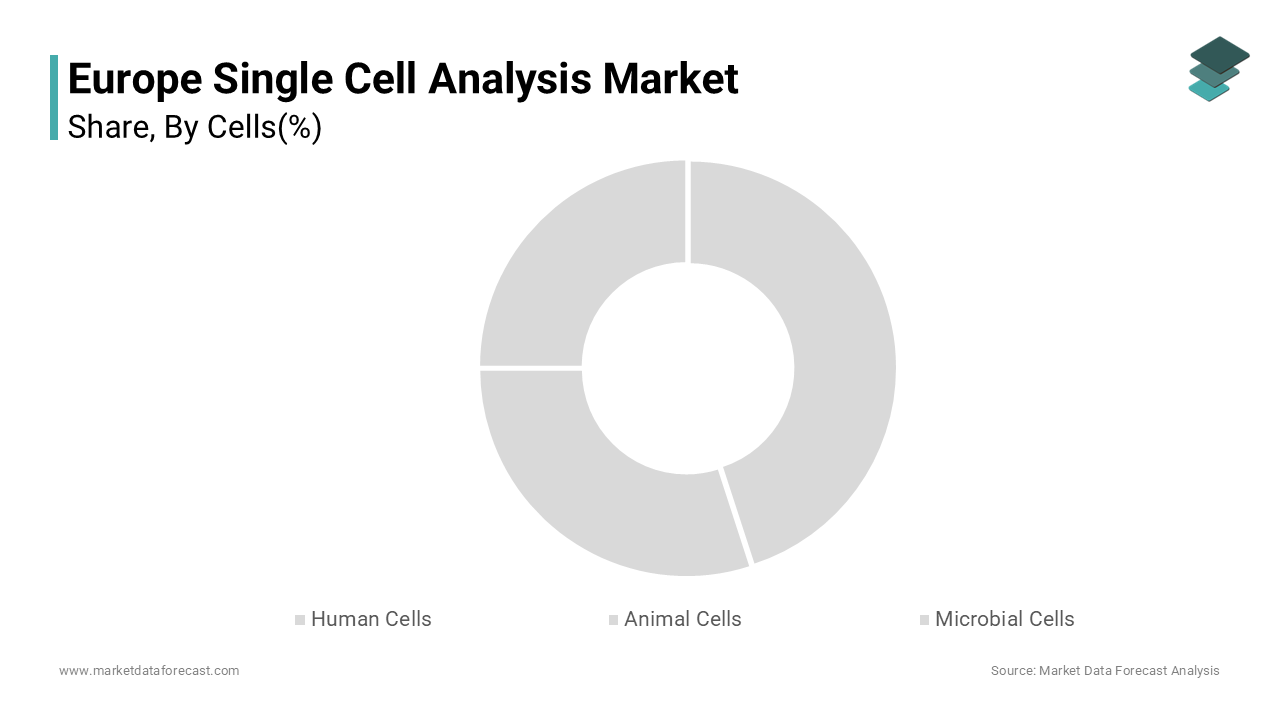
The microbial cells segment is likely to grow with an anticipated CAGR of 19.3% during the forecast period. The EU Joint Action on Antimicrobial Resistance reported in 2024 that over 670000 infections caused by resistant bacteria occur annually in Europe underscoring the need for high resolution pathogen profiling. Single cell genomics now enables the detection of rare resistant subpopulations within heterogeneous bacterial communities that bulk sequencing misses. The Pasteur Institute in France successfully applied single cell sequencing to track plasmid transfer dynamics in E-coli during urinary tract infections in 2024. Simultaneously, the Human Microbiome Project Europe has catalyzed over 40 national studies mapping gut lung and skin microbiota using single cell metagenomics. As per the European Food Safety Authority, single cell analysis is increasingly used to trace foodborne pathogen outbreaks with 12 member states implementing pilot surveillance systems in 2024.
By Product Insights
The consumables segment was the largest by holding a prominent share of the Europe single cell analysis market in 2024 with the recurring nature of reagents microfluidic chips barcoded beads and library preparation kits required for every single cell experiment. The European Commission’s Horizon Europe program funded over 220 single cell projects in 2024 each consuming an average of 15000 euros annually in consumables as documented by project financial audits. Academic core facilities further drive volume with the Wellcome Sanger Institute alone purchasing over 30000 single cell capture kits in 2024. Standardization efforts such as the EuroBioImaging consumables catalog have streamlined procurement across 14 countries reducing vendor fragmentation. Additionally, the rise of multi omics workflows which combine transcriptomics proteomics and epigenetics on the same cell has increased per sample consumable complexity and cost.
The instruments segment is likely to grow with an expected CAGR of 14.8% during the forecast period owing to the national investments in next generation life science infrastructure and the deployment of integrated single cell platforms in clinical research hospitals. Germany’s National Decade Against Cancer allocated 180 million euros in 2024 specifically for single cell instrumentation at 12 university medical centers. Similarly, the UK’s Life Sciences Infrastructure Fund disbursed 95 million pounds to install high throughput single cell sorters and sequencers, across the National Institute for Health and Care Research network. As per the French Ministry of Higher Education, over 35 new single cell instruments were installed in French public research institutions in 2024 alone under the France 2030 investment plan. Technological convergence is also accelerating adoption with newer platforms combining microfluidics imaging and sequencing in one workflow reducing hands on time.
By Technique Insights
The Next generation sequencing segment was the largest by occupying 48.3% of the Europe single cell analysis market share in 2024 from NGS’s unparalleled capacity to profile transcriptomes epigenomes and immune repertoires at single cell resolution across thousands of cells in parallel. The European Molecular Biology Laboratory processed over 4.2 million single cells using NGS based methods in 2024 primarily through droplet-based platforms like 10x Genomics. Large scale collaborative efforts such as the Human Cell Atlas Europe rely exclusively on NGS to construct reference maps of healthy and diseased human tissues. National genomics strategies further entrench this dominance with Sweden’s SciLifeLab committing 25 million euros in 2024 to expand single cell NGS capacity.
The mass spectrometry segment is expected to likely to grow at a fastest CAGR of 16.7% from 2025 to 2033 owing to the breakthroughs in sensitivity and throughput that now enable proteomic and metabolomic profiling at single cell levels previously deemed impossible. The Max Planck Institute for Biochemistry in Germany demonstrated in 2024 the quantification of over 1000 proteins from individual neurons using nano flow liquid chromatography coupled to high resolution mass spectrometers. The European Research Council awarded 12 Proof of Concept grants in 2024 specifically for single cell mass spectrometry applications in cancer metabolism and immunology. National metrology institutes such as France’s LNE are developing calibration standards for single cell proteomics to support clinical translation.
REGIONAL ANALYSIS
Germany Single Cell Analysis Market Analysis
Germany was the top performer in the Europe single cell analysis market by accounting for 26.3% of share in 2024 with its dense ecosystem of university medical centers Max Planck Institutes and Helmholtz Centers that collectively operate over 70 dedicated single cell core facilities. The National Decade Against Cancer initiative has channeled more than 500 million euros into single cell and spatial omics infrastructure since 2021 with 2024 seeing the inauguration of the Berlin Single Cell Center. As per the German Cancer Research Center over 120 clinical oncology trials in Germany now incorporate single cell profiling for patient stratification. Germany also hosts key technology developers including Miltenyi Biotec which launched an integrated microfluidic sorter for single cell proteomics in 2024. Strong collaboration between academia and industry under the BioRegio STERN network accelerates method translation.
The United Kingdom Single Cell Analysis Market Analysis
The United Kingdom single cell analysis market was positioned second by holding 17.2% of the Europe single cell analysis market share in 2024 with world class genomics institutions, such as the Wellcome Sanger Institute and the Francis Crick Institute which pioneered many foundational single cell protocols. The UK Biobank’s release of single cell RNA sequencing data from 50000 participants in 2024 created an unprecedented resource for disease association studies. The National Institute for Health and Care Research funded 38 single cell focused clinical innovation projects in 2024, which is totaling 72 million pounds. Additionally, the UK’s Life Sciences Vision explicitly identifies single cell analytics as a priority for diagnostic development with the Medicines and Healthcare products Regulatory Agency establishing a sandbox for novel cellular assays.
France Single Cell Analysis Market Analysis
France single cell analysis market growth is likely to be driven by the strategy combines centralized national investments with regional excellence clusters particularly in Paris Lyon and Marseille. The Plan France Médecine Génomique 2025 established 12 genomic medicine hubs each equipped with single cell sequencing capacity serving over 200 hospital. The French alliance for life sciences research over 90 single cell projects received public funding in 2024 with a strong emphasis on immunology and developmental biology. France also contributes significantly to European consortia such as the Human Cell Atlas through the Imagine Institute’s work on rare diseases.
COMPETITIVE LANDSCAPE
The Europe single cell analysis market is characterized by intense competition among global technology providers and specialized regional innovators. Unlike commodity diagnostics the contest is centered on platform performance data richness workflow integration and scientific credibility rather than price. Leading firms differentiate through unique capabilities such as true spatial resolution live cell sorting or multi modal profiling at scale. Academic institutions often serve as early adopters and validators influencing broader adoption across national research networks. Competition is further shaped by compatibility with EU data governance frameworks including GDPR and the European Health Data Space which favor vendors with secure cloud infrastructure. Emerging European start-ups focusing on computational analysis or novel microfluidics add disruptive pressure but face scale limitations. Strategic partnerships between instrument makers reagent suppliers and bioinformatics firms are increasingly common to offer end to end solutions. As clinical translation accelerates competition is shifting toward regulatory readiness analytical validation and integration into diagnostic pathways.
KEY MARKET PLAYERS
Some of the companies that are playing a dominating role in the europe single cell analysis market profiled include
- Merck KGaA
- Becton, Dickinson and Company
- Promega Corporation
- Danaher Corporation
- General Electric Company
- Thermo Fisher Scientific
- Miltenyi Biotec
- Illumina
- Bio-Rad Laboratories
- Fluidigm Corporation
- NanoString Technologies
- Agilent Technologies
- Abcam Plc
- NuGEN Technologies Inc.
- LumaCyte
- PluriSelect Life Science UG & Co. KG
- Sysmex Partec
- Bio-Techne Corporation
- Promega Corporation (duplicate)
- 10x Genomics
- WaferGen Bio-systems
- Bruker
- Fluxion Bioscience
Top Players in the Europe Single Cell Analysis Market
10x Genomics
10x Genomics is a global leader in single cell analysis technology with significant penetration across European research and clinical institutions. The company’s Chromium platform enables high throughput single cell RNA sequencing immune profiling and spatial genomics widely adopted in oncology immunology and neuroscience studies throughout Europe. It launched the Chromium X platform in Europe featuring enhanced cell throughput and multi omics integration. These initiatives reinforce its role as a foundational technology provider accelerating discovery and clinical translation across the region without reliance on legacy bulk analysis methods.
BD (Becton Dickinson)
BD is a major contributor to the Europe single cell analysis market through its advanced flow cytometry and single cell sorting platforms which enable high precision isolation of rare cell populations. The company’s FACSymphony and FACSDiscover systems are integral to immunophenotyping and functional assays in European academic medical centers and biopharma R and D. The company also partnered with leading European cancer networks to standardize minimal residual disease detection using single cell workflows.
NanoString Technologies
NanoString Technologies plays a pivotal role in the Europe single cell analysis landscape through its GeoMx Digital Spatial Profiler and CosMx Single Cell Imaging System which preserve tissue architecture while delivering single cell and subcellular resolution data. European pathology departments and translational research centers increasingly rely on these platforms for spatial biology in immuno oncology and neurodegenerative diseases. The company also integrated cloud based AI analytics into its European data platform enhancing collaborative analysis. These moves solidify its niche in spatially resolved single cell analysis a rapidly growing frontier in European precision medicine.
Top Strategies Used by the Key Market Participants
Key players in the Europe single cell analysis market focus on technological differentiation through integrated multi omics and spatial capabilities. They invest in regional application support centers to accelerate user adoption and protocol standardization. Companies form strategic alliances with academic hospitals and pan European research consortia to embed their platforms in large scale studies. Continuous platform upgrades enhance throughput sensitivity and ease of use addressing historical complexity barriers. Expansion of cloud-based bioinformatics and AI driven analytics reduces dependency on local computational expertise. Participation in regulatory sandbox initiatives helps shape future diagnostic pathways for single cell-based biomarkers. Development of standardized reagent kits and reference materials improves reproducibility across sites. These strategies collectively enhance scientific impact clinical relevance and market stickiness in a highly specialized and evolving ecosystem.
MARKET SEGMENTATION
This research report on the Europe Single Cell Analysis market has been segmented and sub-segmented into the following categories:
By Cells
- Human Cells
- Animal Cells
- Microbial Cells
By Product
- Consumables
- Beads
- Microplates
- Reagents
- Assay Kits
- Others
- Instruments
- Flow Cytometers
- NGS Systems
- PCR Instruments
- Others
By Technique
- Flow Cytometry
- NGS
- PCR
- Microscopy
- Mass Spectrometry
- Other Techniques
By Application
- Research Application
- Medical Application
By Country
- UK
- France
- Spain
- Germany
- Italy
- Russia
- Sweden
- Denmark
- Switzerland
- Netherlands
- Turkey
- Czech Republic
- Rest of Europe