- Product Description Description
- Table of Contents TOC
- List of Table & Figure LOT
- Get Free Sample PDF Sample PDF
Market Size, 2025
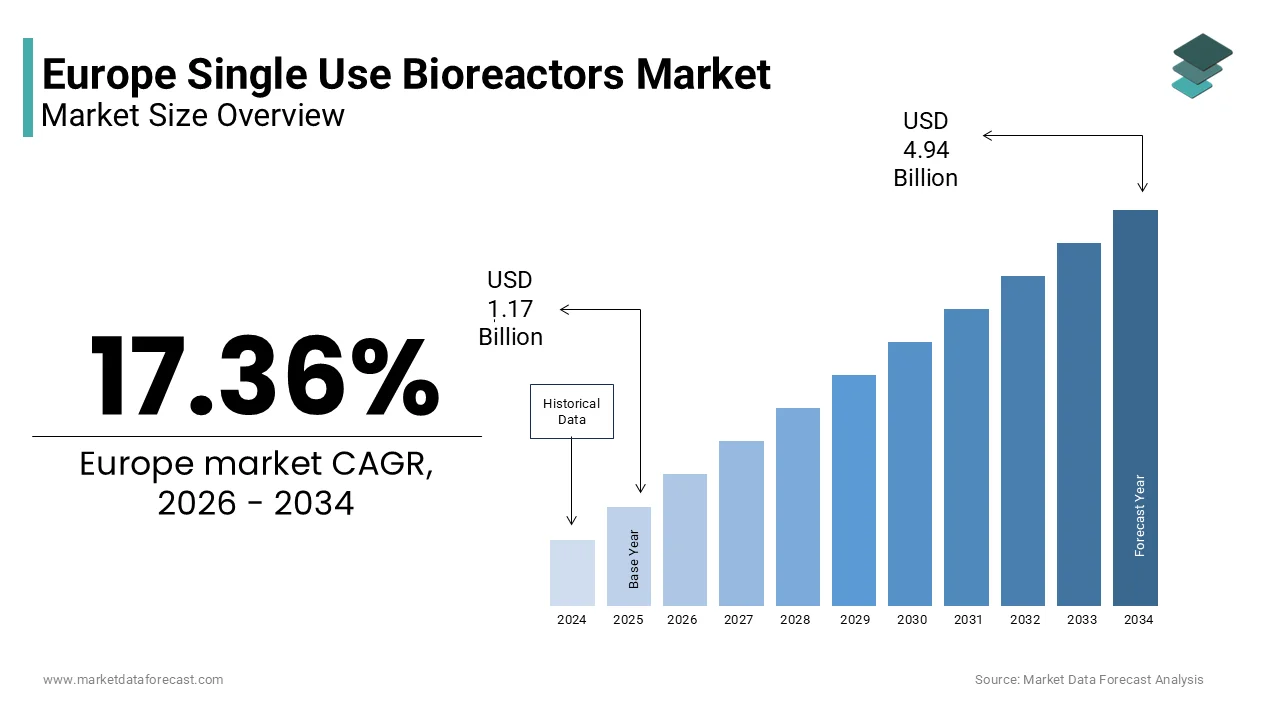
$1.17 BnMarket Estimate, 2026
$1.37 BnMarket Forecast, 2034
$4.94 BnCAGR, 2026–2034
17.36%Executive Summary: Europe Single Use Bioreactors Market
- Market Scope: European market analysis covering products, bioreactor types, cell types, and country-level landscapes.
- Market Valuation: Valued at USD 1.17 billion (2025), estimated at USD 1.37 billion (2026), and projected to reach USD 4.94 billion by 2034, growing at a robust CAGR of 17.36% (2026–2034).
- Primary Growth Drivers: High regional manufacturing density (>350 biomanufacturing facilities and >250,000 annual bioreactor bag consumptions), significant operational enhancements (assemblies reducing operator intervention by up to 70%), and widespread adoption of GMP suites (Germany hosting >50 GMP suites using single-use techs).
Key Market Segment Metrics (2026–2034)
| Category | Leading Segment (Position) | Fastest-Growing Segment |
|---|---|---|
| By Product | Bags Segment (58.7% share in 2025) | Assemblies Segment (14.8% CAGR; reduces operator intervention by up to 70%) |
| By Type | Stirred-Tank Single-Use Bioreactors (significant share in 2025) | Wave-Induced Bioreactors (16.2% CAGR) |
| By Cell Type | Mammalian Cells (32.1% share in 2025) | Mammalian Cells (15.3% CAGR) |
| By Country | Germany (24.6% share in 2024; >50 GMP single-use suites) | — |
Major Market Players & Market Structure
Market Structure: Competitive landscape driven by performance, reliability, regulatory documentation, digital capabilities, and resilient integrated supply chains. Industry leaders are focusing on embedded sensors, digital twins, and cloud-based analytics integration.
Key Companies: PBS Biotech, Sartorius Stedim Biotech SA, Eppendorf, Danaher Corp, Thermo Fisher Scientific Inc, Getinge AB ADR, and Merck KGaA.
Europe Single Use Bioreactors Market Size
The Europe single use bioreactors market size was valued at USD 1.17 billion in 2025 and is projected to reach USD 4.94 billion by 2034 from USD 1.37 billion in 2026, growing at a CAGR of 17.36%.
The single use bioreactors are disposable, pre sterilized cultivation systems used primarily in biopharmaceutical manufacturing for the production of monoclonal antibodies, vaccines, gene therapies, and recombinant proteins. Unlike traditional stainless steel systems, they employ gamma irradiated polymer bags housed within rocker or stirred platforms, eliminating the need for cleaning validation and reducing cross contamination risks. In Europe, their adoption has accelerated due to the region’s dense concentration of biologics developers, contract manufacturing organizations, and advanced therapy medicinal product innovators. The European Commission’s Pharmaceutical Strategy for Europe emphasizes agile and resilient manufacturing, explicitly endorsing flexible facilities enabled by disposable systems. Furthermore, the European Directorate for the Quality of Medicines mandates stringent extractables and leachables testing for all single use components, ensuring regulatory rigor without stifling innovation.
MARKET DRIVERS
Rise of Advanced Therapy Medicinal Products Requiring Flexible Manufacturing
The exponential growth in advanced therapy medicinal products, including cell and gene therapies, which demand small scale highly flexible and contamination free production environments. The rise of advanced therapy medicinal products requiring flexible manufacturing is fuelling the growth of the Europe single use bioreactors market. These therapies often involve autologous processes where each batch is patient specific requiring rapid changeover and strict segregation capabilities inherent to single use systems. Unlike stainless steel facilities, which require weeks of cleaning validation between batches single use bioreactors enable same day campaign switching. Companies like Novartis in Switzerland and Orchard Therapeutics in the UK operate entirely disposable suites for their gene therapy pipelines.
Shift Toward Modular and Multi Product Biomanufacturing Facilities
The strategic pivot among European biopharmaceutical companies toward modular multi product facilities is significantly boosting the growth of the Europe single use bioreactors market. In Germany, major contract development and manufacturing organizations like Rentschler Biopharma and Bayer’s CDMO unit have replaced stainless steel lines with single use trains capable of switching between monoclonal antibodies viral vectors and recombinant proteins within days. The biomanufacturing loans favored modular designs citing lower financial risk and faster deployment. With the average cost of a traditional 2000 liter stainless steel suite exceeding 150 million euros versus 90 million for an equivalent single use facility the economic logic is compelling. This operational and financial agility ensures sustained demand for scalable single use bioreactor platforms across therapeutic segments.
MARKET RESTRAINTS
Stringent Regulatory Requirements for Extractables and Leachables Testing
The European Medicines Agency’s rigorous requirements for extractables and leachables assessment, which increase validation complexity and time is hampering the growth of the Europe single use bioreactors market. All polymer components in contact with cell cultures must undergo extensive analytical testing to identify potential compounds that could migrate into the product under process conditions. According to the study, manufacturers must submit full chemical characterization data including gas chromatography mass spectrometry and inductively coupled plasma mass spectrometry results for every new single use system. Unlike the United States, where the FDA permits vendor provided master files the EMA often requires drug sponsors to conduct independent testing adding 3 to 6 months to process validation. Furthermore, the lack of harmonized testing protocols across member states forces companies to replicate studies for national submissions.
Limited Scalability Beyond 2000 Liters for Commercial Production
The technical ceiling in scalability that restricts deployment in large volume commercial manufacturing is also declining the growth of the Europe single use bioreactors market. While systems up to 2000 liters are commercially available from vendors like Sartorius and Thermo Fisher most European biomanufacturers consider 1000 to 1500 liters the practical upper limit due to challenges in oxygen transfer mixing homogeneity and bag integrity. The oxygen transfer rates in single use systems decline significantly above 1500 liters compromising cell growth for high density cultures. In contrast, stainless steel bioreactors routinely operate at 10000 to 20000 liters for blockbuster monoclonal antibodies. Companies like Roche in Switzerland and Sanofi in France maintain stainless steel lines for high volume products, while using single use only for clinical and niche therapies.
MARKET OPPORTUNITIES
Expansion of Viral Vector Manufacturing for Gene and Cell Therapies
The surging demand for viral vector production to support the commercialization of gene therapies and CAR T cell treatments is setting up new opportunities for the growth of the Europe single use bioreactors market. According to the survey, 18 gene therapy products were under review in 2023 with viral vectors produced in adherent or suspension cultures requiring precisely controlled bioreactor environments. Single use systems dominate this space due to their closed nature which minimizes contamination risks during the 10 to 14 day production cycle. Companies like Oxford Biomedica in the UK and Yposkesi in France operate large scale single use suites with bioreactors ranging from 50 to 500 liters for lentiviral and adeno associated virus production. The European Commission’s 2023 Vector Manufacturing Initiative allocated 180 million euros to expand GMP capacity explicitly endorsing single use platforms for their scalability and reduced validation burden.
Adoption of Digital Twins and Process Analytical Technology Integration
The integration of digital twins and advanced process analytical technology into single use bioreactor platforms for real time quality control and predictive process optimization is also to elevate the growth of the Europe single use bioreactors market. Vendors like Sartorius and Merck now embed non-invasive sensors for pH dissolved oxygen and biomass directly into single use bags enabling continuous monitoring without sampling. The European Medicines Agency’s 2023 reflection paper on real time release testing encourages such innovations as part of quality by design frameworks. The EU’s Horizon Europe program has funded 12 collaborative projects, since 2022 to develop AI driven bioprocess control for disposable systems.
MARKET CHALLENGES
Supply Chain Vulnerability for Critical Polymer Resins and Films
The heavy dependence on imported specialty polymers, primarily multilayer fluoropolymer and polyethylene films from a limited number of global suppliers, which is a challenge for the Europe single use bioreactors market. According to the European Bioprocessing Association, over 90% of single use bag films used in Europe are sourced from three US based manufacturers with no domestic alternatives. The 2021 global resin shortage caused lead times for bioreactor bags to extend from 8 weeks to over 24 weeks disrupting clinical trial material production. In 2023, the European Commission identified ethylene vinyl acetate and cyclic olefin copolymer, as raw materials with high supply risk yet no EU production capacity. This dependency creates strategic vulnerability; a single plant fire or regulatory shutdown can cascade through hundreds of biomanufacturing sites.
Shortage of Skilled Personnel for Advanced Single Use System Operation
The scarcity of bioprocessing engineers trained in disposable system integration automation and data analytics is additionally to pose as a major challenge for the growth of the Europe single use bioreactors market. Modern single use platforms require expertise in aseptic connections sensor calibration and digital process control skills absent in traditional stainless steel training curricula. In Ireland and Belgium, where over 30 new biomanufacturing facilities are under construction labor shortages have delayed commissioning by 6 to 12 months, as reported by the Irish Pharmaceutical Healthcare Association. Although, the European Commission’s Skills Agenda includes biomanufacturing the implementation of standardized training programs across member states remains fragmented.
REPORT COVERAGE
| REPORT METRIC | DETAILS |
| Market Size Available | 2025 to 2034 |
| Base Year | 2025 |
| Forecast Period | 2026 to 2034 |
| CAGR | 17.36% |
| Segments Covered | By Product, Type, Molecule, Cell Type, Application, and Region |
| Various Analyses Covered | Global, Regional, & Country Level Analysis; Segment-Level Analysis; DROC, PESTLE Analysis; Porter’s Five Forces Analysis; Competitive Landscape; Analyst Overview of Investment Opportunities |
| Regions Covered | UK, France, Spain, Germany, Italy, Russia, Sweden, Denmark, Switzerland, Netherlands, Turkey, and the Czech Republic |
| Market Leaders Profiled | PBS Biotech, Sartorius Stedim Biotech SA, Eppendorf, Danaher Corp, Thermo Fisher Scientific Inc, Getinge AB ADR, and Merck KGaA |
SEGMENTAL ANALYSIS
By Product Insights
The bags segment was the largest by holding 58.7% of the Europe single use bioreactors market share in 2025. Unlike reusable hardware, bioreactor bags are single use items replaced after every production campaign creating recurring demand. The European Medicines Agency mandates full traceability and gamma irradiation certification for each bag lot adding to procurement complexity and volume. With over 350 biomanufacturing facilities operating in Europe, as per the European Federation of Pharmaceutical Industries and Associations the cumulative bag consumption exceeds 250000 units annually. This consumable nature coupled with strict good manufacturing practice requirements for sterility integrity and leachables makes bags the highest revenue and fastest turning segment in the product portfolio. Modern bioreactor bags are increasingly engineered with application specific features, such as integrated sensors, oxygen permeable films, and tailored sparger geometries. Vendors like Sartorius and Thermo Fisher offer over 200 bag variants with different port layouts film thicknesses and sensor integration options. The rise of high titer processes demands films with enhanced gas permeability cyclic olefin copolymer layers now feature in 65% of mammalian culture bags. Additionally, the shift toward continuous perfusion requires bags with reinforced welds and multi day stability.
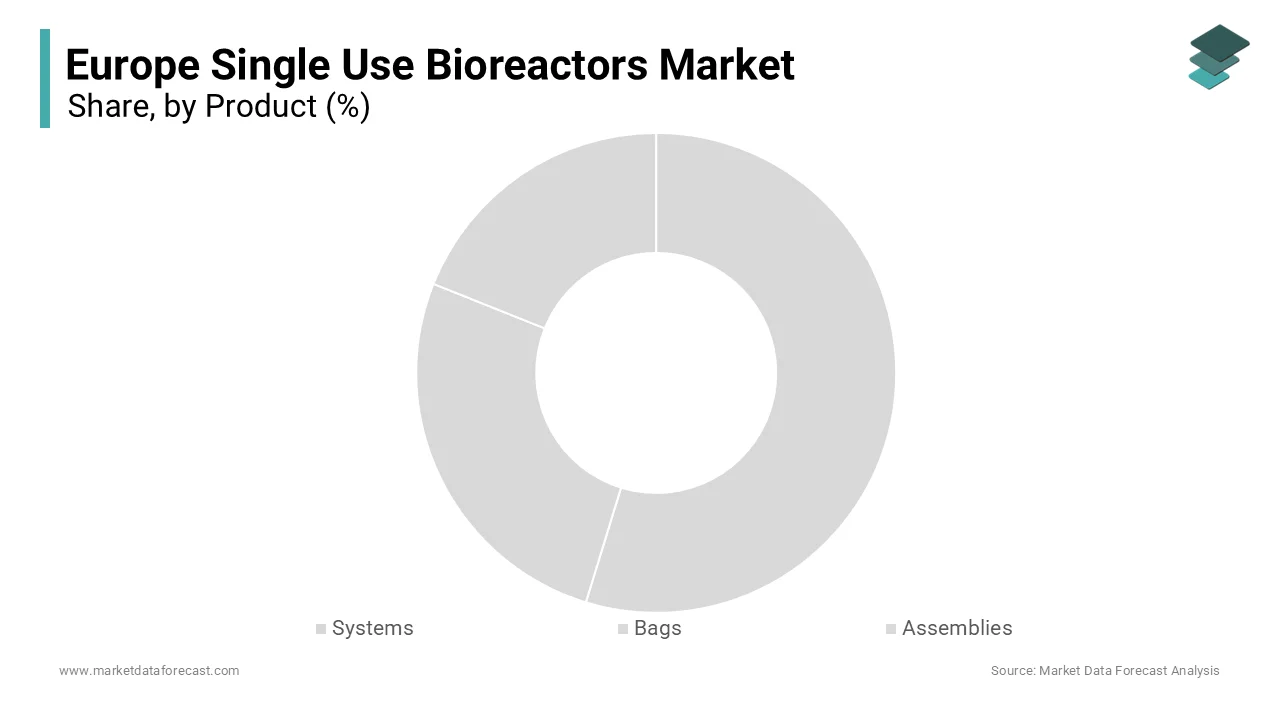
The assemblies segment is likely to witness a fastest CAGR of 14.8% throughout the forecast period. These kits reduce operator intervention by up to 70% by lowering the risk of microbial ingress in sensitive cell culture processes. Companies like Lonza and Catalent now specify vendor validated assemblies in their master production records to ensure consistency across campaigns. The European Commission’s Good Manufacturing Practice Annex 1 update explicitly encourages the use of closed systems for aseptic processing further accelerating adoption. Assemblies are increasingly designed as standardized interface modules that connect bioreactors to downstream purification trains and data acquisition systems. Vendors now embed RFID chips in connectors to track usage and ensure correct installation for real time release testing under the European Medicines Agency’s quality by design framework. The EU’s Horizon Europe program has funded 8 collaborative projects since 2022 to develop interoperable single use components enabling plug and play facility design.
By Type Insights
The stirred tank single use bioreactors segment was the largest by holding a significant share in 2025. Stirred tank systems provide homogeneous mixing precise oxygen control and linear scale up from R&D to commercial volumes for high titer monoclonal antibody production. Vendors like Sartorius and Thermo Fisher offer stirred systems from 50 to 2000 liters with impeller designs optimized for shear sensitive cells. The European Medicines Agency’s process validation guidelines recognize stirred tank platforms as mature technology reducing regulatory risk. Stirred tank bioreactors support the most comprehensive suite of embedded sensors for pH dissolved oxygen and capacitance enabling real time process control. This compatibility with quality by design frameworks and real time release testing makes them the default choice for commercial facilities. Companies like Roche in Switzerland and Sanofi in France use stirred tanks with digital twin models to predict metabolite profiles and optimize feed strategies.
The wave induced bioreactors segment is projected to witness a fastest CAGR of 16.2% throughout the forecast period. Wave systems using rocking motion for mixing and gas exchange are preferred for early stage cell expansion due to their gentle hydrodynamics and low shear stress. Companies like Novartis and Gilead’s Kite facility in the Netherlands rely on wave platforms for clinical trial material production where batch sizes range from 1 to 20 liters. The European Commission’s Advanced Therapy Manufacturing Network identifies wave systems as essential for decentralized point of care models due to their compact footprint and ease of operation. Wave bioreactors require minimal infrastructure no complex piping external controllers or high power inputs by making them ideal for resource constrained environments. The EU’s Horizon Europe SME Instrument has funded 35 biotech start ups since 2022 that selected wave technology for their initial GMP runs. Additionally, their portability enables use in modular cleanrooms and mobile manufacturing units for pandemic response and regional therapy delivery.
By Cell Type Insights
The mammalian cells segment was accounted in holding 32.1% of the Europe single use bioreactors market in 2025. Mammalian cell lines, primarily Chinese hamster ovary cells are the industry standard for producing glycosylated proteins that require human like post translational modifications. The European Medicines Agency has approved over 120 mammalian derived products with well-established manufacturing guidelines reducing development risk. Companies like Roche Sanofi and GSK operate large scale single use suites dedicated to mAb production with titers exceeding 5 grams per liter. The BioPhorum Operations Group has standardized fed batch and perfusion protocols exclusively for mammalian cultures further entrenching their dominance. Mammalian cells are highly sensitive to shear stress pH shifts and dissolved oxygen fluctuations necessitating precise bioreactor control.
The mammalian cells segment is likely to grow at a fastest CAGR of 15.3% throughout the forecast period. The next generation of mammalian derived therapeutics bispecific antibodies and antibody drug conjugates is driving demand for high fidelity single use platforms. These molecules demand single use systems with ultra-low leachables and segregated fluid paths to prevent cross contamination. Companies like F Hoffmann La Roche in Switzerland and ImmunoGen in the UK use dedicated 200 liter single use suites for ADC production with enhanced extractables testing. The shift from batch to continuous perfusion in mammalian culture is increasing bioreactor utilization and consumable demand. Vendors now offer perfusion specific bags with integrated cell retention devices and multi-port manifolds.
COUNTRY LEVEL ANALYSIS
Germany single use bioreactors market was the top performer by holding 24.6% of share in 2024 due to its dense cluster of biopharmaceutical companies contract manufacturers and engineering expertise. The country hosts global players like Bayer’s CDMO unit Rentschler Biopharma and Miltenyi Biotec operating over 50 GMP suites using single use technologies. Germany’s Federal Ministry of Education and Research allocated 180 million euros in 2023 to the Bioproduction 4.0 initiative supporting digital integration of single use platforms. The country’s strong chemical and polymer industry, including Covestro and Evonik provides local raw material support though film production remains limited.
SSwitzerland single use bioreactors market growth is driven by its concentration of global biopharma headquarters and advanced therapy developers. The country is home to Roche Novartis and Lonza which operate some of the world’s most sophisticated single use facilities for monoclonal antibodies and gene therapies. Switzerland’s regulatory agency maintains one of the fastest approval pathways for single use system validation reducing time to market.
COMPETITIVE LANDSCAPE
The Europe single use bioreactors market is characterized by intense competition among global leaders and specialized innovators vying for dominance in a highly technical and regulated environment. Competition centers on performance reliability regulatory documentation and digital capabilities rather than price alone. Incumbents like Sartorius and Thermo Fisher leverage scale integrated supply chains and established validation dossiers to serve large biopharma clients while regional players differentiate through niche applications like viral vector or microbial systems. The European Medicines Agency’s stringent extractables requirements create high barriers to entry favoring vendors with comprehensive regulatory support. At the same time, the shift toward advanced therapies is attracting new entrants from engineering and automation sectors. National differences in GMP interpretation and supply chain security concerns further fragment the landscape.
KEY MARKET PLAYERS
Some of the notable key players in the European single-use bioreactors market are
- PBS Biotech
- Sartorius Stedim Biotech SA
- Eppendorf
- Danaher Corp
- Thermo Fisher Scientific Inc
- Getinge AB ADR
- Merck KGaA
Top Players in the Market
- Sartorius AG is a German life science leader and a global pioneer in single use bioreactor technology with deep integration across Europe’s biopharmaceutical ecosystem. The company offers a comprehensive portfolio from 50 to 2000 liter stirred tank systems under its BIOSTAT STR platform widely used by contract manufacturers and innovators for monoclonal antibodies and viral vectors. Sartorius contributes globally by setting industry standards for sensor integration scalability and extractables documentation. In 2023, Sartorius expanded its GMP film production capacity in Germany to secure supply of medical grade multilayer films and launched its Ambr 350 high throughput system for automated process development. The company also enhanced its digital bioprocess platform with AI driven predictive analytics aligned with the European Medicines Agency’s quality by design expectations reinforcing its role as a trusted end to end partner for European biomanufacturers.
- Thermo Fisher Scientific is a US headquartered global life sciences giant with significant single use bioreactor operations across Europe serving biopharma and advanced therapy developers. Its HyPerforma DynaDrive and Rocker systems are deployed in over 200 GMP facilities in the EU for mammalian bacterial and viral vector production. Thermo Fisher contributes globally by enabling rapid facility deployment through standardized single use platforms and comprehensive regulatory support dossiers. In 2024 the company inaugurated a new single use innovation center in Ede Netherlands focused on viral vector and cell therapy applications featuring integrated digital twin capabilities. It also expanded its bioreactor bag manufacturing in Ireland to reduce lead times for European clients.
- Merck KGaA is a German science and technology company operating under the MilliporeSigma brand in life science with a strong European footprint in single use bioreactors. Its Mobius stirred tank and wave systems are certified for mammalian and microbial cultures and widely adopted in Germany Switzerland and the UK for clinical and commercial production. Merck contributes globally by advancing sustainable single use solutions, including bio based films and recyclable components under its Green Bioprocessing initiative. In 2023, Merck launched its next generation Mobius 2000 liter bioreactor with enhanced oxygen transfer and integrated process analytical technology compliant with EU GMP Annex 1.
Top Strategies Used by the Key Market Participants
Key players in the Europe single use bioreactors market focus on securing raw material supply chains by investing in local film production and resin partnerships to mitigate import dependency. They enhance digital integration through embedded sensors digital twins and cloud based analytics to support real time release testing and quality by design compliance. Companies expand regional manufacturing and innovation centers to reduce lead times and tailor solutions for European regulatory expectations. Strategic collaborations with biopharma clients and contract manufacturers enable co development of application specific platforms for viral vectors and cell therapies. Additionally, firms pioneer sustainability initiatives including bio based materials recyclable components and take back programs to align with the EU Green Deal and Circular Economy Action Plan.
MARKET SEGMENTATION
This research report on the Europe single-use bioreactors market has been segmented and sub-segmented based on categories.
By Product
- Systems
- Bags
- Assemblies
By Type
- Stirred Tank
- Bubble-Column
- Wave Induced
By Molecule
- mAbs
- Vaccines
By Cell Type
- Mammalian
- Bacterial
- Yeast
By Application
- R&D
- Bioproduction
By Country
- UK
- France
- Spain
- Germany
- Italy
- Russia
- Sweden
- Denmark
- Switzerland
- Netherlands
- Turkey
- Czech Republic
- Rest of Europe