- Product Description Description
- Table of Contents TOC
- List of Table & Figure LOT
- Get Free Sample PDF Sample PDF
Market Size, 2025
$603.13 MnMarket Estimate, 2026
$651.14 MnMarket Forecast, 2034
$1201.65 MnCAGR, 2026–2034
7.96%Europe Small Wind Market Summary
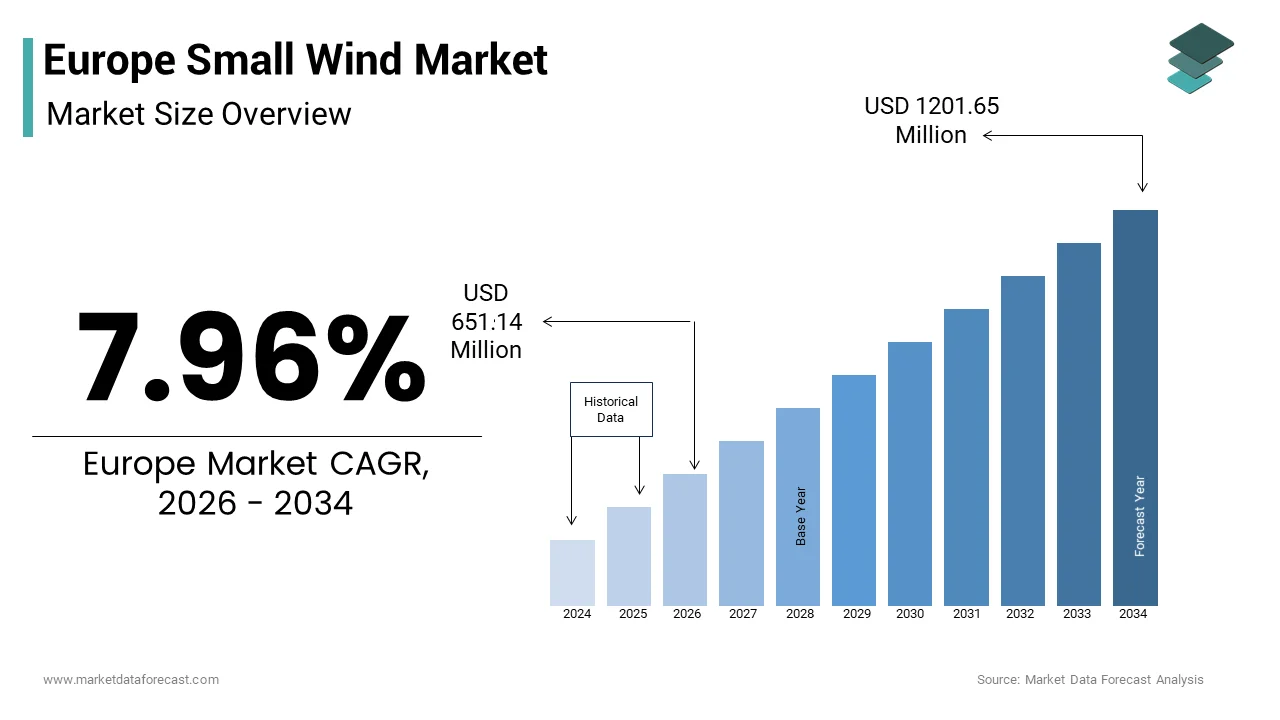
The Europe Small Wind Market was valued at USD 603.13 Million in 2025, and is expected to reach a valuation of USD 651.14 Million in 2026, and is forecast to reach USD 1201.65 Million by 2034 (CAGR 7.96%, 2026–2034), driven by rural electrification needs, distributed energy adoption, supportive renewable policies, and advancements in compact, low-noise turbine designs.
Market Highlights
- 2025 value: USD 603.13 million
- 2026 (est): USD 651.14 million
- 2034 (forecast): USD 1201.65 million
- CAGR (2026–2034): 7.96%
Quick Growth Drivers
- Rising demand for distributed and off-grid renewable power, especially in rural, agricultural, and remote communities.
- Strong emphasis on energy independence as electricity prices fluctuate across Europe.
- Advancements in small turbine efficiency, low-wind-speed performance, and noise reduction.
- Favorable EU renewable energy directives, feed-in tariffs, and grid-integration incentives.
- Growing adoption of hybrid energy systems (small wind + solar + storage) for residential and commercial installations.
Principal Restraints
- Permitting complexity and zoning restrictions in several EU countries slow installation timelines.
- Highly variable wind resources across regions impact project economics.
- Competition from solar PV, which often has lower upfront costs and simpler siting requirements.
- Maintenance challenges for small turbine owners due to limited service networks in remote areas.
- Limited consumer awareness of lifecycle costs and performance differences between turbine models.
High-Value Opportunities
- Scaling horizontal-axis turbine innovations for low-wind-speed urban and semi-urban use cases.
- Development of plug-and-play micro-wind systems for homes, telecom towers, and municipal lighting.
- Integration of energy storage and smart inverters to improve reliability and grid compatibility.
- Expansion of community energy projects and cooperative wind ownership models.
- Retrofitting older turbines with high-efficiency blades and digital monitoring systems.
Key Operational Challenges
- Balancing turbine performance with aesthetic and noise constraints in populated areas.
- Managing intermittency while ensuring safe and consistent grid interconnection.
- Building skilled installer networks to support quality installation and long-term maintenance.
- Navigating multi-country certification standards, including CE conformity and acoustic limits.
- Reducing turbine CAPEX through local manufacturing and improved supply chain coordination.
Fastest-Growing Segments
- Horizontal Axis Wind Turbines (HAWT): Leading adoption due to higher efficiency and reliability across varied wind conditions.
- Residential & agricultural applications: Rapid uptake in farms, homesteads, and rural microgrids.
- Hybrid micro-generation systems: Bundled small wind + solar + battery enabling 24/7 distributed power.
Regional Leadership & Dynamics
- Germany (leader): 26.1% share in 2024 — strong policy backing, mature distributed generation ecosystem, and high citizen adoption.
- United Kingdom: Second-largest market — large wind footprint (34.5 GW in 2025), supportive grid policies, and proven community wind models.
- France: Third position — 24.41 GW installed wind capacity; expanding rural electrification and municipal renewable projects.
- Spain: Notable growth — 29 GW installed capacity in 2025, accelerating hybrid and community wind adoption.
- Italy: Growing steadily — 13.33 GW installed in 2025, strong incentives, and rising agricultural sector installations.
What Wins Commercially
- Durable, low-noise turbines optimized for low-to-medium wind speeds.
- Bundled solutions include installation, monitoring software, and maintenance plans.
- Clear, transparent performance data validated by independent testing and certification.
- Strong distributor networks and local service availability to reduce downtime.
- Financing options such as leasing, power-as-a-service, and community funding models.
Top Strategic Actions for Executives
- Expand R&D for quieter, more compact turbines suitable for semi-urban markets.
- Build partnerships with energy storage providers to deliver hybrid ecosystems.
- Strengthen relationships with municipalities, cooperatives, and rural development agencies.
- Localize manufacturing and assembly to lower costs and cut lead times.
- Invest in installer training academies to improve installation quality and customer experience.
Leading Players
Northern Power Systems SRL · SD Wind Energy Limited · Aeolos Wind Energy Ltd · Ryse Energy · City Windmills Holdings PLC · Aria SRL · Enerlice · SkyWind Energy GmbH · Wind Energy Solutions · TUGE Energia OU
Europe Small Wind Market Size
The Europe small wind market size was valued at USD 603.13 million in 2025 and is anticipated to reach a valuation of USD 651.14 million in 2026 and USD 1201.65 million by 2034, growing at a CAGR of 7.96% from 2026 to 2034.
Small wind is are energy system with a rated capacity typically under 100 kilowatts, designed for decentralized power generation in residential, agricultural, commercial, and remote off-grid applications. Unlike utility-scale turbines, these systems prioritize localized energy autonomy, grid resilience, and integration with hybrid renewable setups. In Europe, small wind technology serves as a complementary solution within the broader clean energy transition, particularly in regions with dispersed populations or constrained grid access. According to the European Environment Agency, around 80% of Europe’s land surface has been shaped by human activities, including agriculture, infrastructure, and settlements, leaving significant rural and sparsely populated areas that present potential for distributed generation models. As per Eurostat, renewables accounted for 34.3% of the EU’s net electricity generation in 2022, highlighting both progress and ongoing challenges in grid stability. For example, the Bundesnetzagentur reported that electricity supply interruptions averaged just 12.8 minutes per customer in 2023 in Germany, which indicates the reliability of the grid despite energy transition pressures. The European Commission’s Clean Energy for All Europeans package explicitly recognizes small-scale renewables as critical enablers of energy democracy and consumer empowerment. Furthermore, the revision of the Renewable Energy Directive (RED II) mandates that member states remove administrative barriers to citizen-led energy communities, many of which deploy small wind alongside solar. While market metrics are intentionally excluded, these contextual parameters illustrate the socio-technical and policy environment shaping the European small wind landscape.
MARKET DRIVERS
Rural Electrification and Energy Autonomy in Non-Interconnected Zones
The pursuit of energy self-sufficiency in rural and non-interconnected territories where grid extension is economically unviable or environmentally disruptive is one of the primary drivers propelling the growth of the European small wind market. According to the European Commission, Europe has one of the most interconnected electricity grids globally, yet several regions, such as islands and mountainous areas, continue to face energy insecurity due to limited transmission infrastructure. This geographic challenge makes small wind turbines a reliable complement to solar, particularly during winter months when solar irradiance drops significantly, thereby ensuring a consistent energy supply. As per the International Renewable Energy Agency and related studies, electricity in small remote islands is generally supplied by diesel generators, leading to high energy costs often exceeding €0.30 per kilowatt hour. This makes small wind integration highly relevant, as it reduces reliance on costly fossil fuels and enhances affordability. The European Islands Facility (NESOI) has supported numerous renewable energy projects, aiming to mobilize over €100 million in investments across more than 2,400 inhabited EU islands. These initiatives include hybrid systems that significantly reduce diesel consumption, demonstrating the tangible impact of small wind adoption. Additionally, the EU Strategy for the Alpine Region promotes decentralized renewables to preserve landscape integrity while ensuring power access. For remote farms and eco-lodges, small wind systems under 50 kilowatts eliminate dependency on volatile fuel supply chains and provide predictable operational costs. This convergence of geographic necessity, policy support, and cost rationality sustains consistent demand for small wind across Europe’s dispersed communities.
Policy Incentives for Prosumer Energy Communities
The rapid expansion of citizen-led renewable energy communities across Europe is another key driver supporting the growth of the European small wind market. According to REScoop.eu, the European Federation of Renewable Energy Cooperatives, over 2,500 energy communities are now active in the EU, involving more than 2 million citizens. More than 60% of these communities incorporate multiple renewable sources to ensure year-round supply stability, underscoring the relevance of small wind in diversified generation portfolios. Small wind turbines fill critical seasonal gaps in solar-dominated microgrids, producing peak output during autumn and winter when wind resources are strongest. As per the European Commission’s Clean Energy Package and related policy frameworks, numerous member states have implemented incentives such as feed-in tariffs, net metering, or tax exemptions for sub-100-kilowatt wind installations. For instance, France’s autoconsommation collective framework allows neighbourhood groups to share small wind output with zero grid export charges, while Germany’s EEG 2023 revision introduced streamlined permitting for community turbines under 50 kilowatts located on agricultural land. The Netherlands has integrated small wind into its “WindOpZee” citizen participation model, originally designed for offshore projects but now adapted for onshore micro installations.
MARKET RESTRAINTS
Inconsistent Permitting Frameworks Across Member States
The fragmented and unpredictable permitting landscape that varies drastically between and within member states is primarily hampering the European small wind market growth. According to WindEurope’s 2023 permitting analysis, approval timelines for wind projects differ significantly across Europe, with some countries achieving approvals in under six months while others face delays exceeding two years due to overlapping municipal, regional, and environmental regulations. This inconsistency directly impacts small wind projects, where administrative hurdles outweigh technical or financial constraints. As per the European Commission’s Wind Power Action Plan, permitting delays remain one of the most critical barriers to renewable energy deployment, with more than half of project postponements attributed to administrative bottlenecks. Even in supportive markets such as Germany, regulatory rulings have required stringent noise assessments for turbines under 20 kilowatts, applying the same protocols as utility-scale projects. This has effectively stalled residential deployments and discouraged small-scale adoption. The absence of a harmonized EU definition for “small wind” further complicates legal classification, with eligibility thresholds ranging from 10 kilowatts in some nations to 100 kilowatts in others. This regulatory inconsistency deters private investment and discourages cross-border technology transfer and undermining the internal market for decentralized renewables.
Intermittency and Low-Capacity Factors in Urban Settings
The supply chain disruptions and raw material shortages that are exacerbated by global trade tensions and logistical bottlenecks are not the only restraints. The operational performance of small wind turbines in densely populated European regions is also severely limited by turbulent airflow and suboptimal wind resources. According to the German Aerospace Center, average wind speeds in urban environments often fall below 4.5 meters per second at hub heights under 20 meters, far below the 6 meters per second typically required for viable energy yield. This makes small wind installations economically inefficient in cities. As per a 2023 study by the University of Strathclyde, small wind installations in urban areas such as Brussels, Paris, and Warsaw exhibited annual capacity factors of just 3 to 6% compared to 15 to 25% in rural coastal zones. This underperformance is exacerbated by building-induced turbulence, which increases mechanical stress and maintenance costs. According to the European Environment Agency, over 70% of proposed small wind projects in urban planning applications fail to meet minimum return on investment thresholds due to unrealistic energy forecasts. Moreover, grid operators in countries like the Netherlands and Belgium often reject small wind interconnection requests, citing voltage fluctuation risks from variable output.
MARKET OPPORTUNITIES
Integration with Agricultural Decarbonization Initiatives
The growing adoption of small wind technology within Europe’s agricultural decarbonization agenda represents a significant opportunity for the European smart wind market. According to the European Commission, agriculture accounts for approximately 10% of the EU’s greenhouse gas emissions, with on-farm energy use representing a notable share of this footprint. This makes renewable energy integration highly relevant to sustainability targets. Small wind turbines under 50 kilowatts can directly power irrigation pumps, refrigeration units, and ventilation systems, which reduces reliance on diesel generators and grid electricity. As per the EU Common Agricultural Policy, more than €8 billion in eco-scheme funding was allocated in 2023 to support on-farm renewable energy with explicit eligibility for hybrid wind-solar installations. In Ireland, the Targeted Agricultural Modernisation Scheme provides grants covering up to 60% of small wind system costs for dairy and livestock operations, while France’s Plan de Relance includes subsidies for wind-powered water pumping in drought-prone regions such as Occitanie. The integration of small wind into precision agriculture platforms also enables real-time energy data to optimize equipment scheduling. With over 9 million farms in the EU and rising pressure to meet Farm to Fork sustainability targets, small wind offers a scalable pathway to reduce Scope 2 emissions while enhancing operational resilience against energy price volatility.
Expansion of Off-Grid Telecom and Remote Monitoring Infrastructure
The development of advanced off-grid digital infrastructure across Europe’s remote and ecologically sensitive areas offers another promising avenue for the expansion of the European small wind market. According to the European Telecommunications Standards Institute, thousands of remote cell towers and environmental sensor stations operate beyond reliable grid access, particularly in Nordic boreal forests, Mediterranean islands, and Alpine conservation zones. These sites require continuous power for 5G expansion, wildlife tracking, and climate monitoring, yet face strict emissions restrictions that prohibit diesel use. As per the European Environment Agency, more than 35% of EU-protected Natura 2000 sites now host digital monitoring equipment mandated under the Biodiversity Strategy for 2030. Small wind turbines rated between 5 and 20 kilowatts provide silent, low-maintenance power that complements solar in high-latitude winter conditions. In Sweden, Telia has deployed 180 hybrid wind-solar systems to power rural base stations, reducing annual CO2 emissions by approximately 1,200 tons. Similarly, the Italian National Institute for Environmental Protection operates 75 small wind-powered air quality stations in the Apennines, where grid connection would disrupt protected habitats.
MARKET CHALLENGES
Lack of Standardized Performance Certification and Testing Protocols
The absence of harmonized performance certification and testing protocols is primarily challenging the credibility and consumer confidence in the European small wind market. According to the International Electrotechnical Commission, IEC 61400-2 provides design and safety requirements for small wind turbines, but national adoption and enforcement vary across Europe, which is leading to inconsistent application and limited third-party verification mandates. This inconsistency creates uncertainty for buyers and investors and weakens comparability across products. As per IRENA’s overview of small wind testing and certification, the ecosystem relies on a patchwork of IEC standards (including IEC 6140 -11 for acoustic measurements and IEC 61400-12-1 for power performance), which are not uniformly required by national authorities, and reinforces information asymmetry for consumers and institutional procurers. According to emerging EU policy on substantiation of environmental claims, the proposed “Green claims” directive seeks to tighten verification and comparability requirements for performance claims, which indicates current gaps in enforcement and the high risk of misleading product communications in energy technologies. Even where standards exist, enforcement remains weak, with several national programs continuing to accept manufacturer-declared data without independent lab validation, thereby increasing due diligence burdens for consumers and installers. As per IEC 61400-2 and related conformity guidance, the lack of a centralized EU registry of validated turbine performance comparable to PV databases perpetuates market fragmentation and inhibits economies of scale for compliant manufacturers, which is directly impacting market credibility and procurement pathways.
Competition from Rapidly Declining Solar PV and Battery Costs
The growing instability due to competitive pressure from rapidly declining solar PV and battery costs is also challenging the expansion of the European small wind market. According to IRENA, the global weighted average LCOE for utility-scale PV fell to about $0.044/kWh in 2023, whicmarksng a 12% year-on-year decline and roughly a 90% drop since 2010, which indicates the steep cost trajectory that strengthens solar’s advantage; while wind costs also decreased, the relative pace favours PV in distributed applications. As per BloombergNEF, lithium-ion battery pack prices reached a record low global average of $115 per kilowatt hour in 2024 after a 20% drop from 2023, which is reinforcing the economics of solar-plus-storage for prosumers across Europe and improving project paybacks for residential systems. According to PV resource assessments, large parts of southern and central Europe exhibit high solar irradiation suitable for robust rooftop generation, further boosting the energy yield advantages of PV in many urban and suburban contexts. As per SolarPower Europe’s EU Market Outlook, 2023 saw record PV deployment in the EU with around 56 GW added and broad uptake of prosumer systems, indicating market preference for solar as the primary distributed technology. This momentum compounds, permitting simplicity and faster installation cycles relative to small wind. Even in northern regions, advances such as bifacial modules and diversified mounting orientations have supported stronger year-round performance for PV, which is narrowing seasonal gaps that historically favored winter wind output. Without breakthroughs in turbine efficiency or targeted policy mechanisms that value wind’s winter generation premium, small wind risks marginalization in the distributed energy marketplace as prosumers increasingly select PV-plus-storage.
REPORT COVERAGE
| REPORT METRIC | DETAILS |
| Market Size Available | 2025 to 2034 |
| Base Year | 2025 |
| Forecast Period | 2026 to 2034 |
| CAGR | 7.96% |
| Segments Covered | By Axis, And By Country |
| Various Analyses Covered | Global, Regional & Country Level Analysis; Segment-Level Analysis, DROC, PESTLE Analysis, Porter’s Five Forces Analysis, Competitive Landscape, Analyst Overview of Investment Opportunities |
| Regions Covered | UK, France, Spain, Germany, Italy, Russia, Sweden, Denmark, Switzerland, Netherlands, Turkey, Czech Republic & Rest of Europe |
| Market Leaders Profiled | Northern Power Systems SRL, SD Wind Energy Limited, Aeolos Wind Energy Ltd, Ryse Energy, City Windmills Holdings PLC, Aria SRL, Enerlice, SkyWind Energy GmbH, Wind Energy Solutions, TUGE Energia OU |
SEGMENTAL ANALYSIS
By Axis Insights
The horizontal axis wind turbine segment held the dominating share of the European small wind market in 2025 due to its superior aerodynamic efficiency, higher energy yield, and technological maturity. These systems align rotor blades perpendicular to the wind, enabling optimal capture of kinetic energy, particularly in regions with consistent unidirectional winds such as coastal and rural zones. According to the European Wind Energy Association, horizontal-axis turbines under 100 kilowatts achieve average capacity factors of around 20% in favorable sites, which is significantly outperforming vertical-axis counterparts, which typically range between 6% and 12%. This performance gap translates into faster payback periods and stronger economic justification for farmers, telecom operators, and energy communities. Small-scale horizontal axis systems have consistently generated higher annual electricity output compared to equivalent vertical axis units in Germany and the Netherlands, which reinforces their efficiency advantage. Furthermore, decades of refinement have standardized yaw control, blade pitch, and tower integration, reducing maintenance complexity. Manufacturers such as Energiekontor and Vergnet offer modular horizontal axis platforms with certified performance data accepted by subsidy agencies in over 15 EU member states. The combination of proven reliability, regulatory recognition,n, and energy density ensures horizontal axis turbines remain the default choice for serious off-grid and hybrid energy projects across Europe.
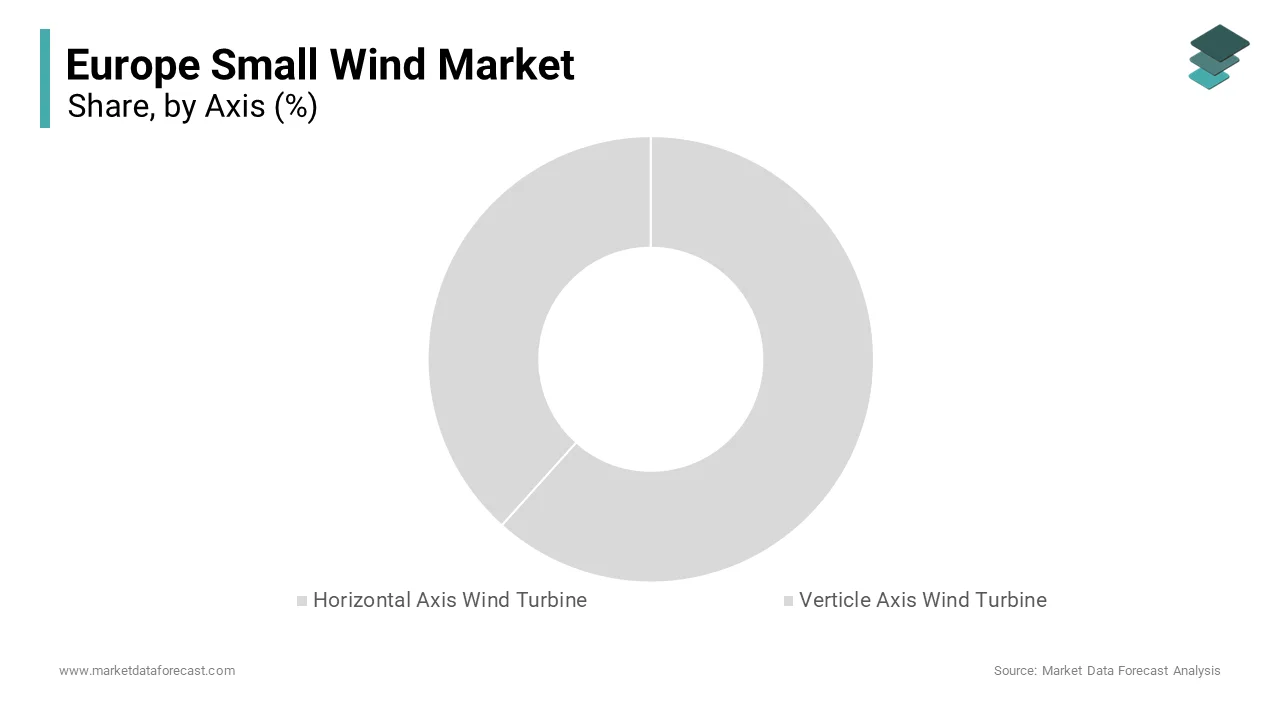
Vertical-axis wind turbine segment is anticipated to record a CAGR of 19.1% over the forecast period in the European smart wind market. The evolving urban energy needs and architectural integration trends are propelling the vertical axis segment in this regional market. Unlike horizontal designs, vertical-axis turbines operate efficiently in turbulent and multidirectional wind flows typical of built environments, making them suitable for rooftops, balconies, and public infrastructure. According to the European Urban Wind Initiative, a growing share of new small wind pilot projects in cities like Barcelona, Milan, and Copenhagen since 2022 have opted for vertical axis configurations due to their omnidirectional capability and lower noise emissions. As per the European Commission’s New European Bauhaus program, several urban sustainability demonstrators now incorporate vertical axis turbines as aesthetic and functional elements of green building envelopes. Advances in helical blade design and composite materials have also improved energy capture, with Italian firm Kite Wind reporting enhanced torque stability in recent field tests. Additionally, vertical axis systems face fewer permitting hurdles in historic districts where rotating horizontal blades are deemed visually intrusive. According to Eurostat, over 75% of Europeans live in urban areas, which is driving steady demand for distributed generation. This confluence of urban planning policy, design innovation, and regulatory tolerance positions vertical-axis turbines as a rapidly growing axis type in Europe’s small wind landscape.
REGIONAL ANALYSIS
Germany Small Wind Sector Market Analysis
Germany holds a commanding position in the European small wind sector and accounted for 26.1% of the European small wind market share in 2025. The dominance of Germany in the European market is driven by its strong renewable energy policies under the Energiewende framework, which has consistently promoted decentralized energy systems. Germany’s installed wind capacity exceeded 69 GW in 2025, with small wind contributing significantly to rural electrification and community projects. The market status is mature with strong domestic manufacturing and innovation in ivertical-axisis turbines. Driving factors include government feed‑in tariffs, a robust engineering base, and increasing demand for off‑grid solutions in agricultural regions. The German market also benefits from EU climate targets, which require a 55% reduction in emissions by 2030, pushing the adoption of distributed wind systems. Challenges remain in permitting and grid integration, but Germany continues to dominate due to its scale and policy consistency.
United Kingdom Small Wind Sector Market Analysis
The United Kingdom represents the second largest share in the European small wind market. The UK’s installed wind capacity reached 34.5 GW in 2025, with small wind projects serving community and industrial applications. Market status is dynamic, driven by ambitious net‑zero targets for 2050 and strong offshore wind leadership that indirectly supports small wind innovation. Driving factors include government subsidies for rural electrification, community energy schemes, and technological advances in micro‑turbines. The UK market is also supported by rising electricity prices, which make self‑generation attractive for households and small businesses. The country’s regulatory environment has streamlined approvals for small wind installations, encouraging adoption in Scotland and Wales, where wind resources are abundant.
France Small Wind Sector Market Analysis
France occupied the third position in the European small wind market in 2024. France’s installed wind capacity stood at 24.41 GW in 2025, with small wind projects increasingly used in rural and island communities. The market status is growing, supported by the French government’s renewable energy plan targeting 40% renewable electricity by 2030. Driving factors include strong policy incentives, rising demand for decentralized energy, and technological partnerships with EU manufacturers. France has also invested in hybrid systems combining solar and small wind, which are particularly effective in regions with variable weather. The French market benefits from EU funding for rural electrification and innovation grants, making small wind a viable solution for off‑grid communities.
Spain Small Wind Sector Market Analysis
Spain is anticipated to account for a prominent share of the European small wind market during the forecast period. Spain’s installed wind capacity reached 29 GW in 2025, with small wind contributing to rural electrification and agricultural applications. The market status is expanding, driven by the country’s commitment to renewable energy under its National Energy and Climate Plan. Driving factors include abundant wind resources, government subs,idies, and rising demand for self‑sufficiency in energy. Spain has also promoted small wind in island territories such as the Canary Islands, where grid extension is costly. The Spanish market benefits from EU climate funding and domestic innovation in turbine design. Challenges include grid integration and policy uncertainty, but Spain remains a strong player due to its natural wind potential and supportive policies.
Italy Small Wind Sector Market Analysis
Italy a notable market for small wind in Europe. Italy’s installed wind capacity was 13.33 GW in 2025, with small wind projects concentrated in rural and coastal areas. The market status is developing, supported by Italy’s National Energy and Climate Plan, which emphasizes renewable energy expansion. Driving factors include government incentives, rising demand for off‑grid solutions, and strong community energy initiatives. Italy’s small wind sector is also supported by EU funding and domestic innovation in turbine design. The country faces challenges in regulatory complexity and grid integration, but its market continues to grow steadily. Italy’s role in the European market is significant, providing localized solutions for rural electrification and contributing to EU climate goals.
COMPETITIVE LANDSCAPE
The Europe small wind market features a fragmented and specialized competitive environment dominated by regional engineering firms rather than multinational conglomerates. Competition is driven by technical differentiation, its specific performance, and integration capabilities rather than price alone. German and French companies lead in horizontal axis systems for rural application,,s while Italian and Spanish innovators pioneer vertical axis designs for urban settings. Barriers to entry remain high due to certification costs, permitting complexity, and the need for localized technical support. However, er the absence of dominant global players creates space for agile specialists to capture niche segments such as island microgrids, agricultural decarbonization, and off-grid digital infrastructure. Regulatory alignment across EU member states remains inconsistent, which limits scale but encourages deep regional engagement. Overall, the market rewards engineering excellence, policy adaptability, and hybrid system integration over mass production.
KEY MARKET PLAYERS
A major market player in the Europe small wind market is
- Northern Power Systems SRL
- Energiekontor AG
- Kite Wind Srl
- Vergnet SA
- SD Wind Energy Limited
- Aeolos Wind Energy Ltd
- Ryse Energy
- City Windmills Holdings PLC
- Aria SRL
- Enerlice
- SkyWind Energy GmbH
- Wind Energy Solutions
- TUGE Energia OU
Top Players in the Market
- Energiekontor AG is a leading German renewable energy developer with significant expertise in small wind turbine deployment across rural and island communities in Europe. The company designs and installs customized horizontal-axis wind systems under 100 kilowatts tailored for farms, telecom sites, and microgrids. In 20,23, Energiekontor expanded its small wind division by launching a hybrid solar wind solution certified under Germany’s BAFA subsidy scheme. It also partnered with the University of Oldenburg to integrate real-time wind forecasting algorithms into its control systems, enhancing energy predictability. These initiatives reinforce Energiekontor’s commitment to delivering reliable decentralized power while supporting EU energy autonomy goals.
- Vergnet S, a French engineering firm, specializes in robust small wind turbines engineered for extreme climates and off-grid applications across Europe and the Global South. Its 10 to 50 kilowatt horizontal axis turbines feature cyclone-resistant tilt-down towers and are widely deployed in Mediterranean islands and mountainous regions. In 2024, Vergnet introduced a modular hybrid platform combining wind, solar for EU agricultural cooperatives under the Common Agricultural Policy funding window. The company also strengthened its service network in Spain and Greece to reduce maintenance response times. Vergnet’s focus on durability and rural resilience solidifies its niche in Europe’s distributed energy landscape.
- Kite Wind Sr, an innovator, focuses on vertical-axis turbine technology designed for urban and semi-urban environments. Its helical blade systems prioritize low noise omnidirectional operation and architectural integration, making them suitable for public buildings and eco districts. In 2023, ite Wind collaborated with Milan’s Polytechnic University to validate performance in turbulent urban airflow and achieved compliance with Italy’s Decree on Renewable Energy Communities. The company also secured inclusion in the European Commission’s New European Bauhaus initiative, promoting sustainable design. These actions position Kite Wind at the intersection of clean energy and urban innovation in Southern Europe.
Top Strategies Used by the Key Market Participants
Key participants in the Europe small wind market focus on hybridization with solar and storage to enhance reliability and economic viability. They actively align product certification with national subsidy frameworks to facilitate customer access to public funding. Companies invest in localized service networks to ensure rapid maintenance and build trust in remote regions. Strategic partnerships with universities and research institutes drive performance validation and regulatory credibility. AAdditionallyfirms increasingly integrate digital monitoring and predictive analytics to improve energy forecasting and grid compatibility. These approaches collectively addretechnicalhni, ca economic and policy barriers to adoption.
MARKET SEGMENTATION
This research report on the Europe small wind market is segmented and sub-segmented into the following categories.
By Axis Insights
- Horizontal Axis Wind Turbine
- Vertical Axis Wind Turbine
By Country
- UK
- France
- Spain
- Germany
- Italy
- Russia
- Sweden
- Denmark
- Switzerland
- Netherlands
- Turkey
- Czech Republic
- Rest of Europe