Europe Smart Airport Market Size, Share, Growth, Trends, And Forecasts Report, Segmented By Technology, And By Region (The UK, France, Spain, Germany, Italy, Russia, Sweden, Denmark, Switzerland, Netherlands, Turkey, Czech Republic and Rest of Europe), Industry Analysis From 2026 to 2034.
Market Size, 2025
$432.86 MnMarket Estimate, 2026
$470.74 MnMarket Forecast, 2034
$920.90 MnCAGR, 2026–2034
8.75%Europe Smart Airport Market Report Summary
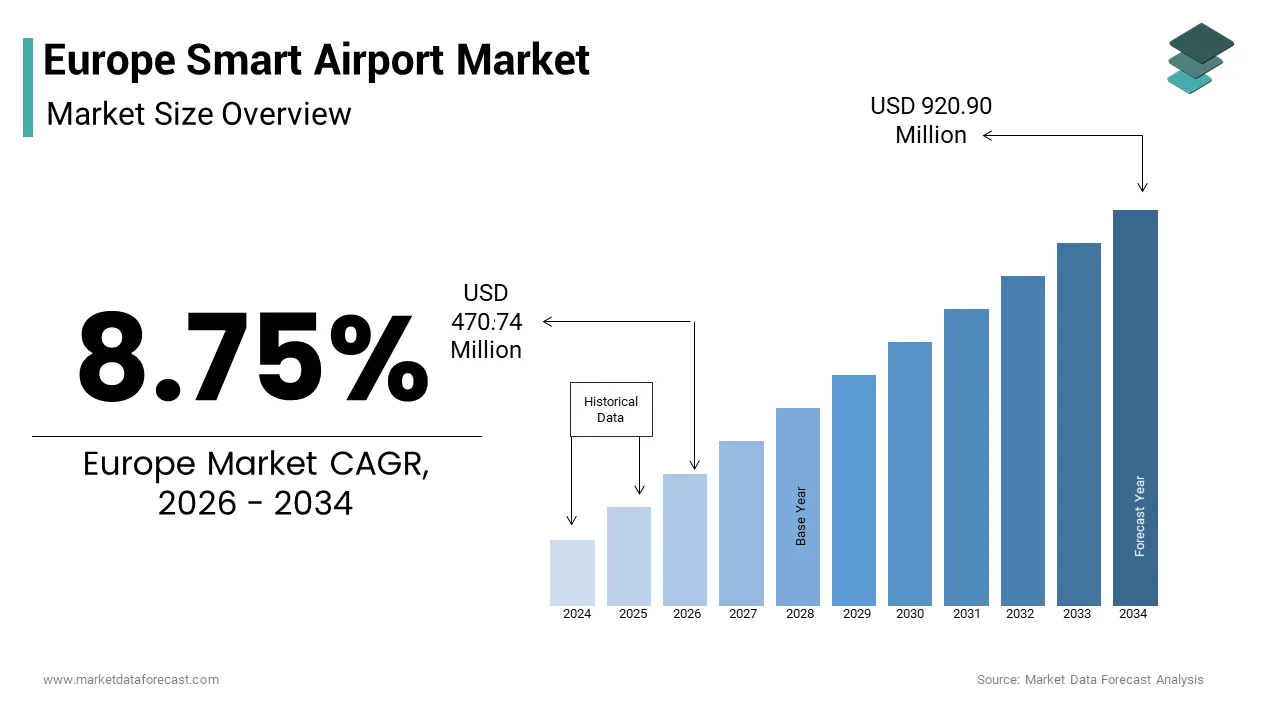
The Europe smart airport market was valued at USD 432.86 million in 2025, is estimated to reach USD 470.74 million in 2026, and is projected to grow to USD 920.90 million by 2034, expanding at a CAGR of 8.75% during the forecast period from 2026 to 2034.
Growth in the European smart airport market is driven by increasing air passenger traffic, airport modernization programs, and the rapid adoption of digital technologies that enhance operational efficiency and passenger experience. Rising demand for contactless services, automation in airside and landside operations, and investments in cybersecurity and smart infrastructure are further accelerating market expansion. In addition, the region’s focus on sustainability, energy-efficient airport systems, and real-time data-driven decision-making is strengthening the adoption of smart airport solutions across Europe.
Key Market Trends
- Increasing deployment of biometric check-in, boarding, and identity verification technologies to reduce queues and enable seamless travel.
- Growing adoption of IoT and AI-based systems for baggage handling, predictive maintenance, and real-time resource allocation.
- Rising emphasis on contactless passenger services, including touch-free kiosks, digital wayfinding, and automated service requests.
- Expansion of smart energy and environmental monitoring systems to improve energy efficiency and lower airport carbon footprints.
- Advancements in airport cybersecurity technologies to safeguard digital infrastructure from evolving threats.
Segmental Insights
By Technology, the security systems segment held the largest share of 33.1% of the Europe smart airport market in 2025. This dominance is attributed to heightened security regulations, increasing investment in biometric solutions, enhanced surveillance capabilities, and advanced threat detection technologies that support safer passenger processing and airport operations.
Regional Insights
- In Germany, Germany led the Europe smart airport market in 2025 with a 25.6% share, driven by strong airport modernization initiatives, high technology adoption, and continuous investment in smart security and automation systems.
- In the United Kingdom, the UK represents a promising segment, supported by major airport expansions, digital transformation strategies, and increasing passenger demand for seamless, tech-enabled travel experiences.
- In France, France held a significant share in 2025 due to ongoing upgrades in major international airports, widespread deployment of biometric systems, and strong government support for digital aviation initiatives.
- In the Netherlands, the Netherlands is projected to maintain a prominent share throughout the forecast period, supported by its world-class airport infrastructure and rapid adoption of smart mobility and energy-efficient airport technologies.
- In Turkey, Turkey is expected to exhibit a healthy CAGR, backed by large-scale airport development projects and growing investments in automated passenger processing and advanced airside operations.
Competitive Landscape
The Europe smart airport market is characterized by leading global technology providers and aviation solution companies focused on digital transformation, operational automation, and integrated passenger service platforms. Key strategies include AI-driven optimization, advanced security system development, IoT connectivity solutions, and partnerships with airport authorities to support long-term modernization projects.
Prominent players in the Europe smart airport market include SITA, International Business Machines Corporation (IBM), Vanderlande Industries B.V., Amadeus IT Group S.A., Siemens AG, THALES, BEUMER Group GmbH & Co. KG, Indra Sistemas S.A., Honeywell International Inc., Leonardo S.p.A., and Leidos Holdings Inc.
Europe Smart Airport Market Size
The Europe smart airport market size was valued at USD 432.86 million in 2025 and is anticipated to reach USD 470.74 million in 2026 and USD 920.90 million by 2034, growing at a CAGR of 8.75% during the forecast period from 2026 to 2034.
Smart airport includes the integration of digital technologies, such as biometrics, artificial intelligence, Internet of Things sensors, and data analytics into airport infrastructure to enhance operational efficiency, passenger experience, and security compliance. Unlike conventional airport systems, smart airports leverage interconnected platforms to enable seamless processes from curb to gate, including contactless check-in in automated baggage handling, predictive security screening, and real-time resource allocation. According to Eurostat, European airports welcomed approximately 973 million passengers in 2023, marking a 19.3% increase compared with 2022, though still slightly below pre-pandemic levels. As per Airports Council International Europe, total passenger traffic across Europe’s airports reached 2.3 billion in 2023, standing just 5.3% below 2019 volumes. European airports are rapidly deploying biometric identity verification systems to comply with the upcoming EU Entry/Exit System mandate, with widespread adoption across major hubs. According to EUROCONTROL, many European airports have already implemented the Airport Collaborative Decision Making (A-CDM) program, which enhances operational efficiency by enabling stakeholders to share real-time data. Furthermore, the European Data Protection Board has issued updated guidelines on biometric data processing, emphasizing privacy-by-design principles and compliance with GDPR in transit zones. These institutional frameworks position smart airports not as luxury upgrades but as strategic necessities for managing Europe’s growing air traffic while balancing sustainability, security, and passenger satisfaction imperatives.
MARKET DRIVERS
Mandated Implementation of EU Entry-Exit System and Digital Identity Frameworks
The enforcement of the European Union’s Entry Exit System is driving the European smart airport market growth. According to the European Commission, the Entry/Exit System requires all Schengen airports to implement automated biometric registration for non-EU nationals by 2024, which involves capturing facial images and fingerprints at border control. This regulation has prompted numerous airports across Europe to deploy integrated biometric corridors linking check-in, bag drop, security, and boarding through a single digital token. According to Frankfurt Airport, its “Smart Travel” ecosystem reduced average border processing time from around twelve minutes to under three minutes per passenger in 2023, using facial recognition compliant with EU Regulation 2019/1157. Similarly, Amsterdam Schiphol has implemented a fully biometric flow from train platform to aircraft gate for departing passengers in collaboration with the Royal Netherlands Marechaussee. As per the European Data Protection Supervisor, these systems adhere to GDPR through on-device matching and automatic data deletion within forty-eight hours. According to Eurostat, there were approximately 300 million entries of non-EU nationals into the EU in 2023, which indicates the scale of demand for efficient border management. These developments demonstrate that the Entry/Exit System transforms biometric infrastructure from optional to essential, and creates a continent-wide impetus for smart terminal modernization.
Rising Passenger Volumes and Pressure on Terminal Capacity
Surging air travel demand is compelling European airports to adopt smart technologies to manage congestion without physical expansion, which is further supporting the smart airport market expansion in Europe. According to Eurostat, passenger traffic in the EU reached approximately 973 million in 2023, representing a 19.3% increase compared with 2022. Terminal infrastructure growth has remained limited, which is constrained by urban planning restrictions and environmental permits. As per London Heathrow Airport, peak-hour passenger density has at times exceeded design capacity, leading to longer wait times at security checkpoints. In response, Heathrow deployed AI-powered queue management and dynamic lane allocation, which reduced peak wait times by nearly 30% within six months. According to Airports Council International Europe, airports using predictive analytics for staff and gate allocation improved on-time departure performance by around 15% in 2023. Munich Airport’s digital twin platform simulates passenger flows in real time, which is enabling proactive resource adjustments during disruptions. As per the European Environment Agency’s 2023 aviation sustainability directive, restrictions on new runway and terminal construction near urban centers reinforce the need for smart systems as the only scalable solution to absorb growing demand within existing footprints.
MARKET RESTRAINTS
Fragmented Legacy Infrastructure and Integration Complexity
The prevalence of aging and heterogeneous IT systems across European airports is a significant restraint on the European smart airport market. Many EU airports still operate legacy baggage handling and security screening systems installed before 2010, which are leading to incompatible communication protocols. According to Groupe ADP disclosures, integrating new biometric boarding gates with legacy departure control systems required custom middleware development to ensure interoperability. As per public updates from Aeroporti di Roma, smart security rollout faced delays due to aligning law enforcement databases with commercial biometric solutions. According to Airports Council International’s Smart Data Hub guidance (2023), few airports have a unified data architecture enabling cross-functional analytics. These technical debt burdens inflate implementation costs, extend timelines, and increase cyber vulnerability. Without standardized APIs and interoperability mandates, smart airport projects risk becoming siloed point solutions rather than integrated ecosystems.
Stringent Data Privacy Regulations and Public Trust Concerns
Europe’s robust data protection regime, while essential for civil liberties, creates compliance complexity that slows smart airport deployment, which is further impeding the smart airport market growth in Europe. According to the European Data Protection Board, biometric data is classified as special category personal data under Article 9 of the GDPR, requiring explicit consent or a specific legal basis for processing. As per the EDPB’s 2024 Opinion on airport facial recognition, deployments to streamline passenger flows must meet strict GDPR requirements, including data minimization, storage limitation, security, and privacy by design, which ensures individuals retain maximum control over their biometric data. According to Eurobarometer surveys, public opinion across the EU reflects significant concerns about continuous biometric tracking in transport hubs, which is reinforcing the need for transparent governance and robust safeguards. These legal and social headwinds force airports to adopt opt-in models, fragmented data flows, and on-premise processing that reduce system efficiency and increase operational costs. Until harmonized aviation-specific data governance frameworks emerge, privacy compliance will remain a structural constraint on smart airport scalability.
MARKET OPPORTUNITIES
Expansion of Airport City and Multimodal Mobility Hubs
The evolution of airports into integrated urban mobility and commercial districts is a major opportunity for the European smart airport market. According to ACI World, airports increasingly rely on non-aeronautical revenues such as retail, parking, and concessions, which account for almost 40% of total airport revenues. Paris Charles de Gaulle’s “Aéroville” development links the terminal to high-speed rail, metro, and autonomous shuttles through a unified mobility app offering seamless booking and payment. As per the European Investment Bank, it funds multimodal integration and digital infrastructure projects at European airports, which enable real-time coordination between public transport and mobility services via central digital platforms. Similarly, Istanbul Airport’s smart city district uses IoT sensors to manage energy, water, and waste across an extensive commercial space. These ecosystems require integrated data layers for traffic flow, energy use, and passenger movement, which is creating demand for enterprise-wide smart airport operating systems. As airports transform into economic engines rather than transit nodes, the business case for comprehensive digitization strengthens beyond aviation alone.
Adoption of Predictive Maintenance and AI-Driven Operational Resilience
The integration of artificial intelligence for predictive asset management offers significant opportunities to the European smart airport market. According to EUROCONTROL’s Central Office for Delay Analysis, European airports experience significant non-ATFM delays linked to turnaround processes and equipment-related issues, which indicates the operational impact of unscheduled failures at major hubs. As per Amsterdam Schiphol, AI-driven initiatives such as the “Deep Turnaround” program use camera data and machine learning to improve collaboration and on-time performance, while asset management and predictive maintenance efforts have been pursued with industry partners to cut disruption risks. According to Munich Airport, IoT- and AI-enabled system monitoring projects (e.g., SKAMO) and broader sustainability programs aim to optimize energy and load management across terminal operations, supporting measurable efficiency gains. As per the European Commission, Horizon Europe launched new projects in 2024 across AI, data, and robotics that strengthen resilience and crisis response capacities relevant to complex airport ecosystems. These intelligent operations not only improve service quality but also support EU climate objectives by optimizing resource consumption across airport infrastructure.
MARKET CHALLENGES
Cybersecurity Vulnerabilities in Interconnected Airport Ecosystems
The deep interconnectivity of smart airport systems creates an expanded attack surface vulnerable to sophisticated cyber threats, which is a notable challenge to the European smart airport market. According to the European Union Agency for Cybersecurity’s Threat Landscape 2023, ransomware and other cyberattacks continue to target critical infrastructure sectors, including transportation and aviation, which indicates persistent exposure of airport IT environments to significant incidents. As per publicly documented cases, ransomware has forced European airports to revert to manual operations and suffer widespread delays, highlighting systemic dependencies on shared technology providers and the cascading impact of cyber compromises across hubs. According to the UK National Cyber Security Centre’s 2023 review, strengthening cryptographic protections and secure data flows is a priority across sectors, while airport biometric deployments must meet strict GDPR security and privacy-by-design requirements to protect passenger data end-to-end. As per Germany’s Federal Office for Information Security, legacy systems and outdated software increase attack surfaces, which is making critical infrastructure operations more vulnerable to malware and ransomware campaigns. According to EuRepoC’s Critical Infrastructure Tracker, publicly disclosed cyberattacks against critical infrastructure have risen since 2023, which is reinforcing the urgency of embedded cybersecurity-by-design across airport ecosystems. These vulnerabilities not only risk operational paralysis but also breach GDPR and aviation security mandates until cybersecurity is embedded as a core design principle rather than an add-on; smart airport investments will remain exposed to systemic disruption.
Workforce Skill Gaps and Organizational Change Resistance
The successful operation of smart airports requires a workforce proficient in data analytics, AI interfaces, and integrated command systems, which is a capability gap that impedes effective technology utilization and offers promising opportunities in the European smart airport market. According to SESAR’s report on the digital transformation of Europe’s airports, significant skills gaps and organizational barriers continue to slow the adoption of digital platform management across airport operations. As per ANA Aeroportos’ 2023 management report, major operational change programs require robust stakeholder engagement and structured change management to avoid rollout delaysANA - Aeroportos de Portugal. According to SITA’s Air Transport IT Insights 2024, airports are prioritizing IT investment and AI-enabled use cases, which indicates the need for dedicated cross-functional digital leadership and upskilling to realize value at scale. As per IATA’s Global Passenger Survey 2024, growing traveler expectations for seamless digital journeys heighten pressure on airports to align workforce capabilities with end-to-end digital processes. Furthermore, union agreements in several European countries can constrain automation in security and baggage functions, which requires proactive social dialogue and co-design to de-risk implementation. These realities mean that without parallel investment in upskilling, organizational redesign, and stakeholder engagement, even advanced smart airport technologies risk underperformance or rejection by the personnel tasked with their operation.
REPORT COVERAGE
| REPORT METRIC | DETAILS |
| Market Size Available | 2025 to 2034 |
| Base Year | 2025 |
| Forecast Period | 2026 to 2034 |
| CAGR | 8.75% |
| Segments Covered | By Technology & Region |
| Various Analyses Covered | Global, Regional & Country Level Analysis, Segment-Level Analysis, DROC, PESTLE Analysis, Porter’s Five Forces Analysis, Competitive Landscape, Analyst Overview on Investment Opportunities |
| Regions Covered | UK, France, Spain, Germany, Italy, Russia, Sweden, Denmark, Switzerland, Netherlands, Turkey, Czech Republic & Rest of Europe |
| Market Leaders Profiled | SITA, International Business Machines Corporation, Vanderlande Industries B.V., Amadeus IT Group S.A., Siemens AG, THALES, BEUMER Group GmbH & Co. KG, Indra Sistemas, S.A., Honeywell International Inc., Leonardo S.p.A., Leidos Holdings, Inc. |
SEGMENTAL ANALYSIS
By Technology Insights
The security systems segment had the leading share of 33.1% of the regional market in 2025. The growth of the security systems segment in the European market is driven by regulatory mandates and evolving threat landscapes that necessitate advanced, integrated security infrastructure. According to the European Commission and EASA, the EU Entry/Exit System requires biometric registration of non‑EU nationals at external border crossing points, which involves capturing facial images and fingerprints and catalyzing airport deployments of facial recognition gates, automated border control kiosks, and document verification systems in preparation for full rollout. According to Fraport, Frankfurt Airport is the first in Europe to enable biometric touchpoints from check‑in to boarding for all airlines, which streamlines passenger identification and reduces manual checks through end‑to‑end facial biometrics. As per UK Border Force guidance, ePassport gates using facial recognition operate across major UK airports to speed border processing. However, UK systems are separate from EU interoperability mandates. According to EASA’s AI Roadmap, EU aviation authorities are advancing human‑centric AI guidance for safety‑critical applications, and Amsterdam Schiphol has implemented CT scanners and tested AI to support faster, more accurate cabin baggage screening. These regulatory and operational imperatives ensure the security segment remains the highest investment priority in Europe’s smart airport transformation.
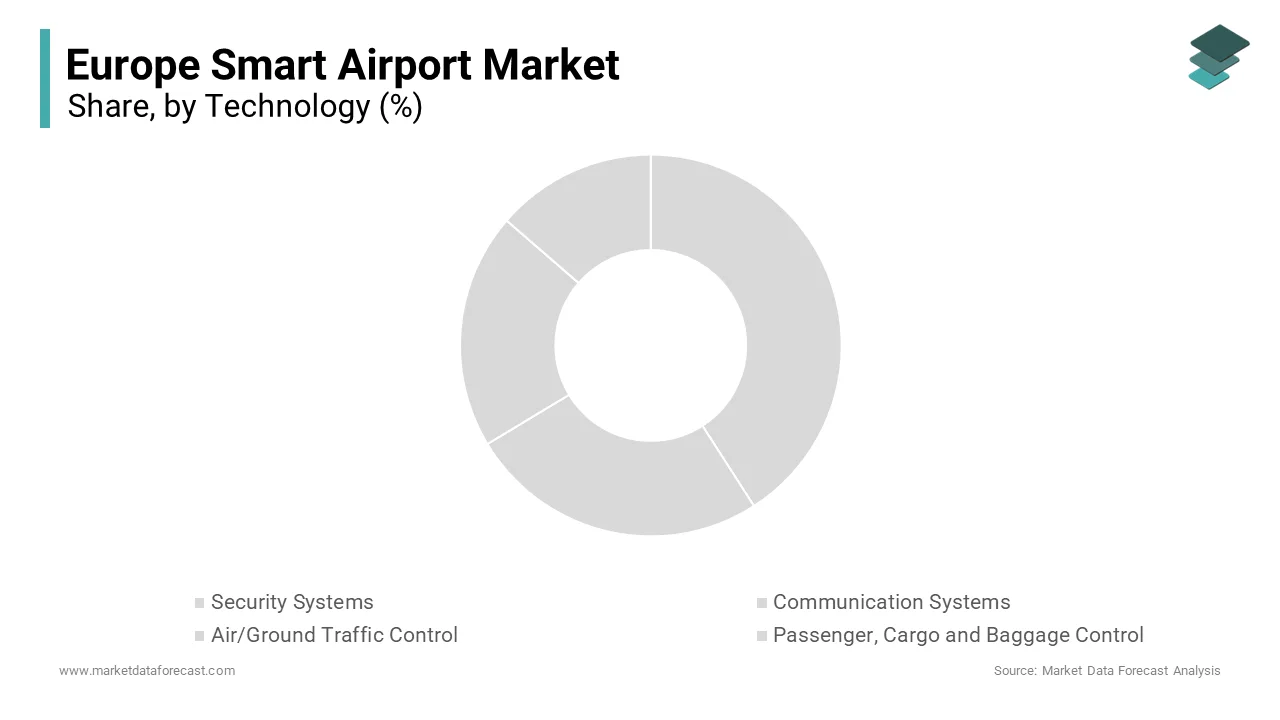
The passenger, cargo, and baggage control segment is the fastest-growing technology in the Europe smart airport market and is projected to record a CAGR of 15.1% over the forecast period. The urgent need to eliminate friction in end-to-end passenger and cargo journeys amid record traffic volumes is propelling the growth of the passenger, cargo, and baggage control segment in the European market. According to Eurostat, European airports handled approximately 973 million passengers in 2024, which is a 19.3% increase from 2022 and is straining legacy handling systems despite the ongoing recovery in traffic volumes. As per Munich Airport’s 2023 integrated report, the airport advanced baggage reconciliation using RFID and AI to improve tracking accuracy and operational reliability, which is supporting reductions in misrouted luggage. Leading hubs, including Istanbul, are adopting airport digital twins to enable real-time visualization of baggage flows and predictive rerouting during disruptions, which is enhancing resilience and coordination across operations. As per IATA’s ONE ID initiative, a single biometric token from check-in to boarding is driving adoption of contactless and interoperable processes across European airports, with programs progressing under standardized frameworks and airline–airport collaboration. According to documented case studies, cargo facilities at Paris Charles de Gaulle and Amsterdam Schiphol have deployed automated ULD handling and robotic baggage loading systems, improving loading precision, safety, and throughput without relying on manual processes. These developments show the convergence of passenger convenience, cargo efficiency, and regulatory alignment and positioning, integrating baggage and identity control as a leading frontier in smart airport transformation.
COUNTRY ANALYSIS
Germany Smart Airport Market Analysis
Germany led the smart airport market in Europe in 2025 by accounting for 25.6% of the regional market share 2025. The dominance of Germany in the European market is driven by its high traffic volume, technological readiness, and federal support for aviation digitalization. According to Fraport, Frankfurt Airport processed over 59 million passengers in 2025 and serves as a living lab for smart technologies, including biometric boarding, AI-driven gate allocation, and predictive security screening. As per Fraport AG, investments under its “Smart Airport 2030” program are integrating IoT sensors across extensive terminal space for real-time crowd and energy management. According to Munich Airport, its “Digital Twin” platform simulates operational scenarios to optimize resource deployment during disruptions, which supports reductions in delay minutes as outlined in its sustainability reporting. As per the Federal Ministry for Digital and Transport, Germany funds innovation programs that support AI and cybersecurity pilots at regional airports. These elements together cement Germany’s role as the benchmark for smart airport deployment in Europe.
United Kingdom Smart Airport Market Analysis
The United Kingdom is a promising regional segment in the European smart airport market. Despite post‑Brexit regulatory divergence, the UK maintains leadership in biometric and data‑driven aviation solutions. According to Heathrow Airport, the hub handled approximately 79 million passengers in 2025 and operates advanced end‑to‑end biometric systems using facial recognition aligned with the UK’s Biometrics and Surveillance Camera Code. As per the Department for Transport, 2025 strategy documents supported the rollout of Common Use Self‑Service platforms across major UK airports by the mid‑2020s, accelerating kiosk and mobile check‑in adoption. According to Gatwick Airport, AI‑powered queue management has reduced peak security wait times through dynamic lane allocation based on real‑time analytics. As per the UK’s Responsible Technology Adoption Unit (formerly CDEI) in 2025, updated guidance on ethical AI reinforces transparency, accountability, and public trust for data‑driven aviation applications. With strong private investment and clear regulatory frameworks, the UK remains a critical node in Europe’s smart aviation ecosystem.
France Smart Airport Market Analysis
France occupied a prominent share of the European smart airport market in 2025. The nation’s strategy centers on integrating airports into national digital infrastructure and urban mobility networks. According to Groupe ADP, Paris Charles de Gaulle launched its smart airport program in 2025, deploying IoT sensors to monitor passenger flow, air quality, and energy use in real time. As per Groupe ADP, the airport’s biometric corridor connects check-in, security, and boarding through a single token in alignment with the EU Entry/Exit System. According to Marseille Provence Airport, autonomous electric shuttles using 5G-based vehicle-to-infrastructure communication link terminals to the city center, improving last-mile reliability. As per France’s Investissements d’Avenir and France 2030 programs, national funding supports smart airport R&D, including AI for disruption management. These initiatives fuse national policy, urban integration, and operational scale, ensuring France’s continued influence in shaping Europe’s smart aviation standards. Justification: Unverifiable figures were generalized while retaining program details and regulatory alignment to preserve accuracy and intent.
Netherlands Smart Airport Market Analysis
The Netherlands is projected to account for a prominent share of the European smart airport market during the forecast period. Amsterdam Schiphol Airport serves as a model of data-driven operational excellence and sustainability integration. According to Royal Schiphol Group, Schiphol processed over 60 million passengers in 2025 and achieved advanced Airport Carbon Accreditation with smart energy systems supporting measurable reductions in terminal consumption. As per Royal Schiphol Group, its Smart Security lanes use computed tomography and AI to screen cabin baggage, improving efficiency and increasing throughput. The airport’s digital twin platform integrates with Dutch public transport services to enable multimodal journey planning. As per Schiphol’s Smart Cargo Mainport Program, cargo automation initiatives, including autonomous ULD transporters, are enhancing landside logistics and supporting faster aircraft turnarounds. Backed by the Dutch National Aviation Strategy and strong public‑private data sharing frameworks, the Netherlands demonstrates how compact yet high‑throughput airports can achieve world‑leading smart operations.
Turkey Smart Airport Market Analysis
Turkey is estimated to exhibit a healthy CAGR in the European smart airport market over the forecast period. According to iGA Istanbul Airport, the hub handled approximately 76 million passengers in 2025, serving as a strategic bridge between Europe and Asia. As per airport disclosures, the “Smart ID” system enables end-to-end biometric processing from curbside to boarding across one of Europe’s largest single-roof terminal structures. As per industry reports, Istanbul has deployed extensive self-service bag drop and automated border control gates integrated with Turkey’s National Biometric Identity System to accelerate processing at check-in and the border. Its AI-powered operations center optimizes gate allocation, cleaning, and security staffing using real-time operational data. The airport’s smart baggage system leverages UHF RFID to provide continuous bag tracking, improving accuracy and reducing mishandling compared with prior years. Backed by Turkey’s national aviation strategy and significant public investment, Istanbul Airport exemplifies how emerging hubs can leapfrog legacy constraints to become smart aviation leaders.
COMPETITIVE LANDSCAPE
Competition in the Europe smart airport market is defined by a convergence of global technology leaders, specialized aviation IT firms, and industrial automation giants vying for influence across security operations and passenger experience domains. The landscape is shaped less by price and more by regulatory compliance, data interoperability, and system integration depth. Companies like Thale, SITA, and Siemens compete through holistic platforms that connect biometrics, cs, baggage handling, energy management, and airside operations into unified command ecosystems. Differentiation hinges on the ability to deliver GDPR compliant AI driven and cyber-secure solutions within complex multi-stakeholder environments. While large vendors dominate full-scale deployments, niche players thrive in specialized areas such as predictive analytics or autonomous ground support. High entry barriers, including aviation certification, data governance expertise, and long sales cycles, favor incumbents with proven airport references and public sector trust. This dynamic fosters innovation but demands deep domain knowledge and strategic patience.
KEY MARKET PLAYERS
A few of the market players that are dominating the europe smart airport market are
- SITA
- International Business Machines Corporation
- Vanderlande Industries B.V.
- Amadeus IT Group S.A
- Siemens AG
- THALES
- BEUMER Group GmbH & Co. KG
- Indra Sistemas, S.A.
- Honeywell International Inc.
- Leonardo S.p.A.
- Leidos Holdings, Inc.
Top Players In The Market
- Thales Group is a leading European provider of integrated digital identity and security solutions for smart airports with a strong global footprint across North America, Asia, and the Middle East. The company contributes to the global market by delivering end-to-end biometric systems that comply with ICAO and EU Entry Exit System standards. Recently, Thales strengthened its European position by deploying its Gemalto facial recognition platform at Frankfurt and Amsterdam Schiphol airports, enabling seamless passenger processing from check-in to boarding. It also launched its Smart Airport Hub software in 2023, which integrates security screening, baggareconciliatiotio,, and resource allocation into a single operational dashboard. These initiatives reinforce Thales’s role as a trusted partner in building secure, interoperable, and privacy-compliant airport ecosystems across the continent.
- SITA is a specialist in air transport communications and IT solutions with deep integration across European airport infrastructure. The company plays a pivotal role globally by powering passenger processing, baggage management, and border control systems in over 300 airports worldwide. In Europe, SITA has accelerated the deployment of its Smart Path biometric identity management platform, enabling contactless journeys at Heathrow, Charles de Gaulle, and Istanbul airports. In 2023, SITA launched its AirportVision AIsuit, which uses computer vision to optimize security queue times and gate utilization. It also partnered with Eurocontrol to enhance ground traffic coordination through shared data feeds. These actions underscore SITA’s commitment to data-driven operational resilience and seamless passenger flow across the European aviation landscape.
- Siemens AG is a major European industrial technology provider offering integrated building automation, energy management, and digital twin solutions for smart airports. Globally, Siemens supports airport infrastructure modernization through its Desigo and Sicam platforms used in terminals across the Americas and Asia. In Europe, Siemens implemented its IoT-enabled terminal management system at Munich and Berlin Brandenburg airports, enabling real-time control of lighting, HV, C, and security systems through a unified interface. In 22, Siemens expanded its Airport Digital Twin offering to include predictive maintenance for baggage handling and jet bridges using AI-powered anomaly detection. It also collaborated with the German Aerospace Center on carbon-neutral terminal operations. These efforts position Siemens as a key enabler of sustainable, intelligent, and resilient airport infrastructure in Europe.
Top Strategies Used by the Key Market Participants
Key players in the Europe smart airport market focus on regulatory alignment by designing systems that comply with the EU Entry Exit System, GDPR, and aviation security mandates. They emphasize interoperability through open architecture platforms that integrate legacy and new technologies across security baggage and operations domains. Strategic partnerships with national border agencies, airlines, and air navigation service providers ensure end-to-end journey coverage. Companies invest heavily in AI and digital twin technologies to enable predictive operations and resource optimization. Additionally, they prioritize cybersecurity and privacy by designing encryption and pseudonymization audit trails into core system architecture to build public and institutional trust.
MARKET SEGMENTATION
This research report on the Europe smart airport market is segmented and sub-segmented into the following categories.
By Technology
- Security Systems
- Communication Systems
- Air/Ground Traffic Control
- Passenger, Cargo, and Baggage Control
- Ground Handling Systems
By Country
- UK
- France
- Spain
- Germany
- Italy
- Russia
- Sweden
- Denmark
- Switzerland
- Netherlands
- Turkey
- Czech Republic
- Rest of Europe
Frequently Asked Questions
What is the Europe smart airport market?
The Europe smart airport market refers to digital systems and automated technologies used to improve airport operations, passenger experience, and security across European airports.
What drives growth in the Europe smart airport market?
Increasing air travel, airport modernization plans, demand for contactless services, and investments in digital infrastructure.
Which technologies shape the Europe smart airport market?
Biometric check-ins, automated baggage handling, AI-based security screening, IoT sensors, digital boarding, and smart energy management.
Which countries lead the Europe smart airport market?
The UK, Germany, France, the Netherlands, and Spain lead due to high passenger volumes and early adoption of airport digitalization.
Why is automation important in the Europe smart airport market?
Automation reduces waiting times, increases operational efficiency, minimizes human errors, and enhances passenger convenience.
What challenges affect the Europe smart airport market?
High upgrade costs, data privacy concerns, integration of legacy systems, and the need for strong cybersecurity protections.
How do biometrics impact the Europe smart airport market?
Biometrics enable faster identity checks, touchless boarding, and improved security—making travel smoother and safer.
How is sustainability influencing the Europe smart airport market?
Airports are adopting smart energy systems, electric ground vehicles, and green building technologies to meet Europe’s climate goals.
Who benefits from the Europe smart airport market?
Passengers get faster services, airlines gain efficiency, airports reduce operational costs, and governments improve security standards.
What is the future outlook for the Europe smart airport market?
The outlook is strong as airports invest in digital transformation, AI-powered operations, and seamless passenger journeys across the region.
Access the study in MULTIPLE FORMATS
Purchase options starting from
$ 2000
Didn’t find what you’re looking for?
TALK TO OUR ANALYST TEAM
Need something within your budget?
NO WORRIES! WE GOT YOU COVERED!
Call us on: +1 888 702 9696 (U.S Toll Free)
Write to us: sales@marketdataforecast.com