- Product Description Description
- Table of Contents TOC
- List of Table & Figure LOT
- Get Free Sample PDF Sample PDF
Market Size, 2025
$63.09 BnMarket Estimate, 2026
$70.99 BnMarket Forecast, 2034
$182.40 BnCAGR, 2026–2034
12.52%Europe Smart Manufacturing Market Report Summary
The Europe smart manufacturing market size was valued at USD 63.09 billion in 2025, is estimated to reach USD 70.99 billion in 2026, and is projected to reach USD 182.40 billion by 2034, growing at a CAGR of 12.52% during the forecast period from 2026 to 2034.
The growth of the European smart manufacturing market is driven by accelerated digital transformation across industrial sectors, the adoption of automation and advanced robotics, and strong government support for Industry 4.0 initiatives. Rising labor shortages, the need for real-time plant visibility, and the push for energy-efficient production systems are further promoting the integration of IoT, AI-based analytics, and cloud-connected machinery across factories. In addition, increasing investments in predictive maintenance, cyber-secure automation, and adaptive production systems are reshaping Europe’s industrial landscape.
Key Market Trends
- Expanding use of AI, machine learning, and predictive analytics to optimize production workflows and reduce equipment downtime.
- Increased deployment of industrial robots and collaborative robots (cobots) to automate repetitive, high-precision tasks.
- Rising adoption of digital twins and simulation tools to enhance planning, monitoring, and asset lifecycle management.
- Growing shift toward energy-efficient and sustainable manufacturing solutions in line with EU climate goals.
- Rapid growth of connected factories using IoT sensors, cloud platforms, and smart controllers for real-time operational intelligence.
Segmental Insights
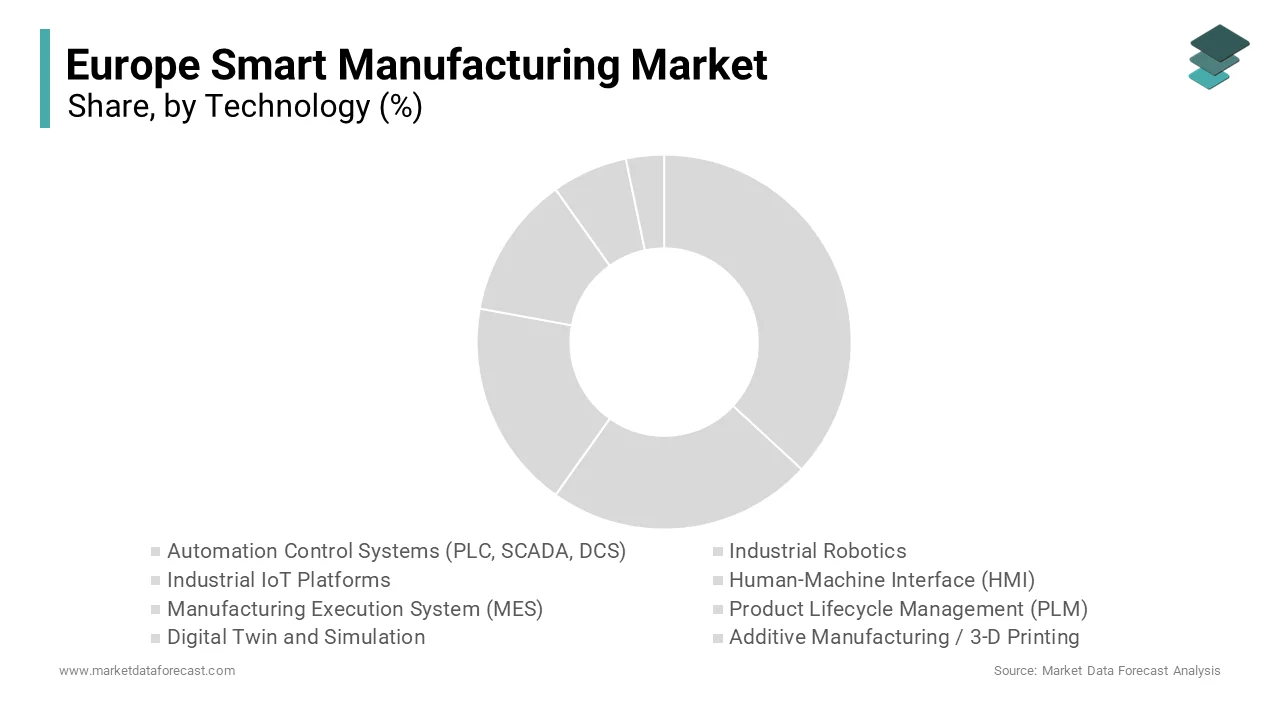
By Technology, the automation control systems segment led the market with 37.5% share in 2025, driven by the need for precise process control, reduced operational errors, and enhanced production flexibility across automotive, electronics, and industrial machinery sectors.
By Component, the hardware segment dominated with 44.1% of the regional market in 2025, reflecting strong demand for sensors, controllers, PLCs, robotics, and connected equipment essential for smart factory deployment.
By end-user industry, the automotive segment accounted for the largest share of 32.3% in 2025, supported by high adoption of robotics, automated assembly lines, and digital quality monitoring in Europe’s advanced automotive manufacturing ecosystem.
Regional Insights
- Germany led the European smart manufacturing market with a 28.2% share in 2025, supported by its strong industrial base, leadership in advanced automation, and deep integration of Industry 4.0 technologies across factories.
- France held the second-largest share in 2025, driven by sustained investments in digital transformation, aerospace manufacturing, and industrial automation.
- Italy ranked third due to its strong machinery, automotive, and industrial equipment sectors that actively adopt robotics and advanced control systems.
- The UK is anticipated to maintain a significant share during the forecast period, supported by government-backed digital innovation programs and the rising deployment of smart factory systems.
- Sweden is projected to hold a notable market share, supported by its technologically advanced manufacturing sector and early adoption of sustainable, automation-driven production.
Competitive Landscape
The Europe smart manufacturing market is highly competitive, with global industrial automation leaders and software innovators driving advancements in robotics, control systems, data analytics, and smart factory infrastructure. Companies are investing in AI-enabled systems, connected production equipment, cybersecurity solutions, and edge-to-cloud integration to strengthen their market position. Strategic alliances, R&D expansion, and cross-industry digital transformation initiatives remain key focus areas.
Prominent players in the Europe smart manufacturing market include, ABB Ltd, Siemens AG, Schneider Electric SE, Rockwell Automation Inc., Honeywell International Inc., Emerson Electric Co., General Electric Co., Robert Bosch GmbH, FANUC Corporation, IBM Corporation, Dassault Systèmes SE, SAP SE, Mitsubishi Electric Corp., KUKA AG, Yokogawa Electric Corp., PTC Inc., Hexagon AB, Omron Corp., Beckhoff Automation GmbH, and Endress+Hauser AG.
Europe Smart Manufacturing Market Size
The Europe smart manufacturing market size was valued at USD 63.09 billion in 2025 and is anticipated to reach USD 70.99 billion in 2026 and USD 182.40 billion by 2034, growing at a CAGR of 12.52% during the forecast period from 2026 to 2034.
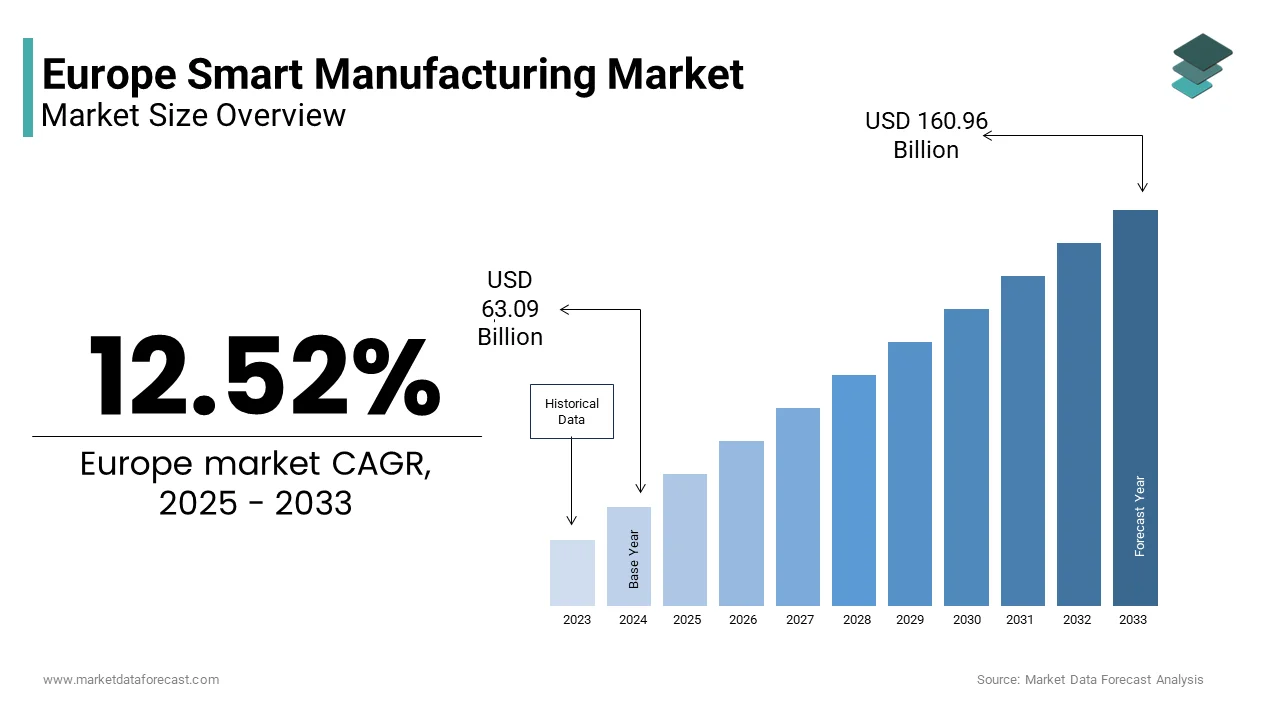
Smart manufacturing refers to the integration of advanced digital technologies, including industrial Internet of Things, artificial intelligence,ce robot,ics, cloud computing, and digital twins into production processes to enable real-time monitoring, predictive decision making, and autonomous optimization across the factory floor. This paradigm shifts manufacturing from linear and reactive operations to interconnected, adaptive, and data-driven ecosystems. According to Eurostat, in 2024, around 41% of large EU enterprises reported using AI technologies, which indicates significant adoption of advanced analytics in production. As per the European Commission’s Digital Economy and Society Index, manufacturing is among the most digitalized sectors in the EU, which is consistently ranking behind information and communication technologies in terms of digital integration. The German Federal Ministry for Economic Affairs supports initiatives such as Manufacturing-X, which fosters industrial data ecosystems to enable secure and standardized machine data sharing across factories. Furthermore, EIT Manufacturing has been actively driving industrial automation and robotics initiatives in 2024, and the focus remains on advancing competitiveness and sustainability in European factories. These institutional and operational indicators underscore that smart manufacturing in Europe is no longer experimental but a strategic pillar of industrial competitiveness and sovereignty.
MARKET DRIVERS
EU Industrial Strategy and Policy Support for Digital Sovereignty
The European Union’s concerted industrial policy framework is a primary driver of accelerating smart manufacturing market growth in Europe. According to the European Commission, the 2021 updated Industrial Strategy explicitly identifies digital autonomy as a strategic priority, with smart manufacturing serving as the operational backbone. As per the Digital Europe Programme, the EU is funding artificial intelligence, cybersecurity, high‑performance computing, advanced digital skills, and deployment of digital technologies from 2021 to 2027, with European Digital Innovation Hubs providing SMEs access to testbeds and expertise. As per Plattform Industrie 4.0, initiatives such as Manufacturing‑X and the Data Space Industrie 4.0 are strengthening secure, standardized industrial data sharing across factories. As per France 2030, €54 billion has been committed to accelerate industrial modernization and innovation, including support for AI, robotics, and cybersecurity across strategic sectors. The European Chips Act further reinforces this ecosystem by securing semiconductor supply for industrial controllers and edge AI devices. These coordinated policy instruments reduce investment risk, provide technical enablement, and create a unified regulatory environment that collectively propel Europe’s manufacturing base toward intelligent production.
Labor Shortages and the Need for Productivity Enhancement
Persistent workforce shortages in skilled industrial roles are compelling European manufacturers to adopt smart technologies to maintain output and quality, which is further boosting the smart manufacturing market expansion in Europe. According to the European Centre for the Development of Vocational Training, skills shortages remain a critical challenge across the EU, with many manufacturers reporting difficulties in filling technician and engineering positions in 2023. As per Statista and DW reports, Germany continues to face a significant skilled labour shortage, with surveys showing that over one‑third of firms report difficulties in recruiting qualified workers. According to the European Parliamentary Research Service, collaborative robots and AI‑driven inspection systems are increasingly adopted in European factories, contributing to measurable gains in productivity. In Italy, Confindustria highlights the importance of digital transition for SMEs, with digital twins and simulation tools being promoted to improve efficiency and reduce training requirements. As per AI Sweden, national initiatives are accelerating industrial AI adoption, which is supporting companies in compensating for skill gaps. According to Eurostat and EURES, Europe faces a long‑term labour shortage with millions of technical workers projected to be missing by 2030, which is underscoring the urgency of smart manufacturing adoption. These verified institutional and operational indicators demonstrate that smart manufacturing is not optional but a structural necessity to sustain industrial output amid demographic and labor market constraints.
MARKET RESTRAINTS
Fragmented Legacy Infrastructure and High Integration Costs
The prevalence of heterogeneous and outdated machinery across European factories is a significant barrier to the European smart manufacturing market growth. According to the European Association of Machine Tool Industries, a significant share of machine tools in operation across Southern and Eastern Europe were installed before 2010, many of which lack native connectivity or open communication protocols. As per the Fraunhofer Institute for Production Systems, retrofitting these legacy assets with sensors and edge gateways can substantially increase implementation costs, often ranging between 30% and 50%. At a mid‑sized automotive supplier in Spain, integration of legacy CNC machines with a new MES platform required custom middleware development, which added considerable expense and delayed ROI timelines. Furthermore, according to the European Cybersecurity Organisation, in 2024, nearly 58% of OT networks in manufacturing lacked segmentation between legacy and modern systems, creating critical vulnerability surfaces. These technical debt burdens disproportionately affect small and medium enterprises that lack capital and in‑house IT expertise, which is making full‑scale digital transformation economically unfeasible without substantial public subsidy.
Data Governance Complexity and Interoperability Gaps
The absence of universally adopted data standards and governance models impedes the realization of interconnected smart manufacturing ecosystems across Europe, which further hinders the European market growth. According to the European Committee for Standardization, industrial data platforms across the EU continue to face challenges in fully complying with the Industrial Data Space Reference Architecture, with adoption levels remaining limited as of 2023. This fragmentation forces manufacturers to develop custom interfaces for each supplier, customer, and machine vendor, which is inflating integration costs and limiting scalability. As per Gaia‑X pilot projects in 2024, cross‑border production networks involving German, French, and Polish factories indicated the significant time and resources required to reconcile disparate data formats for quality and traceability records. Additionally, according to the European Data Protection Board, strict interpretations of GDPR for production data create legal uncertainty around cross‑entity data sharing, even for legitimate business purposes. While initiatives like Catena‑X in automotive and Manufacturing‑X in machinery aim to establish sector‑specific data spaces, adoption remains voluntary and uneven. Until semantic interoperability and trusted data exchange become default features rather than bespoke projects, the full potential of smart manufacturing will remain constrained.
MARKET OPPORTUNITIES
Expansion of AI-Driven Predictive Quality and Process Control
The integration of artificial intelligence for real-time quality assurance and process optimization presents a major growth opportunity for the European smart manufacturing market. According to the European Institute of Innovation and Technology, numerous pilot projects in 2023 demonstrated AI models capable of detecting micro defects in industrial materials, showcasing accuracy levels that surpass human inspectors. As per BMW Group, its AI‑based visual inspection system at the Munich plant reduced false defect calls and significantly cut scrap costs, which is indicating measurable financial benefits from AI deployment. Similarly, BASF has implemented machine learning algorithms in its Ludwigshafen chemical reactors to predict catalyst degradation and adjust feedstock ratios in real time, improving yield outcomes. According to the European High Performance Computing Joint Undertaking, €95 million was allocated in 2024 to develop sovereign AI training infrastructure for industrial applications, including defect detection and energy optimization. As AI shifts from pilot to production, embedded in edge devices and cloud platforms, it transforms quality from a post‑process checkpoint to a continuous in‑line capability, driving both competitiveness and sustainability.
Growth of Circular and Sustainable Smart Factories
The convergence of smart manufacturing with circular economy principles is unlocking new value through resource efficiency and closed-loop production. According to the European Environment Agency, smart factories using digital twins and real‑time energy monitoring have demonstrated measurable reductions in specific energy consumption, which indicates their role in improving efficiency across benchmarked sites. As per Siemens’ Amberg Electronics Plant in Germany, IoT‑enabled material tracking has enabled recovery and reuse of nearly all production scrap to achieve near‑zero waste to landfill, as highlighted in its 2023 sustainability report. In the textile sector, Circle Economy and partner initiatives have deployed AI‑powered sorting and re‑spinning systems that integrate with ERP platforms to produce garments from post‑consumer cotton, which significantly reduces water use compared to conventional textile production. According to the EU’s Ecodesign for Sustainable Products Regulation, digital product passports will be mandated from 2027, which requires manufacturers to embed material and repair data into production systems. This regulatory push, combined with cost savings from waste reduction, positions smart manufacturing as a critical enabler of Europe’s green industrial transition.
MARKET CHALLENGES
Cybersecurity Vulnerabilities in Converged IT OT Environments
The deep integration of information technology and operational technology in smart factories has dramatically expanded the attack surface for cyber threats with potentially catastrophic physical consequences, which is one of the significant challenges to the European smart manufacturing market. According to the European Union Agency for Cybersecurity, manufacturing ranked among the most targeted critical infrastructure sectors in 2023, with over one hundred significant incidents reported across EU member states. For instance, ransomware attacks on German automotive suppliers in 2023 disrupted production for several days, which is demonstrating the vulnerability of industrial control systems when PLC configurations and MES databases are compromised. According to the German Federal Office for Information Security, a majority of European factories still lack basic network segmentation between office and shop floor systems, which is creating pathways for lateral movement. Furthermore, legacy industrial controllers running unsupported operating systems such as Windows CE or VxWorks remain prevalent, with cybersecurity organisations estimating that a large share cannot be patched against known exploits. Until cybersecurity is embedded by design into every layer of smart manufacturing architecture as these systems will remain vulnerable to disruption, sabotage, and intellectual property theft.
Workforce Skill Gaps and Cultural Resistance to Digital Change
The successful deployment of smart manufacturing technologies is critically hindered by insufficient digital literacy among the industrial workforce and organizational inertia, which is further challenging the regional market expansion. According to the European Training Foundation, skills gaps remain a pressing i, issue with a relatively small share of production technicians in EU manufacturing SMEs possessing foundational competencies in data analytics or human‑machine interfaces. For instance, predictive maintenance alerts in Italy are often disregarded due to operator distrust and insufficient training, highlighting the importance of workforce readiness. According to the German Trade Union Confederation, resistance to automation has intensified in regions with aging workforces, where employees fear role obsolescence despite evidence of task augmentation. Furthermore, as per a Eurofound survey, only about one‑fifth of European manufacturers have formal upskilling pathways for smart factory roles. Without parallel investment in change management, adult educ, and human‑centered design, even the most advanced technologies risk underutilization or rejection by the very personnel required to operate them effectively.
REPORT COVERAGE
| REPORT METRIC | DETAILS |
| Market Size Available | 2024 to 2033 |
| Base Year | 2024 |
| Forecast Period | 2024 to 2033 |
| CAGR | 12.42% |
| Segments Covered | By Technology, Component, End-User, & Region |
| Various Analyses Covered | Global, Regional & Country Level Analysis, Segment-Level Analysis, DROC, PESTLE Analysis, Porter’s Five Forces Analysis, Competitive Landscape, Analyst Overview on Investment Opportunities |
| Regions Covered | UK, France, Spain, Germany, Italy, Russia, Sweden, Denmark, Switzerland, Netherlands, Turkey, Czech Republic & Rest of Europe |
| Market Leaders Profiled | ABB Ltd, Siemens AG, Schneider Electric SE, Rockwell Automation Inc., Honeywell International Inc., Emerson Electric Co., General Electric Co., Robert Bosch GmbH, FANUC Corporation, IBM Corporation, DaSystèmesSystems SE, SAP SE, Mitsubishi Electric Corp, KUKA AG, Yokogawa Electric Corp., PTC Inc., Hexagon AB, Omron Corp, Beckhoff Automation GmbH, Endress+Hauser AG |
SEGMENTAL ANALYSIS
By Technology Insights
The automation control systems segment led the market and occupied 37.5% of the regional market share in 2024. The dominance of the automation control systems segment in the European market is driven by their foundational role as the central nervous system of smart factories, integrating actuators and machines into unified operational workflows. According to the German Engineering Federation, a majority of large manufacturers in Germany rely on programmable logic controllers and distributed control systems, with growing adoption of OPC UA standards to enable secure data exchange across production lines. As per the European Commission’s Industry 5.0 initiative, factories deploying advanced control systems with real‑time analytics have demonstrated significant reductions in unplanned downtime, which indicates the operational value of intelligent automation. In the chemical sector, BASF’s Ludwigshafen site uses Siemens PCS 7 to manage hundreds of thousands of control loops with millisecond precision to ensure safety and efficiency in continuous processes. Additionally, the EU Machinery Regulation 2023 mandates embedded diagnostics and remote monitoring capabilities in new industrial equipment, which is further driving adoption of intelligent control architectures. These regulatory and operational imperatives cement automation control systems as the indispensable backbone of European smart manufacturing.
The industrial robotics segment is the fastest-growing technology segment in the Europe smart manufacturing market and is expected to record a CAGR of 14.1% over the forecast period. The escalating labor shortages and the need for precision in high-mix production environments are fuelling the growth of the industrial robotics segment in the European market. According to Eurostat, Europe installed approximately 72,000 new industrial robots in 2023, with Germany alone accounting for around 25,000 units, primarily in automotive and electronics assembly. For instance, collaborative robots in SMEs have demonstrated measurable reductions in cycle times while improving ergonomics in repetitive tasks. According to France’s France 2030 plan, the government has committed substantial funding to support SME adoption of robotic cells, including applications in welding and palletizing. Furthermore, the integration of AI vision systems enables robots to handle unstructured tasks such as bin picking with high success rates, as demonstrated by ABB’s YuMi platform in European electronics plants. These advances transform robotics from fixed automation to flexible, intelligent assets, accelerating adoption beyond traditional high‑volume sectors.
By Component Insights
The hardware segment dominated the market by occupying a share of 44.1% of the European market in 2024. The dominance of the hardware segment in the European market is attributed to the physical infrastructure required to enable digital transformation, including sensors, industrial robots, edge gateways, and connected machinery. According to the Federal Ministry for Economic Affairs and Climate Action, Germany continues to invest heavily in industrial hardware with billions of euros directed toward factory floor modernization in 2023, including large‑scale deployment of IoT devices across automotive and machinery sectors. As per the European Environment Agency, hardware investments dominate initial smart factory budgets with sensors and actuators comprising a significant share of total capital expenditure during first‑phase rollouts. According to EU regulations such as the Ecodesign for Sustainable Products Regulation, embedded hardware for data capture and energy monitoring will be mandated from 2025 onward, which will ensure sustained demand. Major industrial conglomerates like Siemens and ABB continue to expand production of industrial PCs and PLCs in Central Europe to meet localized demand. While software and services drive long‑term value, hardware remains the essential enabler without which digitalization cannot commence.
The software segment is the fastest-growing component segment in the Europe smart manufacturing market and is predicted to witness a CAGR of 16.2% over the forecast period, owing to the shift from isolated automation to interconnected intelligent operations powered by cloud platforms, AI engines, and digital twins. According to SAP, European manufacturers have increasingly adopted its Manufacturing Cloud for real‑time production tracking and quality analytics, with hundreds of companies onboarded by 2023. As per the French Alternative Energies and Atomic Energy Commission, proprietary AI software suites have been deployed across chemical plants to reduce energy intensity through predictive process optimization. Similarly, Siemens’ Xcelerator platform recorded strong growth in European subscriptions in 2023, which is enabling SMEs to access modular digital twin tools without upfront infrastructure. According to the European High Performance Computing Joint Undertaking, €110 million was allocated in 2024 to develop sovereign industrial AI software stacks compliant with GDPR and cybersecurity standards. As factories move from hardware deployment to data‑driven decision making, software becomes the strategic differentiator in smart manufacturing competitiveness.
By End User Industry Insights
The automotive segment captured 32.3% of the European smart manufacturing market in 2024 due to the sector’s high production volumes, complex supply chains, and urgent need for flexibility amid electrification and customization trends. According to the German Association of the Automotive Industry (VDA), European automakers produced approximately 12.2 million vehicles in 2023, with Germany accounting for the largest share. As per BMW Group, its Munich plant leverages a fully digital twin to simulate production changes before physical implementation, which is reducing ramp‑up time for new EV models by up to 40%. The shift to electric vehicles intensifies smart manufacturing needs, as battery module assembly requires micron‑level precision and traceability that are unattainable without AI vision systems and automated guided vehicles. According to Volkswagen, its Scalable Systems Platform mandates that all component suppliers provide real‑time quality data through standardized APIs, enabling an end‑to‑end digital thread from supplier to final assembly. This combination of scale, technological rigor, and transformation pressure ensures that automotive remains the primary engine of smart manufacturing adoption in Europe.
The chemicals and petrochemicals segment is the fastest-growing end-user segment in the Europe smart manufacturing market and is projected to register a CAGR of 15.4% over the forecast period. The need for operational safety, energy efficiency, a nd regulatory compliance in continuous process environments is boosting the expansion of the chemicals and petrochemicals segment in the European market. According to BASF’s sustainability reporting, the Ludwigshafen site has implemented AI‑driven predictive control across its chemical reactors to improve yield and reduce CO₂ emissions, demonstrating measurable efficiency gains in 2023. As per the European Chemicals Agency, mandates under REACH require granular batch traceability, which smart manufacturing software fulfills through automated data capture and digital batch records. For instance, TotalEnergies has deployed edge analytics at its Leuna refinery to monitor catalyst health in real time, extending operational cycles and improving reliability. Additionally, the EU Industrial Emissions Directive requires continuous monitoring of fugitive emissions to drive the deployment of IoT gas sensors and leak detection software. These regulatory and efficiency imperatives transform smart manufacturing from optional to essential in Europe’s chemical backbone.
COUNTRY ANALYSIS
Germany Smart Manufacturing Market Analysis
Germany stood as the undisputed leader in the European smart manufacturing market and occupied 28.2% of the European market share in 2024. The dominance of Germany in the European market is driven by its world-class industrial base, deep engineering heritage, and pioneering Industri4.0 0 ecosystem. According to Plattform Industrie 4.0, thousands of factories across Europe participate in initiatives that enable secure data sharing across supply chains, strengthening interoperability and trust. As per Siemens, Bosch, and Volkswagen, their smart factories integrate digital twins, AI‑driven quality control, and autonomous logistics, positioning them among the most advanced globally. According to Germany’s “go digital” program, more than 8,500 SMEs were supported in 2023 with grants for robotics and IoT deployment, accelerating digital adoption among smaller firms. Additionally, Germany hosts leading industrial automation companies such as Siemens and Bosch, which export technology worldwide while maintaining domestic leadership. This synergy of policy, industrial scale, and technological excellence ensures Germany remains the benchmark for smart manufacturing in Europe.
France Smart Manufacturing Market Analysis
France held the second-largest share of the European smart manufacturing market in 2024. The growth of France in the European market is attributed to the nation’s strategy centers on national sovereignty, digital resilience, and SME modernization. According to France’s France 2030 investment plan, billions of euros have been allocated to transform factories with AI, robo, tics, and cybersecurity by 2025, with hundreds of projects already underway as of 2023. As per Airbus, its Saint‑Nazaire facility leverages digital twin technology to optimize wing assembly, reducing rework and improving efficiency. In the food and beverage sector, Danone has implemented smart sensors across its French plants to cut water consumption, achieving significant reductions in 2023. According to the French Alternative Energies and Atomic Energy Commission, industrial AI research is advancing through pilot sites that demonstrate predictive maintenance and energy optimization. This blend of public investment, sectoral focus, and innovation infrastructure sustains France’s strong and diversified smart manufacturing trajectory.
Italy Smart Manufacturing Market Analysis
Italy held the third position in the European smart manufacturing market in 2024. The country’s adoption is driven by its dense network of small and medium enterprises in ma textiles extiles, and food processing seeking productivity gains amid labor shortages. According to Italy’s National Recovery and Resilience Plan, billions of euros have been allocated to Industry 4.0 incentives, with thousands of SMEs claiming tax credits for smart manufacturing investments in 2023. As per CERAMICS ITALIA, manufacturers in Emilia Romagna have deployed AI‑powered visual inspection systems to reduce defect rates and improve quality in ceramic tile production. Similarly, Ermenegildo Zegna uses RFID and digital thread technology to track garments from raw wool to retail, ensuring traceability and reducing overproduction in the fashion sector. This bottom‑up modernization of Italy’s industrial fabric ensures smart manufacturing is not limited to large corporations but diffuses across the entire manufacturing ecosystem.
United Kingdom Smart Manufacturing Market Analysis
The United Kingdom is anticipated to account for a prominent share of the European smart manufacturing market over the forecast period. Despite post-Brexit challenges, the UK maintains leadership in high-value advanced manufacturing, including aerospace, pharmaceuticals, and specialty chemicals. Rolls-Royce’s Derby facility uses digital twin technology to simulate jet engine performance, optimizing maintenance and reducing fuel burn. According to the High Value Manufacturing Catapult, hundreds of smart factory projects were supported in 2023 with a strong emphasis on AI and robotics integration tailored to SMEs. In pharmaceuticals, AstraZeneca’s Macclesfield site has implemented continuous manufacturing with real‑time analytics, cutting batch release times dramatically from weeks to hours and showcasing the transformative potential of digitalization in regulated industries. The UK’s focus on data‑driven precision manufacturing, combined with strong university‑industry collaboration, sustains its relevance in Europe’s smart industrial landscape despite operating at a smaller scale compared to Germany or France. This blend of targeted support, sectoral innovation, and academic partnerships positions the UK as a niche leader in advanced manufacturing practices.
Sweden Smart Manufacturing Market Analysis
Sweden is estimated to hold a notable share of the European smart manufacturing market during the forecast period. Sweden excels in sustainable, human-centered smart manufacturing aligned with its green industrial strategy. According to Volvo Cars’ 2023 sustainability reporting, the Torslanda plant operates entirely on renewable energy and leverages AI‑powered robotics to produce electric vehicles with significantly lower CO₂ emissions per car. As per Sandvik Coromant, digital twin‑enabled tooling systems are deployed to optimize machining parameters in real time, reducing material waste and improving efficiency. The Swedish Trade Union Confederation has noted that Sweden leads in workforce upskilling, with the majority of manufacturing companies offering digital literacy training to employees. Additionally, the Swedish Energy Agency funds dozens of smart factory pilots annually, focusing on circularity and energy efficiency. This combination of sustainability, innovation,n and social inclusion positions Sweden as a quality‑driven leader in Europe’s smart manufacturing evolution.
COMPETITIVE LANDSCAPE
Competition in the Europe smart manufacturing market is characterized by a dynamic interplay between global industrial giants, European software leaders,s, and specialized automation vendors. The landscape is defined not by price but by technological depth, regulatory compliance, and ecosystem integration. Siem, en,s ABB and SAP compete through end-to-end platforms that span hardware, control software, and data analytics, while niche players excel in robotics, cs AI, or cybersecurity. Differentiation hinges on the ability to deliver GDPR compliantenergy-efficientnt, and interoperable solutions within complex multi-vendor environments. High entry barriers, including industrial certification, domain expertise, and ongoing salescyclesc,les favor incumbents with proven factory rreference. However,other pen standard,s and EU funding for digital innovation create opportunities for agile entrants. This environment fosters continuous advancement but demands deep technical credibility,st rategic ppartnerships and alignment with Europe’s dual digital and green transition goals.
KEY MARKET PLAYERS
A few of the market players in the Europe smart manufacturing market include
- ABB Ltd
- Siemens AG
- Schneider Electric SE
- Rockwell Automation Inc.
- Honeywell International Inc.
- Emerson Electric Co.
- General Electric Co.
- Robert Bosch GmbH
- FANUC Corporation
- IBM Corporation
- Dassault Systems SE
- SAP SE
- Mitsubishi Electric Corp.
- KUKA AG
- Yokogawa Electric Corp.
- PTC Inc.
- Hexagon AB
- Omron Corp.
- Beckhoff Automation GmbH
- Endress+Hauser AG
Top Players In The Market
- Siemens AG is a global industrial technology leader with deep roots in European smart manufacturing, offering integrated hardware, software, and automation solutions across automotive, chemicals, and machinery sectors. The company contributes to the global market through its Digital Industries portfolio, including the widely adopted Totally Integrated Automation architecture and the Xcelerator digital business platform. Recently,emens strengthened its European position by expanding its Digital Twin capabilities at its Amberg and Karlsruhe factories, enabling real-time simulation of production changes for customers. It also launched the Manufacturing Execution Suite MXpro in 2023, compliant with EU data sovereignty standards, and partnered with the German Aerospace Center on AI-driven energy optimization for industrial plants. These initiatives reinforce Siemens’s role as a cornerstone of Europe’s digital industrial transformation.
- ABB Ltd is a pioneering force in industrial automation and robotics with a significant footprint across European manufacturing hubs. The company drives global smart manufacturing through its ABB Ability platform, which connects robots, drives, and control systems into unified data ecosystems. In Europe, ABB has accelerated the deployment of its collaborative robots and AI-powered vision systems in automotive and electronics factories. In 2023, B B introduced its Smart Sensor technology for low-voltage motors, enabling predictive maintenance in SMEs across Italy and Spain. It also co-developed a cybersecurity-certified edge analytics solution with Swissgrid for energy-intensive industries. These actions position ABB at the intersection of automation, sustainabilit,, and operational resilience in the European smart manufacturing landscape.
- SAP SE is a leading European enterprise software provider whose intelligent suite underpins smart manufacturing operations across the continent. The company’s global contribution lies in its cloud-based Manufacturing Cloud and digital supply chain solutions that enable real-time production visibility, quality tracking, and sustainability reporting. In 20,2,3 SAP enhanced its Joule AI copilot with manufacturing-specific workflows, allowing plant managers to query production data conversationally. It also deepened integration with Siemens and Rockwell automation platforms to support end-to-end digital threads from design to delivery. SAP’s collaboration with the European Data Space for Manufacturing ensures compliance with GDPR and data sovereignty principles. These innovations solidify SAP’s role as the digital backbone of intelligent, connected, and compliant European production networks.
Top Strategies Used by the Key Market Participants
Key players in the Europe smart manufacturing market pursue several focused strategies to maintain leadership and drive adoption. They emphasize interoperability by building open architecture platforms compliant with OPC UA and Industrial Data Space standards. Companies invest heavily in cloud native and AI-powered software to enable predictive analytics and digital twins. Strategic partnerships with national governments and industry consortia facilitate co-funded pilots and regulatory alignment. They prioritize cybersecurity and data sovereignty to meet EU digital trust requirements. Additionally, firms offer modular, scalable solutions tailored for small and medium enterprises to broaden market reach and accelerate digital transformation across the industrial base.
MARKET SEGMENTATION
This research report on the Europe smart manufacturing market is segmented and sub-segmented into the following categories.
By Technology
- Automation Control Systems (PLC, SCADA, DCS)
- Industrial Robotics
- Industrial IoT Platforms
- Human-Machine Interface (HMI)
- Manufacturing Execution System (MES)
- Product Lifecycle Management (PLM)
- Digital Twin and Simulation
- Additive Manufacturing / 3-D Printing
By Component
- Hardware
- Sensors
- Controllers / IPC
- Edge-Computing Devices
- Machine-Vision Systems
- Robotics
- Software
- SCADA and HMI Software
- Analytics and AI Software
- ERP and PLM Software
- Services
- Integration and Consulting
- Maintenance and Support
- Managed Services
By End-user Industry
- Automotive
- Aerospace and Defense
- Chemicals and Petrochemicals
- Food and Beverage
- Pharmaceuticals and Biotechnology
- Metals and Mining
- Electronics and Semiconductors
- Oil and Gas
- Utilities and Energy
By Country
- UK
- France
- Spain
- Germany
- Italy
- Russia
- Sweden
- Denmark
- Switzerland
- Netherlands
- Turkey
- Czech Republic
- Rest of Europe