- Product Description Description
- Table of Contents TOC
- List of Table & Figure LOT
- Get Free Sample PDF Sample PDF
Market Size, 2025
$24.35 BnMarket Estimate, 2026
$25.68 BnMarket Forecast, 2034
$39.32 BnCAGR, 2026–2034
5.47%Europe Sneakers Market Report Summary
The European sneakers market was valued at USD 24.35 billion in 2025 and is projected to reach USD 25.68 billion in 2026 and USD 39.32 billion by 2034, growing at a CAGR of 5.47% during the forecast period. The growth of the European sneakers market is driven by rising consumer interest in fashion-forward and athleisure footwear, increased health and fitness awareness, and the growing influence of streetwear culture. Additionally, the expanding popularity of sustainable and eco-friendly sneakers made from recycled materials and the rise of online retail channels are key trends contributing to the market’s expansion.
Key Market Trends
- Rising demand for athleisure and lifestyle sneakers blending comfort, performance, and fashion.
- Increased focus on sustainable manufacturing using recycled textiles and bio-based materials.
- Expansion of celebrity collaborations and limited-edition releases driving consumer excitement and brand loyalty.
- Growth of D2C (Direct-to-Consumer) online channels enhancing brand accessibility and personalization.
- Adoption of digital customization technologies enabling consumers to design personalized sneakers.
Segmental Insights
- Based on product type, the low-top sneakers segment dominated the European sneakers market in 2025, holding a dominant share. The segment’s popularity stems from its versatility, comfort, and adoption as both casual and performance footwear across diverse age groups. Its prevalence in streetwear and everyday fashion has further accelerated its demand in Europe’s urban markets.
- Based on category, the branded sneakers segment captured the largest share of the European sneakers market in 2025. This dominance is attributed to the strong brand equity of global players, continuous product innovation, and high consumer preference for premium, design-oriented footwear with superior comfort and technology integration.
- Based on price point, the economic sneakers segment held a dominant share of the European sneakers market in 2025. The segment benefits from the wide availability of affordable yet stylish sneakers, catering to budget-conscious consumers and increasing distribution through online and retail outlets across Europe.
Regional Insights
The Europe sneakers market is experiencing robust growth across major economies, fueled by urban lifestyle shifts, increased fitness participation, and evolving fashion preferences.
- Germany was the top performer in the Europe sneakers market, accounting for 22.3% of the share in 2025, driven by a strong sportswear culture, the presence of leading brands like Adidas and Puma, and a growing preference for sustainable sneaker collections.
- The United Kingdom and France continue to showcase significant demand due to fashion innovation, streetwear trends, and a thriving e-commerce footwear ecosystem.
- Italy and Spain are witnessing steady growth, fueled by rising consumer inclination toward comfort-oriented footwear and designer sneaker collaborations.
- The Nordic countries are emerging markets emphasizing sustainability, favoring eco-conscious and ethically produced sneakers.
Competitive Landscape
The European sneakers market is highly competitive, with both international and domestic players focusing on expanding their product portfolios through innovation, digitalization, and sustainability. Companies are increasingly adopting eco-friendly materials, AI-driven design tools, and omnichannel retail strategies to meet dynamic consumer preferences. Collaborations with influencers, fashion designers, and athletes remain key marketing strategies in the region. Notable players in the European sneakers market include Relaxo Footwears, New Balance, ASICS Corp, Puma SE, Adidas AG, Skechers USA Inc, Nike Inc, Kering SA, VF Corp, and Under Armour Inc.
Europe Sneakers Market Size
The Europe sneaker market size was valued at USD 24.35 billion in 2025 and is projected to reach USD 39.32 billion by 2034 from USD 25.68 billion in 2026, growing at a CAGR of 5.47%.
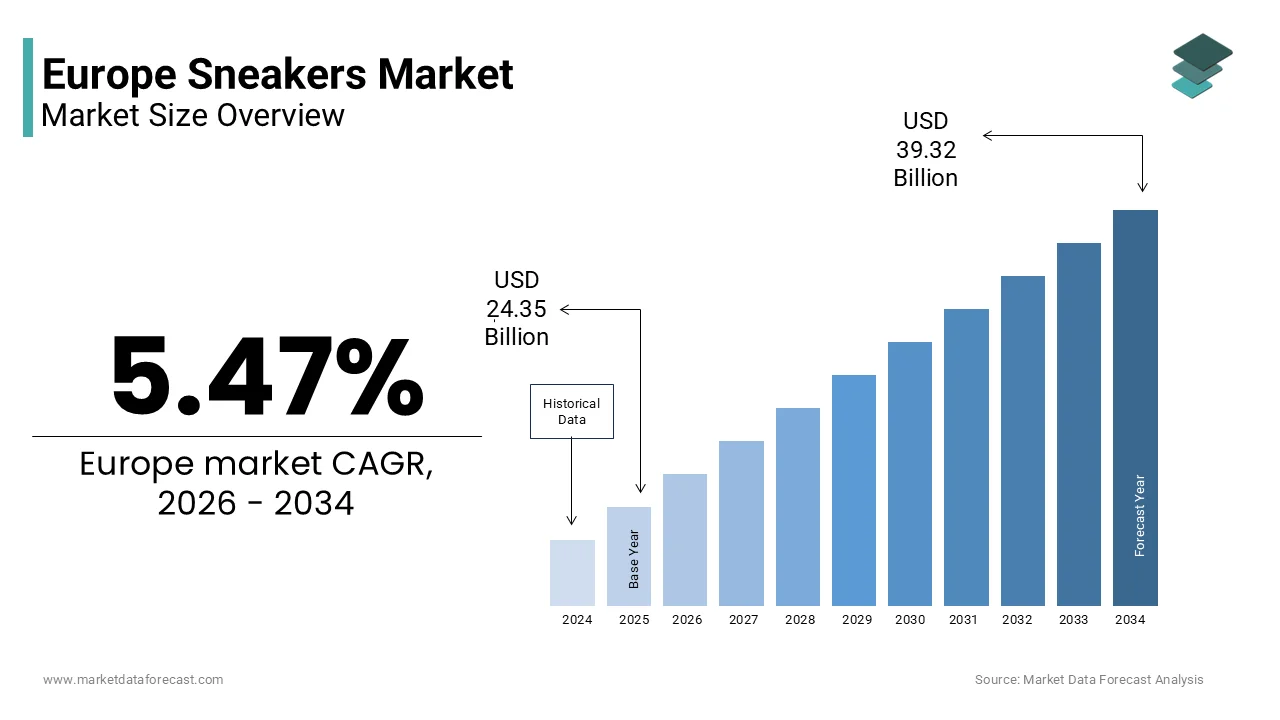
Sneakers are athletic and lifestyle footwear characterized by cushioned soles, synthetic or natural uppers and design elements rooted in sport performance or street culture. Unlike conventional footwear, this segment blurs the boundaries between utility, fashion and identity expression with products often released in limited editions or collaborations that drive collectability. Europe serves as both a key consumption hub and a creative epicentre where heritage sportswear brands intersect with avant garde fashion houses. According to Eurostat, Europeans aged 15 to 34 owned sneakers in 2023, which is reflecting deep cultural embedding beyond athletic use. Urbanization further amplifies demand, as per the European Environment Agency, the EU population resides in cities where casual dress codes and active mobility favor versatile footwear. National policies also play a role, with countries like France and Germany integrating physical education into daily school curricula, thereby normalizing sportswear from an early age. This market is thus shaped less by pure functionality and more by social signaling, sustainability consciousness, and the fusion of performance with aesthetic innovation.
MARKET DRIVERS
Cultural Integration of Sneakers into Everyday Fashion Drives Demand
Sneakers have transcended athletic origins to become a staple of European daily attire across genders, ages, and social contexts, which is a major factor propelling the European sneakers market growth. This normalization is evident in workplace dress codes, educational settings, and high fashion runways where luxury brands routinely feature trainer-inspired silhouettes. According to the European Apparel and Textile Confederation, office workers in Western Europe now wear sneakers under relaxed corporate policies. In Milan and Paris fashion weeks, runway looks incorporated elevated sneakers from brands like Balenciaga and Prada, which is signalling institutional endorsement. As per YouGov, Europeans aged 18 to 25 consider sneakers a core element of personal style rather than sportswear. Retailers have responded by dedicating entire store sections to “fashion sneakers” distinct from performance lines. This cultural assimilation ensures consistent baseline demand irrespective of seasonal sports cycles and transforms sneakers into a canvas for self-expression rather than mere foot protection.
Rising Participation in Urban Fitness and Recreational Sports Fuels Functional Demand
Increased engagement in running, cycling, and gym-based activities across European cities has amplified demand for performance-oriented sneakers with technical features, which is further boosting the sneakers market expansion in Europe. According to the European Health and Fitness Association, Europeans held gym memberships in 2023 with urban fitness participation growing annually since 2020. National initiatives such as Germany’s “Bewegungswelten” program and France’s “Sport Santé” scheme promote physical activity as preventive healthcare, further embedding sportswear into daily life. Running in particular has surged, with city marathons in Berlin, London, and Valencia attracting participants as per the Association of International Marathons. This active lifestyle shifts drives demand for specialized cushioning, arch support, and breathability features. Brands like ASICS and Saucony have seen growth in Europe by aligning product development with biomechanical research from institutions like the University of Jena.
MARKET RESTRAINTS
Stringent EU Environmental Regulations Increase Production Compliance Costs
The European Union’s expanding regulatory framework on sustainability imposes significant operational and financial burdens on sneaker manufacturers, which is hindering the European sneakers market growth. The Ecodesign for Sustainable Products Regulation, which takes full effect in 2025, mandates detailed disclosures on material composition, recyclability, and carbon footprint for all footwear sold in the bloc. According to the European Commission, sneaker brands operating in Europe will incur compliance costs annually to meet these requirements. Additionally, the EU Strategy for Sustainable and Circular Textiles require all new shoes to be reusable, repairable, and recyclable by 2030, a standard that challenges current multi-material construction methods. As per PwC, footwear firms reported delays in product launches due to sustainability audits and material requalification. Sourcing restrictions on synthetic dyes and virgin polyester further limit design flexibility. These regulations elevate barriers to entry and compress margins, particularly for mid-tier brands lacking scale to absorb transition costs.
Pervasive Counterfeit Trade Erodes Brand Value and Consumer Trust
Counterfeit sneakers represent a persistent threat to brand integrity and consumer safety across Europe, which is also impeding the regional market growth. According to the European Union Intellectual Property Office, fake footwear accounted for counterfeit goods seized at EU borders in 2023. Iconic models from Nike, Adidas, and New Balance are most frequently replicated with increasing sophistication that includes near-identical stitching and box packaging. Europol’s Intellectual Property Crime Threat Assessment identified organized networks in Eastern Europe and Turkey operating industrial-scale replica factories that distribute through social media and unauthorized online marketplaces. As per the Observatory on Counterfeiting, European consumers under 30 have unknowingly purchased counterfeit sneakers believing them authentic. These fakes often use toxic adhesives and non-breathable materials, posing health risks while damaging brand reputation. The erosion of perceived exclusivity also diminishes the emotional premium that drives full-price purchases, particularly in the luxury sneaker segment.
MARKET OPPORTUNITIES
Circular Business Models Unlock New Revenue Through Resale and Rental
The emergence of certified pre-owned and sneaker rental platforms presents a significant opportunity for the European sneakers market. According to ThredUp’s Resale Market Report, the secondhand footwear segment in Europe grew with sneakers accounting for transactions. Brands are responding proactively, Adidas launched its “Certified Pre-Owned” program across Germany, France, and the Netherlands in 2023 offering refurbished sneakers with authenticity verification and warranty. Similarly, Nike’s “Refurbished” initiative expanded to 10 European countries in early 2024. Rental services like SneakQ in Sweden allow consumers to lease limited edition pairs for events, reducing ownership barriers. As per Bain and Company, circular models could represent sneaker revenue in Europe by 2027. These strategies not only reduce environmental impact but also foster deeper brand engagement through continuous interaction beyond the initial sale.
Collaborations with European Designers and Artists Enhance Cultural Relevance
Strategic partnerships between global sneaker brands and local European creatives are generating high-impact product drops that resonate with regional identity and artistic heritage, which is another promising opportunity for the European sneakers market. These collaborations transform sneakers into cultural artifacts rather than mass merchandise. In 2023, Puma teamed up with Parisian artist JR to release a limited-edition collection inspired by urban portraiture which sold out quickly across Europe. Similarly, New Balance’s ongoing partnership with London-based designer Paul Smith blends British tailoring motifs with performance silhouettes, achieving increased brand favorability among UK consumers as per YouGov. The Milan-based brand Diemme regularly collaborates with Alpine artisans to produce hand-stitched hiking-inspired sneakers that celebrate Italian craftsmanship. According to the European Cultural Foundation, such co-creations generate more social media engagement than standard releases. By anchoring products in local narratives, these alliances deepen emotional connection and insulate brands from global homogenization.
MARKET CHALLENGES
Overproduction and Inventory Glut Trigger Margin Erosion
Excess inventory resulting from over forecasting and pandemic-era demand surges continues to pressure profitability across the Europe sneakers market. According to the European Retail Association, unsold footwear stock in European warehouses reached a record high in early 2024 forcing aggressive discounting. Major brands including Nike and Adidas reported declines in full-price sell-through during the first half of 2023 as per their earnings disclosures. This glut stems from misaligned supply chains that failed to adjust to post-lockdown normalization, with consumers shifting spending toward experiences rather than goods. Discount retailers like TK Maxx and SportScheck have capitalized on this surplus, offering branded sneakers at reduced prices which trains consumers to delay purchases. A McKinsey analysis warns that prolonged discounting risks devaluing brand equity, particularly in the premium segment where scarcity and pricing power are critical. Until inventory levels rebalance, the market faces sustained margin compression and promotional fatigue.
Geopolitical Disruptions Amplify Supply Chain Volatility
Ongoing geopolitical tensions and trade policy shifts are introducing significant uncertainty into sneaker sourcing and logistics across Europe, which is further challenging the growth of the European sneakers market. The EU’s Carbon Border Adjustment Mechanism, which began phased implementation in 2023, imposes tariffs on carbon-intensive imports including footwear from non-compliant countries. According to the Federation of European Footwear Associations, sneakers sold in Europe rely on components sourced from Vietnam, Indonesia, and China where decarbonization infrastructure remains limited. Simultaneously, the Red Sea shipping crisis extended average transit times from Asia to Rotterdam in early 2024 as per the European Maritime Safety Agency, increasing air freight dependency and costs. As per Deloitte, European footwear brands are now diversifying production to Morocco, Tunisia, and Portugal though capacity constraints limit nearshoring potential. These macro disruptions complicate inventory planning, inflate landed costs, and challenge just-in-time models that underpin seasonal launches.
REPORT COVERAGE
| REPORT METRIC | DETAILS |
| Market Size Available | 2025 to 2034 |
| Base Year | 2025 |
| Forecast Period | 2026 to 2034 |
| CAGR | 5.47% |
| Segments Covered | By Product Type, Category, Price Point, and Region |
| Various Analyses Covered | Global, Regional, & Country Level Analysis; Segment-Level Analysis; DROC; PESTLE Analysis; Porter’s Five Forces Analysis; Competitive Landscape; Analyst Overview of Investment Opportunities |
| Regions Covered | UK, France, Spain, Germany, Italy, Russia, Sweden, Denmark, Switzerland, Netherlands, Turkey, Czech Republic, Rest of Europe |
| Market Leaders Profiled | Relaxo Footwears, New Balance, ASICS Corp, Puma SE, Adidas AG, Skechers USA Inc, Nike Inc, Kering SA, VF Corp, Under Armour Inc, and others. |
SEGMENTAL ANALYSIS
By Product Type Insights
The low top sneakers segment commanded for the highest share of 60.6%of the regional market share in 2025. The growth of low top sneakers segment in this regional market is driven by their versatility, comfort, and seamless integration into both casual and semi-formal urban lifestyles. A key factor is the prevalence of walking and public transport use across European cities where lightweight, low-profile footwear is preferred for daily mobility. As per the European Environment Agency, urban Europeans walk annually, making comfort a non-negotiable criterion. Additionally, low tops align with minimalist fashion trends that prioritize clean lines and understated aesthetics as seen in Scandinavian and German street style. Retailers like Zalando and H&M report that low top models account for 75% of sneaker sales in their online and physical stores due to broad demographic appeal across genders and age groups. Their compatibility with diverse outfits, from denim to tailored trousers, further cements their status as a wardrobe essential rather than a seasonal accessory.
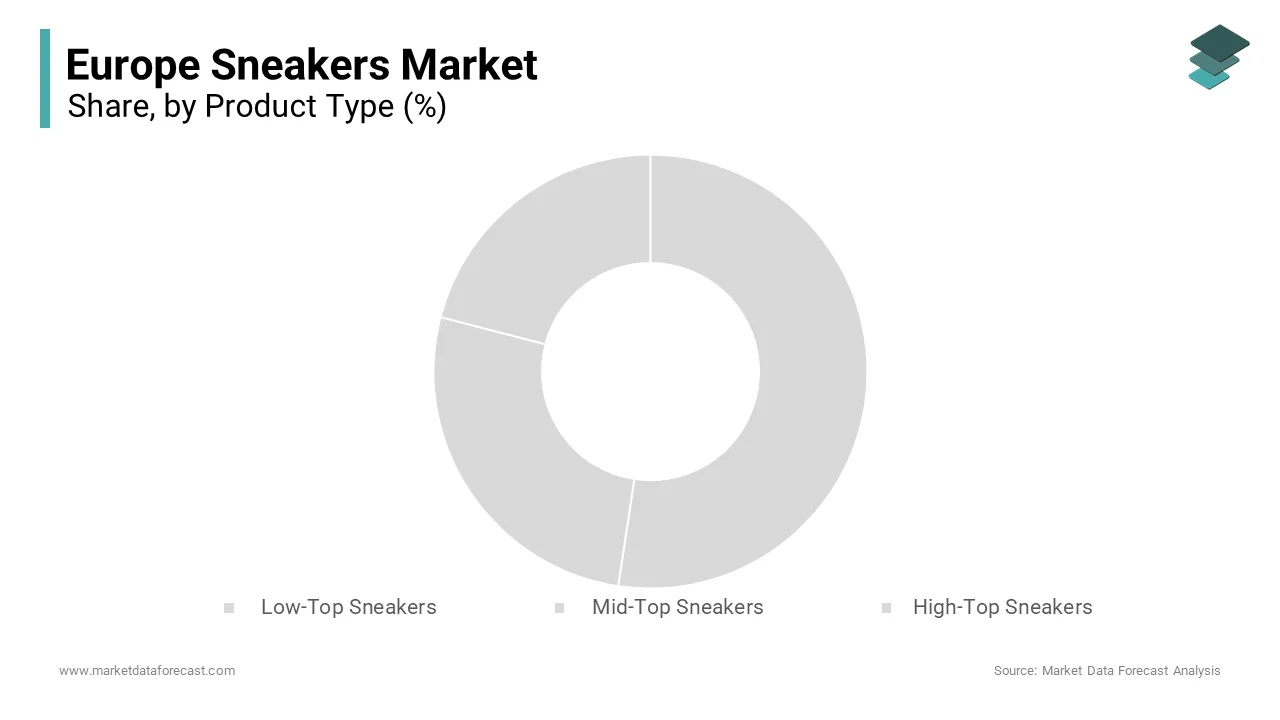
The mid top sneakers segment is estimated to grow at a CAGR of 10.3% over the forecast period owing to their strategic positioning between lifestyle and performance functionality, appealing to consumers seeking both style and ankle support. Urban fitness trends such as street training, parkour, and functional gym workouts have elevated demand for mid top silhouettes that offer stability without bulk. According to the European Health and Fitness Association, participation in hybrid training formats grew in 2023 with cities like Berlin and Stockholm leading adoption. Brands like Puma and Reebok have responded with mid top models featuring responsive cushioning and breathable knit uppers tailored for European gym goers. Furthermore, fashion collaborations such as Adidas’s mid top release with Parisian label A Cold Wall have infused the segment with avant-garde credibility. Social media visibility also plays a role, with Instagram data showing increased mid top sneaker mentions among European influencers aged 20 to 35.
By Category Insights
The branded segment dominated the market by capturing 70.6% of the European market share in 2025. The dominance of branded segment in the European market is attributed to the strong emotional equity, technological innovation, and cultural resonance cultivated over decades. Global sportswear giants like Nike, Adidas, and Puma invest heavily in localized marketing, storytelling, and athlete endorsements that reinforce authenticity. As per Kantar, Nike and Adidas rank among the most trusted apparel brands in Germany, France, and the Netherlands due to perceived quality and performance reliability. Limited edition drops and collaborations with European designers further enhance desirability with resale premiums often exceeding 200% on platforms like StockX. Additionally, branded players lead in sustainability transparency with Nike’s “Move to Zero” and Adidas’s Parley collections setting benchmarks that private labels struggle to match. Consumers associate branded sneakers with durability, innovation, and social status, making them resistant to price-based substitution despite economic headwinds.
The private label segment is estimated to witness the fastest CAGR of 12.5% over the forecast period due to the value-conscious shopping and retailer vertical integration. According to Eurostat, inflation in the EU averaged in 2023 prompting consumers to seek affordable alternatives without sacrificing style. Major retailers like Decathlon, H&M, and C&A have leveraged their supply chain control to launch in-house sneaker lines that mimic premium aesthetics at lower price points. Decathlon’s “Kalenji” and “Newfeel” sub brands alone sold pairs in Europe in 2023 as per the company’s annual sustainability report. These private labels benefit from in-store placement data and real-time trend analytics allowing rapid design iterations aligned with local preferences. As per NielsenIQ, European shoppers aged 18 to 30 now consider private label sneakers “good enough” for daily wear. This shift reflects a broader normalization of value retail in fashion where quality perception gaps are narrowing due to improved manufacturing standards.
By Price Point Insights
The economic segment held the highest share of the European market in 2025. This dominance of the economic segment in this regional market is attributed to their broad accessibility, daily utility, and alignment with pragmatic European consumption patterns. In countries like Spain and Italy where average disposable income for non-essentials remains constrained post-pandemic, economic models fulfill the need for durable, versatile footwear without premium markups. As per Eurostat, European households prioritize “value for money” over brand prestige in footwear purchases. Mass retailers and fast fashion chains dominate this segment, offering trend-aligned designs updated weekly. Additionally, school and workplace requirements for comfortable casual footwear sustain baseline demand across age groups. Brands like Skechers and Geox thrive here by combining orthopedic features with affordable pricing. The segment’s resilience lies in its decoupling from luxury cycles, making it less vulnerable to macroeconomic volatility while serving as an entry point for younger consumers.
The luxury segment is predicted to register a promising CAGR of 15.1% over the forecast period in the European market. The convergence of high fashion and streetwear culture are propelling the luxury segment in the European market. According to Bain and Company’s Luxury Goods Report, Europe accounts for global luxury sneaker sales with demand concentrated among affluent urban consumers aged 25 to 45. Houses like Gucci, Balenciaga, and Louis Vuitton have redefined sneakers as collectible objects through exaggerated silhouettes, artisanal materials, and limited production runs. A key driver is the rise of “quiet luxury” where understated yet expensive models like the Common Projects Achilles Low signal wealth through subtlety. As per Vestiaire Collective, luxury sneaker transactions increased in 2023. Additionally, luxury brands integrate sneakers into full-look styling, reinforcing their role in modern wardrobes. This segment thrives not on volume but on emotional premiumization where sneakers function as wearable art and social capital.
REGIONAL ANALYSIS
Germany Sneakers Market Analysis
Germany occupied the leading position in the European sneakers market in 2025 by holding 23.3% of the regional market share. The dominance of Germany in the European market is driven by high urbanization, strong disposable income, and a culture that blends functionality with minimalist design. According to the Federal Statistical Office, Germans aged 15 to 45 own sneakers with daily wear common across professional and casual settings. The country’s robust gym and outdoor activity participation, supported by registered sports clubs, fuels demand for performance-oriented models. Retail infrastructure is highly developed, with Zalando headquartered in Berlin operating the continent’s largest online sneaker platform. German consumers also exhibit strong sustainability awareness, as per GfK, considering eco credentials when purchasing footwear. This combination of scale, pragmatism, and ethical consumption makes Germany the benchmark for both mass and premium segments.
United Kingdom Sneakers Market Analysis
The United Kingdom had the second largest share of the European market in 2025 due to its influential streetwear culture and dynamic secondary market. According to the British Footwear Association, London consistently ranks among the top global cities for sneaker launches and collaborations. The UK’s youth population is highly engaged with sneaker collecting, as per YouGov, Britons aged 18 to 30 own limited-edition pairs. Platforms like Depop and Vinted have normalized pre-owned sneaker trading, with resale volume growing in 2023 as per the UK Circular Fashion Index. Additionally, British fashion education institutions like Central Saint Martins feed a pipeline of designers who reinterpret athletic silhouettes through avant-garde lenses. Despite economic pressures, the UK remains a laboratory for cultural innovation where global brands test new concepts before continental rollout.
France Sneakers Market Analysis
France is estimated to showcase a promising CAGR in the European sneakers market over the forecast period. Paris’s status as a global fashion capital is one of the major factors driving the French market growth. According to the French Ministry of Culture, the integration of sneakers into haute couture began in earnest in the early 2010s and is now institutionalized with every major fashion house featuring trainer-inspired footwear. French consumers prioritize design heritage and brand narrative, as per IFOP, associating luxury sneakers with artistic expression rather than sport. The country’s strong intellectual property enforcement also limits counterfeit penetration, preserving brand integrity. Retail innovation thrives in districts like Le Marais where concept stores blend vintage sportswear with contemporary luxury. Furthermore, national initiatives promoting physical activity in schools ensure early adoption of performance footwear. This duality of high fashion leadership and grassroots athleticism positions France as the aesthetic compass of the European market.
Italy Sneakers Market Analysis
Italy is expected to exhibit a notable CAGR in the European sneakers market during the forecast period owing to its world-renowned footwear craftsmanship to produce premium and luxury sneakers. According to Confindustria Moda, high-end sneakers sold globally are manufactured in Italian industrial districts like Montebelluna and Florence. Domestic brands such as Diadora and Superga blend heritage with modernity, while luxury houses like Prada and Gucci drive global desirability. Italian consumers exhibit strong loyalty to domestic production, as per Eurisko, preferring “Made in Italy” labeling even at higher price points. The country’s artisanal workshops enable small batch customization that appeals to discerning buyers seeking uniqueness. Additionally, Italy’s tourism sector amplifies exposure with millions of visitors purchasing sneakers as fashion souvenirs. This fusion of industrial scale and handcrafted detail ensures Italy’s outsized influence beyond its domestic consumption.
Spain Sneakers Market Analysis
Spain is projected to account for a notable share of the European sneakers market during the forecast period owing to the price sensitivity and growing urban youth engagement. According to Spain’s National Statistics Institute, per capita footwear expenditure remains below the EU average yet sneaker ownership is high due to the dominance of affordable brands like El Corte Inglés’s private label and international value players. Madrid and Barcelona have emerged as streetwear hubs with local designers collaborating with global brands on region-specific drops. The warm climate also favors lightweight low top models year-round. As per the Observatorio del Calzado, Spaniards aged 16 to 29 prioritize comfort and breathability over brand name. Despite economic constraints, Spain’s cultural vibrancy and digital fluency, evident in high social media engagement with sneaker content, position it as a fertile ground for accessible fashion innovation and future premiumization.
COMPETITIVE LANDSCAPE
Competition in the Europe sneakers market is intensely multifaceted involving global giants, regional specialists and fast fashion entrants vying across performance fashion and sustainability dimensions. Nike Adidas and Puma dominate through scale innovation and cultural capital yet face pressure from luxury houses like Balenciaga and Gucci that command premium pricing through exclusivity and design authority. Simultaneously private label offerings from Zalando H&M and Decathlon capture value conscious segments with trend aligned affordability. The market is further fragmented by digital native brands leveraging social media and limited drops to build cult followings. Regulatory pressures around circularity and carbon footprint raise operational complexity favoring players with integrated supply chains. Consumer loyalty is increasingly fluid with purchasing decisions influenced by resale value environmental impact and social signalling rather than brand heritage alone. This dynamic environment demands constant reinvention agility and authentic engagement to sustain relevance.
KEY MARKET PLAYERS
Some of the notable key players in the European sneakers market are
- Relaxo Footwears
- New Balance
- ASICS Corp
- Puma SE
- Adidas AG
- Skechers USA Inc
- Nike Inc
- Kering SA
- VF Corp
- Under Armour Inc
Top Players in the Market
- Nike Inc maintains a commanding presence in the Europe sneakers market through its fusion of performance innovation and cultural storytelling. The company leverages localized marketing campaigns athlete partnerships and digital ecosystems like the Nike App to deepen consumer engagement across diverse European regions. In 2023 Nike expanded its circularity initiatives by launching “Nike Refurbished” in ten European countries offering certified pre owned sneakers with full warranty. It also opened a dedicated sustainability hub in Amsterdam to accelerate the use of recycled materials in regional product lines. These moves reinforce its leadership in both athletic performance and responsible consumption while aligning with EU environmental directives and evolving consumer values.
- Adidas AG stands as a homegrown European powerhouse with deep roots in sport heritage and street culture. Headquartered in Herzogenaurach Germany the company uniquely bridges football legacy with fashion relevance through collaborations with designers like Stella McCartney and brands like Gucci. In early 2024 Adidas scaled its Speedfactory concept by integrating on demand manufacturing in Paris and Milan enabling rapid response to local trends. The company also enhanced its “Primeblue” and “Primegreen” material lines to meet EU textile sustainability standards. By combining German engineering with pan European cultural fluency Adidas sustains strong emotional resonance across both performance and lifestyle segments.
- Puma SE has strategically repositioned itself as a design led sportswear brand with strong appeal among younger European consumers. Through high impact collaborations with artists designers and musicians including Dua Lipa and Balmain Puma has elevated its fashion credibility without compromising athletic roots. In 2023 the company launched its “Forever Better” program across Europe introducing sneakers made with up to ninety percent recycled polyester and bio-based foams. Puma also invested in digital try on technology via its app in partnership with European e commerce platforms to reduce return rates. These initiatives strengthen its niche as an agile innovator that balances style sustainability and accessibility across the continent.
Top Strategies Used by the Key Market Participants
Key players in the Europe sneakers market prioritize localized storytelling circular business models and digital integration to maintain competitive advantage. They invest heavily in regional collaborations with designers, artists and athletes to create culturally resonant products that transcend generic sportswear. Sustainability is embedded through material innovation such as bio-based foams and recycled textiles aligned with EU regulatory expectations. Direct to consumer channels are enhanced with virtual try on AI driven recommendations and exclusive app-based drops to foster loyalty and data capture. Inventory strategies are shifting toward on demand and nearshoring to reduce waste and respond faster to micro trends. Additionally certified pre owned programs and take back schemes are scaling to meet circular economy demands. These strategies collectively reinforce brand relevance trust and long-term consumer engagement in a highly dynamic market.
MARKET SEGMENTATION
This research report on the European sneaker market has been segmented and sub-segmented based on categories.
By Product Type
- Low-Top Sneakers
- Mid-Top Sneakers
- High-Top Sneakers
By Category
- Branded
- Private Label
By Price Point
- Luxury
- Economic
By Country
- UK
- France
- Spain
- Germany
- Italy
- Russia
- Sweden
- Denmark
- Switzerland
- Netherlands
- Turkey
- Czech Republic
- Rest of Europe