- Product Description Description
- Table of Contents TOC
- List of Table & Figure LOT
- Get Free Sample PDF Sample PDF
Europe SOC as a Service Market Size
The europe SOC as a service market size was valued at USD 34.55 billion in 2024 and is anticipated to reach USD 39.99 billion in 2025 from USD 128.86 billion by 2033, growing at a CAGR of 15.75% during the forecast period from 2025 to 2033.
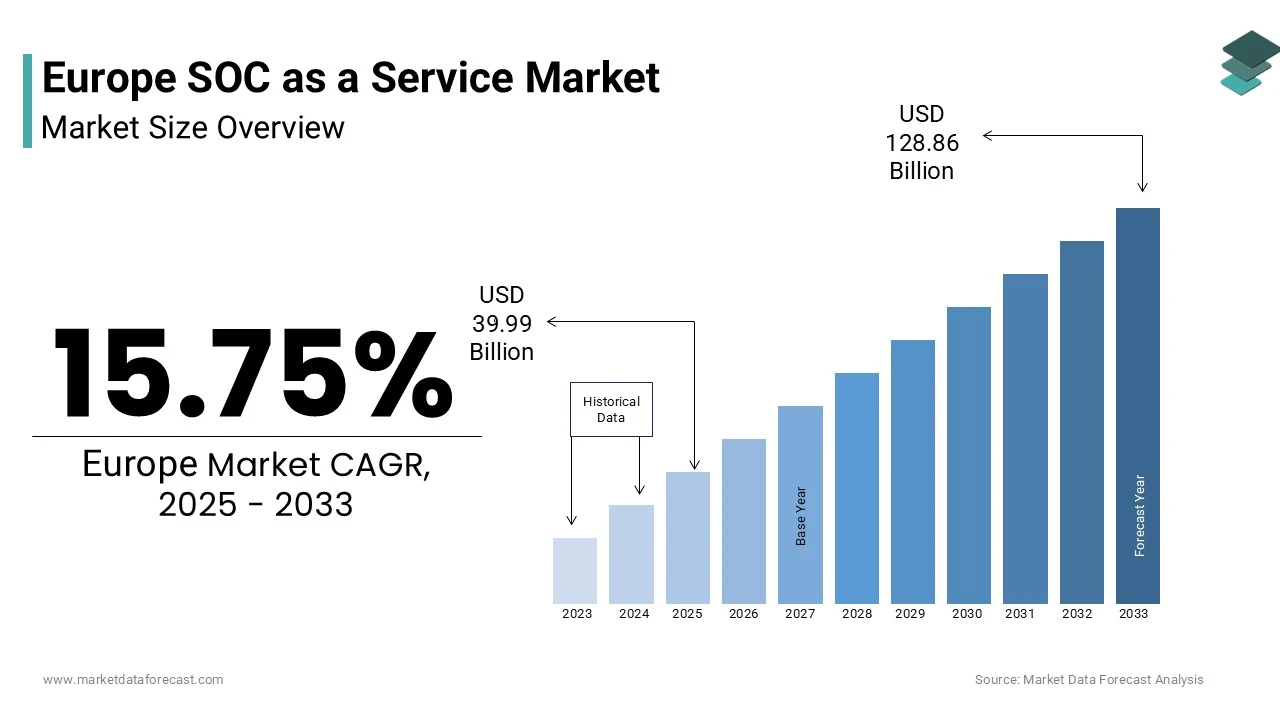
Security Operations Center as a Service (SOCaaS) refers to the delivery of outsourced, cloud-based cybersecurity monitoring, detection, analysis, and response capabilities by specialized providers to organizations across the region. Rather than building and maintaining an in-house SOC, enterprises subscribe to managed services that offer 24/7 threat surveillance, incident triage, endpoint detection and response, and compliance support through a combination of artificial intelligence, human expertise, and integrated security platforms. As of 2025 Europe’s SOCaaS adoption is accelerating in response to a sharp rise in cyber threats, persistent talent shortages, and stringent regulatory mandates. According to the World Economic Forum's Global Cybersecurity Outlook 2025, ransomware remains the top organizational cyber risk, and 54% of large organizations cite third-party risk management as a major challenge. Meanwhile, The European Union faces a significant shortage of cybersecurity professionals, which has been identified by the European Union Agency for Cybersecurity (ENISA) as a key area for improvement in the EU's cyber workforce. The General Data Protection Regulation, NIS2 Directive, and Digital Operational Resilience Act further compel entities to implement continuous monitoring and rapid incident response, capabilities that SOCaaS efficiently delivers. In this context, SOCaaS has evolved from a cost saving alternative to a strategic necessity for digital resilience across Europe.
MARKET DRIVERS
Escalating Cyber Threat Landscape and Ransomware Proliferation
The intensifying frequency and sophistication of cyberattacks in the region is a key accelerator of the Europe SOC as a Service market. According to sources, ransomware attacks remain a prime cybersecurity threat in the EU and are predicted to rise, with average demands in Europe exceeding €200,000 in 2023. The healthcare sector is a frequent target of cyber attacks, and the financial services industry is particularly vulnerable to supply chain risks, which are a growing concern. These threats often exploit delayed detection windows. According to a 2025 Unit 42 report, the median dwell time for ransomware has decreased significantly to just 7 days in 2024, down from 13 days in 2023. SOCaaS providers counter this through continuous monitoring powered by extended detection and response platforms that correlate logs across endpoints cloud workloads and identity systems in real time. SOCaaS delivers the vigilance, velocity, and expertise needed to maintain defensive parity as cyber threats become more agile.
Acute Shortage of Skilled Cybersecurity Talent Across the EU
The region’s chronic deficit of qualified cybersecurity personnel is compelling organizations to outsource security operations to specialized SOCaaS vendors, which fuels the expansion of the Europe SOC as a service market. This talent gap is exacerbated by the rapid evolution of attack techniques requiring expertise in cloud forensics threat hunting and adversary simulation, skills scarce even among experienced IT staff. SOCaaS providers address this by pooling talent across hundreds of clients enabling access to tiered analyst teams threat intelligence units and automation engineers at a fraction of in-house costs. For instance, companies operate European SOCs in Finland Ireland and the Netherlands staffed with multilingual analysts certified in CISSP and GIAC disciplines. SOCaaS democratizes enterprise-grade protection by turning the challenge of hiring cybersecurity talent into a scalable and accessible service.
MARKET RESTRAINTS
Regulatory Complexity and Compliance Burdens Under NIS2 and DORA
The overlapping and technically demanding requirements of new cybersecurity regulations, which complicate service standardization and cross border delivery, hinder the growth of the Europe SOC as a service market. The NIS2 Directive, effective from October 2024, requires numerous entities in critical sectors like energy, transport, health, and digital infrastructure to implement advanced detection and incident reporting systems with stringent deadlines. Simultaneously, the Digital Operational Resilience Act imposes granular obligations on financial entities including continuous vulnerability testing and third party risk monitoring. According to research, financial institutions face challenges in understanding the varied national implementations of the Digital Operational Resilience Act (DORA), especially concerning cloud service provider obligations. SOCaaS vendors must therefore customize architectures for each jurisdiction, a challenge when operating pan European platforms. Compliance expenses for security operations centers (SOC) have risen significantly due to the need for multiple audits and conflicting rules on where data must be stored. Legal fragmentation and operational redundancy will continue to hinder the scalability of SOCaaS until the EU achieves true regulatory harmonization.
Data Sovereignty and Cross Border Data Transfer Restrictions
Persistent legal uncertainty around data residency and cross border data flows is a major restraint for the Europe SOC as a Service market. Under the General Data Protection Regulation personal data processed for security monitoring must remain within the European Economic Area unless adequate safeguards are in place. This complicates SOCaaS delivery for providers with global operations such as Palo Alto Networks and CrowdStrike whose analytics engines historically relied on centralized cloud clusters in the United States. Even though EU data center capacity is growing, with Microsoft Azure offering sovereign cloud regions in key member states, many vendors still process threat intelligence in non-EU hubs. Fears about data residency will continue to limit market penetration in sensitive sectors until fully sovereign SOC architectures become standard.
MARKET OPPORTUNITIES
Integration of AI and Machine Learning for Autonomous Threat Response
The incorporation of advanced artificial intelligence and machine learning into SOCaaS platforms is opening unprecedented efficiency and proactive defense capabilities in the region, which is setting up new opportunities for the Europe SOC as a service market. Leading providers are deploying behavioral analytics engines that establish baselines for user and entity activity then flag anomalies indicative of credential theft lateral movement or data exfiltration. Companies have integrated large language models to auto generate incident summaries and remediation playbooks in local languages meeting NIS2 documentation requirements. The shift in EU regulations toward mandating "real-time" responses means AI is upgrading SOCaaS capabilities to include predictive and prescriptive cyber defense, rather than just reactive monitoring.
Expansion into Mid-Market and Sector Specific Vertical SOCs
The tailored development of vertical specific and mid-market focused offerings that address unique compliance and threat profiles and thereby provide fresh prospects for the expansion of the Europe SOC as a service market. Historically SOCaaS catered to large enterprises but the NIS2 Directive now includes medium sized entities in critical sectors creating a vast new addressable base. In addition, vendors are launching industry optimized packages. Moreover, Orange Cyberdefense’s manufacturing SOC includes OT asset visibility and ICS protocol analysis. These vertical SOCs reduce configuration time and improve detection relevance. SOCaaS providers can deliver scalable and precise security to previously underserved segments by aligning their offerings with industry-specific regulations and threat intelligence.
MARKET CHALLENGES
Lack of Standardized Metrics and Service Level Agreement Benchmarks
The absence of universally accepted performance metrics and service level agreement frameworks which affects buyer confidence and vendor accountability and thus hampers the growth of the Europe SOC as a service market. Most agreements rely on vague assurances like “continuous monitoring” or “best effort response” making it difficult for clients to validate value or compare providers. Technical guidance from resources like the MITRE ATT&CK framework and ISO/IEC 27035 is available, but these standards are not legally or contractually mandated in commercial agreements. The market will experience information asymmetry and inconsistent service quality until Europe adopts standardized SOC performance certification frameworks, much like the uptime SLAs used in cloud computing.
Integration Complexity with Legacy and Hybrid IT Environments
Many European organizations operate heterogeneous IT infrastructures comprising legacy on premise systems cloud workloads and operational technology, which obstructs the expansion of the Europe SOC as a service market. This resists seamless integration with modern SOC as a Service platform. Moreover, healthcare institutions maintain decades old medical devices that cannot install endpoint agents without violating regulatory certifications. This fragmentation forces SOC providers to deploy custom collectors proxy log forwarders and manual correlation rules increasing implementation time and cost. The full potential of SOCaaS remains unrealized in critical sectors with legacy systems, a situation that will persist until either European companies modernize their digital infrastructure or vendors create universal and lightweight telemetry agent.
REPORT COVERAGE
| REPORT METRIC | DETAILS |
| Market Size Available | 2024 to 2033 |
| Base Year | 2024 |
| Forecast Period | 2025 to 2033 |
| Segments Covered | By Organization Type, End-User & Region |
| Various Analyses Covered | Global, Regional & Country Level Analysis, Segment-Level Analysis; DROC, PESTLE Analysis; Porter's Five Forces Analysis, Competitive Landscape, Analyst Overview of Investment Opportunities |
| Regions Covered | United Kingdom, France, Spain, Germany, Italy, Russia, Sweden, Denmark, Switzerland, the Netherlands, Turkey, and the Czech Republic. |
| Key Market Players | AT&T Inc., Atos SE, Cloudflare Inc., ConnectWise LLC, Fortinet Inc., NTT Data Corp., Thales SA, Verizon Communications Inc., IBM Corporation, SecureWorks Inc., Airbus Cybersecurity, Arctic Wolf Networks Inc., Check Point Software Technologies, LRQA, and Proficio Inc. |
SEGMENTAL ANALYSIS
By Organization Size Insights
The large enterprises segment held the leading share of 64.4% of the Europe SOC as a Service market in 2024. The dominance of the large enterprises segment is attributed to its extensive digital footprints stringent regulatory obligations and high stakes in maintaining operational continuity. Entities in sectors such as finance energy and telecommunications operate complex hybrid infrastructures spanning hundreds of cloud accounts on premise data centers and third-party vendors generating petabytes of security logs daily. Furthermore, the NIS2 Directive and Digital Operational Resilience Act impose strict incident reporting and resilience testing mandates that require advanced detection correlation and forensic capabilities only scalable through specialized SOC providers. Companies have opted for managed SOCs to access tiered analyst teams threat intelligence fusion and automated response playbooks without the overhead of maintaining large internal teams. Large enterprises see SOCaaS as a critical strategic control layer necessary for achieving digital sovereignty, a perception driven by high levels of compliance risk and potential reputational exposure.
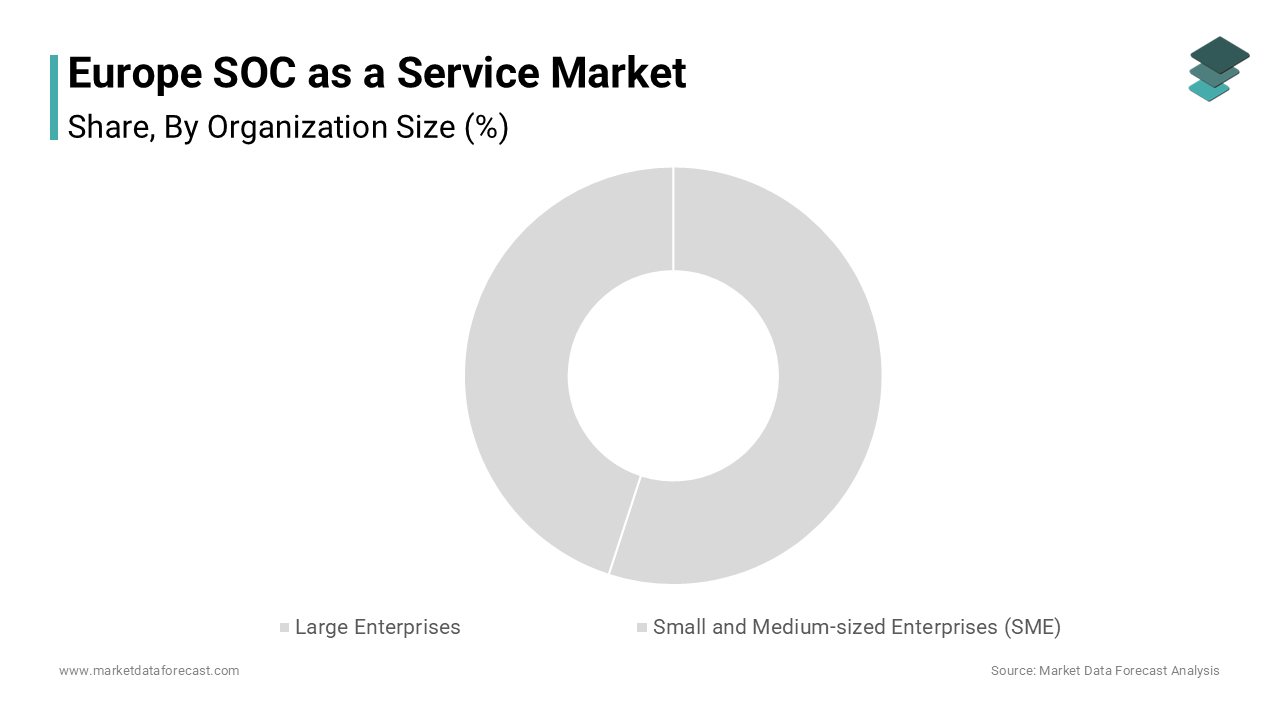
The small and medium sized enterprises segment is anticipated to witness the fastest CAGR of 29.4% between 2025 and 2033. The rapid expansion of the small and medium sized enterprises segment is driven by the inclusion of mid-sized firms. According to the European Small Business Portal, many European small and medium-sized enterprises (SMEs) lack dedicated security staff and cannot afford in-house security operations centers despite facing rising ransomware threats. In response, vendors are offering affordable modular Security Operations Center as a Service (SOCaaS) packages, and some national agencies are subsidizing these costs for eligible SMEs. This convergence of regulatory mandate affordability and state support is transforming SOCaaS from an enterprise luxury into an accessible necessity for Europe’s economic backbone.
By End User Insights
The banking financial services and insurance (BFSI) segment led the Europe SOC as a Service market and captured a share of 28.5% in 2024. The growth of the BFSI segment is propelled by the sector’s extreme exposure to cybercrime stringent regulatory scrutiny and zero tolerance for operational disruption. The Digital Operational Resilience Act mandates that all credit institutions implement continuous monitoring threat led penetration testing and third party ICT risk assessments, requirements that necessitate advanced SOC capabilities. Major banks have transitioned to managed SOCs to access real time fraud detection behavioral analytics and automated incident response aligned with ECB and EBA guidelines. The sector’s high digital maturity and compliance budget ensure sustained and sophisticated demand for SOCaaS as a core component of financial stability.
The healthcare segment is likely to experience the fastest CAGR of 32.1% from 2025 to 2033 due to the convergence of digital transformation regulatory pressure and escalating threat activity targeting patient data and critical care systems. The healthcare sector faces frequent and significant cyber threats, including a high number of ransomware attacks which can disrupt essential patient services. New directives like the NIS2 Directive and the European Health Data Space Regulation mandate stricter security measures. Hospitals and medical device manufacturers must implement continuous security monitoring. Providers offer healthcare specific SOCs that integrate with electronic health record alerts monitor legacy medical devices and comply with GDPR health data provisions. This segment is undergoing rapid and unavoidable digital defense modernization because patient safety is now directly tied to cyber resilience.
REGIONAL ANALYSIS
Germany SOC as a Service Market Analysis
Germany was the top performer in the Europe SOC as a Service market and accounted for a 23.5% share in 2024. Its industrial base, stringent regulatory enforcement, and national cybersecurity strategy fuel the domination of the German market. The country’s implementation of the NIS2 Directive is among the most rigorous in the EU. Major corporations partner with local providers to operate sovereign SOCs within German data boundaries. The government also funds the Alliance for Cybersecurity. Germany anchors the European SOCaaS (Security Operations Center as a Service) ecosystem, thanks to strong industrial demand, clear regulatory guidance, and an emphasis on data sovereignty.
United Kingdom SOC as a Service Market Analysis
The United Kingdom followed closely in the Europe SOC as a service market by capturing a 19.6% share in 2024 because of its mature financial services sector robust cybersecurity regulation and post Brexit digital resilience agenda. The vast majority of UK financial institutions utilize managed security operations, often operating hybrid SOCs through various vendors. The UK also hosts European headquarters for global providers including Palo Alto Networks and CrowdStrike which operate UK sovereign cloud regions compliant with NCSC and ICO data rules. With deep expertise agile regulation and global connectivity, the UK remains a high value hub for advanced SOC delivery.
France SOC as a Service Market Analysis
France experienced steady growth in the Europe SOC as a Service market due to its emphasis on digital sovereignty, the rise of national champions, and public sector cybersecurity. The French National Cybersecurity Agency mandates that all operators of vital importance implement certified SOC capabilities with real time threat detection and sovereign data processing. National champions operate AI powered SOCs within French data centers using locally developed analytics engines to meet sovereignty requirements. The country’s strict enforcement of GDPR and Banque de France cybersecurity norms further drives demand for compliant managed detection and response. France leverages a blend of state strategy, industrial policy, and technological independence to ensure that SOCaaS solutions meet national security imperatives.
Netherlands SOC as a Service Market Analysis
The Netherlands grew moderately in the Europe SOC as a Service market owing to its role as a digital gateway and hub for international enterprises. Amsterdam hosts the second largest internet exchange in the world facilitating dense cloud and data center infrastructure that attracts global SOC providers including Microsoft Azure and AWS to establish sovereign regions. The country’s proactive approach includes the Digital Trust Center which certifies SOC providers and offers subsidies to SMEs for adoption. Companies rely on hybrid SOCs that integrate Dutch based monitoring with global threat intelligence. The Netherlands serves as a testbed and launchpad for pan-European SOC (Security Operations Center) innovation and deployment, due to its advanced digital maturity, strong public-private collaboration, and strategic location.
Sweden SOC as a Service Market Analysis
Sweden is anticipated to grow in the Europe SOC as a Service market from 2025 to 2033 due to its tech advanced economy strong public sector digitization and Nordic cybersecurity cooperation. The Swedish Civil Contingencies Agency enforces strict NIS2 compliance requiring real time monitoring for energy telecom and health entities with penalties for delayed reporting. Sweden’s dominance in green tech and electric mobility has also expanded SOC demand among EV and battery manufacturers facing IP theft and supply chain attacks. The country participates in the Nordic Cybersecurity Network enabling threat intelligence sharing and joint SOC exercises with Finland and Denmark. Sweden exemplifies how proactive public policy and private innovation can drive the efficient and effective adoption of SOCaaS (Security Operations Center as a Service) across a digitally native society, leveraging high trust in digital services, transparent governance, and regional collaboration.
COMPETITIVE LANDSCAPE
Competition in the Europe SOC as a Service market is shaped by a dual dynamic between global cybersecurity firms and European sovereign providers. Global players like Palo Alto Networks CrowdStrike and SecureWorks offer advanced technology and threat intelligence but face scrutiny over data residency and regulatory alignment. In contrast European specialists such as Orange Cyberdefense WithSecure and Airbus CyberSecurity emphasize data sovereignty local compliance and sector specific expertise gaining favor in public sector and critical infrastructure tenders. The market is highly fragmented with over 120 certified SOC providers operating across the EU yet consolidation is accelerating as mid sized vendors struggle with the capital intensity of 24/7 operations and NIS2 compliance. Differentiation hinges on response speed analyst quality data governance and vertical relevance. Rising regulatory pressure and evolving cyber threats mean competition is now centered on trust, transparency, and resilience, which makes compliance and sovereignty as vital as a product's technical features.
KEY MARKET PLAYERS
Some of the companies that are playing a dominating role in the Europe SOC as a Service Market include
- AT&T Inc.
- Atos SE
- Cloudflare Inc.
- ConnectWise LL
- Fortinet Inc.
- NTT Data Corp.
- Thales SA
- Verizon Communications Inc.
- IBM Corporation
- SecureWorks Inc.
- Airbus Cybersecurity
- Arctic Wolf Networks Inc.
- Check Point Software Technologies
- LRQA (UK)
- Proficio Inc.
Top Players in the Market
Orange Cyberdefense
Orange Cyberdefense is a leading European provider of SOC as a Service with deep integration across the continent’s critical infrastructure and public sectors. As the cybersecurity arm of Orange Group the company delivers sovereign security operations from SOC centers in France Spain and Belgium serving clients in finance healthcare energy and government. Globally Orange Cyberdefense contributes to threat intelligence sharing through partnerships with INTERPOL and the World Economic Forum and operates one of Europe’s largest cybersecurity consulting teams. It also expanded its healthcare vertical SOC to support national health systems in Germany and the Netherlands. By combining sovereign architecture regulatory expertise and sector specific threat models Orange Cyberdefense reinforces Europe’s digital resilience strategy.
WithSecure (formerly F Secure Business)
WithSecure is a Finland headquartered cybersecurity firm specializing in managed detection and response and SOC as a Service for mid market and enterprise clients across Europe. The company is renowned for its lightweight agent technology and human led threat hunting approach that minimizes false positives while ensuring rapid validation. Globally WithSecure influences endpoint security standards through its research on ransomware and supply chain attacks published via the WithSecure Labs. It also partnered with the Swedish Civil Contingencies Agency to onboard over 200 public sector entities onto its sovereign SOC platform. By prioritizing simplicity sovereignty and human expertise WithSecure bridges the gap between affordability and enterprise grade defense.
NTT Security
NTT Security is a global cybersecurity leader with a strong European SOC as a Service presence through its security operations centers in the UK Ireland and Germany. The company offers 24/7 monitoring threat intelligence and incident response aligned with NIS2 DORA and GDPR requirements serving clients in BFSI telecom and industrial sectors. Globally NTT Security contributes to cybersecurity resilience through its proprietary Threat Intelligence Platform which aggregates data from sensors worldwide. It also signed strategic agreements with European banks and utility providers to deliver sector specific detection playbooks. By combining global scale with local compliance NTT Security ensures consistent and context aware protection across complex European enterprises.
Top Strategies Used by the Key Market Participants
Key players in the Europe SOC as a Service market employ several strategic approaches to differentiate and scale in a highly regulated environment. Sovereign architecture is paramount with providers establishing EU based data centers and analyst teams to comply with GDPR NIS2 and data localization mandates. Vertical specialization enables tailored threat detection for sectors like healthcare finance and manufacturing through industry specific playbooks and compliance mappings. AI and automation are integrated to enhance detection accuracy reduce response times and address talent shortages while maintaining human oversight. Modular and tiered pricing models make SOCaaS accessible to mid-market firms now covered under NIS2. Finally strategic partnerships with national cybersecurity agencies cloud providers and industry consortia strengthen credibility facilitate public sector adoption and ensure real time threat intelligence sharing across borders.
MARKET SEGMENTATION
The research report on the Europe SOC as a Service Market has been segmented and sub-segmented based on categories.
By Organization Size
- Large Enterprises
- Small and Medium-sized Enterprises (SME)
By End User
- Banking, Financial Services and Insurance (BFSI)
- Healthcare
By Country
- UK
- France
- Spain
- Germany
- Italy
- Russia
- Sweden
- Denmark
- Switzerland
- Netherlands
- Turkey
- Czech Republic
- Rest of Europe