- Product Description Description
- Table of Contents TOC
- List of Table & Figure LOT
- Get Free Sample PDF Sample PDF
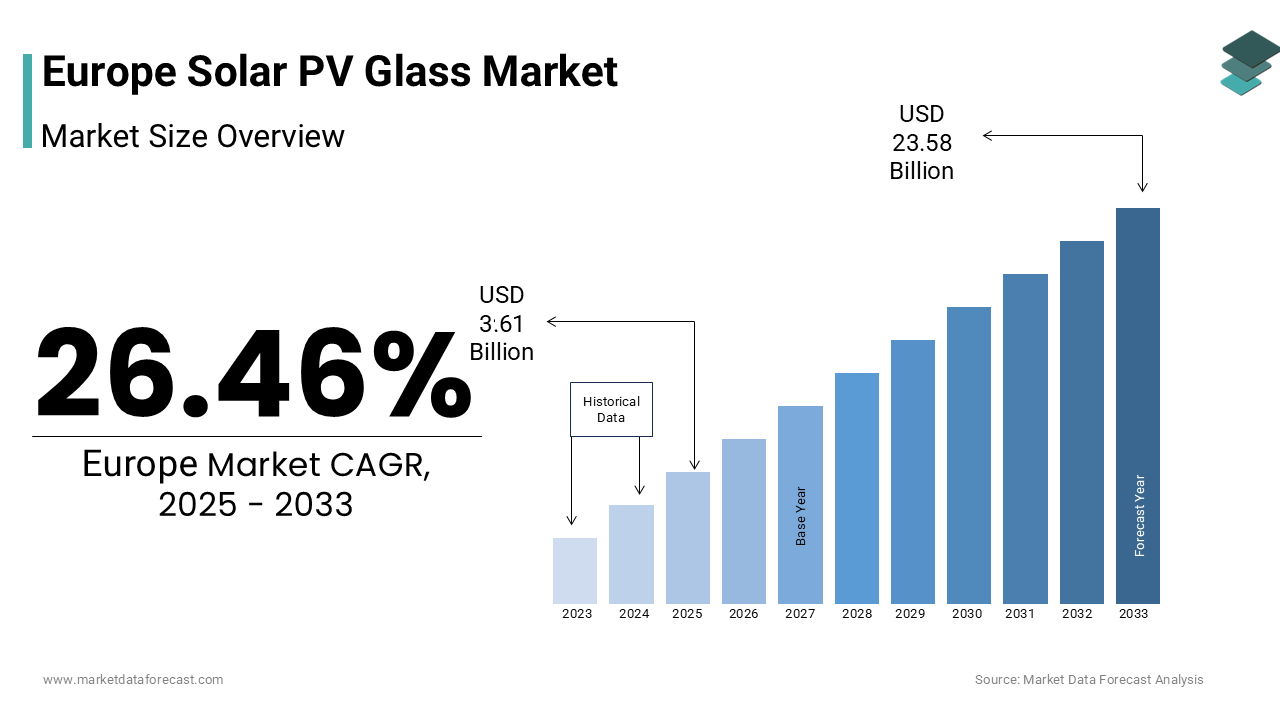
Market Size, 2025
$3.61 BnMarket Estimate, 2026
$4.57 BnMarket Forecast, 2034
$28.89 BnCAGR, 2026–2034
26.46%Europe Solar PV Glass Market Report Summary
The Europe Solar PV Glass Market was valued at USD 3.61 billion in 2025, is estimated to reach USD 4.57 billion in 2026, and is projected to reach USD 29.89 billion by 2034, growing at a CAGR of 26.46% during the forecast period from 2026 to 2034. The growth of the Europe Solar PV Glass Market is driven by ambitious renewable energy targets, rapid expansion of solar photovoltaic installations, and increasing adoption of building-integrated photovoltaics (BIPV). Rising investments in utility-scale solar projects, growing demand for high-performance tempered and anti-reflective glass, and supportive government incentives for clean energy deployment are further fueling market growth. Moreover, advancements in PV glass coating technologies, increasing domestic solar manufacturing, and the integration of solar energy into modern building infrastructure are supporting the expansion of the Europe Solar PV Glass Market.
Key Market Trends
-
Rising deployment of utility-scale and rooftop solar projects across Europe to meet renewable energy targets.
-
Increasing adoption of building-integrated photovoltaics (BIPV) in commercial and residential construction.
-
Growing demand for anti-reflective coated PV glass to improve module efficiency and energy output.
-
Rising investments in sustainable and low-carbon solar glass manufacturing technologies.
-
Expanding research and commercialization of next-generation perovskite and tandem solar modules requiring advanced PV glass solutions.
Segmental Insights
- Based on type, the tempered glass segment held the largest share of the Europe Solar PV Glass Market in 2024. The segment’s dominance is attributed to its superior mechanical strength, high impact resistance, excellent thermal stability, and mandatory use in crystalline silicon photovoltaic modules to meet stringent European safety and durability standards.
- Based on technology, the crystalline silicon segment occupied the largest share of the Europe Solar PV Glass Market in 2024. The dominance of this segment stems from its high conversion efficiency, proven long-term reliability, widespread adoption across residential, commercial, and utility-scale installations, and compatibility with standardized low-iron tempered PV glass.
- Based on application, the utility-scale segment accounted for 53.8% of the Europe Solar PV Glass Market share in 2024. The segment’s dominance is driven by the rapid development of large-scale solar farms, increasing government funding for renewable energy infrastructure, favorable financing mechanisms, and growing investments in high-capacity photovoltaic projects across Europe.
Regional Insights
The Europe Solar PV Glass Market is witnessing substantial growth across major countries, supported by aggressive renewable energy policies, increasing solar capacity additions, and expanding domestic solar manufacturing.
- Germany was the largest contributor, accounting for 23.8% of the Europe Solar PV Glass Market share in 2024, driven by ambitious solar installation targets, strong government incentives, advanced manufacturing capabilities, and increasing deployment of rooftop and utility-scale photovoltaic systems.
- Spain continues to perform strongly, supported by excellent solar irradiation, rapid expansion of utility-scale solar parks, favorable regulatory policies, and increasing commercial rooftop solar installations.
- France remains a key market owing to growing investments in building-integrated photovoltaics, mandatory renewable energy integration in new commercial buildings, increasing public infrastructure solar projects, and continuous innovation in solar glass technologies.
- The Netherlands is emerging as a significant market, driven by extensive adoption of solar façades, advanced urban solar integration, corporate sustainability initiatives, and increasing demand for high-performance architectural PV glass.
- Italy also continues to witness strong growth due to expanding residential rooftop installations, favorable tax incentives, rising agrivoltaic projects, and increasing investments in utility-scale solar energy developments.
Competitive Landscape
The Europe Solar PV Glass Market is characterized by the presence of leading flat glass manufacturers competing through technological innovation, advanced coating technologies, sustainable manufacturing processes, and strategic partnerships with photovoltaic module producers. Leading companies are focusing on expanding low-iron glass production capacity, developing anti-reflective and self-cleaning coatings, improving product sustainability through recycling initiatives, and supporting next-generation photovoltaic technologies including perovskite and tandem solar cells. Continuous investments in domestic manufacturing and product innovation are strengthening competition across the Europe Solar PV Glass Market.Prominent players in the Europe Solar PV Glass Market include Saint-Gobain Group, Euroglas GmbH, AGC Glass Europe, Pilkington Europe, and Sisecam Flat Glass.
Europe Solar PV Glass Market Size
The Europe Solar PV Glass Market size was valued at USD 3.61 billion in 2025 and is anticipated to reach USD 4.57 billion in 2026 from USD 29.89 billion by 2034, growing at a CAGR of 26.46% during the forecast period from 2026 to 2034.
Solar PV glass is a specialized tempered glass engineered for photovoltaic modules with high light transmittance low iron content and enhanced durability against environmental stressors. In Europe, this material serves as the primary protective front layer in crystalline silicon and thin film solar panels ensuring optical efficiency and mechanical resilience over decades of outdoor exposure. The market is distinguished by stringent performance standards including requirements for anti-reflective coatings self-cleaning surfaces and resistance to hail impact as defined by European Norm EN 50674. The push for this high specification glass stems from Europe’s aggressive decarbonization agenda and expanding solar deployment across diverse climatic zones from the Nordic regions to the Mediterranean. According to SolarPower Europe, the continent installed over 56 GW of new solar capacity in 2023, which is a record. According to the think-tank Ember, solar generated ~11% of the EU’s electricity in 2024 and overtook coal (which fell below 10%) for the first time that year. These energy transitions demand reliable high-performance PV components, where glass constitutes a critical interface between environmental exposure and energy conversion efficiency.
MARKET DRIVERS
Stringent EU Climate and Energy Targets Accelerating Solar Deployment
The binding climate framework of the European Union serves as a primary catalyst for solar PV glass demand by mandating rapid expansion of renewable energy infrastructure, which is majorly propelling the regional market growth. According to the Fit for 55 packages, the European Commission aims to reduce greenhouse gas emissions by at least 55% by 2030 compared to 1990 levels. As part of this strategy, the Renewable Energy Directive (EU/2023/2413) (revised in 2023) raises the bloc’s renewable-energy target to at least 42.5% of final energy consumption by 2030 with a potential extension toward 45%. According to the International Energy Agency, solar PV is expected to account for around 80% of new global renewable-capacity additions through 2030. Germany alone plans to install 200 gigawatts of solar capacity by 2030 (up from about 82 GW in 2023) as per the Federal Ministry for Economic Affairs and Climate Action. Each gigawatt of solar capacity requires approximately 700,000 m² of PV glass, which is creating sustained material demand. This policy-driven deployment surge directly translates into robust requirements for high-transmittance low-iron tempered glass that meets European durability and performance benchmarks.
Integration of Solar into Building Envelopes Through BIPV Mandates
The incorporation of solar technology into building materials particularly through Building Integrated Photovoltaics is further boosting the expansion of the solar PV glass market. The revised Energy Performance of Buildings Directive mandates that from 1 January 2028 all new public buildings and from 1 January 2030 all other new buildings in the EU must be zero-emission buildings, which is the successor to the “nearly-zero energy” standard. It also includes provisions encouraging on-site renewable generation by requiring buildings to be designed to accommodate solar energy installations. Unlike standard rooftop modules, building-integrated photovoltaics (BIPV) applications require custom-shaped tempered glass with dual functionality as both a weather barrier and power generator. The Netherlands has approved national building codes that allow PV glass to count toward glazing requirements while providing energy offsets. In Germany, the KfW Bank development bank offers subsidies for BIPV retrofits in urban-renewal projects. These regulatory and financial incentives are transforming PV glass from a component into an architectural material, thereby expanding its application scope beyond conventional solar farms into urban infrastructure.
MARKET RESTRAINTS
High Energy Intensity and Carbon Footprint of Glass Manufacturing
The production of low iron tempered glass for PV modules is inherently energy intensive presenting a paradox within Europe’s green transition, which is one of the significant restraints for the European solar PV glass market. Manufacturing one square metre of solar PV glass requires approximately fifteen to eighteen kilowatt-hours of energy primarily from natural-gas-fired furnaces. According to Glass for Europe the flat-glass sector accounts for roughly 2.3 million tonnes of CO₂ emissions annually in the EU, which contradicts the environmental objectives of downstream solar applications. The EU’s Carbon Border Adjustment Mechanism and upcoming revisions to the Industrial Emissions Directive are increasing compliance costs for glass producers. In 2023, Saint‑Gobain reported that over 35% of its flat-glass production costs were linked to energy and carbon pricing. Moreover, the recycling rate for end-of-life PV glass remains below 20% as per the European PV Cycle Association due to lamination and encapsulation complexities. This sustainability tension limits the eligibility of PV modules for certain green public-procurement tenders that now require full life-cycle carbon assessments thereby constraining demand for conventionally produced PV glass.
Supply Chain Vulnerability to Raw Material Price Volatility
The significant exposure to fluctuations in critical raw material costs particularly for high purity silica sand and soda ash is also hampering the growth of the solar PV glass market in Europe. Low iron silica sand which must contain less than point zero two percent iron oxide to achieve the required light transmittance is sourced from limited geological deposits in Germany Norway and the Czech Republic. According to the European Commission’s 2023 Critical Raw Materials list, Silicon metal is classified as a strategic raw material due to its role in clean-energy technologies. Soda ash prices in Europe have experienced volatility and were influenced by high energy costs and gas price surges, which impacted synthetic production routes. These input instabilities compress margins for glass manufacturers and delay module-production schedules. As Europe seeks to on-shore solar manufacturing under the Net Zero Industry Act, securing stable and affordable raw-material supply remains a structural bottleneck for PV-glass scalability.
MARKET OPPORTUNITIES
Adoption of Advanced Coating Technologies for Performance Enhancement
Innovations in anti-reflective and self-cleaning coatings is a promising opportunity for the European solar PV glass market. Multi-layer anti-reflective coatings can increase light transmittance from 91% to over 94%, directly enhancing module efficiency. According to the Fraunhofer Institute for Solar Energy Systems a 1% absolute increase in transmittance translates to approximately a 1.5% higher annual energy output under Central European conditions. Companies like AGC Glass Europe have commercialised hydrophilic coatings that use photocatalytic titanium dioxide to break down organic dirt and enable rain-based cleaning, which is reducing soiling losses by up to 15% in arid regions like Spain. According to the European Patent Office, a 2.9% year-on-year increase in patent filings for clean-energy technologies in 2023, which is signaling increased innovation in functional glass coatings. As project developers seek to maximise return on land-constrained installations, particularly in Germany and the Benelux countries, performance-enhanced glass is becoming a premium specification. This trend supports higher pricing and margins while aligning with Europe’s focus on efficiency over mere capacity addition.
Expansion of Recycling Infrastructure for End-of-Life PV Modules
The development of dedicated PV glass recycling streams is a notable opportunity for the European solar PV glass market. Manufacturing one square metre of solar PV glass requires approximately fifteen to eighteen kilowatt-hours of energy, primarily from natural-gas-fired furnaces. As per the Glass for Europe Association, the flat-glass sector accounts for roughly 2.3 million tonnes of CO₂ emissions annually in the EU, which contradicts the environmental objectives of downstream solar applications.
MARKET CHALLENGES
Technical Limitations in Lightweight and Flexible PV Glass Alternatives
The growth of the European solar PV glass market is being challenged by a significant materials science challenge in developing lightweight or curved PV glass that maintains optical and mechanical integrity without compromising safety or longevity. Traditional tempered glass used in modules is 4 millimetres thick and weighs approximately 10 kg per square metre, which limits installation on roofs with low load-bearing capacity. According to the European Construction Technology Platform, technical and structural building constraints reduce suitability of many existing urban residential roofs for standard PV loads. While ultra-thin glass down to two millimetres exists, it lacks the required hail-resistance as defined by IEC 61215 that mandates survival of 25 mm ice-ball impacts at 23 m/s. Attempts to use polymer front sheets sacrifice transmittance and degrade under UV exposure. As per the Saint‑Gobain research division, no commercially viable lightweight glass alternative currently meets all European safety, durability, and efficiency standards in 2023. This technical gap restricts solar deployment on historic buildings, flat roofs and lightweight structures, thereby capping the addressable market for conventional PV glass and delaying innovation in next-generation module formats.
Regulatory Fragmentation in Construction and Safety Certification Across Member States
Divergent national building codes and fire safety classifications for PV modules create market access barriers for standardized PV glass products across Europe, which is further challenging the expansion of the European market. Although EN 50674 provides a harmonised standard for PV-module performance, the integration of modules into building envelopes is governed by national regulations that vary significantly. According to the European Committee for Standardization Germany requires PV glazing to achieve Class A1 non-combustibility under DIN 4102 while France uses the Euroclass B rating under NF EN 13501 which permits limited flammability. In the Netherlands, fire-safety assessments are conducted on a project-by-project basis through municipal authorities, which is leading to inconsistent approval timelines. According to a 2023 survey by SolarPower Europe, over 50% of BIPV projects experienced delays due to unclear or conflicting certification requirements. This fragmentation forces glass manufacturers to maintain multiple product variants with different lamination and framing configurations, increasing complexity and inventory costs. Until the EU establishes a fully harmonised construction-products regulation for solar glazing, market efficiency and product innovation will remain hindered by regulatory silos.
REPORT COVERAGE
| REPORT METRIC | DETAILS |
| Market Size Available | 2025 to 2034 |
| Base Year | 2025 |
| Forecast Period | 2026 to 2034 |
| Segments Covered | By Type, Technology, Application, and Region |
| Various Analyses Covered | Global, Regional & Country Level Analysis, Segment-Level Analysis; DROC; PESTLE Analysis; Porter’s Five Forces Analysis, Competitive Landscape, Analyst Overview of Investment Opportunities |
| Regions Covered | United Kingdom, France, Spain, Germany, Italy, Russia, Sweden, Denmark, Switzerland, the Netherlands, Turkey, and the Czech Republic. |
| Market leaders Profiled | Saint-Gobain Group, Euroglas GmbH, AGC Glass Europe, Pilkington Europe, and Sisecam Flat Glass. |
SEGMENTAL ANALYSIS
By Type Insights
The tempered glass segment held the major share of the European solar PV glass market in 2024. The dominance of the tempered glass segment in the European market is primarily attributed to its mandatory role as the structural and protective front layer in nearly all crystalline silicon modules. The intrinsic mechanical and safety properties of tempered glass including high impact resistance thermal stability and compliance with international photovoltaic standards is also boosting the growth of the tempered glass segment in the European solar PV glass market. According to the International Electrotechnical Commission standard IEC 61215, photovoltaic modules must withstand hail impacts of 25 mm diameter ice balls travelling at 23 m/s. The European Committee for Standardization enforces these performance criteria across all EU member states, which is ensuring uniform adoption. According to the data from Glass for Europe, over 95% of utility-scale and rooftop solar modules deployed in Germany, France and Spain in 2023 used 3.2 mm or 4.0 mm tempered glass. Moreover, tempering enhances post-breakage safety by causing glass to fracture into small granular pieces rather than sharp shards, which is a critical feature for installations on residential and commercial buildings. This combination of regulatory mandate, engineering necessity and safety compliance boosts the growth of the tempered glass segment as the foundational material in European solar architecture.
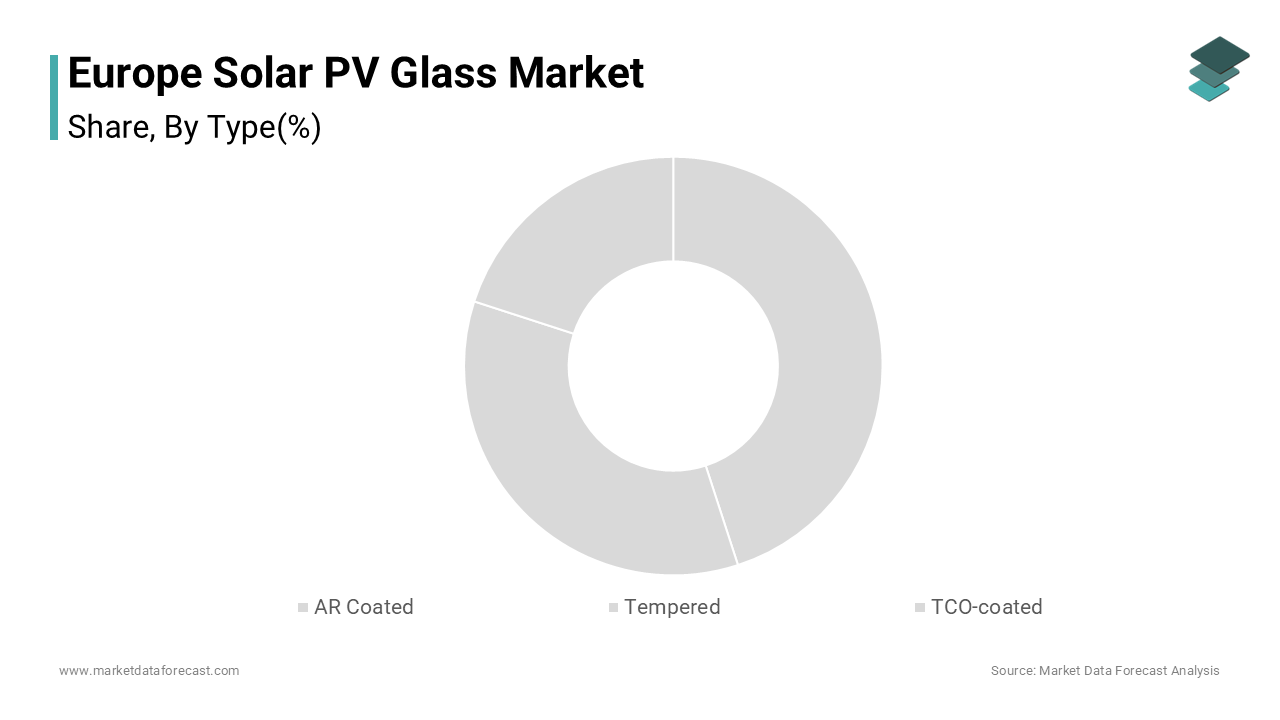
The anti-reflective coated glass segment is estimated is the fastest growing segment in the Europe solar PV glass market over the forecast period owing to the industry’s shift toward maximizing energy yield per square meter in land constrained environments. AR coatings reduce surface reflectance from approximately 4% to below 1%, thereby increasing light transmittance and module efficiency. The performance uplift is particularly valuable in countries like the Netherlands and Germany where rooftop space is limited and utility land is scarce. In 2023, SolarPower Europe reported that over sixty % of new commercial PV tenders in Western Europe included minimum transmittance specifications of 93.8%, which is effectively mandating AR coatings. Leading European glass producers such as AGC Glass Europe and Saint‑Gobain have responded by scaling up magnetron sputtering lines capable of depositing durable multi-layer coatings that withstand decades of UV and abrasion exposure. Additionally, the EU’s revised Energy Efficiency Directive now incentivises high-yield systems through faster permitting and higher feed-in tariffs, which is further accelerating adoption of performance-enhanced glass.
By Technology Insights
The crystalline silicon segment occupied the largest share of the European solar PV glass market in 2024 and the domination of the segment is likely to continue throughout the forecast period. The maturity, reliability and compatibility of crystalline silicon technology with standardized tempered low iron glass substrates is majorly propelling the growth of the segment in the European market. Monocrystalline and polycrystalline modules account for the vast majority of installations across residential utility and commercial segments. Crystalline modules represented a substantial majority of solar capacity installed in Europe in 2023, owing to their average module efficiency of 21% to 23% and proven 25-year lifespan. This technology requires a single pane of high-transmittance tempered glass per module, typically 3.2 mm thick, which is creating strong and consistent demand for PV glass. Germany’s Bundesnetzagentur confirmed that a high proportion of new solar permits issued in 2023 were for crystalline systems, which is reflecting installer and financier preference for bankable technology. Furthermore, Europe’s domestic module-manufacturing revival under the Net Zero Industry Act prioritises crystalline lines due to established supply chains and workforce expertise. As long as crystalline silicon remains the backbone of European solar deployment, the demand for its associated glass component will remain structurally dominant.
The perovskite solar technology segment is predicted to grow at the fastest CAGR in the European market over the forecast period owing to its current niche status driven by aggressive R&D investments and tandem cell potential. Unlike traditional thin film perovskite layers are typically deposited on textured or planar glass substrates often requiring specialized low iron glass with ultra smooth surfaces to minimize recombination losses. According to the European Commission’s Horizon Europe programme, over €280 million have been allocated since 2021 to perovskite commercialisation initiatives including the SCALENANO and SOLPROCELL projects. In 2023, researchers at EPFL in Switzerland achieved a certified 31.2 % efficiency for a perovskite-silicon tandem cell using a custom glass superstrate. Companies like Oxford PV are preparing pilot production lines in Brandenburg, Germany with plans to ship tandem modules by late 2025. The European Solar Prize recognised three perovskite-integration projects in 2023 including building façades in Denmark and agrivoltaic applications in Spain. Although volumes remain small, the technology’s potential to exceed 30 % efficiency using existing glass infrastructure positions it as a high-growth frontier which will increasingly influence glass specifications for next-generation photovoltaics.
By Application Insights
The utility scale segment captured 53.8% of the European solar PV glass market share in 2024. The growth of the utility scale segment in the European market can be credited to massive project footprints and centralized procurement of standardized modules. These ground-mounted plants typically deploy hundreds of thousands of identical crystalline modules with each requiring a single sheet of tempered low-iron glass. According to the SolarPower Europe report, Europe added 56 GW of new solar capacity in 2023. A single 100-megawatt solar farm consumes approximately 700 000 m² of PV glass is equivalent to the annual residential demand of a mid-sized country. The European Bank for Reconstruction and Development reported that over €8 billion in green loans were disbursed in 2023 for utility solar projects across Southern and Eastern Europe. Additionally, these projects operate under strict bankability requirements mandating glass that meets EN 50674 durability norms and IEC 61215 mechanical standards, which is ensuring consistent high-volume orders for certified tempered glass from industrial suppliers. The scale economics and regulatory certainty of utility projects make them the primary engine of PV glass consumption.
The non-residential segment is predicted to exhibit the fastest CAGR of 13.3% over the forecast period in the European solar PV glass market owing to the mandatory building energy regulations and corporate sustainability commitments. The revised Energy Performance of Buildings Directive requires all new public buildings to be zero-emission from 2028, and all other new buildings to follow by 2030. In France, the Decree Tertiaire mandates a reduction in energy consumption for commercial buildings by 40 % by 2030, spurring rooftop solar adoption. The Netherlands has approved building codes that allow PV-glass to serve dual roles as façade cladding and power generator. Corporate PPAs are also accelerating deployment as companies like IKEA and Lidl install solar canopies and glazed atriums across their European facilities. This convergence of regulation, corporate ESG and architectural integration is transforming non-residential rooftops and façades into high-growth zones for specialized PV-glass.
REGIONAL ANALYSIS
Germany Solar PV Glass Market Analysis
Germany dominated the solar PV glass market in Europe in 2024 by holding 23.8% of the regional market share. The Energiewende policy ambitious solar targets and dense network of rooftop and utility installations are primarily driving the growth of the German market in Europe. According to the Bundesnetzagentur, Germany added 14.1 GW of solar capacity in 2023. The Federal Ministry for Economic Affairs and Climate Action has set a target of 215 GW of solar by 2030. The Renewable Energies Heat Act mandates solar-thermal or PV integration in new residential buildings in several federal states. The Solar Package I and Solar Package II introduced in 2023 streamlined permitting for rooftop and agrivoltaic systems. Germany is also home to key glass processing facilities including Saint‑Gobain’s Wermlingen plant and Von Ardenne’s coating lines which supply domestic and export markets. The KfW Bankengruppe provided substantial low-interest promotional funding in 2023, supporting sustainable energy projects nationwide. With the strong policy support and domestic manufacturing push under the Net Zero Industry Act, Germany’s dominance in PV glass consumption is structurally entrenched and set to expand.
Spain Solar PV Glass Market Analysis
Spain is a promising regional segment for solar PV glass in Europe and is likely to hold a substantial share of the European market over the forecast period due to its exceptional solar irradiance favorable regulatory environment and rapid expansion of utility scale projects. Spain boasts a global horizontal irradiance of around 1,800 kWh/m² annually, which is enabling high energy yields that justify large glass investments. According to Red Eléctrica de España, Spain installed about 7.2 GW of solar capacity in 2023, with the vast majority coming from ground-mounted plants in regions such as Extremadura, Andalusia and Castilla-La Mancha. The national integrated energy and climate plan targets roughly 39 GW of solar by 2030 and includes fast-track permitting for projects in designated “solar zones”. Major developers like Iberdrola and Acciona are constructing gigawatt-scale solar parks, each requiring millions of square metres of tempered glass. Additionally, Spain’s new net-metering law enacted in 2023 has spurred commercial rooftop adoption in industrial parks around Madrid and Barcelona. The combination of natural advantage, policy support and a growing project pipeline ensures Spain remains a cornerstone of European PV-glass demand.
France Solar PV Glass Market Analysis
France is expected to account for a prominent share of the European solar PV glass market during the forecast period owing to its dual focus on utility scale farms and building integrated photovoltaics. France installed 4.7 GW of solar capacity in 2023. The Energy Code mandates that all new commercial buildings over 500 m² incorporate renewable energy systems, with solar glazing increasingly chosen for façades and skylights. The French Environment and Energy Management Agency allocated €320 million in 2023 for solar integration in public buildings including schools and hospitals. Paris’s Solar Plan requires all new parking lots over 500 m² to be covered with solar canopies—a regulation that alone created demand for over 1.2 million m² of PV glass in 2023. Moreover, France hosts key R&D centres such as CEA Liten which collaborate with glass-makers on anti-reflective and self-cleaning coatings. These policy, design and innovation synergies sustain robust and diversified glass consumption across multiple application segments.
Netherlands Solar PV Glass Market Analysis
The Netherlands is projected to grow at a prominent CAGR in the European solar PV glass market over the forecast period. The innovative urban integration land use efficiency and strong corporate adoption in Netherlands is majorly boosting the solar PV glass market growth in Netherlands. The country installed about 4.82 GW of new solar capacity in 2023 according to Dutch Solar Association and related industry research. This strong growth is happening despite limited available land, with many deployments on commercial rooftops and along infrastructure corridors. The national ambition for solar extends toward the 2030 timeframe, with estimates pointing toward significantly higher capacity than the current base. In parallel, building and planning codes in the Netherlands have increasingly adapted to integrate solar-glass applications in façade cladding, atriums and industrial roofs. Companies like Philips and Shell have implemented custom PV-glass façades at their headquarters in Eindhoven and The Hague, setting architectural precedents. The focus on high-value urban and industrial roof and façade applications where every square metre counts is driving consistent demand for performance-enhanced PV-glass with architectural functionality.
Italy Solar PV Glass Market Analysis
Italy maintains a strong presence in the European solar PV glass market. The high solar irradiation southern regional incentives and a resurgence in residential and agrivoltaic installations are contributing to the growth of the Italian market. The country installed about 5.21 GW of new solar capacity in 2023. The southern regions of Puglia, Sicily and Calabria accounted for a large share of new utility-scale projects. The Superbonus 110% tax credit reintroduced in 2023 for energy-efficiency upgrades has reignited residential rooftop demand particularly in historic city centres, where lightweight tempered glass solutions are preferred. Agrivoltaics is also gaining traction, with investment grants of around €1.1 billion approved for agrivoltaic systems under the National Recovery and Resilience Plan. Italy’s flat-glass industry supplies both domestic and Mediterranean markets. Moreover, the Italian National Agency for New Technologies, Energy and Sustainable Economic Development (ENEA) has published technical guidelines for PV-glass durability under high humidity and salt-spray conditions, which is critical for coastal installations. These geographic, economic and policy factors sustain Italy’s position as a key consumer of specialised solar PV-glass.
COMPETITIVE LANDSCAPE
Competition in the Europe solar pv glass market is characterized by a concentrated landscape of technologically advanced flat glass manufacturers competing on optical performance durability and sustainability credentials rather than price alone. The market is dominated by vertically integrated players with in house float and tempering capabilities enabling tight control over iron content surface quality and coating consistency. Regulatory compliance with EN 50674 and IEC 61215 standards serves as a baseline while differentiation arises through proprietary coating technologies lightweight designs and circular economy initiatives. New entrants face high capital and technical barriers due to the precision required in low iron glass production and the need for long term field validation. Competition is further intensified by the European Union’s push for domestic solar manufacturing under the Net Zero Industry Act which incentivizes local sourcing of critical components including glass. As a result established players are expanding capacity and deepening collaborations with module assemblers to secure long term offtake agreements and reinforce their strategic positioning.
KEY MARKET PLAYERS
Some of the companies that are playing a dominating role in the Europe Solar PV Glass Market include
- Saint-Gobain Group
- Euroglas GmbH
- AGC Glass Europe
- Pilkington Europe
- Sisecam Flat Glass
Top Players in the Market
AGC Glass Europe
AGC Glass Europe is a leading manufacturer of solar PV glass with a strong presence across the continent through its production facilities in Belgium France and Italy. The company supplies high transmittance low iron tempered glass with advanced anti reflective and self cleaning coatings tailored for both crystalline and thin film modules. Globally AGC contributes by setting benchmarks in glass durability and optical performance under diverse climatic conditions. Recently the company expanded its magnetron sputtering capacity at its Gosselies plant to meet rising demand for AR coated glass in utility and BIPV projects. It also launched a new generation of hydrophilic coated glass validated by independent European testing institutes for long term soiling resistance thus reinforcing its technological leadership in performance enhanced PV glass.
Saint Gobain
Saint Gobain is a major European player in the solar PV glass market offering a comprehensive portfolio under its Solar Glass brand including tempered low iron glass with anti reflective treatments. The company leverages its extensive flat glass manufacturing network across Germany the Czech Republic and Spain to serve both domestic and export markets. On the global stage Saint Gobain integrates PV glass production with its sustainable building materials strategy promoting solar glazing as part of net zero construction solutions. In recent developments the company upgraded its float glass lines to reduce iron content below 0.012 percent enhancing light transmittance. It also partnered with European module assemblers to co develop lightweight glass solutions for residential rooftops with low load bearing capacity thus addressing a critical market gap.
NSG Group (Nippon Sheet Glass)
NSG Group operates in Europe through its Pilkington brand and is a key supplier of high performance solar PV glass used in utility and commercial solar installations. The company contributes globally by aligning its European production standards with its Asian and North American operations ensuring consistency in low iron content surface flatness and mechanical strength. NSG’s European facilities in the Netherlands and UK focus on tempered glass with anti reflective coatings optimized for Northern European diffuse light conditions. Recently the company invested in digital quality control systems at its Greilheim Germany plant to enhance thickness uniformity and surface defect detection. It also introduced a recycling program that reintegrates end of life PV glass cullet into new float glass batches supporting circular economy goals under EU sustainability frameworks.
Top Strategies Used by the Key Market Participants
Key players in the Europe solar pv glass market prioritize technological differentiation by developing advanced anti reflective and self cleaning coatings that enhance light transmittance and reduce maintenance costs. They invest in expanding and modernizing float and tempering lines to produce ultra low iron glass with consistent optical quality. Companies align production with European sustainability mandates by integrating recycled content and reducing furnace energy consumption through hybrid electric melting. Strategic partnerships with module manufacturers and BIPV architects enable co engineered solutions for specialized applications such as curved façades or lightweight rooftops. Additionally firms actively participate in EU funded R&D initiatives to validate next generation glass for perovskite and tandem cells ensuring readiness for emerging photovoltaic technologies.
MARKET SEGMENTATION
The research report on the europe solar PV glass market has been segmented and sub-segmented based on categories.
By Type
- AR Coated
- Tempered
- TCO-coated
By Technology
- Crystalline Solar PV Module
- Thin Film Module
- Perovskite Module
By Application
- Residential
- Non-residential
- Utility
By Country
- UK
- France
- Spain
- Germany
- Italy
- Russia
- Sweden
- Denmark
- Switzerland
- Netherlands
- Turkey
- Czech Republic
- Rest of Europe