- Product Description Description
- Table of Contents TOC
- List of Table & Figure LOT
- Get Free Sample PDF Sample PDF
Europe Solar Tracker Market Report Summary
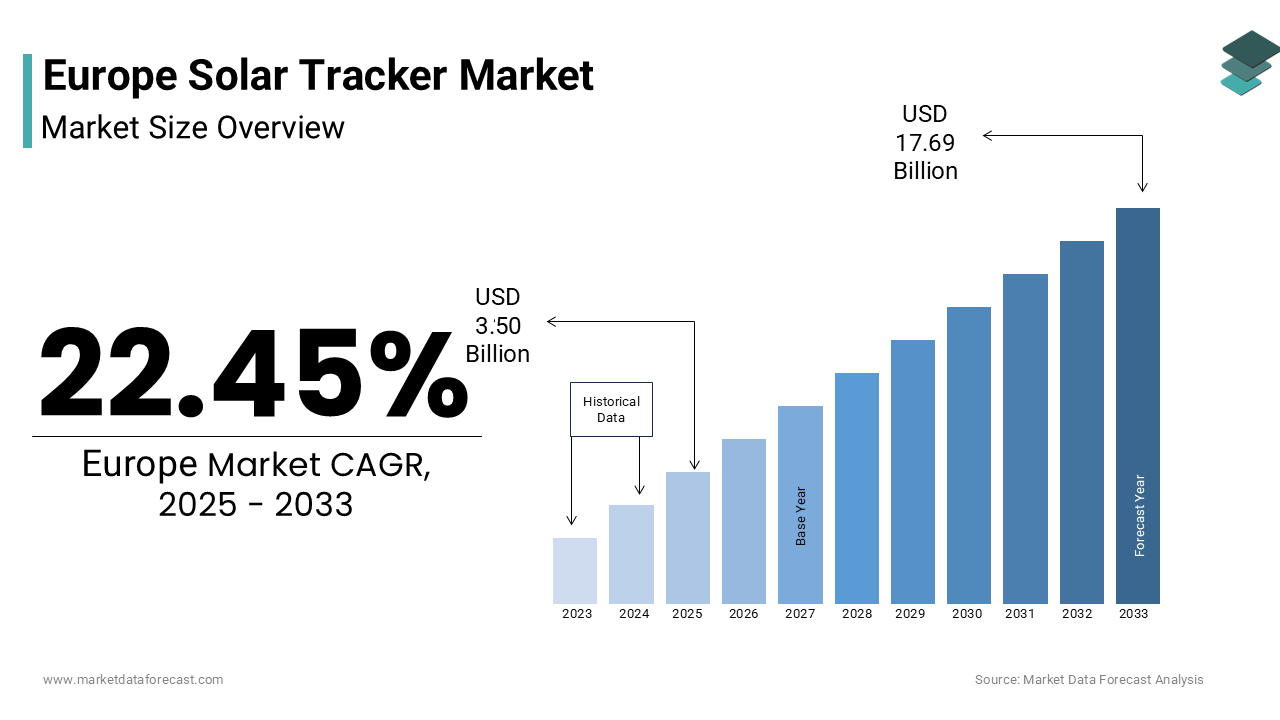
The Europe solar tracker market was valued at USD 2.86 billion in 2024, is estimated to reach USD 3.50 billion in 2025, and is projected to reach USD 17.69 billion by 2033, growing at a CAGR of 22.45% during the forecast period from 2025 to 2033. The growth of the Europe solar tracker market is driven by aggressive renewable energy targets, rapid expansion of utility-scale solar installations, and the need to maximize energy output per unit of land in densely populated regions. Solar trackers enhance photovoltaic efficiency by dynamically orienting panels toward the sun, significantly increasing annual energy yield compared to fixed-tilt systems. Supportive EU policies, declining levelized cost of solar power, and increasing deployment across Southern and Central Europe further accelerate market adoption. Moreover, integration of trackers into agrivoltaic projects and brownfield solar developments is expanding their role as a strategic enabler of Europe’s clean energy transition.
Key Market Trends
- Rising deployment of single-axis solar trackers in utility-scale projects due to optimal cost-to-performance balance.
- Increasing adoption in Southern Europe, particularly Spain and Italy, where high solar irradiance enhances tracker economics.
- Growing integration of trackers with agrivoltaic systems, enabling dual land use for agriculture and power generation.
- Technological advancements in terrain-following and wind-resilient trackers to address uneven land and extreme weather.
- Rising demand for grid-responsive and digitally monitored tracking systems to comply with evolving EU grid codes.
Segmental Insights
- Based on axis type, the single-axis tracker segment dominated the Europe solar tracker market in 2024. The segment’s leadership is attributed to its mechanical simplicity, lower installation and maintenance costs, and superior land-use efficiency, making it the preferred choice for large-scale solar projects across Europe.
- The single-axis segment is also expected to register the fastest growth during the forecast period due to declining system costs, supportive EU land-efficiency policies, and expanding deployment on sloped and irregular terrain enabled by advanced tracking designs.
Regional Insights
The Europe solar tracker market is experiencing strong growth across major solar-producing countries, supported by renewable energy mandates, favorable irradiation levels, and policy-backed procurement frameworks.
- Germany was the largest contributor, accounting for 24.3% of the Europe solar tracker market share in 2024, driven by its ambitious solar capacity targets, limited land availability, and strong domestic manufacturing base for advanced tracking systems.
- Spain ranked second, supported by its exceptional solar resources, streamlined permitting in designated solar zones, and large pipeline of utility-scale projects utilizing tracker technology.
- France continues to expand steadily as tracker adoption rises in ground-mounted and agrivoltaic solar projects aligned with national decarbonization goals.
- Italy benefits from high solar irradiation in southern regions and incentive structures under the National Recovery and Resilience Plan, encouraging tracker-based solar deployment.
- The United Kingdom is gradually adopting trackers in large-scale projects, supported by corporate power purchase agreements and grid code updates that recognize higher capacity factors from tracked systems.
Competitive Landscape
The Europe solar tracker market is moderately consolidated and characterized by technological differentiation, regional engineering expertise, and alignment with EU renewable energy policies. Leading players compete on tracker durability, terrain adaptability, extreme weather resilience, and digital intelligence, rather than price alone. European manufacturers leverage local climate and regulatory expertise, while global players gain traction through advanced terrain-following and data-driven optimization technologies. Increasing emphasis on clean-tech sovereignty and localized supply chains is shaping future competition. Prominent players in the Europe solar tracker market include Arctech Solar, Ideematec, Nextracker Inc., Soltec Power Holdings SA, Array Technologies, Convert Italia, DCE Solar, PV Hardware, Solar Flexrack, and Mechatron.
Europe Solar Tracker Market Size
The europe solar tracker market size was valued at USD 2.86 billion in 2024 and is anticipated to reach USD 3.5 billion in 2025 from USD 17.69 billion by 2033, growing at a CAGR of 22.45% during the forecast period from 2025 to 2033.
The solar tracker systems that orient photovoltaic panels toward the sun to maximize energy capture throughout the day. These include single axis and dual axis tracking mechanisms deployed primarily in utility scale and large commercial solar installations. As of 2025, solar trackers are increasingly integrated into Europe’s renewable energy strategy to enhance generation efficiency without expanding land use. According to the European Environment Agency, the average solar irradiance across Southern and Central Europe ranges from 1300 to 1700 hundred kilowatt hours per square meter annually making tracking technology particularly effective in countries like Spain, Italy, and Greece. Additionally, the EU’s revised Renewable Energy Directive mandates that new large scale solar projects undergo land use efficiency assessments where trackers often demonstrate superior output density. As per the Joint Research Centre, installations equipped with single axis trackers in Mediterranean regions generate more electricity annually than fixed tilt systems. These technical and policy aligned conditions position solar trackers as a strategic enabler of Europe’s clean energy transition.
MARKET DRIVERS
EU Renewable Energy Targets Accelerate Tracker Adoption
The European Union’s binding commitment to its energy from renewables by 2030 is a major driving factor for the growth of the Europe solar tracker market. According to the European Commission, this target necessitates a tripling of current solar capacity requiring not only more panels but smarter generation per unit area. Solar trackers directly support this goal by boosting energy yield without increasing land footprint, which is an advantage in densely populated regions. In Spain, for instance the Ministry for Ecological Transition reported that new solar farms using single axis trackers achieved average annual production of peak compared for fixed systems. National energy and climate plans from thirteen EU member states, now explicitly endorse tracker use in utility scale tenders to meet generation quotas. This policy driven procurement shift transforms trackers from optional enhancements into essential components of compliant solar infrastructure.
Declining Levelized Cost of Solar Power Enhances Tracker Economics
Falling photovoltaic system costs combined with rising energy prices have improved the financial viability of solar trackers across Europe. The declining levelized cost of solar power enhances tracker economics is substantially fuelling the growth of Europe solar tracker market. According to the International Renewable Energy Agency, the global weighted average levelized cost of electricity from utility scale solar declined to 42 euros per megawatt hour in 2024 making even modest yield gains from trackers economically significant. In Italy, the Gestore dei Servizi Energetici observed that tracker equipped plants secured power purchase agreements at premiums due to their flatter and more predictable generation profiles. Additionally, advancements in tracker durability have reduced maintenance costs with modern systems designed with minimal intervention, as confirmed by the European Photovoltaic Industry Association. The cost differential between fixed and tracking systems has narrowed, while delivering more energy in optimal zones. This narrowing breakeven threshold encourages developers in countries like Portugal and southern France to adopt trackers even in moderate irradiance areas. These evolving economics turn trackers into high return investments rather than luxury add ons.
MARKET RESTRAINTS
Complex Permitting and Land Use Regulations Delay Tracker Deployment
Stringent spatial planning rules across many European countries create significant barriers to solar tracker installation, particularly for dual axis systems that require greater inter row spacing. The complex permitting and land use regulations delay tracker deployment is one of the restraining the growth of Europe solar tracker market. According to the European Land Use Monitoring Service, EU member states classify tracker based solar farms as “industrial infrastructure” triggering more rigorous environmental impact assessments than fixed tilt arrays. In Germany, for example local zoning laws in Bavaria and Baden Württemberg restrict tracker height and movement amplitude to protect landscape aesthetics leading to project redesigns or cancellations. The French Energy Regulatory Commission reported that permitting timelines for tracker projects averaged 22 months in 2024 compared to 14 months for fixed systems due to additional shadow flicker and wildlife disturbance studies. Moreover, the EU’s Habitats Directive requires case by case evaluations if installations are near Natura 2000 protected zones, which cover some portion of EU land area. These procedural hurdles increase development risk and deter smaller developers lacking regulatory expertise thereby slowing tracker adoption despite technical advantages.
Structural Vulnerability to Extreme Weather Events Raises Reliability Concerns
The mechanical complexity of solar trackers makes them more susceptible to damage from Europe’s increasing frequency of extreme weather including storms hail and heavy snow. The structural vulnerability to extreme weather events raises reliability concerns is additionally to decline the growth of the Europe solar tracker market. According to the European Severe Storms Laboratory, severe wind events across the continent rose between 2020 and 2024 with gusts becoming common in Central Europe. In 2023, a derecho storm in Czechia damaged some of tracked solar arrays in the Moravian region due to torque overload on drive motors as documented by the Czech Energy Regulatory Office. While modern trackers are rated for wind speeds up to 150 kilometers per hour sudden microbursts can exceed design thresholds. Insurance premiums for tracker equipped plants are on average 25% higher than for fixed system, as per the European Insurance and Occupational Pensions Authority. This risk perception discourages investment in regions with volatile climates, such as the UK and Benelux despite adequate solar resources.
MARKET OPPORTUNITIES
Integration with Agrivoltaics Opens Dual Land Use Pathways
The emergence of solar tracking technology with agrivoltaic systems by enabling simultaneous agricultural production and clean energy generation is creating new opportunities for the growth of Europe solar tracker market. According to the European Commission, EU’s land is agricultural yet less than one% currently hosts dual use solar installations. Recent pilot projects in France and the Netherlands demonstrate that elevated single axis trackers can be programmed to adjust panel height and tilt throughout the growing season to optimize both crop photosynthesis and power output. The French National Institute for Agricultural Research reported that lettuce and wheat yields under dynamic trackers remained within full sun conditions. The EU’s Common Agricultural Policy now offers direct subsidies to agrivoltaic tracker systems through the Rural Development Program. This regulatory and technical synergy addresses land competition concerns and unlocks underutilized farmland for renewable deployment without displacing food production.
Repurposing Decommissioned Industrial Sites with Trackers Enhances Brownfield Revitalization
Former mining quarries and industrial brownfields are being transformed into high yield solar farms using tracking systems to maximize output on constrained or irregular plots. According to the European Environment Agency, there are some suitable brownfield land in Germany Poland and Spain alone that receive high solar irradiance but are unsuitable for agriculture. In 2024, the German Federal Ministry for Economic Affairs approved a 500 megawatt tracker based solar project on a lignite mine site in Lusatia where terrain undulation made fixed tilt layouts inefficient. Similarly, Spain’s Ministry for Ecological Transition launched the “Solar on Spoil” initiative to convert coal ash ponds and slag heaps into tracked solar parks. These sites often have existing grid connections and minimal ecological value reducing permitting friction.
MARKET CHALLENGES
Supply Chain Dependence on Non European Actuator and Sensor Components
The imported electromechanical components including motors sensors and control units primarily sourced from Asia is significantly to degrade the growth of Europe solar tracker market. According to the European Solar Manufacturing Council, tracking actuators installed in EU projects in 2024 were manufactured outside Europe creating vulnerability to trade disruptions and quality inconsistencies. The European Commission’s 2023 Critical Raw Materials Act identified rare earth magnets and precision bearings as strategic dependencies with imported from a single geopolitical region. In 2023, delivery delays for azimuth drives extended tracker installation schedules by up to 16 weeks in projects across Italy and Greece, as reported by the European Photovoltaic Industry Association. While companies like STI Norland and Soltec have localized final assembly few produce core motion control subsystems domestically. This supply gap undermines the EU’s goal of strategic autonomy in clean tech and exposes developers to cost volatility and compliance risks under emerging digital product passport regulations.
Lack of Harmonized Technical Standards for Tracker Grid Integration
The absence of EU wide technical specifications for solar tracker behavior during grid disturbances creates interoperability and compliance uncertainties. The lack of harmonized technical standards for tracker grid integration is also degrading the growth of Europe solar tracker market. According to the European Network of Transmission System Operators for Electricity, each member state applies divergent rules on how trackers must respond to voltage sags frequency deviations or curtailment signals. In Poland, trackers must cease movement during grid instability, while in Portugal they are allowed to continue optimizing within safe voltage bands. This fragmentation forces manufacturers to customize firmware for each increasing development costs and delaying certification. Although, CENELEC has initiated a standard for “smart tracker grid services” its adoption remains voluntary and incomplete. Until harmonized rules define required functionalities such as rapid stow low voltage ride through and reactive power support tracker deployment will face technical and regulatory friction across Europe.
REPORT COVERAGE
| REPORT METRIC | DETAILS |
| Market Size Available | 2024 to 2033 |
| Base Year | 2024 |
| Forecast Period | 2025 to 2033 |
| Segments Covered | By Axis Type and Region. |
| Various Analyses Covered | Global, Regional, and Country Level Analysis, Segment-Level Analysis, DROC, PESTLE Analysis, Porter’s Five Forces Analysis, Competitive Landscape, Analyst Overview of Investment Opportunities |
| Regions Covered | United Kingdom, France, Spain, Germany, Italy, Russia, Sweden, Denmark, Switzerland, the Netherlands, Turkey, and the Czech Republic. |
| Market Leaders Profiled | Arctech Solar, Ideematec, Nextracker Inc., Soltec Power Holdings SA, Array Technologies, Convert Italia, DCE Solar, PV Hardware, Solar Flexrack, and Mechatron. |
SEGMENTAL ANALYSIS
By Axis Type Insights
The single axis segment held a dominant share of the Europe solar tracker market in 2024 for the overwhelming majority of installations across utility scale projects. Their horizontal configuration enables tighter panel packing, which is crucial in land constrained European countries. In Spain and Italy, where solar irradiance is high but available land is limited developers consistently select horizontal single axis trackers to maximize megawatt output per hectare. The International Renewable Energy Agency notes that over new large scale solar projects in Southern Europe in 2024 incorporated single axis tracking. Furthermore, their mechanical simplicity translates to lower maintenance requirements and higher reliability in variable weather key considerations in Central European climates. These technical and economic attributes make single axis trackers the default choice for European solar developers prioritizing bankability and lifecycle ROI.
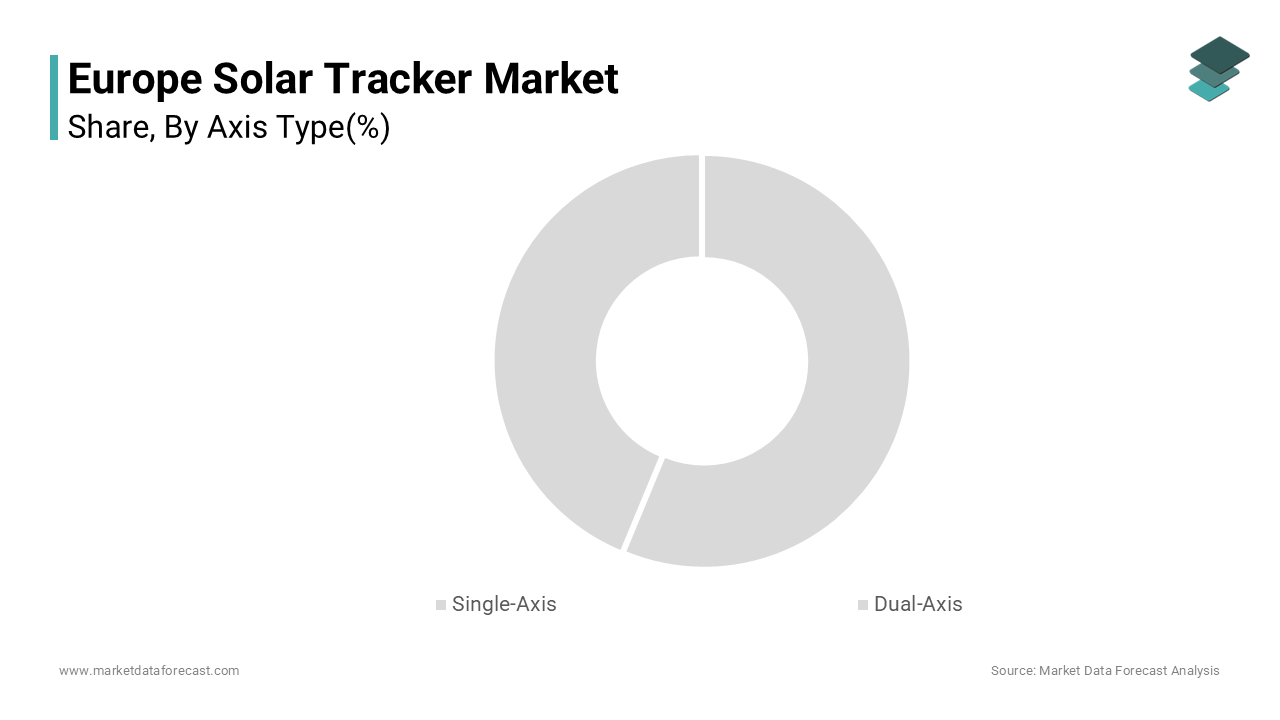
The single axis segment is also the fastest growing in the Europe solar tracker market with a projected CAGR of 21.96% from 2025 to 2033 owing to the declining system costs and increasing policy emphasis on land use efficiency. The European Commission’s Solar Energy Strategy explicitly encourages technologies that boost energy yield per square meter to minimize agricultural displacement a directive that inherently favors single axis trackers. In Germany, where land prices exceed 30000 euros per hectare for developable plots solar project economics now hinge on maximizing output density, which single axis systems achieve without the complexity of dual axis alternatives. Additionally, advancements in terrain following designs, such as Nextracker’s NX Horizon XTR enable deployment on sloped or uneven sites previously deemed unsuitable expanding the addressable land pool. According to the European Photovoltaic Industry Association, the average installed cost of single axis trackers fell between 2022 and 2024 due to economies of scale and localized manufacturing. Coupled with rising power purchase agreement values like France and the Netherlands, this cost performance trajectory ensures sustained high growth even as the segment scales.
REGIONAL ANALYSIS
Germany Solar Tracker Market Analysis
Germany was the largest contributor of the Europe solar trackers market by capturing 24.3% of share in 2024 with its aggressive solar expansion targets and structural shift away from fossil and nuclear energy. The country aims to install two hundred gigawatts of solar capacity by 2030 requiring high yield solutions on limited available land. German developers increasingly adopt single axis trackers to enhance per hectare generation especially in repurposed industrial zones like Lusatia. Homegrown manufacturers such as Ideematec and Deger Energie drive innovation with locally engineered trackers featuring snow sensors wind resilience up to 180 kilometers per hour and adaptive back tracking algorithms. The federal government’s removal of value added tax on solar storage and tracking systems in 2023 further improved project economics. These policy technological and spatial factors position Germany not only as a volume leader but as a strategic hub for tracker R&D and deployment.
Spain Solar Tracker Market Analysis
Spain ranked second by holding 18.7% of the European solar tracker market share in 2024 with its exceptional solar resources and rapid utility scale project pipeline. The country’s high direct normal irradiance averaging over 2000 kilowatt hours per square meter annually makes tracker adoption highly cost effective. The government’s National Integrated Energy and Climate Plan targets renewable electricity by 2030 accelerating auction-based deployments in regions like Extremadura and Andalusia. International developers including Ib Vogt have selected advanced terrain following trackers like Nextracker’s XTR for complex sites, such as the Garnacha solar plant. Spain also benefits from streamlined permitting in designated solar zones where tracker projects receive priority grid access. These natural regulatory and market advantages solidify Spain’s role as Europe’s high irradiance solar powerhouse.
France Solar Tracker Market Analysis
France solar tracker market growth is likely to grow with its strategic pivot toward solar energy amid nuclear maintenance challenges and decarbonization mandates. The country’s Energy Transition Law sets a goal of one hundred gigawatts of solar by 2050 with aggressive intermediate targets driving near term deployment. According to the French Ministry for Ecological Transition, solar capacity were added in 2024 with tracker usage rising in ground mounted projects over 10 megawatts. French innovators like Luciole & Basilic are advancing next generation tracking algorithms that reportedly improve energy capture by up to 12% over conventional systems as announced in April 2023. Additionally, France’s agrivoltaic policy framework actively promotes elevated single axis trackers that allow dual land use for crops and energy generation unlocking agricultural parcels previously excluded from solar development.
Italy Solar Tracker Market Analysis
Italy solar tracker market growth is likely to be driven by the strong solar irradiance southern land availability and supportive incentives under the National Recovery and Resilience Plan. The country benefits from over 1700 kilowatt hours per square meter of annual solar irradiation, particularly in Puglia and Sicily, where tracker equipped plants achieve capacity factors, according to the Italian Energy Authority. In 2024, Italy auctioned three gigawatts of solar capacity with bid evaluations explicitly rewarding technologies that increase energy density per hectare that favors single axis trackers. Developers are also repurposing decommissioned industrial sites, such as former steel plants in Taranto for high yield solar farms using tracking systems to offset irregular terrain.
United Kingdom Solar Tracker Market Analysis
The United Kingdom solar tracker market growth is anticipated to grow with the moderate solar resources with the corporate power purchase agreements and the government’s commitment to decarbonize the grid by 2035. In 2024, the UK added over 1.5 gigawatts of solar capacity with tracker usage concentrated in large scale projects in East Anglia and Yorkshire, where land is more available. The Contracts for Difference scheme is now includes specific strike prices for tracked solar projects recognizing their higher capacity factors. According to the UK Solar Trade Association, tracker equipped plants in southern England generate up to 22% more annual energy than fixed systems due to improved winter sun capture at higher latitudes. Additionally, the National Grid’s recent grid code updates facilitate faster curtailment response from tracked arrays enhancing system stability.
COMPETITIVE LANDSCAPE
Competition in the Europe solar tracker market is characterized by a blend of technological differentiation regional specialization and strategic alignment with policy frameworks. While the market features both global and European headquartered players it remains moderately consolidated with leaders competing on reliability performance under extreme weather and digital capabilities rather than price alone. German and Spanish manufacturers leverage local engineering expertise to address latitude specific challenges such as low angle winter sun and high wind loads. International firms like Nextracker gain traction through terrain following innovations that unlock previously unusable sites. The regulatory environment including land use restrictions and grid code requirements raises the technical bar favoring established players with proven compliance records. At the same time the EU’s push for clean tech sovereignty is encouraging localization of supply chains and software development.
KEY MARKET PLAYERS
Some of the companies that are playing a dominating role in the Europe Solar Tracker Market include
- Arctech Solar
- Ideematec
- Nextracker Inc.
- Soltec Power Holdings SA
- Array Technologies
- Convert Italia
- DCE Solar
- PV Hardware
- Solar Flexrack
- Mechatron.
Top Players in the Europe Solar Tracker Market
Nextracker Inc
Nextracker Inc is a global leader in intelligent solar tracking solutions with significant penetration across Europe’s utility scale solar sector. The company supplies its terrain following NX Horizon XTR trackers to complex sites where conventional systems underperform. In Europe Nextracker has partnered with major developers like Ib Vogt to deploy advanced tracking technology in Spain and Germany enabling solar farms on sloped or ecologically sensitive land. The company actively supports EU decarbonization goals by enhancing energy yield without expanding land use. Recent actions include localized technical support centers in Madrid and Berlin to accelerate commissioning and maintenance response. Nextracker’s commitment to digital integration through its NX Navigator software platform also aligns with Europe’s push for grid responsive and data transparent renewable assets reinforcing its strategic relevance in the region.
Ideematec
Ideematec is a German engineered solar tracker manufacturer renowned for high performance systems tailored to Central and Northern European climates. The company contributes globally by exporting its wind resilient and snow adaptive tracking solutions to markets with extreme weather conditions. In Europe Ideematec has strengthened its footprint through innovations like the one in portrait horizontal single axis tracker capable of withstanding winds up to one hundred and eighty kilometers per hour and integrating snow sensors for automatic stow. It actively collaborates with German research institutes to refine astronomical algorithms and 3D back tracking for higher latitudes. Recent initiatives include expanding production capacity in Bavaria to meet surging demand from repurposed lignite mining sites. These actions position Ideematec as a key enabler of Germany’s solar transition with exportable engineering excellence.
Soltec Power Holdings SA
Soltec Power Holdings SA is a Spain based solar tracker manufacturer with deep roots in Southern Europe and expanding global operations across Latin America, and Asia. The company specializes in single axis tracking systems optimized for high irradiance environments and offers end to end engineering support for large scale photovoltaic plants. In Europe, Soltec has reinforced its leadership by delivering trackers for gigawatt scale projects in Spain, Italy, and Greece often in conjunction with agrivoltaic and brownfield redevelopment schemes. Recently, the company enhanced its SFOne tracker with real time wind monitoring and predictive stow capabilities compliant with European grid code requirements. It also established a digital operations center in Murcia to provide remote diagnostics and performance optimization.
Top Strategies Used by the Key Market Participants
Key players in the Europe solar tracker market pursue distinct yet convergent strategies to strengthen their positions. They prioritize product innovation by developing terrain adaptive and weather resilient tracking systems suited to Europe’s diverse geography. Companies invest in localized manufacturing and service hubs to reduce lead times and ensure rapid post installation support. Strategic partnerships with European solar developers and engineering procurement contractors facilitate early integration into project design phases. Firms also embed digital intelligence through cloud-based monitoring and control platforms to enable grid compliance and predictive maintenance. Additionally, leading manufacturers actively engage with EU regulatory bodies to align product standards with sustainability land use and grid stability mandates their role as strategic clean energy enablers.
MARKET SEGMENTATION
This research report on the europe solar tracker market has been segmented and sub–segmented into the following categories.
By Axis Type
- Single-Axis
- Dual-Axis
By Country
- UK
- France
- Spain
- Germany
- Italy
- Russia
- Sweden
- Denmark
- Switzerland
- Netherlands
- Turkey
- Czech Republic
- Rest of Europe