- Product Description Description
- Table of Contents TOC
- List of Table & Figure LOT
- Get Free Sample PDF Sample PDF
Market Size, 2025
$258.33 MnMarket Estimate, 2026
$271.43 MnMarket Forecast, 2034
$403.17 MnCAGR, 2026–2034
5.07%Europe Sorghum Market Size, Growth Drivers, and Forecast (2025–2034)
- Market Scope: Comprehensive European regional industry analysis covering grain types, application verticals, country-level breakdowns, and adoption metrics across gluten-free foods, sustainable livestock feed, and bioenergy.
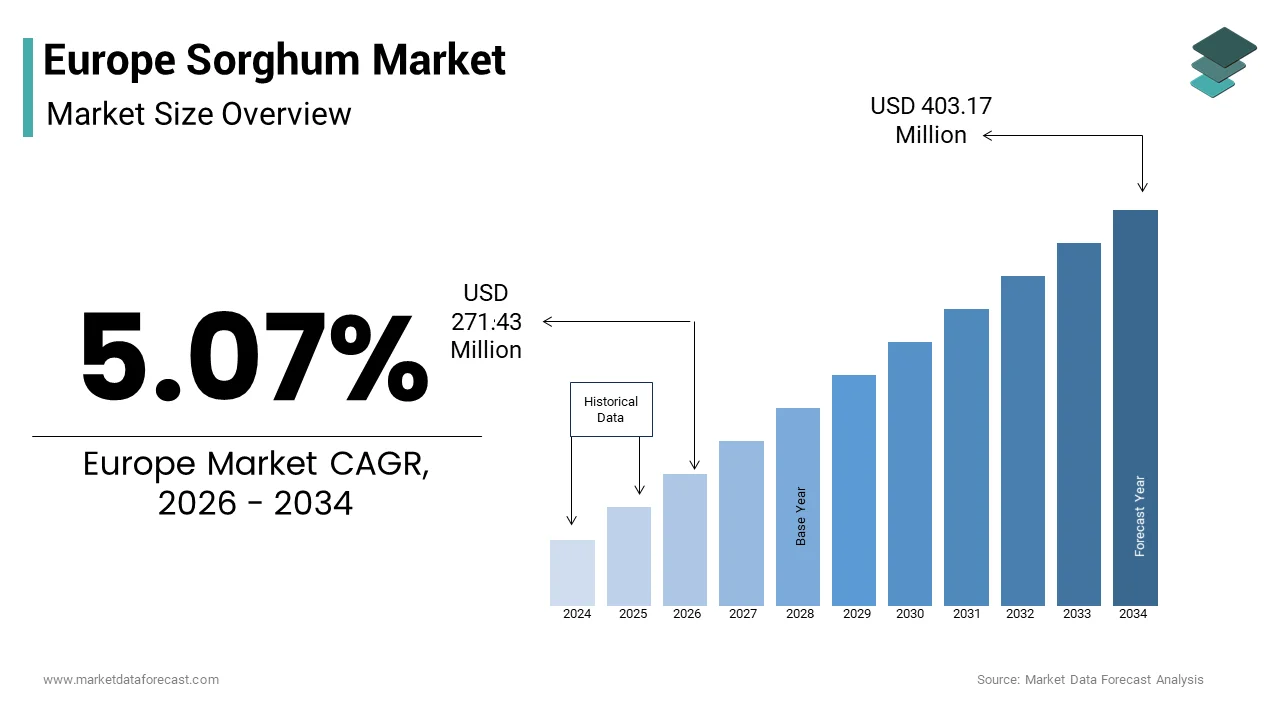
- Market Valuation: Valued at USD 258.33 million in 2025, estimated at USD 271.43 million in 2026, and projected to reach USD 403.17 million by 2034, registering a steady CAGR of 5.07% from 2026 to 2034.
- Primary Growth Drivers: Rising consumer demand for gluten-free cereal alternatives (affecting ~7 million celiac individuals in Europe), structural expansion of sustainable livestock feed solutions due to sorghum's low water footprint compared to maize, and alignment with EU climate-smart agricultural policies.
Europe Sorghum Market Segment Metrics (2026–2034)
| Category | Leading Segment (2025 Position) | Fastest-Growing Segment |
|---|---|---|
| By Type | Grain Sorghum (holding significant share via dual utility in animal nutrition and human food) | Sweet Sorghum (projected to expand at a 9.3% CAGR driven by RED III biofuel frameworks) |
| By Application | Animal Feed (dominant sector mitigating supply risks and lowering carbon footprint for poultry/pigs) | Human Consumption (projected to grow at an 11.2% CAGR for certified gluten-free foods) |
| By Country | France (held 28.3% share in 2024 via integrated feed systems and strong protein crop plans) | Germany & Italy (fueled by plant-based protein innovations and celiac-focused functional foods) |
Europe Sorghum Market Players & Industry Structure
Market Structure: Moderately competitive European landscape featuring specialized seed developers and multinational agribusinesses competing on non-GMO hybrid performance, drought tolerance, and regional value-chain integration.
Key Companies: KWS SAAT SE Co KGaA, Limagrain, Bayer AG, National Sweet Sorghum Producers & Processors Assn, Shri Lal Mahal Group, Sorghum Forum of South Africa, National Sorghum Producers, Mabele Fuels, Richardson Seeds, DuPont, and Advanta Seeds.
 Download Free Sample Report
Europe Sorghum Market Size
The Europe sorghum market size was valued at USD 258.33 million in 2025 and is projected to reach USD 271.43 million in 2026 to reach USD 403.17 million by 2034, growing at a CAGR of 5.07% during the forecast period from 2026 to 2034.
Sorghum is a resilient cereal grain with origins in Africa and Asia, has progressively gained traction across European agricultural and industrial sectors due to its drought tolerance, low input requirements, and versatile end uses. In Europe, sorghum is primarily cultivated for animal feed, bioethanol production, and increasingly as a gluten free ingredient in human food. The European Commission’s Farm to Fork Strategy emphasizes crop diversification as a pillar of agroecological transition, indirectly supporting sorghum adoption. Additionally, as per the Food and Agriculture Organization of the United Nations, global sorghum production reached 61.2 million metric tons in 2023, with European output concentrated in southern member states such as France, Italy, and Spain, where summer temperatures and irrigation infrastructure align with sorghum’s agronomic needs.
MARKET DRIVERS
Growing Demand for Gluten Free Cereal Alternatives
Consumer awareness of gluten related disorders and the rising prevalence of celiac disease for naturally gluten free grains, with sorghum emerging as a nutritionally robust and functional option. The growing demand for gluten free cereal alternatives is majorly propelling the growth of Europe sorghum market. Celiac disease affects approximately 1% of the European population, equivalent to over 7 million individuals, according to data published by the European Society for Paediatric Gastroenterology Hepatology and Nutrition. This underpins a sustained market need for safe grain alternatives beyond rice and maize, both of which face allergenic and glycemic concerns. Sorghum offers high levels of antioxidants, polyphenols, and complex carbohydrates by aligning with health-conscious dietary trends. The European Food Safety Authority acknowledges sorghum as inherently gluten free, making it suitable for certified gluten free product development. France has emerged as a key processor, with domestic food manufacturers incorporating sorghum flour into breads, snacks, and infant cereals to meet regulatory and nutritional benchmarks. This dietary shift is further amplified by the European Union’s harmonized standards for gluten free labeling, which require products to contain less than 20 parts per million of gluten, thereby incentivizing ingredient transparency and sorghum integration.
Expansion of Sustainable Livestock Feed Solutions
The livestock sector is undergoing a structural transformation toward environmentally sustainable feed formulations, and sorghum’s high energy content and low water footprint position it as a compelling alternative to maize and soy. This factor is likely to elevate the growth of Europe sorghum market. Maize cultivation in Europe consumes an average of 500 to 800 cubic meters of water per ton of grain, whereas sorghum requires up to 30% less irrigation under comparable climatic conditions. In 2023, France produced over 350,000 metric tons of grain sorghum, primarily destined for poultry and pig feed, where its starch digestibility matches that of maize without the associated mycotoxin risks prevalent in humid growing zones. Italy and Spain have also increased sorghum inclusion rates in ruminant and monogastric diets, supported by the European Feed Manufacturers’ Federation’s guidelines on non-genetically modified protein sources. Sorghum, often grown in rotation with legumes, contributes to this strategy by improving soil health and lowering synthetic nitrogen demand.
MARKET RESTRAINTS
Limited Cultivation Infrastructure and Agronomic Expertise
The underdeveloped cultivation infrastructure and a scarcity of region specific agronomic knowledge among farmers is limiting the growth of Europe sorghum market. As per assessments by FranceAgriMer, fewer than 15% of arable farms in the European Union have ever planted sorghum, with seed distribution networks confined largely to southern regions. This geographic concentration limits scalability, especially in Central and Eastern Europe where soil suitability exists but farmer adoption lags. The lack of high yielding, early maturing, and disease resistant cultivars tailored to temperate European climates restricts yield potential and increases production risk. Additionally, advisory services rarely include sorghum in crop rotation planning or pest management guides, leaving growers without critical decision support tools.
Regulatory Ambiguity in Biofuel Feedstock Classification
The inconsistent and evolving regulatory frameworks that fail to clearly differentiate its sustainability credentials from those of food competing crops is also limiting the growth of Europe sorghum market. Under the European Union’s Renewable Energy Directive II, only advanced biofuels derived from non-food feedstocks qualify for double counting toward the 14% renewable energy target in transport by 2030. However, grain sorghum is often classified alongside conventional starch crops like wheat and maize, despite its lower lifecycle greenhouse gas emissions and marginal land adaptability. According to the European Environment Agency, sorghum-based ethanol can achieve up to a 60% reduction in greenhouse gas emissions compared to fossil fuels, surpassing the 50% threshold required for conventional biofuels. In Italy, sorghum ethanol has been excluded from incentive programs because it is not listed among the approved feedstocks under the country’s National Renewable Energy Action Plan. Similarly, the European Commission’s delegated acts on high indirect land use change risk feedstocks have created uncertainty, as sorghum’s risk profile remains unassessed due to limited production data. This regulatory limbo discourages investment in sorghum based biorefineries and deters contract farming arrangements.
MARKET OPPORTUNITIES
Surge in Plant Based and Alternative Protein Food Innovation
The accelerating shift toward plant-based diets act as a functional and sustainable ingredient in next generation food products is creating new opportunities for the growth of the Europe sorghum market. Sorghum contains 9 to 11% protein by weight and offers a balanced amino acid profile when combined with legumes, which is making it suitable for meat analogs, dairy substitutes, and ready to eat meals. Startups in the Netherlands and Sweden are already commercializing sorghum based protein concentrates using dry fractionation techniques that avoid chemical solvents, appealing to eco conscious consumers. Additionally, sorghum’s neutral flavor and high thermal stability allow it to be extruded into fibrous textures mimicking meat, a requirement for product acceptance.
Integration into Climate Smart Agricultural Policies
Sorghum’s compatibility with climate smart agriculture principles is additionally to fuel the growth of the Europe sorghum market. The European Green Deal’s Climate Adaptation Strategy explicitly endorses the cultivation of drought tolerant crops to enhance agricultural resilience, and sorghum aligns precisely with this objective. Spain’s Ministry for Ecological Transition has included sorghum in its 2024 National Drought Plan as a recommended rotational crop for irrigated systems in Andalusia and Murcia, regions that account for over 25% of the country’s arable land. Similarly, the Common Agricultural Policy’s eco schemes now provide direct payments to farmers who diversify into non- traditional crops that reduce irrigation pressure, with sorghum eligible under France’s “Crop Diversification Bonus.” Pilot programs in Greece and Portugal are testing sorghum intercropping with olive groves and vineyards to suppress weeds and improve soil organic matter. These initiatives are not only reducing input costs but also generating carbon credits under voluntary market mechanisms.
MARKET CHALLENGES
Competition from Established Cereals in Traditional Markets
Sorghum faces entrenched competition from wheat barley and maize in Europe’s food and feed sectors, where decades of policy support, supply chain integration, and consumer familiarity create formidable barriers to entry. The competition from established cereals in traditional Maize alone accounts for over 60 million metric tons of annual EU production, benefiting from extensive storage infrastructure, futures trading on Euronext, and well-established processing facilities for starch and ethanol. This logistical gap translates into higher handling costs and delivery delays, deterring large scale buyers. Even in animal feed, where sorghum’s nutritional profile is comparable, compound feed mills resist reformulating rations due to the need for recalibrating mixing equipment and conducting new digestibility trials. Furthermore, sorghum’s price volatility driven by small trade volumes and limited futures hedging that adds financial risk that integrated agribusinesses prefer to avoid.
Lack of Standardized Quality Metrics and Market Transparency
The absence of harmonized quality standards and transparent pricing mechanisms for sorghum across Europe undermines buyer confidence and limits commercial scalability. The lack of standardized Unlike wheat, which is traded under strict EU regulations defining protein content, hectoliter weight, and mycotoxin limits, sorghum lacks a unified grading system recognized across member states. This inconsistency complicates cross border transactions and discourages processors from committing to long term supply contracts. Additionally, sorghum is not listed on major European commodity exchanges, resulting in opaque spot markets where prices are negotiated bilaterally and often reflect local supply gluts rather than intrinsic value. According to a 2024 study by the Agricultural Economics Institute in Bonn, over 60% of sorghum growers in Southern Europe were unaware of prevailing regional prices at harvest time, leading to suboptimal sales timing. The European Commission’s Market Observatory for Arable Crops does not publish weekly sorghum price bulletins, unlike for barley or rye, further marginalizing the crop in policy monitoring frameworks.
REPORT COVERAGE
| REPORT METRIC | DETAILS |
| Market Size Available | 2025 to 2034 |
| Base Year | 2025 |
| Forecast Period | 2026 to 2034 |
| CAGR | 5.07% |
| Segments Covered | By Type, Application, and Region |
| Various Analyses Covered | Global, Regional and Country Level Analysis; Segment-Level Analysis; DROC; PESTLE Analysis; Porter’s Five Forces Analysis; Competitive Landscape; Analyst Overview of Investment Opportunities |
| Regions Covered | UK, France, Spain, Germany, Italy, Russia, Sweden, Denmark, Switzerland, Netherlands, Turkey, the Czech Republic, and the Rest of Europe |
| Market Leaders Profiled | National Sweet Sorghum Producers & Processors Assn, Shri Lal Mahal Group, Sorghum Forum of South Africa, National Sorghum Producers, Mabele Fuels, Richardson Seeds, DuPont, Advanta Seeds. |
SEGMENTAL ANALYSIS
By Type Insights
The grain segment was accounted in holding a significant share of the Europe sorghum market in 2024 from its dual utility in animal nutrition and emerging applications in human food and industrial ethanol. Grain sorghum serves as a direct substitute for maize in compound feed due to its comparable metabolizable energy of 3,300 to 3,400 kilocalories per kilogram. In France, over 80% of domestically produced grain sorghum is channelled into feed mills supporting the nation’s 184 million broiler production cycle annually. The crop’s low tannin hybrid varieties minimize anti nutritional effects by enhancing palatability and feed conversion ratios. The Common Agricultural Policy’s eco scheme component allocates direct payments to farmers adopting crop diversification measures, which is explicitly listing sorghum as an eligible crop in at least eight member states. These incentives have increased the area under grain sorghum by 19% in the EU since 2020, according to Eurostat’s crop statistics.
The sweet sorghum is projected to expand at a CAGR of 9.3% from 2025 to 2033. Under the revised Renewable Energy Directive III, member states must ensure that 29% of transport energy comes from renewable sources by 2030, with specific quotas for advanced biofuels. As per the Joint Research Centre, pilot biorefineries in Murcia and Sicily achieved net energy ratios of 4.2 in 2023, significantly higher than first generation wheat ethanol. Sweet sorghum syrup has a glycemic index of 50, markedly lower than glucose syrup at 100. In 2023, over 28 new product launches in Germany and the Netherlands featured sweet sorghum syrup in energy bars and dairy alternatives.
By Application Insights
The animal feed application segment was accounted in holding a dominant share of the Europe sorghum market in 2024. The European Union imports over 18 million metric tons of maize annually, primarily from Ukraine and Brazil, exposing feed mills to geopolitical and climatic disruptions. Sorghum’s protein content of 10 to 12% and starch digestibility of 95%, as verified by the European Reference Laboratory for Feed Additives, make it a near perfect maize substitute in poultry rations without requiring enzyme supplementation. Dairy and pork producers under the EU’s Farm Sustainability Tool for Nutrients are required to document feed origin and carbon footprint.
The human consumption segment is projected to grow at a CAGR of 11.2% throughout forecast period. The European Union’s regulation EC No 41 2009 establishes a legal threshold of 20 parts per million for gluten in foods labeled “gluten free.” Sorghum naturally meets this standard and is increasingly used in certified products. In response, the number of gluten free breads using sorghum flour in France and Italy grew by 52% between 2021 and 2023. This has spurred partnerships between Italian agrifood startups and sports nutrition brands, with sorghum protein isolates featured in 17 new recovery beverages launched in Germany and the Netherlands in 2024.
REGIONAL ANALYSIS
France Sorghum Market Analysis
France sorghum market was accounted in holding 28.3% of share in 2024 by integrated feed systems, favorable agroclimatic conditions in the southwest, and proactive policy support. The country produced over 370,000 metric tons of grain sorghum in 2023 in the regions of Nouvelle Aquitaine and Occitanie, where summer temperatures and irrigation from the Garonne River sustain high yields. The French Ministry of Agriculture’s “Protein Crop Plan” provides 220 euros per hectare for sorghum cultivation under crop diversification contracts. Additionally, France’s ethanol industry, led by Tereos and Cristal Union, is exploring dual use biorefineries that process both grain and sweet sorghum, creating a resilient value chain.
Spain Sorghum Market Analysis
Spain sorghum market was positioned second by holding 21.2% of share in 2024 with production concentrated in Castilla y León, Andalusia, and Aragón. In 2023, Spain harvested 260,000 hectares of sorghum, yielding 290,000 metric tons. The country’s semi-arid climate and water scarcity have made sorghum a strategic alternative to maize, which consumes 35% more irrigation. Under Spain’s National Drought Plan 2024, sorghum is designated a “priority resilient crop,” qualifying farmers for 100% subsidy on drip irrigation installation. Moreover, experimental sweet sorghum plots in Murcia achieved ethanol yields of 4,100 liters per hectare in 2023 trials conducted by the Institute for Sustainable Agriculture, positioning Spain as a future hub for biofuel diversification.
Italy Sorghum Market Analysis
Italy sorghum market growth is likely to grow with cultivation focused in Emilia Romagna, Lombardy, and Puglia. The country’s in organic and specialty grains has interest in tannin free sorghum varieties for gluten free pasta and bakery applications. Over 70 pasta manufacturers in southern Italy now incorporate sorghum flour to meet demand from the 3.2 million celiac consumers in the EU Mediterranean region. Additionally, Italy’s poultry sector the largest in the EU with 780 million birds slaughtered annually that uses sorghum to reduce reliance on Ukrainian maize. Pilot projects integrating sorghum into biogas co digestion with livestock manure, led by CRPA Foundation, further diversify its utility, solidifying Italy’s multifaceted market role.
Germany Sorghum Market Analysis
Germany sorghum market growth is likely to grow with the functional food and alternative protein innovation rather than traditional feed use. According to the German Federal Ministry of Food and Agriculture, over 120 food startups incorporated sorghum into product formulations in 2023, focusing on plant-based meats, infant cereals, and sports nutrition. The Technical University of Munich’s 2024 study confirmed that sorghum extrudates mimic meat fiber structure more effectively than pea protein, driving B2B ingredient sales. Germany’s strict Novel Food regulations have been navigated successfully by companies like Beneo, which received EFSA approval for sorghum resistant starch in 2022. Consumer surveys by GfK show that 38% of German adults actively seek gluten free or ancient grain products, creating fertile ground for sorghum.
COMPETITIVE LANDSCAPE
The Europe sorghum market exhibits moderate competition characterized by a mix of specialized seed companies and multinational agribusinesses. Unlike commodity cereals dominated by vast trading and processing conglomerates sorghum remains a niche crop with fragmented supply chains and limited large scale infrastructure. Competition centers less on price and more on agronomic support variety performance and end market connectivity. Leading participants differentiate themselves through region specific hybrid development digital farming tools and strategic alliances with cooperatives ethanol producers and food manufacturers. Barriers to entry remain high due to the need for localized breeding programs and regulatory navigation particularly under EU seed marketing and novel food frameworks.
KEY MARKET PLAYERS
Some of the notable key players in the Europe sorghum market are
- National Sweet Sorghum Producers & Processors Association
- Shri Lal Mahal Group
- Sorghum Forum of South Africa
- National Sorghum Producers
- Mabele Fuels
- Richardson Seeds
- DuPont
- Advanta Seeds
TOP STRATEGIES USED BY THE KEY MARKET PLAYERS
Key players in the Europe sorghum market primarily focus on genetic innovation through non GMO hybrid development to enhance yield stability and stress tolerance. They actively engage in public private partnerships with agricultural research institutes to validate performance under diverse European agroclimatic zones. Strategic alignment with EU sustainability policies such as the Common Agricultural Policy and Farm to Fork Strategy enables access to eco scheme funding and farmer incentives. Companies also invest in demonstration farms and extension services to build farmer confidence and reduce knowledge gaps. Additionally, they diversify end use applications by collaborating with food feed and biofuel processors to create integrated value chains that support consistent offtake and price stability.
TOP PLAYERS IN THE MARKET
- KWS SAAT SE Co KGaA is a leading European seed company with a strong focus on sorghum genetics and breeding tailored for temperate and Mediterranean climates. The company has intensified its research and development efforts to launch high yielding non-GMO sorghum hybrids that exhibit improved drought tolerance and early maturity. In recent years KWS has expanded its sorghum variety portfolio across France Spain and Italy through strategic partnerships with local agricultural cooperatives. It has also invested in field demonstration networks to showcase agronomic performance under real farming conditions.
- Limagrain is a major agricultural cooperative and seed producer deeply involved in the European sorghum value chain through its grain and forage hybrid programs. The company leverages its extensive distribution network across Southern Europe to supply adapted sorghum varieties to livestock and bioenergy sectors. Limagrain recently launched new tannin free grain sorghum hybrids designed specifically for poultry and human nutrition applications. It has also collaborated with ethanol producers in Italy and Spain to test sweet sorghum feedstocks under regional growing conditions.
- Bayer AG contributes to the Europe sorghum market through its crop science division which provides seed treatment solutions and digital agronomic advisory tools for sorghum growers. Although Bayer does not specialize exclusively in sorghum it supports its cultivation via integrated pest management and soil health platforms that enhance crop performance. Recently the company expanded its Climate FieldView digital offering to include sorghum specific planting and nutrient recommendations for French and Spanish farmers. Bayer has also partnered with research institutions to evaluate sorghum’s role in carbon farming and regenerative agriculture pilots. These actions reflect its strategy to embed sorghum within broader sustainable agriculture portfolios rather than as a standalone commodity.
MARKET SEGMENTATION
This research report on the European sorghum market is segmented and sub-segmented into the following categories.
By Type
- Grain Sorghum
- Forage Sorghum
- Biomass Sorghum
- Sweet sorghum
By Application
- Human Consumption
- Animal Feed
By Country
- UK
- France
- Spain
- Germany
- Italy
- Russia
- Sweden
- Denmark
- Switzerland
- Netherlands
- Turkey
- Czech Republic
- Rest of Europe