Europe Space Launch Services Market Size, Share, Trends, & Growth Forecast Report By Orbit Type (LEO, MEO, GEO, Others), Launch Vehicle, Payload and Country (UK, France, Spain, Germany, Italy, Russia, Sweden, Denmark, Switzerland, Netherlands, Turkey, Czech Republic and Rest of Europe), Industry Analysis From 2025 to 2033
Europe Space Launch Services Market Report Summary
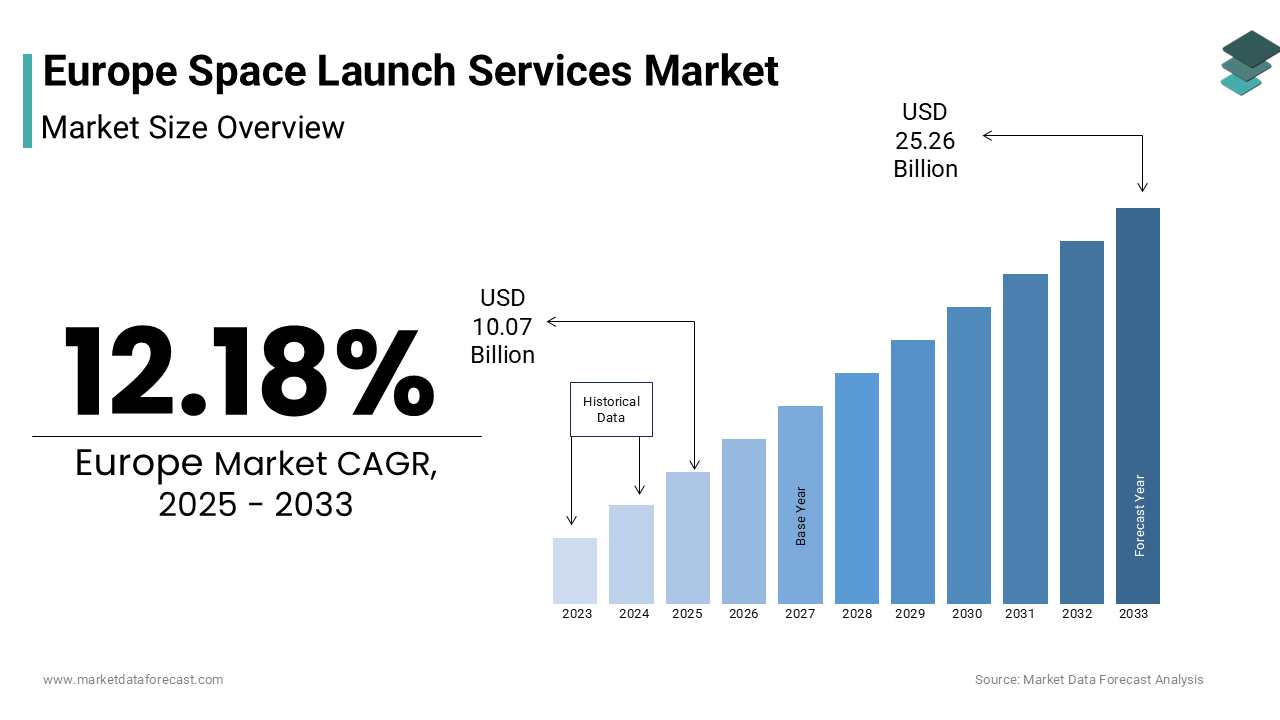
The Europe space launch services market was valued at USD 8.98 billion in 2024, is expected to reach USD 10.07 billion in 2025, and is projected to grow to USD 25.26 billion by 2033, registering a CAGR of 12.18% during the forecast period from 2025 to 2033. Market growth is driven by Europe’s strategic push for sovereign access to space, rising institutional and defense demand, and the rapid expansion of small satellite constellations for Earth observation, secure connectivity, and scientific missions. Increasing geopolitical uncertainty and reduced tolerance for reliance on non-European launch providers have elevated launch services from a commercial function to a core strategic capability under EU and ESA policy frameworks.
Key Market Trends
- Strong policy focus on European strategic autonomy in space access under EU and national defense strategies.
- Rapid growth of small satellite constellations driving demand for responsive and flexible launch services.
- Expansion of New Space launch startups offering dedicated small-lift missions from European soil.
- Rising institutional investment in green propulsion and sustainable launch technologies aligned with the European Green Deal.
- Gradual harmonization of launch regulations under EASA, improving cross-border operational feasibility.
Segmental Insights
- Based on orbit type, the Low Earth Orbit (LEO) segment dominated the Europe space launch services market in 2024. This dominance is attributed to the high volume of Earth observation, communications, IoT, and defense-related satellite deployments that require low-latency and cost-efficient orbits.
- By launch vehicle, the medium lift segment held the largest market share in 2024, supported by institutional missions such as Galileo navigation satellites, Copernicus Earth observation platforms, and defense payloads that demand high reliability and assured European-origin launch capacity.
- The small lift segment is expected to grow at the fastest CAGR over the forecast period, driven by urgent demand for responsive, dedicated launches for micro- and nanosatellites and growing procurement from European defense and New Space customers.
Regional Insights
- France led the Europe space launch services market in 2024, supported by its stewardship of the Guiana Space Centre, leadership in Ariane launcher programs, and strong institutional policy backing for European launch sovereignty.
- Germany followed as a key contributor, driven by its industrial base, substantial ESA funding contributions, and the emergence of launch startups such as Isar Aerospace and Rocket Factory Augsburg.
- Spain, the United Kingdom, and Sweden are emerging as high-growth regions due to investments in new launch sites, regulatory agility, and increasing defense-driven demand for responsive launch capabilities.
Competitive Landscape
The Europe space launch services market features a dual competitive structure combining legacy institutional providers with agile New Space entrants. Market competition is shaped less by price and more by sovereignty, reliability, and regulatory alignment. ArianeGroup and Arianespace dominate medium and heavy-lift institutional missions, while startups such as Isar Aerospace, PLD Space, Rocket Factory Augsburg, Orbex, and Skyrora are reshaping the small-lift segment. Public–private partnerships, ESA certification for institutional missions, and alignment with EU security and sustainability priorities are critical success factors. Overall, competitive advantage is determined by launch reliability, cadence, European origin, and integration into civil, defense, and scientific space programs. Key players operating in the Europe space launch services market include Arianespace, ArianeGroup, Avio S.p.A., Isar Aerospace, Rocket Factory Augsburg, MaiaSpace, PLD Space, Orbex, Skyrora, HyImpulse Technologies, and Latitude.
Europe Space Launch Services Market Size
The europe space launch services market size was valued at USD 8.98 billion in 2024 and is anticipated to reach USD 10.07 billion in 2025 from USD 25.26 billion by 2033, growing at a CAGR of 12.18% during the forecast period from 2025 to 2033.
Space launch services are the provision of orbital and suborbital launch capabilities for satellites scientific payloads and experimental missions operated by European public agencies private companies and international partners. Unlike commercial markets dominated by single entities Europe’s launch ecosystem is characterized by strategic autonomy objectives multi-national coordination through the European Space Agency and a deliberate shift toward responsive flexible and environmentally conscious access to space. The market operates within a complex geopolitical and technological landscape where dependence on non-European launch providers is increasingly viewed as a strategic vulnerability. According to the European Space Agency and the EU Space Programme, Europe will expand its flagship constellations between 2025 and 2030. As per the European Commission, the EU has committed €13.2 billion to space programs under the 2021–2027 Multiannual Financial Framework, supporting innovation, competitiveness, and autonomous access to space. Furthermore, the EU’s 2024 Space Strategy for Security and Defence identifies assured space access as a critical strategic domain, underscoring its importance for national security and sovereignty. These institutional imperatives position Europe’s launch services not as a commercial commodity but as a sovereign strategic asset in an era of orbital competition.
MARKET DRIVERS
Strategic Imperative for European Sovereign Access to Space
The political and security consensus that independent access to space is essential for national sovereignty, economic resilience, and defense autonomy is primarily driving the growth of the Europe space launch services market. The European Commission has acknowledged that Europe relied heavily on non‑European launch providers for institutional missions between 2015 and 2022, which is exposing vulnerabilities during geopolitical disruptions and export control shifts. This realization has catalyzed institutional action. The European Space Agency’s (ESA) Accelerator initiative, launched in 2023, allocated billions of euros to develop next‑generation European launchers such as Ariane 6 and Vega C, while supporting emerging small launch ventures. The European Defence Agency’s 2024 Space Strategy declared uninterrupted access to orbit a “critical military enabler,” which is prompting joint procurement of launch slots by France, Germany, and Italy for secure government payloads. National policies reinforce this shift. France’s 2024 Space Law mandates that defense and critical infrastructure satellites be launched on European or allied vehicles by 2027. Civil programs also align as Copernicus Earth observation missions now reserve a majority of their launch manifest for European vehicles. This convergence of defense, civil, and industrial policy transforms launch services from a logistical function into a pillar of Europe’s strategic autonomy.
Proliferation of Small Satellite Constellations and New Space Demand
The rapid deployment of small satellite constellations for Earth observation, IoT, and secure communications is generating unprecedented demand for flexible, frequent, and cost‑efficient launch services across Europe, which is further boosting the expansion of the European space launch services market. According to the estimations of ESA, hundreds of small satellites under 500 kilograms are scheduled for launch by European entities between 2025 and 2027, many requiring dedicated or rideshare missions. This shift is driven by both institutional and commercial actors. The European Commission’s IRIS² secure connectivity program alone will deploy hundreds of satellites by 2030, necessitating dozens of dedicated launches. Private New Space firms such as Unseenlabs and Kleos are scaling constellations for maritime surveillance and radio‑frequency intelligence as these activities deemed strategically vital by EU security bodies. These missions demand responsive launch windows and mid‑inclination orbits that legacy systems like Ariane 5 could not economically serve. In response, ESA certified three small launch providers or institutional missions in 2024, enabling tailored access from European soil. This New Space dynamism is reshaping Europe’s launch architecture toward agility, specialization, and sovereignty.
MARKET RESTRAINTS
Dependence on Non‑European Launch Providers and Geopolitical Vulnerability
A significant restraint on the Europe space launch services market is the historical reliance on foreign launch systems, which has exposed European missions to geopolitical and logistical risks. The European Court of Auditors reported that multiple institutional satellite launches were cancelled or delayed between 2022 and 2024 due to sanctions on Russian Soyuz vehicles and US export licensing uncertainties. The suspension of Soyuz launches from French Guiana in 2022 left Europe without a mid‑lift vehicle for over 18 months, which is creating a capability gap that forced ESA to broker emergency launches on SpaceX at premium costs. According to the estimations of the European Commission, this dependency cost EU programs hundreds of millions of euros in schedule delays and contractual penalties between 2022 and 2024. National security concerns persist as Germany’s export control authority documented that several satellite missions were denied US launch approval in 2024 due to ITAR restrictions on dual‑use technologies. Until European launch capacity achieves consistent reliability and cadence, this strategic vulnerability will continue to constrain program planning and erode institutional confidence in autonomous space access.
High Development Costs and Fragmented Industrial Coordination
The Europe space launch services market faces persistent financial and organizational challenges due to the enormous capital intensity of launcher development and the fragmented nature of its multinational industrial base. ESA confirms that the Ariane 6 program has incurred billions of euros in development costs, with per‑launch expenses remaining higher than global competitors due to low flight rates and legacy infrastructure. Industrial coordination remains suboptimal as hundreds of companies across more than 20 countries contribute to European launchers, often duplicating efforts or lacking economies of scale. The European Court of Auditors reported in 2024 that inconsistent national procurement rules and divergent technical standards increased integration costs across Ariane and Vega programs. Small launch startups face even steeper barriers. According to Eurospace, European New Space launch firms raise significantly less capital than their US counterparts due to risk‑averse public investment frameworks. Furthermore, Europe lacks a unified regulatory pathway for launch licensing as the European Aviation Safety Agency only began harmonizing launch safety rules in 2024 after years of national fragmentation. Until Europe achieves greater industrial consolidation, streamlined regulation, and sustainable public‑private financing, its launch sector will struggle to achieve cost competitiveness and rapid innovation cycles.
MARKET OPPORTUNITIES
Emergence of Responsive Small Launch Capabilities from European Soil
A major opportunity in the Europe space launch services market lies in the rapid maturation of domestic small launch providers offering dedicated, flexible, and sovereign access to orbit for institutional and commercial payloads. Companies such as Isar Aerospace, Rocket Factory Augsburg, and PLD Space are developing vehicles capable of launching satellites in the 300–1500 kg class from European launch sites including Andøya in Norway and El Arenosillo in Spain. According to the European Defence Agency, responsive small launch is now classified as a “strategic enabler” for rapid reconstitution of reconnaissance and communications satellites during crises. As per the European Space Agency, these three startups were certified for institutional missions in 2024, which is enabling guaranteed access without foreign dependencies. According to the European Innovation Council, €180 million was awarded in 2024 to scale their production and launch infrastructure. As per Eurospace, more than 60 European small satellites currently lack committed launch slots, underscoring pent‑up demand. By providing tailored mid‑inclination orbits, rapid integration, and European data control, these new entrants are transforming launch from a bottleneck into a strategic advantage.
Integration of Green Propulsion and Sustainable Launch Practices
The Europe space launch services market is positioned to lead in environmentally sustainable access to space through the adoption of non‑toxic propellants, renewable‑energy‑powered ground operations, and reusable technologies aligned with the European Green Deal. According to the European Environment Agency, traditional hypergolic fuels used in legacy launchers produce hazardous residues and high carbon footprints, prompting a regulatory shift toward cleaner alternatives. As per the German Aerospace Center, Rocket Factory Augsburg’s RFA One employs a closed‑cycle engine with significantly reduced particulate emissions. According to the European Space Agency, its Clean Space initiative allocated €220 million in 2024 to validate green propulsion systems and low‑impact launch site operations. As per the European Commission, the upcoming Space Sustainability Charter will mandate environmental impact disclosures for all publicly funded launches starting in 2026. According to a 2024 Eurobarometer survey, more than two‑thirds of Europeans support eco‑conscious space practices. Europe’s commitment to green launch not only meets regulatory imperatives but also differentiates its services in a global market increasingly scrutinized for ecological impact.
MARKET CHALLENGES
Lack of Operational Launch Infrastructure Within Mainland Europe
A persistent challenge facing the Europe space launch services market is the absence of active orbital launch sites on the European mainland, creating logistical complexity and geopolitical exposure. Currently, most European orbital launches depend on the Guiana Space Centre in French Guiana or emerging sites in Norway and Spain that are not yet fully operational for heavy‑lift missions. According to the European Space Agency, reliance on French Guiana introduces vulnerability to local political shifts, environmental restrictions, and transport dependencies. As per the European Commission’s Transport and Space Directorate, no EU member state currently possesses a fully autonomous orbital launch range with integrated safety telemetry and recovery zones. Until Europe establishes sovereign operational launch corridors on its own territory, its strategic autonomy in space will remain incomplete.
Workforce Shortages and Skills Gaps in Advanced Propulsion and Launch Operations
The Europe space launch services market confronts a critical shortage of engineers and technicians specialized in liquid propulsion, avionics, and range safety operations, which is limiting development velocity and operational cadence. According to Eurofound, the European space sector had more than 5,000 unfilled technical positions in 2024, with launch system roles among the most-scarce. As per the European Space Agency’s Education Office, fewer than 2,000 graduates annually specialize in propulsion or launch vehicle design across EU universities, which is well below projected needs by 2030. According to Germany’s Aerospace Industries Association, many launch startups delayed critical design reviews in 2024 due to difficulty hiring cryogenic engine specialists. As per the European Defence Agency’s 2024 workforce assessment, without coordinated reskilling initiatives Europe will lack the personnel to sustain even a modest launch cadence by 2027. Until Europe implements a unified space workforce strategy with cross‑border mobility and apprenticeship programs, this human capital gap will constrain the entire launch ecosystem’s growth and reliability.
REPORT COVERAGE
| REPORT METRIC | DETAILS |
| Market Size Available | 2024 to 2033 |
| Base Year | 2024 |
| Forecast Period | 2025 to 2033 |
| CAGR | 12.18% |
| Segments Covered | By Orbit Type, Launch Vehicle, Payload, and Region. |
| Various Analyses Covered | Global, Regional & Country Level Analysis, Segment-Level Analysis, DROC, PESTLE Analysis, Porter’s Five Forces Analysis, Competitive Landscape, Analyst Overview of Investment Opportunities |
| Regions Covered | United Kingdom, France, Spain, Germany, Italy, Russia, Sweden, Denmark, Switzerland, the Netherlands, Turkey, and the Czech Republic. |
| Market Leaders Profiled | Arianespace, ArianeGroup, Avio S.p.A., Isar Aerospace, Rocket Factory Augsburg (RFA), MaiaSpace, PLD Space, Orbex, Skyrora, HyImpulse Technologies, and Latitude |
SEGMENTAL ANALYSIS
By Orbit Type Insights
The Low Earth Orbit (LEO) segment commanded for the highest share of 61.6% of the European market share in 2024. The dominance of LEO segment in the European market is primarily driven by the explosive deployment of Earth observation, secure communications, and scientific microsatellite constellations requiring altitudes between 300 and 2000 kilometers. LEO’s proximity to Earth enables high resolution imaging, low latency data transmission, and reduced launch energy, which is making it the optimal domain for Europe’s strategic and commercial space ambitions. The growing institutional demand is further boosting the dominance of the LEO segment in this regional market. According to the European Space Agency, 82% of satellites scheduled for launch by European entities between 2024 and 2027 are destined for LEO, including the 30-satellite IRIS² secure connectivity constellation and the next generation of Copernicus Sentinel missions. As per the European Commission’s Copernicus program, 18 LEO satellites will be deployed by 2030 for climate monitoring and border surveillance. According to Unseenlabs, Kleos, and Sateliot, over 90 small satellites are planned for launch into LEO by 2026 for maritime domain awareness and IoT connectivity, activities classified as critical by the European Defence Agency. As per the European Environment Agency, 12 dedicated missions for real time pollution tracking were approved in 2024. This convergence of civil defense and commercial imperatives cements its dominance in Europe’s orbital architecture.
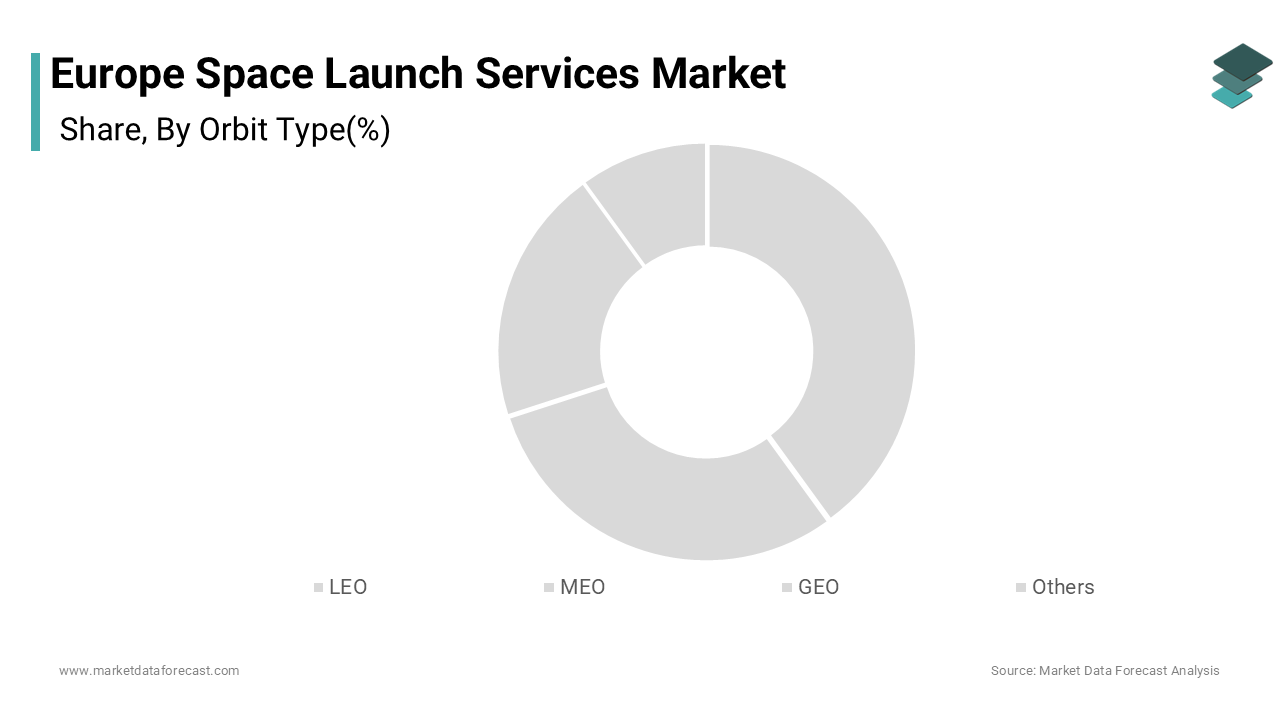
The Medium Earth Orbit segment is the fastest growing segment in the Europe space launch services market and is predicted to grow at a CAGR of 20.5% over the forecast period owing to the expansion of Europe’s sovereign navigation infrastructure, specifically the Galileo satellite navigation system, which operates at approximately 23,222 kilometers altitude. According to the European Commission, the second generation of Galileo satellites will require the launch of 24 satellites between 2026 and 2035 to enhance positioning accuracy, signal robustness, and resilience against jamming. As per the European Space Agency, all G2 satellites will be launched on European vehicles, primarily Ariane 6 and potentially future medium lift systems, to ensure strategic autonomy. According to the European Union Agency for the Space Programme, Galileo currently serves over 2.3 billion devices globally, and the G2 upgrade aims to achieve centimeter level accuracy for critical applications like autonomous vehicles and emergency response. Moreover, MEO offers superior signal coverage over polar regions compared to GEO, a strategic advantage for Arctic monitoring and defense. With no alternative orbits for high integrity navigation and full institutional backing, MEO’s growth is structurally guaranteed and directly tied to Europe’s commitment to technological sovereignty in positioning services.
By Launch Vehicle Insights
The medium lift segment occupied the largest share of 53.8% of the European market share in 2024. The dominance of medium lift segment in the European market is attributed to their role in deploying institutional flagship missions such as Galileo navigation satellites, Copernicus Earth observation platforms, and scientific probes that require payloads between 3000 and 10000 kilograms to LEO or MEO. These missions form the backbone of Europe’s civil and security space programs and demand high reliability over cost efficiency. The Ariane 62 and Vega C configurations serve this segment. According to the European Space Agency, 16 of the 22 institutional launches scheduled between 2024 and 2027 will use medium lift vehicles, including all Galileo G2 and Copernicus missions. As per the European Commission’s 2024 Space Strategy, medium lift capability is explicitly prioritized as “essential for strategic autonomy,” with 1.8 billion euros allocated to ensure Ariane 6 operational readiness. According to France’s Directorate General of Armaments, all future military optical reconnaissance satellites will be launched on Ariane 6 due to its certified payload security and European origin. Unlike small launchers, medium lift systems benefit from established industrial ecosystems, heritage reliability, and integration with the Guiana Space Centre’s proven infrastructure. This institutional entrenchment ensures medium lift remains the cornerstone of Europe’s launch architecture despite higher costs.
The small lift segment is estimated to witness the fastest CAGR in the European market over the forecast period owing to the urgent need for responsive, dedicated, and sovereign access to orbit for micro and nanosatellites that cannot wait for rideshare opportunities or tolerate foreign launch dependencies. European New Space companies and defense agencies are the primary drivers. According to Eurospace, over 140 small satellites under 500 kilograms developed by European entities currently lack committed launch slots, which is creating a backlog that legacy systems cannot address. As per the European Defence Agency, responsive small launch was classified as a “critical capability” in its 2024 strategy, prompting joint procurement by Germany, France, and Italy. According to Isar Aerospace, Rocket Factory Augsburg, and PLD Space, development is accelerating. Isar’s Spectrum vehicle completed its first hot fire test in 2024 and aims for orbital launch from Norway in 2025. As per the European Space Agency, these three firms were certified for institutional missions in 2024, enabling direct contracting. According to the European Innovation Council, 180 million euros were awarded in 2024 to scale their production. With dedicated orbits, rapid integration, and European data control, small lift vehicles are transforming from niche providers into essential pillars of Europe’s agile and sovereign space access.
REGIONAL ANALYSIS
France Space Launch Services Market Analysis
France led the market and had the leading share of the European space launch services market in 2024. The growth of France in the European space launch services market is driven by its stewardship of the Guiana Space Centre and leadership in launcher development through ArianeGroup. According to CNES, over 90% of European institutional launches since 1970 have originated from Kourou, showing how geography and infrastructure sustain dominance. As per the Directorate General of Armaments, all national defense satellites will be launched exclusively on European vehicles in 2024, showing how policy reinforces demand. According to France’s 2024 Space Law, critical infrastructure satellites must use European launch services, embedding sovereignty into regulation. As per the Ministry of Higher Education and Research, France employed 22,000 space sector workers and invested €4.2 billion in public space programs in 2024, ensuring continued dominance. France’s infrastructure, industrial leadership, and policy mandates anchor its role as Europe’s launch nucleus.
Germany Space Launch Services Market Analysis
Germany commanded for the second largest share of the European space launch services market in 2024. The growth of Germany in the European market is attributed to its industrial contributions and private launch startups. According to DLR, Germany contributed 28% of ESA’s launch program budget in 2024, showing how industrial scale sustains influence. As per Isar Aerospace and Rocket Factory Augsburg reports, the two firms raised over €1.2 billion in private capital by 2024, proving startup agility. According to the Federal Ministry for Economic Affairs and Climate Action, €300 million was allocated in 2024 to support launch vehicle development and site readiness, showing how policy accelerates commercialization. As per Germany’s 2024 Space Strategy, responsive launch was classified as a national security priority, embedding defense needs into market growth. Germany’s industrial scale, startup innovation, and policy foresight position it as Europe’s engine of launch investment.
Spain Space Launch Services Market Analysis
Spain is predicted to account for a prominent share of the European space launch services market over the forecast period. Spain is emerging as a hub for small and medium launch operations. According to INTA, the El Arenosillo complex achieved its first suborbital mission in 2024 and is being upgraded for orbital launches by 2026, showing infrastructure transition. As per the Ministry of Science and Innovation, €180 million was allocated in 2024 to expand range infrastructure and telemetry networks, showing how investment supports growth. According to Spain’s National Space Law of 2023, regulatory frameworks were fast‑tracked to enable sovereign launch capacity, proving how policy accelerates adoption. Spain’s geography, infrastructure investment, and regulatory agility position it as a rising launch nation in Europe.
United Kingdom Space Launch Services Market Analysis
The United Kingdom is projected to register a healthy CAGR in the European space launch services market during the forecast period. The UK is notable for its regulatory framework and small launch ambition. According to the UK Civil Aviation Authority, the UK became the first in Europe to establish a dedicated spaceflight licensing regime in 2023, showing how regulation enables innovation. As per the UK Space Agency, £70 million was allocated in 2024 to support launch vehicle development and range readiness, proving government backing. According to UK launch firms’ investment reports, over £500 million in private capital was raised by 2024, showing investor confidence. The UK’s regulatory innovation and private investment position it as a strategic gateway for small satellite launches.
Sweden Space Launch Services Market Analysis
Sweden is estimated to account for a notable share of the European space launch services market over the forecast period due to its Arctic launch corridor and defense integration. According to the Swedish National Space Agency, the Esrange expansion project received SEK 1.1 billion in 2024 to build vertical launch pads, showing infrastructure growth. As per the Swedish Defence Materiel Administration, a 2024 agreement with Germany was signed to jointly fund responsive launch capabilities, embedding defense into market growth. According to Sweden’s national space strategy, launch sovereignty is explicitly linked to security and climate monitoring, proving policy alignment. Sweden’s Arctic geography, defense integration, and sustainability focus transform Esrange into a strategic European launch asset.
COMPETITIVE LANDSCAPE
Competition in the Europe space launch services market is defined by a dual ecosystem where legacy institutional providers coexist with agile New Space entrants all operating under the unifying imperative of strategic autonomy. ArianeGroup remains dominant for medium and heavy lift missions driven by long term contracts for Galileo Copernicus and defense satellites yet faces pressure to reduce costs and increase launch cadence. Meanwhile startups like Isar Aerospace PLD Space and Rocket Factory Augsburg are capturing the small satellite segment with dedicated vehicles responsive timelines and European data control. The market is not price driven but sovereignty driven with institutional customers prioritizing reliability European origin and mission assurance over commercial rates. Regulatory harmonization through the European Union Aviation Safety Agency is slowly enabling cross border launch operations but infrastructure gaps persist. Competition is further shaped by national interests with France Germany Spain and Sweden investing in domestic capabilities while coordinating through ESA. Ultimately success hinges on achieving consistent flight reliability sustainable financing and seamless integration into Europe’s civil defense and scientific space architecture.
KEY MARKET PLAYERS
Some of the companies that are playing a dominating role in the Europe Space Launch Services Market include
- Arianespace
- ArianeGroup
- Avio S.p.A.
- Isar Aerospace
- Rocket Factory Augsburg (RFA)
- MaiaSpace
- PLD Space
- Orbex
- Skyrora
- HyImpulse Technologies
- Latitude
Top Players in the Europe Space Launch Services Market
ArianeGroup SAS
ArianeGroup SAS is a Franco German aerospace joint venture and the cornerstone of Europe’s institutional launch capabilities through the development and operation of Ariane and Vega launchers. The company plays a pivotal role in the global market by providing reliable heavy and medium lift services primarily from the Guiana Space Centre. In 2024 ArianeGroup successfully completed the inaugural flight of Ariane 6 restoring Europe’s autonomous access to orbit after a two year gap. It also secured multi mission contracts from the European Space Agency for Galileo and Copernicus satellite deployments. The company is advancing reusable engine technologies and green propulsion systems in alignment with EU sustainability mandates reinforcing its position as Europe’s strategic launch partner for civil and defense missions.
Isar Aerospace Technologies GmbH
Isar Aerospace Technologies GmbH is a German New Space company pioneering responsive small launch services for European institutional and commercial satellites. The company contributes to the global market by developing the Spectrum rocket designed for dedicated launches of up to 700 kilograms to sun synchronous orbit from European soil. In 2024 Isar Aerospace completed full duration hot fire tests of its Spectre engine and received European Space Agency certification for institutional missions. It also signed launch agreements with the German and Swedish space agencies for technology demonstration and Earth observation payloads. By focusing on agility sovereignty and European launch infrastructure Isar Aerospace is redefining access to space for the continent’s small satellite ecosystem.
PLD Space S.L.
PLD Space S.L. is a Spanish launch provider developing reusable small launch vehicles to enable affordable and frequent access to Low Earth Orbit for European customers. The company contributes globally by advancing European capabilities in stage recovery and green propulsion using liquid oxygen and kerosene. In late 2024 PLD Space successfully conducted the first stage drop test of its Miura 5 orbital vehicle and advanced construction of its launch complex at El Arenosillo. It also signed a framework agreement with the European Space Agency to provide launch services for institutional microsatellites. Additionally, PLD Space is integrating its launch operations with the European Union’s IRIS² secure connectivity program positioning itself as a key enabler of Europe’s sovereign small satellite deployment strategy.
Top Strategies Used by the Key Market Participants
Key players in the Europe space launch services market pursue strategies centered on restoring sovereign access developing responsive small launch capabilities and aligning with institutional security mandates. Companies are prioritizing European launch infrastructure to reduce dependence on foreign providers with new sites emerging in Norway Spain and Sweden. Strategic certification by the European Space Agency for institutional missions is a critical enabler ensuring eligibility for public contracts. Investment in green propulsion and reusable technologies responds to EU environmental directives while lowering long term costs. Public private partnerships bridge funding gaps with support from national space agencies and the European Innovation Council. Industrial consolidation is also underway as legacy firms like ArianeGroup collaborate with New Space startups to combine heritage reliability with agile innovation. These integrated approaches aim to rebuild Europe’s end to end launch autonomy in an era of strategic orbital competition.
MARKET SEGMENTATION
This research report on the europe space launch services market has been segmented and sub–segmented into the following categories.
By Orbit Type
- LEO
- MEO
- GEO
- Others
By Launch Vehicle
- Small Lift
- Medium Lift
- Heavy Lift
By Payload
- Satellite
- Cargo
- Human Spacecraft
- Testing Probes
By Country
- UK
- France
- Spain
- Germany
- Italy
- Russia
- Sweden
- Denmark
- Switzerland
- Netherlands
- Turkey
- Czech Republic
- Rest of Europe
Frequently Asked Questions
What is the Europe Space Launch Services Market?
It refers to commercial and government services that provide launch vehicles and missions to place satellites, cargo, or spacecraft into Earth orbit or deep space from European launch providers.
Which category does the Europe Space Launch Services Market come under?
It comes under the Aerospace & Defense Market, specifically within Unmanned Aircraft Systems / Space Systems.
What types of launch services are included in this market?
The market includes orbital launch services, suborbital launches, rideshare missions, and dedicated satellite launches.
What are the major launch vehicle types used in Europe?
Light-lift, medium-lift, and heavy-lift launch vehicles are commonly used depending on payload size and mission requirements.
What factors are driving the growth of the market in Europe?
Growth is driven by rising satellite deployments, increased government space budgets, commercial space investments, and demand for Earth observation and communication satellites.
Which end users primarily use space launch services in Europe?
Government space agencies, defense organizations, commercial satellite operators, research institutions, and private space companies.
What are the key challenges faced by European launch service providers?
High development costs, launch delays, regulatory compliance, competition from non-European providers, and technical risks.
What future trends are expected in the Europe Space Launch Services Market?
Growth in small launch vehicles, increased private launches, reusable rockets, and on-demand launch capabilities.
How does Europe compete globally in space launch services?
Europe competes through reliable launch systems, institutional support, technological innovation, and growing private-sector participation.
Is the Europe Space Launch Services Market regulated?
Yes, it is regulated by national space laws, European space agencies, and international space treaties.
Access the study in MULTIPLE FORMATS
Purchase options starting from
$ 2000
Didn’t find what you’re looking for?
TALK TO OUR ANALYST TEAM
Need something within your budget?
NO WORRIES! WE GOT YOU COVERED!
Call us on: +1 888 702 9696 (U.S Toll Free)
Write to us: sales@marketdataforecast.com