- Product Description Description
- Table of Contents TOC
- List of Table & Figure LOT
- Get Free Sample PDF Sample PDF
Market Size, 2025
$32.76 BnMarket Estimate, 2026
$39.30 BnMarket Forecast, 2034
$168.53 BnCAGR, 2026–2034
19.96%Europe Spatial Computing Market Report Summary
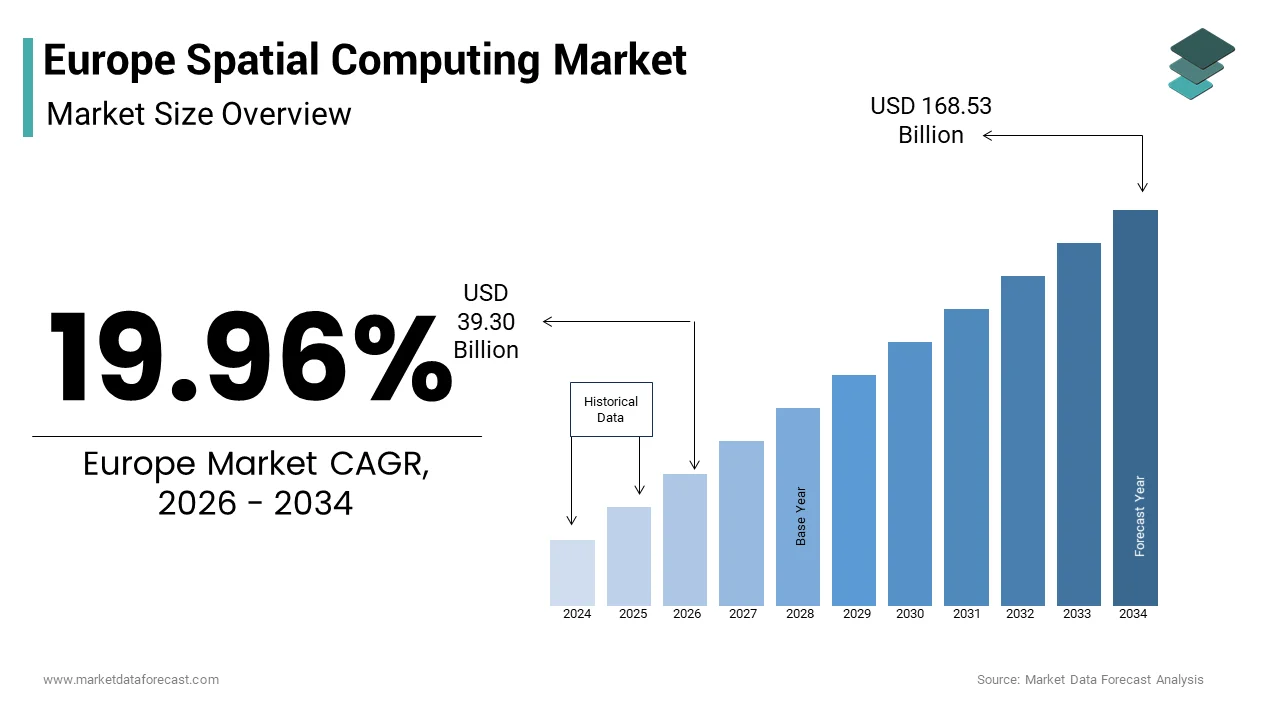
The Europe spatial computing market was valued at USD 32.76 billion in 2025, is estimated to reach USD 39.30 billion in 2026, and is projected to reach USD 168.53 billion by 2034, growing at a robust CAGR of 19.96% during the forecast period from 2026 to 2034. The rapid expansion of the market is driven by the accelerating adoption of immersive technologies across manufacturing, healthcare, automotive, defense, and enterprise training environments. Increasing integration of augmented reality (AR), virtual reality (VR), and mixed reality (MR) with artificial intelligence, IoT, and digital twin platforms is significantly enhancing operational efficiency, visualization, and decision-making across industries. Additionally, rising investments in Industry 4.0, smart factories, and metaverse-enabled enterprise applications are further propelling market growth across Europe.
Key Market Trends
- Growing enterprise adoption of mixed reality solutions for real-time visualization, remote collaboration, and workforce training.
- Increasing use of spatial computing in manufacturing for predictive maintenance, digital twins, and immersive design validation.
- Expansion of spatial computing applications in healthcare for surgical planning, diagnostics, and medical training.
- Rising integration of AI, 5G, and edge computing to enhance real-time spatial data processing and responsiveness.
- Strong momentum toward industrial metaverse platforms enabling immersive simulation and virtual prototyping.
Segmental Insights
- Based on type, the mixed reality segment dominated the Europe spatial computing market in 2025. This dominance is attributed to its ability to blend physical and digital environments, enabling advanced visualization, hands-free workflows, and immersive collaboration across industrial and enterprise use cases. Mixed reality solutions are increasingly favored over standalone AR or VR due to their versatility and scalability in complex operational environments.
- By application, the manufacturing segment commanded the largest share of the European spatial computing market in 2025. The segment’s leadership is driven by widespread adoption of spatial computing for factory automation, assembly guidance, quality inspection, and digital twin implementation, helping manufacturers reduce downtime, improve productivity, and accelerate innovation cycles.
Regional Insights
Europe’s spatial computing market is witnessing strong growth across technologically advanced economies, supported by digital transformation initiatives and industrial modernization.
- Germany emerged as the leading market in 2025, driven by its strong manufacturing base, Industry 4.0 leadership, and early adoption of immersive industrial technologies.
- The United Kingdom continues to capture a significant share due to growing investments in enterprise AR/VR solutions and strong technology ecosystems.
- France is expected to account for a prominent share over the forecast period, supported by government-backed digital innovation programs.
- Sweden and the Netherlands are anticipated to register healthy growth, driven by advanced research capabilities, startup ecosystems, and increasing adoption across smart manufacturing and logistics.
Competitive Landscape
The Europe spatial computing market is characterized by intense competition among global technology leaders and specialized immersive solution providers. Market players are focusing on hardware innovation, software platform development, and strategic partnerships to strengthen their presence across enterprise and industrial applications. Continuous advancements in head-mounted displays, spatial mapping, AI-powered rendering, and developer ecosystems are shaping the competitive dynamics of the market.
Prominent players operating in the Europe spatial computing market include **Apple Inc., Alphabet Inc., Microsoft Corp., NVIDIA Corp., Lenovo Group Ltd, HTC Corp, Qualcomm Inc., Sony Group Corp, Unity Software Inc., PTC, Magic Leap, Vuzix Corp, Seiko Epson Corp, Blippar, and DAQRI, among others.
Europe Spatial Computing Market Size
The Europe spatial computing market size was valued at USD 32.76 million in 2024 and is anticipated to reach USD 39.30 million in 2025 to USD 168.53 billion by 2034, growing at a CAGR of 19.96% during the forecast period from 2026 to 2034.
Spatial computing is a convergence of technologies that enable machines to perceive, interpret,t and interact with three-dimensional physical environments in real time. Unlike conventional digital interfaces, spatial computing creates context-aware systems that map user intent to spatial coordinates,s allowing natural interaction through gestures, re,s voice, and movement. The strategic relevance of this paradigm has grown as Europe advances its digital sovereignty agenda, particularly in industrial automation, public services, es and immersive education. According to Eurostat, the majority of enterprises in the European Union are adopting digital technologies for process automation, underscoring the region’s accelerating digital transformation. According to the European Commission’s 2024 Digital Decade Report, thousands of classrooms across Finland, Sweden, and Estonia have introduced spatial learning environments to enhance STEM education, which embeds immersive technologies into everyday pedagogy. Furthermore, as per the European Space Agency, member states are increasingly integrating spatial computing into national geospatial infrastructure, supporting applications in urban planning, emergency response, and climate resilience. These deployments illustrate how spatial computing is evolving from experimental novelty into operational infrastructure, shaping Europe’s public and private sectors with a focus on innovation, sustainability, and human‑centric digital growth.
MARKET DRIVERS
Industrial Digitalization Under the EU’s Twin Transition Strategy
Europe’s push for simultaneous digital and green transformation has made spatial computing a cornerstone of next-generation industrial operations, which is one of the key factors propelling the European spatial computing market growth. According to the European Commission, the EU’s Twin Transition framework allocates billions of euros through 2027 to support smart manufacturing, ng including digital twins, collaborative robotics, and immersive maintenance, while indicating policy commitment. As per Eurostat, a majority of large manufacturing firms in Germany, France, and Italy reported deploying spatial computing systems for assembly line guidance, worker training, or equipment overlay in 2023, whichreflectsg rapid uptake. In the automotive sector, BMW’s Leipzig plant uses Microsoft HoloLens-based spatial workflows to reduce quality inspection time, while Siemens in Austria employs real-time 3D scene understanding to optimize warehouse logistics. The European Institute of Innovation and Technology has documented that spatially aware digital twins in chemical plants reduce unplanned downtime, highlighting measurable efficiency gains. These improvements align directly with the EU Industrial Plan’s mandate for productivity without added emissions, cementing spatial computing as a strategic enabler of resilient and competitive European industry.
Expansion of Public Sector Immersive Services
European governments are increasingly embedding spatial computing into citizen-facing services to improve accessibility, efficiency, and engagement, which is further supporting the expansion of the European spatial computing market. According to the European Commission’s Digital Government Factsheet 2024, more than 30 national ministries pilot spatial interfaces for urban planning, crisis simulation, and cultural heritage visualization, showing institutional adoption. In Sweden,n the Transport Administration launched a 3D spatial dashboard in 20,23, allowing citizens to explore proposed road expansions in mixed reality before public consultations. Finland’s National Board of Education integrated spatial computing into vocational schools, enabling apprentices to practice complex machinery repairs through holographic overlays. As per the European Environment Agency,y spatial computing models are now used in over a dozen EU countries to simulate flood scenarios and optimize evacuation routes in real time, demonstrating environmental applications. These deployments are further accelerated by the EU’s Interoperable Europe Act,ct which mandates that public digital services support multimodal interaction by 2027. Policy-driven institutional adoption creates a stable demand corridor beyond commercial markets, reinforcing spatial computing’s role in Europe’s digital public infrastructure.
MARKET RESTRAINTS
Fragmented Data Governance and Spatial Privacy Regulations
Despite technological readiness, the deployment of spatial computing systems across Europe is hindered by inconsistent interpretations of privacy and data handling under the General Data Protection Regulation, which is impeding the spatial computing market expansion in Europe. According to the European Data Protection Board, national authorities in Germany, France, and the Netherlands have issued differing guidance on whether 3D point clouds or depth maps constitute biometric data, creating uncertainty. As per the Irish Data Protection Commission, recording spatial environmental scans in public or semi-public spaces may require explicit consent if human silhouettes or gait patterns are reconstructable, which indicates compliance challenges. In 2023, Germany’s data watchdog halted a retail spatial analytics trial in Berlinn,n citing insufficient anonymization of customer movement paths. Similarly, the Swedish Authority for Privacy ruled that school-based spatial learning systems must disable real-time user tracking unless parental opt-in is secured. These jurisdictional variances increase compliance risk and delay enterprise rollouts, particularly for cross-border deployments. Until the European Commission issues harmonized guidelines for spatial data classification, developers face legal uncertainty that suppresses investment in scalable solutions.
Limited Availability of Specialized Talent and Developer Ecosystems
The growth of the spatial computing market in Europe is constrained by a critical shortage of professionals skilled in 3D computer vision, sensor calibration, and real-time rendering engines. According to the European Centre for the Development of Vocational Training, fewer than 12,000 software developers across the EU possess verified expertise in advanced spatial computing frameworks as of 2024, underscoring the talent gap. As per Eurosta,t only a small share of computer science programs in European universities offer dedicated courses in spatial computing, with most curricula still focused on 2D application development. This gap forces enterprises to rely on expensive external vendors or delay pilots due to recruitment bottlenecks. The European Commission’s Digital Skills and Jobs Coalition reported in 2024 that a majority of spatial computing projects in Southern Europe were postponed because local teams could not integrate LiDAR data with Unity or Unreal workflows, showing operational impact. Additionally, open-source spatial libraries remain underdeveloped compared to North American counterparts, limitincommunity-drivenen innovation. Without targeted upskilling initiatives and academic alignment, the talent deficit will continue to throttle market maturation across the region.
MARKET OPPORTUNITIES
Integration into EU Funded Smart City and Mobility Initiatives
Europe’s extensive portfolio of smart city programs is a high-impact opportunity for the spatial computing market in Europe. According to the European Innovation Partnership on Smart Cities, hundreds of municipalities have launched spatially enabled urban operating systems under Horizon Europe funding since 2022, reflecting widespread uptake. In Amsterdam,m city planners use real-time 3D semantic maps to simulate traffic flow and pedestrian congestion during major events, adjusting signage and routing dynamically. As per the European Union Agency for Railways, spatial computing is being trialed in several cross-border rail corridors to enable maintenance crews to visualize underground cable layouts through AR glasses, reducing excavation errors. Additionally, the European Commission’s Urban Mobility Framework encourages cities to deploy spatial navigation aids for visually impaired citizens, with pilot programs active in Barcelona and Copenhagen. These publicly funded deployments create scalable reference architectures that vendors can replicate across member states, lowering entry barriers and accelerating commercial adoption.
Adoption in High-Precision Industrial Training and Remote Expertise
Spatial computing is unlocking transformative applications in workforce development and remote technical support across Europe’s capital-intensive industries, which is another promising opportunity in the European spatial computing market. According to the European Centre for the Development of Vocational Training, spatially guided simulations are now used in maritime academies to train cadets in engine room emergencies without physical risk, which supports safer training. As per the German Federal Ministry of Labour, a significant share of industrial firms participating in the “Qualification Opportunities Act” program implemented spatial computing modules in 2023 to upskill workforces in digital twin interaction, showing institutional adoption. In the energy sector, Equinor and TotalEnergies jointly deployed Microsoft Mesh-based remote assistance in North Sea platforms, which is allowing onshore engineers to annotate live 3D views of subsea valves during maintenance. According to the European Agency for Safety and Health at Work, spatial collaboration reducedhigh-riskk interventions in 2023, which demonstrates safety benefits. With the EU forecasting a shortage of skilled industrial technicians by 2030, spatial computing offers a scalable bridge between knowledge retention, operational safety, and digital continuity.
MARKET CHALLENGES
Interoperability Gaps Between Proprietary Spatial Platforms
The lack of standardized protocols for spatial data exchange and scene representation fragments the European ecosystem and impedes enterprise-scale deployment, which is a prominent challenge to the expansion of the spatial computing market in Europe. According to the European Telecommunications Standards Institute, no universal format currently exists for sharing real-time 3D maps across major device platforms, creating vendor lock-in. As per the Open AR Cloud Association,n only a small share of spatial applications in Europe supportcross-platformm persistence, meaning virtual objects do not remain anchored across different hardware. This limitation forces organizations like hospitals or factories to standardize on a single vendor despite best-of-breed needs in specific functions. In 202,3 a German automotive supplier abandoned a mixed reality training rollout after discovering itUnity-baseded content could not run on workers’ preferred Android AR glasses due to incompatible depth sensor APIs. Until initiatives like the EU’s International Data Spaces establish spatial data sovereignty standards, companies will face integration costs and user experience inconsistencies that constrain market growth.
High Hardware Costs and Consumer Accessibility Barriers
Despite software advancements, the widespread adoption of spatial computing in Europe remains limited by the prohibitive cost and limited availability of high-fidelity headsets and sensors, which further challenge the regional market growth. According to Eurostat, fewer than 5% of households in the European Union owned a mixed reality capable device in 2023, which indicates limited penetration. As per the European Consumer Organisation, enterprise-grade spatial systems, including LiDAR scanners and tracking anchors,s often cost tens of thousands of euros per deployment site, which makes them inaccessible to small and medium enterprises aconstitutesute the majority of EU businesses. Even in education, national procurement budgets rarely cover immersive hardware, with only Nordic and Benelux countries allocating dedicated funds. The European Commission’s Digital Education Action Plan acknowledges this gap and has proposed a dedicated spatial computing access fund for vocational schools by 2026, though implementation remains pending. Until hardware costs decline through European manufacturing or leasing models, spatial computing will remain confined to elite institutions and large corporations rather than achieving democratized utility across the economy.
REPORT COVERAGE
| REPORT METRIC | DETAILS |
| Market Size Available | 2025 to 2034 |
| Base Year | 2025 |
| Forecast Period | 2026 to 2034 |
| CAGR | 19.96% |
| Segments Covered | By Type, Application, By Region |
| Various Analyses Covered | Global, Regional & Country Level Analysis, Segment-Level Analysis, DROC, PESTLE Analysis, Porter’s Five Forces Analysis, Competitive Landscape, Analyst Overview of Investment Opportunities |
| Regions Covered | UK, France, Spain, Germany, Italy, Russia, Sweden, Denmark, Switzerland, Netherlands, Turkey, Czech Republic, & Rest of Europe |
| Market Leaders Profiled | Apple Inc, Alphabet Inc Class A, Lenovo Group Ltd, HTC Corp DR, Microsoft Corp, NVIDIA Corp, PTC, Qualcomm Inc, Oculus VisionTech Inc, Seiko Epson Corp, Sony Group Corp ADR, Unity Software Inc Ordinary Shares, Vuzix Corp, Avegant, Blippar, DAQRI, Magic Leap, 3D Cloud, Zappar |
SEGMENTAL ANALYSIS
By Type Insights
The mixed reality segment held the dominating share of the Europe spatial computing market in 2024 as it bridges physical and digital environments, which is enabling real‑time interaction with holographic content anchored to real‑world coordinates. This capability is indispensable in industrial training, remote collaboration, and precision assembly. According to the European Commission’s 2024 Digital Industry Scoreboard, immersive technologies,ogies including mixed, are increasingly deployed in advanced manufacturing across Europe. Eurostat reports that EU enterprises adopting digital technologies such as AR/VR in manufacturing have seen measurable productivity gains, including reduced downtime and faster fault identification. The European Space Agency has integrated mixed‑reality headsets into astronaut training simulations at its Cologne facility, allowing engineers to manipulate 3D models of International Space Station components in shared spatial environments. Furthermore, Horizon Europe allocated €85 million in 2023 for projects in AI, data, and immersive computing platforms, reinforcing mixed reality’s role in Europe’s industrial digital transformation. Mixed reality is expected to remain dominant as the EU industry continues to prioritize immersive, context‑aware tools for productivity and safety.

The artificial intelligence segment is promising and is expected to exhibit a promising CAGR of 30.3% in the European market over the forecast period. AI enables real‑time scene understanding, object recognition, and adaptive user interaction as these capabilities are essential for spatial computing. According to the European Commission’s AI Watch 2024 report, AI adoption in Europe is accelerating, with embedded AI increasingly used in edge devices to interpret gestures, voice commands, and environmental geometry. National research centers such as Germany’s DFKI (German Research Center for Artificial Intelligence) have developed advanced models for gesture recognition and predictive user intent, supporting industrial applications. Pilot projects in Nordic countries have also demonstrated AI‑driven spatial navigation systems that optimize passenger flows in transport hubs. Artificial intelligence is expected to grow rapidly as it evolves into the cognitive engine of spatial experiences across Europe.
By Application Insights
The manufacturing segment commanded the largest share of the European spatial computing market in 2024. The dominance of the manufacturing segment in the European market is mainlydue to its direct impact on productivity, safety, and digital continuity in high‑value production environments. According to Eurostat, manufacturing contributes nearly 15% of EU GDP and is a leading sector in digital technology adoption. According to the European Commission’s Digital Manufacturing Platform, immersive and spatial computing solutions improve efficiency in assembly guidance, maintenance, and remote expert support. BMW’s Regensburg plant employs spatial computing to overlay torque specifications and wiring diagrams directly onto vehicle chassis during final assembly, while Siemens in Austria uses real‑time 3D digital twins synchronized with production lines to simulate changeovers. The EU’s Net Zero Industry Act further incentivizes such deployments by linking production efficiency to carbon‑intensity benchmarks. Manufacturing is expected to remain the dominant application as spatial computing becomes a strategic lever for competitiveness and compliance in Europe’s industrial heartland.
The healthcare segment is anticipated to witness a CAGR of 30.8% over the forecast period in the European spatial computing market ,owing to the urgent need for precision visualization in surgery, training, and patient rehabilitation. According to the European Commission’s Digital Europe Programme, multiple cross‑border projects have been funded to develop spatially enabled tele‑rehabilitation platforms for stroke patients. The European Society of Radiology has reported growing adoption of immersive visualization tools in academic hospitals for preoperative planning, allowing surgeons to manipulate 3D reconstructions of patient anatomy. Clinical trials in Sweden and Germany have demonstrated improved surgical training outcomes when mixed‑reality simulations are used compared to traditional methods. Healthcare is expected to grow rapidly as spatial computing becomes integral to Europe’s vision of equitable, high‑value digital healthcare.
COUNTRY ANALYSIS
Germany Spatial Computing Market Analysis
Germany held the largest share of 255% of the Europe spatial computing market in 2024. The dominating position of Germany in the European market is driven by its strong industrial base, automotive engineering expertise, and national strategy for sovereign digital infrastructure. More than a thousand manufacturing firms participate in initiatives that subsidize spatial computing adoption for small and medium enterprises. National research institutes have launched testbeds for spatially aware robotics, linking multiple centers with real‑time 3D data exchange. Germany’s vocational education system integrates mixed reality into technical colleges, enabling apprentices to practice complex machinery repairs through holographic overlays. With its combination of industrial policy, academic innovation, and workforce development, Germany is expected to remain Europe’s most advanced spatial computing ecosystem.
United Kingdom Spatial Computing Market Analysis
The United Kingdom captured a promising share of the Europe spatial computing market. The creative technology, healthcare simulation, and defense applications are driving the UK Spatial computing market growth. The National Health Service has deployed spatial computing in hospitals for surgical planning and medical training, improving accuracy and reducing errors. Defense agencies use mixed reality for battlefield simulation and equipment maintenance. London’s immersive‑tech cluster hosts hundreds of startups collaborating with public institutions on large‑scale spatial infrastructure. With its mature venture‑capital landscape and regulatory sandboxes, the UK is positioned as a high‑impact innovation hub in spatial computing.
France Spatial Computing Market Analysis
France is expected to account for a prominent share of the Europe spatial computing market over the forecast period, owing to the sovereign digital‑infrastructure investments under the France 2030 plan. National aerospace labs use spatial computing to simulate cockpit interactions, while automotive manufacturers integrate mixed reality into assembly processes. In education, immersive classrooms have been introduced across secondary schools to enhance physics and engineering learning. Paris has deployed a city‑scale 3D digital twin to manage energy flows and emergency response during major events. With its state‑led coordination across defense, mobility, education, and urban planning, France is expected to remain a comprehensive spatial‑computing leader.
Sweden Spatial Computing Market Analysis
Sweden is estimated to grow at a healthy CAGR in the Europe spatial computing market during the forecast period due to the strong public digital infrastructure and a human‑centred design ethos. Hospitals use spatial operating suites to visualize tumor margins in real time, improving surgical precision. Public‑transport authorities have implemented mixed‑reality control centers to optimize crowd management. Sweden’s broadband strategy ensures nearly universal gigabit connectivity, enabling immersive classroom experiences nationwide. Local startups have pioneered high‑resolution headsets now used in European research labs. With its blend of public‑service innovation, technical excellence, and ethical design principles, Sweden is positioned as a leader in human‑scale spatial computing.
Netherlands Spatial Computing Market Analysis
The Netherlands is predicted to hold a notable share of the Europe spatial computing market during the forecast period due to the strengths in port logistics, smart agriculture, and water management. The Port of Rotterdam uses a real‑time 3D digital twin integrated with IoT and AI to coordinate vessel movements and cargo flows. Wageningen University has developed spatial systems that analyze crop health through drone sensors and project treatment zones via augmented‑reality glasses. National infrastructure programs mandate live spatial models for lifecycle management of major projects. With its ability to transform spatial computing into an operational nervous system for complex systems, the Netherlands is expected to remain a critical enabler of applied spatial computing in Europe.
COMPETITIVE LANDSCAPE
The Europe spatial computing market features intense yet structured competition among global technology giants’ regional hardware innovators and specialized software developers. Microsoft, Apple, and Meta dominate the platform layer through proprietary ecosystems, while European startups such as 3D Spark and Immersium focus on vertical-specific applications in engineering and healthcare. Competition centers on interoperability, data governanc CE,ce and contextual accuracy rather than hardware specifications alone. Regulatory alignment with the EU AI Act, Digital Markets Act, and Interoperable Europe framework shapes vendor strategies significantly. Public sector procurement preferences for open standards and local hosting further favour solutions that balance innovation with compliance. As spatial computing transitions from pilot to production scale, vendors must demonstrate long term viability, security,y and workforce readiness to secure contracts in Europe’s high-scrutiny institutional environment.
KEY MARKET PLAYERS
A few of the market players in the Europe spatial computing market are
- Apple Inc
- Alphabet Inc Class A
- Lenovo Group Ltd
- HTC Corp DR
- Microsoft Corp
- NVIDIA Corp, PTC
- Qualcomm Inc
- Oculus VisionTech Inc
- Seiko Epson Corp
- Sony Group Corp ADR
- Unity Software Inc Ordinary Shares
- Vuzix Corp
- Avegant
- Blippar
- DAQRI
- Magic Leap
- 3D Cloud
- Zappar
Top Players In The Market
- Microsoft Corporation plays a pivotal role in the Europe spatial computing market through its HoloLens 2 mixed reality platform and Azure Spatial Anchors cloud service. The company collaborates extensively with European industrial leaders in aerospace, automotive, and healthcare to deploy secure, scalable spatial workflows. In 2023, Microsoft partnered with Siemens in Germany to integrate HoloLens into a factory floor digital twin,,s enabling real-time remote expert assistance. It also launched the Industrial Metaverse Core initiative with European manufacturing clusters to standardize interoperable spatial data models. These efforts reinforce Microsoft’s global leadership while embedding its ecosystem deeply into Europe’s industrial digital transformation agenda through trusted cloud infrastructure and enterprise integration.
- Meta Platforms Inc is actively expanding its presence in the Europe spatial computing market with its Quest Pro and upcoming Orion devices targeted at enterprise collaboration and immersive training. The company has established research partnerships with universities in France and Sweden to advance eye tracking, hand gesture recognition, and avatars for professional use cases. In 2024, Meta launched Horizon Workrooms for EU public institutions, enabling secure 3D meetings compliant with GDPR through localized data centers in Ireland and the Netherlands. It also joined the European Metaverse Initiative to shape ethical guidelines for spatial computing. These strategic moves position Meta not only as a consumer hardware leader but as a serious enterprise enabler in Europe’s emerging spatial ecosystem.
- Apple Inc has entered the Europe spatial computing market with the Vision Pro headset and visionOS platform,m emphasizing privacy precision,n and seamless integration with professional workflows. The company targets high-value sectors such as architecture, healthcare, and media, where iits high-resolutiondisplays and eye tracking offer distinct advantages. In early 2024, Apple collaborated with architectural firms in Spain and Italy to pilot spatial design reviews using room-scale 3D models. It also certified Vision Pro for use in EU healthcare settings by ensuring on-device processing of patient data to meet strict medical privacy standards. Apple’s focus on premium experiencesde veloper tools, developer tools, nd regulatory compliance positions it as a premium entrant shaping the upper tier of Europe’s spatial computing landscape.
Top Strategies Used by the Key Market Participants
Key players in the Europe spatial computing market prioritize enterprise integration by embedding their platforms into industrial digital twins, public service workflws,, and professional training systems. They invest in localized cloud infrastructure to ensure compliance with GDPR and sector-specific data sovereignty requirements. Companies form strategic alliances with European research institutions, ununiversities and standardization bodies to co-develop ethical frameworks and interoperable data models. Hardware vendors enhance on-device AI to minimize cloud dependency and improve real time responsiveness in latency sensitive environments. Additionally, they tailor developer programs to support Unity, UnUnre, aweb-based spatiall engine,s fostering a robust European creator ecosystem aligned with regional digital sovereignty goals.
MARKET SEGMENTATION
This research report on the Europe spatial computing market is segmented and sub-segmented into the following categories.
By Type
- Virtual Reality
- Mixed Reality
- Augmented Reality
- Internet of Things
- Artificial Intelligence
- Others (Machine Learning)
By Application
- Healthcare
- Automotive
- Transport
- Manufacturing
- Media & Entertainment
- Others (Military, Education, etc.)
By Country
- UK
- France
- Spain
- Germany
- Italy
- Russia
- Sweden
- Denmark
- Switzerland
- Netherlands
- Turkey
- Czech Republic
- Rest of Europe