Europe Spatial Light Modulator Market Size, Share, Trends & Growth Forecast Report – Segmented Application, By Technology, End Use, Component Type, and Country (UK, France, Spain, Germany, Italy, Russia, Sweden, Denmark, Switzerland, Netherlands, Turkey, Czech Republic & Rest of Europe), Industry Analysis From 2026 to 2034
Market Size, 2025
$760.42 BnMarket Estimate, 2026
$864.98 BnMarket Forecast, 2034
$2,424.47 BnCAGR, 2026–2034
13.75%Europe Spatial Light Modulator Market Report Summary
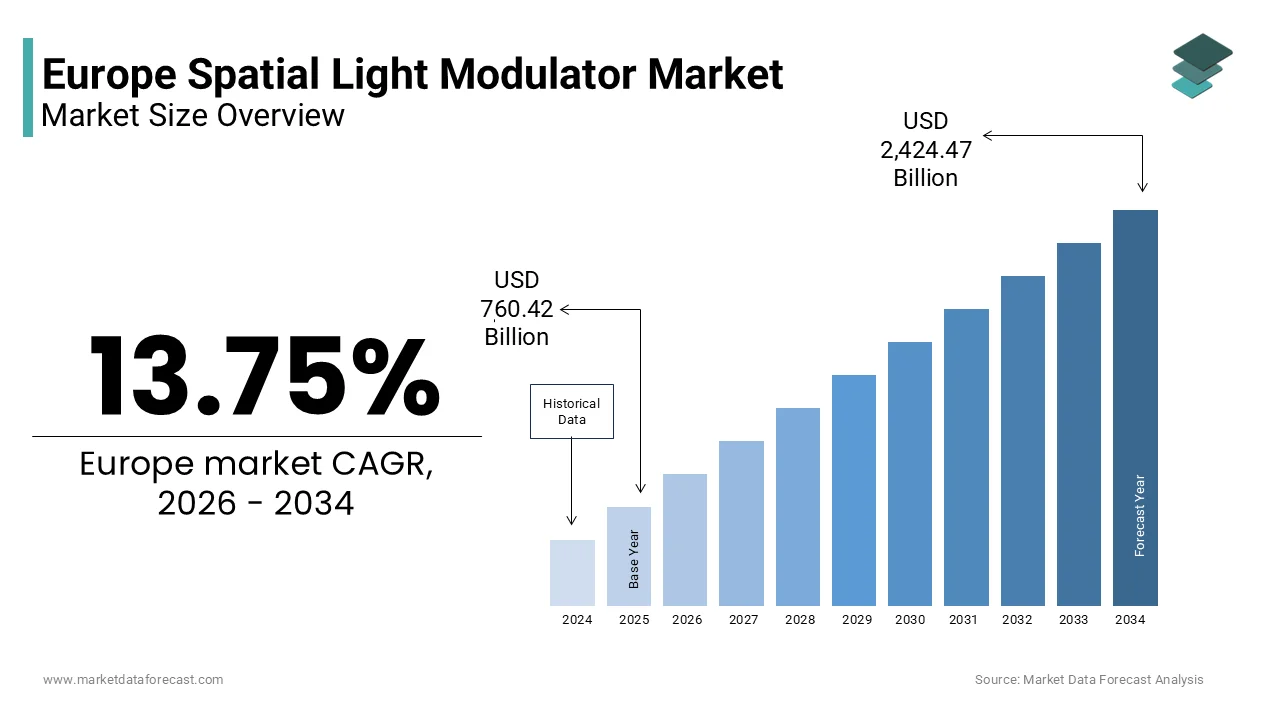
The Europe spatial light modulator market was valued at USD 760.42 billion in 2025 and is estimated to reach USD 864.98 billion in 2026, further projected to reach USD 2,424.47 billion by 2034, growing at a CAGR of 13.75% during the forecast period. Market growth is driven by increasing adoption of advanced optical technologies in biomedical imaging, holography, laser beam shaping, and optical communication systems. Rising investments in healthcare research, photonics innovation, and precision imaging technologies are significantly accelerating demand across Europe. In addition, advancements in micro display technologies, adaptive optics, and wavefront modulation are expanding the application scope of spatial light modulators across industrial and scientific domains.
Key Market Trends
- Growing demand for spatial light modulators in biomedical imaging and microscopy for high resolution and real time optical manipulation.
- Increasing adoption of Liquid Crystal on Silicon technology due to its superior resolution, high fill factor, and precise phase modulation capabilities.
- Rising integration of spatial light modulators in holographic displays, augmented reality systems, and advanced projection technologies.
- Expansion of photonics research and laser based manufacturing applications across Europe.
- Increasing focus on precision optics and miniaturization in medical diagnostics and scientific instrumentation.
Segmental Insights
- Based on application, the biomedical applications segment was the largest in the European spatial light modulator market in 2025. The segment’s dominance is attributed to increasing use in advanced microscopy, optical trapping, neural imaging, and minimally invasive diagnostic technologies.
- Based on technology, the Liquid Crystal on Silicon technology segment led the Europe spatial light modulator market in 2025. Its leadership position is supported by high resolution modulation, low power consumption, and suitability for both amplitude and phase modulation applications.
- Based on end use, the healthcare segment dominated the European spatial light modulator market in 2025. Growth in this segment is driven by expanding medical research infrastructure, adoption of precision diagnostic systems, and integration of optical modulation technologies in clinical applications.
Regional Insights
- Western Europe continues to lead adoption due to strong photonics research ecosystems, advanced healthcare infrastructure, and government funding for scientific innovation. Germany, France, and the United Kingdom remain key contributors supported by established optics and semiconductor manufacturing capabilities.
Competitive Landscape
The Europe spatial light modulator market is characterized by technology intensive competition and strong emphasis on research and development. Companies are focusing on enhancing resolution performance, response time, optical efficiency, and system integration capabilities. Key players operating in the Europe spatial light modulator market include Hamamatsu Photonics Japan, Holoeye Photonics Germany, Texas Instruments Inc US, Meadowlark Optics Inc US, Santec Corporation Japan, Kopic Corporation US, Jenoptik AG Germany, Forth Dimension Display UK, Barco Belgium, PerkinElmer US, ASM Holdings Netherlands, Sony Japan, and ThorLabs US.
Europe Spatial Light Modulator Market Size
The Europe spatial light modulator market size was valued at USD 760.42 billion in 2025 and is projected to reach USD 2,424.47 billion by 2034 from USD 864.98 billion in 2026, growing at a CAGR of 13.75%.
A spatial light modulator is an advanced optical device that dynamically controls the amplitude, phase, or polarization of light across a two-dimensional plane, enabling precise manipulation of wavefronts for applications ranging from holography to adaptive optics. In Europe, this technology has become integral to high-precision scientific instrumentation, industrial laser processing, and next-generation display systems. The European spatial light modulator market is distinguished by its concentration of research-intensive institutions and strong governmental support for photonics innovation, particularly through initiatives, which coordinates public-private partnerships across the continent. According to Eurostat, over 2.1 million researchers were employed in R&D activities across the EU in 2024, reflecting a robust ecosystem that fuels demand for optical components. Furthermore, substantial funding is allocated to photonics within the Horizon Europe program (2021-2027) via the Photonics Partnership, highlighting the strategic importance of optical modulation technologies. This environment positions Europe not merely as a consumer but as a global incubator for spatial light modulator advancements driven by academic excellence and cross-sectoral technological convergence.
MARKET DRIVERS
Rising Investment in Quantum Technologies Drives Adoption
The region’s accelerating commitment to quantum infrastructure serves as a pivotal growth enabler for the Europe spatial light modulator market. These devices are essential in quantum computing and communication systems where they enable high-fidelity control of photonic qubits through precise phase and amplitude modulation. As per the European Quantum Flagship initiative launched in 2018 with a budget of one billion euros over ten years, significant portions of this funding have been directed toward photonic quantum processors and secure communication networks—both of which rely heavily on spatial light modulators for beam shaping and entanglement generation. New European strategic frameworks are directing significant public and private funding toward specialized infrastructure, including pilot production lines and design facilities, to accelerate the commercialization of quantum hardware. Furthermore, specialized research initiatives at major European scientific centers are expanding their collaborative networks, leading to a broader adoption of advanced optical technologies in laboratories dedicated to high-energy physics and quantum optics. Leading European nations have established multi-billion euro national roadmaps to secure a competitive position in the global quantum landscape, focusing on both fundamental research and industrial application. These coordinated investments create sustained demand for high-resolution, low-latency spatial light modulators, particularly liquid crystal on silicon variants, which offer the requisite precision for manipulating single-photon states. Consequently, the quantum sector has emerged as a non-cyclical and technologically imperative growth vector for the European spatial light modulator market.
Expansion of Advanced Biophotonics Applications Fuels Demand
The proliferation of biophotonics research and clinical diagnostics across Europe has significantly accelerated the expansion of the Europe spatial light modulator market. This has amplified the need for spatial light modulators capable of complex wavefront engineering. These devices are critical in techniques such as structured illumination microscopy, optical tweezers, and adaptive optics retinal imaging, where real-time control over light fields enhances resolution, depth penetration, and cellular manipulation accuracy. Specialized biophotonics research is deeply integrated into the European clinical and academic ecosystem, with a widespread network of research groups and centers driving innovation in medical imaging and diagnostics. European research funding continues to allocate significant capital to advanced imaging projects, with a notable focus on programmable light and structured illumination technologies for analogue computation and biological study. Notably, the Human Brain Project, which concluded its final phase in 2023, utilized spatial light modulators in optogenetic stimulation setups across six European neurotechnology hubs, including those in Switzerland and Sweden. Moreover, advanced optical diagnostic technologies are increasingly navigating the rigorous European regulatory framework to achieve clinical validation, reflecting a trend toward high-resolution, non-invasive medical imaging. Countries like Denmark and Austria have established national biophotonics roadmaps with dedicated procurement budgets for programmable optical devices. This institutional embedding ensures consistent demand independent of broader economic fluctuations, positioning biophotonics as a structurally supportive pillar for the spatial light modulator market in Europe.
MARKET RESTRAINTS
High Cost and Limited Scalability of Custom SLM Solutions Restrict Widespread Deployment
Prohibitive costs and manufacturing inflexibility constrain the commercial adoption of these modulators, despite technological sophistication, and the growth of the Europe spatial light modulator market. This is particularly true for application-specific configurations. Most high-performance devices, especially those based on liquid crystal on silicon or micro-electromechanical systems architectures, require custom firmware, optical coatings, and calibration protocols tailored to niche scientific or industrial workflows. High-performance optical control components represent a significant capital investment for research facilities, with specialized technical requirements often leading to extended delivery schedules. Similarly, the high cost of specialized light-shaping hardware is frequently identified as a major challenge for smaller technology firms looking to incorporate advanced optical capabilities into new product designs. Unlike standardized semiconductor components, these modulators lack economies of scale because each modification in pixel count, refresh rate, or wavelength range necessitates reengineering of the entire optical stack. The European supply chain for advanced light modulation technology is characterized by a small number of highly specialized manufacturers, which can lead to dependencies and logistical challenges during periods of high demand. This scarcity not only inflates prices but also discourages iterative design cycles crucial for industrial adoption. Consequently, while academic labs absorb these costs through grant funding, the broader industrial base, particularly in precision manufacturing and medical device sectors, remains hesitant, limiting market penetration beyond elite research environments.
Fragmented Regulatory and Standardization Frameworks Across European Jurisdictions Impede Integration
The absence of harmonized technical standards and certification protocols for optical modulation devices exhibits a persistent structural obstacle in the Europe spatial light modulator market. The EU enforces broad electromagnetic and laser safety directives (IEC 60825/Radio Equipment Directive), but varying national interpretations hinder uniform performance validation for medical and aerospace applications. Technical experts across Europe continue to work toward harmonized measurement protocols for advanced light-shaping technologies to ensure consistent performance verification across different research and industrial applications. This fragmentation forces manufacturers to undergo redundant compliance procedures when commercializing products across multiple member states. Manufacturers of high-precision optical hardware invest significant time and resources into ensuring their products comply with unified European safety and technical regulations to facilitate trade across the Single Market. In clinical settings, the challenge intensifies, as per sources, adaptive optics systems incorporating spatial light modulators must satisfy country-specific medical device classifications even when used solely for research. Uniform European medical device regulations ensure that once an advanced optical component is certified for clinical use in one Member State, it can be marketed across the Union without undergoing redundant technical assessments in other national jurisdictions. Such regulatory asymmetry not only delays time to market but also deters startups from scaling beyond domestic borders, thereby stifling pan-European innovation ecosystems and reinforcing reliance on non-EU suppliers with more streamlined global certification pathways.
MARKET OPPORTUNITIES
Integration into Next-Generation AR and Holographic Displays Presents Strategic Growth Avenues
The region’s emerging leadership in augmented reality and holographic visualization technologies opens up untapped potential for manufacturers within the Europe spatial light modulator market. These devices serve as the foundational engine for dynamic hologram generation, enabling true three-dimensional light field reconstruction without the need for stereoscopic eyewear. The European Union is directing hundreds of millions of euros toward the development of virtual worlds and immersive digital environments, focusing on cross-sector deployment and the enhancement of European digital capabilities. European innovation funding is increasingly supporting startups that utilize advanced augmented reality and smart-edge components to disrupt industries such as automotive manufacturing and medical navigation. Notably, academic and industrial partnerships in Europe are pushing the boundaries of holographic display technology, aiming to achieve the high resolution and rapid refresh rates necessary for immersive 3D communication. Furthermore, International standards bodies are collaborating to define the data structures required for next-generation immersive media, ensuring that complex 3D content can be seamlessly shared across different hardware platforms. National initiatives amplify this momentum. Major European research centers are establishing large-scale pilot production facilities to bridge the gap between laboratory photonic designs and industrial-scale manufacturing for next-generation display and sensing systems. These developments signal a shift from laboratory curiosities to scalable commercial platforms, creating a fertile ground for European firms to capture value in the global immersive optics supply chain.
Defense and Aerospace Modernization Programs Create Niche but High-Value Demand Channels
The region’s strategic pivot toward autonomous defense systems and space-based observation infrastructure is underway, which has created specialized yet lucrative prospects for the Europe spatial light modulator market. These components are increasingly deployed in adaptive optics for satellite imaging, laser communication terminals, and directed energy weapons, where atmospheric distortion compensation is critical. European defense strategies are increasingly prioritizing the development of sophisticated surveillance and reconnaissance systems, allocating significant resources to advance optical sensing capabilities and disruptive defense technologies. Next-generation European air combat platforms are being designed with modular architectures to integrate advanced directed energy and laser-based technologies for enhanced targeting and communication. Similarly The European Space Agency is actively funding the development of secure optical and quantum communication technologies to establish high-speed, space-based data networks and enhance European competitiveness in the satellite market. Leading aerospace manufacturers are continuously improving the image quality of Earth observation satellites by implementing advanced sensor technologies and innovative data processing algorithms to provide higher-resolution global imagery. National space programs in the United Kingdom are making multi-million pound investments in satellite technology to foster innovation in communications, secure connectivity, and sovereign space-based surveillance. Unlike consumer markets, these defense and aerospace applications prioritize performance, reliability, and security over cost, enabling premium pricing and long-term service contracts. This creates a resilient revenue stream insulated from commercial volatility and positions European spatial light modulator suppliers as strategic enablers of sovereign technological capabilities.
MARKET CHALLENGES
Persistent Shortage of Specialized Photonics Engineers Constrains Product Development Cycles
The acute scarcity of engineers proficient in both optical physics and embedded systems design is a critical barrier to the European spatial light modulator market. Developing next-generation modulators requires interdisciplinary expertise spanning liquid crystal material science, high-speed electronics, and computational wavefront optimization, skills rarely consolidated in a single professional cohort. Industrial reports indicate a significant and growing gap between the demand for specialized optical engineers and the available talent pool within the European technology sector. Small and medium-sized enterprises in the high-tech sector frequently encounter operational challenges and timeline extensions due to the difficulty of finding personnel with highly specialized technical competencies. Numerous high-level academic programs exist across the continent. However, the number of graduates specializing in the intersection of optics and electronic control remains lower than the volume required by the expanding photonics industry. This talent gap directly impedes iterative prototyping and customization, key differentiators in a market where end users demand application-specific performance envelopes. Consequently, firms often outsource firmware development or rely on legacy architectures, slowing innovation velocity and ceding competitive advantage to vertically integrated non-European players. Without targeted reskilling initiatives and industry-aligned curricula, this human capital shortfall will continue to throttle Europe’s ambition to lead in adaptive optics hardware.
Technological Obsolescence Risk Due to Rapid Advancements in Alternative Wavefront Control Methods
Mounting pressure from emerging non-modulator-based approaches to light field manipulation slows down the expansion of the Europe spatial light modulator market. These approaches threaten the long-term relevance of traditional modulators in several high-growth segments. Metasurfaces, diffractive optical elements, and integrated photonic circuits now offer static or semi-programmable wavefront control with superior durability, lower power consumption, and compatibility with semiconductor fabrication lines. Research into nanostructured surfaces is progressing toward high-efficiency light control, offering potential advantages in device stability and miniaturization compared to current liquid crystal technologies. In the industrial laser processing sector, companies like Trumpf and Coherent have begun replacing spatial light modulators with fixed diffractive optics for multi-spot drilling applications, citing reductions in system footprint and maintenance costs. Moreover, the rise of neural network-driven optical systems enables model-based wavefront prediction without physical modulation hardware, which reduced reliance on spatial light modulators. Strategic research agendas in Europe are increasingly prioritizing the development of next-generation light-shaping technologies, reflecting a shift toward more compact and integrated optical solutions. This paradigm shift compels European manufacturers to either diversify into hybrid architectures or risk marginalization in applications where speed, robustness, and integration density outweigh the benefits of full programmability.
REPORT COVERAGE
| REPORT METRIC | DETAILS |
| Market Size Available | 2025 to 2034 |
| Base Year | 2025 |
| Forecast Period | 2026 to 2034 |
| CAGR | 13.75% |
| Segments Covered | By Application, By Technology, End Use, Component Type, and Region |
| Various Analyses Covered | Global, Regional, & Country Level Analysis; Segment-Level Analysis; DROC, PESTLE Analysis; Porter’s Five Forces Analysis; Competitive Landscape; Analyst Overview of Investment Opportunities |
| Regions Covered | UK, France, Spain, Germany, Italy, Russia, Sweden, Denmark, Switzerland, Netherlands, Turkey, and the Czech Republic |
| Market Leaders Profiled | Hamamatsu Photonics (Japan), Holoeye Photonics (Germany), Texas Instruments Inc. (US), Meadowlark Optics Inc. (US), Santec Corporation (Japan), Kopic Corporation (US), Jenoptik AG (Germany), Forth Dimension Display (UK), Barco (Belgium), PerkinElmer (US), ASM Holdings (Netherlands), Sony (Japan), and ThorLabs (US) |
SEGMENTAL ANALYSIS
By Application Insights
The biomedical applications segment was the largest segment in the European spatial light modulator market in 2025. The dominance of the segment is driven by the continent’s world class research infrastructure and deep integration of adaptive optics in life sciences. Specialized biophotonics research is concentrated within major European industrial and academic hubs, reflecting a high density of facilities dedicated to advancing medical and biological imaging. European research funding continues to support a significant volume of high-impact imaging projects, with a strong emphasis on innovative techniques for high-resolution microscopy and cellular stimulation. Furthermore Advanced optical technologies are increasingly transitioning from laboratory settings to clinical practice, successfully navigating European regulatory requirements for diagnostic medical devices. National innovation strategies in Northern and Central Europe are providing substantial financial support for photonics research, fostering the development and acquisition of advanced optical tools for health-related applications. This institutional embedding ensures consistent high value demand insulated from consumer market volatility.
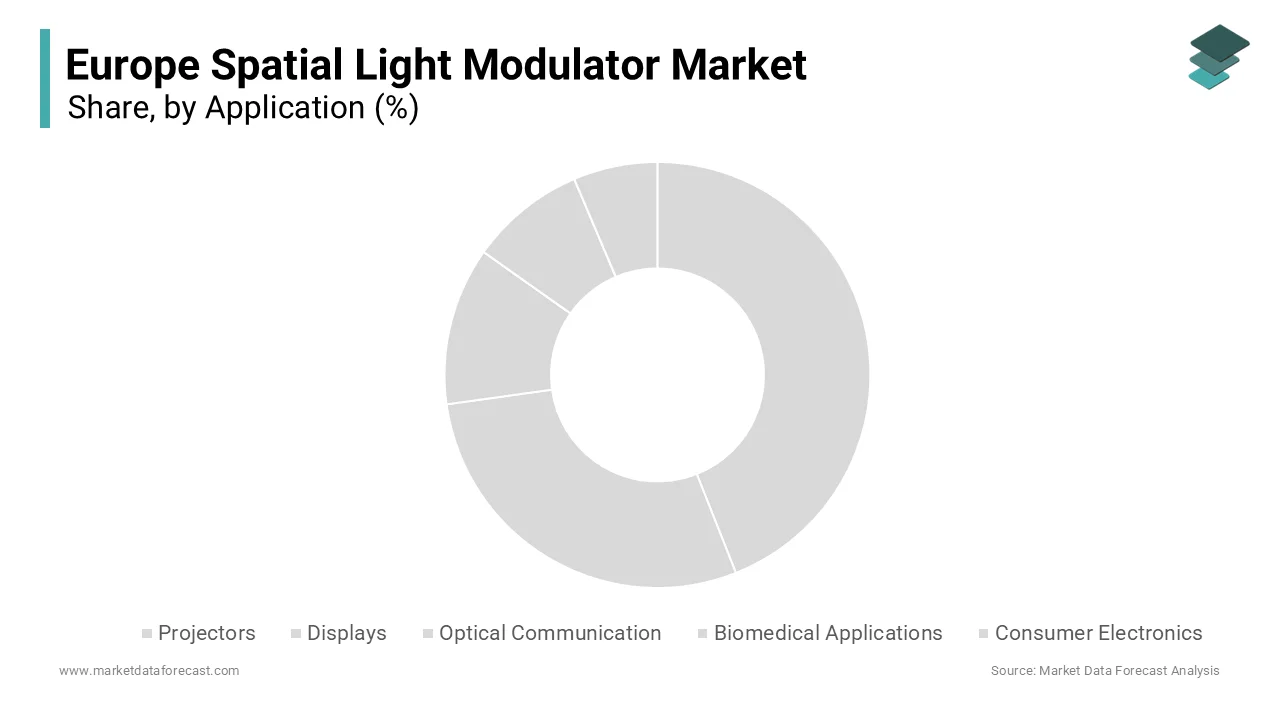
The optical communication segment is anticipated to witness the fastest CAGR of 13.6% from 2026 to 2034 due to Europe’s strategic push toward secure high bandwidth data transmission via free space and fiber based quantum networks. European space agencies are awarding significant contracts to develop high-capacity optical communication terminals for satellite constellations, focusing on achieving multi-gigabit data transfer rates through advanced beam control technologies. The European Union is investing heavily in the rollout of secure and high-speed communication networks, prioritizing the implementation of advanced infrastructure to support a sovereign and resilient digital economy. Additionally European defense initiatives are increasingly focusing on the development of advanced optical surveillance and laser-based communication systems to maintain a technological edge in long-range sensing and secure data transmission. Companies like Airbus Defence and Space have integrated liquid crystal on silicon modulators into satellite payloads to maintain signal coherence through atmospheric turbulence. This convergence of civil defense and space applications creates a unique high growth trajectory unmatched by other segments.
By Technology Insights
The Liquid Crystal on Silicon (LCoS) technology segment led the Europe spatial light modulator market in 2025. The leading position of the segment is attributed to its superior phase modulation accuracy high resolution and compatibility with visible to near infrared wavelengths. LCoS devices are the preferred choice in quantum computing biophotonics and holographic displays where sub wavelength precision is non negotiable. Collaborative quantum research networks in Europe are expanding rapidly, leading to the broader adoption of advanced light-modulation hardware for the development of photonic quantum computing and communication systems. Major European neuroscience initiatives have successfully employed high-resolution light-shaping technology to enable precise, multi-target cellular stimulation for mapping complex brain functions. Moreover, leading European research institutes are advancing semiconductor manufacturing techniques to produce more efficient and scalable optical components, aiming to improve the performance and consistency of integrated photonic systems. National technology strategies in Germany are providing substantial financial support for the development of advanced microelectronics and optical manufacturing infrastructure to secure a competitive position in the global photonics market. This technological maturity combined with institutional trust solidifies LCoS as the backbone of Europe’s adaptive optics ecosystem.
The Microelectromechanical Systems (MEMS) based spatial light modulators segment is likely to experience the fastest CAGR of 14.2% during the forecast period owing to demand for high speed robust and thermally stable modulation in industrial laser processing and aerospace applications. Unlike liquid crystal variants MEMS devices operate without polarization constraints and withstand extreme temperatures making them ideal for directed energy and satellite communications. Next-generation European air combat programs are driving the development of rapid-response optical technologies to enhance precision targeting and communication in highly dynamic aerial environments. Major industrial laser manufacturers are implementing advanced beam-shaping technologies to mitigate thermal distortions and maintain stable focus during high-power material processing. European space research programs are focused on enhancing the durability of micro-optical components against cosmic radiation to enable more flexible and reconfigurable satellite payloads. Additionally, leading astronomical research institutes in Europe are advancing adaptive optics technology to significantly improve the resolution of solar observations, overcoming the challenges posed by intense daytime atmospheric turbulence. These performance advantages in harsh environments position MEMS as the high growth frontier of the European market.
By End Use Insights
The healthcare segment dominated the European spatial light modulator market in 2025. The supremacy of the segment is credited to clinical adoption of adaptive optics in ophthalmology neurosurgery and cellular diagnostics. Advanced optical technologies are increasingly being integrated into European clinical research to provide high-resolution retinal imaging, facilitating the earlier identification of structural changes associated with macular degeneration. The medical imaging market is seeing a rise in high-value diagnostic systems, with newer, more complex technologies often requiring significant initial investment from healthcare providers. Physical equipment remains the primary revenue source for the optical instrumentation industry, though digital components and specialized services are making up an increasing share of the total market value. Software and services remain nascent due to proprietary firmware architectures and limited third party algorithm development. However Manufacturers of specialized optical hardware are increasingly offering service-based contracts and digital support to supplement traditional equipment sales and maintain long-term financial stability.
The telecommunications end use segment is on the rise and is expected to be the fastest growing segment in the market by witnessing a CAGR of 13.8% from 2026 to 2034. The swift expansion of the segment is propelled by the rollout of secure optical networks under the EU’s Cybersecurity Act and the Digital Decade Policy Programme. The European Commission mandates that all critical infrastructure operators implement quantum resistant communication by 2030 creating urgent demand for reconfigurable optical modulators. As per the European Telecommunications Standards Institute many national telecom providers including Deutsche Telekom Orange and Telefónica have launched pilot quantum key distribution networks using spatial light modulators for dynamic beam alignment.
REGIONAL ANALYSIS
Germany Spatial Light Modulator Market Analysis
Germany was the top performer in the European spatial light modulator market and accounted for a 24.3% share in 2025. Moreover, the German market status is driven a strong synergy between academic research institutes such as the Fraunhofer Society and private sector applications in semiconductor lithography and laser material processing. This nation serves as the primary hub for precision optics and photonics manufacturing where companies like Jenoptik and Carl Zeiss drive technological advancements. Federal funding initiatives, including the Action Plan Quantum Technologies, have directed substantial investments, totaling nearly €3 billion by 2026, toward quantum computing and photonics. This financial support specifically targets the development of enabling hardware, including advanced spatial light modulators. The German automotive and aerospace industries are steadily integrating laser-based inspection systems into their production lines. This modernization is driving a consistent rise in the demand for precision beam-shaping components, as manufacturers seek to improve quality control standards. The presence of major trade fairs like Laser World of Photonics in Munich facilitates global networking and accelerates the commercialization of new liquid crystal on silicon devices. Furthermore, the stringent quality standards enforced by German engineering firms ensure that domestically produced modulators meet the rigorous requirements of scientific research facilities across the globe. This ecosystem of innovation and manufacturing excellence solidifies Germany as the indispensable core of the European supply chain.
United Kingdom Spatial Light Modulator Market Analysis
The United Kingdom was the second largest country in the Europe Spatial Light Modulator marketand occupied a 16.8% share in 2025. This position of the UK market is supported by high value low volume production focused on specialized scientific and military applications rather than mass consumer goods. London and Cambridge have emerged as global clusters for quantum computing research where spatial light modulators play a critical role in trapping and manipulating individual atoms for qubit initialization. The UK government has committed £2.5 billion to its National Quantum Strategy which includes substantial grants for developing next generation optical control systems. Defense contractors such as BAE Systems utilize these devices for advanced lidar and free space optical communication projects that require rapid beam steering capabilities. Academic institutions like Imperial College London and the University of Oxford publish leading research on adaptive optics that often translates into commercial products through spin out companies. Procurement data suggests a notable uptick in the acquisition of phase-only modulators by British research institutions. This trend is largely fueled by increased experimental activity in holographic display prototyping and optical manipulation research. This focus on cutting edge research and strategic defense needs ensures that the UK remains a vital innovator pushing the boundaries of what spatial light modulation technology can achieve.
France Spatial Light Modulator Market Analysis
France is also a significant player in the European market and leverages its sovereign capabilities in aerospace and telecommunications to drive demand. The French market has national giants like Thales and Airbus who integrate spatial light modulators into satellite communication payloads and airborne laser systems for secure data transmission. The French Space Agency CNES has launched multiple initiatives to enhance optical inter satellite links which rely on precise beam control provided by these modulators. Paris hosts several key research centers including Institut d Optique that collaborate with industry to develop faster switching speeds and higher damage thresholds for high power laser applications. Under the France 2030 plan, the government has earmarked €5.4 billion for the electronics and semiconductor sector to reduce foreign dependency, while a separate €500 million fund targets the creation of Deep Tech startups, fostering innovation in photonic hardware. Records from the French Ministry of Armed Forces (DGA) show a consistent increase in development contracts for directed energy weapons and electronic warfare systems. These programs increasingly rely on adaptive optics to compensate for atmospheric interference during operation. The strong emphasis on maintaining technological independence from non European suppliers has fostered a resilient domestic supply chain capable of meeting complex specification requirements. This strategic autonomy combined with robust public private partnerships positions France as a key pillar of market stability and growth.
Italy Spatial Light Modulator Market Analysis
Italy witnessed a steady expansion in the Europe Spatial Light Modulator market through niche applications in medical imaging and cultural heritage preservation. The Italian market status is unique due to its heavy reliance on spatial light modulators for advanced microscopy techniques used in biomedical research centers like the Istituto Italiano di Tecnologia. Researchers utilize these devices for structured illumination microscopy which allows for super resolution imaging of cellular structures without damaging live samples. Additionally Italy leads the world in using digital holography powered by spatial light modulators to create detailed three dimensional archives of historical artifacts and artworks for restoration purposes. Italy's National Recovery and Resilience Plan (NRRP) has allocated approximately €4 billion for the technological updating of high-tech hospitals and €11 billion for research and education (Mission 4). This capital injection is modernizing laboratory infrastructure, driving a sustained increase in the acquisition of high-end optical measurement and modulation equipment. Companies in the Milan and Turin corridors are increasingly partnering with international firms to co develop custom solutions for ophthalmology and laser surgery systems. The vibrant startup ecosystem in Bologna is also contributing innovative algorithms that enhance the performance of liquid crystal devices in real time applications. This diverse application base across science culture and medicine ensures that Italy maintains a steady and specialized demand trajectory within the broader European context.
Sweden Spatial Light Modulator Market Analysis
Sweden is anticipated to grow notably in the European spatial light modulator market during the forecast period owing to its world class fundamental physics research and telecommunications heritage. The Swedish market status is defined by the presence of Nobel Prize winning institutions like KTH Royal Institute of Technology and Chalmers University of Technology where researchers push the limits of optical manipulation for quantum experiments. Ericsson and other telecom leaders based in Stockholm are exploring spatial light modulators for future sixth generation wireless networks that may utilize orbital angular momentum multiplexing to drastically increase data capacity. The Swedish Innovation Agency Vinnova provides consistent funding for photonics projects that aim to miniaturize optical components for integration into portable devices. The cold climate and stable power grid make Sweden an ideal location for operating sensitive laser laboratories that require precise environmental control for optimal modulator performance. Furthermore the strong tradition of open science collaboration allows Swedish findings to rapidly influence global standards and commercial product development. This blend of theoretical brilliance and practical telecom application ensures Sweden remains a critical node for high end spatial light modulator innovation in Europe.
COMPETITIVE LANDSCAPE
The Europe spatial light modulator market features intense but specialized competition characterized by a handful of technologically advanced firms competing on performance precision and integration capability rather than price. Unlike mass market electronics this sector is dominated by companies with deep expertise in optical physics and materials science enabling them to serve highly demanding scientific and defense applications. Competition is less about market share and more about securing long term partnerships with elite research institutions government agencies and industrial innovators. Differentiation arises through customizability response fidelity wavelength range and post sale support. New entrants face significant barriers including certification complexity limited talent pools and entrenched relationships between incumbents and national laboratories. As a result the competitive landscape remains stable yet dynamic with continuous innovation in phase control algorithms radiation hardening and thermal management driving iterative product advancement rather than disruptive displacement.
KEY MARKET PLAYERS
Some of the notable key players in the Europe spatial light modulator market are
- Hamamatsu Photonics (Japan)
- Holoeye Photonics (Germany)
- Texas Instruments Inc (US)
- Meadowlark Optics Inc (US)
- Santec Corporation (Japan)
- Kopic Corporation (US)
- Jenoptik AG (Germany)
- Forth Dimension Display (UK)
- Barco (Belgium)
- PerkinElmer (US)
- ASM Holdings (Netherlands)
- Sony (Japan)
- ThorLabs (US)
Top Players in the Market
- Hamamatsu Photonics maintains a strong presence in the European spatial light modulator market through its high precision liquid crystal on silicon devices tailored for scientific and industrial applications. The company actively collaborates with European research institutions including CERN and Max Planck Institutes to co develop modulators optimized for quantum optics and adaptive microscopy. It also launched a new series of phase only modulators with enhanced refresh rates and thermal stability specifically targeting biophotonics and laser material processing sectors across France Italy and the Netherlands reinforcing its commitment to regional innovation ecosystems.
- Meadowlark Optics has established deep roots in Europe by supplying polarization and phase modulation solutions to academic and defense laboratories. The company’s strength lies in its customizable firmware and open architecture platforms that enable seamless integration into complex optical setups. It also introduced a cloud based calibration service allowing European users to remotely optimize device performance. These initiatives reflect its strategy to embed itself within Europe’s sovereign technology infrastructure while offering flexible hardware software bundles that address niche scientific requirements across Sweden Switzerland and the UK.
- Headquartered in Germany Holoeye Photonics is a native European innovator specializing in liquid crystal on silicon spatial light modulators for holography and optical trapping. The company plays a pivotal role in advancing academic and industrial photonics through its close ties with Fraunhoinger Institutes and leading universities. It also launched a developer portal offering Python and MATLAB toolkits to accelerate algorithm deployment. By prioritizing interoperability and local R&D collaboration Holoeye strengthens Europe’s autonomy in critical photonic components and supports emerging applications in AR biotech and quantum computing.
Top Strategies Used by the Key Market Participants
Key players in the Europe spatial light modulator market prioritize strategic collaborations with public research bodies to align product development with national technology roadmaps. They invest heavily in application specific customization offering firmware and calibration services that cater to quantum biophotonics and aerospace end users. Vertical integration of design and manufacturing enables rapid iteration and quality control particularly for liquid crystal on silicon platforms. Companies are increasingly adopting outcome based business models bundling hardware with software subscriptions and remote support. Additionally they establish regional technical hubs across Germany France and the Netherlands to shorten delivery cycles and foster co innovation with local scientists and engineers ensuring sustained relevance in Europe’s high value photonics ecosystem.
MARKET SEGMENTATION
This research report on the European spatial light modulator market has been segmented and sub-segmented based on categories.
By Application
- Projectors
- Displays
- Optical Communication
- Biomedical Applications
- Consumer Electronics
By Technology
- Liquid Crystal Spatial Light Modulators
- Digital Micromirror Devices
- Liquid Crystal on Silicon
- Microelectromechanical Systems
By End Use
- Education
- Entertainment
- Healthcare
- Telecommunications
By Component Type
- Hardware
- Software
- Services
By Country
- UK
- France
- Spain
- Germany
- Italy
- Russia
- Sweden
- Denmark
- Switzerland
- Netherlands
- Turkey
- Czech Republic
- Rest of Europe
Frequently Asked Questions
1. What is the Europe spatial light modulator market?
The Europe spatial light modulator market refers to the production, distribution, and application of devices that modulate light properties such as amplitude, phase, or polarization for advanced optical and photonic systems across European countries.
2. What is a spatial light modulator?
A spatial light modulator is an optical device that dynamically controls light in space and time, commonly used in imaging, holography, laser beam shaping, and optical communication systems.
3. What are the main types of spatial light modulators?
The primary types include liquid crystal based spatial light modulators, microelectromechanical systems based modulators, and digital micromirror devices.
4. What factors are driving growth in the Europe spatial light modulator market?
Growth is driven by increasing demand in advanced research, rising adoption in 3D imaging and holography, expansion of laser based manufacturing, and development of optical communication technologies.
5. Which industries are major end users of spatial light modulators in Europe?
Key industries include telecommunications, aerospace and defense, healthcare and medical imaging, research laboratories, and semiconductor manufacturing.
6. Which countries are leading in this market within Europe?
Germany, France, the United Kingdom, and Switzerland are significant contributors due to strong research infrastructure and advanced photonics industries.
7. How is the telecommunications sector influencing the market?
The need for high speed optical communication systems and advanced signal processing technologies supports demand for spatial light modulators.
8. What role does research and development play in market growth?
Academic institutions and research centers use spatial light modulators extensively in optical experiments, microscopy, quantum computing, and laser systems.
9. What challenges does the Europe spatial light modulator market face?
Challenges include high production costs, technical complexity, limited standardization, and the need for precise calibration and integration.
10. Who are the key players in the Europe spatial light modulator market?
Major companies include Hamamatsu Photonics, HOLOEYE Photonics, Meadowlark Optics, Texas Instruments, and other specialized photonics manufacturers.
Related Reports
Access the study in MULTIPLE FORMATS
Purchase options starting from
$ 2000
Didn’t find what you’re looking for?
TALK TO OUR ANALYST TEAM
Need something within your budget?
NO WORRIES! WE GOT YOU COVERED!
Call us on: +1 888 702 9696 (U.S Toll Free)
Write to us: sales@marketdataforecast.com