- Product Description Description
- Table of Contents TOC
- List of Table & Figure LOT
- Get Free Sample PDF Sample PDF
Market Size, 2025
$22.15 BnMarket Estimate, 2026
$23.87 BnMarket Forecast, 2034
$43.40 BnCAGR, 2026–2034
7.76%Europe Specialty Generics Market Report Summary
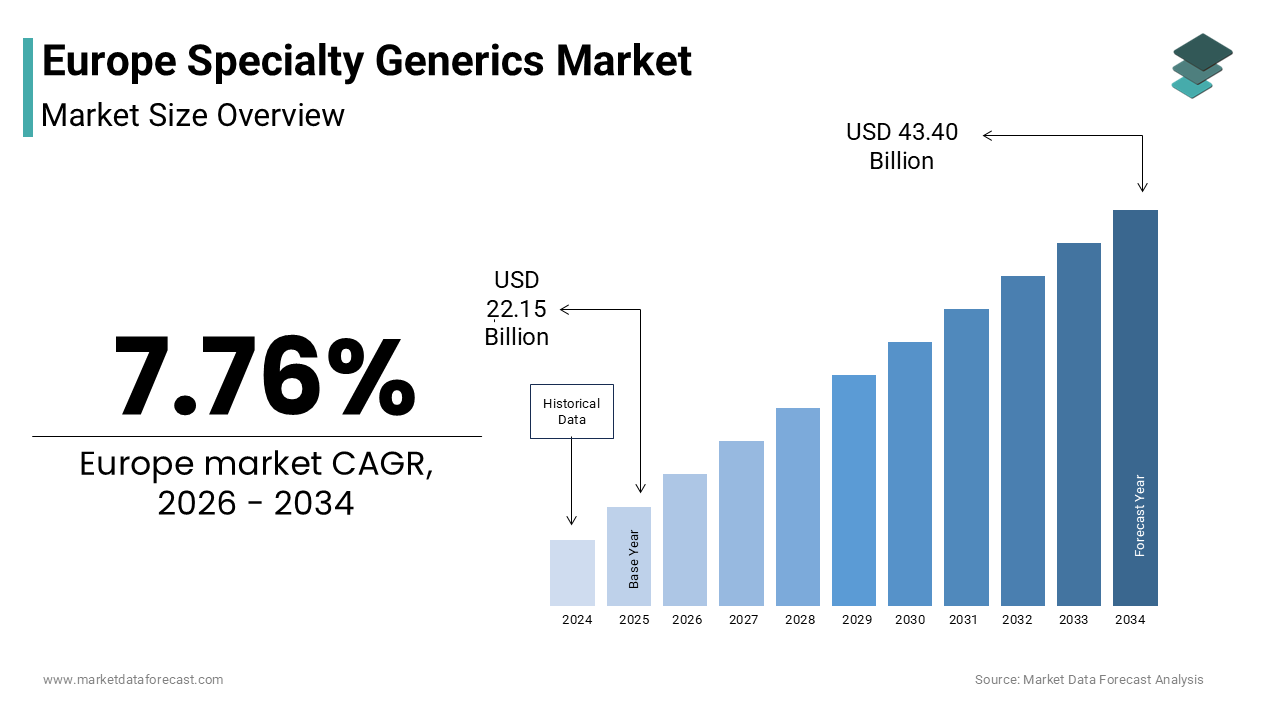
The Europe specialty generics market was valued at USD 22.15 billion in 2025, is estimated to reach USD 23.87 billion in 2026, and is projected to reach USD 43.40 billion by 2034, growing at a CAGR of 7.76% during the forecast period from 2026 to 2034. The growth of the Europe specialty generics market is driven by the rising prevalence of chronic and complex diseases, increasing demand for cost-effective alternatives to high-priced branded therapies, and the growing aging population across the region. Specialty generics play a crucial role in reducing pharmaceutical expenditure while maintaining therapeutic efficacy, particularly in oncology, autoimmune disorders, and rare diseases. Moreover, supportive government initiatives aimed at optimizing healthcare budgets and improving patient access to advanced therapies are accelerating market expansion. The increasing adoption of biosimilars, advanced injectable formulations, and decentralized outpatient treatment models is further strengthening the market outlook across Europe.
Key Market Trends
- Rising adoption of complex injectable specialty generics for oncology and autoimmune disease treatments.
- Increasing development of biosimilars and biologics-based generic therapies to address high-cost specialty drug markets.
- Growing shift toward home healthcare and outpatient treatment models, driving demand for patient-friendly oral formulations.
- Expansion of specialty pharmacy networks offering personalized medication management and improved patient adherence.
- Strong focus on cost containment strategies by European healthcare systems, encouraging wider specialty generics adoption.
Segmental Insights
- Based on route of administration, the injectables segment was the largest and held a significant share of the Europe specialty generics market in 2025. The segment’s dominance is attributed to its extensive use in hospital settings for treating cancer, infectious diseases, and other life-threatening conditions requiring rapid therapeutic intervention.
- Based on the indication, the oncology segment accounted for 41.4% of the Europe specialty generics market share in 2025. The growth of this segment is driven by the high prevalence of cancer across Europe and the increasing need for affordable yet effective oncology therapies to reduce healthcare spending.
- Based on distribution channel, the hospital pharmacies segment was the largest, occupying a prominent share of the Europe specialty generics market in 2025. The dominance of this segment stems from the growing use of specialty generics in acute care settings and complex treatment regimens requiring clinical supervision.
Regional Insights
The Europe specialty generics market is witnessing steady growth across major economies, supported by rising healthcare expenditures, aging populations, and increasing adoption of cost-efficient pharmaceutical solutions.
- Germany was the largest contributor, accounting for 22.3% of the European specialty generics market share in 2025, driven by its advanced healthcare infrastructure, high pharmaceutical spending, and strong presence of leading generic drug manufacturers.
- France continues to perform strongly, fueled by a growing burden of oncology cases, an aging population, and government initiatives aimed at improving access to affordable specialty treatments.
- Italy is emerging as a key market due to its expanding geriatric population and increasing demand for chronic disease therapies delivered through hospitals and outpatient settings.
- Spain and the United Kingdom are also witnessing notable growth, supported by expanding home healthcare services, strong pharmaceutical innovation, and rising adoption of decentralized treatment models across Europe.
Competitive Landscape
The Europe specialty generics market is characterized by intense competition among global and regional pharmaceutical manufacturers focusing on complex formulations, biosimilars development, and advanced delivery technologies. Leading companies are investing in regulatory compliance, manufacturing innovation, and strategic collaborations to strengthen their market position. Expansion into specialty pharmacy channels, development of oncology-focused generics, and integration of biologics manufacturing capabilities are key strategies shaping the competitive environment. Prominent players in the Europe specialty generics market include Sandoz Group AG, Teva Pharmaceutical Industries Ltd., Viatris Inc., STADA Arzneimittel AG, Hikma Pharmaceuticals PLC, Fresenius SE & Co. KGaA, KRKA d.d., Sun Pharmaceutical Industries Ltd., Dr. Reddy’s Laboratories Ltd., Lupin Limited, and Zentiva.
Europe Specialty Generics Market Size
The Europe specialty generics market size was valued at USD 22.15 billion in 2025 and is anticipated to reach USD 23.87 billion in 2026 from USD 43.40 billion by 2034, growing at a CAGR of 7.76% during the forecast period from 2026 to 2034
Specialty generics represents a niche yet rapidly growing segment within the pharmaceutical industry, characterized by its focus on complex and high-value generic drugs. Specialty generics are bioequivalent versions of branded specialty drugs, which are typically used to treat chronic and complex conditions such as cancer, autoimmune diseases, and rare disorders. According to the European Medicines Agency, these drugs require advanced manufacturing processes, specialized delivery mechanisms, and stringent regulatory compliance, distinguishing them from traditional generics. The demand for specialty generics has surged due to their ability to offer cost-effective alternatives to expensive branded drugs while maintaining therapeutic efficacy. As per Eurostat, in 2022 an average of €3,685 per inhabitant was spent on healthcare in the EU, which represented about 10.4% of GDP. Pharmaceutical expenditure accounted for around one sixth of overall healthcare spending in OECD countries. The rising prevalence of chronic diseases, coupled with an aging population, has further amplified the need for affordable and accessible treatments. As per Eurostat, more than one fifth of the EU population was aged 65 years and over in 2024, which is driving demand for specialty generics in geriatric care. Additionally, government initiatives aimed at reducing healthcare costs have bolstered the adoption of these drugs, positioning the specialty generics market as a critical component of Europe’s healthcare landscape.
MARKET DRIVERS
Increasing Prevalence of Chronic Diseases
The escalating incidence of chronic diseases across Europe serves as a primary driver for the specialty generics market. As per the European Society of Cardiology, cardiovascular disease alone accounts for over 3.9 million deaths in Europe each year, representing the leading cause of mortality. These conditions often necessitate long-term treatment with high-cost specialty drugs, which is creating a significant burden on healthcare systems. Furthermore, as per Eurostat, chronic diseases remain among the top causes of hospital admissions, intensifying the demand for cost-effective alternatives like specialty generics. Healthcare expenditures on chronic disease management represent a substantial share of total spending in Europe, with specialty generics playing a pivotal role in reducing treatment costs while ensuring therapeutic efficacy.
Rising Geriatric Population and Healthcare Expenditures
Europe’s rapidly aging population is another key driver propelling the demand for specialty generics. As per Eurostat, more than one fifth of the EU population was aged 65 years and over in 2024, and this figure is projected to continue rising in the coming years. This demographic shift is accompanied by a higher prevalence of age-related conditions, including cancer, rheumatoid arthritis, and neurodegenerative disorders, which necessitate advanced therapeutic interventions. According to the World Health Organization, older adults consume a significant proportion of prescription medicines, driving demand for affordable specialty generics. Geriatric care represents a major component of healthcare spending, with specialty generics being integral to managing hospital stays and outpatient treatments.
MARKET RESTRAINTS
Stringent Regulatory and Manufacturing Requirements
The stringent regulatory and manufacturing requirements that impose significant barriers to entry is one of the major restraints to the growth of the European specialty generics market. As per the European Directorate for the Quality of Medicines & HealthCare, manufacturers must adhere to Good Manufacturing Practices (GMP) and undergo rigorous testing to ensure bioequivalence and safety. Compliance-related expenses represent a considerable portion of production costs, creating barriers for smaller players who lack the financial resources to meet these requirements. Additionally, delays in obtaining regulatory approvals often disrupt supply chains, exacerbating shortages and reducing market competitiveness.
High Development Costs and Limited Profit Margins
The high development costs associated with specialty generics is limiting profit margins and deter investment, which is further restraining the growth of the European specialty generics market. Developing a specialty generic drug requires significant financial resources due to the complexity of formulations and the need for specialized manufacturing facilities. Profit margins for specialty generics are generally lower than those for traditional generics, which creates challenges for small and medium-sized enterprises that struggle to compete with larger pharmaceutical companies. The limited profitability of specialty generics often discourages innovation and market expansion, hindering overall growth.
MARKET OPPORTUNITIES
Expansion of Biologics and Biosimilars
The growing emphasis on biologics and biosimilars offers a significant opportunity for the European specialty generics market. As per the European Medicines Agency, Europe has approved more biosimilars than any other region globally, making it a leader in this segment. Researchers are investigating advanced formulations and delivery mechanisms to enhance efficacy and reduce side effects. Biosimilars continue to expand their share in the European pharmaceutical market, driven by their therapeutic effectiveness and affordability. This trend aligns with Europe’s focus on precision medicine and personalized healthcare, creating a fertile environment for innovation and market expansion.
Growing Adoption in Home Healthcare and Outpatient Settings
The increasing adoption of home healthcare and outpatient treatments offers another promising avenue for the specialty generics market. As per the World Health Organization, there is a growing shift toward community-based and outpatient care across Europe, supported by advancements in portable medical devices and self-administration technologies. Specialty generics, particularly those used for chronic disease management, are increasingly being utilized in home settings to reduce hospitalization costs and improve patient convenience. Outpatient care represents a significant share of healthcare expenditures, reflecting a broader move toward decentralized healthcare delivery. This trend not only enhances patient outcomes but also positions specialty generics as a key enabler of sustainable healthcare solutions.
MARKET CHALLENGES
Risk of Contamination and Sterility Concerns
The risk of contamination and sterility concerns poses a significant challenge to the European specialty generics market, which is undermining trust in product safety and efficacy. As per the European Medicines Agency, incidents of contamination in injectable medicines have been reported in recent years, leading to recalls and heightened regulatory scrutiny. Although stringent quality control measures have been implemented, the threat of contamination persists due to the complexity of manufacturing processes and reliance on imported raw materials. These incidents not only jeopardize patient safety but also result in costly recalls and reputational damage for manufacturers.
Limited Accessibility in Rural and Underserved Areas
The limited accessibility of specialty generics in rural and underserved areas, which restricts equitable healthcare delivery across Europe and challenging the growth of the European specialty generics market. As per the World Health Organization, rural regions often face shortages of essential medical supplies compared to urban counterparts, due to underdeveloped infrastructure and inefficient supply chains. This disparity exacerbates healthcare inequalities and limits the ability of rural healthcare providers to manage emergencies and chronic conditions effectively. Addressing these gaps requires significant investment in logistics and infrastructure, which remains a challenge for many European countries.
REPORT COVERAGE
| REPORT METRIC | DETAILS |
| Market Size Available | 2025 to 2034 |
| Base Year | 2025 |
| Forecast Period | 2026 to 2034 |
| CAGR | 7.76% |
| Segments Covered | By Route of Administration, Indication, Distribution Channel and Region |
| Various Analyses Covered | Regional & Country Level Analysis, Segment-Level Analysis, DROC, PESTLE Analysis, Porter’s Five Forces Analysis, Competitive Landscape, Analyst Overview on Investment Opportunities |
| Countries Covered | UK, France, Spain, Germany, Italy, Russia, Sweden, Denmark, Switzerland, the Netherlands, Turkey, the Czech Republic, and the Rest of Europe. |
| Market Leaders Profiled | Sandoz Group AG, Teva Pharmaceutical Industries Ltd., Viatris Inc., STADA Arzneimittel AG, Hikma Pharmaceuticals PLC, Fresenius SE & Co. KGaA, KRKA d.d., Sun Pharmaceutical Industries Ltd., Dr. Reddy’s Laboratories Ltd., Lupin Limited, and Zentiva. |
SEGMENTAL ANALYSIS
By Route of Administration Insights
The injectables segment dominated the European specialty generics market by holding 51.5% of the European market share in 2025. The dominance of injectables segment in the European specialty generics segment is attributed to their widespread use in treating chronic and life-threatening conditions such as cancer, autoimmune diseases, and infectious diseases. As per Eurostat, injectable medicines represent a significant share of hospital prescriptions, underscoring their critical role in acute care settings. Their ability to deliver precise and rapid therapeutic interventions makes them indispensable in managing complex health conditions, solidifying their dominance in the market.
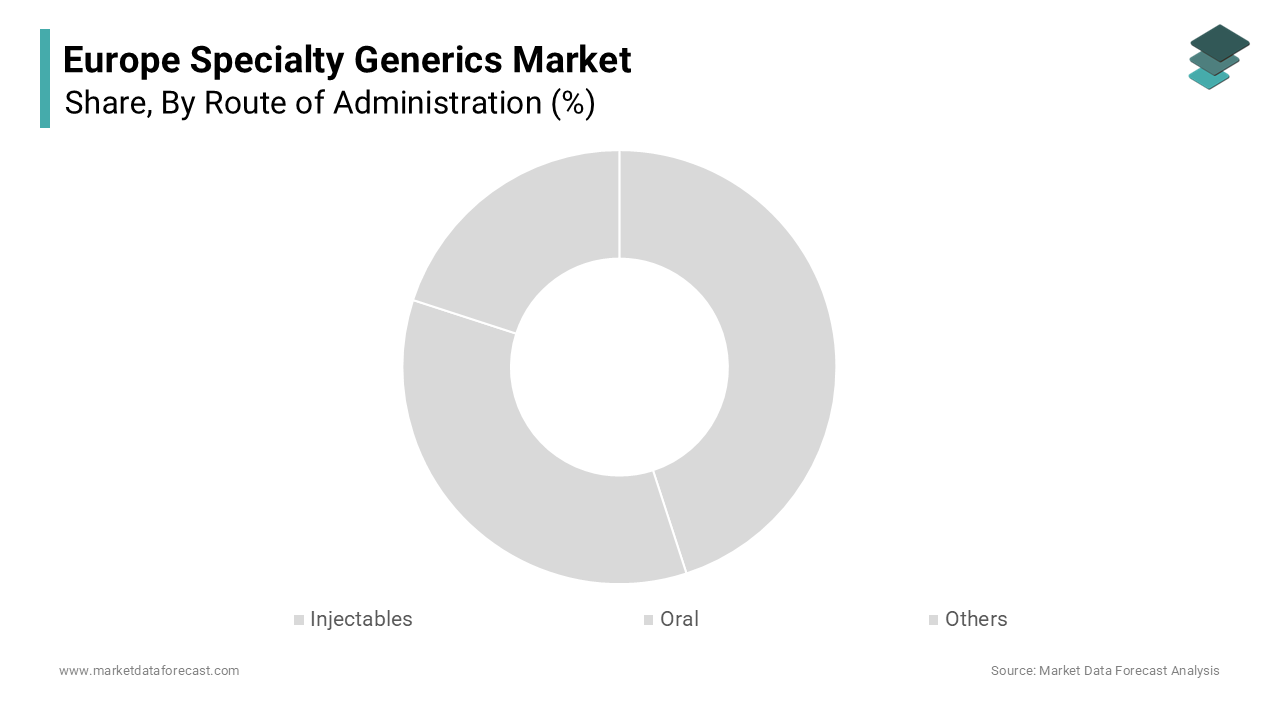
The oral specialty generics segment is the fastest-growing segment and is estimated to register a CAGR of 15.5% over the forecast period owing to their suitability for chronic disease management and their ease of administration compared to injectables. As per the European Society for Clinical Nutrition and Metabolism, oral formulations are increasingly being adopted for conditions such as rheumatoid arthritis and multiple sclerosis, which is making them a versatile option in outpatient and home healthcare settings. Their compatibility with patient-centric care enhances adherence and reduces hospitalization costs, positioning them as a transformative force in the specialty generics market.
By Indication Insights
The oncology segment led the market by holding 41.4% of the European market share in 2025. The dominance of oncology segment in the European market is driven by the high prevalence of cancer, with more than 4 million new cases diagnosed annually in Europe according to the European Society for Medical Oncology. Oncology drugs account for a substantial share of pharmaceutical spending, underscoring the critical role of specialty generics in managing treatment costs. Their ability to provide cost-effective alternatives to branded oncology drugs ensures optimal patient outcomes, which is contributing to the growth of the oncology segment in the European market.
The autoimmune diseases segment is the fastest-growing segment and is predicted to record a CAGR of 16.5% over the forecast period owing to the rising prevalence of conditions such as rheumatoid arthritis, psoriasis, and Crohn’s disease that require long-term treatment with specialty generics. As per the European Medicines Agency, autoimmune diseases affect a significant portion of Europe’s population, driving demand for affordable and effective therapies. Their role in enhancing immune modulation and overall health positions them as a critical component of advanced healthcare solutions.
By Distribution Channel Insights
The hospital segment dominated the market by holding 46.4% of the regional market share in 2025. The dominance of the hospital segment in this regional market is attributed to the widespread use of specialty generics in acute care settings, particularly for treating chronic and life-threatening conditions such as cancer and autoimmune diseases. Hospital pharmacies account for a significant share of specialty generic prescriptions, which is indicating their critical role in patient care. Their ability to ensure timely access to complex therapies makes them indispensable in managing hospital stays and outpatient treatments.
The specialty pharmacies segment is the fastest-growing distribution channel and is estimated to grow at a CAGR of 17.7% over the forecast period owing to their focus on providing personalized care and managing complex therapies for chronic conditions such as rheumatoid arthritis and multiple sclerosis. Specialty pharmacies are increasingly being adopted for their ability to enhance patient adherence and reduce hospitalization costs, making them a key enabler of decentralized healthcare delivery.
REGIONAL ANALYSIS
Germany Specialty Generics Market Analysis
Germany led the European specialty generics market by capturing 22.3% of the total market share in 2025. The country’s advanced healthcare infrastructure and high prevalence of chronic diseases drive demand for specialty generics. As per Eurostat, Germany has one of the largest healthcare expenditures in Europe, reflecting the need for robust therapeutic strategies. Additionally, the presence of leading pharmaceutical companies fosters innovation, further solidifying Germany’s leadership in the market.
France Specialty Generics Market Analysis
France captured a promising share of the European specialty generics market in 2025. The growth of France in the European market is driven by its strong pharmaceutical sector and aging population. As per the European Society for Medical Oncology, France records a high burden of cancer cases annually, underscoring the critical need for specialty generics. The government’s focus on enhancing healthcare accessibility has also bolstered the adoption of cost-effective alternatives.
Italy Specialty Generics Market Analysis
Italy is anticipated to showcase a prominent CAGR in the European market during the forecast period owing to its high geriatric population and robust healthcare system. As per the European Observatory on Health Systems and Policies, Italy’s elderly population exceeds 14 million, driving demand for chronic disease management. Specialty generics’ widespread use in hospitals and outpatient settings positions Italy as a key contributor to the regional market.
Spain Specialty Generics Market Analysis
Spain is predicted to hold a notable share of the European market over the forecast period due to its growing emphasis on preventive healthcare and chronic disease management. As per Eurostat, healthcare expenditures in Spain represent a significant share of GDP, highlighting the importance of specialty generics in addressing public health challenges.
UK Specialty Generics Market Analysis
The UK is expected to register a healthy CAGR in the European market during the forecast period owing to its advanced pharmaceutical industry and rising adoption of home healthcare solutions. As per the World Health Organization, home healthcare services are expanding across Europe, and the UK has been a key contributor to this trend. Specialty generics play a pivotal role in enabling decentralized care delivery.
KEY MARKET PLAYERS
Some of the companies that are playing a dominating role in the Europe Specialty Generics Market include
- Sandoz Group AG
- Teva Pharmaceutical Industries Ltd
- Viatris Inc.
- STADA Arzneimittel AG
- Hikma Pharmaceuticals PLC
- Fresenius SE & Co. KGaA
- KRKA d.d.
- Sun Pharmaceutical Industries Ltd.
- Dr. Reddy’s Laboratories Ltd.
- Lupin Limited
- Zentiva
MARKET SEGMENTATION
This research report on the europe specialty generics market has been segmented and sub-segmented based on following categories.
By Route of Administration
- Injectables
- Oral
- Others
By Indication
- Oncology
- Autoimmune Diseases
- Infectious Diseases
- Others
By Distribution Channel
- Retail Pharmacies
- Specialty Pharmacies
- Hospital Pharmacies
By Country
- UK
- France
- Spain
- Germany
- Italy
- Russia
- Sweden
- Denmark
- Switzerland
- Netherlands
- Turkey
- Czech Republic
- Rest of Europe