- Product Description Description
- Table of Contents TOC
- List of Table & Figure LOT
- Get Free Sample PDF Sample PDF
Market Size, 2025
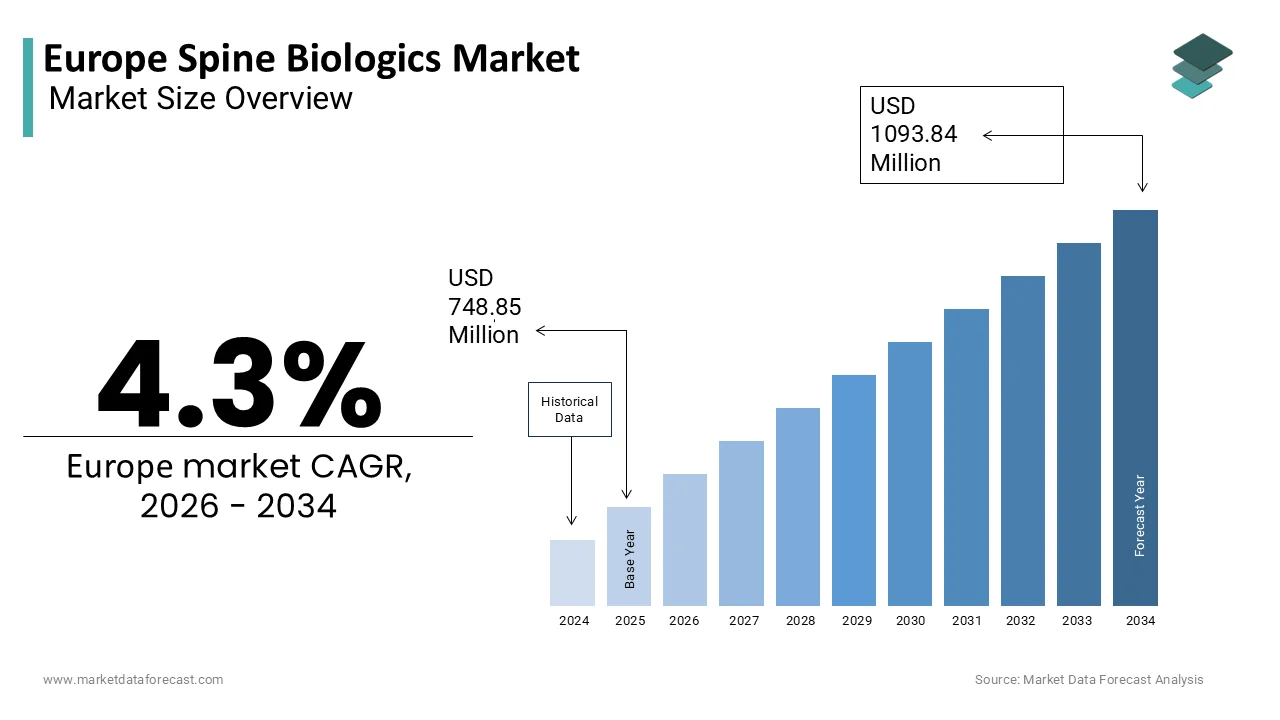
$748.85 MnMarket Estimate, 2026
$781.05 MnMarket Forecast, 2034
$1,093.84 MnCAGR, 2026–2034
4.3%Europe Spine Biologics Market Size
The europe spine biologics market size was valued at USD 748.85 million in 2025, is expected to have 4.3% CAGR from 2026 to 2034, and be worth USD 1093.84 million by 2034 from USD 781.05 million in 2026.
The spine biologics are a class of therapeutic products, including bone graft substitutes, demineralized bone matrices, and cellular allografts, that are designed to enhance spinal fusion and promote natural bone regeneration in degenerative, traumatic, or deformity-related spinal conditions. Unlike traditional hardware-based interventions, these biologics aim to harness the body’s innate healing mechanisms, aligning with Europe’s broader shift toward minimally invasive and biologically integrated orthopedic care. The regulatory landscape is uniquely defined by the European Union’s stringent classification under the Medical Devices Regulation and the inclusion of certain advanced biologics as combined advanced therapy medicinal products when they contain viable cells or recombinant protein. As per Eurostat, spinal fusion procedures were performed across EU hospitals in 2023, with an increasing proportion incorporating biologics to improve fusion success rates.
MARKET DRIVERS
Aging Population and Rising Prevalence of Degenerative Spinal Disorders
The growing aging population is a primary driver of spine biologics demand, as age correlates strongly with degenerative spinal pathologies requiring surgical intervention is driving the growth of the European spine biologics market. According to Eurostat, 21.3% of the EU population was aged 65 or older in 2023, a figure projected to reach 29.1% by 2050, with countries like Italy and Germany already exceeding 23%. As per the European Registry of Spinal Procedures, the annual volume of lumbar fusions in patients over 65 grew by 8.7% between 2020 and 2023, which is significantly outpacing younger cohorts. These older patients often exhibit compromised bone quality, making autograft harvesting risky and increasing reliance on osteoconductive and osteoinductive biologics to ensure fusion success. The European Society for Spine Surgery confirmed that 74% of surgeons now use bone graft substitutes in elderly patients to reduce operative time and donor site morbidity.
Regulatory Pathways Encouraging Innovation in Minimally Invasive Spine Surgery
The European Union’s Medical Devices Regulation has created a structured yet innovation-friendly environment for spine biologics that support minimally invasive surgical techniques. The regulatory pathways encouraging innovation in minimally invasive spine surgery are eventually enhancing the growth of the European spine biologics market. The European Medicines Agency reported that seventeen spine biologic products received CE certification under the new MDR framework in 2023 alone, with thirteen classified as Class III due to their biological activity. National competent authorities reinforce this momentum, where Germany’s Federal Institute for Drugs and Medical Devices established a fast-track evaluation pathway in 2025 for biologics used in endoscopic lumbar interbody fusion. Additionally, the European Spine Study Group documented that minimally invasive spine surgeries incorporating biologics reduced hospital stays by 2.8 days on average compared to open procedures, aligning with EU healthcare efficiency goals. These regulatory and clinical synergies incentivize developers to innovate within Europe’s framework rather than seek less stringent markets.
MARKET RESTRAINTS
Stringent Clinical Evidence Requirements Under the Medical Devices Regulation
The clinical evidence expectations mandated by the EU Medical Devices Regulation, which significantly increase development timelines and costs, are hampering the growth othe f the European spine biologics market. According to the European Medicines Agency, manufacturers must now provide robust clinical data demonstrating both safety and performance for Class III spine biologics, including comparative studies against established treatments. Small and medium enterprises are particularly affected, where the European Confederation of Medical Device Associations confirmed that the average cost of compiling a complete MDR technical file for a bone graft substitute, excluding clinical trial expenses.
Reimbursement Uncertainty and Fragmented Health Technology Assessment
The inconsistent reimbursement across healthcare systems suppresses the commercial viability of spine biologics, which is additionally declining the growth of the European spine biologics market. The European Health Insurance Consortium reported that in countries like Spain and Poland, spine biologics are often excluded from diagnosis-related group tariffs, forcing hospitals to absorb costs or limit use to exceptional cases. The reimbursement approval timelines for new spine biologics averaged 19 months post CE mark, with prices varying by over 300% between countries for identical products. This fragmentation discourages manufacturers from launching broadly across Europe and limits patient access even when clinical evidence supports use.
MARKET OPPORTUNITIES
Integration of Spine Biologics in Outpatient and Ambulatory Surgery Centers
The expansion of ambulatory spine surgery for next-generation spine biologics that support rapid recovery and same-day discharge is creating new opportunities for the growth of the European spine biologics market. According to the European Association of Ambulatory Surgery, the number of outpatient spinal fusions in the EU grew by 22% in 2023, driven by advances in endoscopic techniques and enhanced recovery protocols. These settings demand biologics that are easy to handle, require no secondary harvesting, and accelerate early bone formation to ensure stability without prolonged bracing. As per the European Spine Registry, ambulatory centers now prefer ready-to-use putty or gel-based bone graft substitutes over traditional particulate forms due to procedural efficiency.
Development of Next Generation Cellular and Molecular Biologics
Emerging as a hub for advanced spine biologics that incorporate stem cells, exosomes, and recombinant growth factors, which is creating new opportunities for the growth of the European spine biologics market. According to the European Institute of Innovation and Technology Health KIC, it supports translational research on cell-based spinal fusion therapies across academic hospitals. The European Medicines Agency’s Committee for Advanced Therapies granted orphan designation in 2025 to a mesenchymal stem cell-seeded scaffold for complex spinal reconstructions, accelerating its clinical pathway. National regulatory bodies are adapting; the UK’s Medicines and Healthcare products Regulatory Agency launched a sandbox program in early 2025 to co-develop evaluation frameworks for next-generation biologics with developers. These scientific and regulatory advances position Europe to lead in the next wave of regenerative spine therapeutics.
MARKET CHALLENGES
Shortage of Standardized Fusion Assessment Protocols Across Clinical Sites
The lack of harmonized criteria for evaluating spinal fusion success, which undermines comparative effectiveness research and regulatory decision-making, is a significant challenge for the growth of the European spine biologics market. According to the European Spine Registry, only 43% of participating centers use the same radiographic or CT-based fusion grading system, with definitions of “solid fusion” varying widely between institutions. This inconsistency affects clinical trials, with a multicenter study on a bone morphogenetic protein substitute showing fusion rates ranging from 67 to 91% across sites due to assessment variability rather than product performance.
Ethical and Supply Chain Constraints in Allograft Sourcing
The reliance on human donor tissue for many spine biologics faces growing ethical scrutiny and logistical limitations in Europe, which is threatening supply continuity and patient acceptance. This factor is likely to be another attribute that degrades the growth of the European spine biologics market. Countries like Germany and Italy enforce strict traceability and processing standards under the EU Tissues and Cells Directives, limiting the number of certified tissue banks to fewer than 35 across the bloc. Additionally, patient concerns about disease transmission and religious objections persist, with a Eurobarometer survey finding that 33% of respondents expressed discomfort with cadaver-derived implants.
REPORT COVERAGE
| REPORT METRIC | DETAILS |
| Market Size Available | 2025 to 2034 |
| Base Year | 2025 |
| Forecast Period | 2026 to 2034 |
| Segments Covered | By Product Type, Surgery Type, Application and Region. |
| Various Analyses Covered | Global, Regional, and Country-Level Analysis, Segment-Level Analysis, Drivers, Restraints, Opportunities, Challenges; PESTLE Analysis; Porter’s Five Forces Analysis, Competitive Landscape, Analyst Overview of Investment Opportunities |
| Countries Covered | UK, France, Spain, Germany, Italy, Russia, Sweden, Denmark, Switzerland, Netherlands, Turkey, Czech Republic, Rest of Europe |
| Market Leaders Profiled | Alphatec Holdings, Inc., Depuy Synthes (Johnson & Johnson), Exactech, Inc., Globus Medical, Inc., Medtronic plc, NuVasive, Inc., Orthofix International N.V., RTI Surgical, Inc., SeaSpine, Zimmer Biomet Holdings, Inc. |
SEGMENTAL ANALYSIS
By Surgery Type Insights
The posterior lumbar interbody fusion segment was accounted for in holding 38.2% of the European spine biologics market share in 2025, with its widespread use in treating degenerative disc disease, spondylolisthesis, and spinal stenosis, which are the most prevalent lumbar pathologies in Europe’s aging population. As per the European Society for Spine Surgery, 82% of PLIF cases in 2023 incorporated bone graft substitutes or demineralized bone matrix to enhance fusion rates in osteoporotic patients. Germany’s AWMF Spine Guidelines, updated in 2023, recommend biologic augmentation in all PLIF procedures for patients over 60 to mitigate pseudarthrosis risk.
The lateral lumbar interbody fusion segment is expected to witness the fastest CAGR of 11.2% during the forecast period, with the technique’s minimally invasive nature, reduced muscle disruption, and suitability for outpatient settings. According to the European Spine Study Group, LLIF volumes grew by 24% in 2023 across high-volume centers in France, Italy, and the Netherlands for multilevel degenerative disease in elderly patients with comorbidities. National reimbursement systems are adapting, where the UK’s National Institute for Health and Care Excellence issued guidance in early 2025 recognizing LLIF with biologic augmentation as a cost-effective option for select lumbar pathologies.
By Product Type Insights
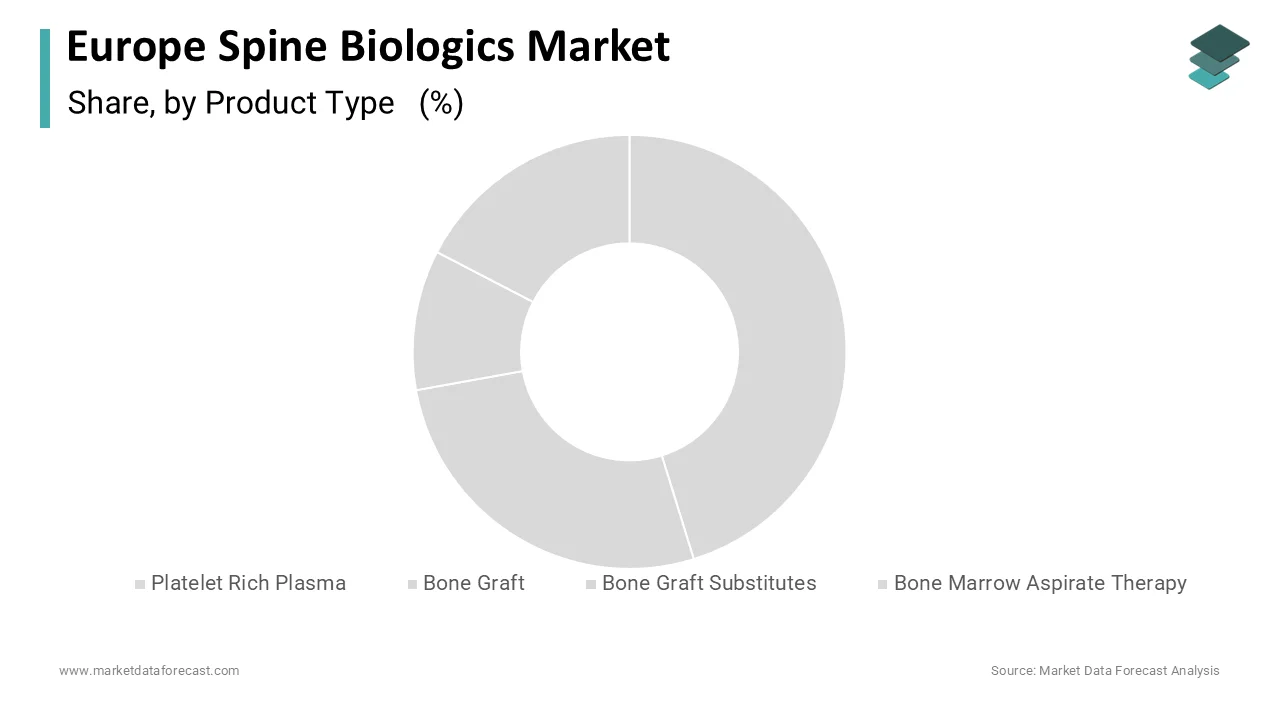
The bone graft substitutes segment was the largest and held 42.3% of the European spine biologics market share in 2025, with its synthetic or ceramic composition, which eliminates donor site morbidity, ethical concerns, and supply constraints associated with autografts and allografts. These clinical, economic, and regulatory advantages make substitutes the backbone of European biologic use.
The bone marrow aspirate therapy segment is likely to grow with an anticipated to register a fastets CAGR of 30.7% throughout the forecast period, with its autologous nature, which bypasses MDR classification hurdles for allogeneic or recombinant products while delivering mesenchymal stem cells directly to the fusion site. As per the European Medicines Agency BMAT, regulated as a minimally manipulated tissue under the EU Tissues and Cells Directives, allowing point of care use without full advanced therapy medicinal product oversight. National centers are scaling adoption; Germany’s Charité Hospital performed over 1200BMAT-enhancedd fusions in 2023 under its hospital exemption pathway. Additionally, the European Commission’s Horizon Europe program allocated 18 million euros in 2025 to standardize BMAT processing protocols across EU trial sites.
COUNTRY LEVEL ANALYSIS
Germany Spine Biologics Market Analysis
Germany was the top performer of the European spine biologics market by capturing 25.3% of the share in 2025, with its high volume of spinal surgery, advanced healthcare infrastructure and strict adherence to evidence-based guidelines. As per the German Federal Statistical Office, over 52,000 spinal fusions were performed in 2023, with 87% incorporating biologics as recommended by the AWMF Spine Guidelines. Additionally, the Paul Ehrlich Institute enforces rigorous donor screening for allografts, ensuring high safety standards that build clinician trust. This integration of clinical policy reimbursement and quality control sustains Germany’s dominant position
France Spine Biologics Market Analysis.
France's spine biologics market growth is likely to be driven by the centralized healthcare decision-making and strong support for minimally invasive techniques. France’s HAS issued updated recommendations in early 2025 endorsing biologic augmentation in all fusions for patients over 60, aligning with geriatric care priorities. Additionally, the country hosts leading spine centers like Pitié Salpêtrière Hospital, which performs over 800 biologic-enhanced fusions annually as part of its national spine care network.
Italy Spine Biologics Market Analysis
Italy's spine biologics market growth is likely to grow eventually in the coming years, with one of Europe’s oldest populations aged 65 or older and a high prevalence of degenerative spinal conditions. The National Institute of Health updated its spinal fusion guidelines in 2023 to mandate biologic use in all lumbar procedures for osteoporotic patients. Reimbursement supports access with the National Health Service covers 100% of biologic costs for hospital-based fusions.
United Kingdom Spine Biologics Market Analysis
The United Kingdom spine biologics market is likely to grow steadily throughout the forecast period. NICE issued updated guidance in early 2025 recommending biologic use in revision surgeries and for patients with comorbidities that impair healing. As per the British Association of Spine Surgeons, biologic use reduced pseudarthrosis rates by 26% in 2023.
Spain Spine Biologics Market Analysis
Spain's spine biologics market growth is fueled by rising demand for spinal care in its aging population and the expansion of specialized spine units in public hospitals. As per the Spanish Society of Neurosurgery, over 29000 spinal fusions were performed in 2023, with biologic use increasing to 72% from 58% in 2020 due to updated clinical protocols. Additionally, Spain is a leader in minimally invasive spine surgery; the Catalan Spine Center reported that 38% of its 2023 fusions used LLIF with biologic augmentation, enabling same-day discharge.
COMPETITIVE LANDSCAPE
The European spine biologics market features intense competition among global orthopedic leaders and specialized biotech firms, all navigating a highly regulated and clinically discerning environment. Unlike markets driven by price competition in Europe centered on regulatory credibility, clinical validation, and integration with surgical workflows. Global players like Medtronic, Stryker, and DePuy Synthes leverage scale and surgeon relationships but face scrutiny over long-term safety data, especially for recombinant proteins. European specialty companies differentiate through niche allograft processing or synthetic formulations that align with local reimbursement policies. The absence of harmonized fusion assessment standards creates both opportunity and risk as vendors invest in real-world evidence to prove efficacy. Reimbursement fragmentation remains a key barrier, with only select countries offering predictable coverage.
KEY MARKET PLAYERS
Key players operating in the europe spine biologics market profiled in this report are
- Alphatec Holdings, Inc.
- Depuy Synthes (Johnson & Johnson)
- Exactech, Inc.
- Globus Medical, Inc.
- Medtronic plc
- NuVasive, Inc.
- Orthofix International N.V.
- RTI Surgical, Inc
- SeaSpine
- Zimmer Biomet Holdings, Inc.
TOP LEADING PLAYERS IN THE MARKET
- Medtronic plc is a leading force in the European spine biologics market, offering a comprehensive portfolio including INFUSE Bone Graft and Osteotech allograft solutions. The company serves major spine centers across Germany, France, and the UK with MDR-certified biologics that integrate seamlessly with its surgical instrumentation platforms. Globally, Medtronic contributes by setting clinical and manufacturing standards for recombinant bone morphogenetic proteins and promoting surgeon training on biologic handling and dosing protocols in alignment with international guidelines.
- Stryker Corporation plays a strategic role in the European spine biologics market through its proprietary bone graft substitutes and cellular allograft technologies under the OPUS and GRAFTJACKET brands. The company supports high-volume spine centers in Italy, Spain, and the Netherlands with ready-to-use putty and sheet formulations designed for outpatient and endoscopic procedures. It also collaborated with the French Society for Spine Surgery to develop standardized biologic use protocols for osteoporotic patients. Globally, Stryker advances biologic innovation by investing in synthetic scaffold R and D and embedding sustainability principles in allograft processing to meet evolving EU tissue safety requirements.
- DePuy Synthes, a Johnson & Johnson company, is a key contributor to the European spine biologics market with its VITOSS Foam and ALLOMATRIX platforms widely adopted in revision and complex spinal reconstructions. The company maintains strong relationships with academic hospitals in Sweden, Switzerland, and Germany, where its biologics are used in registry-driven clinical pathways. Globally, DePuy Synthes strengthens its position by aligning biologic development with value-based healthcare models and supporting health technology assessment submissions to facilitate reimbursement across diverse European systems.s
TOP STRATEGIES USED BY THE KEY MARKET PARTICIPANTS
Key players in the European spine biologics market prioritize regulatory compliance by generating robust clinical evidence aligned with the Medical Devices Regulation and securing CE certification for expanded indications. They invest in real-world evidence generation through partnerships with European spine registries and professional societies to demonstrate long-term fusion outcomes. Strategic integration of biologics with proprietary surgical systems ensures procedural efficiency and surgeon loyalty. Companies develop ready-to-use formulations tailored to minimally invasive and outpatient settings to meet evolving surgical trends. Additionally, they establish centralized logistics and traceability systems to comply with EU tissue safety directives and support hospital procurement requirements.
MARKET SEGMENTATION
This research report on the europe spine biologics market has been segmented and sub-segmented into the following categories.
By Product Type
- Platelet Rich Plasma
- Bone Graft
- Bone Graft Substitutes
- Bone Marrow Aspirate Therapy
By Surgery Type
- Transforaminal Lumbar Interbody Fusion
- Anterior Lumbar Interbody Fusion
- Lateral Lumbar Interbody Fusion
- Anterior Cervical Discectomy And Fusion
- Posterior Lumbar Interbody Fusion
- Others
By Country
- UK
- France
- Spain
- Germany
- Italy
- Russia
- Sweden
- Denmark
- Switzerland
- Netherlands
- Turkey
- Czech Republic
- Rest of Europe