Europe Sportswear Market Size, Share, Trends, & Growth Forecast Report By Product Type ( Footwear, Apparel, Wearables), End User, Distribution Channel and Country (UK, France, Spain, Germany, Italy, Russia, Sweden, Denmark, Switzerland, Netherlands, Turkey, Czech Republic and Rest of Europe), Industry Analysis From 2025 to 2033
Europe Sportswear Market Size
The europe sportswear market size was valued at USD 58.59 billion in 2024 and is anticipated to reach USD 62.66 billion in 2025 from USD 107.09 billion by 2033, growing at a CAGR of 6.93% during the forecast period from 2025 to 2033.
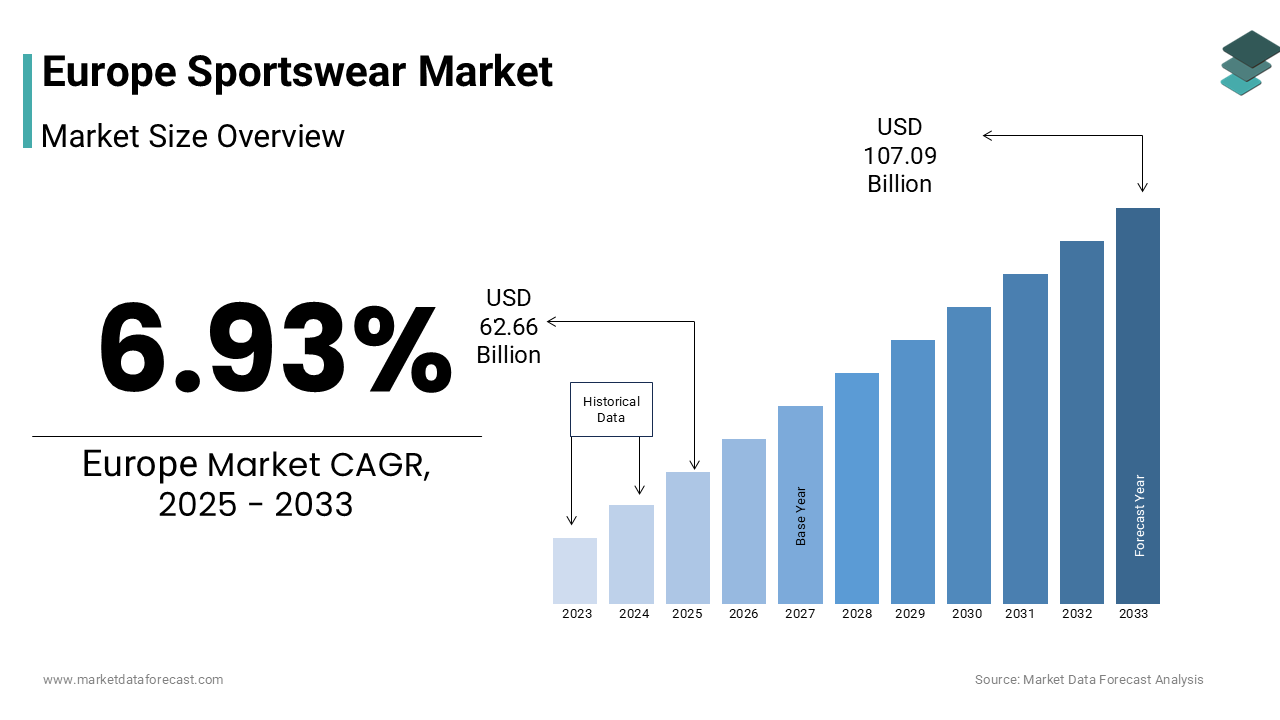
Sportswear refers to performance-oriented apparel, footwear, and accessories designed for athletic activity, fitness training, and sports-inspired lifestyle wear. Unlike generic activewear this segment is defined by functional innovation technical fabric engineering and alignment with both competitive sports and wellness culture. The market spans elite performance gear for professional athletes to athleisure collections worn in urban settings reflecting a broader societal shift toward health consciousness and body positivity. According to research, a share percent of adults in the European Union engaged in moderate or vigorous physical activity at least once a week. This public health imperative combined with fashion driven consumer behavior and sustainability expectations shapes a dynamic market where performance technology and cultural relevance intersect.
MARKET DRIVERS
Rising Integration of Physical Activity into Public Health Policy and Daily Life
Governments in the region are institutionalizing physical activity as a preventive health measure driving forward the growth of the Europe sportswear market. The European Commission’s ongoing public health initiatives emphasize the importance of active living, which aims to encourage healthier lifestyles across all age groups. As per sources, consistent physical activity continues to be recognized as one of the most effective measures for reducing the risk of chronic diseases such as cardiovascular disorders and type 2 diabetes. The structural interventions normalize sportswear as essential daily attire rather than occasional gear. Furthermore, workplace wellness programs are expanding. According to research, large employers across Europe are increasingly supporting workplace well-being by offering subsidies for gym memberships and active lifestyle benefits, aligning corporate health strategies with public wellness goals. This policy driven embedding ensures stable baseline demand insulated from fashion volatility.
Convergence of Performance Innovation and Fashion Aesthetics in Athleisure
The blurring boundary between sportswear and high fashion has redefined consumer expectations and expanded the Europe sportswear market. European consumers increasingly view technical apparel as acceptable for commuting social gatherings and remote work settings. The shift is amplified by strategic collaborations between sportswear brands and luxury designers, such as Adidas with Stella McCartney and Puma with Balmain, which elevate perceived value and cultural cachet. Retailers like Zalando and About You have dedicated premium performance sections featuring moisture wicking leggings and temperature regulating jackets styled as urban essentials. Social media further fuels this trend. This fusion of function and fashion transforms sportswear from a utilitarian category into a versatile wardrobe staple with recurring purchase cycles.
MARKET RESTRAINTS
Stringent Environmental Regulations on Textile Production and Waste
The region’s progressive sustainability legislation imposes significant compliance burdens on sportswear manufacturers, particularly regarding synthetic fiber use and end of life management, which restrains the growth of the Europe sportswear market. The upcoming Extended Producer Responsibility scheme will require brands to finance collection and recycling of used garments, a cost estimated to increase operational expenses. Apart from these, France’s anti waste law bans the destruction of unsold inventory compelling brands to redesign production planning. These regulatory pressures force companies to invest in bio based materials chemical recycling infrastructure and circular business models often at the expense of short term profitability and speed to market.
Persistent Greenwashing Allegations and Erosion of Consumer Trust
Many sportswear brands face skepticism due to lack of verifiable data and standardized metrics, and this hampers the expansion of the Europe sportswear market. There is widespread unsubstantiated "eco-friendly" claims in consumer products and found significant issues with greenwashing and a lack of evidence for environmental claims. The European Commission is actively identifying and targeting major brands for misleading sustainability labels. This regulatory scrutiny coincides with growing consumer literacy. The reputational risk is substantial—brands failing authenticity audits face not only fines but social media backlash and boycotts. A lack of transparent supply chain disclosures and independent verification of science-based targets could precipitate a market credibility crisis, which is ultimately eroding premium pricing power and brand loyalty.
MARKET OPPORTUNITIES
Advancement of Bio Based and Recycled Performance Materials
Innovation in sustainable textiles offers a key opportunity for the Europe sportswear market. Brands are increasingly adopting next generation materials that maintain performance while reducing environmental impact. According to research, bio-based polyamides are emerging as a viable alternative to conventional nylon, which offers comparable elasticity and durability while reducing environmental impact. Similarly, mechanical and chemical recycling technologies have matured. As per sources, lifecycle assessments show that chemically recycled polyester significantly lowers carbon emissions compared to traditional fabric manufacturing methods, supporting the transition toward more sustainable textile production. Major players are scaling these solutions. Supported by Horizon Europe funding these material innovations align with circular economy mandates and appeal to eco conscious consumers willing to pay premium.
Expansion of Direct to Consumer Digital Ecosystems with Personalization
Sportswear brands are leveraging digital platforms to build direct relationships and offer hyper-personalized experiences to enhance loyalty and lifetime value, which provides fresh opportunities for the Europe sportswear market. Proprietary apps and e-commerce sites serve as tools for companies to accumulate data on user activity, preferences, fit feedback, and local climate to inform personalized product recommendations. The digital touchpoints also enable circular services which allows customers to return worn sportswear for onsite recycling. The transition from transactional to relationship-based marketing enables companies to build deeper connections with customers while simultaneously acquiring real-time data essential for responsive product development.
MARKET RESTRAINTS
Supply Chain Vulnerability Due to Geopolitical and Climate Disruptions
Mounting burden from external shocks threatens raw material availability and production continuity that constrains the growth of the Europe sportwear market. Many performance textiles used by European brands are sourced from Asia and accounted for a notable share of polyester yarn and technical fabric production according to research. The 2022 Red Sea shipping crisis extended lead times causing inventory shortfalls during peak seasons. Simultaneously, climate change impacts cotton yields, a key natural fiber. These disruptions expose the fragility of lean just in time supply models. The increasing nearshoring activity in Portugal and Turkey has yet to catch up with demand, as current operations only meet a limited portion. The market remains vulnerable to cost spikes and product shortages, which damage brand trustworthiness, if companies fail to implement diversified sourcing, robust inventory buffers, and regional material innovation.
Intensifying Competition from Fast Fashion and Private Label Offerings
Fast fashion retailers and supermarket private labels are replicating performance aesthetics at significantly lower price points, and consequently, this negatively impacts the Europe sportswear market. Chains dedicate entire sections to sports inspired collections using moisture wicking finishes and stretch fabrics that mimic technical attributes. Supermarkets have also launched budget activewear lines priced below branded equivalents. This encroachment compresses margins for authentic performance brands and confuses consumers about functional differentiation. Premium manufacturers highlight features like certification and durability, but typical consumers find it hard to evaluate quality effectively in busy shopping environments. Established sportswear companies may lose significant market share to cheaper, and style-focused alternatives if they fail to clearly communicate their products' performance benefits and functional valu.
REPORT COVERAGE
| REPORT METRIC | DETAILS |
| Market Size Available | 2024 to 2033 |
| Base Year | 2024 |
| Forecast Period | 2025 to 2033 |
| Segments Covered | By Product Type, End User, Distribution Channel and Region |
| Various Analyses Covered | Global, Regional & Country Level Analysis, Segment-Level Analysis, DROC, PESTLE Analysis, Porter’s Five Forces Analysis, Competitive Landscape, Analyst Overview of Investment Opportunities |
| Regions Covered | UK, France, Spain, Germany, Italy, Russia, Sweden, Denmark, Switzerland, the Netherlands, Turkey, the Czech Republic, and the Rest of Europe |
| Market Leaders Profiled | Adidas AG, Nike, Inc., PUMA SE, Under Armour, Inc., ASICS Corporation, New Balance Athletics, Inc., The Columbia Sportswear Company, FILA Holdings Corporation, VF Corporation, and PVH Corp. |
SEGMENTAL ANALYSIS
By Product Type Insights
The apparel segment dominated the Europe sportswear market by accounting for 48.3% of the regional market share in 2024. The dominance of the apparel segment is attributed to the category’s dual role as both performance gear and lifestyle wear across diverse settings. Moreover, the institutionalization of physical activity in daily life also drive the growth of this segment. Besides, the athleisure trend has normalized technical fabrics in non athletic contexts. Retailers have responded with modular apparel systems that transition seamlessly from gym to street. This versatility combined with frequent seasonal refreshes sustains apparel’s position as the largest and most dynamic product segment.
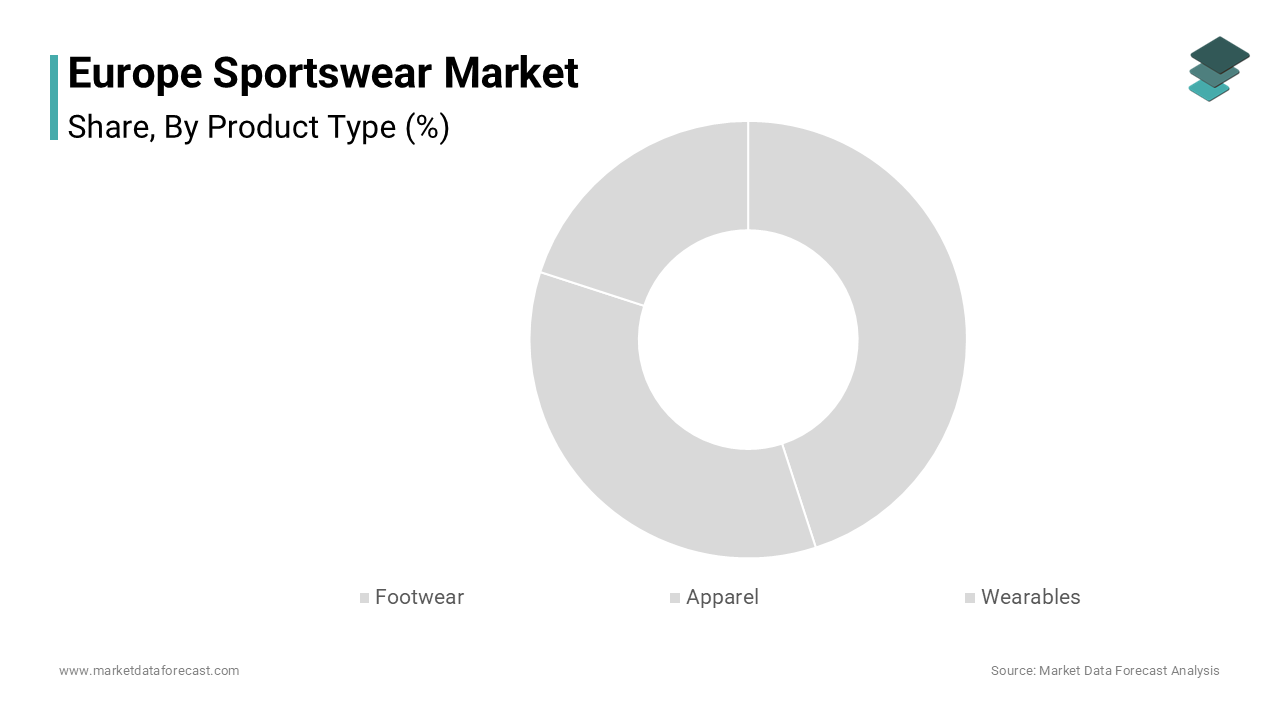
The wearables segment is likely to experience the fastest CAGR of 15.6% from 2025 to 2033 due to the convergence of fitness tracking health monitoring and smart textile innovation. European consumers are increasingly adopting connected devices to manage chronic conditions and optimize wellness. Simultaneously, fashion tech is advancing. Regulatory support also plays a role. The EU’s Medical Device Regulation includes certification pathways for wellness wearables with clinical claims. These developments transform wearables from niche gadgets into essential health and performance tools driving unprecedented adoption across age groups.
By End User Insights
The women segment captured 42.7% share of the Europe sportswear market in 2024. The prominence of the women segment is propelled a confluence of social empowerment health awareness and targeted product innovation. Women’s participation in organized sport has surged. According to studies, female enrollment in fitness clubs rose in recent years. Brands have responded with inclusive sizing adaptive support and modest performance lines. Workplace wellness programs also drive demand. As per research, a portion of corporate wellness subsidies are used by women for sportswear purchases. Social media further amplifies engagement. This ecosystem of participation representation and personalization solidifies women as the largest and most influential consumer segment.
The children segment is on the rise and is expected to be the fastest growing segment in the market by witnessing a CAGR of 13.8% from 2025 to 2033. Factors such as national policies prioritizing early physical literacy and combating childhood obesity fuel the growth of the children segment. According to research, rising childhood obesity rates across Europe are driving governments to implement compulsory physical activity programs within school systems to promote early lifestyle interventions. Parents are also increasingly investing in performance gear for youth sports clubs. As per studies, a portion of registered youth players wear branded technical kits. Sustainability concerns are shaping choices too. These structural and behavioral shifts position children as a high growth segment with long term brand loyalty potential.
By Distribution Channel Insights
The retail stores segment led the Europe sportswear market and held 56.4% share in 2024. The growth of the retail stores segment is because of the experiential and tactile nature of sportswear shopping where fit performance and fabric feel are critical decision factors. Specialty retailers operate thousands of stores across Europe offering in store gait analysis bra fitting and product testing zones that digital channels cannot replicate. According to sources, a share of European shoppers prefer trying on sportswear before purchase especially for technical categories like running shoes and compression wear. Furthermore, retail stores serve as community hubs. The resurgence of urban shopping districts post pandemic and government support for brick and mortar through VAT incentives further reinforce physical retail’s dominance despite digital advances.
The e-commerce stores segment is expected to exhibit a noteworthy CAGR of 14.2% from 2025 to 2033. The rapid expansion of the e-commerce stores segment is driven by enhanced digital experiences that address historical barriers to online sportswear shopping. Virtual try on powered by AI and augmented reality now achieves size accuracy and reduce return rates. Brands have integrated workout tracking data from their apps to recommend personalized gear users who sync fitness metrics more likely to convert. Sustainability is also driving online growth. These innovations transform e commerce from a convenience channel into a personalized sustainable and data driven shopping ecosystem.
SEGMENTAL ANALYSIS
Germany Sportswear Market Analysis
Germany captured the largest share of the Europe sportswear market at 19.8% in 2024. The domination of Germany is attributed to a deeply ingrained sports culture supported by thousands of registered clubs and millions of members, as per research. Public investment is substantial. Consumer behavior reflects this engagement. A share of Germans aged 16 to 65 exercise weekly. Domestic brands anchor a robust innovation ecosystem while retail giants such as Decathlon and SportScheck offer extensive product testing. This synergy of institutional support grassroots participation and retail infrastructure ensures Germany remains Europe’s most dynamic and resilient sportswear market.
United Kingdom Sportswear Market Analysis
The United Kingdom occupied the second-largest share of the Europe sportswear market in 2024. Strong legacy of professional sport and rising health consciousness post pandemic are boosting the sportwear market in UK. Many adults participated in physical activity with running and gym workouts leading participation. The National Health Service’s campaign actively promotes exercise for mental wellbeing driving demand for accessible sportswear. Retail innovation is advanced. Apart from these, the UK’s departure from the EU has accelerated local manufacturing initiatives with brands investing in Midlands based production hubs. These factors sustain the UK’s position as a high value trend setting market.
France Sportswear Market Analysis
France is a noteworthy country in the Europe sportswear market. Integrating sport into public health and education policy is contributing to the expansion of this market in France. French consumers also prioritize style and sustainability, a portion consider eco certification when purchasing sportswear, according to studies. Domestic brands blend heritage with innovation while Decathlon’s global R and D hub in Lille pioneers circular design. This fusion of policy support cultural identity and environmental responsibility defines France’s distinctive and influential market position.
Italy Sportswear Market Analysis
Italy is expected to grow steadily in the Europe sportswear market over the forecast period. Its global reputation for design excellence and technical textile manufacturing is driving the growth of sportswear in Italy. Italian mills produce high performance fabrics used by global sportswear giants. Consumer demand is driven by football passion. Apart from these, the government’s program mandates sportswear for millions of students boosting volume sales. Italian brands like Fila and Kappa leverage fashion collaborations to elevate athleisure appeal while sustainability initiatives like the Green Label certification gain traction. This combination of manufacturing prowess cultural passion and policy support ensures Italy remains a key innovation and production hub in the European sportswear landscape.
Spain Sportswear Market Analysis
Spain is likely to expand in the Europe sportswear market from 2025 to 2033 owing to climate driven outdoor activity and strong football culture. A notable share of Spaniards engage in physical activity at least weekly, according to sources with running cycling and padel leading participation. The national padel boom has created a specialized sportswear subcategory with technical requirements for breathability and flexibility. Retail is vibrant with El Corte Inglés and Decathlon operating experiential flagship stores in Madrid and Barcelona. Apart from these, Spain’s tourism sector drives seasonal demand. Coastal regions higher sportswear sales in summer months as per data from the Spanish Retail Federation. These lifestyle and cultural dynamics position Spain as a high engagement growth oriented market within Southern Europe.
COMPETITIVE LANDSCAPE
The Europe sportswear market features a multifaceted competitive landscape where global giants regional specialists and fast fashion retailers vie for consumer attention. Established players like Adidas Nike and Puma compete on brand heritage, technological innovation and sustainability credentials while leveraging extensive retail and digital networks. Decathlon dominates the value segment through vertical integration and in house product development enabling rapid iteration and affordability. Simultaneously,y fast fashion brands such as H&M Zara and Primark erode margins by offering trend driven sportswear at low price points creating confusion between performance and aesthetics. The market is further shaped by rising consumer demand for transparency with independent certifications like EU Ecolabel and Global Organic Textile Standard becoming key differentiators. Competition is increasingly less about logo visibility and more about demonstrable impact, spanning circularity inclusivity digital utility and authentic community engagement, forcing all players to elevate their value proposition beyond traditional marketing.
KEY MARKET PLAYERS
A few of the major companies in the europe sportswear market include
- Adidas AG
- Nike, Inc.
- PUMA SE
- Under Armour, Inc.
- ASICS Corporation
- New Balance Athletics, Inc.
- The Columbia Sportswear Company
- FILA Holdings Corporation
- VF Corporation
- PVH Corp.
Top Players in the Market
Adidas AG
Adidas AG is a German multinational and a cornerstone of the Europe sportswear market with deep roots in performance innovation and cultural relevance. The company contributes globally by pioneering sustainable materials such as Primeblue and Primegreen fabrics made from recycled ocean plastic and bio based yarns. It also introduced AI powered fit recommendation tools on its European e commerce platforms to enhance personalization and reduce returns. These actions reinforce Adidas’ prominence in combining athletic performance environmental responsibility and digital engagement across both European and international markets.
Nike Inc
Nike Inc maintains a strong presence in the Europe sportswear market through its premium performance offerings and lifestyle collaborations that resonate with urban consumers. The company drives global trends by integrating digital ecosystems like the Nike App and Nike Training Club to create seamless experiences between product and service. In Europe Nike recently enhanced its localized sustainability strategy by partnering with textile recyclers in the Netherlands and France to scale chemical recycling of polyester. It also launched region specific collections inspired by European football culture and climate adaptive running gear for Nordic markets. These initiatives demonstrate Nike’s commitment to cultural relevance technological integration and circular innovation tailored to European consumer expectations.
Decathlon SA
Decathlon SA is a French retail giant that plays a pivotal role in democratizing access to sportswear across Europe through its vertically integrated model and value driven innovation. The company contributes globally by developing over 100 in house brands that balance performance affordability and sustainability. Recently Decathlon accelerated its circular economy efforts by introducing repair stations in 800 stores and launching a resale platform for pre owned gear in Germany and Sweden. It also invested in local manufacturing hubs in Portugal and Poland to shorten supply chains and improve responsiveness. These actions emphasize Decathlon’s mission to make sport accessible to all while advancing environmental and operational resilience in the European and global sportswear landscape.
Top Strategies Used by the Key Market Participants
Key players in the Europe sportswear market pursue several strategic imperatives to maintain competitiveness and relevance. They invest heavily in sustainable material innovation including bio based fibers and chemical recycling to comply with the EU Strategy for Sustainable Textiles. Brands enhance digital engagement through proprietary apps AI driven personalization and virtual try on technologies to reduce returns and build loyalty. Strategic collaborations with athletes designers and sports federations strengthen cultural credibility and market reach. Retail experiences are reimagined with in store fitness zones product testing labs and community events to drive foot traffic. Besides, companies localize product development for regional climates sports preferences and body diversity while scaling circular services such as take back programs and resale platforms to meet evolving consumer expectations.
MARKET SEGMENTATION
This research report on the europe sportswear market has been segmented based on the following categories.
By Product Type
- Footwear
- Apparel
- Wearables
By End User
- Men
- Women
- Children
By Distribution Channel
- E-commerce Stores
- Retail Stores
By Country
- UK
- France
- Spain
- Germany
- Italy
- Russia
- Sweden
- Denmark
- Switzerland
- Netherlands
- Turkey
- Czech Republic
- Rest of Europe
Frequently Asked Questions
What is the Europe sportswear market?
The Europe sportswear market includes apparel, footwear, and accessories designed for sports, fitness, and athletic lifestyle use. It covers products used for performance, training, outdoor activities, athleisure, and casual fashion.
What is driving growth in the Europe sportswear market?
Growth is driven by rising health & fitness awareness, increasing gym memberships, athleisure fashion trends, growth of e-commerce, outdoor sports participation, and influence of sports celebrities & social media.
Which countries lead the Europe sportswear market?
Germany, the United Kingdom, France, Italy, Spain, and the Netherlands are among the leading markets due to strong sports culture, fitness infrastructure, and brand presence.
What are the major trends in the Europe sportswear market?
Key trends include sustainable & recycled fabrics, seamless & performance wear, athleisure lifestyle fashion, rise of online fitness communities, and collaborations with celebrities, athletes, & designers.
What challenges does the market face?
Challenges include intense competition, fluctuating raw material prices, counterfeit products, sustainability pressure, and supply chain disruptions.
What is the outlook for the Europe sportswear market?
The market outlook is strong, supported by increasing sports participation, expanding athleisure adoption, brand innovation, and digital retail growth.
Access the study in MULTIPLE FORMATS
Purchase options starting from
$ 2000
Didn’t find what you’re looking for?
TALK TO OUR ANALYST TEAM
Need something within your budget?
NO WORRIES! WE GOT YOU COVERED!
Call us on: +1 888 702 9696 (U.S Toll Free)
Write to us: sales@marketdataforecast.com