- Product Description Description
- Table of Contents TOC
- List of Table & Figure LOT
- Get Free Sample PDF Sample PDF
Market Size, 2025
$3.01 BnMarket Estimate, 2026
$3.21 BnMarket Forecast, 2034
$5.37 BnCAGR, 2026–2034
6.65%Europe Spring Market Report Summary
The European spring market was valued at USD 3.01 billion in 2025, is estimated to reach USD 3.21 billion in 2026, and is projected to reach USD 5.37 billion by 2034, growing at a CAGR of 6.65% from 2026 to 2034. The growth of the European spring market is driven by increasing demand from the automotive and manufacturing industries, the growing use of precision-engineered springs in machinery and electronics, and expanding applications in aerospace and industrial automation. Moreover, advancements in material science and the integration of smart spring technologies are further enhancing product performance, durability, and energy efficiency across key sectors.
Key Market Trends
- Rising use of high-performance and lightweight spring materials to enhance energy efficiency and load-bearing capacity.
- Growing adoption of custom and precision-engineered springs across manufacturing, medical, and defense industries.
- Increasing integration of advanced production technologies, such as CNC coiling and automated stress testing for quality improvement.
- Expanding demand for springs in electric vehicles (EVs) and renewable energy equipment.
- Rising emphasis on sustainability and recyclability of spring materials in compliance with EU environmental directives.
Segmental Insights
- Based on type, the helical springs segment was the top performer in the European spring market, accounting for 64.1% share in 2025, primarily due to its extensive use in automotive, machinery, and industrial applications.
- Based on end use, the manufacturing segment dominated the European spring market, capturing 48.1% share in 2025, driven by rising automation, industrial expansion, and increasing use of springs in equipment and assembly systems.
Regional Insights
- The European spring market exhibits strong geographical variation based on industrial base and manufacturing intensity.
- Germany led the European spring market in 2025, accounting for a 28.5% share, owing to its robust automotive, machinery, and engineering sectors.
- France and the United Kingdom showcased steady growth driven by increasing adoption of springs in aerospace and industrial automation.
- Italy remains a significant producer of precision-engineered springs, supported by strong domestic manufacturing and export demand.
- Eastern European countries, including Poland and the Czech Republic, are witnessing rising production capacity and foreign investments in component manufacturing.
Competitive Landscape
- The European spring market is moderately fragmented, with leading companies emphasizing technological innovation, material optimization, and capacity expansion to maintain competitiveness.
- Market players are focusing on customization, sustainability, and advanced testing solutions to meet specific industrial and performance requirements.
- Prominent players in the European spring market include Lesjöfors AB, European Springs & Pressings Ltd, Dietz GmbH, Springmasters Ltd, Kilen Springs, Ressorts Lacroix, FA Krosno GmbH, RDO Springs, Vit Ressort, REM Ressort, Ressorts SPEC, and CARL HAAS GmbH.
- These companies are strengthening their market presence through strategic collaborations, new product innovations, and expansion into emerging European manufacturing hubs, aiming to serve diverse applications across automotive, industrial, and engineering domains.
Europe Spring Market Size
The Europe spring market size was valued at USD 3.01 billion in 2025 and is projected to reach USD 5.37 billion by 2034, growing from USD 3.21 billion in 2026 at a CAGR of 6.65%.
A spring is an elastic device typically made of metal, shaped (often coiled) to store mechanical energy when compressed, stretched, or twisted. These components serve as essential elements for energy storage, vibration damping, and force application in precision engineering systems. The European spring market operates within a highly regulated manufacturing ecosystem that emphasizes material traceability, dimensional accuracy, and compliance with international quality standards such as ISO 9001 and IATF 16949. As per sources, a portion of spring manufacturers in the European Union are classified as small and medium enterprises, yet they supply critical components to global OEMs through tightly integrated supply chains. This regulatory and industrial context positions the European spring market not as a commodity segment but as a precision engineering domain embedded in high-value manufacturing value chains.
MARKET DRIVERS
Stringent Automotive Safety and Emissions Regulations Drive Precision Spring Demand
The European automotive sector’s compliance with rigorous safety and emissions standards drives the growth of the European spring market. This necessitates high-performance springs in vital subsystems such as suspension, engine valves, es, and braking mechanisms. In addition, the General Safety Regulation mandates advanced driver assistance systems in vehicles that rely on precision torsion springs in sensor mounting brackets and actuator mechanisms. These regulatory and technological imperatives ensure sustained demand for high-tolerance springs that meet exacting performance and reliability criteria.
Growth of Industrial Automation and Robotics Fuels Demand for Custom Springs
The rapid adoption of industrial automation across European manufacturing facilities has significantly increased demand for application-specific springs in robotic joints, grippers, and linear actuators, which propels the expansion of the European spring market. According to sources, Europe has seen strong growth in the installation of industrial robots, with countries such as Germany, Italy, and Sweden at the forefront of automation efforts. Each robotic system typically incorporates a range of specialized springs that play essential roles in motion control, precision, and durability. In manufacturing and packaging applications, leading equipment suppliers have highlighted the importance of miniature spring components in maintaining accuracy and product consistency, as per research. Apart from these, the shift toward collaborative robots demands springs with tighter tolerances and longer fatigue life to ensure human safety. This industrial transformation positions custom spring manufacturers as indispensable enablers of Europe’s advanced manufacturing ambitions.
MARKET RESTRAINTS
Volatility in Specialty Steel Prices Constrains Profit Margins
Cost burden due to fluctuating prices of high-grade alloy steels obstructs the growth of the European spring market. Such as chrome vanadium and stainless variants, which constitute a portion of production expenses. According to studies, European steel prices experienced significant volatility and increases between 2021 and 2023, reflecting broader market trends driven by factors such as the post-pandemic recovery and geopolitical events. Small and medium enterprises are particularly vulnerable as they lack the purchasing power to secure long-term fixed price contracts with mills. This margin compression limits reinvestment in automation and R&D, thereby constraining innovation and competitiveness in cthe apital-intensive sector.
Shortage of Skilled Labor in Precision Metal Forming Hampers Production Capacity
The shortage of technicians and engineers proficient in precision coiling heat treatment and shot peening processes, which affects output scalability and quality consistency, obstructs the growth of the European spring market. According to research, persistent labor shortages and skills gaps in the European metalworking and manufacturing sectors. In Germany, there is a known challenge in matching the supply and demand for skilled labor, particularly for small and medium-sized enterprises (SMEs). This has led to difficulties for companies seeking to fill vacancies and may contribute to extended lead times for specialized products like custom springs. The reliance on aging workforces also increases production risk as tacit knowledge remains undocumented. A persistent human capital deficit, due to inadequate training and reskilling, will continue to impede the sector's capacity to satisfy rising demand.
MARKET OPPORTUNITIES
Integration of Smart Springs in Predictive Maintenance Systems Creates New Revenue Streams
The emergence of smart springs embedded with strain gauges or fiber optic sensors gives a potential opportunity for the growth of the European spring market. These smart springs provide real-time data on load cycles, fatigue, and deformation, enabling predictive maintenance in important infrastructure. A 2023 collaboration between Deutsche Bahn and tech company Konux demonstrated that sensor-equipped railway switches and advanced machine learning reduced maintenance costs and failures that cause delays. Similarly, in wind energy, in 2023, Siemens Gamesa experienced highly publicized and expensive quality issues with its onshore wind turbines concerning rotor blades and main bearings. This convergence of mechanical engineering and digital sensing allows spring makers to offer value-added services and participate in the industrial Internet of Things ecosystem.
Expansion of Medical Device Manufacturing in Europe Drives Demand for Miniature Springs
The region’s growing medical technology sector is creating robust demand for ultra-precise miniature springs used in surgical instruments, implantable devices, and diagnostic equipment, which in turn generates the expansion of the European spring market. Companies rely on local spring suppliers to ensure supply chain resilience and compliance with the EU Medical Device Regulation’s stringent traceability requirements. The European Health Union’s strategic plan further prioritizes domestic production of vital medical components, which secures long-term demand for high-reliability miniature springs.
MARKET CHALLENGES
Intensifying Global Competition from Low-Cost Spring Producers Threatens Market Position
Mounting burden from Asian competitors, particularly in China and India, where production costs are significantly lower due to cheaper labor and less stringent environmental compliance, slows down the expansion of the European spring market. The market for commoditized segments, such as general industrial springs, is increasingly sourced offshore, despite European firms retaining an edge in high precision and safety-critical applications. This trend erodes the market share of European SMEs that lack the scale to compete on price while simultaneously investing in sustainability and digitalization. The decline of European mid-tier spring manufacturing will likely speed up without better trade protections or certified product differentiation.
Stringent Environmental Regulations Increase Compliance Burden on Spring Finishing Processes
Escalating regulatory burden on surface treatment and waste management, particularly concerning electroplating and phosphate coating operation, remains a key impediment to the European spring market. The EU’s Industrial Emissions Directive requires all metal finishing facilities to operate under Best Available Techniques. According to sources, a portion of spring manufacturers reported increased operational costs due to compliance with revised wastewater limits for zinc and chromium. Transitioning to eco-friendly alternatives, such as mechanical plating or PVD coating, adds to unit costs as per the European Spring Federation. These environmental mandates, while aligned with sustainability goals, impose disproportionate burdens on small producers with limited capital for green retrofit,,s thereby threatening their viability in an already competitive landscape.
REPORT COVERAGE
| REPORT METRIC | DETAILS |
| Market Size Available | 2025 to 2034 |
| Base Year | 2025 |
| Forecast Period | 2026 to 2034 |
| CAGR | 6.65% |
| Segments Covered | By Type, End use and Region |
| Various Analyses Covered | Global, Regional, & Country Level Analysis; Segment-Level Analysis; DROC, PESTLE Analysis; Porter’s Five Forces Analysis; Competitive Landscape; Analyst Overview of Investment Opportunities |
| Regions Covered | UK, France, Spain, Germany, Italy, Russia, Sweden, Denmark, Switzerland, Netherlands, Turkey, and Czech Republic |
| Market Leaders Profiled | Lesjöfors AB, European Springs & Pressings Ltd Dietz GmbH, Springmasters Ltd, Kilen Springs Ressorts Lacroix, FA Krosno GmbH, RDO Springs, Vit Ressort, REM Resort, Ressorts SPEC, and CARL HAAS GmbH |
SEGMENTAL ANALYSIS
By Type Insights
The helical springs segment is the top performer in the European spring market by accounting for 64.1% share in 2025. Their versatility, high load capacity, and widespread use across the automotive industry,,l and medical applications propel the dominance tof he helical springs segment. Their cylindrical coil design allows efficient energy storage in compression, extension, and torsion mod, es, making them indispensable in precision engineering systems. According to sources, a portion of automotive valve trains and suspension dampers in Europe utilize helical springs, with an average passenger vehicle containing more such components. In industrial machinery, helical springs are vital in conveyor systems, clutches, and safety vvalveswith the European Committee for Standardization listing over 120 ISO specifications for their dimensional and performance tolerances. Germany’s automotive sector consumed significant metric tons of helical springs, as per sources, which reflects deep integration into high-value manufacturing. Besides, the rise of electric vehicles has increased demand for high fatigue-resistant helical springs in battery contact systems and motor mounts. This functional adaptability across sectors ensures helical springs remain the backbone of the European spring market.
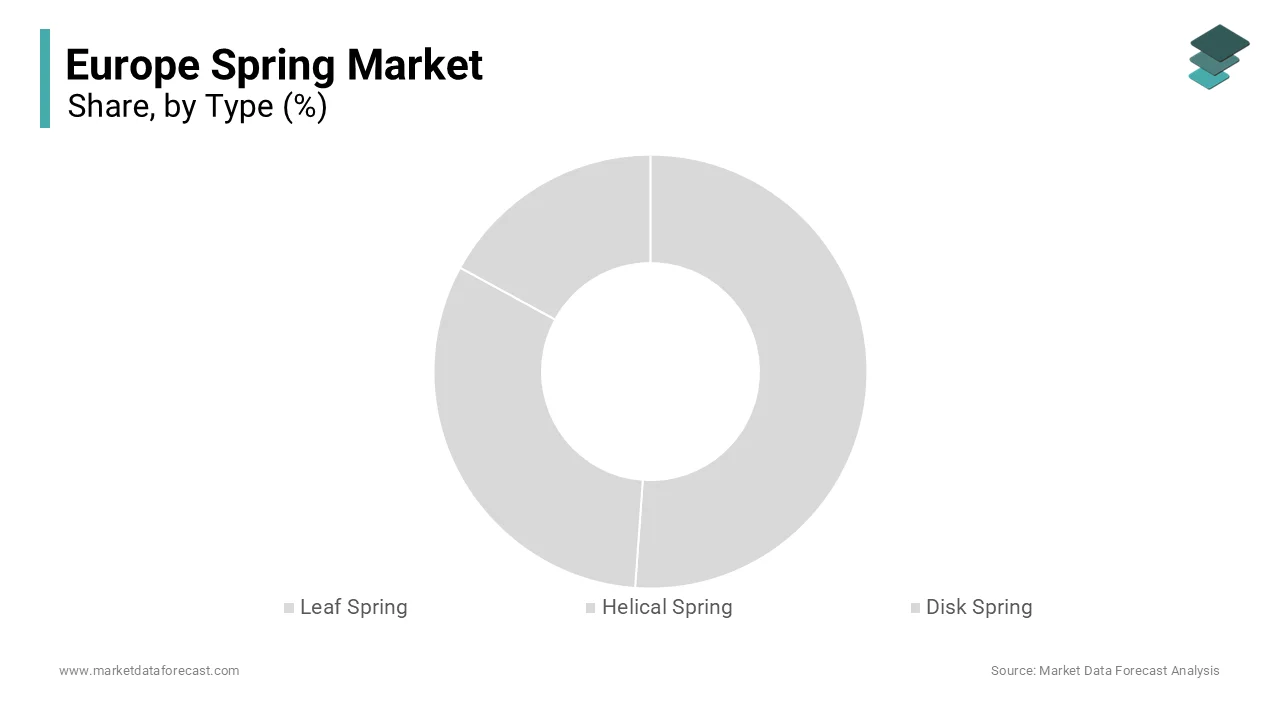
The disk springs segment is likely to experience the fastest CAGR of 6.8% from 2026 to 2034. Their unique ability to deliver high force in compact spaces with precise deflection control fuels the expansion of the disk springs segment in the regional market. These conical washers are increasingly specified in heavy machinery, aerospace actuators, and high-pressure valve systems where space constraints and reliability are paramount. According to research, disk spring usage in wind turbine pitch control systems grew as they provide a stable preload under extreme thermal cycling. In the oil and gas sector, European operators adopted disk spring stacks in subsea blowout preventers to maintain sealing integrity at depths exceeding notable meters, as per studies. Furthermore, the shift toward modular industrial design favors disk springs for their stackability and linear load response. These performance advantages in mission-critical applications position disk springs for sustained accelerated growth.
By End Use Insights
The manufacturing segment dominated the European market by capturing 48.1% share in 2025. Springs are fundamental components in machinery, tools, automation systems, and production line equipment, which fuels the growth of the manufacturing segment. Every industrial robot packaging machine or CNC press relies on multiple springs for actuation, damping, and safety functions. Furthermore, the rise of collaborative robotics demands springs with tighter tolerances and longer fatigue life to ensure human safety. This deep entrenchment in Europe’s advanced manufacturing base ensures the manufacturing sector remains the primary end user of spring components.
The aerospace segment is on the rise and is expected to be the fastest-growing segment in the global market by witnessing a CAGR of 7.9% during the forecast period, owing to the expansion of commercial aviation, defense modernization, and space exploration programs. Springs in this sector must meet extreme reliability standards operating under high stress, temperature, and vibration conditions. According to sources, aircraft deliveries across Europe have continued to rise, with each new commercial plane requiring thousands of precision-engineered springs designed for use in critical systems such as landing gear, controls, and engines. As per research, leading aerospace manufacturers have increased the use of advanced nickel alloy springs in their latest models to enhance performance and improve fuel efficiency. Space programs in the region are also contributing to demand growth, particularly through the use of corrosion-resistant materials in satellite and launch components. These high-value applications with stringent certification requirements ensure aerospace remains the highest growth end-use segment.
REGIONAL ANALYSIS
Germany Spring Market Analysis
Germany LED the European spring market in 2025 and accounted for a 28.5% share in 2025. The prominence of Germany is primarily driven by its world-leading automotive and machinery industries, which demand high-precision springs in massive volumes. The country hosts many spring manufacturers, rs, including global leaders like Röhrs and Scherdel that supply directly to BMW, Daimler, and Siemens. The mechanical engineering sector also consumed large metric tons of industrial equipment. Germany’s dual vocational education system ensures a steady pipeline of skilled coiling and heat treatment technicians. Apart from these, the government’s Industrie 4.0 initiative supports digitalization of spring production through grants for smart factory integration. This synergy of industrial demand, skilled labor, and policy support cements Germany’s dominance in high-end spring manufacturing.
Italy Spring Market Analysis
Italy is moving ahead steadfastly in the European spring market, with its specialization in high-quality miniature and medical springs serving the luxury automotive and healthcare sectors. The country is home to multiple spring producers concentrated in the Emilia Romagna and Lombardy regions, known for their precision engineering heritage. Companies like Tecnofili and FCI Italia supply micro springs with diameters under 0.3 millimeters for surgical robots and implantable devices compliant with EU MDR regulations. Italy’s strength in niche applications and strong export orientation sustains its influential role despite the smaller scale compared to Germany.
France Spring Market Analysis
France is expected to be the most lucrative region in the European spring market due to its robust aerospace defense and railway industries, which require mission-critical spring components. According to sources, France’s national railway operator has implemented advanced disk spring braking systems in its high-speed trains to improve safety and performance at very high velocities. The country’s energy sector also relies on specialized corrosion-resistant springs in reactor control mechanisms, where reliability is critical. This focus on high-reliability applications in sovereign sectors ensures France’s continued relevance in the precision spring landscape.
United Kingdom Spring Market Analysis
The United Kingdom is also a key region in the European spring market, owing to strengths in motorsport, rt medical ttechnologyyand renewable energy applications. The Motorsport Valley cluster in Oxfordshire and Northamptonshire accounts for a portion of UK spring production, supplying Formula 1 teams with ultra-light titanium and Inconel springs capable of withstanding a substantial number of rpm stresses as documented by Motorsport UK. In healthcare, companies like Smith & Nephew and Olympus rely on British spring makers for endoscopic and orthopedic device components. The offshore wind sector also drives demand with Orsted and SSE procuring corrosion-resistant springs for turbine pitch systems in North Sea installations. According to sources, spring exports grew despite Brexit headwinds due to niche engineering excellence. This blend of high-performance sectors sustains the UK’s specialized and export-oriented spring market.
Sweden Spring Market Analysis
Sweden is anticipated to grow in the European spring market over the forecast period due to dominance in sustainable manufacturing and heavy machinery applications. The country’s spring producers, such as Lesjöfors and Wärda, specialize in high-load disk and helical springs for mining, forest, and rail equipment used by global OEMs like Volvo CE and Scania. Sweden’s stringent environmental regulations have also driven innovation in phosphate-free surface treatments, reducing wastewater contamination. This combination of industrial relevance, clean production, and engineering quality positions Sweden as a forward-looking player in the European spring ecosystem.
COMPETITIVE LANDSCAPE
KEY MARKET PLAYERS
Some of the notable key players in the European spring market include
- Lesjöfors AB
- European Springs & Pressings Ltd
- Dietz GmbH
- Springmasters Ltd
- Kilen Springs
- Ressorts Lacroix
- FA Krosno GmbH
- RDO Springs
- Vit Ressort
- REM Resort
- Ressorts SPEC
- CARL HAAS GmbH
TOP STRATEGIES USED BY THE KEY MARKET PLAYERS
Key players in the European spring market prioritize vertical integration by controlling raw material sourcing, heat treatment, and surface finishing to ensure quality and traceability. They invest heavily in automation and digital twin technologies to enhance precision, reduce lead times, and enable predictive quality control. Strategic alignment with European regulatory frameworks such as the Medical Device Regulation and Industrial Emissions Directive ensures compliance and market access. Companies also focus on sustainable manufacturing by adopting fossil-free energy sources and developing recyclable spring alloys. Furthermore, they strengthen customer partnerships through co-engineering services and application-specific testing labs to deliver customized solutions for high-performance sectors like aerospace, medical, and electric mobility.
COMPETITION OVERVIEW
The European spring market features intense competition among specialized manufacturers who differentiate through precision engineering, material science, and sector-specific certifications rather than price. Lesjöfors Röhrs and Scherdel lead by serving high-value segments such as aerospace, medical devices, and electric vehicles, where failure is not an option. They compete against both regional SMEs with niche capabilities and low-cost Asian producers targeting commoditized segments. The market is highly fragmented with numerous spring makers in Europe, yet dominated by firms that combine technical expertise with compliance agility. Regulatory complexity, including REACH, RoH, S, and EU MDR, creates barriers that favor established players with robust quality management systems. Innovation in smart springs, digital production, and green metallurgy is reshaping competitive dynamics with sustainability and digitalization becoming key differentiators. Success hinges on balancing customization and compliance in a capital-intensive precision engineering landscape.
TOP PLAYERS IN THE MARKET
-
Lesjöfors AB is a leading European spring manufacturer headquartered in Sweden with a global footprint across automotive, industrial, and railway sectors. The company specializes in high-performance helical and disk springs engineered for extreme conditions, including high temperature and heavy load applications. Lesjöfors supplies critical components to global OEMs such as Siemens Mobility, Scania, and Alstom, ensuring compliance with stringent European safety and durability standards. It also expanded its digital twin capabilities for spring simulation by enabling customers to optimize designs before physical prototyping. These initiatives strengthen Lesjöfors’ position as an innovator in sustainable precision spring manufacturing on the global stage.
-
Röhrs AG is a prominent German spring producer renowned for its expertise in miniature and medical-grade springs used in surgical instruments and implantable devices. The company operates under strict ISO 13485 certification and supplies to leading medtech firms across Europe and North America. Röhrs integrates advanced CNC coiling and laser welding technologies to achieve micron-level tolerances required for life essential applications. These actions emphasize Röhrs’ commitment to quality innovation and regulatory excellence in high-value niche markets.
-
Scherdel GmbH is a major force in the European spring market with deep expertise in automotive and industrial springs, particularly for electric mobility and heavy machinery. Scherdel fffocusesghigh-fatigue-resistantaterialsmaterialsn heat treatment processes to meet the demands of next-generation powertrains and automation systems. These strategic moves position Scherdel at the forefront of digitalization and sustainability in industrial spring manufacturing.
MARKET SEGMENTATION
This research report on the European spring market has been segmented and sub-segmented based on categories.
By Type
-
Leaf Spring
-
Elliptical Leaf Spring
-
Semi Elliptical Leaf Spring
-
Quarter Elliptical Leaf Spring
-
Three-quarter Elliptical Leaf Spring
-
Transverse Leaf Spring
-
Helical Spring
-
Compression Spring
-
Extension Spring
-
Torsion Spring
-
Spiral Spring
-
Disk Spring
-
Belleville Disk Spring
-
Curved Disk Spring
-
Slotted Disk Spring
-
Wave Disk Spring
By End Use
-
Automotive and Transportation
-
Construction
-
Agriculture & Forestry
-
Manufacturing
-
Aerospace
-
Railway
-
Electronics
-
Oil and Gas
-
Renewables
-
Wind Turbines
-
Hydropower Plants
-
Solar Power Mounting Systems
-
Energy Storage Systems
-
Others
-
Others
By Country
-
UK
-
France
-
Spain
-
Germany
-
Italy
-
Russia
-
Sweden
-
Denmark
-
Switzerland
-
Netherlands
-
Turkey
-
Czech Republic
-
Rest of Europe