Europe Stainless Steel Market Size, Share, Trends, & Growth Forecast Report By Type (Cold Rolled Flat, Hot Plate & Sheet, Cold Bars & Wire, Hot Bars & Wire, Rod Others), Application and Country (UK, France, Spain, Germany, Italy, Russia, Sweden, Denmark, Switzerland, Netherlands, Turkey, Czech Republic and Rest of Europe), Industry Analysis From 2025 to 2033
Europe Stainless Steel Market Report Summary
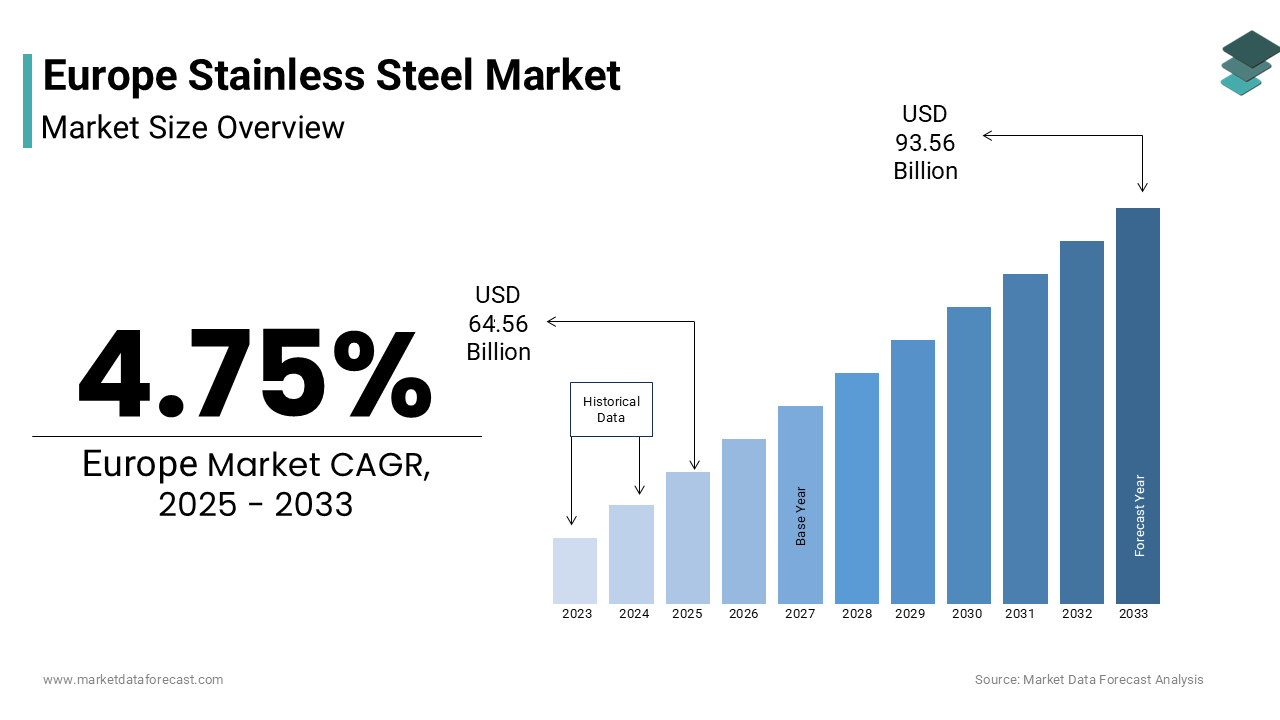
The Europe stainless steel market was valued at USD 61.63 billion in 2024, is estimated to reach USD 64.56 billion in 2025, and is projected to reach USD 93.56 billion by 2033, growing at a CAGR of 4.75% during the forecast period from 2025 to 2033. The growth of the European stainless steel market is driven by rising demand across renewable energy infrastructure, sustainability-focused construction, and precision engineering industries. Increasing emphasis on circular economy models, high recycling rates, and stringent EU environmental regulations are further supporting market expansion. Moreover, the growing adoption of stainless steel in hydrogen technologies, electric motors, consumer appliances, and architectural applications is broadening material usage across Europe.
Key Market Trends
- Rising use of stainless steel in renewable energy infrastructure such as offshore wind, hydrogen electrolyzers, and solar systems due to its corrosion resistance and long service life.
- Increasing focus on circularity and sustainability, supported by Europe’s high stainless steel recycling rates and the introduction of certified low-carbon stainless steel grades.
- Growing demand for high-precision stainless steel components in medical devices, engineering, and advanced manufacturing applications.
- Expansion of clean-tech manufacturing—including hydrogen production, battery systems, and electric mobility driving demand for specialty stainless steels.
- Rising regulatory influence through EU directives emphasizing traceability, low-emission production, and lifecycle sustainability, shaping procurement preferences.
Segmental Insights
Based on type, the cold rolled flat segment was the largest and held a significant share of the Europe stainless steel market in 2024. The segment’s dominance is attributed to its superior surface finish, dimensional accuracy, and mechanical strength, making it essential for appliances, clean-energy components, and architectural applications.
Based on type, the cold bars and wire segment is expected to grow rapidly over the coming years, supported by rising use in precision engineering, medical device manufacturing, and specialty fasteners requiring high tensile strength and biocompatibility.
Based on application, the engineering segment occupied a major share of the European stainless steel market in 2024. This segment’s prominence is linked to the growing replacement of carbon-steel components with corrosion-resistant stainless steel in industrial machinery, chemical processing equipment, and process-piping systems.
Regional Insights
The European stainless steel market is witnessing healthy growth across major economies, supported by industrial modernization, renewable energy investments, and high-value manufacturing.
- Germany was the largest contributor, holding 23.8% of the regional stainless steel market share in 2024, driven by its strong automotive, chemical, and machinery sectors and its advanced recycling infrastructure.
- Italy remains a key consumer, supported by its large household appliance industry, marine manufacturing, and architectural innovation.
- France continues to perform well due to its nuclear energy sector, aerospace manufacturing, and high-speed rail infrastructure requiring specialty stainless grades.
- Turkey is emerging as a major stainless steel processing and export hub, supported by strong appliance and automotive production and expanding manufacturing capacity.
- Spain is also becoming a significant market driven by renewable energy projects, hydrogen infrastructure development, and upgrades in tourism-related construction.
Competitive Landscape
The European stainless steel market is characterized by the dominance of technologically advanced producers with strong sustainability credentials, metallurgical expertise, and integrated operations. Leading companies are focusing on producing low-carbon stainless steel, expanding cold-rolling and finishing capacities, and strengthening digital traceability across supply chains. Strategic collaborations with hydrogen-electrolyzer manufacturers, EV battery producers, and renewable energy developers are enhancing market positioning. Prominent players in the Europe stainless steel market include Acerinox S.A., Outokumpu Oyj, Aperam S.A., Thyssenkrupp AG, ArcelorMittal, Voestalpine AG, Sandvik AB, Salzgitter AG, Marcegaglia S.p.A., and Tata Steel Europe.
Europe Stainless Steel Market Size
The europe stainless steel market size was valued at USD 61.63 billion in 2024 and is anticipated to reach USD 64.56 billion in 2025 from USD 93.56 billion by 2033, growing at a CAGR of 4.75% during the forecast period from 2025 to 2033.
Stainless steel in Europe serves as a cornerstone material across critical industrial and consumer sectors owing to its corrosion resistance, durability, and recyclability. The European stainless steel landscape is shaped by stringent environmental regulations, evolving construction codes, and strategic shifts toward circular economy models. In 2023, the European Union produced approximately 126 million metric tons of crude steel, according to the World Steel Association. Stainless steel accounted for roughly 7% of this output, which indicates its specialized role within the broader steel sector. The region recycles over 80% of stainless steel scrap, as reported by the European Stainless Steel Development Association, reflecting a deeply embedded culture of material recovery and circularity. Unlike commodity steel, stainless steel production in Europe is concentrated in technologically advanced facilities, primarily in Germany, Italy, and Finland, which together account for a majority of the region’s melt shop capacity (Eurostat). Its significance extends beyond traditional applications, with rising adoption in renewable energy infrastructure, including hydrogen electrolyzers and offshore wind turbine components, where corrosion resistance and durability are critical. Regulatory frameworks such as the EU Industrial Emissions Directive also shape production methods, which is compelling manufacturers to adopt cleaner technologies and best available techniques (BAT). This intersection of material science, policy, and industrial strategy defines the contemporary European stainless steel ecosystem as it navigates decarbonization pressures and supply chain reconfiguration.
MARKET DRIVERS
Surge in Renewable Energy Infrastructure Investment Drives Demand
Europe’s accelerated deployment of renewable energy infrastructure has emerged as a pivotal demand catalyst for stainless steel due to its essential role in durable and corrosion resistant components, which is primarily driving the European stainless steel market growth. The European Commission’s REPowerEU plan targets a 45% renewable energy share in the EU’s final energy consumption by 2030, which is driving extensive construction of wind, solar, and hydrogen facilities. Offshore wind projects are projected to require over 300 GW of installed capacity by 2050, according to WindEurope, and these installations rely heavily on stainless steel for turbine foundations, subsea cabling, and maintenance platforms. Similarly, green hydrogen electrolyzers predominantly use stainless steel grades such as 316L and 304 for bipolar plates and piping systems. The EU aims to install 40 GW of renewable hydrogen electrolyzers by 2030, as outlined in the European Hydrogen Backbone initiative. Stainless steel’s durability and low lifecycle emissions align closely with the EU Taxonomy for Sustainable Activities, which classifies clean energy projects as environmentally sustainable. This regulatory endorsement strengthens material preference among engineering firms and utilities. Furthermore, a study by the Joint Research Centre (JRC) of the European Commission highlights that stainless steel contributes to a significant share of the total metal content in modern electrolyzer stacks, ensuring long‑term operational reliability in highly corrosive environments. These converging policy targets and technical imperatives solidify stainless steel as an indispensable enabler of Europe’s energy transition, bridging renewable energy infrastructure with industrial decarbonization.
Stringent Regulatory Push for Sustainable Construction Elevates Material Preference
The European construction sector’s pivot toward sustainability has intensified demand for stainless steel driven by updated building codes and environmental performance standards, which is further fuelling the stainless steel market growth in Europe. The revised Energy Performance of Buildings Directive (EPBD) mandates that all new public buildings achieve nearly zero energy consumption by 2026, a benchmark that encourages the use of durable, low‑maintenance materials. Stainless steel facades, roofing, and structural elements can deliver service lives exceeding 50–60 years with minimal degradation, directly supporting lifecycle assessment criteria under EN 15978, the European standard for sustainability in construction. Additionally, the Level(s) framework developed by the European Commission promotes circularity in building design, and stainless steel’s high recovery rate at the end of life (typically >80–90%), as documented by the International Molybdenum Association, positions it as a preferred material. In urban infrastructure projects such as metro stations, bridges, and water treatment plants, municipalities across France, Germany, and the Nordic countries have specified austenitic stainless steel grades to meet resilience and aesthetic longevity requirements. For instance, a growing share of large‑scale public projects now includes explicit material clauses favouring corrosion‑resistant alloys, reflecting regulatory and institutional momentum. This shift not only reduces long‑term maintenance costs but also aligns with the EU Green Public Procurement criteria, which prioritize materials with verified environmental product declarations. Together, these institutional mechanisms create a structural upward trajectory for stainless steel demand in Europe’s built environment, which is linking material science with policy and sustainability goals.
MARKET RESTRAINTS
Volatility in Critical Raw Material Supply Chains Constrains Production
The high import dependency on critical raw materials, particularly nickel and chromium, which are essential for austenitic and ferritic grades, which is a major restraint for the European stainless steel market. The European Union relies heavily on imports for critical alloying elements used in stainless steel production. According to the European Raw Materials Alliance, the EU sources the vast majority of its nickel from countries such as Indonesia and the Philippines, leaving the supply chain exposed to geopolitical friction, export restrictions, and shipping disruptions. In 2023, Indonesia tightened nickel ore export quotas to prioritize domestic processing, which contributed to a sharp rise in European nickel prices as reported by Argus Media. Similarly, the United States Geological Survey (USGS) notes that a significant share of the EU’s chromium originates from South Africa and Kazakhstan, where logistical bottlenecks at key ports such as Durban have repeatedly delayed deliveries. These dependencies are further complicated by the EU’s Carbon Border Adjustment Mechanism (CBAM), which imposes tariffs on high‑emission imports but does not yet secure alternative low‑carbon sources for alloying elements. The European Stainless Steel Development Association (ESSDA) has cautioned that without diversified sourcing strategies or strategic stockpiling, the region’s stainless steel output could face periodic curtailments. Recycling, while robust, cannot fully compensate for primary alloy deficits since stainless scrap often lacks the precise nickel content required for high‑grade applications. This raw material fragility directly undermines production planning, inventory management, and cost predictability for European mills operating in a just‑in‑time supply environment.
Escalating Energy Costs Undermine Competitiveness Against Global Producers
The European stainless steel market contends with a severe cost disadvantage stemming from persistently elevated industrial energy prices, which erode its ability to compete with producers in Asia and the Middle East. According to Eurostat, average industrial electricity prices in the EU were around €0.20–0.25 per kilowatt hour in 2024, significantly higher than in major competing regions such as China and India. Since electric arc furnaces (EAFs) account for the majority of Europe’s stainless steel melting capacity, energy represents a substantial share of total production costs. Natural gas prices, though more stable after the 2022 crisis, remain volatile and directly affect energy‑intensive processes such as annealing and pickling. In 2023, the German Steel Federation reported a notable decline in stainless steel output, with several mills citing unsustainable energy economics as the rationale for temporary shutdowns. Meanwhile, the EU Emissions Trading System (ETS) continues to raise compliance costs, with carbon allowances priced at above €80 per ton in early 2025 according to ICE Endex. While decarbonization is a strategic priority, these cumulative cost pressures have triggered concerns about “carbon leakage,” where demand shifts to imported semi‑finished stainless products from countries with less stringent climate policies. Without a coordinated energy affordability strategy, including access to long‑term renewable power purchase agreements (PPAs), European stainless steel producers risk a permanent erosion of their industrial base and undermining competitiveness in global markets.
MARKET OPPORTUNITIES
Circular Economy Transition Unlocks High Value Recycling Streams
Europe’s advancing circular economy agenda is a notable opportunity for the European stainless steel market. Stainless steel is inherently 100% recyclable without loss of properties, and EU directives such as the End‑of‑Life Vehicles Directive (2000/53/EC) and the Waste Electrical and Electronic Equipment Directive (2012/19/EU) mandate high recovery rates for metal content. According to the European Environment Agency (EEA), millions of tons of end‑of‑life stainless steel are collected annually from appliances, automotive exhausts, and industrial equipment across the bloc, which reflects Europe’s embedded recycling culture. Emerging digital technologies are enabling mills to identify and segregate specific alloy grades, improving melt chemistry control and reducing reliance on virgin nickel. Producers such as Outokumpu and Acerinox have introduced certified circular stainless steel products with very high recycled content (often above 90%). The EU Circular Economy Action Plan requires that by 2030 all new products placed on the market be designed for durability and recyclability, which will increase the availability of clean post‑consumer scrap. This systemic shift not only lowers embodied carbon but also qualifies producers for green financing under the EU Sustainable Finance Disclosure Regulation (SFDR). Finally, the Joint Research Centre (JRC) confirms that recycled stainless steel requires up to 70% less energy than primary production. This pathway aligns economic incentives with environmental obligations, positioning Europe as a global exemplar in industrial circularity.
Expansion of Green Hydrogen and Clean Tech Manufacturing Creates New Demand Nodes
The rapid industrialization of Europe’s clean technology sector is forging novel and high specification applications for stainless steel beyond traditional domains, which is another promising opportunity for the European stainless steel market. The European Clean Hydrogen Alliance projects that hydrogen‑related manufacturing will require large volumes of specialty stainless steel by 2030, particularly for components such as bipolar plates, pressure vessels, and high‑purity gas lines. Similarly, the EU’s Net Zero Industry Act designates electrolysers, fuel cells, and carbon capture units as strategic technologies, spurring the construction of gigafactories across France, Spain, and Poland. These facilities demand austenitic and duplex grades that meet stringent hydrogen embrittlement resistance and surface finish standards. In battery production, stainless steel is increasingly used in cathode drying ovens and solvent recovery systems, with each gigafactory consuming several thousand tons annually, according to industry data compiled by BloombergNEF. The European Investment Bank (EIB) has approved over €17 billion in loans for clean tech manufacturing since 2023, which is further catalyzing infrastructure build‑out. Unlike commodity steel applications, this emerging demand centers on high‑margin engineered products with strict certification requirements, creating a value‑added niche for European mills with metallurgical expertise. Companies such as Aperam and Outokumpu have already reallocated rolling mill capacity to serve this segment, reflecting a strategic pivot toward future‑proof markets. This convergence of industrial policy, technological innovation, and material science positions stainless steel as a critical enabler of Europe’s sovereign clean tech supply chain, underpinning the continent’s energy transition and industrial resilience.
MARKET CHALLENGES
Carbon Border Adjustment Mechanism Triggers Trade and Compliance Complexities
The implementation of the European Union’s Carbon Border Adjustment Mechanism introduces significant operational and strategic challenges for the European stainless steel sector market. Starting in 2026, importers of stainless steel products into the EU will be required to purchase carbon certificates equivalent to the embedded emissions of goods originating from countries without comparable carbon pricing, under the Carbon Border Adjustment Mechanism (CBAM). However, the methodology for calculating embedded emissions remains contentious, particularly for complex supply chains involving multiple processing stages across jurisdictions. According to the European Commission’s implementing regulation, thousands of import declarations were filed during the transitional phase in 2024, yet only a minority contained fully verifiable emissions data. This led to provisional assessments and payment delays, disproportionately affecting small and medium‑sized enterprises (SMEs) that lack resources for data verification. The mechanism also creates incentives for substitution toward lower‑alloyed or non‑stainless alternatives in cost‑sensitive applications such as fasteners and shelving, eroding stainless steel’s market share. At the same time, European producers face pressure to accelerate decarbonization investments without guaranteed protection from cheaper imports during the phase‑in period. A 2025 study by the European Round Table for Industry (ERT) warned that inconsistent global carbon accounting standards could lead to double taxation or trade disputes, further fragmenting the market. Navigating this regulatory labyrinth demands enhanced data infrastructure, traceability systems, and cross‑border coordination, posing a systemic challenge that extends well beyond traditional production parameters.
Structural Overcapacity in Downstream Processing Intensifies Price Competition
The chronic overcapacity in downstream processing segments such as cold rolling, coil slitting, and tube manufacturing that fuels intense price competition and margin compression is further challenging the growth of the European stainless steel market. While primary melt capacity has rationalized since 2019, the number of service centers and finishing lines has grown due to low entry barriers and fragmented demand patterns. According to the European Steel Association (EUROFER), the EU hosts hundreds of cold rolling mills, with capacity exceeding domestic demand. This structural surplus is exacerbated by the influx of semi‑finished imports from Turkey and South Korea, which benefit from lower energy and labor costs. The resulting price pressure has narrowed margins for many mid‑tier processors, as reflected in financial disclosures from 2024. Compounding the challenge is the trend toward just‑in‑time procurement in automotive and appliance sectors, which reduces order volumes while increasing customization demands, straining operational efficiency. At the same time, digital platforms and e‑procurement tools have heightened price transparency, enabling buyers to arbitrage across multiple suppliers. Attempts at consolidation have been hindered by regional fragmentation and divergent national industrial policies, leaving the downstream stainless steel segment vulnerable. Without coordinated rationalization or differentiation through value‑added services such as laser cutting, precision slitting, or advanced surface engineering, the sector risks a prolonged profitability crisis that could destabilize the entire stainless steel value chain in Europe.
REPORT COVERAGE
| REPORT METRIC | DETAILS |
| Market Size Available | 2024 to 2033 |
| Base Year | 2024 |
| Forecast Period | 2025 to 2033 |
| Segments Covered | By Type, Application & Region |
| Various Analyses Covered | Global, Regional & Country Level Analysis, Segment-Level Analysis, Drivers, Restraints, Opportunities, Challenges, PESTLE Analysis, Porter's Five Forces Analysis, Competitive Landscape, Analyst Overview on Investment Opportunities |
| Regions Covered | United Kingdom, France, Spain, Germany, Italy, Russia, Sweden, Denmark, Switzerland, the Netherlands, Turkey, and the Czech Republic. |
| Key Market Players | Acerinox S.A., Outokumpu Oyj, Aperam S.A., Thyssenkrupp AG, ArcelorMittal, Voestalpine AG, Sandvik AB, Salzgitter AG, Marcegaglia S.p.A., and Tata Steel Europe. |
SEGMENTAL ANALYSIS
By Type Insights
The cold rolled flat segment dominated the market by holding 41.4% of the European market share in 2024. The dominance of cold rolled flat segment in the European market is attributed to its superior surface finish dimensional precision and mechanical strength, making it indispensable in high value applications. Cold rolled flat products are essential in the production of household appliances, HVAC units, and clean energy components where surface integrity and tight tolerances are non-negotiable. According to Eurostat, the European household appliances sector consumes hundreds of thousands of tons of cold‑rolled stainless steel annually, driven by demand for energy‑efficient refrigerators, dishwashers, and other products regulated under the EU Ecodesign Directive. Cold‑rolled stainless steel is also indispensable in advanced industrial applications: for example, bipolar plates in proton exchange membrane (PEM) electrolyzers require surface roughness below 0.2 micrometers, a standard achievable only through precision cold rolling. The European Clean Hydrogen Partnership projects that electrolyzer manufacturing will require substantial volumes of cold‑rolled stainless steel by 2027, reflecting the material’s critical role in hydrogen infrastructure. These technical specifications effectively lock cold‑rolled flat steel into next‑generation industrial supply chains, spanning both consumer appliances and clean energy technologies.
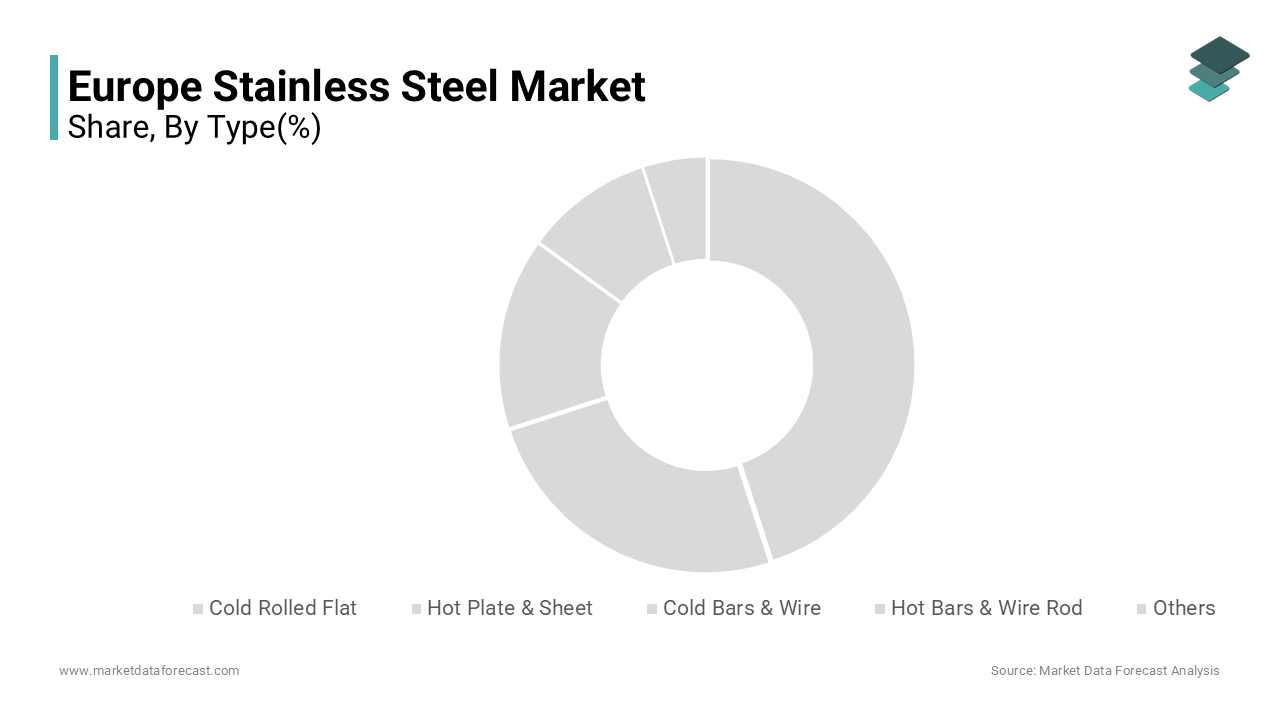
The cold bars and wire segment is predicted to grow at a CAGR of 7.12% over the forecast period in the European stainless steel market. The rising use in precision engineering and medical device fabrication is primarily contributing to the growth of the cold bars and wire segment in the European market. Cold drawn stainless bars and wire are critical for producing surgical tools implants and diagnostic components that require ultra-high tensile strength and biocompatibility. Europe is a global leader in medical device manufacturing, accounting for a significant share of worldwide production. According to the European Medical Devices Industry Group (MedTech Europe), countries such as Germany, Italy, and Ireland serve as key hubs for design and manufacturing. Each surgical scalpel, orthopedic screw, or implant demands micron‑level dimensional consistency, achievable only through cold working processes such as drawing and rolling. The EU medical device sector sources substantial volumes of cold‑drawn stainless wire and bar annually, primarily in grades 316L and 440C, which are valued for their corrosion resistance, biocompatibility, and mechanical strength. Stricter compliance under the Medical Device Regulation (MDR) has further elevated requirements for material traceability and purity, reinforcing demand for certified cold‑finished products. This combination of precision engineering, regulatory rigor, and specialized stainless grades positions Europe’s medical device industry as a high‑value downstream market for stainless steel, linking metallurgical expertise directly to healthcare innovation.
By Application Insights
The engineering segment had the major share of 30.8% of the regional market in 2024. The growth of the engineering segment is driven by the increasing usage of stainless steel in industrial machinery, chemical processing equipment and process piping systems. Europe’s push to upgrade legacy industrial infrastructure under the EU Industrial Strategy has triggered significant reinvestment in corrosion resistant process equipment. In 2023, the European Commission allocated billions of euros to support industrial decarbonization projects, many of which involve replacing carbon steel reactors with dual‑certified stainless steel alternatives. Industries such as pulp and paper, chemical manufacturing, and food processing rely on austenitic stainless steel to withstand aggressive media at elevated temperatures. According to the European Chemical Industry Council (CEFIC), a significant share of new chemical plant investments since 2022 specify 316L or duplex grades for piping and vessels, ensuring longevity in chloride‑rich environments. These material choices reflect both regulatory pressure and operational necessity, as stainless steel provides superior corrosion resistance, durability, and compliance with sustainability standards. This shift underscores how industrial decarbonization policy, material science, and sectoral investment strategies are converging to reinforce stainless steel’s role as a critical enabler of Europe’s low‑carbon industrial base.
The electrical machinery segment is the fastest expanding application segment and is expected to showcase a CAGR of 8.08% over the forecast period in this regional market. The surge in electric motor and transformer production is propelling the growth of the electrical machinery segment in this regional market. The EU’s Ecodesign for Energy Related Products framework mandates higher efficiency standards for electric motors pushing manufacturers to adopt stainless steel housings and structural supports that minimize magnetic interference and enhance thermal management. According to Eurostat, Europe produces tens of millions of industrial electric motors annually, with stainless steel content per unit rising steadily since 2021 as efficiency requirements tighten. Leading manufacturers such as Siemens and ABB increasingly specify ferritic stainless grades for stator frames to reduce eddy current losses, improving performance in high‑efficiency designs. The European Copper Institute notes that stainless steel usage in motor casings is expected to grow significantly by the mid‑2020s, driven by the adoption of IE4 and IE5 efficiency classifications. These advanced standards demand materials with superior durability, magnetic compatibility, and corrosion resistance, positioning stainless steel as a critical enabler of next‑generation motor technology. This trajectory underscores how industrial policy, efficiency regulation, and material innovation converge to reinforce stainless steel’s role in Europe’s electrification and energy efficiency agenda.
REGIONAL ANALYSIS
Germany Stainless Steel Market Analysis
Germany led the stainless steel market in Europe in 2024 and held 23.8% of the regional market share. The country’s dominance stems from its integrated industrial base spanning automotive engineering machinery and chemical production. Germany’s stainless steel demand is anchored by its advanced manufacturing ecosystem which prioritizes precision durability and regulatory compliance. Germany hosts Europe’s largest chemical cluster in Ludwigshafen, where BASF operates thousands of stainless steel process reactors. According to the German Chemical Industry Association (VCI), the sector invested billions of euros in plant modernization in 2023, with stainless steel comprising a significant share of material spend due to its durability in aggressive chemical environments. At the same time, Germany’s automotive industry remains the largest in Europe, producing millions of passenger vehicles annually as reported by the Federal Motor Transport Authority (KBA). These vehicles require extensive use of stainless steel in exhaust systems, fasteners, and increasingly in EV battery housings. The government’s Industrial Decarbonization Roadmap further accelerates substitution toward high‑grade alloys in hydrogen‑ready equipment, reinforcing stainless steel’s strategic role. Germany also achieves very high stainless scrap recycling rates (above 90%), according to the Fraunhofer Institute, ensuring supply chain resilience and circularity. With dozens of specialized mills, including those operated by Outokumpu and Acerinox, Germany maintains metallurgical leadership that cements its market supremacy in Europe’s stainless steel ecosystem.
Italy Stainless Steel Market Analysis
Italy ranked as the second largest stainless steel consumer in Europe in 2024. The growth of Italy in the European market is driven by the high value niche manufacturing and architectural innovation. Italy’s stainless steel consumption is uniquely driven by its globally recognized appliance and design sectors. Brands such as Smeg, Whirlpool, and Indesit rely on cold‑rolled austenitic stainless grades for premium kitchen equipment, with the Italian appliance industry sourcing hundreds of thousands of tons annually, according to Eurostat. Italy also leads Europe in stainless steel use for luxury yachts and marine structures, reflecting its Mediterranean shipbuilding heritage. Fincantieri, the state‑owned shipbuilder, reports significant consumption of marine‑grade stainless steel for superyacht superstructures and naval projects. Architecturally, cities like Milan, Turin, and Florence have institutionalized stainless steel in public art and transit hubs. For example, the Milan Metro Line 4 features extensive custom brushed stainless panels, highlighting the material’s aesthetic and durability advantages. The Italian government’s National Recovery and Resilience Plan (NRRP) allocated billions of euros to sustainable construction in 2023, further boosting demand for stainless steel in infrastructure. Italy also achieves a high recycling rate (close to 90%), according to the European Environment Agency (EEA), ensuring strong circularity. This fusion of aesthetics, engineering, and policy sustains Italy’s robust market position in stainless steel, bridging consumer appliances, marine industries, and architectural innovation.
France Stainless Steel Market Analysis
France is expected to hold a promising share of the European stainless steel market during the forecast period. France plays a strategic role in nuclear energy aerospace and high speed rail infrastructure. France’s stainless steel demand is heavily influenced by its state led energy and transport policies. France derives around 70% of its electricity from nuclear power, according to the International Atomic Energy Agency (IAEA), making it the most nuclear‑reliant country in Europe. Each reactor requires large volumes of stainless steel (notably grades 304L and 316L) for primary coolant loops and containment vessels. With plans announced by EDF to build six new EPR2 reactors by 2035, stainless demand from the nuclear sector is expected to grow steadily over the coming decade. France also leads in high‑speed rail, with SNCF operating thousands of TGV trains, each incorporating stainless steel in braking systems, interior fixtures, and structural components. In aerospace, Airbus facilities in Toulouse and Saint‑Nazaire consume significant volumes of specialty stainless steel for landing gear brackets, hydraulic lines, and other critical applications. The French Circular Economy Law mandates high recyclability standards for public infrastructure, reinforcing stainless steel adoption thanks to its 100% recyclability without loss of properties. These sovereign industrial priorities—spanning nuclear energy, rail, aerospace, and sustainability policy—secure France’s top‑tier status in the regional stainless steel market, combining technological leadership with regulatory alignment.
Turkey Stainless Steel Market Analysis
Turkey has emerged as a notable market in the European stainless steel market in 2024. The dual role of Turkey as a manufacturing hub and export gateway are majorly driving the Turkish market growth. Turkey’s growth is fueled by aggressive industrial export strategies and infrastructure development. Turkey is Europe’s largest exporter of white goods, shipping tens of millions of units annually, according to TurkStat, with leading appliance manufacturers such as Arçelik and Vestel accounting for the majority of stainless steel demand in the sector. The country also hosts major automotive plants for Ford, Renault, and Toyota, producing over a million vehicles annually, which require significant volumes of stainless steel for exhaust systems and structural components. Large infrastructure projects, such as the Istanbul Canal Project, are expected to consume substantial amounts of stainless steel for lock gates, corrosion‑resistant reinforcements, and desalination units, as outlined by the Ministry of Transport. Turkish mills, led by Tosyali and Erdemir, have invested billions of euros since 2021 in cold rolling and annealing lines to meet EU material standards. With preferential trade access to both EU and Middle Eastern markets, Turkey leverages its geographic position and industrial base to sustain rapid market expansion. This combination of appliance exports, automotive production, infrastructure demand, and mill investment reinforces Turkey’s role as a strategic stainless steel hub in the wider European and regional ecosystem.
Spain Stainless Steel Market Analysis
Spain holds a notable share of the European stainless-steel market. The renewable energy leadership of Spain and tourism-oriented construction are propelling the Spanish market growth. Spain is Europe’s fastest deployer of solar and wind capacity, installing over 10 GW of new renewable capacity in 2023, according to Red Eléctrica de España (REE). In solar thermal plants, stainless steel is widely used for heat collection tubes, while offshore wind foundations rely on duplex grades for seawater resistance. Projects such as Iberdrola’s Baltic Eagle offshore wind farm have sourced large volumes of Spanish‑produced stainless steel for substation platforms, underscoring the material’s critical role in renewable infrastructure. Simultaneously, Spain’s tourism economy drives continuous upgrades in hotels and airports, with the Barcelona El Prat Terminal expansion featuring extensive use of architectural stainless steel for durability and aesthetics. The Spanish government’s PERTE strategy allocated billions of euros to green hydrogen in 2023, supporting initiatives such as the Puertollano electrolyzer factory launched by Iberdrola and Enagás, which consumes significant volumes of stainless steel annually. Spain’s abundant solar resources combined with industrial policy alignment create a self‑reinforcing cycle of stainless steel demand, spanning renewable energy, infrastructure, and hydrogen technologies. This positions Spain as a key growth market in Europe’s stainless steel ecosystem.
COMPETITIVE LANDSCAPE
Competition in the Europe stainless steel market is characterized by a concentrated landscape of technologically advanced producers vying for dominance in high value segments amid tightening environmental regulations. The rivalry centers not on volume but on product sophistication sustainability credentials and supply chain reliability. Established players leverage integrated operations spanning melting cold rolling and precision finishing to serve demanding sectors such as clean energy medical devices and premium automotive. New entrants face high barriers due to capital intensity stringent quality certifications and scrap logistics complexity. Competitive intensity is further shaped by the EU Carbon Border Adjustment Mechanism which penalizes imports lacking verified emission data thereby favoring local producers with transparent footprints. However pressure from low cost Turkish and Asian semi finished imports persists particularly in commodity applications. Differentiation through certified circular content digital traceability and application engineering services has become the primary battleground. Strategic alliances with end users in hydrogen and battery manufacturing are emerging as critical levers for long term positioning. This dynamic fosters a market where innovation sustainability and regulatory alignment outweigh traditional cost competition.
KEY MARKET PLAYERS
Some of the companies that are playing a dominating role in the Europe Stainless Steel Market include
- Acerinox S.A.
- Outokumpu Oyj
- Aperam S.A.
- Thyssenkrupp AG
- ArcelorMittal
- Voestalpine AG
- Sandvik AB
- Salzgitter AG
- Marcegaglia S.p.A.
- Tata Steel Europe
Top Players in the Europe Stainless Steel Market
Outokumpu is a Finnish stainless steel producer recognized globally for its leadership in sustainable metallurgy and circular production practices. The company operates integrated mills in Finland Germany and the United States and supplies high grade austenitic and duplex stainless steels to sectors including automotive energy and construction. In recent years Outokumpu has intensified its decarbonization initiatives launching carbon neutral stainless steel certified by third parties and expanding its scrap based electric arc furnace capacity. The company commissioned a new cold rolling line in Tornio Finland in early 2024 to meet rising demand for precision flat products in clean tech applications. Its closed loop recycling model and commitment to the EU Green Deal reinforce its strategic alignment with European industrial policy and global environmental standards.
Acerinox is a Spain headquartered multinational with significant production assets in Spain the United Kingdom and the United States. It specializes in a wide range of stainless steel products including cold rolled coils plates and long products used in consumer goods infrastructure and industrial machinery. Acerinox has recently invested in digitalization and traceability systems to enhance supply chain transparency and support compliance with evolving EU regulations. In 2023 the company inaugurated a new hydrogen ready annealing and pickling line at its Bahía de Algeciras plant enabling lower emission processing. Its focus on energy efficiency material innovation and circular economy principles positions it as a key enabler of Europe’s industrial transition while maintaining strong export channels to Africa and the Americas.
Aperam is a Luxembourg based stainless steel manufacturer with major operations in France Belgium and Brazil. The company is known for its expertise in specialty alloys including electrical steel and high performance stainless grades for extreme environments. Aperam supplies critical materials to the aerospace automotive and renewable energy sectors and has strengthened its portfolio through technology driven product development. In 2024 Aperam launched a new bio based degreasing process at its Châtelet site significantly reducing chemical usage and wastewater impact. The company also expanded its service center network in Central Europe to offer just in time delivery of precision slit coils. These actions underscore Aperam’s commitment to sustainable innovation and customer centric solutions in alignment with European industrial decarbonization goals.
Top Strategies Used by the Key Market Participants
Key players in the Europe stainless steel market prioritize decarbonization through scrap based electric arc furnace adoption and renewable energy integration to comply with EU climate mandates. They invest heavily in product differentiation by developing certified low carbon and circular stainless steel grades tailored to clean tech and medical applications. Strategic capacity rationalization includes idling high emission assets while expanding cold rolling and finishing lines for high value products. Companies enhance supply chain resilience via digital traceability systems and long term scrap sourcing agreements. Geographic diversification and service center expansion enable just in time delivery models that cater to automotive and engineering customers. Partnerships with hydrogen electrolyzer and offshore wind manufacturers secure future demand. Continuous R and D in corrosion resistant alloys supports entry into high margin niches. These strategies collectively reinforce competitiveness amid energy cost pressures and regulatory complexity.
MARKET SEGMENTATION
This research report on the europe stainless steel market has been segmented and sub–segmented into the following categories.
By Type
- Cold Rolled Flat
- Hot Plate & Sheet
- Cold Bars & Wire
- Hot Bars & Wire Rod
- Others
By Application
- Metal Products
- Electrical Machinery
- Engineering
- Construction
- Automotive Parts
- Others
By Country
- UK
- France
- Spain
- Germany
- Italy
- Russia
- Sweden
- Denmark
- Switzerland
- Netherlands
- Turkey
- Czech Republic
- Rest of Europe
Frequently Asked Questions
What is the Europe Stainless Steel Market?
It refers to the production, distribution, and consumption of stainless steel products across various European industries.
What factors are driving the growth of the market in Europe?
Growth is driven by rising construction activities, increasing automotive production, industrial expansion, and demand for corrosion-resistant materials.
Which industries are the major end users of stainless steel in Europe?
Key end users include construction, automotive, engineering, electrical machinery, consumer goods, and energy industries.
Which product forms are most in demand?
Cold rolled flat products, hot plates & sheets, cold bars & wires, and hot bars & wire rods.
What challenges are affecting the Europe Stainless Steel Market?
Challenges include fluctuating raw material costs, rising energy prices, environmental regulations, and competition from low-cost imports.
Which European countries dominate the stainless steel market?
Germany, Italy, France, the UK, and Spain are the major contributors.
What key trends are shaping the market?
Trends include an increasing focus on recycling, adoption of green steel, technological advancements in alloy development, and rising demand from renewable energy projects.
Who are the major players operating in the Europe Stainless Steel Market?
Key players include Acerinox S.A., Outokumpu Oyj, Aperam S.A., Thyssenkrupp AG, ArcelorMittal, Voestalpine AG, Sandvik AB, Salzgitter AG, Marcegaglia S.p.A., and Tata Steel Europe.
What are the opportunities for new entrants?
Opportunities lie in advanced stainless steel products, green manufacturing technologies, and niche applications like hydrogen infrastructure.
How does global competition affect the Europe market?
Imports from Asia, especially China and India, create pricing pressure and influence local production strategies.
Access the study in MULTIPLE FORMATS
Purchase options starting from
$ 2000
Didn’t find what you’re looking for?
TALK TO OUR ANALYST TEAM
Need something within your budget?
NO WORRIES! WE GOT YOU COVERED!
Call us on: +1 888 702 9696 (U.S Toll Free)
Write to us: sales@marketdataforecast.com