- Product Description Description
- Table of Contents TOC
- List of Table & Figure LOT
- Get Free Sample PDF Sample PDF
Market Size, 2025
$8.29 BnMarket Estimate, 2026
$8.66 BnMarket Forecast, 2034
$12.24 BnCAGR, 2026–2034
4.43%Europe Stationery Market Report Summary
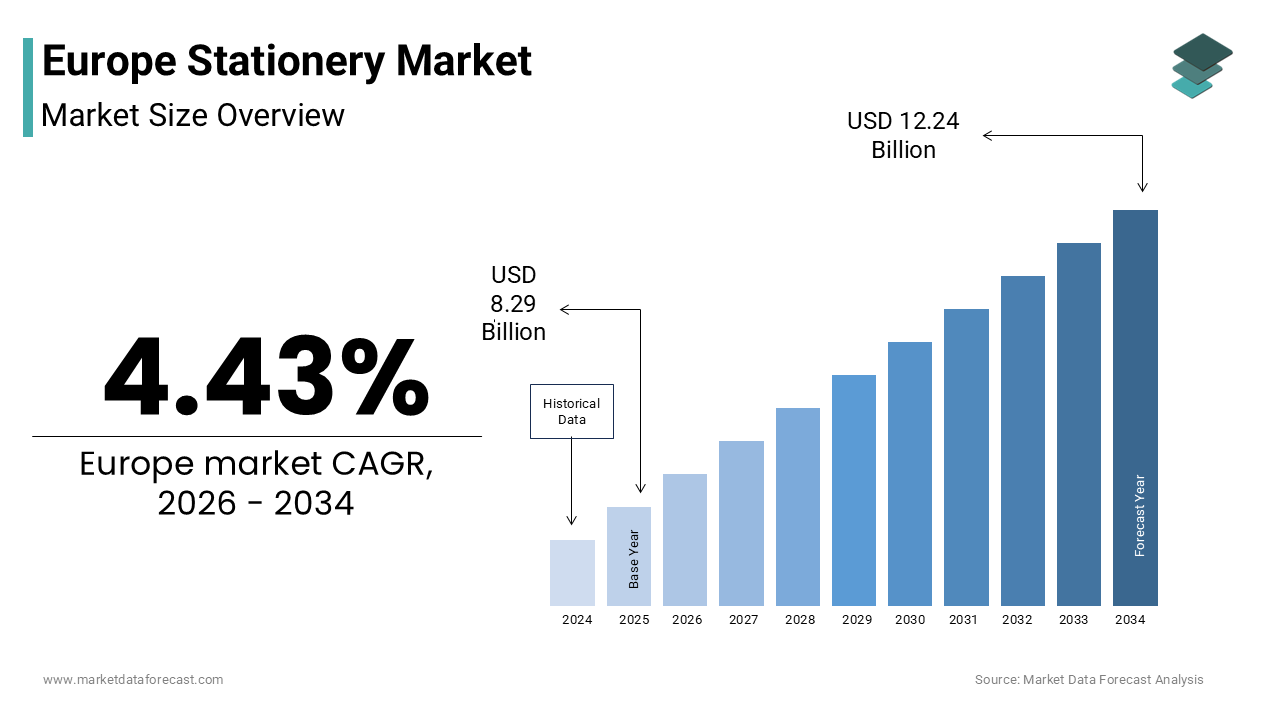
The Europe stationery market was valued at USD 8.29 billion in 2025, is estimated to reach USD 8.66 billion in 2026, and is projected to reach USD 12.24 billion by 2034, growing at a CAGR of 4.43% during the forecast period from 2026 to 2034. The growth of the Europe stationery market is driven by the enduring role of handwriting in European education systems, sustained institutional demand from schools and public administration, and the resurgence of analog creativity and mindful practices. Despite increasing digitalization, the cognitive and pedagogical benefits of handwriting continue to support steady demand for writing instruments and paper products. Moreover, growing interest in premium, sustainable, and design-led stationery products is expanding value-based consumption across residential and commercial segments in Europe.
Key Market Trends
-
Continued reliance on handwriting and physical learning tools across primary and secondary education systems in Europe.
-
The rising popularity of analog creativity, journaling, calligraphy, and mindful writing practices among adults.
-
Increasing demand for premium, design-oriented, and artist-grade stationery products.
-
Growing focus on sustainable stationery made from recycled paper, FSC-certified wood, and eco-friendly materials.
-
Rapid expansion of online and direct-to-consumer channels for niche and specialty stationery products.
Segmental Insights
- Based on type, the paper products segment held the largest share of 42.4% of the Europe stationery market in 2025. The dominance of this segment is attributed to the indispensable role of paper in education, administration, and official documentation, supported by recurring academic-year demand and continued use in public sector processes.
- Based on application, the commercial segment accounted for 58.5% of the Europe stationery market share in 2025, driven by large-scale procurement from schools, offices, and government institutions requiring consistent supplies of basic stationery items.
- Based on distribution channel, the offline segment dominated the Europe stationery market with a 65.1% share in 2025, supported by the tactile nature of stationery products, bulk purchasing needs, and strong back-to-school retail demand across physical stores.
Regional Insights
The Europe stationery market demonstrates stable demand across major economies, supported by strong education systems, cultural appreciation for writing and creativity, and well-established retail infrastructure.
-
Germany was the largest contributor, accounting for 24.9% of the Europe stationery market share in 2025, driven by a robust education system, strong SME presence, and demand for high-quality functional stationery.
-
The United Kingdom remains a key market due to its vibrant creative industries, emphasis on handwriting education, and strong demand for premium writing instruments.
-
France continues to show steady growth, supported by cultural appreciation for art, literature, and high-quality stationery products.
-
Italy plays an important role through its design heritage, luxury stationery production, and strong art and design education ecosystem.
Competitive Landscape
The Europe stationery market is characterized by the presence of established heritage brands and global mass-market players competing alongside niche and design-led manufacturers. Leading companies focus on balancing cost-efficient production for mass-market products with innovation in premium, sustainable, and aesthetically driven stationery lines. Strategic emphasis on recycled materials, refillable designs, and brand storytelling around craftsmanship and sustainability is strengthening competitive positioning. Prominent players in the Europe stationery market include BIC Group, Staedtler Mars GmbH & Co. KG, Faber-Castell AG, Maped, Pelikan International Corporation Berhad, Herlitz PBS AG, Lamy, Stabilo International GmbH, ACCO Brands Corporation, and Hamelyn.
Europe Stationery Market Size
The Europe stationery market size was valued at USD 8.29 billion in 2025 and is anticipated to reach USD 8.66 billion in 2026 from USD 12.24 billion by 2034, growing at a CAGR of 4.43% during the forecast period from 2026 to 2034.
Stationery refers to the wide range of materials used for writing, correspondence, and office tasks. It encompasses a broad range of products including writing instruments, paper goods, notebooks, filing supplies, and art materials. Despite the digital age, the market remains vital due to the persistent cognitive and pedagogical benefits of handwriting and physical note-taking. This demand is underpinned by Europe’s robust educational infrastructure and a strong cultural appreciation for analog creativity. According to sources, a massive, recurring annual demand for basic stationery persists across the European Union, driven by a large, stable population of students enrolled in primary and secondary education. Furthermore, as per the European Commission’s Joint Research Centre, studies have confirmed that handwriting activates distinct neural pathways compared to typing, reinforcing its use in learning environments and ensuring the continued relevance of pens, pencils, and paper in an increasingly digital world.
MARKET DRIVERS
Enduring Role of Handwriting in European Education Systems
The institutionalized and scientifically supported role of handwriting within the continent’s education systems is a primary driver of the European stationery market. Across most EU member states, cursive and print handwriting are mandatory components of the primary school curriculum, recognized not just as a practical skill but as a critical tool for cognitive development, memory retention, and fine motor skill acquisition. This policy creates a non-discretionary, annual demand cycle as millions of students require a standardized set of pens, pencils, notebooks, and rulers at the start of each academic year. As per a study, educational professionals across Europe maintain a strong consensus that the integration of handwriting in early education remains a foundational element for developing literacy and fine motor skills. This deep-rooted educational mandate provides a stable and predictable foundation for the entire stationery market, insulating it from short-term digital trends and ensuring its long-term viability.
Resurgence of Analog Creativity and Mindful Practices
The powerful cultural counter-movement towards analog creativity and mindful practices as a response to digital saturation propels the expansion of the Europe stationary market. In an era dominated by screens, there is a growing consumer desire for tactile, screen-free activities that promote focus, relaxation, and personal expression. This trend has revitalized segments like high-quality notebooks, fountain pens, artist-grade sketchbooks, and adult coloring books. The act of journaling, bullet planning, and hand-lettering has become a popular form of self-care and mindfulness across Europe. According to a study, a growing, popular movement exists among European adults to engage in analog creative hobbies, fostering a trend for non-digital artistic pursuits. This shift transforms stationery from a utilitarian office supply into a tool for personal well-being and artistic exploration, opening new premium and high-margin avenues for brands that cater to this conscious, experience-driven consumer.
MARKET RESTRAINTS
Persistent Pressure from Digital Substitution in Professional Settings
The ongoing and irreversible shift toward digital tools in professional and administrative environments is a significant barrier to the European stationery market. The widespread adoption of cloud-based collaboration software, digital note-taking apps, and electronic document management systems has drastically reduced the need for traditional office stationery like file folders, notepads, and even pens in many white-collar workplaces. This trend is accelerated by corporate sustainability goals aimed at achieving a “paperless office,” which directly impacts bulk purchasing decisions. As per research, formal digital transformation policies across large European enterprises have led to widespread adoption of digital tools, significantly reducing dependency on physical paper. This structural decline in professional demand creates a persistent headwind for the B2B segment of the stationery market, forcing suppliers to adapt their product portfolios or seek new customer bases.
Volatile Input Costs for Paper and Petrochemical-Based Products
A constant financial challenge from the volatility in the cost of its core raw materials, particularly wood pulp for paper and petrochemical derivatives for plastic components in pens and markers hampers the expansion of the Europe stationery market. These commodities are subject to global supply and demand fluctuations, energy price swings, and environmental regulations that can cause sudden and significant price increases. For instance, stringent EU forestry regulations and global logistics disruptions can tighten the supply of certified sustainable pulp, driving up paper costs. Similarly, the price of crude oil directly impacts the cost of producing ink and plastic barrels. High volatility in raw material prices and energy costs has caused persistent instability in stationery manufacturing and retail margins, making long-term pricing strategies difficult to establish.
MARKET OPPORTUNITIES
Expansion of Premium and Sustainable Product Lines
The strategic expansion of premium and certified sustainable product lines is a major opportunity for the Europe stationery market. Consumers, particularly younger demographics, are increasingly willing to pay a significant premium for stationery made from recycled paper, FSC-certified wood, or bio-based plastics, provided the brand can demonstrate genuine environmental stewardship. This opens the door for brands to move beyond basic commodities and develop high-value products with compelling narratives around circularity and ethical sourcing. The market for sustainably certified paper goods is experiencing robust expansion as European businesses shift from exploring to actively implementing circular economy solutions. Brands can capture a growing market of eco-conscious consumers and cultivate deep loyalty by embedding sustainability into products and using digital passports for full transparency.
Integration of Smart Features with Traditional Analog Tools
Integrating smart technology with traditional stationery provides a major opportunity for the Europe stationery market. This shift helps bridge the analog-digital divide. Products like smart notebooks that can digitize handwritten notes via a companion app, or pens that record strokes for later upload, offer the best of both worlds: the cognitive benefits of writing by hand with the convenience of digital storage and sharing. This hybrid model appeals to professionals and students who value the focus of analog writing but need their work in a digital format. Educational pilots integrating smart technology and digital tools in European classrooms are showing significant improvements in student engagement and the digitization of learning. This innovation transforms stationery from a passive tool into an active part of a connected workflow, creating a new, high-tech category that can command premium pricing and attract a tech-savvy user base.
MARKET CHALLENGES
Intense Competition from Low-Cost Asian Imports
The relentless competition from low-cost manufacturers in Asia, particularly China and India, is a serious challenge to the Europe stationery market. These producers can offer basic stationery items like pens, pencils, and notebooks at a fraction of the price of European-made goods, leveraging economies of scale and lower labor costs. This price pressure is especially acute in the mass-market and discount retail segments, where brand loyalty is weak and purchasing decisions are highly price-sensitive. Despite overall steady import levels, imports of specific, lower-cost stationery items are increasing, providing intense competition in the price-sensitive market segment. This dynamic forces European manufacturers to either compete on a playing field tilted against them or retreat entirely to the premium niche, limiting their overall market reach and growth potential.
Complex and Fragmented Waste Management Regulations
A complex and often inconsistent web of national and municipal waste management and extended producer responsibility regulations across the European Union holds back the expansion of the Europe stationery market. While the EU sets broad directives, individual member states implement their own rules regarding the collection, sorting, and recycling of paper and plastic waste, including stationery. This fragmentation creates a significant administrative burden for manufacturers and distributors who must navigate different compliance requirements, labeling standards, and fee structures in each country they operate. Variations in national waste management regulations across Europe are creating operational challenges and rising compliance costs for businesses trying to develop uniform, sustainable packaging solutions. The complexity discourages investment in innovative, recyclable designs and makes it difficult for companies to achieve economies of scale in their sustainability initiatives.
REPORT COVERAGE
| REPORT METRIC | DETAILS |
| Market Size Available | 2025 to 2034 |
| Base Year | 2025 |
| Forecast Period | 2026 to 2034 |
| CAGR | 4.43% |
| Segments Covered | By Type, Application, Distribution Channel and Region |
| Various Analyses Covered | Regional & Country Level Analysis, Segment-Level Analysis, DROC, PESTLE Analysis, Porter’s Five Forces Analysis, Competitive Landscape, Analyst Overview on Investment Opportunities |
| Countries Covered | UK, France, Spain, Germany, Italy, Russia, Sweden, Denmark, Switzerland, the Netherlands, Turkey, |
| Market Leaders Profiled | BIC Group, Staedtler Mars GmbH & Co. KG, Faber-Castell AG, Maped, Pelikan International Corporation Berhad, Herlitz PBS AG, Lamy, Stabilo International GmbH, ACCO Brands Corporation, and Hamelyn are some of the key market players operating in the Europe stationery market. |
SEGMENTAL ANALYSIS
By Type Insights
The paper products segment was the largest segment in the European stationery market by holding a share of 42.4% in 2025. The prominence of the paper products segment is driven by the indispensable role of paper in education and administration across the continent. From exercise books and printer paper to notebooks and notepads, paper remains the primary medium for learning, note-taking, and official documentation. The demand is institutionalized and cyclical, peaking at the start of each academic year when millions of students across the EU require a standardized set of supplies. Eurostat indicates that the EU's educational system, from early childhood to secondary levels, involves a substantial population of students, ensuring consistent demand for school supplies. Furthermore, despite digital advances, many governmental and legal processes still mandate physical paper submissions, ensuring a steady commercial and public sector demand that solidifies paper’s position as the bedrock of the stationery market.

The calligraphy-related tools and materials segment is estimated to register the fastest CAGR of 11.3% from 2026 to 2034 due to a powerful cultural renaissance of hand lettering and mindful writing practices as a direct counterbalance to digital life. Consumers, particularly among millennials and Gen Z, are embracing calligraphy as a form of creative expression, meditation, and personalization for events like weddings and gift-giving. The aesthetic appeal of beautifully crafted scripts has been amplified by social media platforms like Instagram, where the art form has gained a massive following. A growing interest in artistic, creative, and handcrafted materials has fueled a surge in specialized art supplies, including high-quality writing instruments and calligraphy tools. This trend transforms calligraphy from a niche skill into a mainstream hobby, driving demand for premium, artisanal tools that cater to both beginners and advanced practitioners.
By Application Insights
The commercial application segment dominated the European stationery market by accounting for a 58.5% share in 2025. The dominance of the commercial segment is attributed to the vast scale of Europe’s business, educational, and public administration sectors, which require a constant and massive supply of basic stationery for daily operations. Offices need pens, paper, folders, and staplers; schools require textbooks, exercise books, and art supplies for millions of students; and government agencies rely on physical forms and documentation. This institutional demand is highly predictable and recurring, forming the economic backbone of the market. The European Commission's procurement data supports a high level of, and consistent, annual spending on office supplies by public institutions across the EU. This stable, high-volume B2B channel provides a resilient foundation that insulates the market from fluctuations in individual consumer spending.
The residential application segment is anticipated to witness the fastest CAGR of 9.7% during the forecast period owing to the rise of home-based activities, including remote work, homeschooling, and a broad spectrum of creative hobbies. The pandemic permanently altered work and lifestyle patterns, leading to a sustained increase in home office setups and a renewed interest in analog leisure pursuits like journaling, bullet planning, sketching, and adult coloring. Consumers are now investing in higher-quality, aesthetically pleasing stationery for their personal spaces, viewing it as a tool for productivity and well-being. A growing percentage of European households have increased their purchases of art and craft supplies for personal use at home, fueled by a rise in creative, specialized hobbies. This shift from purely utilitarian to experiential and therapeutic home use is creating a vibrant and high-value residential market.
By Distribution Channel Insights
The offline distribution channel segment led the European stationery market by capturing a 65.1% share in 2025 because of the tactile nature of stationery products and the importance of immediate availability for both institutional and impulse purchases. Physical retail formats, from large office supply superstores and hypermarkets to specialized independent stationery shops and bookstore chains, offer customers the ability to see, feel, and test products before buying, which is crucial for items like pens and high-end paper. For commercial clients, offline channels provide the convenience of bulk purchasing and established account relationships. As per a study, the back-to-school season alone drives a significant spike in foot traffic to physical stores, where parents and students can efficiently purchase entire school supply lists in one visit, a convenience that online shopping often cannot match for this specific, time-sensitive need.
The online or e-commerce segment is on the rise and is expected to be the fastest growing segment in the market by witnessing a CAGR of 14.2% over the forecast period. This rapid expansion is propelled by the convenience, vast product selection, and competitive pricing offered by digital platforms. Online retailers can cater to niche interests—such as specific fountain pen inks, Japanese washi tape, or professional-grade art materials—that are unavailable in most physical stores. The rise of subscription boxes and curated online bundles has also created new, engaging ways for consumers to discover and purchase stationery. According to Ecommerce Europe, the digital commerce sector continues to expand as consumers increasingly rely on online platforms for both researching and purchasing hobby and craft products. This growth is driven by a preference for the convenience and personalized experiences offered by digital storefronts, leading to a steady rise in the market share of online specialty stores and stationery supplies.
REGIONAL ANALYSIS
Germany Stationery Market Analysis
Germany outperformed other countries in the Europe stationery market by accounting for a 24.9% share in 2025. The dominance of the German market is driven by a powerful combination of a world-class education system, a dense network of small and medium-sized enterprises, and a consumer base that values quality, precision, and efficiency. The German market is characterized by a strong demand for functional, durable, and well-designed stationery from both its vast commercial sector and its highly educated populace. As per research, the country’s commitment to vocational training and technical education ensures a steady demand for specialized drafting and technical drawing supplies. This focus on utility and quality, combined with a robust retail infrastructure, makes Germany the definitive engine of the European stationery market.
United Kingdom Stationery Market Analysis
The United Kingdom was the second largest country in the European stationery market by capturing a 16.7% share in 2025. The growth of the UK market is fuelled by a vibrant creative industry and a strong culture of literary and artistic pursuits, which fuels demand for premium writing instruments, artist-grade materials, and bespoke notebooks. London, as a global cultural capital, is a major hub for design-led stationery brands and independent artisans. According to sources, the national curriculum places a strong emphasis on handwriting and creative writing, ensuring a consistent base of demand from the education sector. The UK’s market is also highly receptive to global trends, making it a key launchpad for innovative and aesthetically focused stationery products that blend functionality with style.
France Stationery Market Analysis
France is also a key player in the European stationery market. The nation’s deep-rooted appreciation for the written word, fine arts, and craftsmanship is reflected in its strong demand for high-quality, aesthetically refined stationery. French consumers favor elegant notebooks from heritage brands, sophisticated fountain pens, and artist materials that support the country’s renowned tradition of drawing and painting. The French Ministry of Culture continues to promote arts education and literature as a fundamental pillar of national identity and youth development, aiming to foster a cultural environment that balances traditional, hands-on artistic practices with modern creative engagement. This cultural context creates a resilient market for premium and artisanal stationery, where products are seen not just as tools but as objects of beauty and cultural significance.
Italy Stationery Market Analysis
Italy commands a significant position in the European stationery market due to its unparalleled heritage in design, leathercraft, and papermaking, which translates into a strong preference for stationery that combines functionality with exceptional aesthetics. Brands from Florence and Milan are celebrated for their luxury notebooks bound in fine leather, beautifully crafted pens, and high-quality paper goods that reflect the “Made in Italy” ethos. According to research, the country’s extensive network of art schools and design academies generates a steady demand for professional-grade art and drafting supplies. This fusion of artistic tradition and modern design sensibility ensures that Italy remains a vital source of inspiration and a key market for premium stationery.
Netherlands Stationery Market Analysis
The Netherlands is likely to grow in the European stationery market from 2026 to 2034 owing to a highly educated population, a strong emphasis on sustainability, and a leading role in e-commerce adoption. Dutch consumers are early adopters of innovative stationery solutions, including smart notebooks and eco-friendly products made from recycled or alternative materials. As per a study, the country has one of the highest rates of online retail penetration in Europe, which has accelerated the growth of direct-to-consumer stationery brands. Furthermore, the Dutch government’s active promotion of circular economy principles has fostered a market that is highly receptive to refillable pens, plastic-free packaging, and other sustainable innovations, making the Netherlands a crucial testing ground for the future of the industry.
COMPETITIVE LANDSCAPE
The competition in the Europe stationery market is a complex interplay between historic European brands, global mass-market giants, and agile niche players. At the premium end, competition revolves around heritage, design aesthetics, and sustainable craftsmanship, where brands leverage their legacy to command higher prices. In the mass market, the battle is fiercely fought on price, distribution efficiency, and brand recognition, dominated by companies with vast economies of scale. The market is further fragmented by a surge of independent artisans and online-only brands catering to specific hobbies like calligraphy or bullet journaling. Success requires a delicate balance: maintaining cost leadership for core commodities while simultaneously innovating in premium, sustainable, and digitally connected products to capture the evolving demands of a diverse and increasingly environmentally conscious European consumer base.
KEY MARKET PLAYERS
Some of the companies that are playing a dominating role in the Europe Stationery Market include
- BIC Group
- Staedtler Mars GmbH & Co. KG
- Faber-Castell AG
- Maped
- Pelikan International Corporation Berhad
- Herlitz PBS AG
- Lamy
- Stabilo International GmbH
- ACCO Brands Corporation
- Hamelyn
Top Players in the Europe Stationery Market
Staedtler SE
Staedtler is a German icon and a cornerstone of the European stationery market, renowned for its precision-engineered writing and drawing instruments that are trusted by students, professionals, and artists worldwide. Its contribution to the global market is defined by its legacy of quality, innovation in materials like its Noris pencil lead, and its strong presence in technical drafting supplies. To strengthen its position in Europe, Staedtler has recently intensified its focus on sustainability by launching a new line of products made from recycled ocean-bound plastic and FSC-certified wood. The company has also expanded its digital learning solutions, partnering with schools to provide integrated analog-digital kits that combine traditional pencils with smart technology for modern education.
Faber-Castell AG
Faber-Castell is a legendary German manufacturer with a profound influence across the European stationery market, celebrated for its premium pencils, art supplies, and luxury writing instruments. Its global impact stems from its centuries-old heritage, commitment to sustainable forestry through its own plantations, and its reputation for artistic excellence. To fortify its market stance, Faber-Castell has significantly expanded its artist-grade product portfolio, introducing new watercolor and sketching lines tailored to the growing hobbyist market. The company has also deepened its e-commerce capabilities with a virtual color-matching tool and launched refillable pen systems to align with the European consumer’s demand for circular and long-lasting products.
BIC Group
BIC is a French giant and a dominant force in the European stationery market, known for its affordable, reliable, and ubiquitous disposable pens, pencils, and lighters. Its contribution to the global market is its mastery of mass production and distribution, making essential writing tools accessible to billions. To strengthen its European presence, BIC has aggressively pivoted toward sustainability by introducing its BIC ReVolution line of pens made from recycled plastic and launching take-back programs in partnership with retailers. The company has also invested in ergonomic designs for its school supplies, responding to educational guidelines on child development, thereby reinforcing its position as a trusted partner for the back-to-school season across the continent.
Top Strategies Used by the Key Market Participants
Key players in the Europe stationery market are pursuing a strategic agenda focused on three core pillars. They are aggressively investing in sustainable product innovation by replacing virgin plastics with recycled content and developing refillable or biodegradable alternatives. Simultaneously, they are enhancing their digital integration by creating hybrid analog-digital products and online platforms that support modern learning and creativity. Finally, they are strengthening direct consumer engagement through e-commerce channels and social media storytelling that highlight their heritage, craftsmanship, and environmental commitments, thereby building brand loyalty in a competitive and value-conscious market landscape.
MARKET SEGMENTATION
This research report on the Europe Stationery Market has been segmented and sub-segmented based on the following categories.
By Type
- Paper Products
- Writing Instruments
- Art & Craft
- Others
By Application
- Residential
- Commercial
By Distribution Channel
- Offline
- Online/ E-commerce
By Country
- UK
- France
- Spain
- Germany
- Italy
- Russia
- Sweden
- Denmark
- Switzerland
- Netherlands
- Turkey
- Czech Republic
- Rest of Europe