- Product Description Description
- Table of Contents TOC
- List of Table & Figure LOT
- Get Free Sample PDF Sample PDF
Market Size, 2025
$1.83 BnMarket Estimate, 2026
$1.99 BnMarket Forecast, 2034
$3.81 BnCAGR, 2026–2034
8.46%Europe Sterilization Equipment Market Size, Growth, Trends & Forecast (2026–2034)
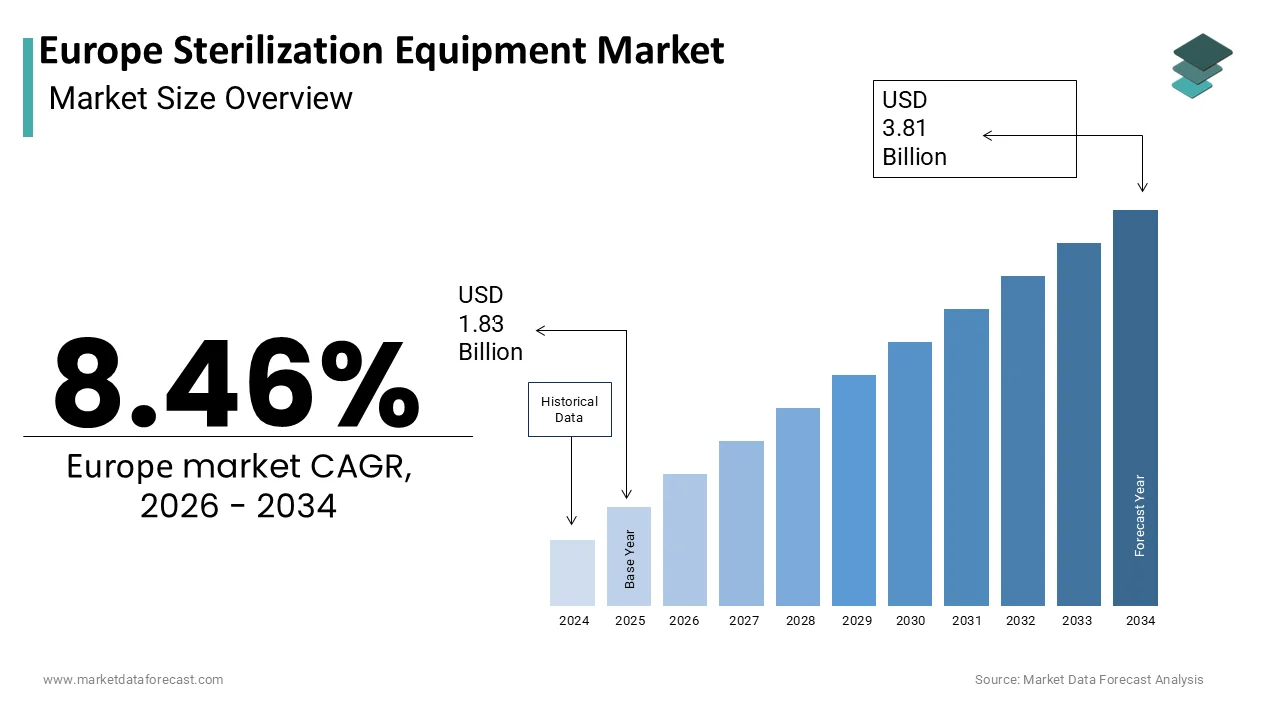
The Europe Sterilization Equipment Market size was valued at USD 1.83 billion in 2025, is anticipated to reach USD 1.99 billion in 2026, and is projected to scale up to USD 3.81 billion by 2034, registering a compound annual growth rate (CAGR) of 8.46% during the forecast period from 2026 to 2034. Driven by stringent EU medical device reprocessing regulations, aging demographic trends, and rising surgical intervention frequencies across healthcare infrastructure, the market continues to expand steadily across the region.
Key Executive Metrics (At-a-Glance)
- 2025 Base Valuation: USD 1.83 Billion
- 2026 Current Valuation: USD 1.99 Billion
- 2034 Forecast Valuation: USD 3.81 Billion
- Compound Annual Growth Rate (CAGR): 8.46% (2026–2034)
- Dominant Product Segment: Low-Temperature/High-Temperature Heat Sterilization (occupying 62.2% of the market share in 2025 due to extensive steam autoclave and dry heat oven integration)
- Fastest-Growing Product Segment: Ionizing Radiation Sterilization Equipment (projected to grow at a fast CAGR of 8.2% driven by single-use medical devices and biologics)
- Dominant End User Segment: Hospitals (holding 47.4% of the market share in 2025 backed by high central sterile supply processing volumes)
- Fastest-Growing End User Segment: Pharmaceutical Companies (expected to register the fastest CAGR of 7.9% due to the surge in aseptic manufacturing of biologics and injectables)
- Dominant Consumables & Accessories Segment: Sterilization Indicators (largest category holding 31.3% market share in 2025)
- Fastest-Growing Consumables & Accessories Segment: Sterilization Pouches (growing at a CAGR of 9.1% fueled by ambulatory surgery and single-use tray trends)
- Dominant Country Market: Germany (holding 20.3% of the European market share in 2025 supported by a dense network of hospitals and strict KRINKO guidelines)
Core Market Drivers
- Aging Population & Surgical Volume Growth: Geriatric demographic shifts driving higher intervention frequencies (e.g., joint replacements, cardiovascular procedures) that mandate reliable instrument sterilization.
- Stringent EU Regulations: The EU Medical Devices Regulation (MDR) 2017/745 enforcing strict reprocessing standards, traceability, and cycle validation across clinical facilities.
Primary Market Restraints & Challenges
- High Capital & Operational Costs: Substantial expenses for advanced hydrogen peroxide plasma systems and high-capacity autoclaves limiting adoption in smaller healthcare centers.
- Environmental Restrictions on Ethylene Oxide: Health and safety concerns regarding carcinogen classifications prompting strict emission reductions and phase-out timelines.
- Workforce Shortages & Complex Validation: Inconsistent protocol adherence caused by a shortage of certified sterile processing technicians and complex load configuration variables.
Europe Sterilization Equipment Market Segmentation Breakdown
| Segment Category | Leading Sub-Segment (2025 Base) | Fastest-Growing Sub-Segment (2026–2034) |
|---|---|---|
| By Product | Low-Temperature/High-Temperature Heat Sterilization (62.2% share in 2025) | Ionizing Radiation Sterilization Equipment (8.2% CAGR for heat-sensitive biologics) |
| By End User | Hospitals (47.4% share in 2025 due to acute care processing volumes) | Pharmaceutical Companies (7.9% CAGR driven by aseptic manufacturing and biologics) |
| By Consumables & Accessories | Sterilization Indicators (31.3% share in 2025 for cycle confirmation) | Sterilization Pouches (9.1% CAGR driven by ambulatory surgery and single-use trays) |
| By Country | Germany (20.3% share backed by advanced infrastructure and strict standards) | France & UK (expanding through autoclave modernizations and regulatory compliance frameworks) |
Major Industry Players Profiled
Key enterprises shaping the competitive European sterilization equipment market include STERIS Corporation, Getinge Group, Advanced Sterilization Products, 3M Company, Belimed AG, Cantel Medical Corporation, Anderson Products, Inc., Matachana Group, MMM Group, and Sterigenics International, Inc. Detailed market insights and analytical metrics are available via research providers such as [Market Data Forecast](https://www.marketdataforecast.com/market-reports/europe-sterilization-equipment-market).
Europe Sterilization Equipment Market Size
The Europe Sterilization Equipment Market is projected to grow from USD 1.83 billion in 2025 to USD 1.99 billion in 2026 and reach USD 3.81 billion by 2034, registering a CAGR of 8.46% during the forecast period from 2026 to 2034.
Sterilization equipment is medical and laboratory devices designed to eliminate all forms of microbial life, including bacteria, viruses, fungi, and spores, from instrument surfaces and heat-sensitive materials through physical or chemical means. In Europe, these technologies are crucial to infection prevention across hospitals, pharmaceutical manufacturing facilities, and research laboratories. Common modalities include steam autoclave, ethylene oxide gas systems, hydrogen peroxide plasma units, and dry heat sterilizers, each selected based on material compatibility, regulatory requirements, and throughput needs. Furthermore, the European Medicines Agency mandates aseptic processing for all sterile medicinal products, highlighting the non-negotiable role of validated sterilization systems in drug safety. Additionally, the EU Medical Devices Regulation 2017 745 enforces stringent reprocessing standards for reusable devices, compelling healthcare facilities to upgrade legacy equipment.
MARKET DRIVERS
Rising Surgical Volumes Driven by an Aging Population Increase Demand for Reliable Sterilization
The demographic shift toward an older population directly fuels the need for sterilization equipment as age correlates strongly with surgical intervention frequency. The growing surgical volumes driven by an aging population and increasing demand for reliable sterilization are accelerating the growth of the European sterilization equipment market. According to Eurostat, 102 million people in the European Union were aged 65 or older in 2023, representing more than one-fifth of the total population, and this cohort is projected to reach 30% by 2050. Older adults are significantly more likely to undergo procedures such as joint replacements, cataract surgeries, nd cardiovascular interventions which require sterile instrumentation. The Organisation for Economic Co-operation and Development reports that hip replacement rates in Germany, France,e, and Italy exceed 300 per million population annually, with sterilization cycles required for every implant and instrument set. Furthermore, the rise of same-day surgeries in ambulatory centers, now accounting for 65% of all elective procedures in the Netherlands, as per the Dutch Health Authority, places pressure on compact high-efficiency sterilizers with rapid cycle times. Hospitals in Sweden and Austria have reported a 12 to 15% annual increase in instrument processing volumes directly tied to geriatric surgical demand.
Stringent EU Regulations on Medical Device Reprocessing Mandate Advanced Sterilization Technologies
The European Union’s Medical Devices Regulation 2017 745 imposes rigorous requirements on the reprocessing of reusable medical devices, including validation documentation, traceability, t,y and personnel training, which collectively drive adoption of modern sterilization equipment. The stringent EU regulations on medical device reprocessing mandate advanced sterilization is hampering the growth of the European sterilization equipment market. Under this framework, healthcare facilities must demonstrate that each sterilization cycle achieves a sterility assurance level of 10 6, meaning less than one in a million chance of microbial survival. The European Commission’s 2022 guidance on reprocessing explicitly discourages the use of unvalidated or manual methods and requires automated recording of time, temperature, and pressure parameters for every cycle. Hospitals across Germany and France have decommissioned older gravity displacement autoclaves in favor of pre-vacuum steam sterilizers with integrated data logging capabilities. Additionally, the regulation mandates that sterilization processes be performed in controlled environments with defined air quality standards, thereby increasing demand for integrated washer-disinfectant sterilizer lines.
MARKET RESTRAINTS
High Capital and Operational Costs of Advanced Sterilization Systems Limit Adoption in Smaller Facilities
The acquisition and maintenance of modern sterilization equipment present significant financial barriers, particularly for small hospitals, outpatient clinics, and dental practices across Southern and Eastern Europe. A fully automated hydrogen peroxide plasma sterilization system can cost between 80000 and 150000 euros, while a high-capacity class B steam autoclave ranges from 30000 to 60000 euros. Operational expenses further compound the burden with ethylene oxide systems requiring specialized ventilation gas monitoring and hazardous waste disposal protocols that add 15000 to 25000 euros annually in compliance costs. In countries like Romania and Bulgaria, where over 60% of healthcare providers operate with annual budgets under 2 million euros, as per the World Health Organization regional office, many facilities continue using outdated gravity autoclaves that lack cycle validation or data export functions.
Environmental and Safety Concerns Surrounding Ethylene Oxide Restrict Its Use
The ethylene oxide sterilization, while effective for heat-sensitive devices, faces increasing restrictions in Europe due to its classification as a carcinogen and environmental pollutant, which additionally declines the growth of the European sterilization equipment market. Several member states have responded with stringent controls; France halted operations at three major contract sterilization plants in 2023 following air quality violations, while the Netherlands imposed a 50% reduction target for ethylene oxide emissions by 2026. These regulations complicate facility permitting and increase monitoring costs, with continuous emission tracking systems costing up to 75000 euros per installation. Consequently, medical device manufacturers are reformulating products to withstand alternative methods such as steam or hydrogen peroxide plasma.
MARKET OPPORTUNITIES
Integration of Digital Monitoring and Predictive Maintenance Enhances Operational Efficiency
The integration of sterilization equipment with digital health infrastructure is creating new opportunities for the growth of the European sterilization equipment market. Leading manufacturers now embed Internet of Things sensors and cloud-based analytics into autoclaves and low-temperature sterilizers, enabling real-time tracking of cycle parameters, maintenance alerts, and compliance documentation. According to the European Health Telematics Observatory, over 70% of new sterilization equipment procured by German and Dutch university hospitals in 2023 included digital connectivity features. These systems reduce human error by automatically archiving sterilization records for audits and flagging deviations before they compromise sterility. Furthermore, the EU’s Digital Europe Programme allocates funding for hospital digitization projects that include sterile processing departments as critical nodes in infection control networks.
Expansion of Single-Use Device Reprocessing Creates Demand for Specialized Validation Systems
The growing acceptance of single-use medical device reprocessing by cost containment and sustainability goals is creating niche demand for sterilization equipment with enhanced validation capabilities. While traditionally considered disposable, over 2000 devictypeses, including electrophysiology catheters, surgical clamps, ps and ultrasonic probes, are now reprocessed under strict regulatory oversight. The European Commission estimates that 15 to 20% of EU hospitals engage in some form of single-use device reprocessing, often through third-party vendors certified under the Medical Devices Regulation. These processes demand sterilization systems that can accommodate complex geometries and provide cycle documentation traceable to individual devices. Hydrogen peroxide plasma and low-temperature steam formaldehyde units are increasingly preferred for their material compatibility and rapid turnaround. A 2025 study by the Technical University of Munich found that reprocessing facilities using integrated washer sterilizer lines achieved 30% higher throughput than manual methods while maintaining sterility assurance levels. Furthermore, the EU’s Green Public Procurement criteria now encourage hospitals to consider environmental impact in purchasing decisions, lending institutional support to reprocessing initiatives.
MARKET CHALLENGES
Cycle Validation Complexity Hinders Consistent Sterility Assurance Across Device Types
The consistent sterilization across diverse medical instruments remains a persistent operational challenge due to variations in load composition, material density, and packaging, which is one of the challenges for the growth of the European sterilization equipment. Steam sterilization efficacy depends on steam penetration, which is obstructed by lumens, inges, nd tightly packed trays. According to the Robert Koch Institute in Germany, up to 22% of sterilization failures in 2022 were attributed to improper load configuration rather than equipment malfunction. Biological indicators must be placed in the most challenging locations of each load, yt many facilities lack standardized protocols for complex devices such as robotic surgery arms or neurosurgical kits. Moreover, new materials such as carbon fiber reinforced polymers used in orthopedic instruments absorb moisture differently, altering heat transfer dynamics and requiring customized cycles.
Workforce Shortages and Training Gaps Compromise Sterilization Protocol Adherence
The effective operation of sterilization equipment relies heavily on trained personnel shortage of sterile processing technicians in rural and Eastern regions. According to the European Federation of Sterile Supply Services, fewer than 40% of EU member states have formal certification programs for central sterile supply department staff. In Poland, Romania, and Greece, over 5% of sterilization operators receive on-the-job training without standardized curriculleadingngg to inconsistent practice. A 2023 inspection by the UK’s Care Quality Commission found that 31% of non-compliant sterilization incidents were linked to human error, including incorrect cycle selection, inadequate drying, time, and failure to monitor Bowie Dick tests. The problem is exacerbated by high turnover; the average tenure of sterile processing staff in Italian public hospitals is under 18 months, as per data from the Italian Society of Hospital Hygiene.
REPORT COVERAGE
| REPORT METRIC | DETAILS |
| Market Size Available | 2025 to 2034 |
| Base Year | 2025 |
| Forecast Period | 2026 to 2034 |
| Segments Covered | By Product, End User Consumables and Accessories, and Region. |
| Various Analyses Covered | Global, Regional, and Country-Level Analysis, Segment-Level Analysis, Drivers, Restraints, Opportunities, Challenges; PESTLE Analysis; Porter’s Five Forces Analysis, Competitive Landscape, Analyst Overview of Investment Opportunities |
| Countries Covered | UK, France, Spain, Germany, Italy, Russia, Sweden, Denmark, Switzerland, Netherlands, Turkey, Czech Republic, Rest of Europe |
| Market Leaders Profiled | STERIS Corporation (U.S.), Getinge Group (Sweden), Advanced Sterilization Products (U.S.), 3M Company (U.S.), Belimed AG (Switzerland), Cantel Medical Corporation (U.S.), Anderson Products, Inc. (U.S.), Matachana Group (S.A.), MMM Group (Germany), Sterigenics International, Inc. (U.S.). |
SEGMENTAL ANALYSIS
By Product Insights
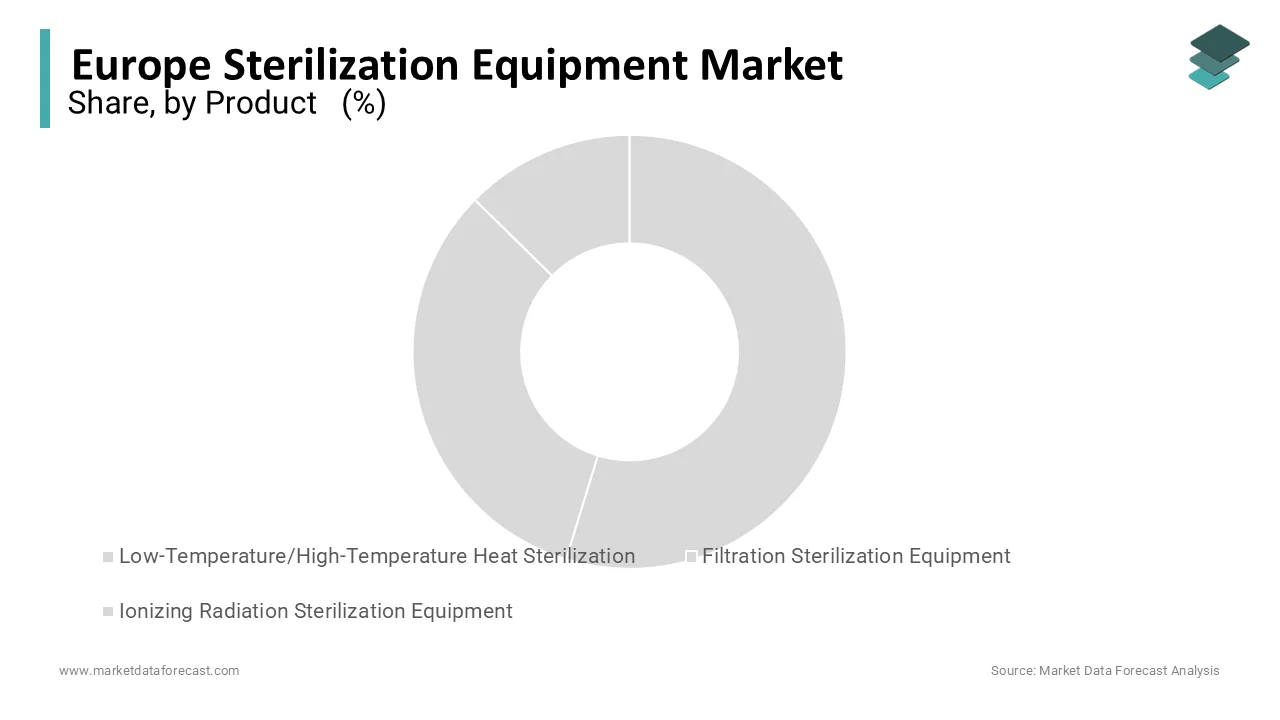
The low-temperature, high-temperature heat sterilization segment was the largest by occupying 62.2% of the European sterilization equipment market share in 2025, from the widespread use of steam autoclaves and dry heat ovens across hospitals and laboratories, where reliability and material compatibility are paramount. Furthermore, the EU Medical Devices Regulation 2017 745 mandates validated thermal processes for all reusable surgical instruments, reinforcing autoclave dependency. Countries like Germany and France operate centralized sterile processing departments in over 80% of public hospitals, ensuring high throughput and standardized protocols. This combination of regulatory endorsement, clinical necessity, and technological maturity ensures thermal methods remain the backbone of Europe’s sterilization infrastructure.
The ionizing radiation segment is growing at a fast CAGR of 8.2% throughout the forecast period, owing to the expanding production of single-use medical devices and biologics that cannot withstand heat or moisture. As per the European Medicines Agency, sterile biologic drug approvals increased by 24% in 2023 alone, heightening reliance on radiation facilities that offer aseptic validation without chemical residues. Moreover, the EU’s push for a circular economy in healthcare has spurred investment in contract sterilization centers, with Germany and the Netherlands commissioning three new electron beam facilities in 2023 to reduce dependence on ethylene oxide. Radiation sterilization also aligns with the EU’s Chemicals Strategy for Sustainability, which seeks to phase out hazardous gases.
By End User Insights
The hospitals segment held 47.4% of the European sterilization equipment market share in 2025, with the sector’s operational scale and regulatory obligations across over 7000 acute care facilities in the EU. Eahospital'stal central sterile supply department processes an average of 15000 instrument sets per month, as documented by the European Federation of Sterile Supply Services, with every set requiring validated sterilization before surgical use. Furthermore, the EU Medical Devices Regulation 2017 745 imposes strict traceability and documentation requirements compelling hospitals to upgrade to automated autoclaves with digital logging capabilities. In countries like Sweden and the Netherlands, over 90% of public hospitals have transitioned to class BvB vacuum-assisted steam sterilizers to meet these standards. The rise of robotic and minimally invasive surgery has further intensified demand as these procedures use complex instruments with narrow lumens that require advanced cycle validation. Hospitals also face infection control mandates from national health agencies, with the German Robert Koch Institute requiring monthly biological indicator testing.
The pharmaceutical companies segment is expected to register the fastest CAGR of 7.9% throughout the forecast period, with the surge in aseptic manufacturing of biologics, sterile injectables, and advanced therapy medicinal products, which require validated sterilization of fill finish components, vials, and isolator environments. The European Medicines Agency approved 132 new biological medicines between 2021 and 2,02,3, a 35% increase over the prior three-year period, driving expansion of sterile production lines. Filtration sterilization systems have seen heightened adoption as they enable the sterilization of heat-sensitive protein-based drugs without degradation. Additionally, the EU’s Good Manufacturing Practice Annex 1 revision, effective 20,3, mandates enhanced environmental monitoring and sterilization validation for all aseptic processes, compelling firms to invest in integrated sterilization and containment systems.
By Consumables and Accessories Insights
The sterilization indicators segment was the largest by holding 31.3% of the European sterilization equipment market share in 2025. These include chemical integrators, biological indicators, and Class 6 emulating indicators that provide visual or biological confirmation of successful sterilization cycles. Hospitals across Germany, Franc e, a nd the UK routinely use over 500 indicators per operating room monthly as per audits by national health inspectorates. The Robert Koch Institute in Germany mandates biological indicator testing at least weekly for every autoclave, a practice mirrored in Sweden and the Netherlands. Moreover, the shift toward complex minimally invasive devices necessitates placement of indicators in hard-to-reach locations within instrument sets, increasing per-cycle consumption. Manufacturers like 3M and Cantel have developed digital indicators that log data directly into hospital tracking systems, aligning with EU digitization goals.
The sterilization pouches segment is likely to grow at a CAGR of 9.1% throughout the forecast period, with the rising use of single-use instrument trays and the need for short-term sterile storage in ambulatory surgery centers, which now perform 65% of all elective procedures in countries like the Netherlands and Denmark. Medical-grade sterilization pouches made from medical-grade paper and transparent plastic films allow visual inspection and maintain sterility for up to six months under proper conditions. The European standard EN 868 requires all pouches to undergo microbial barrier testing and aging studies, ensuring reliability.
COUNTRY LEVEL ANALYSIS
Germany Sterilization Equipment Market Analysis
Germany was the top performer of the European sterilization equipment market by holding 20.3% of the share in 202, with its advanced healthcare infrastructure, dense network of hosphospitalan strong medical device manufacturing base. The country hosts over 1900 hospitals, including 37 university medical centers of which operate centralized sterile processing departments compliant with the stringent KRINKO recommendations issued by the Robert Koch Institute. Germany is also home to leading medical device firms such as B Braun and Siemens Healthineers, which internally utilize high-end sterilization systems for production and reprocessing. According to the German Federal Statistical Office, many surgical procedures were performed in 2023, requiring rigorous instrument sterilization. Additionally, Germany enforces one of Europe’s strictest ethylene oxide phase-out timelines, with full cessation of medical device sterilization using the gas mandated by 2027. This regulatory pressure accelerates the adoption of alternative technologies like hydrogen peroxide plasma and steam.
France Sterilization Equipment Market Analysis
France's sterilization equipment market growth is propelled by its extensive public hospital network and centralized healthcare planning. The country operates over 1000 public hospitals under the Assistance Publique Hôpitaux de Paris and regional university hospital groups, which collectively perform more than 11 million surgical interventions annually, as per France’s Ministry of Health. This directive triggered a wave of autoclave replacements with over 2500 new class B units procured in 2023 alone, according to the French Health Products Safety Agency. France also hosts major sterilization service providers like Steris and Belimed, serving both domestic and Southern European markets. The country’s 2023 ban on ethylene oxide emissions from medical sterilization facilities further accelerated investment in low-temperature plasma systems.
UK Sterilization Equipment Market Analysis
The United Kingdom's sterilization equipment market growth is likely to grow with its integrated National Health Service and high surgical throughput. The Care Quality Commission’s 2023 inspection framework places explicit emphasis on sterilization compliance, with facilities required to demonstrate full traceability from decontamination to the point of use. This has driven widespread adoption of automated washer-disinfectant sterilizer lines integrated with instrument tracking software. The UK also leads in reprocessing innovation, with over 40 certified single-use device reprocessing units operating under Medicines and Healthcare products Regulatory Agency oversight. Post Brexit, the UK has maintained alignment with EU MDR sterilization standards while accelerating approval of novel sterilization technologies through its Innovative Devices Access Pathway. Major teaching hospitals in London, Manchester, er and Edinburgh serve as test beds for next-generation sterilization systems, further reinforcing the UK’s role as a technologically advanced and regulation-driven market.
Italy Sterilization Equipment Market Analysis
Italy's sterilization equipment market growth is likely to grow with its regionalized healthcare system and high volume of orthopedic and cardiovascular surgeries. Italy is also a hub for medical device manufacturing, with over 2500 firms, including Sorin and Eurospita, relying on in-house sterilization for product validation.
TOP LEADING PLAYERS IN THE MARKET
- Getinge is a Swedish multinational with deep integration across the European sterilization equipment market, offering a comprehensive portfolio of steam autoclaves, hydrogen peroxide plasma systems,n d washer disinfectors tailored to hospital and industrial needs. The company plays a pivotal role globally by setting benchmarks in sustainable sterilization through energy anwater-efficientnt technologies. Getinge launched its next-generation T-DOC sterilizer with real-time digital validation and cloud-based cycle documentation fully aligned with EU Medical Devices Regulation requirements. It also expanded its sterile processing training academy in Germany to certify healthcare technicians on advanced reprocessing protocols.
- STERIS maintains a commanding footprint in the European sterilization equipment market through its integrated solutions spanning steam, ethylene oxide, and vaporized hydrogen peroxide technologies for healthcare and pharmaceutical applications. Headquartered in the United States company operates major manufacturing and service centers in the UK, Germany, and Ireland, serving both EU and global clients. STERIS inaugurated a state-of-the-art contract sterilization facility in the Netherlands focused on electron beam processing to support the EU’s phase out of ethylene oxide. It also introduced its Harmony sterilization intelligence platform, enabling predictive maintenance and compliance analytics across hospital networks.
- Belimed, a Swiss-based leader in sterile processing solutions, delivers high-performance autoclaves and reprocessing workstations widely adopted across European hospitals and medical device manufacturers. As part of the Metall Zug Group, the company leverages Swiss precision engineering to produce class B steam sterilizers, renowned for reliability in high-throughput environments. Belimed enhanced its SmartLine series with integrated RFID tracking and automatic load recognition features that reduce human error and support EU traceability mandates. It also partnered with university hospitals in France and Sweden to validate sterilization protocols for robotic surgery instruments.
TOP STRATEGIES USED BY THE KEY MARKET PARTICIPANTS
Key players in the European sterilization equipment market prioritize regulatory alignment by designing systems that meet the EU Medical Devices Regulation and EN ISO standards for reprocessing validation and traceability. Companies invest heavily in digital integration, embedding Internet of Things sensors, cloud analytics, and electronic documentation into sterilizers to support paperless compliance. Strategic expansion of low-temperature sterilization capacity, particularly hydrogen peroxide plasma and electron beam technologies, addresses the EU’s phase-out of ethylene oxide driven by environmental and health concerns. Firms also establish regional training academies and technical support hubs to bridge workforce competency gaps and ensure proper equipment utilization. Additionally, manufacturers collaborate with hospitals and medical device companies to co-develop customized sterilization protocols for complex instruments such as robotic and minimally invasive tools.
COMPETITIVE LANDSCAPE
The European sterilization equipment market features a competitive landscape dominated by a few technologically advanced global players alongside specialized regional manufacturers. Competition is primarily driven by regulatory compliance, innovation in cycle efficiency, and digital capabilities rather than price alone. The stringent requirements of the EU Medical Devices Regulation 2017 745 act as a significant entry barrier, favoring companies with established validation expertise and quality management systems. Leading firms differentiate through integrated solutions that combine hardware, software, and services, including remote monitoring, predictive maintenance, and staff training. The phase out of ethylene oxide has intensified rivalry in low-temperature sterilization, with companies racing to scale hydrogen peroxide plasma and radiation alternatives. Meanwhile, rising demand for outpatient care fuels innovation in compact rapid-cycle autoclaves tailored for ambulatory settings. Although new entrants face high certification costs and long sales cyclestheyey continuously invest in R and D to address evolving clinical needs, needs as the sterilization of heat-sensitive robotic instruments.
KEY MARKET PLAYERS
A few of the notable players operating in the europe sterilization equipment market profiled in this report are
- STERIS Corporation (U.S.)
- Getinge Group (Sweden)
- Advanced Sterilization Products (U.S.)
- 3M Company (U.S.)
- Belimed AG (Switzerland)
- Cantel Medical Corporation (U.S.)
- Anderson Products, Inc. (U.S.)
- Matachana Group (S.A.)
- MMM Group (Germany)
- Sterigenics International, Inc. (U.S.)
MARKET SEGMENTATION
This research report on the europe sterilization equipment market has been segmented and sub-segmented into the following categories.
By Product
- Low-Temperature/High-Temperature Heat Sterilization
- Filtration Sterilization Equipment
- Ionizing Radiation Sterilization Equipment
By End User
- Pharmaceutical Companies
- Medical Device Companies
- Hospitals
- Food & Beverage companies
By Consumables and Accessories
- Detergents
- Sterilization Accessories
- Sterilization Indicators
- Pouches
- Lubricants
By Country
- UK
- France
- Spain
- Germany
- Italy
- Russia
- Sweden
- Denmark
- Switzerland
- Netherlands
- Turkey
- Czech Republic
- Rest of Europe