- Product Description Description
- Table of Contents TOC
- List of Table & Figure LOT
- Get Free Sample PDF Sample PDF
Market Size, 2025
$14.04 BnMarket Estimate, 2026
$16.02 BnMarket Forecast, 2034
$46.14 BnCAGR, 2026–2034
14.14%Europe Streaming Music Market Report Summary
The Europe streaming music market was valued at USD 14.04 billion in 2025, is estimated to reach USD 16.02 billion in 2026, and is projected to reach USD 46.14 billion by 2034, growing at a CAGR of 14.14% during the forecast period from 2026 to 2034. The growth of the Europe streaming music market is driven by the widespread availability of high-speed internet connectivity, increasing smartphone penetration, and the rapid shift from physical music ownership to subscription-based digital entertainment models. The expansion of 5G networks and the growing adoption of smart devices are further accelerating music streaming consumption across the region. Moreover, the integration of podcasts, personalized playlists, and algorithm-driven music discovery is enhancing user engagement and transforming streaming platforms into comprehensive digital audio ecosystems.
Key Market Trends
-
Rising adoption of subscription-based streaming services offering unlimited access to extensive music catalogs.
-
Increasing demand for high-fidelity and lossless audio streaming, particularly among audiophiles and premium subscribers.
-
Growing integration of podcasts and spoken-word audio content within music streaming platforms to enhance user engagement.
-
Expansion of AI-driven recommendation engines that personalize playlists and improve music discovery experiences.
-
Increasing collaborations between streaming platforms and telecom operators to bundle music subscriptions with mobile data plans.
Segmental Insights
- Based on service, the on-demand streaming segment held the largest share of the Europe streaming music market in 2024. The dominance of this segment is attributed to consumer preference for flexible listening experiences, where users can access millions of tracks instantly and curate personalized playlists according to their preferences.
- Based on platform, the mobile applications segment accounted for a major share of the Europe streaming music market in 2024. The segment’s growth is driven by widespread smartphone adoption, improved mobile network infrastructure, and the convenience of app-based features such as offline downloads, personalized notifications, and voice assistant integration.
- Based on content, the audio segment remains the dominant format in the Europe streaming music market due to the continued demand for music streaming services across personal listening environments including commuting, workouts, and home entertainment.
Regional Insights
The Europe streaming music market is expanding across several countries due to increasing digital media consumption, strong telecommunications infrastructure, and a vibrant music industry ecosystem.
-
The United Kingdom held the largest share of the Europe streaming music market in 2024, supported by high digital music adoption, strong smartphone penetration, and a well-established music industry that actively promotes digital streaming platforms.
-
Germany continues to grow steadily due to consumer preference for high-quality audio streaming and the integration of streaming services across connected home devices and automotive infotainment systems.
-
France maintains a strong presence in the market driven by regulatory policies promoting local content and the popularity of French-language music across streaming platforms.
-
Italy is witnessing growing streaming adoption supported by increasing smartphone usage, improved mobile internet connectivity, and a strong cultural affinity for music consumption.
-
Spain is experiencing consistent growth due to its young population, high engagement with Latin and global pop music, and strong integration of streaming services with mobile telecom subscriptions.
Competitive Landscape
The Europe streaming music market is characterized by intense competition among global technology companies and specialized music streaming platforms. Market participants focus heavily on improving user experience through personalized content recommendations, high-quality audio formats, and exclusive music or podcast content. Strategic partnerships with telecommunications providers, device manufacturers, and entertainment companies are further strengthening the competitive landscape. Additionally, companies are investing in artificial intelligence technologies and immersive audio experiences to enhance engagement and differentiate their services in a highly competitive digital entertainment market. Prominent players in the Europe streaming music market include Spotify Technology S.A., Apple Inc., Amazon.com, Inc., Google LLC, Deezer S.A., SoundCloud Global Limited & Co. KG, Tidal (Block, Inc.), and Tencent Music Entertainment Group.
Europe Streaming Music Market Size
The Europe streaming music market size was valued at USD 14.04 billion in 2025 and is anticipated to reach USD 16.02 billion in 2026 from USD 46.14 billion by 2034, growing at a CAGR of 14.14% during the forecast period from 2026 to 2034.
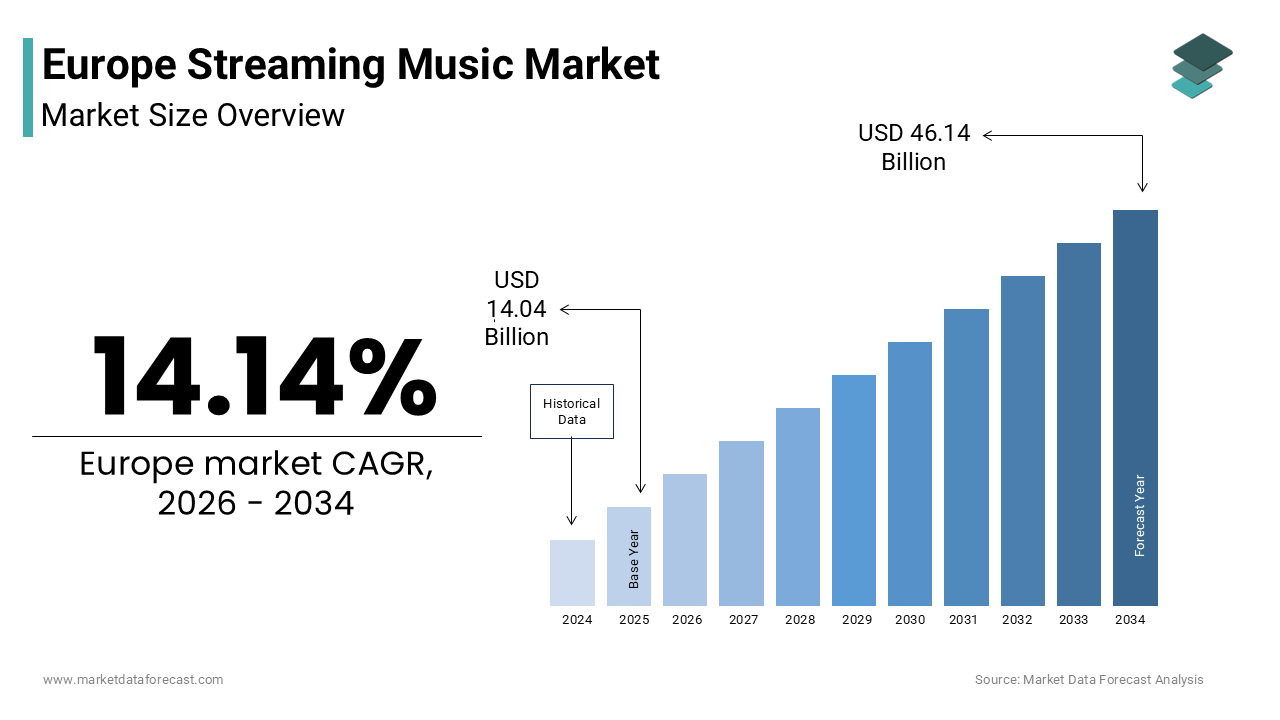
The streaming music is a digital ecosystem, where audio content is delivered to consumers via on-demand internet protocols, fundamentally shifting consumption from physical ownership to access-based models. As of 2025, the European Union reports that 94% of households are covered by 5G networks, creating an environment where high-fidelity audio transmission occurs without latency barriers. The region boasts an internet penetration rate exceeding 99% in leading nations such as Iceland and Denmark, ensuring near-universal access to digital platforms. Smartphone shipments in Europe reached 197.90 million units in 2025 by providing the essential hardware interface for billions of daily streaming sessions. The growth of the market now extends beyond simple song playback to include integrated podcast services, spatial audio experiences, and algorithmic curation that adapts to local linguistic and cultural nuances across the diverse European landscape.
MARKET DRIVERS
Pervasive High-Speed Connectivity and Mobile Device Saturation
The ubiquitous availability of advanced telecommunications infrastructure coupled with high smartphone adoption rates is majorly driving the growth of Europe streaming music market. The proliferation of 5G technology has been transformative, with coverage reaching 94% of EU households by 2025 by enabling seamless transmission of lossless and high-resolution audio formats that were previously impractical on mobile networks. The synergy between these factors is critical because streaming services require consistent, high-bandwidth connections to deliver premium user experiences without interruption. Consequently, the barrier to entry for consumers has diminished significantly by allowing streaming platforms to capture demographic segments that were previously reliant on physical media or radio. The statistical correlation between network speed and consumption volume suggests that as 5G penetration approaches total saturation, the average data consumption per user for audio streaming will rise correspondingly. This infrastructural backbone supports the delivery of data-heavy features such as personalized playlists and real-time lyrics, which are now standard expectations for European subscribers.
Escalating Preference for Access-Based Digital Entertainment Models
The shift in consumer behavior toward access-based ownership models is additionally leveraging the growth of Europe streaming music market. European listeners increasingly favor the convenience of unlimited catalog access over the accumulation of physical albums or digital downloads, a trend reflected in the fact that subscription streaming revenues accounted for over 50% of global recorded music revenues in 2024. This behavioral transition is driven by the value proposition of cost-efficiency and variety, where a single monthly fee grants access to tens of millions of tracks, a model that resonates strongly with younger demographics who prioritize experiential consumption. The flexibility of these platforms allows users to curate personal soundtracks for various activities, from commuting to exercising, thereby increasing stickiness and reducing churn rates. Moreover, the ability to switch devices seamlessly, while maintaining playback continuity aligns with the multi-device lifestyle of modern European consumers.
MARKET RESTRAINTS
Complex Fragmentation of Copyright Licensing and Royalty Distribution
The intricate and often fragmented nature of copyright licensing regimes, across different European jurisdictions is declining the growth of Europe streaming music market. Unlike a unified national, the Europe streaming music market must navigate a mosaic of national collecting societies and varying legal frameworks, which complicates the process of securing rights for pan-European distribution. This fragmentation forces streaming platforms to engage in prolonged negotiations with multiple entities, delaying the availability of new content and increasing operational costs. The European Union has attempted to harmonize these rules through directives, such as the Copyright in the Digital Single Market, yet implementation varies significantly by member state, creating lingering legal ambiguities. These legal complexities not only hinder the speed at which platforms can expand their catalogs but also create friction for independent artists, who struggle to navigate the bureaucratic landscape. The lack of a fully streamlined, continent-wide licensing protocol means that resources which could be invested in innovation are instead diverted to legal compliance and rights management.
Market Saturation and Intensifying Price Sensitivity Among Consumers
As the Europe streaming music market matures, it faces the growing restraint of subscriber saturation combined with heightened price sensitivity among the consumer base. This factor is also degrading the growth of Europe streaming music market. The initial phase of rapid user acquisition is slowing in key Western European countries, where penetration rates are already high, forcing platforms to compete aggressively for a finite pool of potential subscribers. With major players like Spotify, Apple Music, and Amazon Music dominating the landscape, the differentiation between services has become increasingly marginal, which is leading consumers to view these subscriptions as commoditized utilities rather than premium offerings. Economic pressures and inflation in 2025 have made European households more scrutinizing of recurring monthly expenses, prompting some users to cancel subscriptions or rotate between services to minimize costs. While the market generated substantial revenue in 2024, the rate of new subscriber growth is expected to decelerate as the addressable market of willing payers reaches its ceiling in developed nations. Platforms attempting to increase prices to improve margins risk triggering churn, particularly among younger demographics with lower disposable income. This dynamic creates a challenging environment where growth must be extracted from existing users through upselling higher-tier plans rather than acquiring new ones. The saturation effect is further compounded by the prevalence of ad-supported free tiers, which generate lower revenue per user and can cannibalize premium conversions.
MARKET OPPORTUNITIES
Expansion of High-Fidelity and Immersive Audio Experiences
The aggressive expansion of high-fidelity and immersive audio formats that leverage the region's advanced technical infrastructure is creating new opportunities for the growth of Europe streaming music market. European consumers have demonstrated a strong affinity for premium audio quality, with the region accounting for nearly 34% of global revenue in the Hi-Fi network streamer segment in 2024. This hardware enthusiasm translates directly to software demand, as listeners seek streaming services that offer lossless and spatial audio capabilities to maximize the potential of their high-end equipment. The luxury segment of the home audio market commanded a 46.8% share in 2025, indicating a wealthy demographic willing to pay a premium for superior sound staging and clarity. Streaming platforms that introduce or enhance tiered subscription models featuring high-resolution audio can effectively monetize this audiophile segment, which has historically been underserved by standard compression algorithms. Furthermore, the widespread deployment of 5G networks ensures that the bandwidth required for streaming large, uncompressed files is readily available to the majority of the population. The emergence of sophisticated home audio systems and mobile listening habits creates a dual-channel opportunity for revenue expansion. As technology evolves, the integration of virtual reality and augmented reality audio experiences could further deepen engagement, positioning high-fidelity streaming as the next frontier for market development in Europe.
Integration of Podcasting and Diversified Audio Content Ecosystems
The strategic integration of podcasting and non-music audio content for expanding user engagement and diversifying revenue streams is ascribed to bolster new opportunities for the growth of Europe streaming music market. Platforms are increasingly evolving into comprehensive audio hubs, recognizing that listeners often seek spoken-word content alongside musical tracks during their daily commutes and work routines. By bundling music and podcasts into a single interface, streaming services can increase the total time spent on their platforms, thereby enhancing user retention and reducing the likelihood of subscription cancellation. Major players are already investing heavily in exclusive podcast deals and original audio productions to capture this emerging demand, effectively transforming their value proposition from a music library to a holistic entertainment destination. The synergy between music discovery and podcast recommendation algorithms allows for more sophisticated cross-promotion, introducing users to content they might not otherwise encounter.
MARKET CHALLENGES
Ensuring Equitable Artist Compensation Amidst Regulatory Scrutiny
The persistent controversy surrounding artist compensation and the transparency of royalty distribution mechanisms is one of the challenges for the growth of Europe streaming music market. The European Union has intensified its focus on this issue, with new regulations aimed at ensuring fair contracts and greater transparency in how streaming revenues are shared across the value chain. This disconnect has led to increased pressure from creator advocacy groups and legislative bodies demanding a shift toward user-centric payment systems or other reforms that better reflect actual listening habits. The complexity of tracking and distributing micro-payments to millions of rights holders exacerbates the problem, often resulting in delays and inaccuracies that frustrate artists. If platforms fail to address these concerns adequately, they risk reputational damage and potential regulatory interventions that could disrupt their business models. The challenge lies in balancing the economic viability of the streaming services with the ethical imperative to support the creative community that fuels the industry.
Combating Algorithmic Bias and Preserving Cultural Diversity
The reliance on automated recommendation algorithms is another challenge for the growth of Europe streaming music market. These algorithms are designed to maximize engagement, often inadvertently create feedback loops that prioritize popular mainstream tracks over niche or locally produced content, potentially homogenizing the musical landscape. Concerns have been raised that European cultural diversity is under pressure as streaming giants promote a standardized global playlist culture that marginalizes regional genres and languages. The lack of transparency in how these recommendation engines function makes it difficult for regulators and artists to assess the extent of this bias or to implement corrective measures. In response, there are growing calls for algorithms to be audited for fairness and to include parameters that actively promote diverse content, ensuring that European artists receive adequate visibility alongside international superstars. The challenge is technical and ethical, requiring platforms to refine their machine learning models to balance user preference with cultural responsibility. Failure to do so could lead to a decline in the vibrancy of local music scenes and a reduction in the variety of content available to consumers. Furthermore, if users perceive that their discovery experience is limited to a narrow set of hits, they may lose interest in the platform's curation capabilities.
REPORT COVERAGE
| REPORT METRIC | DETAILS |
| Market Size Available | 2025 to 2034 |
| Base Year | 2025 |
| Forecast Period | 2026 to 2034 |
| CAGR | 14.14% |
| Segments Covered | By Service, Platform, Content, End-use and Region. |
| Various Analyses Covered | Global, Regional & Country Level Analysis, Segment-Level Analysis, DROC, PESTLE Analysis, Porter’s Five Forces Analysis, Competitive Landscape, Analyst Overview of Investment Opportunities |
| Country Covered | UK, France, Spain, Germany, Italy, Russia, Sweden, Denmark, Switzerland, the Netherlands, Turkey, the Czech Republic, and the Rest of Europe. |
| Market Leaders Profiled | Spotify Technology S.A., Apple Inc., Amazon.com, Inc., Google LLC, Deezer S.A., SoundCloud Global Limited & Co. KG, Tidal (Block, Inc.), and Tencent Music Entertainment Group. |
SEGMENTAL ANALYSIS
By Service Insights
The on-demand streaming segment was the largest by holding a dominant share of the Europe streaming music market in 2024. The growth of the segment is propelled with the fundamental consumer preference for control over content selection and playback timing, which aligns perfectly with modern lifestyle demands for flexibility. Unlike live streaming, which is constrained by scheduled events or broadcasts, on-demand services allow users to access a vast library of millions of tracks instantly, creating a highly sticky user base. Data indicates that the average European subscriber spends over 25 hours per week listening to on-demand music, significantly outpacing time spent on live radio or concert streams. Furthermore, the infrastructure supporting on-demand delivery has matured, with 94% of EU households now covered by 5G networks by ensuring buffer-free access to high-quality audio files at any moment.
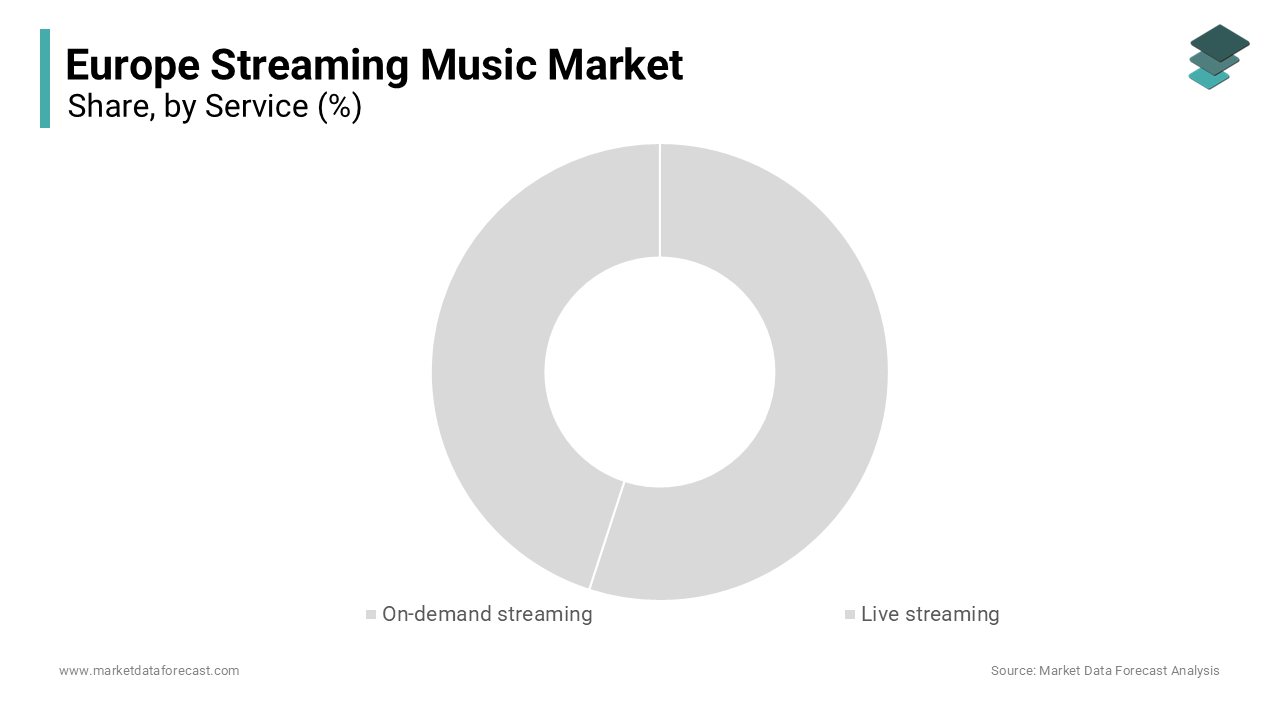
The live streaming segment is emerging at an anticipated CAGR of 14.8% from 2025 to 2033 owing to the rising popularity of virtual concerts, exclusive artist Q&A sessions, and real-time festival broadcasts that offer a sense of community and immediacy absent in on-demand models. The post-pandemic era has normalized digital event attendance, with platforms investing heavily in high-definition multi-camera setups and interactive chat features to replicate the live venue experience. The increasing collaboration between streaming services and major music festivals, such as Glastonbury and Tomorrowland, exclusively to subscribers is also enhancing the growth of the segment. Additionally, the monetization potential of live streaming through virtual tipping and exclusive merchandise sales during broadcasts provides a new revenue stream that incentivizes platforms to prioritize this format. The integration of low-latency streaming technologies ensures that interactions between artists and fans occur in real time by fostering a deeper emotional connection.
By Platform Insights
The mobile applications segment was the largest by accounting for a prominent share of the Europe streaming music market in 2024. The growth of the segment is driven by the superior user experience offered by dedicated apps, which provide seamless navigation, offline playback capabilities, and deeper integration with device hardware such as lock screens and voice assistants. The ubiquity of smartphones across Europe, with shipments reaching 197.90 million units in 2025, ensures that the vast majority of consumers have immediate access to these optimized interfaces. Apps allow for more efficient data management and battery usage compared to browser-based streaming, a critical consideration for mobile-first users who consume music throughout the day. Furthermore, push notifications and personalized home screens within apps drive higher engagement rates, reminding users of new releases and curated playlists tailored to their tastes. The ability to sync preferences across devices while maintaining a consistent app interface reinforces user loyalty, making it the preferred choice for daily listening routines. Industry data reveals that 72% of European users stream music daily, with the overwhelming majority accessing these services via native applications on iOS and Android devices. The frictionless onboarding process for app subscriptions, often facilitated by integrated payment systems like Apple Pay and Google Pay, also contributes to higher conversion rates from free trials to paid plans.
The web browser segment is anticipated to register a CAGR of 11.2% throughout the forecast period with the increasing sophistication of web technologies, such as Progressive Web Apps (PWAs), which deliver app-like experiences directly through browsers without the need for downloads or storage space. The rising usage of streaming services on desktop and laptop computers in workplace and educational settings, where installing unauthorized software is restricted. Users in corporate environments increasingly rely on browser-based players to access music during work hours, leveraging the ease of access and lack of installation barriers. The flexibility of accessing accounts from any device with an internet connection appeals to users who switch frequently between tablets, PCs, and smart displays. Browser-based platforms also benefit from enhanced privacy features and incognito modes, attracting users who prefer not to leave a footprint on shared devices.
REGIONAL ANALYSIS
United Kingdom Streaming Music Market Analysis
The United Kingdom was the largest contributor by holding a significant share of the Europe streaming music in 2024 with its early adoption of digital music services and a deeply ingrained culture of music consumption that seamlessly blends heritage with innovation. British consumers exhibit high engagement levels, with streaming accounting for over 80% of all recorded music revenue in the nation, reflecting a near-total shift away from physical formats. High smartphone penetration and extensive 5G coverage across urban and rural areas ensure that access to streaming services is ubiquitous. Furthermore, the UK’s vibrant live music scene complements digital consumption, as fans frequently use streaming apps to discover artists before attending concerts. The government’s supportive stance on digital economy initiatives has also facilitated robust infrastructure development, enabling high-speed data transmission essential for lossless audio streaming.
Germany Streaming Music Market Analysis
Germany streaming music market growth is expected to grow with a consumer base that prioritizes audio fidelity and legal compliance. German listeners are known for their discerning taste, often favoring high-resolution streaming tiers that offer superior sound quality, which has prompted platforms to aggressively lossless and hi-fi options in the region. The country’s strong regulatory framework regarding copyright and data privacy has historically shaped market dynamics by ensuring that royalty distributions are transparent and artists are compensated fairly, which in turn builds trust among both creators and consumers. The widespread adoption of smart home devices and connected car systems in Germany further integrates streaming into daily life, extending usage beyond personal mobiles to household and automotive environments. Additionally, the nation’s rich musical diversity, ranging from classical to electronic genres, necessitates extensive catalog localization, which major platforms have successfully achieved.
France Streaming Music Market Analysis
France streaming music market growth is likely to be grow with its strong emphasis on preserving and promoting local French-language content. The regulatory quotas that require streaming platforms to feature a significant percentage of European and French artists in their recommendations is majorly thriving the growth of the market in this country. This protective measure has cultivated a loyal listener base that actively seeks out local chanson, rap, and electronic music, differentiating France from markets dominated by Anglo-American catalogs. The government’s investment in cultural digitization has further accelerated adoption, with initiatives aimed at connecting rural populations to high-speed internet, thereby expanding the addressable market. French consumers are increasingly embracing subscription models, driven by competitive pricing strategies and bundled offers from telecommunications providers. The nation’s vibrant festival culture also translates into high streaming activity, as attendees use platforms to explore lineups and revisit performances. Moreover, the growing popularity of podcasts and spoken-word content in French adds another layer of engagement, making streaming services a comprehensive audio hub.
Italy Streaming Music Market Analysis
Italy streaming market growth is likely to grow with the passionate consumer base with a deep historical connection to music. Italian listeners show a strong preference for pop, opera, and indigenous genres, prompting streaming services to curate specialized playlists that celebrate the country’s rich musical heritage. The proliferation of smartphones and improved mobile network coverage, particularly in southern regions, has democratized access to digital music, bringing millions of new users online. The younger demographic is particularly influential, adopting streaming as their primary mode of music discovery and sharing. Additionally, partnerships between telecom operators and streaming providers have lowered entry barriers, which is making premium subscriptions accessible to a broader audience.
Spain Streaming Music Market Analysis
Spain streaming music market growth is growing steadily with a youthful population and a fervent enthusiasm for Latin and global pop rhythms. The Spanish market is notable for its high engagement rates, with users spending significant time on platforms discovering new artists and sharing playlists within social circles. The influence of Latin music, which enjoys massive popularity in Spain, has prompted streaming services to invest heavily in regional content and exclusive releases from top Latin artists, creating a unique value proposition for local subscribers. The country’s rapid adoption of mobile technology, supported by extensive 4G and emerging 5G networks, ensures that music is accessible anytime and anywhere, catering to an on-the-go lifestyle. Festivals and live events are integral to Spanish culture, and the synergy between these physical gatherings and digital streaming amplifies consumption, as fans stream sets before and after events. Telecommunications companies in Spain have been instrumental in driving growth by bundling streaming subscriptions with mobile data plans, effectively lowering the cost barrier for consumers.
COMPETITIVE LANDSCAPE
The competition in the Europe streaming music market is intensely fierce characterized by a battle for subscriber loyalty among a few dominant global giants and several strong regional contenders. Market participants constantly innovate their user interfaces and audio quality offerings to distinguish their services in a landscape where core music catalogs are largely similar across platforms. Price wars are common yet companies increasingly rely on value added features such as exclusive podcasts and high-fidelity streams to prevent churn and maintain revenue stability. Regulatory scrutiny regarding artist compensation and data usage adds another layer of complexity forcing firms to adapt their operational models frequently to remain compliant. The saturation of major Western European markets has shifted focus toward emerging economies in Eastern Europe where growth potential remains significant but infrastructure challenges persist. Strategic acquisitions of niche platforms and talent management firms are becoming more frequent as companies seek to secure exclusive content and deepen their engagement with specific demographic groups to sustain long term profitability.
KEY MARKET PLAYERS
Some of the companies that are playing a dominating role in the Europe streaming music market include
- Spotify Technology S.A.
- Apple Inc.
- Amazon.com, Inc.
- Google LLC
- Deezer S.A.
- SoundCloud Global Limited & Co. K
- Tidal (Block, Inc.)
- Tencent Music Entertainment Group
Top Players in the Market
Spotify Technology S.A.
Spotify Technology S.A. remains the undisputed leader in the Europe streaming music market by leveraging its Swedish heritage to deeply understand local consumer nuances across the continent. The company consistently drives global innovation through its sophisticated recommendation algorithms and extensive podcast integrations which set industry standards for user engagement. Recent strategic actions include the rollout of Spotify HiFi to cater to audiophiles and the expansion of its audiobook catalog to create a comprehensive audio ecosystem. Spotify actively partners with European telecommunications providers to bundle services thereby increasing subscriber acquisition rates without direct marketing costs. The firm also invests heavily in local artist development programs ensuring a steady stream of exclusive regional content that resonates with diverse European demographics.
Apple Inc.
Apple Inc. utilizes its massive hardware ecosystem to maintain a formidable presence in the Europe streaming music market through its Apple Music service. The company integrates streaming directly into iOS devices offering a frictionless experience that encourages high conversion rates among iPhone and iPad users across European nations. Recent efforts focus on expanding its spatial audio and lossless quality offerings to appeal to discerning listeners who prioritize sound fidelity over other features. Apple has also strengthened its position by securing exclusive live radio shows and partnering with major European music festivals to broadcast unique content. The firm emphasizes privacy and artist compensation in its marketing campaigns to differentiate itself from competitors in a regulatory sensitive region. By leveraging its global supply chain and retail footprint Apple continues to promote its subscription services effectively ensuring sustained growth and deep penetration within the affluent European consumer base.
Amazon.com Inc.
Amazon.com Inc. capitalizes on its extensive Prime membership base to drive significant adoption of Amazon Music across the Europe streaming music market. The company strategically bundles music access with shipping benefits and video content creating a high value proposition that reduces churn and enhances customer loyalty throughout the region. Recent actions include the integration of advanced voice controls via Alexa enabled devices which simplifies music discovery and playback for users in smart home environments. Amazon has also expanded its HD and Ultra HD tiers to compete directly with high fidelity focused rivals while maintaining competitive pricing structures. The firm leverages its global data analytics capabilities to curate localized playlists and recommend emerging European artists to broader audiences. These moves allow Amazon to deepen its engagement with existing customers while attracting new subscribers who seek convenience and versatility within a single unified digital ecosystem.
Top Strategies Used by Key Market Participants
Key players in the Europe streaming music market primarily employ content differentiation strategies by securing exclusive rights to live concerts and original podcasts to attract distinct user segments. Companies aggressively pursue bundling partnerships with telecommunications operators and hardware manufacturers to lower entry barriers and accelerate subscriber acquisition rates across diverse regions. Investment in artificial intelligence driven recommendation engines remains a critical tactic to enhance user retention by delivering hyper personalized playlists that match individual listening habits and moods. Major participants are also expanding into high resolution and spatial audio tiers to cater to audiophiles and justify premium pricing models in mature markets. Furthermore, firms focus on localizing content libraries and marketing campaigns to respect cultural nuances and comply with varying regulatory frameworks regarding copyright and data privacy throughout the continent.
MARKET SEGMENTATION
This research report on the Europe streaming music market has been segmented and sub-segmented based on the following categories.
By Service
- On-demand streaming
- Live streaming
By Platform
- Apps
- Browsers
By Content
- Audio
- Video
By End-use
- Individual
- Commercial
By Country
- UK
- France
- Spain
- Germany
- Italy
- Russia
- Sweden
- Denmark
- Switzerland
- Netherlands
- Turkey
- Czech Republic
- Rest of Europe