- Product Description Description
- Table of Contents TOC
- List of Table & Figure LOT
- Get Free Sample PDF Sample PDF
Europe Structural Heart Devices Market Report Summary
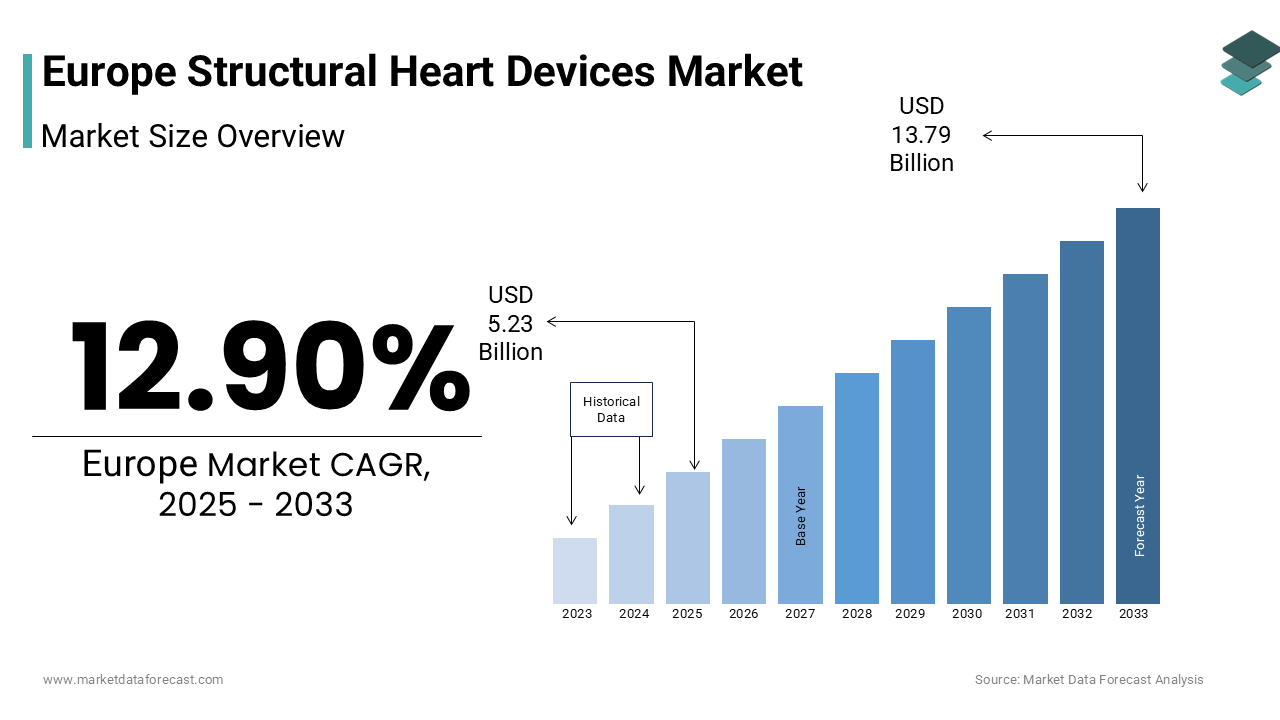
The Europe Structural Heart Devices Market was valued at USD 4.63 billion in 2024, is projected to reach USD 5.23 billion in 2025, and is expected to grow substantially to USD 13.79 billion by 2033, expanding at a CAGR of 12.90% from 2025 to 2033. The market growth is driven by Europe’s rising elderly population, increasing prevalence of moderate to severe valvular heart disease, and expanding adoption of minimally invasive transcatheter procedures as safer alternatives to open-heart surgery. Advancements in multimodal imaging, broader reimbursement across major European health systems, and guideline updates validating transcatheter therapies for intermediate and low-risk patients are accelerating clinical adoption, while regulatory tightening under EU MDR and workforce shortages continue to shape commercialization strategies.
Key Market Trends
- Rapid expansion of transcatheter aortic valve replacement (TAVR) and emerging mitral and tricuspid transcatheter repair platforms as first-line therapies.
- Increasing use of 3D echocardiography, CT fusion imaging, and real-time procedural guidance to enhance device placement accuracy and broaden patient eligibility.
- Rising adoption of left atrial appendage closure (LAAC) is driven by the growing burden of atrial fibrillation and contraindications to long-term anticoagulation.
- Integration of AI-driven procedural planning, valve sizing prediction, and risk scoring for improved efficiency and outcomes across structural heart centers.
- Accelerated development of longer-durability valve technologies and leaflet treatments to support younger and lower-risk patient cohorts requiring extended device lifespans.
Segmental Insights
- Based on type, the TAVR (Transcatheter Aortic Valve Replacement) segment dominated in 2024, supported by high procedural success rates, improved durability, and strong reimbursement across Germany, France, Italy, and the United Kingdom.
- Based on clinical application, the LAAC (Left Atrial Appendage Closure) segment is set for robust growth owing to guideline upgrades for anticoagulation-ineligible AFib patients and rising stroke prevention priorities among national health agencies.
- Based on patient risk profile, expanding clinical evidence supporting transcatheter solutions in intermediate and low-risk populations is reshaping treatment algorithms across Europe’s structural heart programs.
Regional Insights
- Germany held the largest share at 24.3% in 2024, driven by advanced structural heart centers, high reimbursement penetration, and broad participation in European clinical trials and MDR-aligned device evaluations.
- France is a key market with strong national healthcare planning, rapid reimbursement under LPPR, and major investments through the Cardiology Modernization Plan supporting next-generation cath lab upgrades.
- Italy benefits from high-volume referral centers in Milan, Rome, and Bologna, strong academic–industry collaboration, and a rapidly expanding elderly population that drives procedural growth.
- The United Kingdom maintains evidence-based adoption through NHS specialized commissioning, with growing national TAVR and LAAC volumes supported by dedicated training programs and clinical audits.
- Spain leverages strong national stroke prevention strategies, rising TAVR and LAAC capacity in major urban cardiac centers, and consistent reimbursement across autonomous communities.
Competitive Landscape
The Europe Structural Heart Devices Market is increasingly competitive as global device leaders and emerging innovators differentiate on clinical durability, imaging integration, and evidence-backed short- and long-term outcomes. Market advantage depends on demonstrating valve longevity for younger patients, securing reimbursement approvals across Europe’s diverse health systems, and supporting physicians through robust training and real-world data programs. The stringent requirements under the EU Medical Devices Regulation (MDR) reward companies with strong clinical trial capabilities, advanced quality systems, and coordinated post-market surveillance. Strategic collaborations with cardiology societies, academic centers, and imaging technology providers help mitigate workforce shortages while enabling scalable program deployment across Europe’s expanding structural heart networks. Prominent players operating in the market include Edwards Lifesciences, Medtronic, Abbott, Boston Scientific, CryoLife, LivaNova, Lepu Medical, Meril Life Sciences, JenaValve Technology, and MicroPort Scientific Corporation.
Europe Structural Heart Devices Market Size
The europe structural heart devices market size was valued at USD 4.63 billion in 2024 and is anticipated to reach USD 5.23 billion in 2025 from USD 13.79 billion by 2033, growing at a CAGR of 12.90% during the forecast period from 2025 to 2033.
Structural heart devices are specialized class of minimally invasive implants and delivery systems designed to treat anatomical abnormalities of the heart’s valves and chambers without open chest surgery. These include transcatheter aortic valve replacement systems mitral valve repair clips and occluders for congenital defects such as patent foramen ovale or atrial septal defects. As per Eurostat, more than 21% of the European Union’s population was aged 65 or older in 2024 a figure projected to reach 24.5% by 2035 intensifying demand for less invasive cardiac solutions. The European Society of Cardiology estimates that over 22 million adults in Europe currently live with moderate to severe valvular heart disease many of whom are ineligible for conventional surgery due to comorbidities. Regulatory pathways through the European Medicines Agency and notified bodies under the Medical Devices Regulation have enabled timely access to next generation devices while real world evidence registries like EAPCI’s EORP program continue to inform clinical adoption.
MARKET DRIVERS
Aging Population and Rising Prevalence of Valvular Heart Disease Drive Adoption
The rapidly growing aging population is the major driver for increased utilization of structural heart devices particularly among patients with aortic stenosis and mitral regurgitation. This factor is anticipated to fuel the growth of Europe structural hear devices market. With life expectancy at birth reaching 81.5 years across the EU in 2024 according to Eurostat the pool of high risk surgical candidates continues to expand. Transcatheter interventions offer a viable alternative for these frail patients who often present with multiple comorbidities such as chronic kidney disease or pulmonary hypertension that contraindicate sternotomy. National health systems including Germany’s statutory insurers and the UK’s National Health Service now routinely reimburse these procedures following positive outcomes in randomized trials like PARTNER 3 and EVOLUT Low Risk.
Advancements in Imaging and Procedural Guidance Enhance Clinical Feasibility
The precision and safety of structural heart interventions have improved dramatically due to innovations in real time multimodal imaging which directly expand the treatable patient population. This factor is attributed to fuel the growth of Europe structural heat devices market. Three dimensional transesophageal echocardiography fused with fluoroscopic overlay and intraprocedural computed tomography now enable millimeter accurate device placement even in complex anatomies. This infrastructure supports not only valve replacements but also emerging procedures like tricuspid edge to edge repair which require dynamic visualization of leaflet motion.
MARKET RESTRAINTS
Stringent Regulatory Requirements Under the EU Medical Devices Regulation Delay Market Access
The implementation of the European Union Medical Devices Regulation in 2021 has significantly prolonged the approval timeline for novel structural heart devices due to heightened requirements for clinical evidence and post market surveillance. The growing stringent regulations under EU medical devices regulation are hampering the growth of Europe structural heart devices market. Unlike the previous Medical Devices Directive which allowed reliance on equivalence to predicate devices the new regulation mandates robust clinical data for high risk implantables including long term follow up and risk management plans. This delay has discouraged smaller innovators with limited capital from pursuing European commercialization.
High Procedural Costs and Reimbursement Heterogeneity Limit Widespread Uptake
The structural heart interventions face inconsistent reimbursement coverage across European healthcare systems which constrains their adoption particularly in cost sensitive regions. This attribute is hindering the growth of Europe structural hear devices market. Transcatheter aortic valve replacement procedures can cost between 25000 and 35000 euros per patient including device hospital stay and physician fees according to health technology assessments published by Germany’s Institute for Quality and Efficiency in Health Care in 2024. While countries like Germany France and Italy provide comprehensive reimbursement through statutory schemes others such as Poland Romania and Greece restrict access to select academic centers or impose stringent age and risk criteria. This fragmentation forces manufacturers to adopt staggered market entry strategies and discourages investment in physician training programs outside core markets thereby perpetuating geographic disparities in access to life saving structural heart therapies.
MARKET OPPORTUNITIES
Expansion of Indications into Lower Risk and Younger Patient Cohorts
Recent clinical trial data have driven a shift in structural heart therapy by validating transcatheter approaches in lower risk and younger populations previously deemed suitable only for surgical intervention. This factor is levelling up the growth of the Europe structural heart devices market. The 2024 five year outcomes from the NOTION 2 trial published in the European Heart Journal demonstrated non inferiority of transcatheter aortic valve replacement versus surgical replacement in patients aged 70 to 79 with low surgical risk sparking guideline revisions across multiple European societies. National health technology assessment bodies are responding accordingly Germany’s GBA updated its reimbursement criteria in November 2024 to include low risk patients while France’s Haute Autorité de Santé issued a favorable opinion in January 2025. Device manufacturers are aligning by enhancing valve durability profiles with next generation leaflet treatments designed to last 15 to 20 years.
Integration of Artificial Intelligence for Procedural Planning and Outcome Prediction
The incorporation of artificial intelligence into structural heart workflows is creating new opportunity for the growth of Europe structural heat devices market. Machine learning algorithms trained on multimodal imaging datasets can now predict optimal valve sizing annular landing zones and risk of conduction disturbances with over 90% accuracy as demonstrated in a 2024 multicenter study coordinated by the University Hospital Zurich and validated across 12 European centers. These tools are being embedded into vendor neutral platforms such as Siemens Healthineers’ AI RTH and Canon’s Advanced intelligent Clear IQ Engine allowing seamless integration into existing cath lab ecosystems. Furthermore, predictive analytics models using preoperative clinical and imaging variables can estimate 30 day mortality with area under the curve values exceeding 0.85 empowering shared decision making.
MARKET CHALLENGES
Persistent Shortage of Trained Structural Heart Interventionalists
The rapid technological evolution in structural heart therapy has outpaced the development of specialized human capital creating a critical workforce is challenging the growth of Europe structural heart devices market. Performing transcatheter valve procedures demands mastery of echocardiography fluoroscopy and device handling skills that differ fundamentally from traditional coronary interventions. According to a recent report, only 1400 physicians across the EU were certified in structural heart interventions as of early 2025 while the projected annual procedural volume exceeds 150000 cases. This imbalance is most acute in Southern and Eastern Europe where training programs remain limited.
Long Term Durability and Reintervention Uncertainties in Evolving Patient Profiles
The increasing younger and lower risk patients concerns about long term valve durability and the feasibility of future reinterventions is another factor hampering the growth of Europe structural heart devices market. Current transcatheter heart valves are primarily validated for 5 to 10 year performance but patients in their 60s and 70s may require valve function for 15 years or more. This raises complex questions about valve in valve strategies which can compromise hemodynamics and increase heart block risk. Furthermore, the impact of repeated valve implants on annular calcification and conduction system integrity remains poorly understood. The European Heart Journal’s 2024 consensus paper emphasized that long term data beyond 10 years are still sparse for most contemporary platforms
REPORT COVERAGE
| REPORT METRIC | DETAILS |
| Market Size Available | 2024 to 2033 |
| Base Year | 2024 |
| Forecast Period | 2025 to 2033 |
| Segments Covered | By Type and Region |
| Various Analyses Covered | Global, Regional & Country Level Analysis, Segment-Level Analysis; DROC, PESTLE Analysis, Porter's Five Forces Analysis, Competitive Landscape, Analyst Overview of Investment Opportunities |
| Regions Covered | North America, Europe, APAC, Latin America, Middle East & Africa |
| Market Leader Profiled | Edwards Lifesciences, Medtronic, Abbott, Boston Scientific, CryoLife, LivaNova, Lepu Medical, Meril Life Sciences, JenaValve Technology, and MicroPort Scientific Corporation. |
SEGMENTAL ANALYSIS
By Type Insights
The Transcatheter Aortic Valve Replacement (TAVR) segment was the largest and held 42.3% of the Europe structural heart devices market share in 2024 with its established role as the standard of care for inoperable or high risk patients with severe aortic stenosis. Landmark trials, such as PARTNER EU and NOTION demonstrated that TAVR offers non inferior or superior outcomes compared to surgical replacement in these populations, with lower 30 day mortality and fewer major adverse cardiac events. Germany’s statutory health insurance system began full reimbursement for TAVR in high risk patients as early as 2013 and expanded coverage to intermediate risk groups in 2021 following European regulatory endorsements. The procedural efficiency of modern TAVR has transformed it from a complex intervention into a semi outpatient procedure in many European centers, which is directly boosting volume. Furthermore, standardized heart team evaluations and pre procedural CT planning have reduced procedural time to under 60 minutes in over 80% of cases according to the Nordic Aortic Valve Intervention Registry.
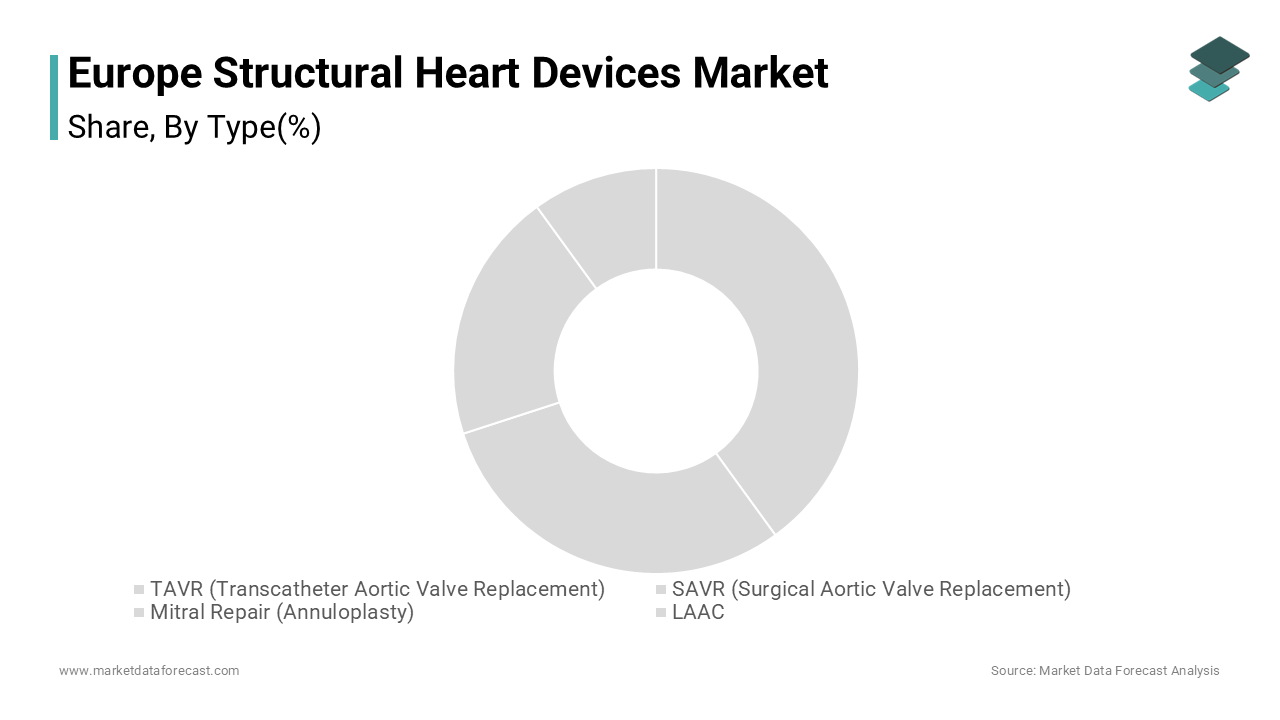
The LAAC segment is projected to grow at a CAGR of 18.7% from 2025 to 2033 owing to the expanding stroke prevention strategies in non valvular atrial fibrillation. Atrial fibrillation affects over 12 million adults in Europe with prevalence doubling every decade after age 55. Among these patients approximately 25% cannot tolerate long term oral anticoagulants due to bleeding risks—particularly those with prior gastrointestinal hemorrhage or recurrent falls. The 2023 European Society of Cardiology guidelines upgraded LAAC to a Class I recommendation for stroke prevention in anticoagulation ineligible patients reinforcing clinical adoption. The operational embedding of LAAC within structured atrial fibrillation management programs has streamlined patient identification and procedural scheduling.
REGIONAL ANALYSIS
Germany Structural Heart Devices Market Analysis
Germany was the top performer of the Europe structural heart devices market by capturing 24.3% of share in 2024 with its advanced cardiology infrastructure robust reimbursement and aging population. Statutory health insurers provide comprehensive coverage for all approved structural heart indications including LAAC and mitral repair since 2022 following positive health technology assessments by IQWiG. Germany also hosts a dense network of over 300 certified structural heart centers many integrated into university hospitals that participate in European clinical trials and real world registries. Regulatory clarity under the Medical Devices Regulation has been effectively managed through early dialogue with notified bodies like TÜV SÜD which has dedicated cardiovascular review teams.
France Structural Heart Devices Market Analysis
France structural heart devices market held 17.3% of share in 2024 by centralized healthcare planning and high procedural standardization. The French Ministry of Health’s “Cardiology Modernization Plan” allocated 180 million euros between 2022 and 2025 to upgrade catheterization labs and train interventionalists in structural heart techniques. Reimbursement is governed by the LPPR nomenclature which provides timely coverage for CE marked devices within six months of approval. Furthermore, France hosts Europe’s largest mitral valve repair registry coordinated by the Paris Cardiovascular Research Center which informs national best practice guidelines.
Italy Structural Heart Devices Market Analysis
Italy structural heart devices market growth is driven by a pronounced elderly demographic and regional innovation hubs. High volume centers in Milan Rome and Bologna perform over 12000 structural heart procedures annually and serve as training sites for Southern Europe. Additionally, Italy benefits from strong academic industry collaboration with the San Raffaele Hospital in Milan partnered with Edwards Lifesciences in 2024 to launch a real world durability study on next generation valves.
The United Kingdom Structural Heart Devices Market Analysis
The United Kingdom structural heart devices market growth is likely to grow with the evidence-based adoption and post Brexit regulatory autonomy. The UK now performs over 10000 TAVR cases annually and over 1500 LAAC implants. The National Health Service funds these procedures through specialized commissioning groups ensuring nationwide access albeit with waiting list challenges average time from referral to TAVR was 14 weeks in Q1 2025. Moreover, the British Heart Foundation invested 45 million pounds in 2024 to support structural heart training fellowships addressing workforce gaps.
Spain Structural Heart Devices Market Analysis
Spain structural heart devices market growth is likely to grow with the urban center excellence and national stroke prevention mandates. The country performs approximately 8500 TAVR and 1200 LAAC procedures annually according to the Spanish Society of Cardiology’s 2024 registry concentrated in reference hospitals in Madrid Barcelona and Valencia. Spain’s National Stroke Plan updated in 2023 requires all tertiary hospitals to establish AFib clinics with LAAC capability by 2026 driving infrastructure investment. Reimbursement is decentralized but coordinated through the Interterritorial Council ensuring consistent coverage for CE marked devices. Additionally, Spain serves as a clinical trial hub for European device studies due to its diverse patient population and streamlined ethics approval process.
COMPETITIVE LANDSCAPE
Competition in the Europe structural heart devices market is defined by technological differentiation clinical validation and strategic alignment with evolving regulatory and reimbursement landscapes. While global leaders such as Edwards Lifesciences Medtronic and Boston Scientific dominate through established platforms the market also sees active participation from emerging innovators introducing next generation solutions for mitral tricuspid and pulmonary valve disease. The shift toward treating lower risk and younger patients intensifies pressure to demonstrate long term durability and reintervention feasibility. Companies compete not only on device performance but also on integrated service models including imaging analytics training and digital patient follow up. The stringent requirements of the EU Medical Devices Regulation have raised barriers to entry yet also created opportunities for firms with strong quality management systems. National variations in healthcare financing further compel vendors to adopt localized market access strategies making pan European commercial execution both complex and highly customized.
KEY MARKET PLAYERS
Some of the companies that are playing a dominating role in the Europe Structural Heart Devices Market include
- Edwards Lifesciences
- Medtronic
- Abbott
- Boston Scientific
- CryoLife
- LivaNova
- Lepu Medical
- Meril Life Sciences
- JenaValve Technology
MicroPort Scientific Corporation
Top Players in the Market
Edwards Lifesciences
Edwards Lifesciences is a global pioneer in structural heart therapies with deep integration across European clinical and regulatory ecosystems. The company’s SAPIEN transcatheter heart valve platform has been instrumental in establishing TAVR as a standard of care in high and intermediate risk patients throughout the region. The company also initiated a multi country real world evidence study across Germany France and Italy to evaluate long term outcomes of its next generation valve in patients under 75. These initiatives reinforce its commitment to clinical excellence and support guideline driven adoption while aligning with EU Medical Devices Regulation requirements for post market surveillance.
Medtronic
Medtronic is a key innovator in the Europe structural heart devices market offering a comprehensive portfolio that includes the Evolut TAVR system and the Harmony transcatheter pulmonary valve. The company has strengthened its European footprint by enhancing its valve in valve data registry in collaboration with the European Association of Percutaneous Cardiovascular Interventions. The firm also launched a dedicated health economics unit in Brussels to generate cost effectiveness analyses tailored to national reimbursement bodies.
Boston Scientific
Boston Scientific plays a critical role in the European structural heart landscape through its differentiated offerings in left atrial appendage closure and mitral valve repair. Its WATCHMAN FLX device is widely used across Western and Northern Europe for stroke prevention in non valvular atrial fibrillation. The company also introduced a new training curriculum focused on transseptal access and imaging integration to address procedural skill gaps. These efforts underscore its strategy to embed its technologies within multidisciplinary AFib care pathways while supporting the continent’s stroke reduction initiatives through scalable and evidence-based solutions.
Top Strategies Used by the Key Market Participants
Key players in the Europe structural heart devices market focus on generating robust real world evidence through multicenter registries to support reimbursement and guideline inclusion. They invest heavily in physician training via simulation based academies and digital learning platforms to address workforce shortages. Companies actively align product development with the EU Medical Devices Regulation by strengthening post market surveillance systems. Strategic collaborations with academic hospitals and cardiology societies enhance clinical credibility and accelerate adoption.
MARKET SEGMENTATION
The research report on the europe structural heart devices market has been segmented and sub-segmented based on categories.
By Type
- TAVR (Transcatheter Aortic Valve Replacement)
- SAVR (Surgical Aortic Valve Replacement)
- Mitral Repair (Annuloplasty)
- LAAC
By Country
- UK
- France
- Spain
- Germany
- Italy
- Russia
- Sweden
- Denmark
- Switzerland
- Netherlands
- Turkey
- Czech Republic
- Rest of Europe