Europe Structural Steel Market Size, Share, Trends & Growth Forecast Report – Segmented By By Product (Heavy Sectional Steel, Light Sectional Steel, Rebar), Application, and Country (UK, France, Spain, Germany, Italy, Russia, Sweden, Denmark, Switzerland, Netherlands, Turkey, Czech Republic & Rest of Europe), Industry Analysis From 2026 to 2034
Market Size, 2025
$17.86 BnMarket Estimate, 2026
$18.82 BnMarket Forecast, 2034
$28.62 BnCAGR, 2026–2034
5.38%Europe Structural Steel Market Size
The Europe structural steel market size was valued at USD 17.86 billion in 2025 and is projected to reach USD 28.62 billion by 2034 from USD 18.82 billion in 2026, growing at a CAGR of 5.38%.
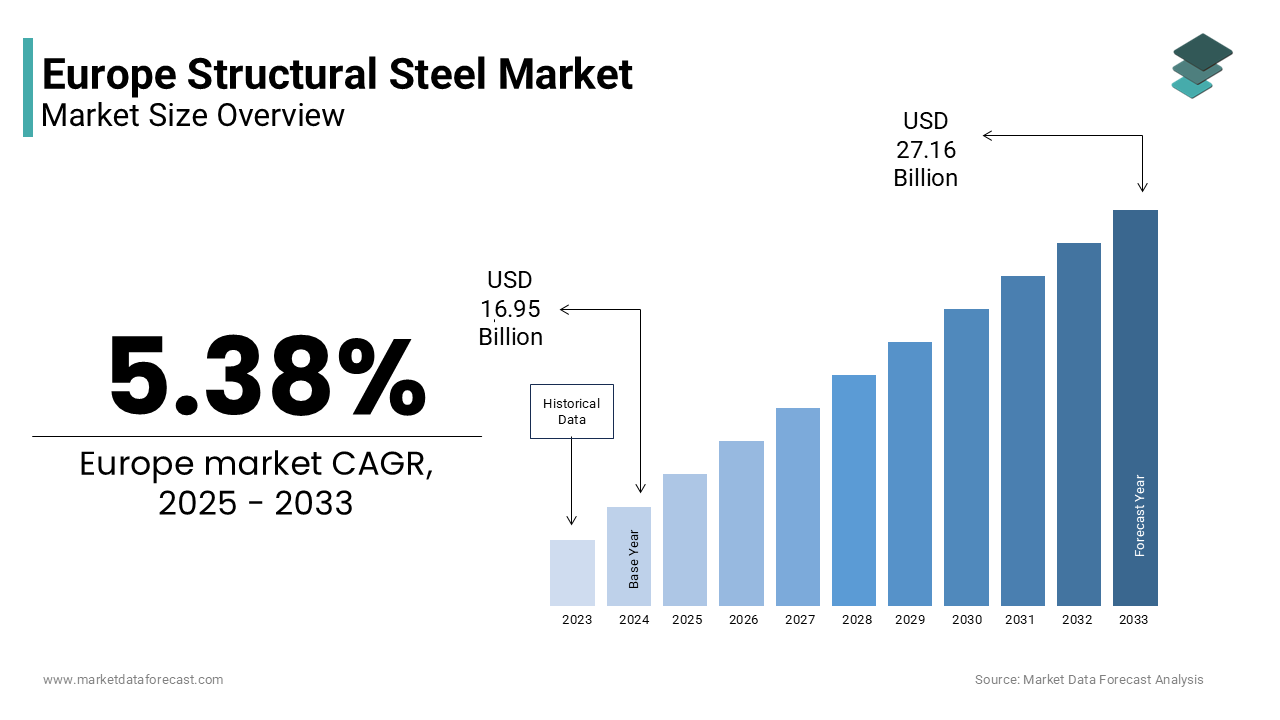
Structural steel is a regulated category of steel used as a primary construction material for load-bearing frameworks. These products serve as the skeletal framework for buildings bridges power plants and manufacturing complexes where strength durability and dimensional precision are non negotiable. In a region advancing toward climate neutrality and resilient infrastructure, structural steel has evolved beyond a commodity into a strategic material enabling rapid modular construction decarbonized industrial systems and circular economy principles. According to sources, the use of structural steel frames in new non-residential buildings within the European Union is a growing trend, driven by the material's benefits in accelerating construction timelines and supporting off-site prefabrication. Structural steel is widely considered a leading material in the European circular economy, achieving high recovery and recycling rates at the end of its life, which conserves raw materials and energy. Furthermore, significant new floor space is added to Europe’s building stock each year, leading to substantial and consistent demand for various primary and fabricated steel sections across the construction industry. These dynamics position structural steel as both a legacy enabler and a modern instrument of Europe’s sustainable industrial future.
MARKET DRIVERS
Large Scale Public Infrastructure Investment Under the NextGenerationEU Program
The European Union’s €806.9 billion NextGenerationEU recovery fund has allocated €723.8 billion to the Recovery and Resilience Facility (RRF), which primarily fuels the growth of the Europe structural steel market. As of early 2026, approximately 58% of these funds have been disbursed, with member states now under significant pressure to complete extensive structural projects in transportation, energy (via REPowerEU), and digital infrastructure before December 31, 2026. The European Union is directing substantial financial resources through multiple funding programs to support the expansion and upgrading of sustainable transport and energy infrastructure across its member states. Germany has a comprehensive, long-term national plan in place to significantly enhance its rail corridors and bridges, demonstrating a strong governmental commitment to modernizing core transport infrastructure. Through its national recovery initiative, France is accelerating the development of key infrastructure, including new high-speed rail lines and facilities supporting the growing offshore wind energy sector. This unprecedented public investment creates a structural and long term demand pipeline that insulates the market from cyclical downturns in private construction.
Revitalization of Industrial Capacity Through the Net Zero Industry Act
The European Union’s Net Zero Industry Act aims to scale clean tech manufacturing, including solar panels batteries and hydrogen electrolyzers, which further contributes to the expansion of the Europe structural steel market. It seeks to achieve this by establishing strategic net zero industrial zones equipped with heavy duty structural steel frameworks. The EU Net-Zero Industry Act (NZIA), adopted in mid-2025, includes an objective for the EU's domestic manufacturing to meet a substantial portion of its annual net-zero technology deployment needs by 2030, encouraging industrial scaling and the creation of "Net-Zero Acceleration Valleys" to cluster projects. In addition, The HYBRIT project has successfully produced pilot-scale fossil-free steel since 2021 and is moving toward industrial-scale demonstration and commercial availability, with the first-of-its-kind hydrogen storage and production facilities involving substantial construction. Similarly Germany is advancing its transition to sustainable metallurgy by integrating large-scale electrolysis units into steel plants to replace traditional carbon-intensive methods with hydrogen. The European industrial landscape is evolving with the establishment of multiple specialized zones for green technology, creating a substantial and sustained demand for high-strength steel in their foundational infrastructure. This industrial renaissance transforms structural steel from a passive building material into an active enabler of Europe’s technological sovereignty and decarbonization.
MARKET RESTRAINTS
Stringent Carbon Border Adjustment Mechanism and Emissions Trading System Costs
The European Union’s Carbon Border Adjustment Mechanism (CBAM) and the revised Emissions Trading System (ETS) officially entered the definitive regime on January 1, 2026, which imposes direct financial obligations on importers of steel and other carbon-intensive goods. This in turn impedes the growth of the Europe structural steel market. According to the European Steel Association, average carbon compliance costs for European integrated steelmakers represent a significant portion of production expenses. These costs disproportionately affect structural steel production via blast furnace routes due to higher emissions. Electric arc furnace production, while offering lower emissions, is limited by scrap availability and electricity prices. In 2023, structural steel service centers in Germany faced margin compression. This regulatory cost structure threatens the competitiveness of European structural steel against imports from regions with laxer climate policies and constrains reinvestment in low carbon technologies.
Skilled Labor Shortages in Fabrication and Erection Services
Acute shortages of certified welders steel detailers and erection crews hamper the expansion of the Europe structural steel market. These are critical roles that cannot be easily automated in complex construction projects. Across Europe, a significant majority of member states face substantial shortages of skilled labor in the construction industry. Major construction projects in Europe are frequently experiencing considerable delays due to the persistent lack of available skilled workers. This deficit stems from declining vocational training enrolment. Over a recent period, the proportion of students in the European Union enrolled in vocational programs within fields like engineering, manufacturing, and construction has experienced a general decrease in importance relative to other fields of study, although specific, consistent data on construction-only apprenticeships as a percentage of all secondary students is not readily available in public summaries. The execution barrier will persist and limit the market’s ability to capitalize on surging infrastructure demand despite material availability, unless there is targeted investment in technical education and immigration pathways for certified tradespeople.
MARKET OPPORTUNITIES
Growth of Modular and Prefabricated Construction for Housing and Healthcare
The European Union’s housing crisis, exacerbated by urbanization and refugee resettlement, has accelerated adoption of modular construction, which paves the way for new opportunities for the Europe structural steel market. Structural steel frames enable rapid assembly of multi-story residential and healthcare facilities. A notable trend indicates a substantial future need for new housing units across the region to fulfill both population and energy performance requirements. One approach observed in the building industry involves the rapid construction of complete multi-story residential buildings using prefabricated structural components, resulting in significantly less on-site work compared to conventional building techniques. There has been an increase in funded construction projects across various public sectors, such as healthcare facilities and educational institutions, which employ standardized building sections to achieve faster construction and greater structural stability. Moreover, the adoption of a specific construction method using modular components aligns with environmental objectives, as it is associated with a considerable reduction in discarded materials and shorter project durations. This shift positions structural steel as the backbone of Europe’s next generation of efficient sustainable built environments.
Integration of Digital Twin and Building Information Modeling in Steel Fabrication
The adoption of Building Information Modeling and digital twin technologies is transforming structural steel fabrication from a manual process into a data driven precision industry, which is expected to boost the expansion of the Europe structural steel market. Public authorities across the European Union are increasingly incorporating Building Information Modelling (BIM) requirements into their national procurement policies for major infrastructure projects to improve efficiency and transparency. This shift enables just in time delivery clash detection and automated CNC cutting, reducing material waste. Leading material manufacturers in Europe, including major steel producers, are developing digital product data and BIM object libraries to integrate their certified structural products into standard architectural and engineering design software. Furthermore, European Union programs encourage research and innovation, including pilot projects, that explore the integration of BIM with advanced construction automation technologies like robotics, aiming to enhance overall productivity and safety across the industry. This digital integration not only improves efficiency but also creates new service revenue streams for steel producers through design support and lifecycle data management.
MARKET CHALLENGES
Volatility in Raw Material and Energy Input Costs
High exposure to fluctuations in iron ore, metallurgical coal, and natural gas prices directly impacts production economics, especially for integrated mills, which remain a serious barrier to the Europe structural steel market. Average energy costs for European steelmakers rose sharply between 2021 and 2023, driven by significant geopolitical disruptions and ongoing carbon pricing pressures. Electric arc furnace steel producers face notable volatility in the availability of scrap and the price of electricity, even as they benefit from the use of recycled materials. Domestic scrap collection across Europe generally experienced a slight decline in 2023, influenced by a broader economic slowdown and reduced steel production, which was also linked to a decrease in the rate of automotive scrappage. Additionally, the European Union’s dependency on imported iron ore creates strategic vulnerability. This input instability compresses margins and discourages long term investment in capacity expansion just as infrastructure and clean tech demand peaks making cost predictability a critical unresolved challenge for the sector.
Fragmented National Standards and Certification Processes
Structural steel projects still face delays and cost overruns, despite European harmonization efforts, which constrains the expansion of the Europe structural steel market. This is due to divergent national implementation of Eurocode standards and certification requirements for welding and fabrication. The European Committee for Standardization has unified structural design rules across much of the continent. However, the ongoing reliance on national annexes means that engineers frequently have to navigate a mosaic of local technical requirements alongside the common European framework. Leading European industrial associations indicate that cross-border steel trade is becoming increasingly burdensome as new environmental regulations and trade protection measures force companies to manage significantly higher compliance expenses and complex documentation for international projects. Moreover, certified welders trained in one country often require re certification to work on projects in neighboring states—hindering labor mobility. This fragmentation adds several weeks to project approval timelines. The European structural steel market's inefficiency and reduced global competitiveness will persist until technical regulations are fully harmonized and certifications are mutually recognized.
REPORT COVERAGE
| REPORT METRIC | DETAILS |
| Market Size Available | 2025 to 2034 |
| Base Year | 2025 |
| Forecast Period | 2026 to 2034 |
| CAGR | 5.38% |
| Segments Covered | By Product, Application, and Region |
| Various Analyses Covered | Global, Regional, & Country Level Analysis; Segment-Level Analysis; DROC, PESTLE Analysis; Porter’s Five Forces Analysis; Competitive Landscape; Analyst Overview of Investment Opportunities |
| Regions Covered | UK, France, Spain, Germany, Italy, Russia, Sweden, Denmark, Switzerland, Netherlands, Turkey, and the Czech Republic |
| Market Leaders Profiled | ArcelorMittal S.A., Nippon Steel Corporation, POSCO, JFE Holdings, Inc., Nucor Corporation, Voestalpine AG, China Baowu Steel Group, ThyssenKrupp AG, Hyundai Steel Co., Ltd., Tata Steel Ltd., EVRAZ plc, and ESAB AB |
SEGMENTAL ANALYSIS
By Product Insights
In 2025, the heavy sectional steel segment led the Europe structural steel market. The leading position of the heavy sectional steel segment is attributed to its critical role in large scale infrastructure and industrial projects requiring high load bearing capacity and long span support. This category includes I beams H beams and columns used in bridges power plants stadiums and high rise buildings where structural integrity under extreme stress is non negotiable. A significant portion of the funds from the EU's NextGenerationEU program is allocated to government investment and capital transfers with the aim of driving a green transition, which generally supports public infrastructure growth including projects that utilize heavy sections. Germany, like other EU nations, is focusing heavily on maintaining and upgrading its transport networks, including rail viaducts and highway overpasses, a sector that is a major and resilient consumer of steel products. The development of a European hydrogen economy involves plans for extensive infrastructure, including a network of pipelines and support systems for hydrogen transport, a trend that is expected to increase demand for specific steel products and related innovative construction methods across member states. This concentration in strategic national projects ensures consistent high volume demand that is less sensitive to residential market cycles and more aligned with long term public investment.
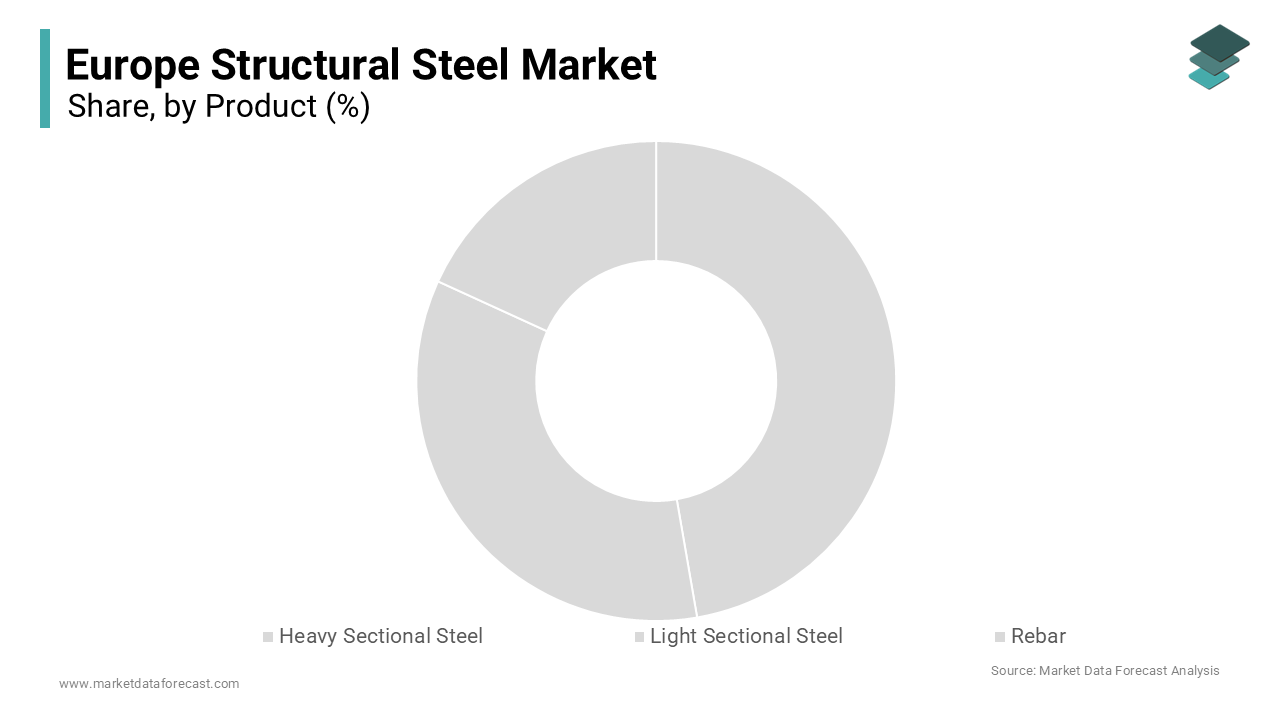
The light sectional steel segment is predicted to witness the highest CAGR of 5.8% from 2026 to 2034 due to the rise of modular construction residential infill development and lightweight industrial sheds that prioritize speed efficiency and cost control. Leading European cities such as Amsterdam, Berlin, and Barcelona are increasingly issuing permits for modular housing that utilizes light-gauge steel frameworks to address urban density. The use of prefabricated steel modules significantly minimizes the need for on-site manual labor and accelerates project completion when compared to traditional masonry or concrete methods. Under the European Commission’s broader affordable housing strategies, increasing support is being directed toward innovative construction methods, including light steel framing, to expand social and student housing across the continent. Companies offer pre engineered light steel kits with integrated insulation and cladding, further streamlining adoption. This alignment with urban density sustainability and labor scarcity positions light sections as the growth engine of residential and small scale commercial steel demand.
By Application Insights
The infrastructure segment was the largest segment in the Europe structural steel market in 2025. The supremacy of the infrastructure segment is credited to massive public investment in transportation energy and digital networks under the European Union’s recovery and decarbonization agendas. The NextGenerationEU program provides significant funding, which member states are using extensively to support a transition towards greener and more resilient economies, including substantial investment in modern transport and clean energy infrastructure. Moreover, the development of the Trans-European Transport Network (TEN-T) involves major infrastructure upgrades to create a comprehensive and efficient rail, road, and port network across Europe, with core sections expected to be completed in the near future. Major national rail projects, such as Germany's Deutschlandtakt plan and France's Grand Paris Express metro extension, involve extensive construction and the use of substantial materials for new lines and stations. The European Hydrogen Backbone initiative is actively developing plans for a vast, integrated hydrogen pipeline network that leverages a combination of repurposed natural gas lines and new construction to transport low-carbon hydrogen across the continent, utilizing steel components for essential infrastructure like pipelines and compressor stations. This policy driven pipeline of multi year projects creates a stable demand base that is largely insulated from private sector volatility and ensures infrastructure remains the market’s dominant application.
The non-residential segment is estimated to register the fastest CAGR of 6.3% during the forecast period owing to the construction of hospitals data centers logistics hubs and net zero industrial parks mandated under the Net Zero Industry Act and Digital Europe Programme. Across the European Union, the construction sector sees ongoing development of non-residential floor space, with a continuing demand for efficient and adaptable building materials. Structural steel framing is increasingly prominent in a significant portion of large construction projects due to its recognized benefits in speed of erection and design flexibility. Major industrial projects, such as emerging data center hubs in northern Sweden and new green hydrogen facilities in Germany, utilize substantial amounts of structural steel in their construction to support complex multi-story facilities. European Commission regulations mandate high energy performance standards for public buildings, encouraging construction methods, like steel frames combined with advanced, prefabricated envelope systems, that meet rigorous energy efficiency targets. This convergence of digital industrial and sustainability mandates positions non-residential as the highest growth application segment.
REGIONAL ANALYSIS
Germany Structural Steel Market Analysis
Germany dominated the Europe structural steel market by accounting for a 24.5% share in 2025. The dominance of the German market is driven by its massive infrastructure renewal programs and leadership in clean industrial manufacturing. Germany's comprehensive national transport strategy prioritizes the extensive modernization of its rail and road networks through 2030, relying heavily on steel-intensive infrastructure for major bridge and tunnel renewals. Under the guidance of federal economic authorities, Germany is establishing itself as a central hub for European net-zero industrial production, prominently featuring large-scale green steel and hydrogen facilities that depend on massive steel frameworks. To combat the severe housing crisis in major metropolitan areas, the German government is accelerating the shift toward prefabricated and modular steel building methods to streamline urban residential development. Recent industrial data shows that public and industrial infrastructure projects remain a vital driver of steel demand in Germany, maintaining substantial consumption levels even during periods of broader economic fluctuation. This integration of infrastructure policy industrial strategy and urban development cements Germany as the market’s core engine.
France Structural Steel Market Analysis
France was the second largest country in the Europe structural steel market and captured a 18.7% share in 2025. The growth of the French market is propelled by its Grand Paris Express metro expansion France Relance recovery plan and hydrogen infrastructure rollout. The ongoing Grand Paris Express transport project is a major infrastructure initiative that involves significant construction activity, including extensive tunneling and station building across the Paris region, with work continuing toward a final completion date in the coming years. France's National Low Carbon Strategy aims to drive the development of domestic clean technology manufacturing, which includes the establishment of several large-scale production facilities (gigafactories) for components such as batteries and electrolyzers to support the energy transition. The French government is actively promoting the creation of numerous low-carbon and green industrial zones through various national investment plans to accelerate the country's reindustrialization and meet its climate objectives, encouraging the use of less carbon-intensive materials and efficient construction methods. The country also leads in modular hospital construction with several new facilities using light steel frames. This blend of mega infrastructure clean industry and public health investment creates a diversified and resilient steel demand base.
United Kingdom Structural Steel Market Analysis
The United Kingdom holds a significant share of the Europe structural steel market due to its High Speed Two rail project data center boom and housing regeneration initiatives. Despite Brexit the UK aligns closely with European construction standards ensuring continued steel compatibility. High Speed Two (HS2) construction is a major consumer of structural steel for large infrastructure elements, with significant portions sourced internationally. Major viaducts are currently under construction as part of the project's progress. The United Kingdom's focus on digital trade and data governance has spurred substantial investment in cloud infrastructure, with modern, steel-framed data centers becoming prominent in key technology hubs like Slough and Manchester. Strong demand in the logistics and industrial sector continues to drive significant development of new spaces, with most new facilities employing structural steel frames to achieve the large, column-free areas required for modern operations. This dual engine of physical and digital infrastructure ensures sustained demand in a high value public private project environment.
Italy Structural Steel Market Analysis
Italy grew steadily in the Europe structural steel market owing to mandatory seismic retrofitting of public buildings and urban regeneration programs in historic city centers. taly's National Recovery and Resilience Plan directs substantial financial resources toward enhancing the energy efficiency and seismic resilience of existing public and private buildings across the country. Current renovation efforts for schools and hospitals focus on adopting integrated seismic and energy retrofitting techniques to improve safety and sustainability. Building safety programs in Italy involve ongoing seismic assessments and a variety of structural strengthening and isolation methods to meet modern seismic codes. The government has incentivized a large volume of private residential and commercial building renovations through significant tax credits, which have been adjusted recently due to economic considerations. A growing focus exists on promoting innovative, sustainable, and less intrusive renovation methods, including modern construction systems, for urban regeneration projects. This focus on safety modernization and heritage-compatible lightweight systems creates a unique and consistent demand profile.
Sweden Structural Steel Market Analysis
Sweden is anticipated to expand in the Europe structural steel market from 2026 to 2034 due to its leadership in fossil free steel production and modular housing innovation. The HYBRIT partnership is increasingly integrating its own fossil-free steel into the infrastructure of its new production facilities to demonstrate a fully sustainable value chain from the mine to the finished product. To address persistent urban housing shortages, the Swedish government and national housing authorities are incentivizing off-site modular construction, favoring these methods for their rapid deployment and superior energy efficiency compared to traditional building practices. In sectors such as student and elderly housing, there is a notable shift toward using prefabricated building components that combine speed and sustainability, with a growing interest in metal-based modular systems to complement the nation's established timber-framed industry. This synergy between green manufacturing policy and sustainable urban development positions Sweden as a high innovation per capita market despite its modest population size.
COMPETITIVE LANDSCAPE
The Europe structural steel market features intense competition among integrated producers specialized fabricators and emerging green steel innovators each navigating a complex landscape of decarbonization policy infrastructure investment and digital transformation. Global leaders like ArcelorMittal and Tata Steel leverage scale integrated raw material access and sustainability roadmaps to dominate public infrastructure and industrial projects. Meanwhile regional players such as Voestalpine focus on high precision engineered sections for complex applications where certification and reliability outweigh cost. The market is increasingly bifurcated between conventional blast furnace steel under carbon pricing pressure and next generation green steel commanding premium pricing. Competition is not solely on price but on environmental credentials digital enablement and alignment with the European Union’s net zero industrial and construction agendas. Success requires strategic investment in low carbon production digital workflows and close collaboration with public and private project owners to ensure timely and compliant delivery in a highly regulated and evolving market.
KEY MARKET PLAYERS
Some of the notable key players in the Europe structural steel market are
- ArcelorMittal S.A.
- Nippon Steel Corporation
- POSCO
- JFE Holdings, Inc.
- Nucor Corporation
- Voestalpine AG
- China Baowu Steel Group
- ThyssenKrupp AG
- Hyundai Steel Co., Ltd.
- Tata Steel Ltd.
- EVRAZ plc
- ESAB AB
Top Players in the Market
- ArcelorMittal SA is the world’s leading steel producer with a dominant footprint in the Europe structural steel market through its integrated mills in France Germany and Belgium. The company supplies heavy and light sectional steel for major infrastructure projects including high speed rail networks offshore wind foundations and modular housing developments across the continent. The company also expanded its BIM library of certified European sections to support digital engineering workflows mandated under public procurement rules. These initiatives reinforce ArcelorMittal’s role as a sustainability and innovation leader while strengthening its position in global green infrastructure supply chains.
- Tata Steel Europe is a key supplier of structural steel sections across the United Kingdom Netherlands and Germany serving construction infrastructure and industrial sectors. The company’s IJmuiden plant in the Netherlands produces a full range of heavy and light sections compliant with Eurocode standards and certified for seismic and fire resistance applications. The company also partnered with modular construction firms to develop pre engineered light steel frame kits for affordable housing projects funded under European social initiatives. These actions align Tata Steel with Europe’s circular economy and housing affordability goals while enhancing its reputation for certified sustainable structural solutions.
- Voestalpine AG is an Austrian technology and steel group renowned for its high precision structural sections used in complex infrastructure and industrial applications across Central and Northern Europe. The company specializes in heavy beams for bridge construction and light gauge systems for modular buildings with stringent tolerance requirements. The company also enhanced its digital twin capabilities by linking BIM models to automated CNC fabrication lines reducing waste and delivery lead times. These strategic advancements position Voestalpine as a premium provider of engineered structural steel for Europe’s decarbonized and digitized construction future.
Top Strategies Used by the Key Market Participants
Key players in the Europe structural steel market prioritize decarbonization by launching certified green steel product lines using hydrogen electric arc furnaces and circular scrap integration to comply with the Carbon Border Adjustment Mechanism and corporate net zero commitments. They invest in digitalization through Building Information Modeling libraries automated fabrication systems and digital twin integration to support public infrastructure mandates and reduce construction waste. Companies strengthen partnerships with modular construction firms and public agencies to co develop standardized steel systems for affordable housing hospitals and gigafactories. Strategic expansion of fabrication capacity near major infrastructure corridors ensures just in time delivery and reduces transport emissions. Additionally vendors pursue third party certifications for seismic fire and sustainability performance to meet stringent Eurocode and public procurement requirements across diverse European markets.
MARKET SEGMENTATION
This research report on the European structural steel market has been segmented and sub-segmented based on categories.
By Product
- Heavy Sectional Steel
- Light Sectional Steel
- Rebar
By Application
- Residential
- Non-residential
- Institutional
- Commercial
- Offices
- Others
By Country
- UK
- France
- Spain
- Germany
- Italy
- Russia
- Sweden
- Denmark
- Switzerland
- Netherlands
- Turkey
- Czech Republic
- Rest of Europe
Frequently Asked Questions
1. What is the Europe structural steel market?
The Europe structural steel market includes steel products used in construction frameworks such as beams, columns, and plates for buildings, bridges, and industrial structures.
2. What factors are driving growth in the Europe structural steel market?
Growth is driven by infrastructure development, urbanization, renovation of aging buildings, and rising demand for sustainable and recyclable construction materials.
3. Which countries lead the Europe structural steel market?
Germany, the United Kingdom, France, Italy, and Spain are key markets due to large-scale construction and infrastructure projects.
4. What are the main types of structural steel used in Europe?
Common types include hot-rolled sections, hollow structural sections, plates, and fabricated steel components.
5. Why is structural steel preferred in construction projects?
Structural steel offers high strength-to-weight ratio, design flexibility, faster construction timelines, and excellent durability.
6. How does sustainability influence the Europe structural steel market?
Structural steel is highly recyclable, supports circular economy goals, and aligns with Europe’s low-carbon construction initiatives.
7. What role does infrastructure investment play in market growth?
Public and private investments in transportation, energy, and commercial infrastructure significantly boost demand for structural steel.
8. Which end-use sectors drive demand in Europe?
Residential construction, commercial buildings, industrial facilities, bridges, and renewable energy projects are major demand drivers.
9. How do regulations affect the Europe structural steel market?
Strict EU building codes, safety standards, and environmental regulations influence material specifications and production processes.
10. What challenges does the Europe structural steel market face?
Challenges include volatile raw material prices, energy costs, supply chain disruptions, and competition from alternative materials.
Related Reports
Access the study in MULTIPLE FORMATS
Purchase options starting from
$ 2000
Didn’t find what you’re looking for?
TALK TO OUR ANALYST TEAM
Need something within your budget?
NO WORRIES! WE GOT YOU COVERED!
Call us on: +1 888 702 9696 (U.S Toll Free)
Write to us: sales@marketdataforecast.com