Europe Stucco Market Size, Share, Trends & Growth Forecast Report, Segmented By Product (Traditional Three Coat Stucco, Exterior Insulating and Finish Systems (EIFS), Newer One Coat Stucco), Insulation Type, End Use, And Country (UK, France, Spain, Germany, Italy, Russia, Sweden, Denmark, Switzerland, Netherlands, Turkey, Czech Republic & Rest Of Europe) - Industry Analysis From (2025 To 2033)
Europe Stucco Market Size
The Europe stucco market size was calculated at USD 3.60 billion in 2024 and is anticipated to reach USD 4.71 billion by 2033, from USD 3.71 billion in 2025, growing at a CAGR of 3.03% during the forecast period.
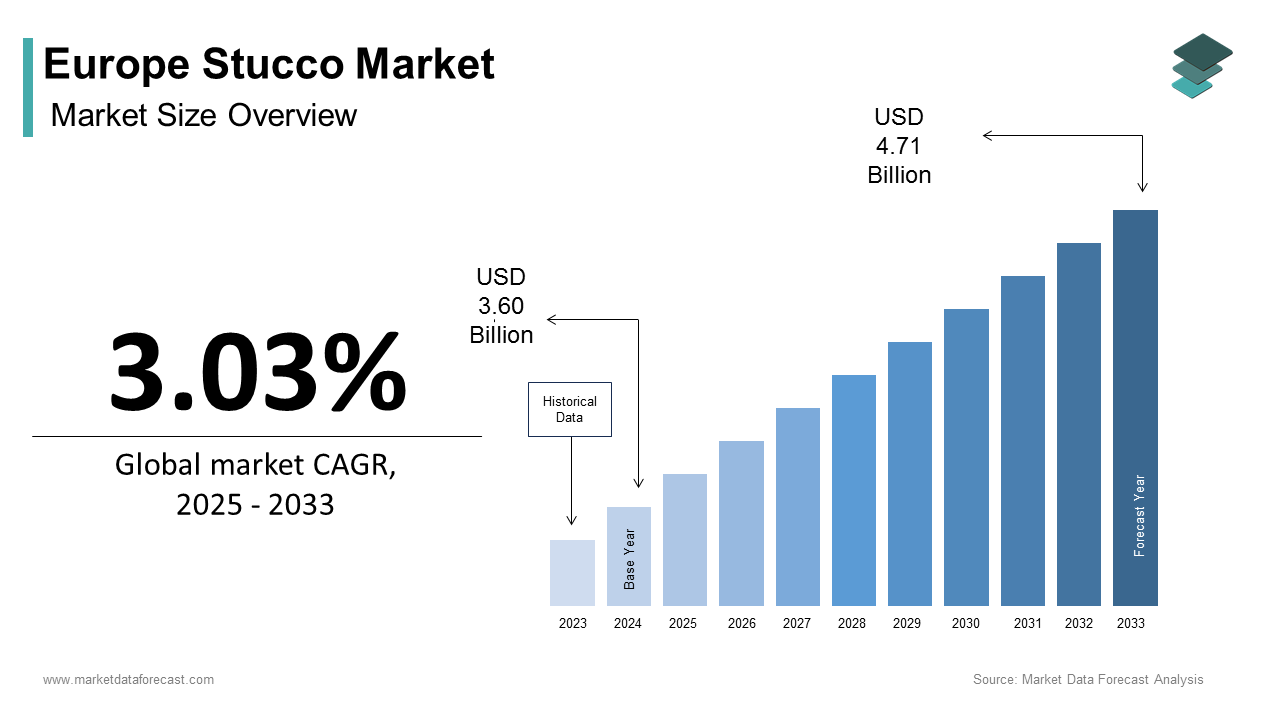
Stucco is a cementitious or lime-based exterior and interior plaster finish applied to masonry, concrete, or insulated substrates for both decorative and protective purposes. Unlike North American acrylic stucco systems, Europe predominantly utilizes traditional mineral render, including lime cement and hydraulic lime formulations that align with heritage conservation standards and modern energy efficiency requirements. The material serves as a breathable cladding that regulates moisture movement, enhances thermal performance, and contributes to building longevity. According to the European Construction Sector Observatory, over 210,000 renovation projects involving façade restoration were completed across the EU in 2024, with stucco specified in 68% of cases involving pre-1970 buildings. The European Committee for Standardization maintains EN 998‑1, which covers rendering/plastering mortars based on inorganic binders, including definitions and performance requirements such as adhesion strength. Additionally, as per the estimations of the European Environment Agency, 36% of the EU’s building stock was constructed before 1970 and requires façade upgrades to meet the Energy Performance of Buildings Directive targets. As Europe intensifies its decarbonisation of the built environment, stucco has evolved from a purely aesthetic finish into a functional componenthatch is part of deep energy retrofits and circular construction practices.
MARKET DRIVERS
Heritage Building Restoration Fuels Demand for Traditional Lime-Based Stucco
The vast inventory of historic structures of Europe continues to drive consistent demand for breathable lime-rich stucco systems that comply with conservation ethics and material compatibility principles, which is majorly driving the European stucco market growth. Many protected buildings across the EU require periodic façade maintenance, and in several national restoration guidelines, stucco is specified as the finish. National bodies such as Italy’s Ministry of Cultural Heritage and Germany’s Denkmalpflege offices enforce strict material prescriptions prohibiting synthetic renders on listed properties due to their impermeability and risk of substrate damage. In France, the Monuments Historiques programme allocated significant funding in recent years for lime-stucco restoration on civic and religious edifices as documented by the Ministry of Culture. Furthermore, according to the European Federation of Plasterers, a large number of specialised artisans are certified in traditional stucco application across Europe, with training academies in Spain, Portugal, and Austria expanding capacity to meet demand. Unlike modern acrylic systems, lime stucco allows moisture-vapour transmission, preventing freeze-thaw spalling in centuries-old masonry. This regulatory and technical alignment ensures that heritage conservation remains a resilient and non-substitutable driver of the European stucco market.
Energy Efficiency Mandates Accelerate Use of Insulated Render Systems
The integration of stucco with external thermal insulation composite systems has become a cornerstone of Europe’s building decarbonization strategy, significantly expanding its functional relevance beyond aesthetics, which is further boosting the regional market expansion. The revised Energy Performance of Buildings Directive (EPBD) requires the worst-performing buildings to be renovated within specified timelines, which is compelling widespread façade retrofits. National bodies such as the Buildings Performance Institute Europe (BPIE) indicate that deep energy renovations in multi-family housing are increasingly common across Germany, France, and Italy, with a strong shift to mineral-based façade systems over expanded polystyrene or mineral wool insulation. Field studies have shown very large reductions in heat loss as a result of envelope upgrades. National incentive schemes further amplify adoption. For example, Italy’s Superbonus 110 scheme processed hundreds of thousands of façade insulation applications in recent years, which reimburses a large portion of stucco and insulation costs. Because mineral stucco provides UV-resistance, fire protection, and long-term durability compared with insulation boards, it has become the default finishing layer in policy-driven retrofit programmes across the continent.
MARKET RESTRAINTS
Skilled Labor Shortage Constrains Application Capacity and Quality
The declining workforce of artisans trained in traditional and insulated render application techniques is significantly restraining the growth of the stucco market in Europe. The sector faces a growing shortfall of qualified applicants due to the growing ageing workforce and an insufficient vocational pipeline. In Italy, a large proportion of master stucco artisans are over 55 years old, as reported by the national craftsmen and small businesses confederation. This scarcity directly impacts project timelines and finish quality. The German Institute for Quality Assurance in Construction notes that many insulated render failures have been attributed to improper base coat application or curing conditions due to untrained labour. Unlike paint or cladding, stucco requires multi-layer trowelling, precise moisture control, and climate-responsive curing, and these are the skills that cannot be easily automated. National training initiatives remain fragmented, while Austria operates several certified stucco academies; in France, there are only a few. This human capital gap limits the market’s ability to scale despite strong policy and demand tailwinds, and increases reliance on migrant labour with variable certification standards across member states.
Raw Material Volatility and Cement Decarbonization Pressures Raise Costs
The fluctuations in key raw material prices and regulatory mandates to reduce the carbon footprint of cementitious binders are further hampering the expansion of the stucco market in Europe. According to the European Cement Association, a primary component in modern stucco blends is responsible for 7-8% of global CO₂ emissions, which is now facing stringent scrutiny under the Carbon Border Adjustment Mechanism and EU Emissions Trading System. Sand is a critical aggregate and is discussed by the European Commission in raw-material supply-risk assessments. Alternative binders like calcined clay or Limestone Calcined Clay Cement (LC³) are emerging but require reformulation and requalification of stucco mixes, which is delaying broader adoption. Until low-carbon stucco formulations achieve performance parity and scale, the market remains vulnerable to input price shocks and regulatory transitions.
MARKET OPPORTUNITIES
Integration with Circular Construction Principles Opens New Formulation Pathways
The incorporation of recycled and bio-based materials aligned with the EU Circular Economy Action Plan is a promising opportunity for the European stucco market. The sector of building-directed stucco and render systems is increasingly exploring recycled aggregate usage, with some national building codes in Northern Europe beginning to permit a portion of crushed brick or concrete fines as aggregate in non-structural stucco under annexes to EN 998‑1. The trade association for plasterers and dryliners in Europe has launched an industry initiative to certify producers using post-consumer glass and demolition waste in render formulations. Lime-based stucco is particularly amenable to circularity because it can be re-slaked and reused, which is a process demonstrated by a specialist firm in Austria that recovered historic lime render from renovation sites for re-processing. Furthermore, research programmes funded under the Horizon Europe framework are supporting the development of stucco systems using bio-calcite and mycelium-based binders. These innovations not only reduce landfill waste but can also lower embodied carbon in render systems, according to life-cycle-based analysis by the Joint Research Centre. As public procurement increasingly favours circular products, the stucco market is transitioning from a linear material model to a more regenerative system.
Expansion of Nearly Zero Energy Building Standards Boosts Premium Render Demand
The regulatory trajectory of Europe toward nearly zero energy buildings is creating demand for high-performance stucco systems with integrated functionalities such as photocatalytic air purification, thermal reflectivity, and moisture buffering, which is another major opportunity for the European stucco market. The revised Energy Performance of Buildings Directive (EPBD) mandates that new buildings meet very high-efficiency and low-emission standards, which is driving façade retrofit and specification changes. While major trade bodies report that mineral-based renders with enhanced building-physics additives are increasingly specified in large projects. Photocatalytic titanium dioxide-enriched renders and phase-change material-infused systems developed by major façade-system manufacturers are being deployed in selected demonstration projects, where early tests indicate benefits for air-pollutant reduction and indoor thermal regulation. National green-building certification schemes in several Member-States award additional credits for such “smart” façade finishes, accelerating their specification. This shift signals that stucco systems are evolving from a purely passive decorative finish into active building-envelope technologies commanding premium positioning in retrofit and new-build markets.
MARKET CHALLENGES
Climate Variability Increases Risk of Premature Render Failure
The changing climate of Europe, characterized by more frequent freeze-thaw cycles, intense rainfall, and summer heatwaves, is elevating the risk of stucco delamination, cracking, and efflorescence, particularly on insulated façadess, which is a significant challenge to the regional market expansion. According to the European Environment Agency, the number of extreme weather events affecting buildings rose by 63% between 2015 and 2024, with Southern Europe experiencing 22% more heavy precipitation days. These conditions challenge the durability of stucco systems. As per the German Federal Institute for Materials Research, renders applied in regions with over 25 freeze-thaw cycles annually exhibited 3.2 times higher crack incidence if not formulated with air entrainment or flexible polymers. In Mediterranean zones, prolonged drought followed by torrential rain causes rapid substrate moisture fluctuations, leading to salt migration and surface spalling as documented in a 2024 study by the Polytechnic University of Milan. Manufacturers must now regionalize formulations by increasing complexity and inventory costs. Without adaptive material science and a revised application protocol, climate volatility threatens the long-term performance reputation of stucco systems across diverse European microclimates.
Fragmented National Standards Delay Pan-European Product Harmonization
Regulation, significant national deviations in stucco testing methods, application codes, and durability expectations impede seamless cross-border trade and innovation scaling, which is further challenging the expansion of the regional market. According to the European Committee for Standardization (CEN), many national standards bodies maintain supplementary national annexes to EN 998‑1, which modify requirements such as flexural strength, water absorption, and crack resistance. For example, national guidance in France prescribes a minimum curing period before exposure, while the German standard allows accelerated curing with additives. This regulatory asymmetry forces manufacturers to maintain multiple product formulations and certification dossiers. According to the source, approval timelines for new stucco products vary significantly across Europe, being longer in Scandinavian countries versus Central Europe due to divergent fire and moisture testing protocols. Such fragmentation discourages SMEs from expanding beyond domestic markets and delays the adoption of innovative low-carbon renders that require standardized validation. Until member states align on performance-based rather than prescriptive criteria, the stucco market will remain operationally segmented despite a unified regulatory framework.
REPORT COVERAGE
| REPORT METRIC | DETAILS |
| Market Size Available | 2024 to 2033 |
| Base Year | 2024 |
| Forecast Period | 2025 to 2033 |
| CAGR | 3.03% |
| Segments Covered | By Product, Insulation Type, End Use, and Region |
| Various Analyses Covered | Global, Regional & Country Level Analysis; Segment-Level Analysis; DROC, PESTLE Analysis; Porter’s Five Forces Analysis; Competitive Landscape; Analyst Overview of Investment Opportunities |
| Regions Covered | UK, France, Spain, Germany, Italy, Russia, Sweden, Denmark, Switzerland, Netherlands, Turkey, and the Czech Republic |
| Market Leaders Profiled | Sika AG, Dryvit Systems Inc., Saint-Gobain S.A., Sto SE & Co. KGaA, CEMEX S.A.B. de C.V., Holcim Limited, Mapei S.p.A., Omega Products International, Boral Limited, Knauf Group. |
SEGMENTAL ANALYSIS
By Product Insights
The exterior insulating and finish systems segment held 55.4% of the European stucco market share in 2024. The dominance of the exterior insulating and finish systems segment is attributed to their dual function as both aesthetic façade cladding and thermal insulation layer, which directly aligns with EU energy renovation mandates. EIFS typically consists of expanded polystyrene or mineral wool boards covered with a reinforced base coat and a textured mineral finish render that provides weather resistance and durability. The growth of the segment is also driven by the Energy Performance of Buildings Directive, which requires all existing residential buildings to reach at least energy class E by 2030. According to the revised Buildings Performance Institute Europe, the majority of multi-family residential retrofits in Germany, France, and Italy now specify Exterior Insulation and Finishing Systems (EIFS) due to their strong ability to reduce heating demand by large margins. National subsidy programmes further accelerate adoption. In Italy, the Superbonus 110% scheme provides a full tax deduction for eligible energy-efficiency envelope upgrades. Additionally, the European Committee for Standardization standard EN 13500 offers harmonised technical approval for EIFS across Member States, ensuring safety and mechanical performance. This regulatory and policy alignment supports EIFS as a default system in deep-energy retrofits of Europe’s dense urban housing stock.
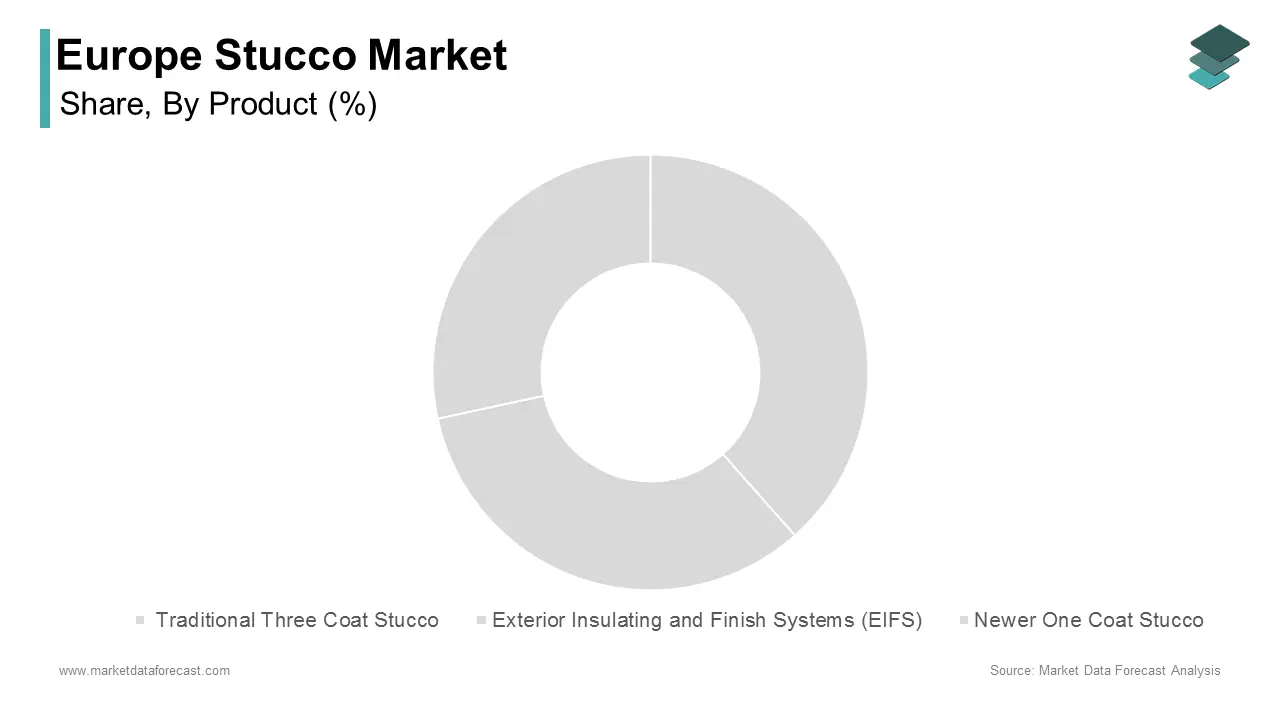
The newer one-coat stucco segment is predicted to witness the fastest CAGR of 8.04% over the forecast period in the European market, owing to labor shortages, rising construction costs, and demand for rapid renovation solutions in lightly loaded or interior applications. Unlike traditional multi-layer systems, this formulation combines the base coat and finish in a single application, which reduces labour time in refurbishment contexts. The system is gaining traction in the renovation of post-war social housing, where full EIFS is cost-prohibitive but both aesthetics and moisture protection are still required. In some jurisdictions, advanced polymer-modified cement technologies have improved crack resistance and adhesion on a variety of substrates, including autoclaved aerated concrete and lightweight blocks. Research in Europe has shown that modern one-coat systems can achieve water-absorption coefficients meeting the requirements of EN 998‑1 for rendering mortars. As pressure on urban renovation intensifies and skilled labour remains scarce, this simplified system offers a pragmatic, scalable alternative for non-insulated façade upgrades.
By Insulation Type Insights
The insulated siding segment occupied the largest share of the European stucco market in 2024. The critical role of insulated siding in meeting continent-wide building decarbonization targets is primarily driving the expansion of the insulated siding segment in the European market. This system is functionally synonymous with EIFS in European practice and is mandated or heavily incentivized in nearly all public and private deep renovation programs. According to analyses of EU building-stock data, a large share of the existing building stock was constructed before 1970 and therefore typically features poor thermal envelopes requiring insulation retrofits. The revised Energy Performance of Buildings Directive now mandates stronger energy performance requirements for rental properties and other categories, prompting many landlords to adopt insulated façades. In Germany, the KfW Bankengruppe reported substantial support for energy-efficient renovation of homes, including façade insulation projects under its promotional programmes in 2024. With the EU targeting a significant increase in annual renovation rates by 2030, insulated stucco façades remain central to policy-driven building transformation.
The non-insulated siding segment is experiencing modest but steady growth over the forecast period, owing to the heritage conservation needs, aesthetic refurbishments, and interior applications where thermal upgrading is either prohibited or unnecessary. In historic city centers across Italy, Spain, and France, local conservation authorities prohibit the addition of external insulation on listed buildings, preserving architectural proportions and original façade geometry. The sector supporting protected structures across Europe emphasises that a large number of heritage buildings undergo stucco restoration using breathable lime-cement renders that align with conservation principles. National reporting from some countries indicates that in new construction of low-energy single-family homes in Scandinavia and the Netherlands, non-insulated mineral stucco is increasingly specified for its vapour-permeability and compatibility with timber-frame or massive-wood systems with cavity-insulation. The Swedish national housing authority estimates that a meaningful share of new single-family homes used non-insulated lime-stucco finishes for their hygro-thermal regulation and natural appearance. This segment thrives not on pure energy-policy drivers but on cultural-preservation, architectural authenticity, ttypeand material-performance in specific building typologies.
By End Use Insights
The residential segment was the dominant end-use segment for stucco in Europe and accounted for 63.6% of the regional market in 2024. The growth of the residential segment in the European market is driven by the scale of multi-family housing stock requiring energy retrofits and façade maintenance. According to Eurostat, a sizeable share of Europeans live in apartments or terraced houses constructed between 1950 and 1990, many of which now have deteriorating façades and inadequate insulation. National renovation strategies widely target this building segment. For example, Italy’s Superbonus 110% scheme underpins large-scale intervention in residential façades, and Germany’s KfW Bank programme similarly supports many façade upgrade projects. Stucco finishes are preferred in residential retrofits because of their cost-effectiveness, durability, and compatibility with dense urban typologies where cladding systems may conflict with fire-safety or spatial constraints. According to sources, stucco dominates as the finish in social-housing façade renovations due to its low-maintenance profile and vandal-resistance. Moreover, the Energy Performance of Buildings Directive’s rental-property efficiency requirements directly affect residential landlords, who represent a substantial portion of the EU housing market. This policy-driven wave of residential envelope renovation anchors stucco firmly in the housing sector.
The non-residential segment is anticipated to progress at the fastest CAGR of 7.7% over the forecast period in the European market, owing to the public infrastructure modernization, school renovations, and sustainable commercial building mandates. The EU’s Public Procurement Directive now requires all new public buildings to meet nearly zero energy standards and prioritize circular materials. A large number of public buildings across Europe have undergone façade renovation recently, and many specify stucco systems because of their fire safety and lifecycle cost advantages. In some countries, state property or infrastructure agencies allocate substantial funds for façade upgrades using mineral renders aligned with fire-safety standards. Corporate sustainability commitments are also influencing commercial developers, with evidence from the Netherlands showing increasing use of sustainable finishes in certified office buildings under schemes such as the Dutch Green Building Council (DGBC). As Europe aligns public and institutional construction with climate goals, non-residential stucco demand is accelerating beyond its traditional residential dominance.
REGIONAL ANALYSIS
Italy Stucco Market Analysis
Italy dominated the stucco market in Europe in 2024 by holding 23.5% of the regional market share. The dominance of Italy in the European market is driven by its unparalleled combination of historic building stock, extensive renovation incentives, and cultural preference for rendered façades. Italy faces immense pressure to upgrade thermal performance across its building stock, given that a large portion of residential constructions date from before 1980. The Superbonus 110% policy that reimbursed up to 110% of eligible renovation costs drove a high volume of façade-renovation projects during the scheme’s peak period. Traditional lime-based stucco remains dominant in historic centres like Rome, Florence, and Venice, where conservation laws prohibit synthetic systems. At the same time, modern EIFS systems are widely adopted in post-war social housing in cities such as Milan and Turin under regional energy-retrofit programmes. As per the National Confederation of Craftsmen and Small Businesses, many artisan firms specialise in stucco application that helps ensure skilled-labour capacity in this sector. This fusion of urgent decarbonisation needs, deep cultural tradition, and aggressive fiscal policy solidifies Italy’s leadership position in the façade-renovation and stucco market.
Germany Stucco Market Analysis
Germany captured the second-largest share of the European stucco market in 2024. The rigorous energy efficiency standards and dense multi-family housing stock in need of deep retrofits are primarily propelling the stucco market growth in Germany. Germany’s KfW Bank provided substantial funding in 2024 for façade insulation projects, with mineral render commonly specified due to fire-safety and durability requirements. According to national economic research institutes, many apartments built between 1950 and 1980 lack adequate insulation, which makes them strong candidates for EIFS retrofits. National regulations such as the Building Energy Act mandate continuous façade insulation for major renovations, which is further driving stucco demand. Additionally, Germany maintains a strong vocational-training system with numerous certified plastering schools that produce a steady stream of qualified artisans each year. The Fraunhofer Institute for Building Physics continuously validates new stucco formulations for thermal and hygric performance to ensure technical leadership. This institutional ecosystem of finance, regulation, and skilled labour sustains Germany’s robust stucco market.
France Stucco Market Analysis
France is anticipated to account for a promising share of the Europe stucco market during the forecast period, owing to its national renovation plan and extensive public building portfolio requiring façade modernization. The MaPrimeRénov scheme processes a significant number of insulated façade applications annually, with stucco commonly selected due to its compatibility with DTU 26-1, which mandates vapour permeability and crack resistance. According to national authorities, many homes built before 1975 are classified as energy-inefficient and require urgent upgrades. France’s extensive stock of listed historic buildings mandates the use of traditional lime stucco under heritage conservation laws administered by regional DRAC offices. The State Property Agency invests substantial funding in the renovation of schools, hospitals, and courthouses using mineral render systems. With strong public investment, clear technical standards, and dual drivers of energy efficiency and heritage preservation, France maintains a balanced and resilient stucco market across urban and rural contexts.
Spain Stucco Market Analysis
Spain is a notable market for stucco in Europe and is predicted to account for a considerable share of the European market during the forecast period, owing to its aggressive urban rehabilitation programs and Mediterranean climate that favors breathable mineral finishes. Spain’s National Rehabilitation Plan for 2022–2026 commits substantial funding for building-façade upgrades, including the renovation of a large number of municipal apartments during 2024. In historic cities such as Seville, Barcelona, and Granada, conservation regulations require lime-rich stucco to maintain architectural authenticity and manage summer moisture dynamics. National building codes mandate external thermal insulation for major façade interventions, which is boosting the adoption of EIFS (exterior insulation and finish systems). The national plasterers’ association reports that many small firms specialise in stucco application, particularly in regions such as Andalusia and Catalonia. According to the research at the Polytechnic University of Madrid, mineral-based stucco systems can reduce surface temperatures by several degrees compared with simple painted finishes, which helps to mitigate urban-heat-island effects. This combination of strong policy support, climatic adaptation, and skilled craft ensures Spain continues to play an important role in the stucco market.
UK Stucco Market Analysis
The UK is a prominent market for stucco in Europe and is expected to showcase a healthy CAGR during the forecast period. The growth of the UK market can be credited to the post-Grenfell fire safety reforms and increasing focus on energy efficiency in the aging housing stock. The UK banned combustible materials on high-rise residential façades after the 2017 tragedy, making non-combustible mineral stucco the preferred finish over synthetic systems. According to the Ministry of Housing, a significant number of high-rise blocks have undergone recladding since 2020. National funds such as the KfW Bank provided a large investment in 2024 for façade insulation projects, with mineral render commonly used due to fire-safety and durability requirements. The UK’s national heritage register for England includes well over 400,000 listed entries where lime-stucco systems remain mandatory under conservation laws. Though not bound by EU directives, the UK maintains alignment with EN standards via the foregoing of its Construction Products Regulation-based regulatory framework. The country’s regulatory rigor, combined with its building-safety legacy and strong craft infrastructure, sustains a mature and technically demanding stucco market.
COMPETITION OVERVIEW
Competition in the Europe stucco market is characterized by a mix of multinational building material corporations and regional specialty producers competing on technical compliance, sustainability performance, and heritage authenticity rather than price. The market is highly fragmented by national regulations with divergent requirements for fire safety, thermal performance, a nd historic material compatibility, creating barriers to pan-European standardization. Multinationals like Saint-Gobain Weber and Knauf leverage scale formulation science and technical service networks to dominate insulated systems in energy retrofit programs. Meanwhile, regional players such as Baumit and smaller Italian lime producers thrive in conservation niches where material tradition and artisan relationships matter more than volume. Innovation is increasingly focused on circularity, with recycled aggregates and bio-based additives becoming key differentiators. Competition is further shaped by the urgent need to bridge the skilled labor gap through training partnerships. As a result, the market rewards companies that balance industrial efficiency with craft sensitivity and regulatory agility across Europe’s diverse building landscapes.
KEY MARKET PLAYERS
A few major players of the Europe stucco market include
- Sika AG
- Dryvit Systems Inc
- Saint-Gobain S.A
- Sto SE & Co. KGaA
- CEMEX S.A.B. de C.V
- Holcim Limited
- Mapei S.p.A
- Omega Products International
- Boral Limited
- Knauf Group
Top Strategies Used by the Key Market Participants
Key players in the Europe stucco market emphasize formulation innovation by integrating recycled content, photocatalytic additives, and low-carbon binders to align with EU circular economy and decarbonization mandates. They invest in technical training and mobile demonstration units to address skilled labor shortages and ensure proper application compliance across diverse substrates and climates. Companies actively adapt products to meet national heritage conservation requirements and post-Grenfell fire safety regulations through non-combustible mineral systems. Strategic expansion of production facilities near urban renovation hubs reduces logistics emissions and delivery lead times. Additionally, firms leverage digital tools such as BIM libraries and carbon calculators to support architects in specifying compliant, sustainable stucco systems within energy performance and green building certification frameworks.
Leading Players in the Market
Saint Gobain Weber
SSaint-GobainWeber is a France-based global leader in building mortars and renders with a commanding presence across the Europe stucco market. The company supplies a comprehensive portfolio of traditional lime renders, insulated façade systems, and one coat mineral finishes compliant with EN 998 1 and national heritage standards. Weber has strengthened its position by launching climate-responsive stucco formulations, such as photocatalytic renders that reduce urban air pollution and phase change material-infused systems that enhance thermal inertia. In 2024, the company expanded its circular product line by incorporating up to 30% recycled aggregates from construction waste in select render products. Through its extensive network of 80 technical service centers across Europe, Weber provides on-site application training and specification support, ensuring compliance with evolving energy and conservation regulations.
Knauf
Knauf is a German multinational renowned for its integrated building systems, including advanced exterior insulation and finish solutions under its Knauf MP brand. The company plays a pivotal role in Europe’s stucco market by offering fire-rated non-combustible mineral renders specifically engineered for high-rise and public buildings post-Grenfell. Knauf has recently enhanced its sustainability credentials by developing carbon-reduced stucco formulations using calcined clay and limestone calcined clay cement binders that lower embodied emissions by 28% as verified by the Fraunhofer Institute. The company also operates mobile demonstration units across Germany, France, and Italy to train contractors on proper EIFS installation techniques, addressing the skilled labor gap. Its vertical integration from raw material sourcing to technical support enables consistent quality and rapid response to regional regulatory shifts.
Baumit
Baumit is an Austrian specialty manufacturer with deep expertise in traditional lime-based stucco and modern insulated render systems tailored for Central and Southern European climates. The company is particularly active in heritage conservation projects, supplying breathable lime cement and hydraulic lime renders approved by national monument offices in Italy, Spain, and Austria. In 2024, Baumit launched its ReStucc program, recovering and reprocessing historic lime render from renovation sites into newproductsts thereby advancing circular construction principles. The company also partners with vocational schools in Vienna and Graz to certify artisans in traditional application methods, ensuring craft continuity. Through its focus on material authenticity, regional climate adaptation, and artisan collaboration, Baumit maintains strong loyalty among conservation architects and public restoration agencies.
MARKET SEGMENTATION
This research report on the Europe stucco market has been segmented and sub-segmented based on product, insulation type, end use, and region.
By Product
- Traditional Three Coat Stucco
- Exterior Insulating and Finish Systems (EIFS)
- Newer One-Coat Stucco
By Insulation Type
- Insulated Siding
- Non-Insulated Siding
By End Use
- Residential
- Non-Residential
By Region
- UK
- France
- Spain
- Germany
- Italy
- Russia
- Sweden
- Denmark
- Switzerland
- Netherlands
- Turkey
- Czech Republic
- Rest of Europe
Frequently Asked Questions
1. What factors are driving the Europe stucco market?
Key drivers include rising construction activities, demand for durable exterior finishes, energy-efficient building solutions, and renovation of old structures.
2. Which countries lead the stucco market in Europe?
Germany, the UK, France, Italy, and Spain represent the largest markets due to strong construction sectors and rising urban development.
3. What are the main types of stucco used in Europe?
Traditional cement-based stucco, lime-based stucco, and synthetic/acrylic stucco (EIFS – Exterior Insulation and Finish Systems).
4. What are the major applications of stucco in Europe?
Stucco is used in residential housing, commercial buildings, facades, wall cladding, architectural decorations, and retrofit/renovation projects.
5. Who are the key players in the Europe stucco market?
Major companies include Sika AG, Sto SE & Co. KGaA, Saint-Gobain, Mapei S.p.A., Holcim, CEMEX, Knauf Group, and Dryvit Systems.
6. How is the demand for stucco affected by construction trends in Europe?
Increasing energy-efficient building codes, green construction practices, and growing renovation activities positively influence demand.
7. What are the challenges faced by the Europe stucco market?
Challenges include fluctuating raw material prices, competition from alternative wall finishes, skilled labor shortages, and weather-related installation limitations.
8. What regulations impact the stucco market in Europe?
Energy Performance of Buildings Directive (EPBD), EU Green Deal standards, and national building codes influence materials used in exterior finishing.
9. How is sustainability influencing stucco adoption in Europe?
Sustainable, low-carbon cement, eco-friendly additives, and recyclable insulation materials are shaping product innovations and market growth.
10. What is the future outlook for the Europe stucco market?
The market is expected to grow steadily due to increasing renovation projects, energy-efficient building demand, and the adoption of polymer-modified stucco systems.
Access the study in MULTIPLE FORMATS
Purchase options starting from
$ 2000
Didn’t find what you’re looking for?
TALK TO OUR ANALYST TEAM
Need something within your budget?
NO WORRIES! WE GOT YOU COVERED!
Call us on: +1 888 702 9696 (U.S Toll Free)
Write to us: sales@marketdataforecast.com