Europe Styrene Butadiene Styrene Market Size, Share, Trends & Growth Forecast Report – Segmented By Type (Non-oil-extended SBS, Oil Extended SBS), Application, and Country (UK, France, Spain, Germany, Italy, Russia, Sweden, Denmark, Switzerland, Netherlands, Turkey, Czech Republic & Rest of Europe), Industry Analysis From 2026 to 2034
Market Size, 2025
$1.91 BnMarket Estimate, 2026
$2.02 BnMarket Forecast, 2034
$3.14 BnCAGR, 2026–2034
5.68%Europe Styrene Butadiene Styrene Market Size
The Europe styrene butadiene styrene market size was valued at USD 1.91 billion in 2025 and is projected to reach USD 3.14 billion by 2034 from USD 2.02 billion in 2026, growing at a CAGR of 5.68%.

Styrene-butadiene-styrene (SBS) is a high-performance thermoplastic elastomer (TPE) that combines the durability of hard plastic with the elasticity of rubber. It serves as a critical material in applications ranging from polymer-modified bitumen for road construction to adhesive footwear soles and medical device components. The European market for SBS is shaped by stringent regulatory frameworks that increasingly favour materials with recyclability and reduced volatile organic compound emissions. As per sources, the use of chemicals in adhesives and sealants across the European Union is increasingly adhering to strict regulatory requirements for hazardous substances, leading to a general shift toward cleaner product formulations. Infrastructure development remains a key consumption driver. The European Investment Bank is substantially increasing its financial support for sustainable transport infrastructure, promoting the use of modern materials and technologies designed to improve pavement durability and environmental performance. Besides, the European footwear manufacturing sector, known for high-quality production, utilises a variety of robust and flexible materials for outsoles, including SBS, to ensure durability and comfort in a wide range of shoe types. These intersecting industrial and regulatory dynamics position SBS not merely as a commodity polymer but as an enabler of performance and compliance in Europe’s advanced manufacturing and construction ecosystems.
MARKET DRIVERS
Surge in Demand for Polymer-Modified Bitumen in Road Infrastructure Rehabilitation
The rehabilitation of ageing road networks across the region is a primary driver for the European styrene butadiene styrene market. This surge in SBS consumption is driven by the need for durable, flexible, and noise-reducing pavement solutions. A significant portion of the European highway network has surpassed its original design life, necessitating urgent maintenance and resurfacing efforts across major continental economies. Polymer-modified binders enhance the structural durability and thermal stability of road surfaces, leading to a substantially extended service life compared to traditional asphalt mixtures. The European Union provides substantial funding through the Connecting Europe Facility modernise transport networks, prioritising high-performance materials that ensure infrastructure resilience on critical corridors. Spanish transport authorities increasingly favour polymer-modified asphalt for national road projects to better withstand the demanding thermal conditions of the Mediterranean environment. Furthermore, the use of modified bitumen helps mitigate traffic-related noise pollution, assisting urban centres in meeting stringent European environmental quality standards for quiet neighbourhoods. This convergence of infrastructure ageing, climate resilience,and acoustic regulation ensures sustained SBS demand in Europe’s public works sector.
Growth in High-Performance Adhesives for Sustainable Packaging and Assembly
The European packaging and industrial assembly sectors are intensifyithe ng adoption of SBS-based pressure-sensitive adhesives, which further propels the expansion of the European styrene butadiene styrene market. This shift is driven by their balance of bond strength, clean removability, and compatibility with recyclable substrates. The recent EU Packaging and Packaging Waste Regulation has intensified the focus on developing and adopting adhesives that are fully compatible with established paper and plastic recycling processes to meet stringent upcoming environmental mandates. SBS formulations enable easy debonding during repulping processes, a key requirement verified by the European Recovered Paper Council’s technical guidelines. Driven by a desire for improved sustainability in packaging, the use of performance-oriented adhesives in the EU's flexible packaging market is diversifying to include options designed for enhanced compatibility with circular economy requirements. In addition, the automotive industry’s shift towalightweight multi-materialall assemblies, such bonding aluminiumumm to composites, relies on SBS for vibration damping and thermal expansion accommodation. Volkswagen, as part of its manufacturing advancements for electric vehicles, is incorporating new adhesive technologies to improve efficiency and support modular assembly processes. Europe's focus on design for disassembly and material recovery is supported by SBS, which acts as a functional enabler for both effective adhesion and efficient end-of-life recyclability.
MARKET RESTRAINTS
Stringent REACH and CLP Regulations Limiting Raw Material Sourcing
Evolving chemical safety rules under the Registration, Evaluation, Authorisation and Restriction of Chemicals (REACH) and Classification, Labelling and Packaging (CLP) frameworks impose substantial limitations that restrithe Europeannpe styrene butadiene styrene market growth. Styrene monomer, a key precursor in SBS synthesis, is classified under the EU's Classification, Labelling and Packaging (CLP) Regulation as a reproductive toxicant, specifically falling under a category for suspected harm to the unborn child. This classification necessitates stringent control measures in the workplace. The regulatory classification of styrene in the EU drives chemical producers to adopt enhanced safety measures, including implementing sophisticated closed-loop production systems and continuous air monitoring, which in turn leads to substantial increases in operational costs and capital investment for facilities. Furthermore, European regulators are actively considering comprehensive restrictions on the use of styrene in various consumer and industrial articles, which may eventually include downstream SBS products if they contain residual monomer levels above a minimal threshold. Compliance requires enhanced devolatilization during compoundng,, a process that reduces throughput and elevates energy consumption. Companies have reported several months of delay in product approvals due to expanded substance dossiers. These regulatory burdens disproportionately affect smaller compounders lacking regulatory affaicapacityct,y thereby consolidating the market and limiting formulation innovation.
Volatility in Butadiene Feedstock Supply from Cracker Operations
SBS production in the region is highly vulnerable to fluctuations in butadiene availabilitco-producttct of naphtha steam cracking, whose yield depends on ethylene demand and crude oil refining margins, and thereby limits the expansion the Europeanane styrene butadiene styrene market. Unlike integrated producers in the United Stat,s Europe relies on refinerithat prioritisesee gasolioutputtpu leading to inconsistent butadiene streams. Western European butadiene production continues to face constraints as high operational costs for traditional naphtha cracking facilities lead to reducfacility utilisationnon across the region. The market has experienced significant volatility in spot prices, driven by periodic supply shortages and fluctuating feedstock costs that create pressure for downstream synthetic rubber manufacturers. SBS manufacturewithout long-termrmm offtake agreements faced margin compression as raw material costs surged while finished product pricing remained sticky in competitive segments like footweaMoreovero,r the EU’s Carbon Border Adjustment Mechanism indirectly affects butadiene economics by increasing the cost importing naphtha-basedded aromatics. The European chemical industry is advancing toward circularity, but bio-basbutadiene commercialisationonn remains at an early stage, as production is currently limited to pilot plants while the technology is being scaled for future industrial use. This feedstock fragility undermines supply chain stability and discourages new SBS capacity investments on the continent.
MARKET OPPORTUNITIES
Expansion of Thermoplastic Elastomer Use in Medical Device Applications
The region’s medtech sector offers good prospects for the growth the Europeanane styrene butadiene styrene market. This is supported by demand for soft touch, biocompatible, and sterilizable materials in single-use devices. SBS grades compliant with ISO 10993 and USP Class VI standards are increasingly replacing PVC in applications such as syringasketskt,s IV connectors, and respiratory masks due to the absence of phthalate plasticisers. The stringent substance requirements within the European Medical Devices Regulation are driving a significant trend toward using alternative materials and phasing out certain legacy medical devices that may contain restricted leachable substances, such as those historically found in some PVC products. Companies like Teknor Apex and KRAIBURG TPE halaunched medical-gradedee SBS compounds validated for gamma and ethyleoxidiser sterilisationo,,n meeting the demands of manufacturers such as B Braun and Fresenius. The European medical technology landscape is experiencing continued growth, driven in part by a steady increase in demand for single-use products as healthcare practices evolve. SBS’s clariy,, flexibility and ease of overmolding make it ideal fcomplex multi-componentntt devices,,while its thermoplastic nature enables cost-efficient high-speed injection moulding. The increased focus on patient safety and regulatory compliance within healthcare systems is strategically expanding the application of SBS beyond its traditional consumer uses.
Adoption of SBS in Sustainable Footwear for Circular Design Initiatives
The European footwear industry is leveraging SBS to meet escalating sustainability mandates through mono material designs and recyclable outsoles, which is expected to fuel the expansion the Europeanane styrene butadiene styrene market. The European Union Strategy for Sustainable and Circular Textiles sets a general vision that all textile and footwear products placed on the EU market by 2030 should be durable, repairable, and recyclable. Major footwear brands are increasingly adopting specific material formulations, like unblended SBS, to improve product recyclability and enable automated separation processes at the end of a product's life. Research and development initiatives, including collaborations within the European footwear industry (likely a body like the European Confederation of the Footwear Industry (CEC)), have demonstrated the technical feasibility and retention of material properties for recycling certain materials like SBS multiple times. A growing portion of athletic footwear manufactured in key European production hubs like Portugal and Romania now features soles designed for easier recycling, supporting emerging circular economy goals. Leading chemical suppliers are offering commercially available bio-attributed feedstocks, enabling the production of materials that reduce the reliance on fossil carbon content in footwear components. The shift towards more sustainabeco-labellededd footwear, supported by industry-wide assessment standards like the Higg Index, is becoming more prominent among manufacturers and retailers. This alignment with circular economy principles transforms SBS from a performance additive into a strategic enabler of footwear decarbonization and material recovery.
MARKET CHALLENGES
Intensifying Competition from Thermoplastic Polyolefin Elastomers
The growing substitution by thermoplastic polyolefin (TPO) and olefin block copolymer (OBC) alternatives, particularly in automotive and packaging applications, holds back the growth the Europeanane styrene butadiene styrene market. TPOs offer superior resistancenc,,lower densityand compatibility with polypropylene recyclingstreamsm attributes increasingly valued under EU extended producer responsibility schemes. In the European automotive interior parts market, the consumption of TPO (thermoplastic polyolefin) has been growing, while the use of SBS (styrene-butadiene-styrene) based compounds has been declining due to ongoing industry concerns regarding foggiand odoururr emissions. The automotisector prioritisesses materials that meet high-performance, safety, and quality standards, including low emissions. In the flexible packaging sector, Olefin Block Copolymers are emerging as a preferred material for high-clarity sealant layers in stand-up pouches, successfully replacing styrenic block copolymers due to their superior sealing performance and optical properties as reported by converters. These alternatives benefit from integration with Europe’s dominant polyolefin infrastructu,,e reducing feedstock risk and carbon footprint. SBS producers face an uphill battle to defend market share withoequivalent bio-basededd or circular offerings. Sustainability-focused procurement decisions are moving away from SBS due to its perceived environmental issues in multi-material waste, even though it performs well in tack and cold temperature applications.
Limited End-of-Life Recycling Infrastructure for SBS Containing Products
SBS faces systemic barriers to circularity in the region, despite its thermoplastic nature, due to the absence of dedicated collection and separation systefor SBS-richchh waste streams, which slows down the expansion of the European styrene butadiene styrene market. Most SBS ends up in complex multi-material produ,cts like asphalt, textile, and adhesives that are not economically recoverable through existing mechanical recycling channels. The European Environment Agency indicates that while recycling efforts for plastic packaging are increasing, a substantial portion of this waste is still diverted to landfills or incineration facilities rather than being returned to the production cycle. Even footweararr, where SBS is concentrated in the sole, automated disassembly remains technically unfeasible at scale, and manual separation is iscost-prohibitivee. Chemical recycling via pyrolysis shopromiseemis, but SBS’s styrene content generates aromatic oils that require costly upgrading before reuse as per pilot data from the Netherlands’ Brightmark facility. Furthermore, SBS is not included in the EU’s Packaging Waste Directive recycling target,disincentivisinging investment in recovery infrastructure. The lifecycle of SBS elastomer will remain largely linear unless specific policy mandates or extended producer responsibility fees are introduced. This circularity gap contradicts Europe’s Green Deal ambitions and risks future regulatory penalties or consumer backlash against non-recyclable polymers.
REPORT COVERAGE
| REPORT METRIC | DETAILS |
| Market Size Available | 2025 to 2034 |
| Base Year | 2025 |
| Forecast Period | 2026 to 2034 |
| CAGR | 5.68% |
| Segments Covered | By Type, Application, and Region |
| Various Analyses Covered | Global, Regional, & Country Level Analysis; Segment-Level Analysis; DROC, PESTLE Analysis; Porter’s Five Forces Analysis; Competitive Landscape; Analyst Overview of Investment Opportunities |
| Regions Covered | UK, France, Spain, Germany, Italy, Russia, Sweden, Denmark, Switzerland, Netherlands, Turkey, and the Czech Republic |
| Market Leaders Profiled | Dynasol Group, CNPC Capital, Kumho Petrochemical, Kraton Performance Polymers, Biesterfeld, LG Chem, Avient Corp, and Trinseo PLC |
SEGMENTAL ANALYSIS
By Type Insights
The oil extended SBS segment held the largest share of 63.5% of the European styrene butadiene styrene market in 2025. The leading position of the oil extended SBS segment is driven by its cost efficiency and enhanced processabiliin ty inhigh-volumee applications. The addition of aromatic or naphthenic process oils reduces raw material costs while improving flow characteristics during extrusion and injectimouldingngg. This formulation particularly favourededd in asphalt modification and footwear outsoles where extreme elasticity is less critical than economic viability. Road construction in Southern European climatincreasingly utilisesess oil-extended polymers to ensure better integration with bitumen and to prevent material separation during the high-temperature mixing process. Public infrastructure projects are increasingly adopting modified asphalt solutions that allow for lower material usage while maintaining the durability and deformation resistance required for heavy-traffic highways. Furthermore, Major European footwear hubs continto utilisesee cost-effective polymer grades to balance performance with competitive pricing in global consumer markets. This balance of performanaffordabilitytyt,y and formulation stability ensures oil-extended SBS remains the workhorse of Europe’s industrial elastomer landscape.
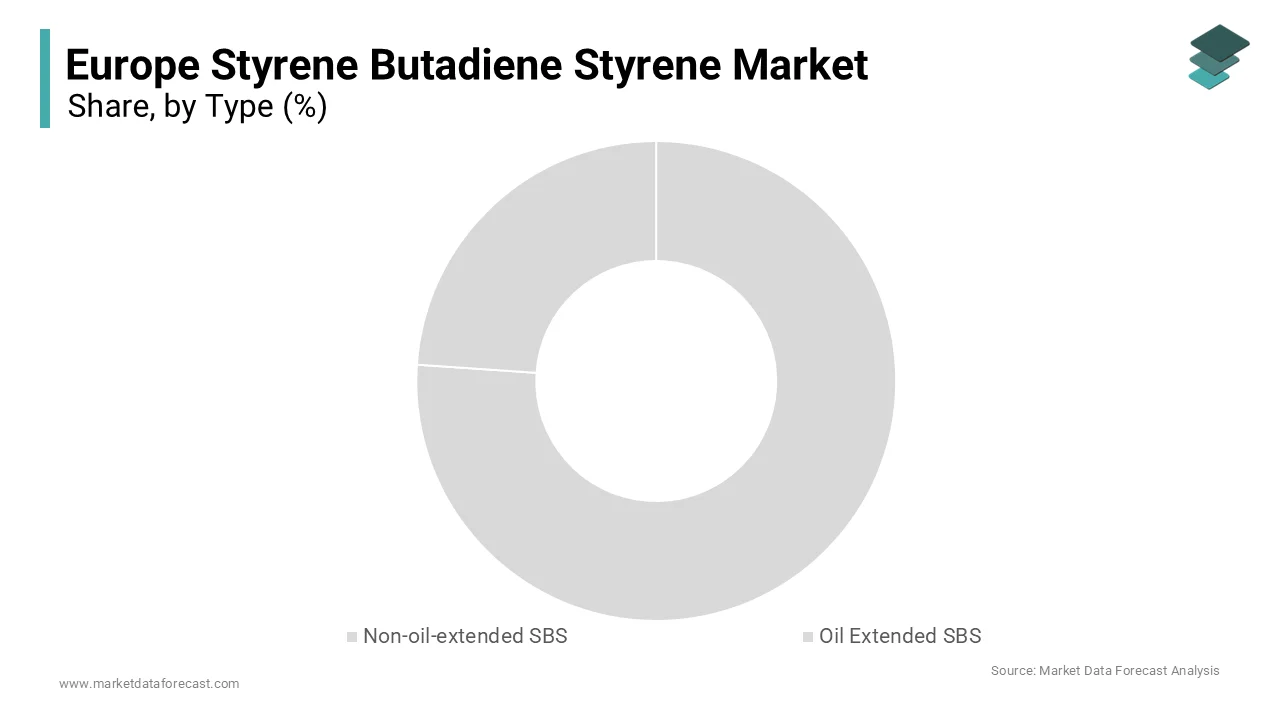
The non-oil extended SBS segment is predicted to witness the highest CAGR of 6.8% from 2026 to 2034 due to rising demand in high-purity applications where oil migratior odoururr is unacceptable, particularly in medical devices, food contact adhesives and premium consumer goods. EU regulations on food contact materials aim to strictly limit or eliminate certain mineral oil aromatic hydrocarbons (MOAH) that may pose a health risk. Hygiene product manufacturers are increasingly shifting to raw materials and adhesives with lower mineral oil content in response to growing regulatory scrutiny and consumer safety concerns. The EU Medical Devices Regulation emphasises stringent requirements for material safety, encouraging the use of pure polymer grades with well-defined extractable profiles to ensure product safety and compliance. Moreover, the European markspecialisededd, non-oil-extended thermoplastic elastomers in medical and hygiene applications is growing significantly, driven by a demand for safer, compliant materials. Additionally, the circular economy agenda discourages oil additives that complicate recyclinaligning non-oilill extended SBS with Europe’s design for recyclability principles and unlocking premium market access.
By Application Insights
The asphalt modification segment was the prominent segment the Europeanane styrene butadiene styrene market by capturing a share of 38.5% in 2025. The prominence of the asphalt modification segment is attributed to extensive road infrastructure renewal programs and regulatory mandates for durable pavement solutions. European Union policy under the Green Deal encourages member states to develop sustainable urban mobility plathat prioritisesee long-life infrastructure materials, such as those enhanced with SBS, to reduce overall transport sector emissions and maintenance needs. The European Asphalt Pavement Association and the wider industry actively advocate for the widespread adoption polymer-modified bitumen, including SBS, because these materials are proven to significantly increase pavement lifespan, reduce maintenance frequency, and improve overall environmental performance compared to conventional asphalt. Several European nations, including France and Spain, have modern road specifications that incorporate the use of polymer-modified binders, such as those made with SBS, for high-traffic applications to ensure performance and durability. The German Federal Ministry for Transport promotes the use of innovative and resilient materials for ongoing autobahn rehabilitation projects, reflecting a national commitment to creating durable and long-lasting transport infrastructure. addition ,the performance benefits, enhanced elasticity at low temperatures and resistance to rutting at high temperatures, coupled with public funding certainty,make asphalt modification the most stable volume-intensive SBS application in Europe.
The adhesives application segment is estimated to register the fastest CAGR of 7.4% during the forecast peio,,d owing to the shift toward sustainable flexible packaging and andpressure-sensitivee tapes that require strong initial tack, clean removability and compatibility with recyclable substrates. The evolving European Union packaging legislation is compelling brands to ensure all packaging is designed for reuse or effective recycling, moving away from complex, multi-layer materials that are difficult to recover. Adhesives compatible with polyolefin materials facilitate the creation of mono-material packaging structures, a design approach recommended by industry guidelines to improve recyclability without compromising functionality. Industry data indicates an increase in the use of pressure-sensitive adhesives in flexible packaging applications, driven by a preference for formulations that align with new product development and sustainability goals. Additionally, growth in the e-commerce sector has significantly increased the need for carton sealing tapes, with a notable portion of this demand met by specific high-performance adhesive formulations. The increasing focus on circularity and performance means that SBS adhesives are now seen less as simple components and more as drivers of overall packaging sustainability.
REGIONAL ANALYSIS
Germany Styrene Butadiene Styrene Market Analysis
Germany dominatthe Europeanane styrene butadiene styrene market by accounted for a 21.6% share in 2025. The dominance of the German market is driven by its advanced chemical manufacturing base and massive road rehabilitation needs. The country hosts key SBS producers such as INEOS Styrolution and Trinse,o whose integrated sites in Cologne and Frankfurt ensure reliable supply to downstream industries. Germany is undertaking significant efforts under national maintenance plans to upgrade and repair its extensive network of autobahns and federal roads, with a considerable portion requiring modern, durable surfacing solutions, such as polymer modification, in the coming years. The substantial German automotive manufacturing sector, a leader in European production, continues to produce a large volume of vehicles annualand utilises varioustyy speciality materials, including SBS polymers, for essential components like interior adhesives and protective coatings. Strict adherence to REACH and eco design standards has pushed local converters adopt high-puritytyy non-oil extended grades, elevating the market’s value profile. The German chemical industry, while a major part of the national economy and a high-performance elastomer hub, is actively pursuing significant decarbonization goals and transitioning towards increased use of renewable electricity and alternative feedstocks to align with national climate targets.
Italy Styrene Butadiene Styrene Market Analysis
Italy was the second-largest player in the European styrene butadiene styrene market by capturing a 16.6% share in 2025. The growth of the Italian market is propelled by its globally renowned footwear industry and polymer compounding expertise. Italian footwear production has experienced a period of decline in recent years, a trend reported by the national manufacturers' association. A key material for shoe outsoles, SBS elastomer, continues to be widely valued across the industry for its beneficial performance characteristics. Industrial districts like Riviera del Brenta and Tuscany house thousands of small and medium enterprises that rely on oil-extended SBS for cost-effective moulding, Concurrently, Italy is a major consumer of SBS in polymer modification for engineering plastics used in household appliances and automotive trims. Whirlpool and Electrolux’s Italian plants use SBS toughened polypropylene in dishwasher housings and refrigerator liners to enhance impact resistance. Italy's National Recovery and Resilience Plan broadly directs substantial investment toward circular economy initiatives and waste management improvements, fostering an environment where research and development in footwear recycling technologies, including those for elastomers like SBS, are emerging and gaining more attention. This dual focus on traditional craftsmanship and material innovation sustains Italy’s strong SBS demand.
France Styrene Butadiene Styrene Market Analysis
France grew steadily in the European styrene butadiene styrene market due to its comprehensimodernisationonn strategy and stringent construction material standards. The French government, through its Ministry for Ecological Transition and related agencies, promotes policies and programs that encourage the use of durable and sustainable road materials, including polymer-modified bitumen, on highly trafficked national roads. France is a prominent European consumer of SBS-modified bitumen, with the government agencies responsible for road maintenance overseeing its widespread application in national infrastructure projects. France also hosts major adhesive producers like Bosi,k whose EuropeR&D centrerer in Colombdevelops next-generationonn SBS formulations for recyclable packaging. The French Agency for Ecological Transition (ADEME) enforces strict volatile organic compound limits in construction materials, favouring SBS over solvent-based alternatives. Additionally, France’s medical device sector, ranked third in Europe, uses non-oil extended SBS in respiratory masks and infusion sets compliant with ANSM safety protocols. This blend of public infrastructure polihigh-valueuee industrial demand positions France as a diversified SBS market.
Spain Styrene Butadiene Styrene Market Analysis
Spain is emerging as a dynamic growth zone the Europeanane styrene butadiene styrene market owing its to itsclimate-drivenn road maintenance cycles and expanding footwear exports. High summer temperatures cause severe asphalt rutting, making SBS modification essential. Spain is increasingly adopting modified asphalt in road maintenance and construction projects to improve infrastructure durability and performance, a general trend in European road management. Moreover, Spain continues to be a major European exporter of footwear, maintaining a competitive position in international markets. The country’s chemical sectmodernisingngg rapidly. Repsol is actively developing and introducing more sustainable polymer solutions, including those with bio-based content that meenvironmental labellingngg standards. Spain's economy, fueled by increased investment in resilient transport and strong SME manufacturing, offers consistent growth opportunities for oil-extendspecialitytyy SBS grades.
United Kingdom Styrene Butadiene Styrene Market Analysis
The United Kingdom is predicted to expand the Europeanane styrene butadiene styrene market from 2026 to 2034 due to its leadershhigh-performancecee adhesives and medical device manufacturing. British adhesive specialists like Henkel UK and Dow Siliconsupply SBS-basededd formulations to the countrythriving e-commercecee and hygiene sectors. There is substantial usage of a specific type of polymer in a high-volume sector that distributes a large quantity of goods. This material is widely utilised as the basis for adhesives in packaging applications. Concurrently, a different industry focused on health and medical devices also employs the same class of polymer. This material's application in medical contexts is due to favourable properties such as compatibility with living tissue and suitability for sterilisation processes. The material serves a variety of purposes across these distinct industries, from general packaging adhesives to specialised health-related compounds. Post-Brexit regulatory autonomy has enabled faster approvals for novel SBS compounds under the UK REACH regime, attracting R&D investment. The UK's strong university-industry collaboration in polymer science, combined with a focus on circular design, positions it as Europe's innovation gateway for advanced SBS applications.
COMPETITIVE LANDSCAPE
Competition in the European styrene butadiene styrencharacterisedscharacterisedd by a balance between established integrated prodand specialisedlcompoundersounder,each vying for dominance through technical differentiation and sustainability credentials. INEOS Styrololiti, on Trin,seo and Arlan with large-scalege-scalee producapabilitiessiitie, stringent control, and deep regulatory expertise, enabling thserve high-volumemelume infrastructure and automotive sectorMeanwhileeh, the niche players focus on customised formulations for medical or premium footwear applications where performance and compliance outweigh cost considerations. The market is further shaped by tightening chemical regulations that raise barriers to entry and favour companies with in-house regulatory affairs teams. Feed volatility,y particular, butadiene,, creates cost pressures that only integrated players can partially mitigate through cracker synergies. Innovation increasingly centredrc on circularity, ty bio-based styrene and recyclable SBS grades becoming key competitive differentiators. As European end users demand both performance and environmental accountability, the competitive landscape rewards those who can deliver certified sustainable solutions without compromising application reliability.
KEY MARKET PLAYERS
Some of the notable key players the European styrene butadiene styrene market are
- Dynasol Group
- CNPC Capital
- Kumho Petrochemical
- Kraton Performance Polymers
- Biesterfeld
- LG Chem
- Avient Corp
- Trinseo PLC
Top Players in the Market
- INEOS Styrolution is a global leader in styrenics with a significant footthe EuropeanEuropeane styrene butadiene styrene market,, with its high-performance Lustran and Styroflex product lines. The company contributes globally by advancing solutions, including the development of pment omass-balancedeusing bio-basedbasedd styrene derived from waste cooking oiEuropeEurope Europe e INEOS Styrolution has strengthened its position by certifying multiple SBS grades under the ISCC PLUS sustainability framework and expanding compounding capacity at its plants in Germany and France. The company also collaborates with footwear and road construction associations to demonstrate the long-term performance and recyclability of its SBS formulation,supp orting downstream sustainability compliance across key European industries.
- Trinseo operates as a major of of sspeciality polymersSBSS tailored adhesives, asphalt mmasticationand medical applications across Europe. The company drives innovation through its EC, O series,,hich offers partially renewable content SBS grades aligned with the circulprinciplesprinciplet. In rrecent, Trinseo has enhanced its European presence by upgrading its productiofacilityty in Scmany to enable flswitchthe switchoil-extendedendedd SBS. The company also partners with EU road agencies to validate the ddurabilityunder diverse climatic conditions and actively participates in European chemical sustainability initiatives to ensure regulatory alignment and customer trust.
- Arlanxe,o a joint venture between Saudi Aramco and LANXE,SS is a key player in syntheticelastomers with a robust SBS portfolio serving the European footwear and polymer modification sectors. The company contributes globally by inintroducing butadiene-freeu energy-efficient team crackers into its productionensuringg consistent quality and supply ssecurityEuro,p e A rlanxeo has reinforced its market position by launching high clarity SBS grades for medical and packaging applications that meet stringent EU regulatory standards. The company also invests inthe services aItalys Italy Spa, in anItaly d the Netherlands to support customers with formulatiodevelopment and processoptimisationo, thereby deepening application expertise and accelerating product performance in high-performance segments.
Top Strategies Used by the Key Market Participants
Key playethe Europeanopeane styrene butadiene market prioritise compliance by aligning product portfolios with REACH CLP and EU circular economy directives through enhanced purity and traceability. They are in biand oo-based mass-balancedSBS formulations to meet corporate sustainability targets of major downstream brands in footwear packaging and medical devices. Strategic expansion of compounding and devolatilization capacity at integrated European sites ensures supply resilience amid feedstock volatility. Companies also strengthen technical service capabilities by establishing application development labs near key customer co-engineerco-engineerr solutions for asphalt modification and adhesiveperformance. Additionallyl, they pursue certification under sustainability schemes like ISCC PLUS to enable customers to claim recycled or renewable content in theiproductsp the oductsa lue chain credibility.
Europe Styrene Butadiene Styrene Market News
- In March 2025, INEOS Styrolution certified its Styroflex 2245 SBS grade under the ISCC PLUS mass balance system across all European production sites. This certification is anticipated to allow INEOS Styrolution to supply verified renewable content elastomers to footwear and packaging customers and strengththestrengthen EuropeanopeEuropeantadiene styrene market presence.
- In June 2025, Trinseo completed a capacity upgrade at its Schk Germany,ny plant to enable flexible produof nonnon-oiltended SBS grades. This upgrade is anticipated to allow Trinseo to meet rising demdemand frome e medical and hygiene sectostrengthenen itsEuropeane styrene butadiene styrene market presence.
- In August 2025, Arlanxeo opened a ntechnical service centre inrer Bressci, a I , focused on SBS formulation for footwear outsoles. This opening is anticipated to allow Arlanxeo to accelerate development with European shoemakers and strestrengthen ngththe EuroEuropeanrene butadiene styrene market presence.
- In October 2025, INEOS Styrolution launched StyLight SBS wi4with 0 per cent biobio-basedyrene content for European medical device manufacturers. This launch is anticipated to allow INEOS Styrolution to address EU medical sustainability requirements and strstrengthen engththe EurEuropeanyrene butadiene styrene market presence.
- In December 2025, Trinseo partnered with the French Road Directorate to validate tlothe long-termrformance of its SBS modified bitbitumene e motorway. This partnership is anticipated to allow Trinseo to influence public infrastructure specifications and strengthen the European styrene butadiene styrene market presence.
MARKET SEGMENTATION
This research report on the European styrene butadiene styrene market has been segmented and sub-segmented based on categories.
By Type
- Non-oil-extended SBS
- Oil Extended SBS
By Application
- Footwear
- Asphalt Modification
- Polymer Modification
- Adhesives
- Others
By Country
- UK
- France
- Spain
- Germany
- Italy
- Russia
- Sweden
- Denmark
- Switzerland
- Netherlands
- Turkey
- Czech Republic
- Rest of Europe
Frequently Asked Questions
1. What is the Europe styrene butadiene styrene market?
The Europe styrene butadiene styrene market covers the production and use of SBS, a thermoplastic elastomer widely used in adhesives, sealants, footwear, and construction materials.
2. What factors are driving growth in the Europe SBS market?
Growth is driven by rising demand from construction, roofing, automotive, and footwear industries, along with increased use in modified asphalt applications.
3. Which countries dominate the Europe SBS market?
Germany, Italy, France, the United Kingdom, and Spain are key markets due to strong industrial manufacturing and construction activity.
4. What are the main applications of SBS in Europe?
Major applications include hot-melt adhesives, pressure-sensitive adhesives, roofing membranes, footwear soles, polymer modification, and asphalt modification.
5. Why is SBS preferred over other elastomers?
SBS offers excellent elasticity, flexibility, impact resistance, and processability, making it suitable for diverse industrial applications.
6. How does the construction sector impact SBS demand?
The construction sector drives SBS demand through its use in waterproofing membranes, sealants, and SBS-modified bitumen for road construction.
7. What role does SBS play in adhesives and sealants?
SBS enhances adhesion strength, flexibility, and durability in adhesives and sealants used across packaging, construction, and automotive sectors.
8. What is the future outlook of the Europe SBS market?
The market is expected to grow steadily, supported by infrastructure development, industrial expansion, and rising demand for high-performance elastomers.
9. What challenges does the Europe SBS market face?
Challenges include raw material price volatility, competition from alternative elastomers, and environmental sustainability concerns.
10. How does technological innovation impact the SBS market?
Innovation in polymer processing and formulation improves SBS performance, efficiency, and application range.
Access the study in MULTIPLE FORMATS
Purchase options starting from
$ 2000
Didn’t find what you’re looking for?
TALK TO OUR ANALYST TEAM
Need something within your budget?
NO WORRIES! WE GOT YOU COVERED!
Call us on: +1 888 702 9696 (U.S Toll Free)
Write to us: sales@marketdataforecast.com