- Product Description Description
- Table of Contents TOC
- List of Table & Figure LOT
- Get Free Sample PDF Sample PDF
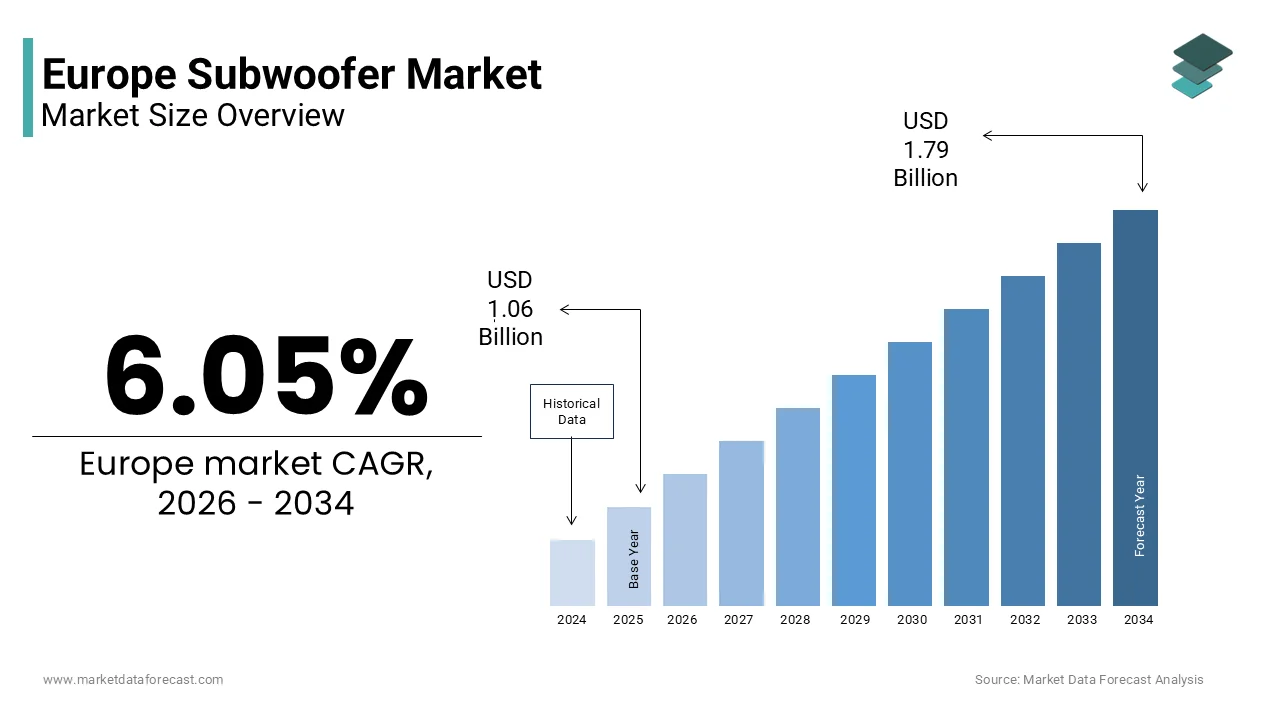
Market Size, 2025
$1.06 BnMarket Estimate, 2026
$1.12 BnMarket Forecast, 2034
$1.79 BnCAGR, 2026–2034
6.05%Europe Subwoofer Market Report Summary
The Europe subwoofer market was valued at USD 1.06 billion in 2025, is estimated to reach USD 1.12 billion in 2026, and is projected to reach USD 1.79 billion by 2034, growing at a CAGR of 6.05% during the forecast period from 2026 to 2034. The growth of the Europe subwoofer market is driven by increasing demand for high quality home entertainment systems, rising adoption of advanced audio technologies, and the growing popularity of immersive sound experiences in residential settings. Consumers across Europe are increasingly investing in premium speakers and home theater systems to enhance music streaming, gaming, and movie viewing experiences. In addition, the expansion of online retail channels, integration of wireless connectivity features, and growing interest in smart home audio ecosystems are further supporting market growth.
Key Market Trends
- Increasing demand for immersive home audio systems driven by rising consumption of streaming content, gaming, and home theater entertainment.
- Growing adoption of active subwoofers that integrate built in amplification and offer improved sound performance and installation convenience.
- Rising popularity of wireless and smart audio systems that allow seamless integration with smart televisions, voice assistants, and streaming devices.
- Expansion of online retail platforms enabling consumers to access a wide variety of audio equipment with product comparisons and customer reviews.
- Increasing consumer preference for compact yet powerful subwoofers designed for modern living spaces and minimalist home interiors.
Segmental Insights
- Based on type, the active subwoofers segment held a dominant share of the Europe subwoofer market in 2024. The segment’s growth is driven by the convenience of integrated amplification, simplified setup, and improved sound control, making active subwoofers a preferred choice for home audio systems.
- Based on application, the home audio segment was the largest in the Europe subwoofer market in 2024. The increasing demand for home theater systems, music streaming devices, and premium soundbars is contributing to the strong adoption of subwoofers in residential audio setups.
- Based on distribution channel, the online stores segment accounted for 52.3% of the Europe subwoofer market share in 2024. The growth of this segment is supported by the rapid expansion of e commerce platforms, availability of product reviews, competitive pricing, and convenient home delivery services.
Regional Insights
- The Europe subwoofer market is witnessing steady growth across several countries due to rising consumer spending on entertainment electronics and growing interest in high fidelity audio systems.
- Germany was the largest contributor, accounting for 21.4% of the Europe subwoofer market share in 2024. The country’s strong consumer electronics market, high adoption of premium audio equipment, and increasing demand for advanced home entertainment systems are supporting market growth.
Competitive Landscape
The Europe subwoofer market is highly competitive with the presence of global audio equipment manufacturers focusing on product innovation, wireless connectivity features, and enhanced acoustic performance. Companies are investing in advanced speaker technologies, compact designs, and smart audio integrations to strengthen their market position. Prominent players in the Europe subwoofer market include SVS, Klipsch, Bowers and Wilkins, Yamaha, Pioneer, JBL, Polk Audio, Sonos, Cerwin Vega, Bose Corporation, KEF International, Infinity, and Audioengine.
Europe Subwoofer Market Size
The Europe subwoofer market size was valued at USD 1.06 billion in 2025 and is projected to reach USD 1.79 billion by 2034 from USD 1.12 billion in 2026, growing at a CAGR of 6.05%.
The subwoofer is design manufacturing and distribution of specialized loudspeakers engineered to reproduce low frequency audio signals typically below 200 hertz across consumer professional and automotive applications. These devices are integral to immersive audio experiences in home theater systems gaming setups live sound reinforcement and vehicle entertainment suites. Unlike full range speakers subwoofers focus exclusively on bass reproduction using dedicated drivers enclosures and amplification to deliver depth impact and spatial realism. As per the European Audio Association, over 18 million households in the EU owned a home theater or multi-channel audio system in 2024 indicating substantial installed infrastructure for subwoofer integration. Urbanization trends further amplify demand as compact living spaces drive preference for powered compact subwoofers that enhance perceived audio quality without requiring large speaker footprints. Additionally cinematic content consumption remains robust with many Europeans streamed films or series weekly in 2024 heightening expectations for theater like sound at home.
MARKET DRIVERS
Proliferation of Immersive Home Entertainment Systems Drives Consumer Demand
The widespread adoption of high-fidelity home entertainment ecosystems has significantly elevated subwoofer necessity, across European households. The proliferation of immersive home entertainment systems is escalating the growth of Europe subwoofer market. The shift from stereo to 5.1 and 7.1 surround sound in home theaters has made subwoofers non optional components rather than luxury add ons. In Germany, France, and the UK national surveys by GfK indicate that 58% of new television purchases in 2024 were paired with external audio systems, including soundbars with wireless subwoofers or full multi speaker setups. Gaming also contributes substantially as next generation consoles support object-based audio formats that leverage deep bass for environmental realism. This cultural normalization of cinematic sound at home transforms the subwoofer from an audiophile niche into a mainstream expectation particularly among urban millennials who prioritize experiential media consumption within space constrained apartments.
Growth of Premium Automotive Audio and In Car Entertainment Integration
The automotive manufacturers are increasingly embedding high performance subwoofers into factory installed audio systems as a key differentiator in mid to high end vehicle segments. The growth of premium automotive audio and In car entertainment integration is additionally fuelling the growth of Europe subwoofer market. According to data from the European Automobile Manufacturers Association, over 34% of new passenger cars sold in Western Europe in 2024 featured branded premium audio systems from partners like Harman Bang & Olufsen or Burmester all of which include dedicated subwoofers integrated into door panels trunks or under seats. Electric vehicles further accelerate this trend as the absence of engine noise elevates the prominence of cabin acoustics making bass response a quality metric. Volvo’s partnership with Google in its EX90 model includes a 16-speaker system with dual subwoofers tuned for spatial audio playback, while BMW’s i7 offers an optional 35 speaker Bowers & Wilkins Diamond Surround System featuring a 10 inch subwoofer. These integrations are no longer confined to luxury marques but extend to volume brands like Volkswagen and Peugeot in their EV lineups reflecting consumer demand for holistic sensory experiences beyond propulsion and connectivity.
MARKET RESTRAINTS
Stringent Noise Regulations in Urban Residential Areas Limit Usage
Despite technological appeal, subwoofer adoption and usage face significant constraints from municipal noise ordinances prevalent across densely populated European cities. Local laws in cities like Paris Berlin Amsterdam and Stockholm enforce strict decibel limits during evening and nighttime hours often prohibiting low frequency sound transmission that can travel through walls and floors due to its long wavelength. According to the European Environment Agency, over 113 million urban residents are exposed to harmful levels of environmental noise prompting municipalities to enact Article 8 compliant noise action plans under the Environmental Noise Directive. Many apartment lease agreements explicitly ban subwoofer use after 10 PM with fines or eviction as penalties. These social and legal barriers suppress actual utilization even when ownership exists thereby dampening replacement cycles and premium model uptake in urban cores where market density is highest.
Space Constraints in European Housing Reduce Practicality of Large Enclosures
The architectural reality of European residential living characterized by smaller average dwelling sizes persistent barrier to integration particularly for larger ported or sealed box designs, which is limiting the growth of Europe subwoofer market. As per Eurostat reports that the average floor area per person in EU urban households is just 33 square meters with countries like Spain, Italy, and the Netherlands, thereby averaging below 30 square meters. In such environments, bulky subwoofers compete for limited floor space conflicting with minimalist interior aesthetics favored in contemporary design. While compact powered models exist they often compromise on output and extension leading to consumer dissatisfaction. This spatial friction discourages first time buyers and pushes consumers toward all in one soundbars that simulate bass electronically albeit with reduced physical impact.
MARKET OPPORTUNITIES
Integration of Smart Calibration and Room Correction Technologies Enhances Value Proposition
The advanced digital signal processing now enables subwoofers to automatically adapt to room acoustics mitigating traditional placement challenges and boosting consumer confidence. The integration of smart calibration and room correction technologies enhances value proposition, which is creating new opportunities for the growth of Europe subwoofer market. Brands like KEF Sonos and Yamaha have embedded proprietary room correction algorithms that use built in microphones to analyze frequency response and apply real time equalization ensuring optimal bass performance regardless of location. According to the Fraunhofer Institute for Integrated Circuits, over 60% of new subwoofers launched in Europe in 2024 featured some form of auto calibration. This technology addresses a key pain point identified in consumer studies where improper placement led to boomy or null bass zones. Furthermore, integration with voice assistants and multi-room ecosystems allows users to control bass levels via app or voice command enhancing convenience and encouraging adoption among non-technical users seeking seamless smart home compatibility.
Rise of Compact High Excursion Drivers Enables Discreet Yet Powerful Designs
Innovations in driver engineering have yielded subwoofers that deliver deep authoritative bass from enclosures small enough to fit under sofas or inside entertainment units without visual intrusion. The rise of compact high excrusion drivers enables disreet yet powerful designs is additionally to bolster the growth of Europe subwoofer market. The development of high excursion woofers using lightweight yet rigid materials like aluminum honeycomb cones and advanced suspension systems allows greater air displacement in minimal volumes. Companies, such as REL Acoustics and SVS now offer models under 30 liters that reach below 20 hertz, previously achievable only with large cabinets. Their discreet profiles align with Scandinavian and Central European design sensibilities that prioritize uncluttered interiors. This engineering breakthrough bridges the gap between acoustic performance and spatial practicality enabling broader acceptance in studio apartments and heritage buildings where aesthetic preservation is paramount.
MARKET CHALLENGES
Intense Price Competition from Asian Mass Market Brands Erodes Margins
The relentless downward pricing pressure from Chinese and Southeast Asian manufacturers offering feature rich products at significantly lower costs is a challenging factor for the growth of Europe subwoofer market. Brands like Edifier Tranya and TaoTronics leverage economies of scale and direct to consumer e-commerce models to sell powered subwoofers with Bluetooth DSP and wireless connectivity for under 150 euros. This influx forces established European and American brands to either discount premium models jeopardizing brand equity or risk losing share in the mid-tier segment. Smaller regional manufacturers lacking global supply chains struggle to compete on cost while maintaining quality standards required by EU safety and electromagnetic compatibility directives. The resulting margin compression stifles R&D investment in acoustic innovation where returns are long term.
Consumer Confusion Over Technical Specifications Hinders Informed Purchasing
Despite growing interest, many European consumers lack the knowledge to differentiate subwoofer performance based on technical parameters leading to mismatched expectations and post purchase dissatisfaction. Marketing often emphasizes misleading metrics like “peak power” or “maximum SPL” rather than meaningful indicators such as frequency extension group delay or distortion at rated output. This knowledge gap results in over reliance on brand name price or aesthetics rather than acoustic suitability. Retailers frequently lack trained staff to guide decisions especially in mass market electronics chains. Consequently consumers may purchase undersized or poorly integrated units that fail to deliver expected bass impact fostering awareness toward the category and reducing willingness to upgrade or invest in higher fidelity solutions.
REPORT COVERAGE
| REPORT METRIC | DETAILS |
| Market Size Available | 2025 to 2034 |
| Base Year | 2025 |
| Forecast Period | 2026 to 2034 |
| CAGR | 6.05% |
| Segments Covered | By Type, Application, Distribution Channel, End User, and Region |
| Various Analyses Covered | Global, Regional, & Country Level Analysis; Segment-Level Analysis; DROC, PESTLE Analysis; Porter’s Five Forces Analysis; Competitive Landscape; Analyst Overview of Investment Opportunities |
| Regions Covered | UK, France, Spain, Germany, Italy, Russia, Sweden, Denmark, Switzerland, Netherlands, Turkey, and the Czech Republic |
| Market Leaders Profiled | SVS, Klipsch, Bowers & Wilkins, Yamaha, Pioneer, JBL, Polk Audio, Sonos, Cerwin Vega, Bose Corporation, KEF international, Infinity, and Audioengine. |
SEGMENTAL ANALYSIS
By Type Insights
The active subwoofers segment held a dominant share of the Europe subwoofer market in 2024. The growth of the segment is driven by their plug and play convenience integrated amplification and optimized driver amplifier matching, which eliminate the need for external power management. Unlike passive models that require separate AV receivers or power amps active subwoofers feature built in crossovers volume controls and room calibration by making them ideal for mainstream consumers with limited technical expertise. In urban markets like Germany, France, and the Netherlands, over 80% of home theater subwoofer purchases in 2024 were active units, as per the reports. The rise of soundbar ecosystems from Sonos Bose and Samsung, which rely exclusively on wireless active subwoofers that has further entrenched this preference. Additionally, EU energy efficiency regulations favor self-contained Class D amplifiers commonly used in active designs due to their low standby power consumption aligning with Ecodesign Directive requirements.
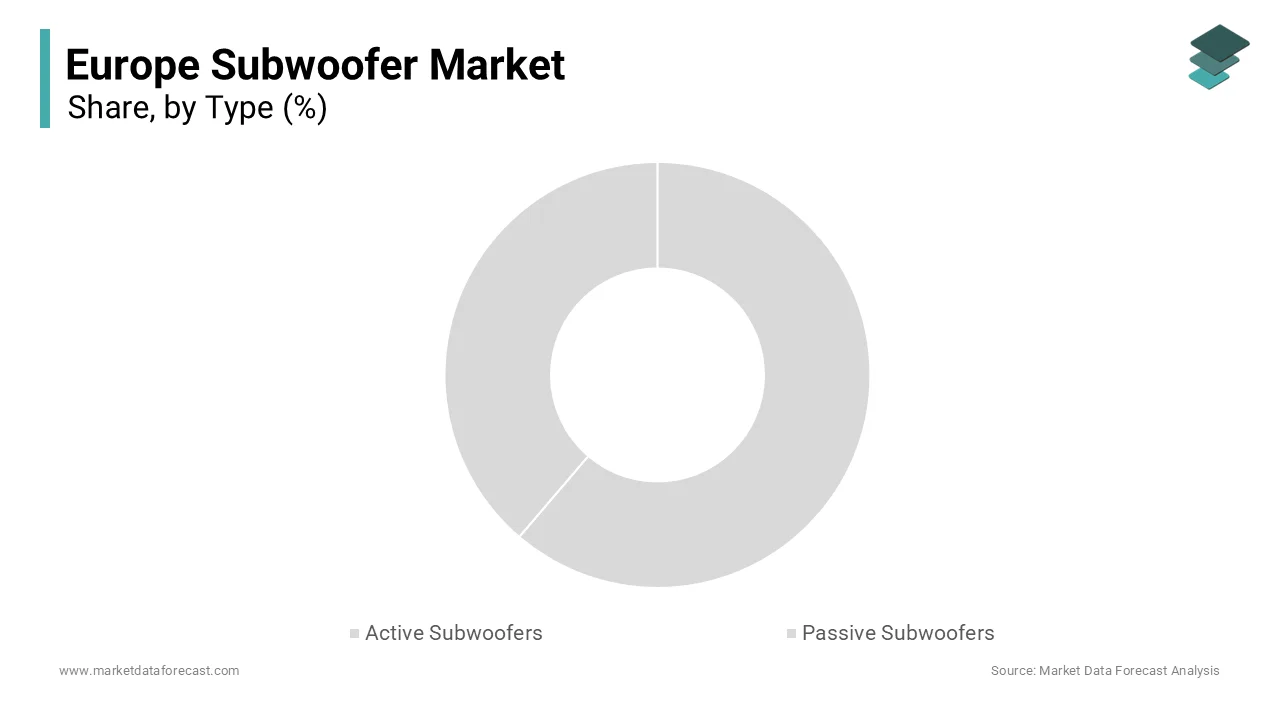
The active subwoofers segment is also a fastest growing segment at a fastest CAGR of 9.4% during the forecast period with the smart integration features such as Wi Fi, Bluetooth, and app based room correction that transform subwoofers into connected audio nodes within broader smart home ecosystems. In 2024, over 65% of new active models launched in Europe included automatic EQ via microphone analysis with a feature now expected by consumers seeking hassle free setup. Automotive premium audio partnerships also drive innovation, brands like REL Acoustics supply custom active modules for Volvo’s high-end systems featuring digital signal processing tuned to cabin acoustics. Furthermore, the shift toward compact living in cities like Copenhagen and Vienna favors all in one active designs that deliver deep bass from small footprints. Regulatory alignment with EU Radio Equipment Directive ensures seamless wireless certification accelerating time to market for new connected models.
By Application Insights
The home audio segment was the largest by holding a dominant share of the Europe subwoofer market share in 2024 from the emergence of streaming culture home theater adoption and spatial audio content proliferation. Multi room audio systems from Sonos and Denon routinely bundle wireless subwoofers to enhance music and movie playback creating recurring upgrade cycles. Urbanization amplifies demand as compact apartments benefit from single subwoofer solutions that compensate for small satellite speakers. National surveys in the UK and Sweden show that over 50% of new TV buyers in 2024 added a subwoofer within six months primarily to improve dialogue clarity and low-end impact demonstrating its transition from luxury to essential component in modern domestic audio setups.
The car audio segment is likely to register a fastest CAGR of 11.2% throughout the forecast period owing to the premiumization of in vehicle entertainment in electric vehicles where the absence of engine noise heightens acoustic expectations. In 2024, over 34% of new passenger cars sold in Western Europe featured factory installed premium audio systems, all of which include dedicated subwoofers as standard or optional equipment. Brands like Harman Bang & Olufsen and Burmester integrate compact, yet powerful active subwoofers into door panels trunks or under seats using proprietary mounting techniques that maximize cabin bass response.
By Distribution Channel Insights
The online stores segment was accounted in holding 52.3% of the Europe subwoofer market share in 2024 owing to the consumer electronics purchasing behavior, where price transparency product comparisons and home delivery outweigh in person demonstrations. Major platforms like Amazon Otto and MediaMarkt online offer extensive subwoofer catalogs with user reviews detailed specifications and algorithm driven recommendations that guide purchase decisions. During the 2024 holiday season online audio sales grew by 19% year over year with subwoofers among the top five best-selling categories in the home entertainment segment. Direct to consumer brands like SVS and KEF leverage e commerce to bypass traditional retail markups offering higher performance at competitive prices. Additionally, subscription based financing options and extended return policies reduce perceived risk encouraging trial of premium models that might otherwise require physical audition.
The online stores segment is expected to witness fastest CAGR of 12.6% during the forecast period with the immersive digital shopping tools, including 360 degree product views augmented reality placement previews and AI powered sound simulations that approximate real world performance. In 2024, Sonos launched an AR feature allowing users to visualize subwoofer size in their living room via smartphone camera significantly reducing size related returns. Cross border e-commerce within the EU has also expanded access to niche brands, where German consumers can now easily purchase Danish or Swedish audiophile subwoofers without import barriers. Logistics improvements including same day delivery in major cities and carbon neutral shipping options further enhance appeal.
REGIONAL ANALYSIS
Germany Subwoofer Market Analysis
Germany was the largest contributor of the Europe subwoofer market by capturing 21.4% of share in 2024 with the strong engineering heritage high disposable income and deep-rooted audiophile culture. Over 45% of German households own a multi-channel audio system with subwoofers commonly integrated into both home theater and hi-fi setups. The country hosts leading audio brands like Teufel and Magnat whose R&D centers continuously refine driver materials and enclosure design. Germany’s strict adherence to EU Ecodesign and RoHS directives ensures high product quality while discouraging low-cost imports. Urban renewal projects in Berlin and Munich increasingly include acoustic insulation standards that encourage controlled bass use fostering responsible subwoofer adoption rather than suppression.
United Kingdom Subwoofer Market Analysis
The United Kingdom subwoofer market was positioned second by holding 17.8% of the share in 2024 with the early adoption of streaming and smart home ecosystems. According to Ofcom, many UK households streamed video content weekly in 2024 driving demand for immersive audio upgrades. The UK remains unique in Europe for its vibrant independent audio retail sector with stores like Richer Sounds offering expert consultation and demo rooms that build consumer confidence.
France Subwoofer Market Analysis
France subwoofer market growth is likely to grow with the distinctive blend of luxury audio preference and urban spatial constraints. Its market status is shaped by high penetration of premium television brands like Canal+ that promote Dolby Atmos content requiring subwoofers for full effect. Data from the French Consumer Electronics Federation shows that 61% of subwoofer buyers in 2024 prioritized aesthetic design alongside performance favoring compact models that complement minimalist interiors. Parisian noise ordinances restrict bass after 10 PM yet demand remains robust due to advanced room correction technologies that minimize neighbor disturbance. French brands like Focal integrate subwoofers into high end furniture collaborations appealing to design conscious consumers unwilling to compromise on visual harmony.
Italy Subwoofer Market Analysis
Italy holds 10.9% of the market marked by regional disparities and strong automotive influence. Its market status combines southern price sensitivity with northern premium adoption particularly in Milan and Turin where home theater culture thrives. According to ISTAT, over 58% of Italian households purchased audio equipment in 2024 with subwoofers increasingly paired with designer TVs from brands like LG and Samsung. The automotive sector drives co development where Fiat’s partnership with Beats that includes a trunk mounted active subwoofer in the 500 Electric model. Italian interior design sensibilities favor hidden or furniture integrated subwoofers leading local manufacturers like Sonus faber to develop bespoke enclosures that double as side tables or media consoles blending acoustic function with artisanal craftsmanship.
Sweden Subwoofer Market Analysis
Sweden subwoofer market growth is key to grow with the sustainability focus and tech integration. Over 70% of subwoofers sold in Sweden in 2024 carried Nordic Swan Ecolabel certification indicating low energy use recyclable materials and sustainable manufacturing, as per the Swedish Environmental Research Institute. Brands like IKEA’s collaboration with Sonos on the SYMFONISK line embed subwoofers into bookshelves and lamps maximizing utility in compact dwellings. High broadband penetration enables seamless streaming of spatial audio content, while strict building codes in Stockholm and Gothenburg mandate acoustic insulation that supports responsible bass enjoyment without community disruption.
COMPETITIVE LANDSCAPE
The Europe subwoofer market features intense rivalry among established audio specialists innovative tech driven brands and mass market electronics manufacturers. Premium players like Sonos KEF and Bowers & Wilkins compete on acoustic fidelity design elegance and smart integration while mid-tier brands such as Yamaha Denon and Teufel emphasize value and feature richness. Simultaneously Asian manufacturers flood online channels with low-cost alternatives creating significant price pressure. Competition is further shaped by shifting consumer expectations toward wireless connectivity space efficiency and aesthetic harmony with modern interiors. Differentiation hinges on proprietary technologies like active noise cancellation room correction algorithms and force balanced driver arrays that deliver deep bass without structural vibration. Retail dynamics also play a role as specialty stores offer expert guidance while e commerce platforms drive volume through reviews and bundling.
KEY MARKET PLAYERS
Some of the notable key players in the Europe subwoofer market are
- SVS
- Klipsch
- Bowers & Wilkins
- Yamaha
- Pioneer
- JBL
- Polk Audio
- Sonos
- Cerwin-Vega
- Bose Corporation
- KEF international
- Infinity
- Audioengine
Top Players in the Market
- Sonos is a global leader in smart wireless audio systems with a commanding presence in the Europe subwoofer market through its Sub and Sub Mini products. The company contributes to the global audio ecosystem by pioneering multi room wireless synchronization and seamless integration with voice assistants and streaming platforms. In Europe Sonos has cultivated strong brand loyalty by emphasizing minimalist design acoustic precision and effortless setup. Recently the company enhanced its European footprint by launching the Sub Mini tailored for compact urban apartments and expanded compatibility with European smart home standards like Matter over Thread. It also deepened partnerships with premium TV brands such as Samsung and LG to enable automatic bass calibration when connected to European models ensuring optimal performance out of the box.
- Bose maintains a prominent position in the Europe subwoofer market through its premium home theater and soundbar ecosystems including the Bass Module series. Globally Bose is recognized for psychoacoustic engineering that delivers perceived deep bass even from compact enclosures. In Europe the company leverages its reputation for reliability and immersive audio to serve both consumer and automotive segments. Recent initiatives, include the integration of Bose Smart Soundbar subwoofers with European broadcast standards for Dolby Atmos via Sky and Canal+ services. Bose also introduced adaptive room calibration software that automatically adjusts bass output based on European apartment acoustics reducing neighbor disturbance and aligning with urban noise sensitivity.
- KEF a British high fidelity audio brand renowned for its Uni Q driver technology plays a pivotal role in the Europe subwoofer market with its KC62 and Kube series. The company contributes globally by advancing compact subwoofer design using force cancelling dual drivers that minimize cabinet vibration, ideal for European hardwood floors and thin walls. KEF’s R&D center in Maidstone England collaborates with European architects and interior designers to create acoustically powerful yet visually discreet solutions.
Top Strategies Used by the Key Market Participants
Key players in the Europe subwoofer market are prioritizing wireless integration with smart home ecosystems to enhance user convenience and reduce cable clutter. They are developing compact yet high output designs using advanced materials and force cancelling technologies to suit small urban living spaces. Companies are embedding automatic room calibration and adaptive EQ to optimize bass performance while minimizing neighbor disturbance in dense residential buildings. Strategic partnerships with television automotive and streaming service providers ensure seamless interoperability and bundled promotions. Additionally, brands are emphasizing sustainability through recyclable materials energy efficient Class D amplifiers and compliance with EU Ecodesign and RoHS directives to appeal to environmentally conscious consumers.
MARKET SEGMENTATION
This research report on the European subwoofer market has been segmented and sub-segmented based on categories.
By Type
- Active Subwoofers
- Passive Subwoofers
By Application
- Home Audio
- Cinema Sound
- Car Audio
- Sound Reinforcement
- Others
By Distribution Channel
- Online Stores
- Specialty Stores
- Supermarkets/Hypermarkets
- Others
By End User
- Residential
- Commercial
- Automotive
- Others
By Country
- UK
- France
- Spain
- Germany
- Italy
- Russia
- Sweden
- Denmark
- Switzerland
- Netherlands
- Turkey
- Czech Republic
- Rest of Europe