- Product Description Description
- Table of Contents TOC
- List of Table & Figure LOT
- Get Free Sample PDF Sample PDF
Europe Surgical Robots Market Report Summary
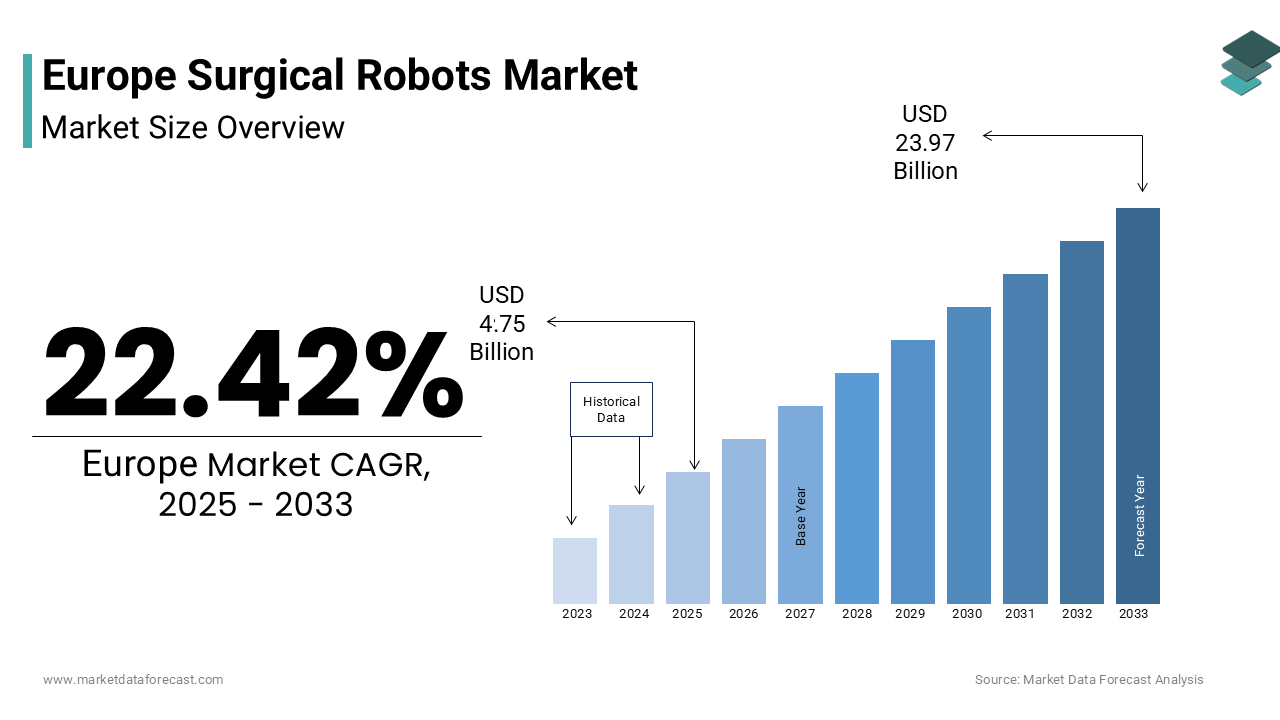
The Europe surgical robots market was valued at USD 3.88 billion in 2024, is estimated to reach USD 4.75 billion in 2025, and is projected to reach USD 23.97 billion by 2033, growing at a CAGR of 22.42% during the forecast period from 2025 to 2033. The growth of the Europe surgical robots market is driven by the increasing adoption of minimally invasive robotic-assisted procedures, rising prevalence of chronic diseases requiring precision surgery, and expanding integration of robotics into national surgical training programs. Growing clinical validation across specialties such as urology, gynecology, and general surgery, along with ongoing technological advancements in robotic platforms, are further fueling market growth. Moreover, the introduction of compact and modular systems, supportive clinical guidelines, and improved visualization and dexterity features has broadened access to robotic-assisted surgery across hospitals in Europe.
Key Market Trends
- Increasing preference for robotic-assisted surgeries is driven by better precision, reduced complications, and enhanced postoperative outcomes.
- Growing integration of robotics into surgical training curricula across European countries to address skill gaps and standardize high-quality care.
- Rising adoption of next-generation modular and compact robotic systems is enabling wider hospital penetration.
- Expansion of robotic-assisted procedures beyond core applications into neurosurgery, colorectal, cardiothoracic, and head & neck surgery.
- Strengthening focus on digital integration, including AI-driven navigation, simulation training, and advanced data analytics for better surgical outcomes.
Segmental Insights
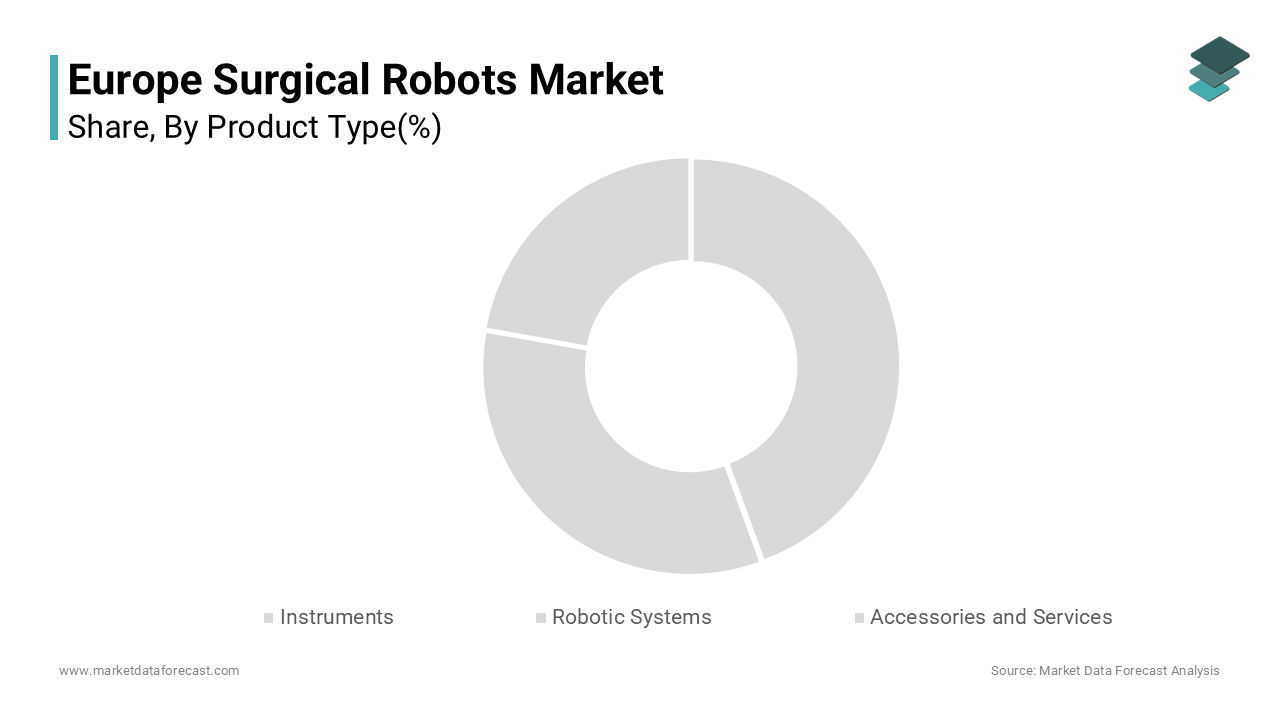
- Based on product type, the instruments segment was the largest and held a significant share of the Europe surgical robots market in 2024. The segment’s leadership is attributed to recurring procedure-driven demand for disposable surgical instruments and precision end-effectors essential for robotic operations.
- Based on brand, the da Vinci Surgical System segment accounted for a prominent share of the Europe surgical robots market in 2024. Its dominance is due to its extensive clinical validation, large installed base, and strong integration across urology, gynecology, and general surgery procedures.
- Based on application, the radical prostatectomy segment captured the largest share of the Europe surgical robots market in 2024, supported by widespread adoption of robotics as the standard of care for prostate cancer due to improved continence and functional outcomes.
Regional Insights
The Europe surgical robots market is experiencing strong growth across major countries, supported by rising clinical awareness, hospital modernization, and national investments in robotic surgery infrastructure.
- Germany was the largest contributor, accounting for 26.3% of the Europe surgical robots market share in 2024, driven by strong hospital adoption, extensive robotic training ecosystems, and robust reimbursement support for selected procedures.
- The United Kingdom continues to perform well, supported by national robotic training networks, centralized procurement, and rising robotic surgery volumes across NHS Trusts.
- France shows steady momentum due to academic hospital leadership, national funding programs for minimally invasive surgery, and strong adoption of robotic systems in gynecologic oncology.
- Italy is emerging as a key market with high-volume urology and colorectal programs and strong regional reimbursement policies supporting robotic system deployment.
Competitive Landscape
The Europe surgical robots market is characterized by the dominance of established robotic system manufacturers with strong clinical evidence, extensive installed bases, and advanced training networks. Leading companies are focusing on innovating next-generation robotic platforms, expanding specialty-specific applications, and enhancing system affordability through modular designs. Strategic partnerships with hospitals, investments in surgeon training, and service-driven business models are strengthening market competitiveness. Prominent players in the Europe surgical robots market include Intuitive Surgical, Medtronic, Stryker Corporation, Smith & Nephew, Zimmer Biomet, Siemens Healthineers, CMR Surgical, Johnson & Johnson (Ethicon/Auris Health), Renishaw plc, Medtech SA (Zimmer Biomet), Distalmotion, Titan Medical, and Think Surgical.
Europe Surgical Robots Market Size
The Europe Surgical Robots Market size was valued at USD 3.88 billion in 2024 and is anticipated to reach USD 4.75 billion in 2025 from USD 23.97 billion by 2033, growing at a CAGR of 22.42% during the forecast period from 2025 to 2033
The surgical robot is a computer assisted electromechanical system that enables surgeons to perform minimally invasive procedures with enhanced precision dexterity and visualization. These systems typically consist of a surgeon console a patient side cart with robotic arms and a high-definition 3D vision system that translates hand movements into scaled micro motions while filtering tremor. As per the European Society of Surgical Oncology, over 380,000 robotic assisted procedures were performed across the European Union in 2024 with urology gynecology and general surgery representing the core specialties. National health technology assessment bodies in countries like Germany France and the UK evaluate cost effectiveness before granting reimbursement which significantly influences adoption.
MARKET DRIVERS
Increasing Prevalence of Chronic Diseases Requiring Minimally Invasive Interventions
The rising burden of cancer and benign chronic conditions for robotic assisted surgery due to its clinical advantages in complex oncologic and reconstructive procedures is certainly a major factor driving the growth of the Europe Surgical Robots Market. The European Association of Urology notes that most of radical prostatectomies in Germany and the UK are now performed robotically due to superior nerve sparing and continence outcomes. Similarly, the European Society of Gynaecological Oncology reports that robotic surgery reduces conversion to open procedures by 40% in endometrial cancer staging. These clinical benefits translate into shorter hospital stays fewer complications and faster return to productivity aligning with national healthcare efficiency goals under pressure from aging demographics and strained budgets.
Integration of Robotics into National Surgical Training and Workforce Development Programs
The European healthcare systems are formally incorporating surgical robots into resident training curricula to address workforce shortages and standardize high quality care is additionally to fuel the growth of the Europe Surgical Robots Market. The UK’s Royal College of Surgeons launched the National Robotic Training Network in 2022 which has certified more than 1,200 surgeons in robotic fundamentals as of 2024. Germany’s Federal Ministry of Health funds simulation based robotic training centers in Berlin Munich and Hamburg to accelerate skill acquisition and reduce the learning curve. This institutionalization transforms robotics from an optional tool into a core competency for the next generation of surgeons. Furthermore, with the EU facing a projected deficit of 230 000 surgeons by 2030 per Eurostat such training investments are critical to maintaining surgical capacity while improving patient outcomes through standardized minimally invasive techniques.
MARKET RESTRAINTS
Stringent Health Technology Assessment and Limited Reimbursement Coverage
The fragmented and conservative health technology assessment processes that often delay or deny reimbursement for robotic procedures is a restraining factor for the growth of Europe Surgical Robots Market. According to the European Observatory on Health Systems and Policies, only 14 of 27 EU member states provide consistent national reimbursement for robotic surgery with others leaving decisions to regional authorities or individual hospitals. In France the Haute Autorité de Santé requires extensive comparative effectiveness data before granting additional payment which took over three years for robotic prostatectomy. The UK’s National Institute for Health and Care Excellence has yet to issue broad guidance favoring robotics leading to postcode lotteries in availability. T
High Capital and Operational Costs Deterring Widespread Hospital Adoption
The substantial upfront investment and recurring expenses associated with surgical robots to adoption especially in publicly funded and resource constrained healthcare systems is another factor hindering the growth of Europe Surgical Robots Market. Additionally, each procedure consumes disposable instruments costing 1,800 to 2,500 euros, which are not always covered by reimbursement tariffs. In Southern and Eastern Europe, where per capita healthcare expenditure remains below 2,000 purchasing power parity dollars less than half the EU average. A 2023 survey by the European Federation of Hospitals found that 68% of district hospitals in Romania Greece and Portugal ruled out robotic adoption due to budget limitations.
MARKET OPPORTUNITIES
Expansion into New Surgical Specialties Beyond Core Applications
The previously unaddressed specialties creating new clinical and commercial frontiers isattribute to create new opportunities for the growth of Europe Surgical Robots Market. According to the European Association of Neurological Surgeons, robotic systems are now being used in transnasal skull base tumor resections with trials at University Hospital Heidelberg demonstrating 30% less intraoperative bleeding compared to conventional endoscopy. In cardiothoracic surgery, the European Association for Cardio Thoracic Surgery reports that robotic mitral valve repair adoption grew by 42% in 2023 with centers in Italy and the Netherlands achieving 98% repair rates. Head and neck oncology is another emerging field where robots enable transoral resection of oropharyngeal tumors preserving speech and swallowing function. The European Head and Neck Society has endorsed robotics in its 2024 guidelines for selected indications. Additionally, colorectal and hepatobiliary procedures are seeing increased robotic use with the European Society of Coloproctology noting a 25% reduction in anastomotic leaks in robotic low anterior resections. These clinical validations supported by specialty society endorsements are unlocking new patient populations and driving system utilization beyond traditional urology and gynecology.
Development of Next Generation Compact and Modular Robotic Platforms
The emergence of smaller more affordable robotic systems is democratizing access and enabling deployment in diverse clinical settings is additionally to fuel the growth of Europe Surgical Robots Market. As per the European Federation of Robotics, companies like CMR Surgical and Medineering have introduced CE marked systems priced under 500,000 euros with procedure specific disposable costs below 1 200 euros. Germany’s Innovation Fund supported a 2023 study showing that compact robots reduced operating room setup time by enabling higher case throughput. Furthermore, these systems are designed for easier integration with existing laparoscopic workflows requiring less specialized staff training.
MARKET CHALLENGES
Lack of Standardized Clinical Evidence and Long Term Outcome Data
The absence of harmonized clinical evidence demonstrating consistent long-term benefits of robotic surgery with broader acceptance and reimbursement. According to the European Medicines Agency while short term outcomes like blood loss and hospital stay are well documented robust data on oncologic equivalence survival rates and quality of life beyond two years are limited for many indications. As per the European Network for Health Technology Assessment, only 18% of robotic studies meet the highest evidence standards due to small sample sizes lack of randomization and short follow up periods. A 2024 meta-analysis published in The Lancet reported that while robotic prostatectomy shows early functional advantages long term cancer control remains statistically equivalent to open surgery, which is raising questions about cost justification.
Workforce Shortages and Inadequate Training Infrastructure
The rising shortage of trained personnel to operate and support surgical robotic systems beyond a few academic hubs is another attribute degrading the growth of Europe Surgical Robots Market. As per the European Association of Hospital Managers fewer than 2,500 surgeons in the EU are certified to perform robotic procedures independently while demand requires over 8,000 by 2027. The bottleneck is exacerbated by limited access to simulation training with only 45 accredited robotic training centers operating across the continent most concentrated in Western Europe. In Eastern member states trainees often travel abroad for certification incurring significant time and cost. Furthermore, each system requires dedicated support staff including robotic coordinators biomedical engineers and sterile processing technicians yet standardized training programs for these roles do not exist.
REPORT COVERAGE
| REPORT METRIC | DETAILS |
| Market Size Available | 2024 to 2033 |
| Base Year | 2024 |
| Forecast Period | 2025 to 2033 |
| Segments Covered | Based on the Product Type, Brand, Application and Region |
| Various Analyses Covered | Global, Regional & Country Level Analysis, Segment-Level Analysis, Drivers, Restraints, Opportunities, Challenges, PESTLE Analysis, Porter’s Five Forces Analysis, Competitive Landscape, Analyst Overview of Investment Opportunities |
| Regions Covered | United Kingdom, France, Spain, Germany, Italy, Russia, Sweden, Denmark, Switzerland, the Netherlands, Turkey, and the Czech Republic. |
| Market Leaders Profiled | Intuitive Surgical, Medtronic, Stryker Corporation, Smith & Nephew, Zimmer Biomet, Siemens Healthineers, CMR Surgical, Johnson & Johnson (Ethicon / Auris Health), Renishaw plc, Medtech SA (Zimmer Biomet), Distalmotion, Titan Medical, and Think Surgical are some of the key players in the Europe Surgical Robots Market. |
SEGMENTAL ANALYSIS
By Product Type Insights
The instruments segment held 42.3% of the Europe Surgical Robots Market share in 2024 with their recurring revenue nature and procedural necessity, as each robotic surgery requires a new set of single use end effectors including graspers scissors and needle drivers. As per the European Society of Surgical Oncology, over 380,000 robotic procedures were performed in the EU in 2024 translating to more than 2 million instrument sets consumed annually. Regulatory classification further reinforces this segment as instruments are classified as Class IIb medical devices under the EU Medical Devices Regulation requiring stringent sterility and biocompatibility validation which limits generic competition. Leading manufacturers embed proprietary locking mechanisms and RFID chips that prevent reuse and ensure compatibility only with their platforms creating vendor lock in. Additionally, the shift toward complex multi quadrant surgeries in colorectal and thoracic applications increases instrument variety and cost per case.
The services segment is likely to grow at a fastest CAGR of 14.3% throughout the forecast period with the rising complexity of robotic platforms and the need for comprehensive support beyond basic maintenance. Services now encompass remote diagnostics predictive maintenance surgeon proctoring training program accreditation and data analytics dashboards that track utilization and clinical outcomes. Germany’s Federal Joint Committee now requires hospitals to demonstrate competency through certified training logs before receiving reimbursement, a mandate fulfilled via vendor led service programs. Additionally, the EU’s In Vitro Diagnostic and Medical Devices Regulation mandates enhanced post market surveillance compelling manufacturers to offer real time performance monitoring and adverse event reporting tools.
By Brand Insights
The da Vinci Surgical System segment held a prominent share of the Europe Surgical Robots Market in 2024 with its first mover advantage extensive clinical validation and deep integration into surgical workflows across urology gynecology and general surgery. Intuitive Surgical’s platform has accumulated over 15 million procedures globally with more than 800 peer reviewed studies supporting its safety and efficacy, which is making it the de facto standard for health technology assessment bodies. The European Association of Urology guidelines endorse da Vinci for radical prostatectomy citing superior functional outcomes while the European Society of Gynaecological Oncology recommends it for complex hysterectomies. Furthermore, the company’s installed base of over 550 systems across the EU creates a powerful ecosystem effect where hospitals prefer compatibility with existing infrastructure. Continuous innovation, including the da Vinci Xi and SP platforms that extends its relevance into single port and multi quadrant surgery maintaining clinical leadership despite emerging competition.
The ROSA by Zimmer Biomet segment is lucratively growing with an anticipated CAGR of 18.6% throughout the forecast period with its specialized focus on neurosurgery and orthopedics where precision in bone and neural targeting is non-negotiable. ROSA Brain has gained rapid adoption in epilepsy and deep brain stimulation procedures with over 120 European centers using it for stereotactic electrode placement by reducing surgical time by 30% and improving target accuracy to sub millimeter levels as validated in multicenter trials at University Hospital Lausanne and Charité Berlin. The European Society for Minimally Invasive Neurological Therapy endorsed ROSA in its 2023 consensus statement accelerating hospital procurement. This clinical specialization and procedural efficiency position ROSA as the highest growth brand in Europe’s evolving robotic landscape.
By Application Insights
The radical prostatectomy segment was the largest by capturing 34.3% of the Europe Surgical Robots Market share in 2024 by owing to the procedure’s high sensitivity to surgical precision and the strong evidence base supporting robotic assistance in preserving urinary continence and erectile function. Over 160,000 robotic prostatectomies were performed in Europe in 2024 as prostate cancer incidence continues to rise with 470 000 new cases diagnosed annually, as per the reports. National guidelines in Germany the UK and the Netherlands explicitly recommend robotic surgery as the standard of care for localized disease due to reduced blood loss shorter hospital stays and equivalent oncologic outcomes. The UK’s National Institute for Health and Care Excellence updated its 2023 guidance to state that robotic prostatectomy should be offered where available. Additionally, the procedure’s complexity are requiring dissection in a narrow pelvic cavity with critical neurovascular bundles, which makes it uniquely suited to robotic 3D visualization and wristed instrumentation.
The colorectal surgery segment is likely to register a fastest CAGR of 16.8% throughout the forecast period with the technical advantages of robotics in low pelvic dissection where limited space and critical structures demand enhanced dexterity and stability. The European Rectal Cancer Guidelines now conditionally recommend robotics for tumors within 5 centimeters of the anal verge. Furthermore, the rise of transanal total mesorectal excision with a complex hybrid technique is almost exclusively performed with robotic assistance in centers like Amsterdam UMC and Hôpital Saint Antoine Paris. National cancer plans in France and Italy have allocated funding for robotic colorectal programs to reduce conversion to open surgery which remains as high as 18% in laparoscopic cases.
REGIONAL ANALYSIS
Germany Surgical Robot Market Analysis
Germany was the top performer of the Europe Surgical Robots Market by occupying 26.3% of share in 2024 from its dense network of over 140 robotic centers strong reimbursement through statutory health insurance and leadership in urologic and colorectal robotic surgery. The Federal Joint Committee includes robotic prostatectomy and hysterectomy in the national service catalog with additional payments averaging 2 500 euros per case. Germany also hosts Europe’s most active robotic training ecosystem with accredited programs at Charité Berlin University Hospital Heidelberg and TU Munich certifying over 400 surgeons annually. Public investment is robust with the Innovation Fund supporting seven robotic surgery outcome studies in 2023.
The United Kingdom Surgical Robot Market Analysis
The United Kingdom surgical robot market growth is likely to have significant CAGR from 2025 to 2033. UK has strategically prioritized robotics through centralized procurement and training. The National Robotic Training Network established in 2022 has certified over 1,200 surgeons and deployed 90 systems across 45 hospital trusts with a focus on equity of access. The National Institute for Health and Care Excellence provides positive guidance for robotic prostatectomy and benign hysterectomy enabling national reimbursement. The UK also leads in service innovation with NHS England piloting outcome based contracts where vendors share financial risk tied to readmission and recovery metrics. Cancer waiting list pressures over 400,000 patients overdue for treatment in 2024 that further justify robotics for faster recovery and theater throughput. Major centers like Guy’s Hospital and Freeman Hospital Newcastle perform over 1,000 robotic cases annually.
France Surgical Robot Market Analysis
France surgical robot market growth is likely to be driven by centralized healthcare planning and strong academic hospital. The Ministry of Health’s 2023 National Strategy for Minimally Invasive Surgery allocated 120 million euros to install 60 new robotic systems in regional university hospitals. France leads in gynecologic oncology with robotic radical hysterectomy performed in over 70 centers under national protocols that reduce lymphedema risk by 35%. Additionally, France is a hub for robotic innovation with Medtech’s ROSA platform developed in Montpellier now used in 50 neurosurgical centers. These coordinated policy clinical and educational efforts ensure France’s robust and expanding role in the European robotic surgery landscape.
Italy Surgical Robot Market Analysis
Italy surgical robot market is likely to be driven by the high volume urology and colorectal programs particularly in the north. The National Health Service provides regional reimbursement for robotic surgery with Lombardy and Emilia Romagna offering full coverage including instrument costs. Italy also leads in single port robotic surgery with the da Vinci SP platform adopted in 15 centers for prostate and kidney procedures. The Italian Ministry of Health’s 2023 Cancer Plan includes robotics as a key enabler for reducing surgical backlogs and improving outcomes in rectal cancer. Academic collaboration is strong with the Italian Robotic Surgery Registry collecting real world data from 60 hospitals to inform national guidelines.
Spain Surgical Robot Market Analysis
Spain surgical robot market growth is likely to have significant opportunities with specific CAGR in coming years with public hospital adoption and strong performance in gynecologic and bariatric robotics. Over 50 systems are installed nationwide with major centers in Madrid Barcelona and Valencia performing over 25 000 robotic procedures in 2024. The Ministry of Health’s Digital Health Strategy includes robotics as a priority for surgical modernization with 45 million euros allocated in 2023 for system acquisition and training. Spain leads in robotic sleeve gastrectomy with the Spanish Society for the Study of Obesity reporting a 40% annual increase in cases due to superior weight loss and fewer complications. Reimbursement is granted through regional health services with Andalusia and Catalonia providing full coverage. Additionally, Spain participates in the European Robotic Surgery Registry contributing data on colorectal and prostate outcomes.
COMPETITIVE LANDSCAPE
The Europe Surgical Robots Market is characterized by a dominant leader and a growing cohort of specialized challengers competing on clinical validation service innovation and cost accessibility. Intuitive Surgical maintains a strong foothold through its extensive installed base clinical data and training infrastructure but faces intensifying pressure from modular and lower cost systems like Medtronic’s Hugo and CMR Surgical’s Versius. Competition is increasingly defined not by hardware alone but by integrated ecosystems encompassing training data analytics and service support. National reimbursement policies and health technology assessments create fragmented adoption landscapes requiring tailored market access strategies. Academic medical centers serve as early adopters and validation hubs while district hospitals remain underserved due to financial constraints. The entry of orthopedic and neurosurgical robotics has diversified the market beyond soft tissue applications.
KEY MARKET PLAYERS
Some of the companies that are playing a dominating role in the Europe Surgical Robots Market include
- Intuitive Surgical
- Medtronic
- Stryker Corporation
- Smith & Nephew
- Zimmer Biomet
- Siemens Healthineers
- CMR Surgica
- Johnson & Johnson (Ethicon / Auris Health)
- Renishaw plc
- Medtech SA (Zimmer Biomet)
- Distalmotion
- Titan Medical
- Think Surgical
Top Players in the Europe Surgical Robots Market
Intuitive Surgical Inc
Intuitive Surgical Inc is the global leader in robotic assisted surgery and maintains a dominant presence in the Europe Surgical Robots Market through its da Vinci Surgical System. The company has installed over 550 systems across European hospitals enabling minimally invasive procedures in urology gynecology and general surgery. Intuitive contributes to the global market by continuously advancing its platform with the da Vinci Xi and SP systems which support multi quadrant and single port surgeries. To strengthen its European position the company has expanded its training infrastructure through partnerships with the European Association of Urology and national surgical societies.
Medtronic plc
Medtronic plc is a key player in the Europe Surgical Robots Market through its Hugo RAS system which offers a modular and cost effective alternative to traditional platforms. The company leverages its global scale in medical devices to integrate robotics with its existing portfolio of energy instruments staplers and stapling technologies. Medtronic has reinforced its European footprint by establishing clinical evaluation sites in Germany France and the UK and securing CE Mark certification for colorectal and gynecologic applications. In 2024 the company launched a robotics as a service model in collaboration with European hospital groups reducing upfront capital barriers. Medtronic also contributes to global standardization by participating in the International Organization for Standardization’s working group on robotic surgery safety and performance metrics.
Zimmer Biomet Holdings Inc
Zimmer Biomet Holdings Inc plays a specialized but rapidly growing role in the Europe Surgical Robots Market with its ROSA platform focused on neurosurgery and spine procedures. The company differentiates through clinical precision in stereotactic and spinal instrumentation applications where sub millimeter accuracy is critical. Zimmer Biomet has strengthened its European presence by expanding ROSA installations to over 120 centers and collaborating with academic institutions like Charité Berlin and University Hospital Lausanne on outcome studies. The company introduced ROSA One a unified platform for both brain and spine surgery enhancing usability. Zimmer Biomet also contributes globally by advancing AI driven preoperative planning and intraoperative navigation tools that are validated under the EU Medical Devices Regulation and adopted in North America and Asia.
Top Strategies Used by the Key Market Participants
Key players in the Europe Surgical Robots Market prioritize clinical evidence generation by funding multicenter trials and contributing to national registries to support health technology assessment and reimbursement decisions. Companies are shifting from capital sales to value based service models offering robotics as a service predictive maintenance and outcome guarantee contracts. Strategic expansion of training ecosystems through partnerships with surgical societies and universities ensures surgeon adoption and competency. Product differentiation focuses on modularity affordability and specialty specific applications such as neurosurgery or single port surgery to capture new segments. Additionally firms invest in digital integration including cloud analytics AI assisted planning and instrument tracking to enhance operational efficiency and comply with EU post market surveillance requirements under the Medical Devices Regulation.
MARKET SEGMENTATION
The research report on the Europe Surgical Robots Market has been segmented and sub-segmented based on categories.
By Product Type
- Instruments
- Robotic Systems
- Accessories and Services
By Brand
- da Vinci Surgical System
- CyberKnife
- Renaissance
- ARTAS
- ROSA
- Others
By Application
- General Surgery
- Urological
- Gynaecologica
- Gastrointestinal
- Radical Prostatectomy
- Cardiothoracic Surgery
- Colorectal Surgery
- Radiotherapy
- Others
By Country
- UK
- France
- Spain
- Germany
- Italy
- Russia
- Sweden
- Denmark
- Switzerland
- Netherlands
- Turkey
- Czech Republic
- Rest of Europe