Europe Syngas Market Size, Share, Trends, & Growth Forecast Report By Feedstock (Natural Gas, Coal, Biomass/Waste, Others), Technology, Gasifier Type, Application and Country (UK, France, Spain, Germany, Italy, Russia, Sweden, Denmark, Switzerland, Netherlands, Turkey, Czech Republic and Rest of Europe), Industry Analysis From 2026 to 2034
Market Size, 2025
$20.31 BnMarket Estimate, 2026
$22.67 BnMarket Forecast, 2034
$54.69 BnCAGR, 2026–2034
11.64%Europe Syngas Market Report Summary
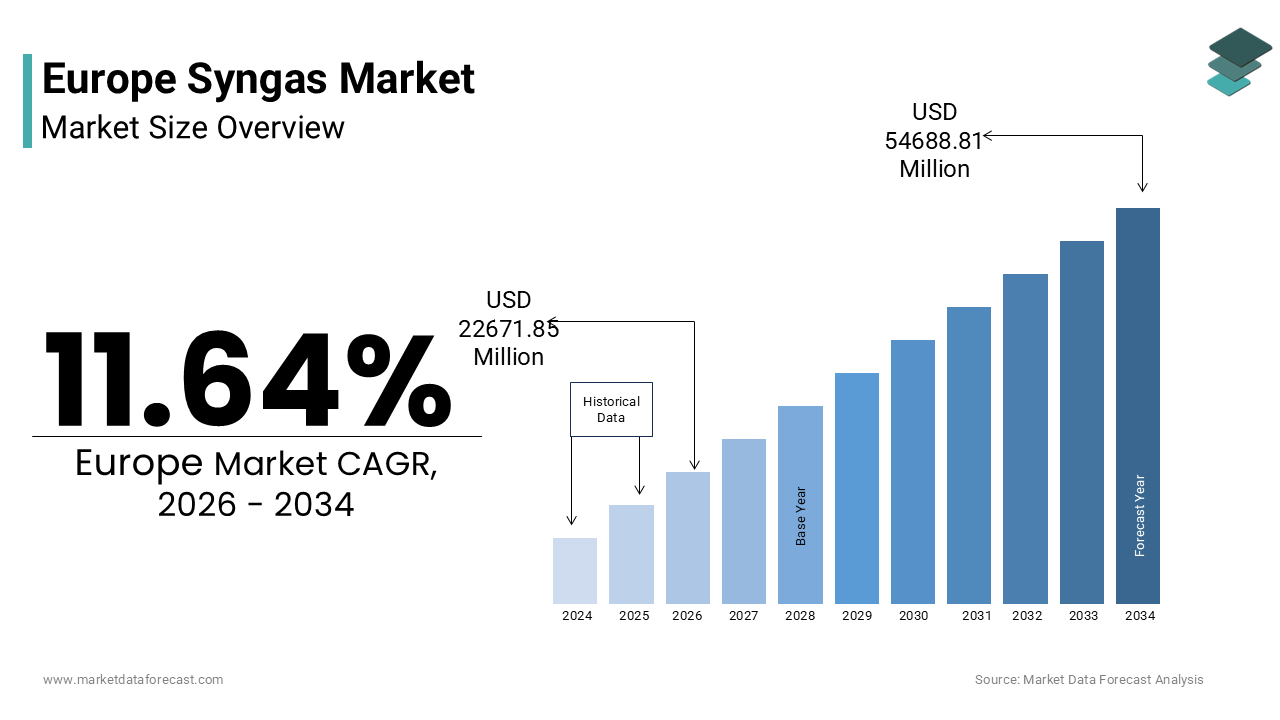
The Europe syngas market was valued at USD 20.31 billion in 2025, is estimated to reach USD 22.67 billion in 2026, and is projected to grow to USD 54.69 billion by 2034, registering a CAGR of 11.64% during the forecast period from 2026 to 2034.
The market growth is driven by industrial decarbonization mandates, expansion of green hydrogen ecosystems, increasing waste-to-energy infrastructure, and rising demand for low-carbon fuels such as green ammonia, methanol, and sustainable aviation fuel (SAF). The European Green Deal, REPowerEU, and ReFuelEU Aviation regulation are accelerating investments in biomass-based, waste-derived, and low-carbon syngas production pathways. Integration of carbon capture technologies and the growing adoption of power-to-syngas systems are further strengthening market growth across industrial clusters in Germany, the Netherlands, Sweden, and France.
Key Market Trends
- Increasing adoption of syngas for green hydrogen and green ammonia production
- Expansion of waste-to-syngas and biomass gasification plants
- Growing investment in carbon capture-enabled syngas (blue syngas)
- Rising demand for synthetic fuels for aviation (SAF) under ReFuelEU mandates
- Integration of syngas infrastructure with renewable power and hydrogen ecosystems
- Strong policy support under EU Green Deal, CBAM, ETS, and national hydrogen strategies
Segmental Insights
- By feedstock, the natural gas segment dominated the market due to its strong integration with existing industrial infrastructure and widespread adoption in steam methane reforming (SMR) processes.
- By technology, the steam methane reforming (SMR) segment held the largest market share owing to its commercial maturity, efficiency, and extensive use in hydrogen, ammonia, and methanol production.
- By application, the ammonia segment accounted for the largest share of the market as syngas remains critical for fertilizer production and agricultural supply chains across Europe.
Regional Insights
- Germany led the European syngas market due to its strong industrial base, aggressive decarbonization policies, and heavy investments in hydrogen and low-carbon fuel infrastructure.
- The Netherlands remains a key strategic hub due to its port-based industrial clusters, carbon transport and storage infrastructure (Porthos project), and strong role in hydrogen and chemical supply chains.
- France continues to expand syngas deployment through state-backed low-carbon hydrogen programs and bio-syngas-to-fuels projects such as BioTfueL.
- Sweden is emerging as a leader in fossil-free syngas adoption due to abundant biomass resources, renewable electricity availability, and advanced waste gasification systems.
Competitive Landscape
The Europe syngas market is characterized by competition focused on technology leadership, carbon reduction capability, feedstock flexibility, and integration with hydrogen and carbon capture infrastructure. Major players are investing in waste gasification, biomass-to-syngas, CCUS-enabled reforming, and power-to-syngas solutions. Partnerships with steel, fertilizer, refining, and aviation sectors are increasingly shaping long-term demand. Regulatory alignment with EU emissions targets plays a decisive role in competitive positioning. Major companies operating in the market include Air Products and Chemicals, Linde, Air Liquide, Technip Energies, Maire Tecnimont, BASF, BP, General Electric, Haldor Topsoe, KBR, OXEA, Shell, and Sasol.
Europe Syngas Market Size
The europe syngas market size was valued at USD 20308.05 million in 2025 and is anticipated to reach USD 22671.85 million in 2026 from USD 54688.81 million by 2034, growing at a CAGR of 11.64% during the forecast period from 2026 to 2034.
Syngas or synthesis gas is a combustible mixture primarily composed of hydrogen and carbon monoxide generated through gasification or reforming of carbon containing feedstocks such as coal natural gas or biomass. In Europe, this gas serves as a critical intermediary in the production of ammonia methanol synthetic fuels and hydrogen while also supporting industrial heat and power generation. The market landscape has evolved considerably as European nations prioritize decarbonization and circular economy principles. As per Eurostat, industrial sectors accounted for 24.6% of the European Union’s final energy consumption in 2023, which is indicating the persistent need for efficient and cleaner gaseous fuels. According to the International Energy Agency, hydrogen consumption across European industries remained substantial in 2023, with a significant portion originating indirectly from syngas routes. The European Green Deal and REPowerEU plan have further intensified scrutiny on feedstock sustainability and carbon intensity, which is driving a strategic pivot toward biomass-derived and waste-based syngas systems. The integration of carbon capture technologies and renewable-driven gasification units is gaining traction, particularly in Germany, the Netherlands, and Sweden, as these countries advance pilot and commercial-scale low-carbon syngas initiatives aligned with the EU’s 2030 climate targets.
MARKET DRIVERS
Policy Driven Industrial Decarbonization Accelerates Syngas Adoption
Europe’s aggressive climate regulatory framework is compelling heavy industries to seek transitional energy vectors and syngas has emerged as a viable bridge solution, which is a key factor driving the growth of the European syngas market. The European Union’s Industrial Emissions Directive and the Carbon Border Adjustment Mechanism have pressured sectors such as steel, chemicals, and refining to reduce scope one and scope two emissions significantly. Syngas derived from low carbon feedstocks enables these industries to lower their carbon footprint while maintaining operational continuity. According to the European Environment Agency, emissions from industrial combustion processes totaled approximately 473 million tonnes of CO₂ equivalent in 2022, which is indicating the urgency for alternatives. As per the German Federal Ministry for Economic Affairs and Climate Action, Germany has allocated up to 1.2 billion euros through its H2Global initiative to support hydrogen and derivative fuel projects, including syngas-based systems. Furthermore, the EU’s Innovation Fund disbursed billions of euros in 2023 to projects integrating renewable energy with carbon management, with several syngas conversion units qualifying for support. These policy instruments not only incentivize investment but also establish stringent lifecycle emission thresholds which favor gasification technologies with integrated carbon capture over conventional fossil routes, thereby reshaping demand toward cleaner syngas configurations.
Expansion of Waste to Energy Infrastructure Fuels Syngas Feedstock Diversification
The growing municipal solid waste burden of Europe has catalysed the development of advanced thermal conversion facilities that utilize non-recyclable waste as syngas feedstock, which is further propelling the growth of the European syngas market. According to Eurostat, 511 kg of municipal waste per capita was generated in the EU in 2023, amounting to over 225 million tonnes in total, and landfilling rates still exceed 11% in several member states. Countries such as France, Italy, and Poland are commissioning gasification plants that convert refuse-derived fuel into syngas for combined heat and power or chemical synthesis. As per the Confederation of European Waste to Energy Plants, more than 530 waste-to-energy facilities operated in Europe in 2024, with gasification and pyrolysis units representing a growing share of new installations. The European Commission’s Circular Economy Action Plan explicitly endorses thermochemical conversion as a recovery option for non-recyclable fractions, thereby legitimizing syngas generation from residual streams. According to Avfall Sverige, Sweden recovers nearly 99% of household waste, with a significant portion processed through thermal methods. This waste valorisation trend not only alleviates disposal pressures but also provides a locally sourced feedstock that circumvents natural gas price volatility and enhances supply chain resilience for syngas producers.
MARKET RESTRAINTS
High Capital Intensity of Advanced Gasification Technologies Inhibits Widespread Deployment
The transition from conventional steam methane reforming to low carbon syngas production methods such as biomass gasification or waste-derived plasma gasification demands substantial upfront investment, which constrains market scalability. Installing an integrated biomass-to-syngas facility with carbon capture capabilities typically requires capital expenditures ranging from €400 to €600 million, according to estimates published in peer-reviewed techno-economic assessments. Such costs are prohibitive for mid-scale industrial players, particularly in Southern and Eastern Europe where access to green financing remains limited. Even with EU funding mechanisms like the Innovation Fund, project developers face prolonged approval cycles and stringent technical validation requirements. As per the European Investment Bank, only 23% of submitted clean energy infrastructure proposals in 2023 secured full financing due to perceived technology and offtake risks. Moreover, the absence of standardized modular gasification units increases engineering complexity and site-specific customization, further inflating costs. This financial barrier delays the replication of successful pilot projects such as the GoBiGas initiative in Sweden, which despite technical success, struggled with economic viability. Consequently, many industrial consumers continue relying on imported hydrogen or conventional natural gas reforming despite higher long-term carbon compliance costs simply because capital constraints outweigh decarbonization incentives.
Feedstock Supply Chain Fragmentation Undermines Operational Consistency
The viability of non-fossil syngas routes in Europe is heavily contingent on reliable and standardized feedstock streams, yet the current supply landscape remains highly fragmented across regions, which is further impeding the growth of the European syngas market. For instance, Biomass residues exhibit significant seasonal and geographic variability in availability and composition. According to the Joint Research Centre of the European Commission, the technical potential of available lignocellulosic residues across the EU is estimated at 220 million tonnes per year, but only 55% is considered economically recoverable due to collection logistics and competing uses. Similarly, the quality of municipal solid waste-derived feedstock fluctuates widely between urban centers and rural zones, affecting gasifier efficiency and syngas composition. As per a 2024 study by the Technical Research Centre of Finland, moisture content and calorific value of refuse-derived fuel can vary by up to 40% between neighbouring waste processing plants, which is undermining stable syngas output. Without harmonized feedstock specifications and coordinated regional collection networks, operators face frequent process interruptions and catalyst degradation. The European Committee for Standardization has initiated work on EN standards for alternative feedstocks, but implementation remains inconsistent. This uncertainty discourages long-term offtake agreements and deters investors seeking predictable plant performance, thereby constraining the market’s ability to scale beyond isolated demonstration sites.
MARKET OPPORTUNITIES
Integration with Green Hydrogen Ecosystems Opens New Value Streams
Syngas infrastructure is increasingly positioned as a complementary enabler within Europe’s expanding green hydrogen economy, particularly through co-processing and retrofit pathways, which is a notable opportunity in the European syngas market. Existing syngas units, especially those based on autothermal reforming, can be adapted to co-feed biogas or green hydrogen, thereby reducing net carbon intensity without complete rebuilds. According to the Hydrogen Council, a significant share of announced low carbon hydrogen projects in Europe as of 2024 incorporate hybrid feedstock strategies where syngas platforms serve as transitional assets. In the Netherlands, the VoltaChem program has demonstrated that blending green hydrogen into conventional syngas streams enhances hydrogen yield while maintaining ammonia synthesis compatibility, as verified by TNO, the Netherlands Organisation for Applied Scientific Researchvoltachem.com. Furthermore, surplus renewable electricity can be utilized in power-to-syngas configurations where electrolytic hydrogen reacts with captured carbon dioxide to produce tailored syngas mixtures. The European Commission’s IPCEI Hy2Tech framework has approved cross-border projects in Belgium and Germany that integrate such pathways with carbon utilization. This synergy not only extends the operational relevance of existing industrial gas infrastructure but also creates dual revenue models through hydrogen and chemical co-production by aligning syngas assets with the EU’s 2030 renewable hydrogen targets.
Emergence of Synthetic Sustainable Aviation Fuel Mandates Creates Premium Demand
Europe’s ReFuelEU Aviation Regulation mandates that 2% of aviation fuel must be synthetic and low carbon by 2030 and is catalyzing demand for Fischer-Tropsch-derived fuels produced from syngas, which is another major opportunity in the European syngas market. Unlike bioethanol or hydrotreated esters, synthetic paraffinic kerosene from syngas offers superior energy density and full drop-in compatibility with existing jet engines. According to the European Union Aviation Safety Agency, the EU’s commercial aviation sector consumed approximately 46 million tonnes of jet fuel in 2023. Companies such as Sasol and Fulcrum BioEnergy are advancing waste-to-syngas-to-jet fuel projects in France and Spain, leveraging municipal solid waste as feedstock. As per the ReFuelEU Aviation Regulation, meeting the 2030 target will require at least 2.8 million tonnes of synthetic fuel annually. Additionally, the EU Emissions Trading System’s inclusion of aviation since 2024 increases the carbon cost of conventional jet fuel, thereby improving the economic case for syngas-based alternatives. With airlines such as Lufthansa and Air France having already signed offtake agreements for synthetic kerosene, this regulatory-driven demand shift is transforming syngas from an industrial intermediate into a strategic mobility fuel component.
MARKET CHALLENGES
Intermittency of Renewable Energy Sources Complicates Power to Syngas Economics
Although power-to-syngas systems offer a promising route to carbon-neutral fuel production, their operational efficiency is heavily undermined by the intermittent nature of Europe’s wind and solar generation. Syngas synthesis via co-electrolysis or reverse water-gas shift requires stable thermal and electrical inputs, yet grid availability fluctuates significantly across regions and seasons. According to ENTSO-E, renewable generation curtailment in the EU reached 14.8 terawatt-hours in 2023, primarily due to grid congestion and inflexible demand profiles. While this surplus could theoretically power syngas units, actual plant utilization rates remain low, with some studies reporting figures below 35%. Low-capacity factors inflate the levelized cost of syngas, making it economically uncompetitive against fossil-based alternatives even with carbon pricing. Additionally, frequent start-stop cycles degrade high-temperature electrolyzer stacks and catalyst beds, which is increasing maintenance costs and downtime. Without dedicated renewable microgrids or long-duration storage integration, syngas facilities cannot achieve the steady-state operation required for chemical synthesis. This intermittency challenge is particularly acute in Northern Europe, where wind resources are abundant but grid reinforcement lags behind deployment targets, thereby constraining the scalability of renewable-driven syngas despite its environmental merits.
Lack of Harmonized Carbon Accounting Methodologies Creates Market Uncertainty
The absence of a universally accepted methodology for quantifying the carbon intensity of syngas across its lifecycle impedes market access and investor confidence in Europe, which is further challenging the expansion of the European syngas market. Current frameworks such as the EU Renewable Energy Directive II and the upcoming CBAM apply divergent calculation rules for biogenic carbon, waste-derived feedstocks, and co-product allocation. According to a 2024 analysis by the International Council on Clean Transportation, carbon intensity values for identical syngas pathways can vary significantly depending on the accounting model applied. This discrepancy complicates compliance with fuel standards like ReFuelEU and discourages cross-border trade in syngas-based products. Moreover, the European Commission’s Product Environmental Footprint initiative has yet to finalize category rules for synthetic gases, which is leaving project developers without clear guidance. In Germany, for example, two syngas plants using similar municipal waste feedstocks received different sustainability classifications from regional auditors, leading to unequal access to subsidies as reported by the German Biomass Research Centre. Such regulatory fragmentation increases administrative burden and creates an uneven playing field, particularly for small and medium enterprises lacking dedicated compliance teams. Until the EU establishes a unified and transparent carbon accounting protocol for gaseous energy carriers, syngas producers will face persistent uncertainty in market positioning and eligibility for green financing.
REPORT COVERAGE
| REPORT METRIC | DETAILS |
| Market Size Available | 2025 to 2034 |
| Base Year | 2025 |
| Forecast Period | 2026 to 2034 |
| CAGR | 11.64% |
| Segments Covered | By Feedstock, Technology, Gasifier Type, Application and Region |
| Various Analyses Covered | Global, Regional & Country Level Analysis; Segment-Level Analysis; DROC, PESTLE Analysis; Porter’s Five Forces Analysis; Competitive Landscape; Analyst Overview of Investment Opportunities |
| Regions Covered | United Kingdom, France, Spain, Germany, Italy, Russia, Sweden, Denmark, Switzerland, the Netherlands, Turkey, and the Czech Republic |
| Market Leaders Profiled | Air Products and Chemicals, Inc., Linde plc, Air Liquide, Technip Energies NV, Maire Tecnimont SpA, BASF SE, BP p.l.c., General Electric, Haldor Topsoe A/S, KBR Inc., OXEA GmbH, Royal Dutch Shell plc, and Sasol. |
SEGMENTAL ANALYSIS
By Feedstock Insights
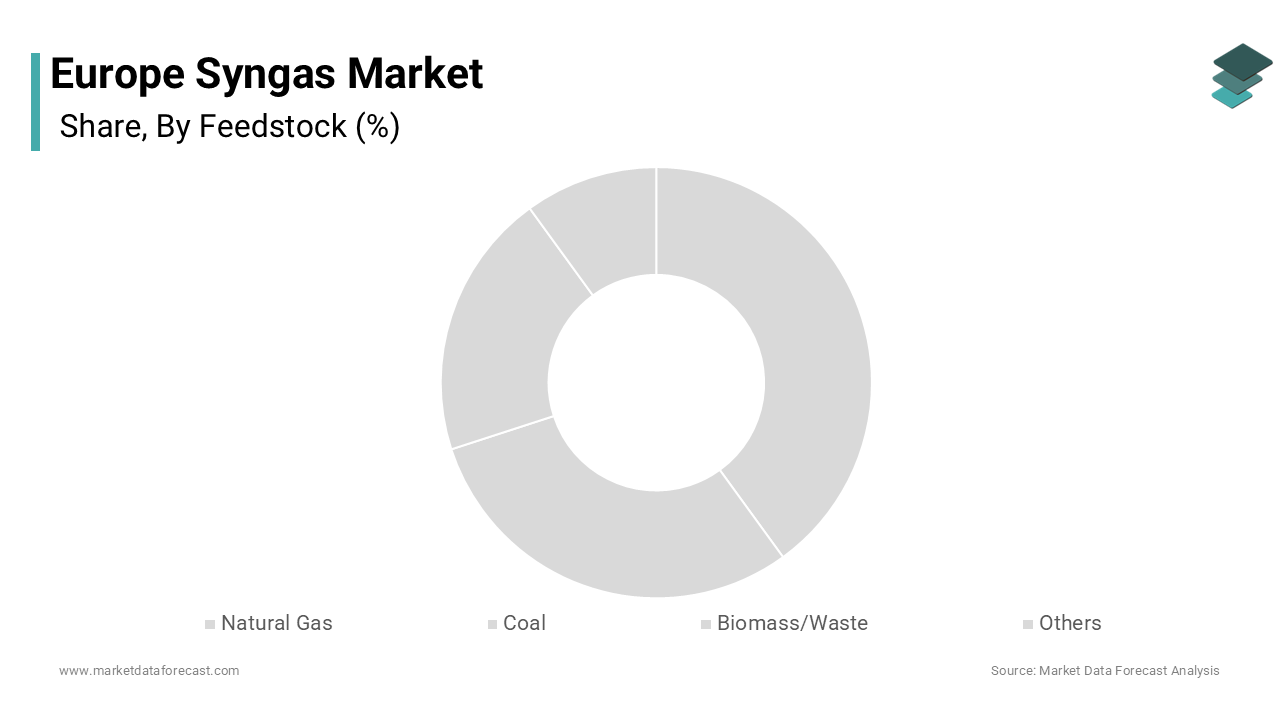
The natural gas segment dominated the European syngas market in 2025 by holding the major share of the regional market in 2024. Europe’s natural gas network spans over 240,000 kilometres, which is enabling reliable delivery to industrial hubs across Germany, Italy, and the Netherlands, as reported by ENTSOG, the European Network of Transmission System Operators for Gas. Following the 2022 energy crisis, the EU accelerated diversification of gas suppliers, including increased LNG imports, which stabilized input costs. As per Eurostat, LNG made up a significantly larger portion of EU gas imports in 2023 compared to 2021, ensuring consistent natural gas availability despite geopolitical tensions.
By Technology Insights
The steam methane reforming segment commanded for 60.5% of the European syngas market share in 2024. The dominance of steam methane reforming segment in this regional market is driven by its high efficiency, mature commercial scale, and integration with existing hydrogen infrastructure. According to Fertilizers Europe, ammonia production in the EU consumed over 11 million tonnes of hydrogen in 2023, nearly all derived via SMR. Similarly, according to the European Fuel Oxygenates Association, a large majority of methanol plants in Europe rely on SMR-based syngas due to precise hydrogen to carbon monoxide ratios.
The gasification technology segment is anticipated to record a CAGR of 10.6% over the forecast period in the European syngas market. According to the European Biogas Association, gasification-based biomethanol projects increased significantly in 2023, reflecting growing demand from shipping and chemical sectors seeking drop-in renewable fuels.
By Application Insights
The ammonia segment led the market by holding 37.7% of the regional market share in 2024. The dominance of ammonia segment in the European market is driven by its entrenched role in agricultural productivity and industrial applications. The European Union produces hundreds of millions of tonnes of cereals annually, requiring consistent nitrogen fertilizer supply, as stated by Eurostat. Despite efficiency gains, synthetic ammonia remains irreplaceable, with the vast majority of European nitrogen fertilizers derived from syngas-based Haber-Bosch processes. The war in Ukraine disrupted Russian ammonia imports, which previously supplied a significant share of EU needs, according to the International Fertilizer Association.
The hydrogen segment is another major segment and is expected to expand at a CAGR of 14.06% over the forecast period. Europe’s refining and chemical sectors require millions of tonnes of hydrogen annually and rising, according to the International Energy Agency. The TotalEnergies refinery in Normandy, for example, commissioned a blue hydrogen unit using SMR with high carbon capture in 2023, as stated by the French Ministry of Ecological Transition.
REGIONAL ANALYSIS
Germany Syngas Market Analysis
Germany led the market in 2024 by capturing 21.1% of the regional market share in 2024. The promising position of Germany in the Europe syngas market is driven by its dense industrial base and aggressive decarbonization agenda. The country hosts a significant number of major syngas-consuming facilities in chemicals, refining, and steel, as per the German Chemical Industry Association. Natural gas-based SMR remains dominant but is rapidly integrating carbon capture with projects like the KIRCH project in Marl, which captures a substantial volume of carbon dioxide annually from syngas, as confirmed by BASF. Renewable syngas from biomass is also scaling through the BioEconomy Council, which reported a notable increase in bio-syngas pilot plants in 2023. Germany’s National Hydrogen Strategy allocates 9 billion euros for low-carbon hydrogen infrastructure, directly supporting syngas conversion and reinforcing its market leadership.
Netherlands Syngas Market Analysis
The Netherlands occupied a prominent share of the European syngas market in 2024 due to its integrated port industrial clusters and pioneering carbon management infrastructure. Rotterdam alone accounts for a major share of Dutch syngas demand, primarily for ammonia, methanol, and hydrogen, as stated by the Port of Rotterdam Authority. The Porthos carbon transport and storage network will enable blue syngas production at scale, with Air Liquide and Shell committing to capture millions of tonnes of carbon dioxide annually by 2026. Additionally, the country leads in waste-derived syngas, with AVR’s Duiven plant converting a large volume of municipal waste into syngas for district heating, as reported by the Dutch Waste Management Federation.
France Syngas Market Analysis
France maintains a strong position through state-led energy sovereignty and nuclear-powered syngas innovation. The country’s syngas market is anchored in ammonia production for agriculture, which consumes a substantial amount of hydrogen annually, according to FranceAgriMer. Recent policy shifts prioritize low-carbon routes, with the France 2030 investment plan allocating 1.5 billion euros for green and blue hydrogen, including syngas-based systems. The BioTfueL project in Lacq demonstrated commercial-scale syngas-to-bio jet fuel conversion, achieving significant lifecycle emission reduction as verified by IFP Energies Nouvelles. Additionally, France’s anti-waste legislation bans landfilling of organic waste by 2025, creating a steady biomass stream for syngas plants, particularly in rural regions.
Sweden Syngas Market Analysis
Sweden excels in fossil-free syngas applications driven by abundant biomass and renewable electricity. The country generates over 95% of its electricity from low-carbon sources, according to Statistics Sweden, enabling power-to-syngas and biomass gasification at scale. The HYBRIT initiative, co-led by SSAB, has replaced coking coal with syngas derived from hydrogen and biocarbon, producing fossil-free steel in 2023, as confirmed by the Swedish Energy Agency. Municipal waste gasification is equally advanced, with Stockholm Exergi operating a large-scale facility converting household waste into syngas for district heating. Sweden’s carbon tax, among the highest globally, further disincentivizes fossil feedstocks and accelerates clean syngas adoption.
Italy Syngas Market Analysis
Italy is estimated to showcase a healthy CAGR in the European syngas market over the forecast period. Italy’s syngas market is sustained by its large refining and chemical sectors concentrated in the Po Valley and Sicily. The country imports a high percentage of its natural gas but has diversified sources through LNG terminals in Sardinia and Adriatic pipelines, as reported by SNAM. This supply security supports stable SMR operations, with Eni’s Sannazzaro refinery producing a significant volume of hydrogen annually from syngas, as stated by the Italian Ministry of Energy. Emerging opportunities lie in agricultural waste gasification, with millions of tonnes of olive pomace and vineyard residues available annually, according to ISMEA, the Italian Agricultural Market Institute. The National Recovery and Resilience Plan allocate 400 million euros for bio-syngas projects targeting this underutilized feedstock, thereby positioning Italy for accelerated growth in circular syngas pathways.
COMPETITIVE LANDSCAPE
Competition in the Europe syngas market is characterized by technological differentiation and strategic alignment with decarbonization policies rather than price-based rivalry. Leading firms focus on integrating carbon management renewable feedstocks and digital optimization to enhance syngas efficiency and sustainability. The market features collaboration driven competition where companies form industrial alliances to share infrastructure such as carbon transport networks and hydrogen pipelines. New entrants specializing in biomass gasification and power to syngas are challenging incumbents by offering fully renewable pathways supported by EU green finance mechanisms. Incumbents respond by retrofitting existing facilities and co-developing pilot projects with research institutions. Regulatory compliance particularly under the EU Emissions Trading System and ReFuelEU shapes competitive positioning more than traditional market metrics. These dynamic fosters a hybrid ecosystem where innovation policy access and feedstock security determine leadership rather than scale alone.
KEY MARKET PLAYERS
Some of the companies that are playing a dominating role in the Europe Syngas Market include
- Air Products and Chemicals, Inc.
- Linde plc
- Air Liquide
- Technip Energies NV
- Maire Tecnimont SpA
- BASF SE
- BP p.l.c.
- General Electric
- Haldor Topsoe A/S
- KBR Inc.
- OXEA GmbH
- Royal Dutch Shell plc
- Sasol
Top Players in the Europe Syngas Market
Air Liquide
Air Liquide maintains a significant presence in the Europe syngas market through its extensive hydrogen and synthesis gas production infrastructure. The company leverages steam methane reforming and increasingly integrates carbon capture to align with EU decarbonization mandates. In 2024 Air Liquide commissioned a blue hydrogen unit at its Rotterdam facility using syngas with over ninety% carbon capture as part of the Porthos project. It also collaborates with industrial clusters in Germany and France to supply low carbon syngas for ammonia and refining. Recent investments in waste to syngas pilot projects demonstrate its commitment to feedstock diversification and circular economy principles strengthening its technological leadership across Europe and globally.
Linde plc
Linde plc plays a pivotal role in the Europe syngas landscape by providing advanced gasification and syngas purification technologies to major industrial consumers. The company supports fertilizer steel and chemical producers with integrated syngas solutions that enhance efficiency and reduce emissions. In 2023 Linde partnered with ThyssenKrupp to deliver a large-scale syngas supply system for direct reduced iron production in Germany marking a strategic move into green steel. It also expanded its hydrogen pipeline network in the North Sea region enabling syngas derived hydrogen distribution. These actions reinforce Linde’s position as a technology enabler and clean energy integrator in both European and global markets.
Siemens Energy
Siemens Energy contributes to the Europe syngas market primarily through power to syngas and electrolysis integration technologies that convert renewable electricity into hydrogen enriched syngas. The company focuses on decarbonizing traditional syngas applications by coupling gasification with green hydrogen inputs. In early 2024 Siemens Energy launched a demonstration plant in Sweden that co processes biomass derived syngas with electrolytic hydrogen to produce renewable methanol. It also collaborates with waste management firms to develop modular gasification units for municipal solid waste. These innovations position Siemens Energy as a key architect of next generation syngas systems aligned with EU net zero objectives and global clean fuel transitions.
Top Strategies Used by the Key Market Participants
Key players in the Europe syngas market prioritize strategic integration of carbon capture technologies to comply with stringent EU emissions regulations while maintaining industrial output. They actively invest in waste and biomass gasification to diversify feedstock and align with circular economy mandates. Partnerships with steel and fertilizer producers enable tailored syngas supply for green ammonia and direct reduced iron. Expansion of hydrogen infrastructure allows syngas derived hydrogen to access cross sectoral markets. Additionally, companies pursue public private collaborations to secure funding from EU innovation programs accelerating commercial deployment of low carbon syngas pathways across the region.
MARKET SEGMENTATION
This europe syngas market research report is segmented and sub-segmented into the following categories.
By Feedstock
- Natural Gas
- Coal
- Biomass/Waste
- Others
By Technology
- Steam Methane Reforming
- Gasification
By Gasifier Type
- Fixed Bed
- Entrained Flow
- Fluidized Bed
By Application
- Power Generation
- Chemicals
- Others
By Country
- UK
- France
- Spain
- Germany
- Italy
- Russia
- Sweden
- Denmark
- Switzerland
- Netherlands
- Turkey
- Czech Republic
- Rest of Europe
Frequently Asked Questions
What is syngas?
Syngas (synthetic gas) is a fuel gas mixture mainly composed of hydrogen, carbon monoxide, and carbon dioxide, produced from gasification of coal, biomass, waste, or natural gas.
What is driving the growth of the Europe syngas market?
Growth is driven by increasing focus on clean energy, decarbonization goals, rising demand for hydrogen production, and adoption of waste-to-energy technologies.
What are the major applications of syngas in Europe?
Syngas is widely used for power generation, chemical production (methanol, ammonia), fuel production, and hydrogen generation.
Which feedstocks are commonly used for syngas production?
Common feedstocks include coal, natural gas, biomass, municipal solid waste, and industrial waste.
Which countries contribute most to the Europe syngas market?
Germany, the UK, France, the Netherlands, and the Nordic countries are key contributors due to strong renewable energy initiatives.
What technologies are used for syngas production?
Gasification, steam reforming, partial oxidation, and autothermal reforming are the primary technologies used.
What challenges affect the Europe syngas market?
High capital costs, complex infrastructure requirements, and regulatory uncertainties are key challenges.
Who are the key end users of syngas in Europe?
Key end users include power plants, chemical manufacturers, refineries, fertilizer producers, and industrial gas companies.
How does syngas support Europe’s decarbonization goals?
Syngas enables low-carbon hydrogen production and supports circular economy models through waste and biomass utilization.
What is the future outlook of the Europe syngas market?
The market is expected to grow steadily due to increasing investment in hydrogen economy, carbon capture technologies, and sustainable fuel production.
Access the study in MULTIPLE FORMATS
Purchase options starting from
$ 2000
Didn’t find what you’re looking for?
TALK TO OUR ANALYST TEAM
Need something within your budget?
NO WORRIES! WE GOT YOU COVERED!
Call us on: +1 888 702 9696 (U.S Toll Free)
Write to us: sales@marketdataforecast.com