- Product Description Description
- Table of Contents TOC
- List of Table & Figure LOT
- Get Free Sample PDF Sample PDF
Market Size, 2025
$2.13 BnMarket Estimate, 2026
$2.3 BnMarket Forecast, 2034
$3.21 BnCAGR, 2026–2034
4.64%Executive Summary: Europe Telehandler Market
- Market Scope: Comprehensive European telehandler industry analysis covering product categories (compact and large telehandlers), equipment types (rotating and non-rotating), ownership models, application sectors (construction, agriculture), regional leadership frameworks, strategic corporate developments, and competitive landscapes.
- Market Valuation: Valued at USD 2.13 billion (2025), estimated at USD 2.30 billion (2026), and projected to reach USD 3.21 billion by 2034, registering a steady CAGR of 4.64% (2026–2034).
- Primary Growth Drivers: Urban construction density requiring compact high-reach material handling, agricultural modernization for labor reduction, electrification for noise-sensitive urban zones, prefabricated modular construction, and rental models optimizing capital expenditure. Restraints include strict EU Stage V emissions regulations and a shortage of certified operators.
Key Market Segment Metrics (2026–2034)
| Category | Leading Segment / Region (Position) | Fastest-Growing Segment |
|---|---|---|
| By Product & Ownership | Compact telehandlers (dominated with 54.5% share in 2025) & Rental segment (held leading ownership position with 63.7% share for capital optimization) | Large telehandlers (predicted to witness the highest CAGR of 8.7% driven by infrastructure scale) |
| By Application Industry | Construction sector (largest application occupying a 61.8% share in 2025) | Agriculture sector (fastest CAGR of 9.4% fueled by labor scarcity and farm intensification) |
| By Region / Country | Germany (top performer with an 18.5% share in 2025) & France (second-prominent market capturing 16.3% share) | European nations stimulated by REPowerEU infrastructure investments and low-emission zone developments |
Major Market Players & Market Structure
Market Structure: Highly competitive European heavy machinery and rental-driven market structure emphasizing electric telehandler portfolio expansions, EU Stage V compliance, digital integration via telematics and predictive maintenance, and strategic service network extensions.
Key Companies: Caterpillar, Manitou, Merlo, Liebherr, Dieci, Bobcat, and JCB.
Europe Telehandler Market Size
The europe telehandler market size was valued at USD 2.13 billion in 2025 and is anticipated to reach USD 2.23 billion in 2026 from USD 3.21 billion by 2034, growing at a CAGR of 4.64% during the forecast period from 2026 to 2034.
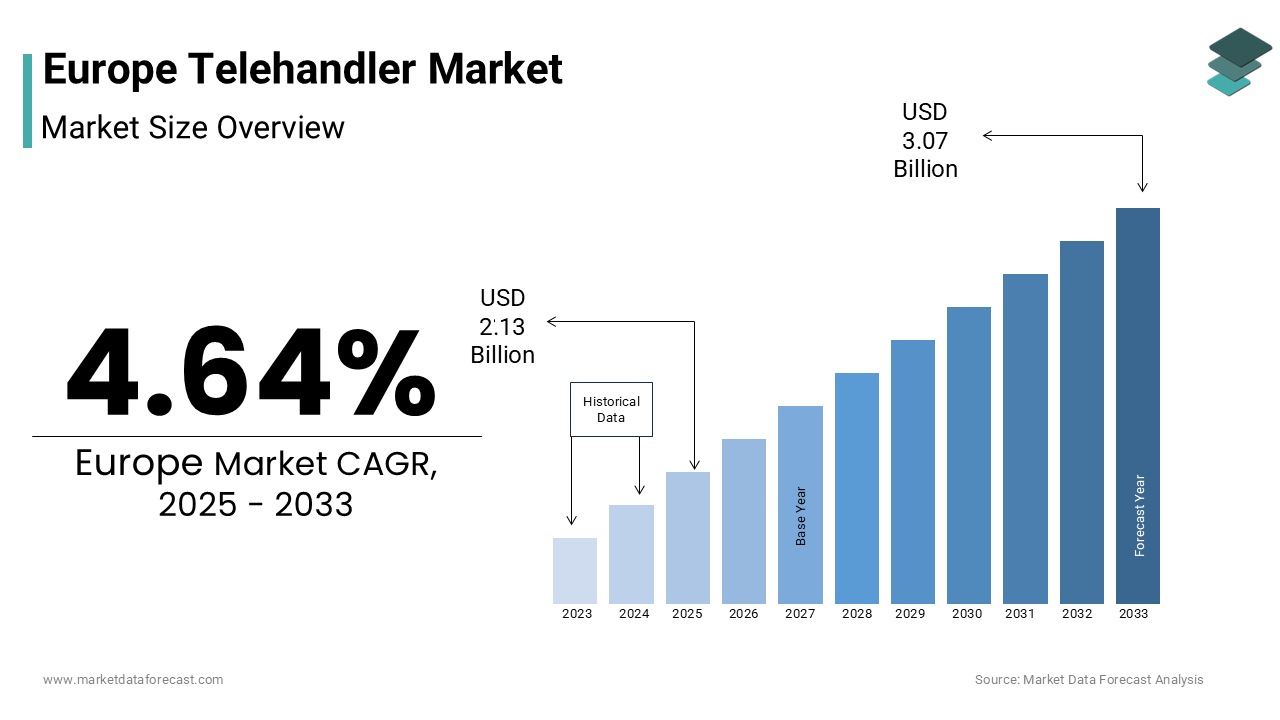
A telehandler refers to the versatile telescopic handler machines used primarily in construction, agriculture, and industrial logistics for lifting, transporting, and placing materials at height or distance. These machines combine the functionalities of forklifts and cranes offering superior reach maneuverability and attachment versatility. In Europe, telehandlers have become indispensable on constrained urban job sites and mixed terrain rural operations where space efficiency and multi tasking capability are critical. A considerable volume of construction projects in the European Union is being developed in areas where the physical constraints of traditional equipment may pose challenges. A significant portion of reported workplace incidents are related to manual material handling activities, indicating a strong need for safer, mechanized alternatives. There is a general trend toward modernizing agricultural operations, which includes integrating versatile material handling equipment for various farm tasks. The regulatory environment is evolving, prompting manufacturers to incorporate more sophisticated stability control and safety features into material handling machinery. Unlike commodity equipment the European telehandler market is defined by application specific customization safety integration and alignment with decarbonization trends notably through electric and hybrid powertrains.
MARKET DRIVERS
Urban Construction Density Favors Compact High Reach Material Handling Solutions
The region’s intensifying urban development patterns create ideal conditions for telehandler adoption due to spatial constraints and multi story project requirements, which in turn drives the growth of the Europe telehandler market. Recent building patterns suggest a transition away from expanding into undeveloped green spaces in favor of densifying established areas. Many new residential projects are being designed to accommodate relatively narrow land parcels, reflecting an emphasis on compact spatial planning within the residential construction sector. In such environments traditional cranes or large forklifts cannot operate efficiently whereas compact telehandlers with vertical lift paths and articulating booms access tight footprints while reaching heights of up to twenty meters. New residential structures in major urban areas frequently rise above a specific low-rise threshold. A common pattern in urban construction involves the use of specialized material transport equipment on site. The use of machinery that lifts and extends materials has increased noticeably on renovation projects within cities. Design and construction practices in dense population centers are adapting to accommodate vertical growth and limited ground space. Contractors value the machine’s ability to switch between pallet forks bucket attachments and personnel cages reducing equipment fleet size. This urban spatial economy combined with rising labor costs makes telehandlers not just convenient but economically essential for timely and safe execution of dense European construction projects.
Modernization of European Agriculture Drives Adoption Beyond Traditional Tractor Implements
European farming is undergoing a structural shift toward efficiency precision and labor reduction prompting widespread telehandler integration even on mid sized holdings, which further fuels the expansion of the Europe telehandler market. The average area of agricultural holdings is expanding, indicating a trend toward farm consolidation. This increase in operational scale facilitates greater capital investment in more versatile and efficient equipment. Farm operators are adopting machinery, such as telehandlers, which offers improved operational speed and safety for handling various materials. A growing number of dairy operations use this specific type of equipment for regular tasks like feed distribution, leading to a measurable reduction in manual work hours. Sales of this machinery to agricultural cooperative groups are increasing, suggesting its utility in managing the demands of large-scale, specialized crop production across diverse landscapes. The machines’ all terrain capability four-wheel drive and high ground clearance make them uniquely suited for Southern Europe’s hilly landscapes. This agricultural transformation from subsistence to commercial production ensures sustained demand for telehandlers as multifunctional farm productivity tools beyond their construction origins.
MARKET RESTRAINTS
Stringent Emissions and Noise Regulations Increase Compliance Costs for Internal Combustion Models
The European Union’s progressive environmental standards impose significant technical and financial burdens on manufacturers and end users of diesel powered telehandlers, which restricts the growth of the Europe telehandler market. A recent directive requires additional components like filtration systems and engine modifications in equipment designs, leading to increased machine production costs. Regulations in urban areas now restrict equipment use based on noise output levels during standard operating hours. A notable percentage of city governments have established zones requiring construction machinery to meet specific emission standards, with jurisdictions enforcing penalties for non-compliant equipment. These regulatory layers compress margins for rental companies and contractors particularly small firms that cannot absorb retrofitting expenses. Consequently, fleet renewal cycles are disrupted as operators delay replacing older units due to cost uncertainty thereby dampening near term market momentum despite underlying demand.
Shortage of Skilled Operators Limits Full Utilization and Safety Compliance
The effective and safe operation of telehandlers requires specialized training in load dynamics stability control and attachment handling yet the region faces a growing deficit of certified equipment operators, and thereby impedes the expansion of the Europe telehandler market. Construction firms in various regions have reported difficulty hiring qualified machinery operators. This gap is particularly acute in certain countries and is exacerbated by an aging workforce. Inexperienced personnel sometimes misuse equipment, like telehandlers, leading to tip over incidents which contribute to fatal construction equipment accidents. Although the EU Machinery Regulation mandates stability monitoring systems these cannot compensate for human error during complex lifts. Training programs exist but vary by country and lack harmonization slowing cross border labor mobility. A lack of standardized operator certification and better recruitment practices is limiting the full safety and productivity benefits of telehandlers on many European job sites.
MARKET OPPORTUNITIES
Electrification of Compact Telehandlers Opens Urban and Indoor Application Frontiers
The emergence of battery electric telehandlers presents a transformative opportunity for operations in noise sensitive and emission controlled environments across the region, which creates new opportunities for the growth of the Europe telehandler market. Zero local emissions and near silent operation enable usage in city centers hospitals warehouses and indoor agricultural facilities where diesel machines are restricted. There is an increase in the inclusion of a specific type of electric heavy machinery within company fleets in certain regions. In urban environments, the electric version of this equipment is observing higher utilization compared to traditional fuel counterparts. A government financial incentive program has encouraged the purchase of electric equipment for public and private construction projects in one region. Manufacturers are releasing new models of electric heavy machinery featuring improved run times and fast charging capabilities designed to support a typical work shift The European Commission’s Green Public Procurement criteria now favor zero emission machinery for all publicly funded projects further accelerating adoption. This regulatory and operational alignment positions electric telehandlers as the fastest growing niche with potential to redefine urban and indoor material handling standards across the continent.
Expansion of Modular and Prefabricated Construction Demands On Site Lifting Versatility
The region’s construction sector is increasingly adopting off site manufacturing with prefabricated modules transported to job sites for rapid assembly, which generates fresh prospects for the Europe telehandler market. This shift requires equipment that can precisely place heavy volumetric units in confined spaces, precisely the strength of telehandlers. There has been an increase in the application of prefabrication techniques for new home construction across the region. A growing proportion of new residential units are built using factory-made modules. These construction modules are substantial in size and require specialized equipment for placement onto foundations. There is a noticeable increase in the use of specific types of heavy machinery on construction sites where modular building methods are employed. Telehandlers equipped with rotating carriages and hydraulic attachments can adjust module orientation mid air reducing manual intervention. The growth of modular construction in housing, hospital, and school projects is driving telehandler evolution. These machines are transitioning from auxiliary roles to primary lifting functions, supporting more efficient and safer on-site assembly throughout Europe.
MARKET CHALLENGES
Intensifying Price Competition from Asian Manufacturers Erodes Profit Margins
Mounting pressure from lower-cost competitors from China and South Korea, whose machines are entering the regional market at lower prices, is among the major challenges for the European telehandler market. There has been an increase in the volume of imported industrial equipment from outside a specific economic region. Manufacturers from a particular Asian country have secured a significant market share in the southern and eastern parts of the region. The imported machines generally comply with mandatory regional safety requirements but offer different levels of durability, service network accessibility, and hydraulic sophistication compared to established regional manufacturers. This competition forces European OEMs to either absorb margin compression or risk volume loss particularly in the entry level segment. European industry leadership, long supported by a traditional value-based pricing model, is now at risk as the mid-tier market becomes highly competitive, even as premium models continue to secure customer loyalty through performance and support.
Fragmented National Safety Certification Delays Cross Border Equipment Deployment
Telehandler operation and certification remain subject to divergent national rules that hinder fleet mobility and increase administrative burden, which also impedes the expansion of the Europe telehandler market. In Germany operators require a separate Fahrerlaubnis Klasse L for telescopic handlers while in Italy a patentino certification with biennial renewal is mandatory. Cross-border equipment transfers frequently encounter delays due to documentation discrepancies that do not meet local specifications. Businesses operating across multiple regions often incur higher administrative costs maintaining separate records for training and equipment. Equipment compliant in one region may be non-compliant elsewhere if localized details, such as language warnings, are absent. These inconsistencies reduce equipment utilization rates and discourage pan European fleet standardization. Harmonization of operator licensing and machine documentation is needed under a unified EU framework to resolve persistent logistical and compliance friction, which currently limits operational agility and market fluidity across the European telehandler landscape.
REPORT COVERAGE
| REPORT METRIC | DETAILS |
| Market Size Available | 2025 to 2034 |
| Base Year | 2025 |
| Forecast Period | 2026 to 2034 |
| CAGR | 4.64% |
| Segments Covered | By Product, Type, Ownership, Height, Capacity, Application and Region. |
| Various Analyses Covered | Global, Regional & Country Level Analysis, Segment-Level Analysis, DROC, PESTLE Analysis, Porter’s Five Forces Analysis, Competitive Landscape, Analyst Overview of Investment Opportunities |
| Regions Covered | United Kingdom, France, Spain, Germany, Italy, Russia, Sweden, Denmark, Switzerland, the Netherlands, Turkey, and the Czech Republic. |
| Market Leaders Profiled | Caterpillar, Manitou, Merlo, Liebherr, Dieci, Bobcat, and JCB. |
SEGMENTAL ANALYSIS
By Product Insights
The compact telehandler segment dominated the Europe telehandler market by accounting for a 54.5% share in 2025. The dominance of the compact telehandler segment is driven by versatility urban suitability and cost efficiency across diverse end user profiles. Europe’s dense cityscapes and narrow job sites demand equipment that can operate in confined footprints without sacrificing lift capacity. New construction projects in the European Union are increasingly occurring on smaller plots. This trend presents challenges for traditional, larger material handlers that require more space to maneuver safely. Compact material handling equipment, designed to navigate narrow spaces like gateways and alleyways, is capable of operating in these confined areas and lifting materials to significant heights. There has been a notable increase in the use of such compact equipment on residential sites, particularly in regions with many infill building projects. Rental fleets in cities like Paris and Berlin are now over eighty percent composed of compact units reflecting contractor preference for agility over brute capacity in regulated urban environments. Compact telehandlers typically retail significantly lower than large models. This pricing aligns with the budget realities of Europe’s vast base of small and medium enterprises. The construction sector across many regions is characterized by a high concentration of micro-enterprises that often lack the financial capacity for significant investments in specialized heavy equipment. In the agricultural sector, smaller livestock and crop operations frequently utilize compact telehandlers to manage tasks such as material handling and feed distribution. The use of smaller machinery allows these operators to maintain productivity without the need for the specialized transport permits required for heavier vehicles. There is a notable market preference in certain areas for compact machinery models, driven largely by the needs of smaller-scale agricultural businesses. These purchasing patterns reflect a broader shift toward versatile, smaller-scale equipment that aligns with the operational constraints of many independent firms. This dual applicability across construction and agriculture ensures consistent volume leadership for the compact segment across diverse European economic contexts.
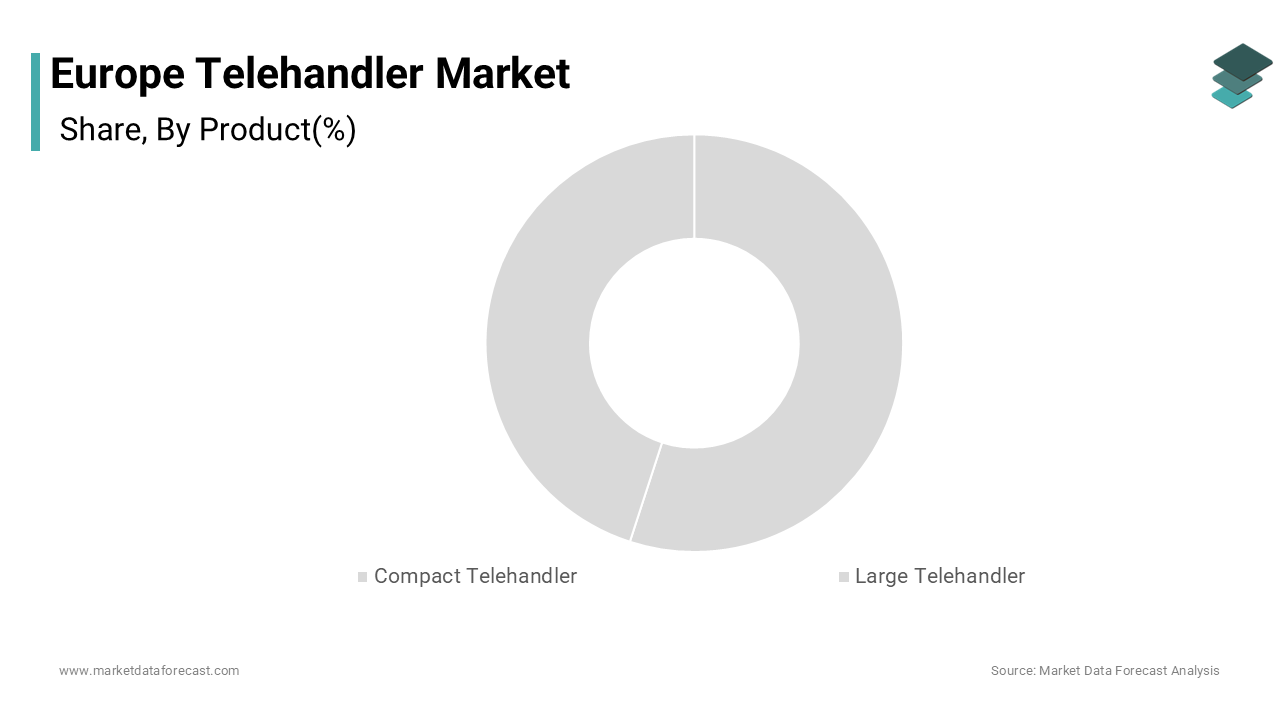
The large telehandler segment is predicted to witness the highest CAGR of 8.7% from 2026 to 2034 due to infrastructure scale and material intensity. Europe’s Green Deal and REPowerEU plans have caused mega projects in wind energy logistics and transportation requiring telehandlers with lift capacities exceeding four tons and reach beyond eighteen meters. A significant amount of funding has been directed toward large-scale transport and energy infrastructure projects, which encompasses expansions in maritime wind facilities and the development of high-speed rail systems. These construction sites frequently manage components such as prefabricated structural elements, large turbine blades, and modular electrical transformers that necessitate equipment beyond the capacity of standard, compact machinery. In one national instance of constructing a major subsea tunnel logistics hub, numerous large material handling vehicles were deployed to manage containerized components. In a different country, there was an increase in the acquisition of large material handling equipment by wind farm developers, indicating a growing preference for using this type of machinery for on-site placement of blades and tower segments as an alternative to relying solely on cranes. Quarries mines and large industrial facilities across Northern and Eastern Europe operate in harsh conditions demanding four wheel drive high ground clearance and hydraulic stability under dynamic loads. Manufacturers like Manitou and Merlo have responded with models featuring reinforced chassis all terrain tires and load sensing hydraulics rated for continuous duty cycles. This performance imperative in capital intensive primary sectors positions large telehandlers as the high growth frontier despite higher acquisition costs.
By Type Insights
The non rotating telehandlers segment led the Europe telehandler market and captured a substantial share in 2025. The supremacy of the non-rotating telehandlers segment is attributed to simplicity cost and task specificity. Most European material handling tasks, such as pallet lifting hay bale stacking or placing construction bundles, require linear reach rather than 360 degree rotation. Non rotating models offer higher lift capacity at lower cost with fewer hydraulic components and simpler operator controls. This functional alignment with routine workflows ensures continued dominance despite the versatility of rotating alternatives. Non rotating telehandlers typically cost fifteen to thirty percent less than rotating models and require fewer service interventions due to absence of slew ring mechanisms and additional hydraulic circuits. Firms with smaller equipment budgets tend to exclusively purchase non-rotating units. This preference appears stronger in regions where financing is more limited. Equipment rental companies favor non-rotating models, suggesting a link to high utilization and low downtime. Data from rental fleets indicate that non-rotating units have higher availability rates compared to rotating ones. This economic pragmatism solidifies the segment’s market leadership across volume driven applications.
The rotating telehandler segment is estimated to register the fastest CAGR of 10.2% during the forecast period owing to complex urban and industrial demands. In historic city centers where cranes cannot operate rotating telehandlers enable precise placement of materials around obstacles without repositioning the entire machine. Construction projects in protected heritage areas show a discernible trend towards mandating equipment that provides extensive load manipulation capabilities to prevent accidental structural contact. In dense urban areas with limited accessibility, a pattern has emerged where specific types of rotating lifting machinery are used to efficiently transfer materials directly from waterways to elevated floors of buildings. This spatial intelligence transforms rotating units from niche tools into essential solutions for Europe’s evolving urban construction challenges. Power plants refineries and railway depots require machinery that can access elevated equipment from multiple angles without moving the base. The ability to rotate the boom while maintaining stability allows technicians to position personnel cages precisely without reorienting the chassis, a critical safety and efficiency factor. Manufacturers like JCB and Liebherr have introduced models with proportional slew control and anti-swing hydraulics tailored for these high precision tasks. This operational necessity in critical infrastructure ensures accelerating adoption of rotating telehandlers across industrial and utility sectors throughout Europe.
By Ownership Insights
The rental segment was the leading share of the Europe telehandler market and held a share of 63.7% in 2025 The leading position of the rental segment is credited to capital optimization and project variability. European contractors increasingly avoid capital lockup in underutilized machinery by sourcing telehandlers through short term rentals. Rental allows firms to match machine specifications to task requirements, using compact units for interior work and large models for site setup, without long term commitment. Major rental companies like Boels and Loxam maintain fleets of over five thousand telehandlers each enabling rapid deployment across national networks. This financial and operational flexibility ensures rental remains the default acquisition mode across Europe’s fragmented and cyclical construction landscape. With the EU Stage V emissions standards and upcoming noise limits equipment compliance is a moving target. Rental companies absorb the cost and complexity of fleet renewal allowing end users to always operate compliant machinery without bearing depreciation or retrofitting expenses. Additionally, the rise of telematics and predictive maintenance requires digital infrastructure that rental firms centralize and manage at scale. This transfer of compliance and technology risk makes rental not just economical but strategically prudent for most European operators facing volatile project pipelines and tightening environmental mandates.
The personal ownership segment is anticipated to witness the fastest CAGR of 7.9% from 2026 to 2034. The rapid expansion of the personal ownership segment is propelled by farm mechanization and long term cost calculus. A general increase in the average operational scale of farms across the region is apparent. This expansion in farm size corresponds with an improved economic viability for farms to invest in specialized machinery, such as telehandlers, as permanent capital assets. In specific northern regions, a significant majority of larger dairy operations have already integrated telehandlers into their daily routines for managing materials like feed and bedding. In southern regions with high-value seasonal crops, large agricultural holdings are increasingly purchasing equipment outright to ensure availability and avoid operational bottlenecks during crucial harvest periods. Economic support programs in some member nations appear to encourage and partially finance the acquisition of farm equipment to enhance overall operational efficiency. This structural shift from subsistence to commercial agriculture transforms telehandlers from shared resources to core farm assets. For farms and contractors with consistent year round demand owning a telehandler becomes economically superior after approximately eight hundred operating hours annuallyAdditionally proprietary attachment integration, such as custom silage grabbers or pruning platforms, is only feasible with owned equipment. This utilization driven breakeven combined with fiscal incentives accelerates personal ownership among professionalized agricultural and niche construction operators across Europe.
By Application Insights
The construction segment was the largest segment in the Europe telehandler market and occupied a 61.8% share in 2025. The expansion of the construction segment is supported to scale diversity and regulatory drivers. Telehandlers serve multiple roles on European construction sites from lifting pallets of bricks to placing roof trusses and installing HVAC units. In urban infill projects where crane permits are costly or unavailable telehandlers substitute as low height lifting solutions. This functional ubiquity across project types, from single family homes to airport expansions, ensures construction remains the largest and most consistent application segment across all European markets. The EU Directive on Manual Handling of Loads requires employers to eliminate or reduce manual lifting where feasible. A significant portion of workplace injuries in a specific industry sector appears to be associated with tasks involving manual manipulation of materials. The prevalence of these injuries has coincided with an increase in the use of mechanical lifting equipment in the workplace. One type of material handling machine is frequently recognized within compliance and safety guidance documents as a recommended strategy for managing heavy weights. The adoption of mechanized equipment is becoming a standard operational best practice for certain material handling tasks. In regions experiencing a scarcity of available personnel, these machines are increasingly being utilized to sustain operational output with a reduced number of staff. This regulatory and demographic pressure transforms telehandlers from optional tools into essential safety and efficiency infrastructure across the European construction ecosystem.
The agriculture segment is likely to experience the fastest CAGR of 9.4% over the forecast period. The swift growth of the agriculture segment is fuelled by labor scarcity and farm intensification. Telehandlers automate time intensive tasks such as bale stacking feed distribution and manure handling that previously required multiple workers. Large-scale dairy operations in certain European regions have increasingly integrated telehandlers into their daily routines to mitigate the physical demands of farm management. The adoption of these machines has led to a noticeable reduction in the amount of time farm workers spend on labor-intensive tasks. The utilization of telehandlers for handling and organizing livestock feed has become a more common practice within the agricultural sector. This labor substitution is not merely convenient but economically necessary as wage costs rise and worker availability declines across the continent. International agricultural frameworks have increasingly directed funding toward balancing operational output with ecological responsibility. Public investment programs frequently categorize the acquisition of modern machinery as a primary method for achieving efficiency goals. National recovery initiatives have utilized grant structures to lower the financial barriers for farms integrating advanced handling equipment. Support is often specifically partitioned for farms that implement circular resource management or precision feeding techniques. Development programs have prioritized the modernization of livestock operations through the procurement of versatile material-handling vehicles. Financial assistance patterns suggest a focus on supporting larger-scale animal husbandry facilities to improve logistics and productivity These subsidies lower entry barriers for mid sized farms enabling them to adopt versatile machinery that boosts output while reducing physical strain. This policy driven capital infusion combined with operational necessity positions agriculture as the highest growth application frontier for telehandlers in Europe.
REGIONAL ANALYSIS
Germany Telehandler Market Analysis
Germany was the top performer in the Europe telehandler market and accounted for a 18.5% share in 2025. The dominance of the German market is driven by its industrial depth construction activity and agricultural mechanization, and a triad of construction infrastructure investment farm modernization and machinery manufacturing excellence. There has been a significant increase in public infrastructure projects within the country, specifically focusing on rail and renewable energy facilities, which necessitates increased demand for heavy material handling equipment. Construction firms rely heavily on telehandlers for a variety of building projects, with a strong trend toward acquiring this equipment through rental services rather than direct purchase. A pattern of investment in the agricultural sector has emerged, supporting the adoption of telehandlers for use in livestock management and biogas production operations. Domestically brands like Weidemann and Kramer drive innovation in compact and agricultural telehandlers while global players maintain engineering hubs in Bavaria and Baden Württemberg. This ecosystem of demand policy and production ensures Germany’s sustained dominance in both volume and technological advancement across the European telehandler landscape.
France Telehandler Market Analysis
France followed closely in the European telehandler market, capturing a 16.3% share in 2025. The growth of the French market is propelled by urban renewal, agricultural demand, and policy incentives. It is uniquely balanced between construction and agriculture with strong government backing in both sectors. A notable emphasis has been placed on urban renovation projects, particularly the modernization of social housing, where compact telehandlers are crucial for navigating restricted spaces like narrow courtyards. The general increase in the size of agricultural operations has facilitated more extensive use of machinery, leading to a high volume of telehandler sales to farms. Government support programs are available to assist agricultural businesses in acquiring equipment that improves operational efficiency. A widespread system of equipment rental depots ensures that machinery can be rapidly deployed in both rural and urban areas as needed. This dual sector momentum reinforced by proactive industrial policy sustains France’s position as a high volume and high growth telehandler market in Western Europe.
United Kingdom Telehandler Market Analysis
The United Kingdom is another key player in the Europe telehandler market, with infrastructure pipelines and rental culture. The region demonstrates a particularly high rate of equipment rental compared to other areas, indicating a preference for this acquisition method within local industries. A significant factor in this high rental rate is the prevailing business structure, where smaller operations dominate the construction sector and often rely on project-based work. Industry trends in the construction sector involve ongoing substantial infrastructure projects that require large machinery for material handling. Within the agricultural sector, changes in farming practices, specifically the consolidation into larger operational units, have led to increased ownership of specific types of machinery on those farms. Despite Brexit equipment standards remain aligned with EU Stage V emissions rules ensuring continued access to advanced models. The combination of mega project demand small contractor reliance on rental and farm modernization creates a resilient and diversified telehandler market that maintains strong momentum across economic cycles.
Italy Telehandler Market Analysis
Italy grew steadily in the Europe telehandler market due to seismic reconstruction, agricultural intensification, and SME adoption. Italy’s telehandler demand is propelled by post earthquake rebuilding in central regions and modernization of its vast agricultural base. There has been significant financial investment directed towards building restoration initiatives in regions with historic, often narrow, streets, where compact equipment is required for access and maneuvering. The agricultural sector exhibits a strong preference for mechanization in specialized crops, notably olives and vineyards, showing a high adoption rate of specific machinery for farm operations. Small construction firms frequently choose equipment rental over outright purchase, a pattern linked to managing project variability and optimizing capital expenditure. Additionally Italian manufacturers like Merlo are global innovators in rotating telehandler technology exporting advanced models while serving domestic demand. This blend of reconstruction urgency farm innovation and entrepreneurial machinery culture sustains Italy’s significant and dynamic role in the European market.
Spain Telehandler Market Analysis
Spain is predicted to expand in the Europe telehandler market from 2025 to 2033 owing to renewable energy, tourism infrastructure, and farm consolidation. The country’s market benefits from dual engines of growth in energy and agriculture. There is a clear increase in the utilization of telehandlers specifically for handling large components on isolated sites where new energy infrastructure is being built. Coastal development and the refurbishment of hospitality venues are driving consistent demand for smaller, more agile equipment suitable for tight building spaces. The merging of agricultural operations into larger entities is allowing the adoption of material handling machinery for the management of specific, high-value permanent crops like almonds, olives, and citrus. A substantial volume of material handling equipment is being acquired by agricultural businesses, an uptake that appears linked to specific financial support mechanisms. Rental companies have expanded fleets in Andalusia and Catalonia to serve both sectors with high seasonal flexibility. This synergy between green energy rural modernization and tourism infrastructure positions Spain as a resilient and expanding telehandler market in Southern Europe.
COMPETITIVE LANDSCAPE
The Europe telehandler market features intense competition among established European manufacturers and emerging global challengers with differentiation centered on application expertise technological innovation and after sales support. Unlike commoditized equipment segments telehandlers demand high engineering precision in stability hydraulics and operator control leading to strong brand loyalty among professional users. Competition is not solely price driven but hinges on total cost of ownership performance in specific tasks and compliance with evolving EU regulations. While large players like JCB and Manitou leverage scale and global R and D smaller specialists such as Merlo compete through niche capabilities like rotating boom technology or alpine terrain optimization. The rise of electric models has intensified innovation with companies racing to balance battery performance runtime and cost. Rental companies exert significant influence by shaping fleet preferences toward reliability and serviceability. This dynamic ecosystem rewards agility regulatory foresight and deep end user understanding across Europe’s diverse construction and agricultural landscapes.
KEY MARKET PLAYERS
Some of the companies that are playing a dominating role in the Europe Telehandler Market include
- Caterpillar
- Manitou
- Merlo
- Liebherr
- Dieci
- Bobcat
- JCB
Top Players in the Market
JCB (J C Bamford Excavators Ltd)
JCB is a leading global manufacturer of telehandlers with deep roots in the Europe market where it pioneered the first compact agricultural telehandler in the 1970s. JCB contributes significantly to global telehandler innovation through its focus on efficiency safety and operator ergonomics. The company also expanded its dealer and service network in Eastern Europe to support growing demand in infrastructure and agriculture sectors.
Manitou Group
Manitou Group headquartered in France is a dominant European telehandler specialist with a strong global footprint particularly in agricultural and all terrain applications. The company distinguishes itself through vertical integration proprietary hydraulic systems and a dedicated R and D focus on telehandler specific dynamics. Manitou actively shapes European safety standards and participates in EU funded projects on construction equipment decarbonization. These initiatives reinforce its commitment to sustainable material handling while strengthening its technological leadership across residential construction livestock farming and industrial logistics throughout Europe.
Merlo S p A
Merlo S p A an Italian manufacturer is globally recognized for its innovation in rotating telehandler technology and modular design philosophy. The company serves diverse European applications from alpine agriculture to historic urban renovation with highly customizable machines featuring advanced load sensing and proportional hydraulics. Merlo exports to over one hundred countries and maintains engineering collaborations with European universities on automation and stability systems. The firm also expanded its production capacity in Cuneo Italy to meet rising demand for high reach rotating telehandlers in wind energy and infrastructure projects across Northern and Southern Europe.
Top Strategies Used by the Key Market Participants
Key players in the Europe telehandler market focus on product specialization by developing application specific models for agriculture urban construction and industrial use. They invest heavily in compliance with EU Stage V emissions and safety regulations to maintain market access and customer trust. Companies expand electric and alternative fuel telehandler portfolios to align with urban low emission zones and sustainability mandates. Strategic strengthening of dealer and service networks ensures rapid parts availability and technical support across diverse European regions. Additionally manufacturers pursue digital integration through telematics predictive maintenance and fleet management software to enhance customer retention and operational efficiency.
MARKET SEGMENTATION
This research report on the europe telehandler market has been segmented and sub–segmented into the following categories.
By Product
- Compact Telehandler
- Large Telehandler
By Type
- Rotating
- Non-rotating
By Ownership
- Rental
- Personal
By Height
- Less Than 50 ft
- 50 ft & Above
By Capacity
- Below 3 Tons
- 3-10 Tons
- Above 10 Tons
By Application
- Construction
- Agriculture
- Forestry
- Mines and Quarries
- Others
By Country
- UK
- France
- Spain
- Germany
- Italy
- Russia
- Sweden
- Denmark
- Switzerland
- Netherlands
- Turkey
- Czech Republic
- Rest of Europe