- Product Description Description
- Table of Contents TOC
- List of Table & Figure LOT
- Get Free Sample PDF Sample PDF
Europe Telehealth Market Size
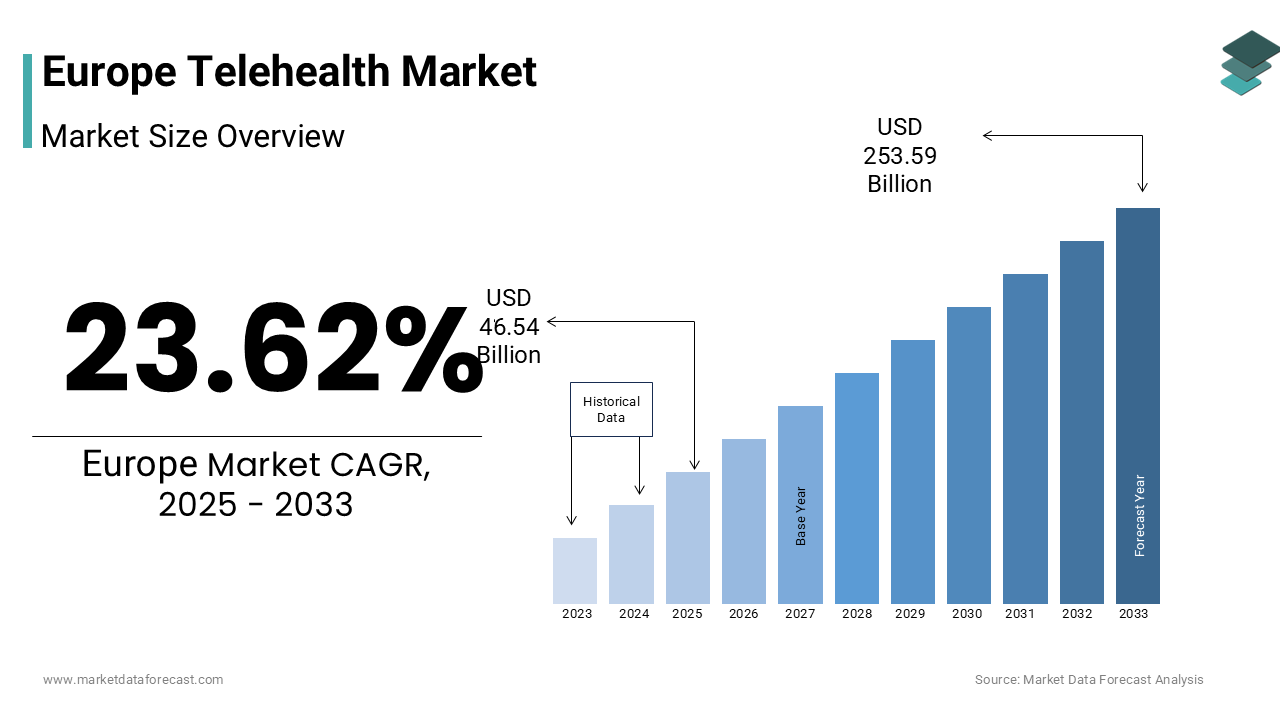
The europe telehealth market size was valued at USD 37.65 billion in 2024 and is anticipated to reach USD 46.54 billion in 2025 from USD 253.59 billion by 2033, growing at a CAGR of 23.62% during the forecast period from 2025 to 2033.
Telehealth in Europe refers to the delivery of healthcare services through digital communication technologies enabling remote clinical and non clinical interactions between patients and health professionals. The model encompasses virtual consultations remote monitoring digital diagnostics, and health education using secure platforms compliant with regional data protection norms. The adoption of telehealth accelerated markedly during the pandemic, but its institutionalization stems from deeper structural shifts in healthcare demand and delivery. As per Eurostat in 2023, a notable share of individuals aged 16 to 74 in the European Union used the internet for health related purposes including contacting health professionals online. As pet the European Commission in 2024, over 20 member states had integrated telehealth into national health strategies with interoperability frameworks under the European Health Data Space initiative. Telehealth infrastructure now spans primary care chronic disease management and mental health support with national health systems increasingly reimbursing digital consultations. The modality addresses systemic pressures including workforce shortages and aging demographics while aligning with the EU’s broader digital transformation agenda for public services.
MARKET DRIVERS
Aging Population Intensifies Demand for Remote Chronic Care Solutions
The region’s demographic trajectory, with its rising prevalence of chronic conditions among older adults, provides a structural impetus for telehealth adoption and fuels the growth of the Europe telehealth market. According to Eurostat the share of the population aged 65 and over in the European Union reached 21.3 percent in 2023 and is projected to exceed 29 percent by 2050. This cohort accounts for a disproportionate burden of non communicable diseases with the World Health Organization estimating that significant share of healthcare expenditures in high income European countries are directed toward chronic disease management. Telehealth enables continuous monitoring and timely intervention for conditions such as diabetes cardiovascular diseases and respiratory disorders reducing hospital readmissions and improving treatment adherence. In Germany for instance the Federal Joint Committee approved reimbursement for remote patient monitoring for heart failure and hypertension in 2020 leading to a threefold increase in connected care programs. Similarly, France's Digital Health Roadmap for 2023–2027 prioritized digital chronic care pathways, including extending telemonitoring beyond existing programs. These developments emphasize how demographic pressure translates into operational demand for scalable virtual care models that maintain clinical efficacy while alleviating strain on overstretched health infrastructures.
Workforce Shortages Drive Institutional Adoption of Virtual Care Platforms
Persistent deficits in healthcare personnel also drives the expansion of the Europe telehealth market. This has caused systemic integration of telehealth to optimize workforce productivity and extend care reach. According to studies, the distribution of physicians across European Union member states varies considerably, with some countries facing lower doctor-to-population ratios than others. Simultaneously, As per sources, Europe could experience a major shortage of healthcare workers in the coming years if training and retention rates do not improve. Telehealth mitigates this gap by enabling task shifting asynchronous consultations and extended consultation hours without proportional increases in staffing. According to studies, the United Kingdom’s healthcare system has adopted digital-first primary care models, enabling doctors to manage more consultations through a mix of virtual and in-person services. As per sources, Sweden’s national health platform has supported a large number of online consultations, reflecting the country’s strong integration of digital tools in primary care delivery. These implementations demonstrate how telehealth functions not merely as a convenience tool but as a strategic workforce multiplier essential for sustaining access amid chronic staffing constraints.
MARKET RESTRAINTS
Fragmented Regulatory Frameworks Impede Cross Border Service Scalability
Regulatory heterogeneity across European jurisdictions is a major obstacle to the Europe telehealth market. Each member state maintains distinct licensing requirements data governance rules and reimbursement policies for virtual care which complicates pan European service models. Only a limited number of European countries currently allow cross-border teleconsultations without extra certification, as per sources. Furthermore, the General Data Protection Regulation while harmonizing privacy standards allows national derogations in health data processing leading to divergent interpretations. For example, Telehealth platforms in Germany must complete a lengthy certification process to meet national regulatory standards, according to studies. In contrast Italy’s regulatory pathway remains ambiguous with regional health authorities exercising discretionary approval powers resulting in inconsistent adoption. Most telehealth providers in Europe consider differing national regulations as a major challenge to expanding their services internationally, as per research. This patchwork landscape increases compliance costs delays innovation cycles and discourages investment in interoperable platforms thereby constraining the scalability of telehealth solutions across the continent.
Digital Exclusion Exacerbates Health Inequities in Vulnerable Populations
Disparities in digital access and literacy, particularly among elderly low income and rural communities, further hamper the expansion of the Europe telehealth market. Many older individuals in Europe continue to face barriers in adopting digital technologies and have limited online skills, according to sources. In rural regions broadband coverage gaps persist with some rural regions across Europe still experience restricted broadband connectivity, which affects access to essential digital services, as per sources. These infrastructural and competency deficits translate into tangible care access barriers. Older patients are significantly less likely to participate in telehealth consultations compared to younger individuals, according to sources. In Portugal, digital health services are used far less in low-income areas than in wealthier urban regions, as per sources. Such disparities risk deepening existing health inequities as telehealth becomes embedded in routine care pathways without parallel investments in digital inclusion infrastructure and tailored support mechanisms.
MARKET OPPORTUNITIES
Integration of Artificial Intelligence Enhances Diagnostic and Triage Capabilities
Artificial intelligence offers new opportunities for the growth of the Europe telehealth market. This can help in clinical decision making and optimize resource allocation across European health systems. AI powered symptom checkers remote diagnostics and predictive analytics are increasingly embedded within telehealth workflows to improve accuracy and efficiency. As per research, several AI-enabled telehealth applications have been approved across Europe under updated regulations, with many designed specifically to assist in primary care triage. According to studies, in the Netherlands, national health programs have promoted the use of AI-driven platforms in dermatology to enhance access and reduce patient waiting times. As per research, in Finland, national digital health services have adopted AI-based tools for predicting chronic disease risks, allowing early interventions for high-risk patients and improving healthcare outcomes. These implementations illustrate how AI not only extends the functional scope of telehealth but also enhances its clinical credibility by delivering measurable improvements in diagnostic precision and system efficiency thereby creating new value propositions for payers and providers alike.
Expansion of 5G Infrastructure Enables Real Time Remote Clinical Interventions
The rollout of fifth generation mobile networks across Europe is unlocking fresh prospects for the expansion of the Europe telehealth market. Also, the new telehealth use cases demand ultra low latency and high bandwidth, particularly in emergency and specialist care domains. Unlike previous generations 5G supports mission critical communications with latency under 10 milliseconds enabling real time transmission of high resolution medical data. 5G connectivity has expanded significantly across European urban regions, with plans aiming for near-universal access by the next decade, as per sources. This infrastructure supports advanced applications such as remote ultrasound guidance ambulance based telestroke consultations and telesurgery. In addition, collaborative health projects have shown how 5G technology can support emergency medical teams in sharing real-time data with hospitals, improving response efficiency, according to studies. Moreover, national health authorities have explored the use of 5G-connected ambulances to strengthen communication between medical staff and hospitals during patient transport, as per sources. These developments signal a paradigm shift from asynchronous teleconsultations to synchronous clinical interventions thereby expanding telehealth’s role from access facilitation to active care delivery.
MARKET CHALLENGES
Interoperability Deficits Affect Data Continuity Across Care Settings
The inability of telehealth platforms to seamlessly exchange data with existing electronic health record systems and national health information infrastructures continues to inhibit the growth of Europe telehealth market. Despite the European Commission’s push for standardized health data exchange under new regulations have been introduced in Europe to support the creation of a unified health data space. According to studies, only a limited number of countries in the region have achieved full interoperability between telehealth systems and hospital electronic records. As per sources, in Italy, many regional telehealth platforms still rely on distinct data formats that require manual data processing for integration. According to studies, in Sweden, healthcare professionals spend additional time reconciling patient data across unconnected telehealth platforms. As per sources, in Germany, integration across telehealth providers within the national digital health infrastructure remains incomplete. These interoperability gaps fragment the patient journey impede longitudinal care coordination and diminish the clinical utility of telehealth by forcing providers to operate in data silos.
Ambiguous Reimbursement Policies Discourage Sustainable Provider Participation
Uncertainty and inconsistency in reimbursement mechanisms for telehealth services deter long term provider investment and integration into standard care pathways, which constrains the expansion of the Europe telehealth market. Although many countries introduced temporary billing codes during the pandemic few have established permanent equitable payment structures. Many European countries differ in their reimbursement policies for teleconsultations compared to in-person visits, as per sources. In Belgium, video consultations are generally supported under reimbursement policies, while certain remote communication methods remain excluded, according to studies. In France, updated healthcare guidelines have included remote monitoring, though financial limits have posed challenges for sustaining related services, as per sources. According to studies, a considerable portion of primary care physicians across Europe reduced or stopped telehealth services once temporary funding measures ended. Adequate and predictable reimbursement is necessary for telehealth to transition from a secondary service to a primary component of value-based care.
REPORT COVERAGE
| REPORT METRIC | DETAILS |
| Market Size Available | 2024 to 2033 |
| Base Year | 2024 |
| Forecast Period | 2025 to 2033 |
| Segments Covered | By Product Type, Delivery Mode, End-User, and Region. |
| Various Analyses Covered | Global, Regional, & Country Level Analysis; Segment-Level Analysis, Drivers, Restraints, Opportunities, Challenges, PESTLE Analysis, Porter’s Five Forces Analysis, Competitive Landscape, Analyst Overview of Investment Opportunities |
| Regions Covered | UK, France, Spain, Germany, Italy, Russia, Sweden, Denmark, Switzerland, the Netherlands, Turkey, the Czech Republic, and the Rest of Europe. |
| Key Market Players | Doctolib, Kry (Livi), Babylon Health, Zava, Ada Health, Philips, Medtronic, and Siemens Healthineers.. |
SEGMENTAL ANALYSIS
By Product Type Insights
The services segment held the largest share of 58.4% of the Europe telehealth market in 2024. The operationalization of virtual care delivery rather than reliance on physical infrastructure or standalone platforms drives the growth of the services segment. This includes remote patient monitoring consultations digital therapeutics and post acute care coordination. As per research, the services component accounted for a portion of total telehealth expenditure across the European Union reflecting a systemic shift toward outcome based care models reimbursed by national health systems. The dominance of this segment is also due to the fact that most European telehealth initiatives are service led with governments contracting providers for care delivery rather than procuring hardware or licensing software independently. According to studies, in France, a large portion of public telehealth funding has been directed toward service-based contracts under national health programs. As per sources, in the United Kingdom, healthcare strategies have emphasized integrating virtual services within long-term care plans to manage patients remotely. These institutional procurement patterns emphasize how reimbursement frameworks and policy priorities favor recurring service engagements over one time technology purchases.
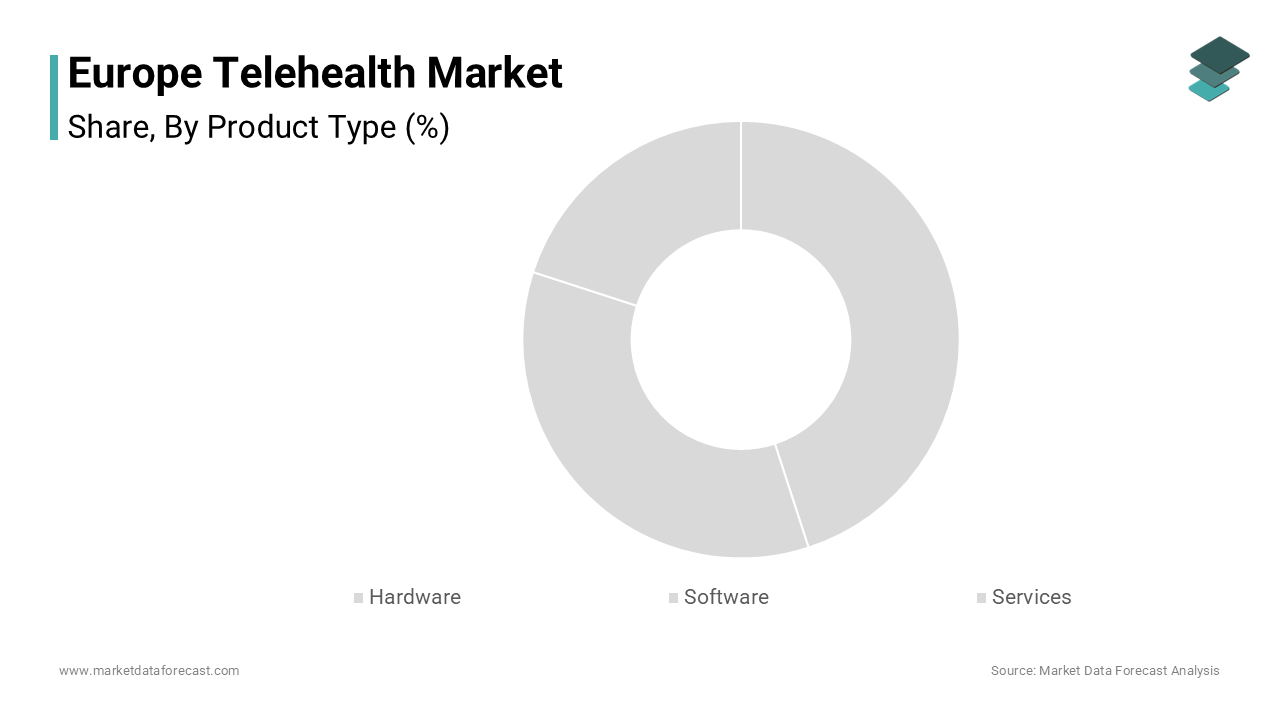
The software segment is anticipated to witness the fastest CAGR of 21.3% from 2025 to 2033 due to the accelerating adoption of cloud native telehealth platforms interoperable electronic health record integrations, and regulatory compliant digital workflows. Telehealth software investments have increased across Europe, with most funding directed toward modular digital platforms, as per sources. Germany exemplifies this trend. According to studies, a growing number of telehealth software solutions have gained regulatory approval in the region for official healthcare use. In parallel, as per sources, in the Netherlands, national frameworks have encouraged widespread adoption of standardized telehealth systems among healthcare providers. This convergence of policy enablement technical standardization and scalable deployment models supports the software segment’s rapid ascent.
By Delivery Mode Insights
In 2024, the web based segment dominated the Europe telehealth market by accounting for a substantial share. Their scalability accessibility and alignment with cloud first national health strategies have significantly boosted the expansion of the web based segment. As per research, web based platforms constituted a portion of all telehealth deployments across the European Union driven by low infrastructure barriers and seamless integration with existing digital identity systems. Web-based models provide immediate access across various devices and locations, a significant advantage for decentralized health systems, unlike on-premises systems that demand localized server maintenance and IT support. According to studies, in Sweden, national digital health platforms have shifted to cloud-based web architectures to improve scalability and service reliability. As per sources, in Italy, regional health systems have expanded the use of web-based teleconsultation modules to increase digital access for citizens. These implementations reflect a strategic preference for agile secure and centrally manageable solutions that support pan European digital health interoperability goals.
The web based segment is also likely to experience the fastest CAGR of 9.8% from 2025 to 2033 due to evolving cybersecurity standards enhanced browser based clinical functionalities and policy mandates favoring zero client architectures. Updated cybersecurity guidelines have been released across the European region to strengthen telehealth data protection, as per sources. In Denmark, revised national strategies have directed health authorities to move toward web-based telehealth platforms to enhance digital service delivery, according to studies. Furthermore browser based real time communication now supports high fidelity medical imaging and remote diagnostics with several web-based telehealth platforms have also achieved certification for meeting clinical standards in video communication and data exchange, as per sources. These technical and regulatory enablers ensure that web based delivery remains not only the largest but also the most dynamically expanding segment.
REGIONAL ANALYSIS
Germany Telehealth Market Analysis
Germany outperformed other regions in the European telehealth market by capturing a 22.6% share in 2024. The domination of Germany is primarily driven by robust regulatory frameworks structured reimbursement and high digital health literacy. The country accounted for a portion of Europe’s telehealth expenditure in 2024, according to research. Central to this dominance is the Digitale Versorgung Gesetz which established a fast track pathway for digital health applications to gain prescription eligibility and statutory insurance reimbursement. Moreover, many digital health apps including telehealth specific solutions had received DiGA status enabling millions of patients to access reimbursed virtual care. Germany also leads in remote patient monitoring with statutory health insurers covering connected devices for chronic conditions. Coupled with nationwide fiber broadband coverage, this ecosystem ensures sustained market primacy.
United Kingdom Telehealth Market Analysis
The United Kingdom followed closely in the Europe telehealth market and captured 18.6% share in 2024. The growth of the United Kingdom is attributed to the National Health Service’s institutionalized digital first care model. Virtual ward programs have been implemented across the United Kingdom to support remote monitoring and care for various health conditions, as per sources. A significant share of primary care appointments and consultations in the United Kingdom are now managed through digital applications and approved telehealth platforms, according to studies. Policy continuity has been critical the 2023 Health and Care Act enshrined digital inclusion as a statutory duty compelling local authorities to fund connectivity and device access for vulnerable populations. Consequently digital consultation uptake among adults aged 65 and over rose. This blend of centralized infrastructure targeted inclusion and legislative backing strengthens the UK’s position.
France Telehealth Market Analysis
France is also a key region in the European telehealth market with a nationally coordinated strategy and high patient engagement in digital chronic care. As per sources, a growing number of patients in France have been enrolled in structured telehealth programs addressing chronic and mental health conditions through national digital health platforms. According to studies, reimbursement policies that equate teleconsultation payments with in-person visits have encouraged wider adoption of virtual appointments among physicians in France. As per sources, government investments in national digital health initiatives have led to improved patient engagement, including a noticeable decrease in missed specialist appointments. Apart from these, France leads in cross sector integration linking telehealth data with pharmacies laboratories and social care via the Dossier Médical Partagé. This holistic interoperability enhances care continuity and strengthens France’s strategic foothold.
Italy Telehealth Market Analysis
Italy grew gradually in the Europe telehealth market with growth propelled by regional innovation and post pandemic institutionalization. The Ministry of Health allocated funds to scale virtual care with Lombardy and Emilia Romagna achieving primary care telehealth coverage. The Fascicolo Sanitario Elettronico now integrates teleconsultation modules used by millions of citizens representing a portion of the adult population, according to sources. A key driver is the mandatory inclusion of telehealth in chronic disease management protocols. Despite historical fragmentation Italy’s recent harmonization efforts and targeted funding have caused rapid adoption.
Netherlands Telehealth Market Analysis
The Netherlands is predicted to grow in the Europe telehealth market during the forecast period owing to its mature digital infrastructure and patient centric design principles. Nearly all general practices utilize the national ZorgDomein referral and teleconsultation platform which processed millions of digital interactions, as per sources. The country’s prominence stems from early adoption of open standards under the MedMij framework which gives patients secure access to health data from certified applications enabling seamless telehealth integration. Furthermore the government is committed to expand virtual mental health and elderly care services increasing geriatric telehealth usage. This combination of technical interoperability user trust and targeted policy ensures the Netherlands remains a top tier telehealth market.
COMPETETIVE LANDSCAPE
The Europe telehealth market features a dynamic competitive landscape characterized by a mix of specialized digital health startups established healthcare IT vendors and global technology entrants. Competition centers not on price but on clinical validation regulatory compliance interoperability with national health infrastructures and depth of integration into public reimbursement systems. Local presence and language adaptation are critical success factors given Europe’s regulatory and linguistic fragmentation. Incumbents leverage long standing relationships with ministries of health and statutory insurers while agile startups differentiate through niche clinical focus such as mental health chronic disease or elderly care. Strategic consolidation is increasing with acquisitions targeting complementary capabilities in data analytics remote diagnostics and secure communication. The absence of dominant pan European players creates opportunities for innovation but also imposes high barriers related to certification scalability and trust. Differentiation increasingly hinges on demonstrable health system impact rather than technology novelty alone.
KEY MARKET PLAYERS
A few of the major companies in the Europe telehealth market include
- Doctolib, Kry (Livi)
- Babylon Health
- Zava, Ada Health
- Philips
- Medtronic
- Siemens Healthineers.
Top Players in the Europe Telehealth Market
Babylon Health
Babylon Health has established a significant footprint in the European telehealth landscape through its AI powered virtual care platform offering consultations diagnostics and health monitoring. The company operates in multiple European countries including the United Kingdom Germany and Ireland providing services to both public health systems and private insurers. This collaboration enhances patient triage efficiency and expands Babylon’s clinical reach. The company continues to invest in regulatory compliance achieving CE certification for several AI driven clinical decision support modules under the EU Medical Device Regulation which supports its credibility and scalability across the region.
Liva Healthcare Telehealth Market Insights
Liva Healthcare is a Copenhagen based digital therapeutics company specializing in behavior change programs delivered through telehealth for chronic disease prevention and management. Active across the United Kingdom Germany France and the Nordic countries Liva works closely with national health services and employers to deploy personalized coaching at scale. The company also secured approval from the French National Health Insurance Fund for reimbursement of its type 2 diabetes prevention program marking a strategic milestone. These initiatives demonstrate Liva’s commitment to evidence based scalable interventions aligned with public health priorities across Europe.
Siilo Telehealth Market Insights
Siilo is a Netherlands headquartered secure clinical communication platform widely adopted by healthcare professionals across Europe for teleconsultations case discussions and care coordination. This enhancement transformed Siilo from a communication tool into a full service virtual care enabler. The company also collaborated with Dutch university medical centers to pilot AI assisted image annotation for dermatology and radiology further embedding its platform into clinical workflows and strengthening its position as a trusted infrastructure provider in European digital health.
Top Strategies Used by the Key Market Participants
Key players in the Europe telehealth market prioritize regulatory alignment by securing CE marking and national health authority approvals to ensure compliance with the EU Medical Device Regulation and data protection laws. They actively pursue strategic partnerships with public health systems insurers and hospitals to embed services into reimbursed care pathways. Continuous platform enhancement through integration of artificial intelligence remote monitoring and interoperability with national electronic health records remains central. Companies also invest in multilingual and culturally adapted user interfaces to facilitate cross border scalability. Besides, they focus on generating real world evidence through clinical studies to validate outcomes and support reimbursement applications demonstrating commitment to clinical efficacy and system value.
MARKET SEGMENTATION
The research report on the europe telehealth market has been segmented and sub-segmented based on categories.
By Product Type
- Hardware
- Software
- Services
By Delivery Mode
- On premises
- Web based
By End Users
- Providers
- Patients
- Payers
- Other End Users
By Country
- UK
- France
- Spain
- Germany
- Italy
- Russia
- Sweden
- Denmark
- Switzerland
- Netherlands
- Turkey
- Czech Republic
- Rest of Europe