- Product Description Description
- Table of Contents TOC
- List of Table & Figure LOT
- Get Free Sample PDF Sample PDF
Market Size, 2025
$335.68 MnMarket Estimate, 2026
$339.92 MnMarket Forecast, 2034
$375.65 MnCAGR, 2026–2034
1.26%Europe Telescope Market Report Summary
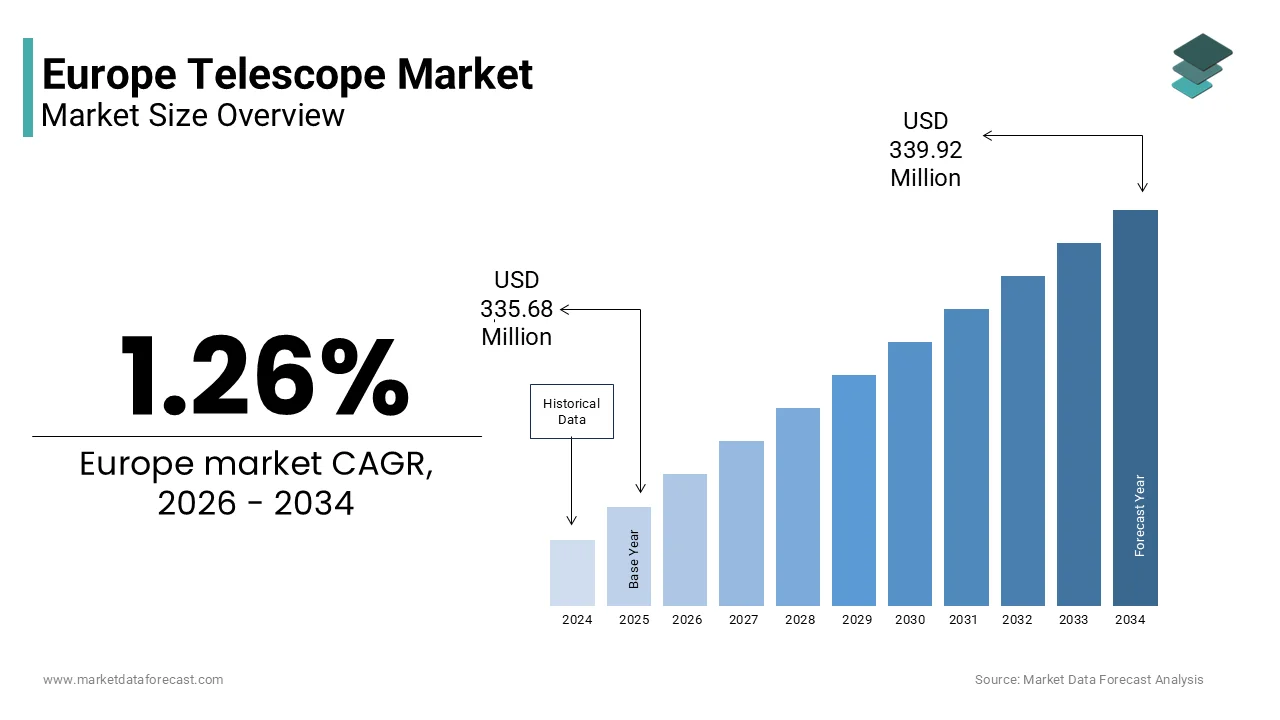
The Europe telescope market was valued at USD 335.68 million in 2025 and is estimated to reach USD 339.92 million in 2026, further projected to reach USD 375.65 million by 2034, growing at a CAGR of 1.26% during the forecast period. Market growth is supported by steady demand from scientific research institutions, academic observatories, and amateur astronomy communities. Increasing investments in space exploration programs, astrophysics research, and satellite observation technologies across Europe are contributing to sustained demand. In addition, technological advancements in optical precision, lightweight materials, and digital imaging integration are enhancing telescope performance and accessibility.
Key Market Trends
- Growing investments in astronomical research projects and space observation initiatives across European countries.
- Rising demand for high precision reflecting telescopes due to their superior light gathering capability and suitability for deep space observation.
- Increasing adoption of computerized and motorized telescopes among research institutions and advanced hobbyists.
- Expansion of astrophotography trends supported by digital imaging compatibility and enhanced optical coatings.
- Steady participation of educational institutions in astronomy programs, supporting institutional telescope procurement.
Segmental Insights
- Based on type, the reflecting telescopes segment dominated the Europe telescope market in 2025. The segment’s leadership is attributed to its ability to provide larger apertures at comparatively lower costs, making it ideal for scientific research and deep sky observations.
- Based on application, the scientific research institutions segment led the Europe telescope market in 2025. Growth in this segment is driven by ongoing astrophysics studies, space science programs, and government funded research initiatives across European observatories and universities.
Regional Insights
- Germany accounted for 24.1% of the Europe telescope market share in 2025, outperforming other countries in the region. The country’s dominance is supported by strong scientific infrastructure, active space research programs, advanced optical manufacturing capabilities, and a well established base of research institutions and observatories.
- Other Western European countries are also contributing steadily due to sustained funding for astronomy and space science initiatives.
Competitive Landscape
The Europe telescope market is moderately competitive, characterized by established optical equipment manufacturers and specialized astronomy brands. Companies are focusing on improving optical precision, digital integration, portability, and product customization to cater to both professional and amateur users. Key players operating in the Europe telescope market include Nikon, Steiner, Bushnell, Canon, Leica, Zeiss, Kowa, Celestron, Vixen Co, Takahashi, Bosma, SharpStar, Visionking, and TianLang.
Europe Telescope Market Size
The Europe telescope market size was valued at USD 335.68 million in 2025 and is projected to reach USD 375.65 million by 2034 from USD 339.92 million in 2026, growing at a CAGR of 1.26%.
A telescope is an optical instrument designed to collect and focus electromagnetic radiation, primarily in the visible infrared and radio wavelengths, to enable detailed observation of celestial objects and phenomena. In Europe the telescope market encompasses a diverse spectrum ranging from amateur refractors and reflectors to professional-grade observatory systems and space-based platforms developed through multinational scientific collaboration. The European telescope ecosystem is distinguished by its deep integration with institutional astronomy infrastructure including the European Southern Observatory the Max Planck Institute for Astronomy and national agencies such as the UK’s Science and Technology Facilities Council. The European Union possesses a substantial and highly specialized academic community dedicated to space sciences, fostering a continuous demand for sophisticated instrumentation and observational infrastructure. Europe maintains a diverse and globally significant network of space-based and terrestrial observatories, reflecting a long-term strategic commitment to advancing our understanding of the universe. This environment fosters a unique market where scientific ambition public investment and engineering excellence converge to shape the evolution of telescopic technology far beyond commercial consumer trends.
MARKET DRIVERS
Sustained Public Investment in Ground Based and Space Astronomy Fuels Demand
The region’s enduring commitment to astronomical discovery is contributing to the growth of the Europe telescope market. This serves as a primary engine for telescope procurement and development. Unlike regions driven predominantly by consumer or defense interests European telescope demand is anchored in long term publicly funded scientific programs that prioritize optical performance data fidelity and observational longevity. A major international collaboration of European nations is funding the construction of the world's largest optical telescope, representing a multi-billion euro investment in next-generation ground-based astronomy. The next generation of giant telescopes relies on an unprecedented number of modular mirror segments and advanced wavefront control systems to achieve high-resolution imaging of distant celestial objects. Similarly, a major European space mission is currently surveying a vast portion of the extra-galactic sky to investigate the expansion of the universe and the nature of dark matter. The European Union provides substantial research grants through its flagship innovation program to support the development of high-precision sensors and automated systems for space exploration. National research ministries are continuing to invest in the modernization of established terrestrial observatories to ensure they remain competitive in the era of large-scale digital astronomy. These coordinated investments ensure continuous demand for high precision optics mounts and control systems insulated from economic cycles and consumer preferences.
Rising Participation in Citizen Science and Amateur Astronomy Drives Consumer Segment Growth
The democratization of astronomical observation has enabled steady expansion in the Europe telescope market. This growth is fueled by educational outreach, digital imaging accessibility, and urban stargazing initiatives. Major European astronomical societies are fostering a vibrant culture of public science by coordinating numerous community stargazing initiatives and educational outreach programmes. Modern planetariums are expanding their roles as educational hubs, offering more interactive technical training to meet a growing public interest in practical observational astronomy. The proliferation of affordable CMOS sensors and smartphone adapters has further lowered entry barriers enabling enthusiasts to capture deep sky images with sub 500 euro setups. A significant number of people in Germany are taking up astronomy as a serious pursuit, increasingly utilizing automated and digitally integrated telescopes to navigate the night sky. National policies amplify this trend with France’s Ministry of Education integrating telescope use into secondary school curricula and Sweden designating numerous Dark Sky Reserves to promote low light pollution observation. This cultural institutional and technological convergence sustains a resilient grassroots market that complements large scale scientific procurement.
MARKET RESTRAINTS
Stringent Light Pollution Regulations Limit Observational Viability in Urban Areas
Dense urbanization and pervasive artificial lighting in the region significantly constrain the practical utility of ground-based telescopes, despite a strong interest in astronomy and growth in the Europe telescope market. This is particularly true for amateur and educational users. A vast majority of the European population resides in areas where artificial skyglow significantly obscures the natural night sky, preventing the observation of many celestial phenomena from urban and suburban environments. European environmental policy is increasingly recognizing artificial light at night as a pollutant that severely degrades the quality of astronomical observations and disrupts ecological balances. Countries like Slovenia and Scotland have enacted comprehensive outdoor lighting ordinances requiring full cutoff fixtures and amber LEDs. However, enforcement of these standards remains inconsistent across most major economies. Europe is seeing a growth in recognized dark sky spots, but these sanctuaries still cover only a minimal percentage of the total, largely light-polluted landmass. This forces amateur astronomers to travel long distances or invest in costly narrowband filters that only partially restore visibility. Educational facilities in densely populated European regions face increasing difficulties in conducting practical stargazing activities as local urban development continues to brighten the night sky. Consequently telescope ownership does not always translate into meaningful observational activity dampening replacement cycles and accessory adoption.
High Entry Barriers in Precision Optics Manufacturing Constrain Local Supply Chains
The scarcity of domestic manufacturers capable of producing large aperture diffraction limited optics and ultra stable mechanical structures is hindering the expansion of the Europe telescope market. While the continent excels in system integration and scientific instrumentation, it relies heavily on specialized suppliers from the United States and Japan. These suppliers provide critical components such as low expansion glass ceramics and ion beam figuring services. The production of large-scale, high-precision mirrors remains a highly specialized industrial capability concentrated within a small number of elite European firms and research organizations. Global supply chain disruptions have highlighted the sensitivity of the precision optics sector to the availability of specialized raw materials and the logistical challenges of transporting delicate, large-scale components. Despite a steady stream of graduates in physics and photonics, the high-end optics industry continues to face a shortage of specialized engineers with the specific technical expertise required for advanced astronomical instrumentation. National efforts to rebuild capacity remain nascent with the Czech Republic’s Pilsen Optical Works representing one of the few active large mirror foundries. Europe risks losing its edge in next-gen telescope construction if it doesn't reinvest in optical expertise, threatening its leadership despite having the vision and funding.
MARKET OPPORTUNITIES
Integration of Artificial Intelligence for Autonomous Observation Creates New Value Streams
The convergence of machine learning and robotic telescope systems offers a transformative opportunity for the Europe telescope market. This transformation is driven by enabling intelligent target selection, real-time anomaly detection, and adaptive scheduling. Unlike traditional observatories requiring manual operation AI driven platforms can autonomously respond to transient events such as gamma ray bursts or near Earth object approaches maximizing scientific return. European research funding is increasingly supporting the integration of deep learning models with automated telescope networks to enable the near-instantaneous identification and characterization of transient cosmic events. Similarly, next-generation survey telescopes are utilizing innovative multi-camera architectures to capture vast areas of the sky simultaneously, relying on sophisticated automated data processing to identify fast-moving objects and potential hazards. National initiatives amplify this trend with Finland’s Arctic Cosmos Network deploying AI powered all sky monitors that adjust exposure parameters based on auroral activity forecasts. These capabilities reduce human intervention lower operational costs and expand the scope of feasible surveys making telescopes not just optical instruments but cognitive observatories. This paradigm shift opens avenues for software licensing data analytics and predictive maintenance services creating recurring revenue models beyond hardware sales.
Expansion of Educational and Tourism Based Observatory Infrastructure Drives Commercial Deployment
The region’s growing emphasis on science tourism and experiential education is enabling demand for mid-scale professional telescopes installed in public observatories science centers and eco resorts, which creates fresh prospects for the Europe telescope market. Unlike research grade instruments these systems prioritize reliability user interactivity and aesthetic integration while maintaining sufficient optical quality for planetary and deep sky viewing. Regional development initiatives and European funding are increasingly supporting the creation of public astronomical facilities to promote scientific literacy and stimulate local tourism in rural areas. The specialized market for stargazing travel is expanding rapidly in premier dark-sky destinations, significantly contributing to the diversification and growth of the local hospitality sector. Companies have responded by developing weather sealed telescope enclosures with touchscreen interfaces and live streaming capabilities tailored for non-expert audiences. Educational collaborations across Northern Europe are implementing remote-access technology to bring live astronomical observation directly into classrooms and community learning environments. This blend of public engagement sustainable tourism and STEM policy creates a stable commercial channel insulated from academic budget fluctuations and reinforces astronomy as a cultural asset.
MARKET CHALLENGES
Fragmented Regulatory Frameworks for Radio Frequency and Optical Spectrum Use Impede Multi Wavelength Coordination
The absence of harmonized regulations governing electromagnetic spectrum allocation across optical and radio bands is challenging the expansion of the Europe telescope market. Radio observatories, such as the Netherlands-based LOFAR array, are facing growing radio frequency interference (RFI) from 5G, satellite constellations, and IoT technology, a challenge parallel to the light pollution affecting optical telescopes. The European Commission’s Spectrum Policy Framework lacks binding provisions to enforce exclusion zones around major observatories leading to jurisdictional conflicts between telecommunications regulators and scientific bodies. As per sources, European partners have delayed data validation protocols due to inconsistent national interpretations of interference thresholds. This regulatory fragmentation complicates multi messenger astronomy efforts that require synchronized optical radio and gravitational wave observations. Europe risks devaluing billions in public investment and undermining its flagship observatories if it fails to adopt a unified spectrum policy.
Accelerated Orbital Congestion from Mega Constellations Degrades Observational Data Quality
The rapid deployment of low Earth orbit satellite mega constellations poses an existential threat to ground based optical and near infrared astronomy across the region, which limits the expansion of the Europe telescope market. Bright reflective surfaces and frequent orbital passes create persistent streaks in long exposure images disrupting surveys of faint galaxies near Earth asteroids and transient phenomena. Advanced astrophysical models show that the rapid expansion of satellite networks will increasingly interfere with ground-based observations, particularly during the twilight hours when orbiting objects are most reflective. The number of active satellites in low Earth orbit is growing at an unprecedented rate, with global telecommunications projects expected to dramatically increase the orbital population by the end of the decade. Although mitigation measures such as satellite dimming and orientation adjustments are being tested their efficacy remains partial and inconsistently applied. The European Space Agency’s Space Safety Programme has initiated coordination talks but lacks enforcement authority over commercial operators. For time domain astronomy this clutter introduces irreducible noise reducing discovery efficiency and increasing post processing costs. Unless binding international norms are established Europe’s world class observatories may face irreversible degradation of their scientific output despite technological and financial readiness.
REPORT COVERAGE
| REPORT METRIC | DETAILS |
| Market Size Available | 2025 to 2034 |
| Base Year | 2025 |
| Forecast Period | 2026 to 2034 |
| CAGR | 1.26% |
| Segments Covered | By Type, Application, and Region |
| Various Analyses Covered | Global, Regional, & Country Level Analysis; Segment-Level Analysis; DROC, PESTLE Analysis; Porter’s Five Forces Analysis; Competitive Landscape; Analyst Overview of Investment Opportunities |
| Regions Covered | UK, France, Spain, Germany, Italy, Russia, Sweden, Denmark, Switzerland, Netherlands, Turkey, and the Czech Republic |
| Market Leaders Profiled | Nikon, Steiner, Bushnell, Canon, Leica, Zeiss, Kowa, Celestron, Vixen Co, Takahashi, Bosma, SharpStar, Visionking, and TianLang |
SEGMENTAL ANALYSIS
By Type Insights
The reflecting telescopes segment dominated the European telescope market in 2025. The dominance of the segment is driven by its superior light gathering capability cost efficiency at large apertures and adaptability to both amateur and professional applications. Unlike refracting systems which suffer from chromatic aberration and high material costs for large lenses reflecting telescopes use mirrors that can be supported from behind enabling construction of instruments with apertures exceeding eight meters. Large-scale European astronomical research facilities primarily utilize reflecting telescope designs, transitioning from massive single-piece mirrors to modular segmented architectures for the next generation of giant observatories. Academic institutions across Europe are increasingly investing in sophisticated reflecting telescope systems that offer the versatility and optical performance required for advanced student research and instrumentation testing. Additionally, reflecting telescopes remain the preferred choice for a majority of amateur astronomers in the United Kingdom who prioritize larger apertures for the observation of faint, deep-sky objects. This architectural dominance is further reinforced by manufacturing scalability as mirror substrates can be produced from low expansion glass ceramics like Zerodur, a material pioneered in Germany and widely available across European optical workshops.
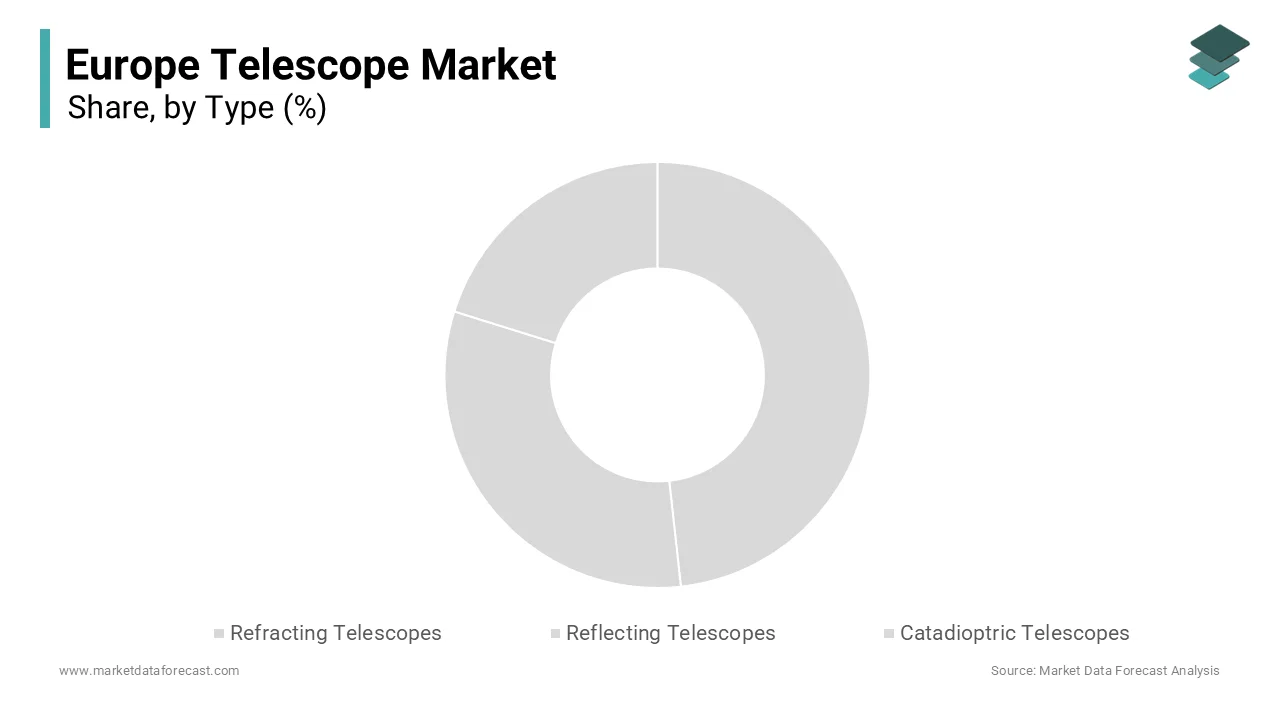
The catadioptric telescope segment is estimated to register the fastest CAGR of 9.4% from 2026 to 2034 due to its hybrid design combining refractive corrector plates with reflective mirrors to deliver compact portable systems with long focal lengths ideal for planetary imaging and astrophotography. Urban observers in Germany are increasingly adopting compact, high-performance optical designs that are easily integrated with modern digital imaging and automated tracking systems. New public astronomical facilities in Southern Europe are frequently opting for versatile hybrid telescope systems that offer high-resolution performance and facilitate efficient remote observation. Moreover companies have introduced European compliant variants with integrated filter wheels and thermal stabilization catering to the growing demand for turnkey astroimaging solutions. The rise of social media astronomy communities further amplifies this trend as users share high resolution lunar and planetary images captured with these versatile instruments fostering peer driven adoption across France Sweden and the Netherlands.
By Application Insights
The scientific research institutions segment led the Europe telescope market in 2025. The leading position of the segment is attributed to decades of multinational investment in observational infrastructure. These entities procure high end instruments not as standalone devices but as integrated components of data acquisition ecosystems involving spectrographs adaptive optics and robotic control systems. A vast network of space-based and ground-based observatories across the globe operates with significant European scientific and financial backing, reinforcing the continent's role in cosmic exploration. The world's leading intergovernmental astronomical organisation allocates a major portion of its annual capital to the development and maintenance of cutting-edge optical systems and sensor technologies to keep its facilities at the forefront of science. Flagship European research programmes are providing substantial multi-year grants to develop the specialized hardware and data infrastructure needed to track transient cosmic events and study planets orbiting other stars. National agencies reinforce this dominance with France’s CNRS and Germany’s MPG jointly funding the 4 meter International Liquid Mirror Telescope in India, a project requiring custom drive systems and mercury containment protocols. This institutional scale ensures consistent demand for precision engineered telescopes far beyond consumer or educational procurement cycles.
The educational services application segment is anticipated to witness the fastest CAGR of 10.2% over the forecast period owing to policy driven STEM integration and experiential learning mandates across European curricula. European educational frameworks are increasingly encouraging the use of digital tools and practical scientific observation to enhance student engagement with physics and earth sciences. Educational authorities in Northern Europe are integrating astronomy more deeply into secondary education, often supporting remote and rural schools with specialized scientific equipment. Similarly, national education ministries are investing in modern scientific instruments and digital simulation software to provide students with a more interactive experience in space and planetary sciences. The Czech Republic has converted decommissioned research telescopes into educational nodes linked via a national network allowing real time classroom access. These systemic investments transform telescopes from luxury tools into standardized pedagogical instruments creating a predictable recurring demand stream that is both publicly funded and geographically widespread.
REGIONAL ANALYSIS
Germany Telescope Market Analysis
Germany outperformed other countries in the Europe Telescope Market and accounting for a 24.1% share in 2025. The dominance of the German market is driven by its world class optical engineering heritage and robust amateur astronomy community. The market status is supported by a high concentration of premium manufacturers who produce sophisticated refractors, reflectors, and catadioptric systems for both professional observatories and serious enthusiasts. A primary driving factor is the strong culture of scientific education and public outreach which encourages stargazing through numerous local astronomy clubs and planetariums. Germany hosts an extensive and well-organized network of community astronomical associations, supported by a large population of enthusiasts who dedicate significant resources to advanced observational hardware. One more reason for growth here is the presence of leading global optical brands headquartered in regions like Wetzlar and Jena, historically known as the cradle of precision optics, which fosters continuous innovation in lens coating and mount stability. The Federal Ministry of Education and Research supports various initiatives to promote STEM education in schools, often including telescope grants and observation programs that stimulate early interest. Furthermore, the growing trend of astrophotography has created a lucrative niche for advanced mounts and tracking systems capable of long exposure imaging. The combination of manufacturing excellence, educational support, and a passionate user base ensures Germany remains the largest and most technologically advanced market for telescopes in the region.
United Kingdom Telescope Market Analysis
The United Kingdom was the next prominent country in the Europe telescope market and captured a share of 18.8% in 2025. The expansion of the UK market is fuelled by a vibrant amateur astronomy sector and significant government investment in space science infrastructure. The market status here is defined by a strong preference for portable and computerized telescopes that cater to observers dealing with variable weather conditions and light pollution in urban areas. A key driving factor is the widespread popularity of astronomy as a hobby, bolstered by major public events such as the annual Stargazing Live festival which attracts millions of viewers and significantly boosts retail sales each year. An added boost for this area is the prestigious professional research sector, home to world leading institutions like the Royal Observatory Greenwich and the UK Astronomy Technology Centre which drive demand for specialized high end instruments and components. Data from the Science and Technology Facilities Council indicates sustained funding for ground based observational projects, fostering a supply chain for custom optical solutions. Additionally, the rise of dark sky reserves in regions like Exmoor and Northumberland has encouraged tourism related astronomy experiences, further stimulating the rental and purchase markets. The blend of public enthusiasm, institutional prestige, and dedicated dark sky locations secures the UK's status as a pivotal and dynamic market for telescope technologies.
France Telescope Market Analysis
France is also a major player in the Europe Telescope Market due to its extensive network of public observatories and a strong tradition of scientific discovery. The market status in this region is propelled by a balanced demand between educational refractors for schools and advanced deep sky instruments for private collectors. A major driving factor is the national commitment to astronomy education, with the Ministry of National Education integrating observational astronomy into secondary school curricula, creating a steady institutional demand for durable and user friendly telescopes. France maintains an extensive network of regional astronomical organisations that provide the public with technical training and frequent opportunities for celestial observation, supporting a sophisticated community of equipment users. Further support for this segment comes from the presence of major professional facilities like the Haute Provence Observatory which not only conduct cutting edge research but also serve as hubs for public engagement and equipment testing. Statistics from the National Centre for Scientific Research show ongoing collaborations between academic institutions and optical manufacturers to develop next generation adaptive optics systems. Furthermore, the tourism sector in rural areas with low light pollution is increasingly offering astro tourism packages, driving rentals and sales of portable telescopes. The synergy between educational policy, professional research leadership, and emerging astro tourism sustains France's strong standing as a key market for diverse telescope applications.
Italy Telescope Market Analysis
Italy expanded steadily in the Europe telescope market owing to a unique demand profile driven by its rich historical legacy in astronomy and a growing community of astrophotographers. The market status is defined by a preference for high quality optical tubes and precision mounts that can capture the detailed celestial views available from its southern latitudes and mountainous regions. A primary driving factor is the resurgence of interest in Galileo's legacy, which inspires numerous cultural festivals and public viewing events that introduce astronomy to the general public and stimulate equipment purchases. An additional driver is the specialized manufacturing sector in northern Italy which produces high end mechanical components and optical accessories exported globally, reinforcing the domestic supply chain with top tier products. The National Institute of Astrophysics operates several major observatories that collaborate with local industries to test prototype instruments, ensuring technological relevance. Additionally, the clear skies available in regions like Sicily and the Alps attract international astro tourists, boosting the local market for rental and guide services equipped with professional grade telescopes. The blend of historical inspiration, specialized manufacturing, and favorable observing conditions creates a distinctive market dynamic where quality and precision are paramount, ensuring Italy remains a vital player in the European landscape.
Spain Telescope Market Analysis
Spain is anticipated to grow in the Europe telescope market during the forecast period due to its status as a global hub for professional astronomy and exceptional atmospheric conditions that attract observers from across the continent. The market status in Spain is marked by a dual focus on massive professional installations and a growing segment of serious amateur astronomers utilizing the country's dark skies. A key driving factor is the presence of world class observatories such as the Roque de los Muchachos Observatory in the Canary Islands and the Calar Alto Observatory, which host some of the largest telescopes on Earth and drive demand for specialized maintenance and auxiliary optical equipment. A different driver is the development of astro tourism, where regions with certified Starlight Reserves offer guided stargazing experiences that rely on high performance telescopes for public use. The Spanish Starlight Foundation reports a significant increase in visitors to these reserves, prompting hotels and tour operators to invest in professional grade instrumentation. Furthermore, the favorable climate allows for more observing nights per year compared to northern Europe, encouraging locals to invest in permanent backyard observatories and advanced tracking systems. The convergence of professional research dominance, astro tourism growth, and superior weather conditions creates a dynamic environment for telescope adoption, securing Spain's position as a key strategic market in the region.
COMPETITIVE LANDSCAPE
The Europe telescope market features a dual tier competitive landscape comprising elite optical engineering firms serving scientific institutions and agile consumer brands targeting amateur astronomers. At the high end competition revolves around optical precision thermal stability and integration with data acquisition systems rather than price with companies like Carl Zeiss competing through legacy trust and co engineered solutions. In the consumer segment rivalry centers on user experience portability and digital connectivity with brands like Meade and Sky Watcher vying for visibility through educational outreach and social media engagement. Barriers to entry remain high due to the need for certified optical metrology cleanroom facilities and long term relationships with research consortia. Meanwhile mid tier players differentiate through hybrid designs and software ecosystems. Unlike mass markets innovation cycles are deliberate and reputation driven ensuring that competition remains specialized collaborative and deeply rooted in Europe’s scientific heritage rather than purely commercial dynamics.
KEY MARKET PLAYERS
Some of the notable key players in the Europe telescope market are
- Nikon
- Steiner
- Bushnell
- Canon
- Leica
- Zeiss
- Kowa
- Celestron
- Vixen Co
- Takahashi
- Bosma
- SharpStar
- Visionking
- TianLang
Top Players in the Market
- Carl Zeiss AG is a foundational pillar of the European telescope market with over a century of expertise in precision optics and astronomical instrumentation. The company supplies high end refracting and catadioptric systems to observatories universities and space agencies worldwide. Zeiss played a critical role in developing the optical train for the European Southern Observatory’s Very Large Telescope and continues to provide adaptive optics subsystems for next generation instruments. It also launched an open access calibration service for academic users across Europe enabling remote performance validation. These initiatives reinforce its position as a trusted enabler of scientific discovery while deepening integration with Europe’s research infrastructure.
- Meade Instruments Europe GmbH serves as the continental hub for one of the world’s most recognized amateur telescope brands offering a comprehensive portfolio of computerized reflectors and catadioptric systems. The company has strengthened its European footprint by localizing customer support and firmware development to address regional observing conditions and language preferences. It also partnered with the European Planetarium Network to deliver educational telescope kits to numerous schools. These actions demonstrate a strategic pivot toward accessibility and public engagement while maintaining technological relevance in a competitive consumer segment.
- PlaneWave Instruments Europe B.V. specializes in professional grade robotic telescopes designed for research astrophotography and satellite tracking. Headquartered in the Netherlands the company caters to university observatories private research foundations and space situational awareness programs across the continent. Its hallmark is the CDK optical design which eliminates coma and field curvature enabling wide field imaging without corrective lenses. It also integrated real time cloud monitoring and automated dome control into its software suite enhancing operational autonomy for remote observatories in Scandinavia and the Alps. This focus on reliability automation and scientific-grade performance solidifies its niche leadership in Europe’s advanced observational ecosystem.
Top Strategies Used by the Key Market Participants
Key players in the Europe telescope market emphasize co development with academic and governmental research bodies to align product roadmaps with scientific priorities. They invest in localized technical support and calibration services to reduce downtime for institutional users. Companies are increasingly embedding artificial intelligence for autonomous target acquisition and image processing to enhance usability. Strategic partnerships with planetariums schools and dark sky reserves drive grassroots adoption and brand loyalty. Additionally manufacturers are integrating sustainable practices such as low power electronics and recyclable packaging to meet EU environmental standards while differentiating their offerings in both professional and consumer segments.
MARKET SEGMENTATION
This research report on the European telescope market has been segmented and sub-segmented based on categories.
By Type
- Refracting Telescopes
- Reflecting Telescopes
- Catadioptric Telescopes
By Application
- Personal
- Educational Services
- Scientific Research Institutions
- Others
By Country
- UK
- France
- Spain
- Germany
- Italy
- Russia
- Sweden
- Denmark
- Switzerland
- Netherlands
- Turkey
- Czech Republic
- Rest of Europe