- Product Description Description
- Table of Contents TOC
- List of Table & Figure LOT
- Get Free Sample PDF Sample PDF
Market Size, 2025
$20.29 BnMarket Estimate, 2026
$21.06 BnMarket Forecast, 2034
$28.28 BnCAGR, 2026–2034
3.80%Europe Testing, Inspection, and Certification (TIC) Market Report Summary
The Europe testing, inspection, and certification (TIC) market was valued at USD 20.29 billion in 2025, is projected to reach USD 21.06 billion in 2026, and is expected to grow to USD 28.28 billion by 2034, registering a CAGR of 3.80% during the forecast period from 2026 to 2034.
The growth of the Europe TIC market is driven by the region’s stringent regulatory environment, increasing product safety requirements, and the need for third-party verification across multiple industries. Testing, inspection, and certification services ensure that products, systems, and processes comply with European Union standards and regulations before entering the single market. Additionally, rising consumer awareness regarding product quality, safety, and sustainability has increased demand for independent verification services. The adoption of digital product passports, sustainability verification, and supply-chain transparency initiatives is also expected to strengthen the role of TIC services across Europe.
Key Market Trends
-
Increasing demand for third-party conformity assessments due to strict EU product safety and regulatory frameworks.
-
Rising adoption of sustainability verification and carbon footprint certification as companies align with ESG regulations.
-
Expansion of digital product passport systems under EU sustainability regulations requiring verified lifecycle data.
-
Growing need for cybersecurity and digital compliance testing with the expansion of IoT, AI, and 5G technologies.
-
Increasing integration of digital inspection platforms and automated testing technologies to improve efficiency.
Segmental Insights
- By service type, the testing segment accounted for the largest share of the Europe testing, inspection, and certification market in 2025. The dominance of this segment is driven by mandatory safety assessments required for products entering the European market under regulatory frameworks such as REACH, RoHS, and CE marking requirements.
- The certification segment is projected to grow at the fastest CAGR of 9.8% during the forecast period. This growth is attributed to increasing demand for management system certifications, sustainability certifications, and ESG reporting verification under the Corporate Sustainability Reporting Directive.
- By sourcing type, the outsourced segment held the largest share of the market in 2025. Most companies rely on external certification bodies due to the high cost and technical complexity associated with maintaining in-house testing infrastructure.
- By industry vertical, the automotive and transportation segment dominated the market in 2025 due to strict vehicle safety regulations, emissions standards, and the growing complexity of electric vehicles and autonomous driving technologies.
Regional Insights
The Europe testing, inspection, and certification market is growing steadily across several countries due to regulatory compliance requirements, technological advancements, and strong industrial sectors.
-
Germany held the largest share of the Europe TIC market in 2025 due to its strong manufacturing sector, strict engineering standards, and presence of leading inspection bodies.
-
The United Kingdom represents a major market driven by strong quality standards, a diversified industrial base, and growing demand for testing services in life sciences and technology sectors.
-
France is witnessing strong growth due to the presence of major aerospace, luxury goods, and nuclear industries that require advanced testing and certification services.
-
Italy is a significant market driven by its strong manufacturing sectors including fashion, food processing, and automotive industries, all of which rely heavily on quality certification.
-
The Netherlands plays an important role due to its position as a major logistics hub in Europe, where large volumes of goods entering the region require inspection and compliance verification.
Competitive Landscape
The Europe testing, inspection, and certification market is highly competitive, with global multinational companies and specialized regional players competing across multiple service segments. Market participants focus on expanding laboratory networks, investing in digital inspection technologies, and offering sustainability verification services to maintain competitive advantages. Major companies operating in the Europe testing, inspection, and certification market include SGS S.A., Bureau Veritas S.A., Intertek Group plc, TÜV SÜD AG, TÜV Rheinland AG, DEKRA SE, Eurofins Scientific SE, DNV Group AS, Applus+, and ALS Limited.
Europe Testing Inspection and Certification Market Size
The Europe testing inspection and certification market size was valued at USD 20.29 billion in 2025 and is anticipated to reach USD 21.06 billion in 2026 from USD 28.28 billion by 2034, growing at a CAGR of 3.80% during the forecast period from 2026 to 2034.
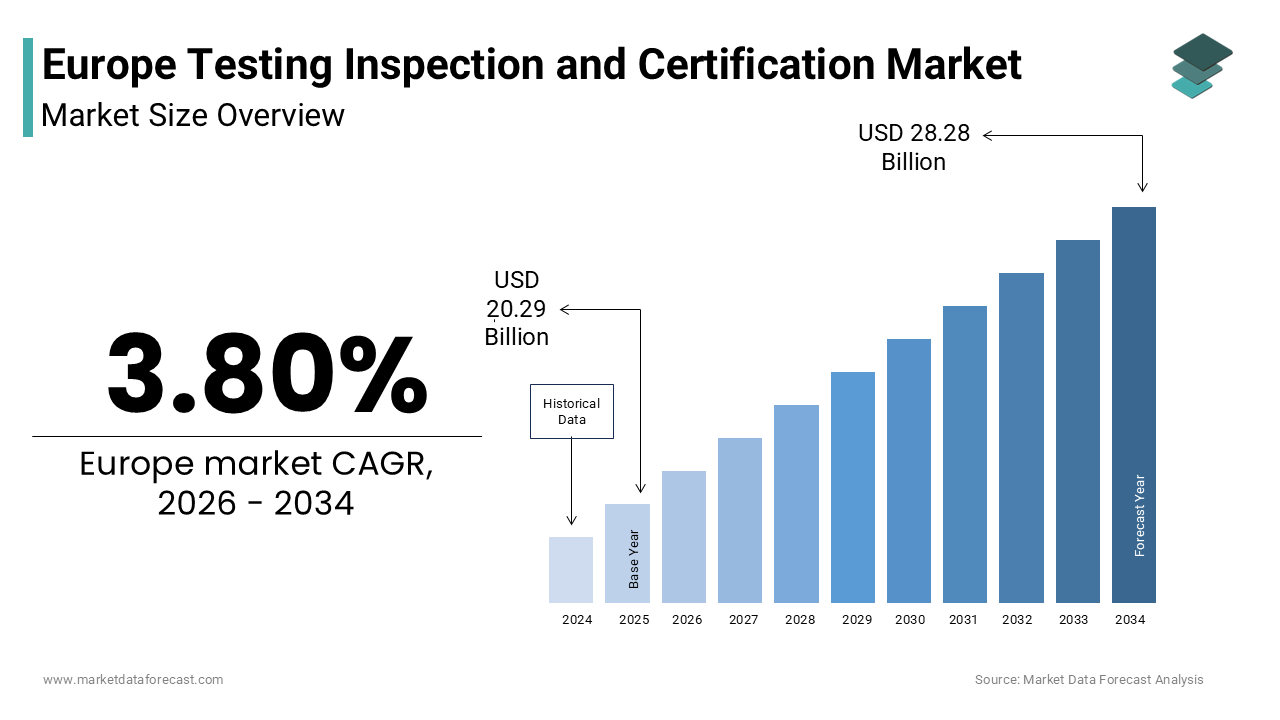
The testing inspection and certification is an infrastructure ensuring that products, systems, and personnel adhere to rigorous safety, quality, and regulatory standards across the continent. This sector functions as a gatekeeper for market access, which is verifying compliance with the extensive legislative framework of the European Union, which governs everything from industrial machinery to consumer electronics. The necessity for these services has intensified as the European Commission enforces stricter conformity assessments under the New Legislative Framework. According to the European Union, over 80% of industrial products circulating in the single market are subject to some form of harmonized legislation requiring third party verification. Data from Eurostat indicates that product safety notifications through the Safety Gate system exceeded 2000 alerts in 2023, underscoring the persistent risks that inspection protocols must mitigate. As per the European Accreditation organization, there are currently over 500 accredited conformity assessment bodies operating across member states, forming a dense network of oversight. The shift towards circular economy principles further complicates the landscape, demanding new testing methodologies for recycled materials and sustainable design. This ecosystem transforms abstract regulatory text into actionable technical validation by ensuring that the free movement of goods does not compromise public safety or environmental integrity within the region.
MARKET DRIVERS
Stringent Regulatory Compliance Mandates Driving Demand
The increasing complex web of mandatory regulations that manufacturers must navigate to sell goods within the European Economic Area is propelling the growth of Europe testing inspection and certification market. Unlike voluntary quality standards, these legal requirements force companies to engage accredited bodies for conformity assessments before products can bear the CE marking. According to the European Commission, the New Legislative Framework covers over 25 distinct product sectors ranging from medical devices to construction materials, each with specific testing protocols. Data from the European Consumer Organisation shows that non compliant products accounted for nearly 12% of all items tested at external borders in 2023, prompting authorities to tighten pre-market scrutiny. This regulatory pressure creates an inelastic demand for inspection services as failure to comply results in severe penalties and market bans. As per the Machinery Regulation adopted in 2023, new safety requirements for artificial intelligence integrated systems will mandate additional software validation steps, expanding the scope of required testing. Furthermore, the Ecodesign for Sustainable Products Regulation introduces digital product passports which will require verified data on material composition and recyclability. These evolving mandates ensure that testing and certification remain indispensable components of the supply chain, driving consistent growth regardless of broader economic fluctuations as companies prioritize market access above all else.
Rising Consumer Awareness and Brand Protection Imperatives
The heightened consciousness, among European consumers regarding product safety and ethical sourcing, which compels brands to seek rigorous independent certification. The rising consumers awareness and brand protection imperatives is leveraging the growth of Europe testing inspection and certification market. Modern shoppers increasingly rely on trust marks and quality labels to make purchasing decisions, viewing them as guarantees against defects and health hazards. According to a survey by the European Consumer Centre Network, over 65% of consumers stated they would avoid buying products lacking clear safety certifications or quality seals. This sentiment forces manufacturers to go beyond minimum legal requirements and invest in comprehensive testing programs to protect their brand reputation. As per the General Product Safety Regulation, which entered into force recently, online marketplaces now share liability for unsafe products, pushing e-commerce platforms to demand stricter documentation from sellers. Consequently, companies are adopting proactive inspection regimes throughout their supply chains to prevent recalls and litigation. This shift transforms testing from a regulatory hurdle into a strategic asset for brand differentiation, fueling demand for premium certification services that offer enhanced visibility and consumer trust in a crowded place.
MARKET RESTRAINTS
Fragmentation of National Standards Creating Operational Friction
The seamless operation is the persistent fragmentation in how different member states interpret and implement EU directives is significantly restricting the growth of Europe testing inspection and certification market. Although, the national authorities often maintain specific additional requirements or varying enforcement strictness that complicate cross border trade. According to the European Federation of National Engineering Associations, engineers and manufacturers frequently face conflicting testing criteria when exporting to multiple countries, necessitating redundant assessments. Data from the Single Market Enforcement Taskforce reveals that over 30% of reported barriers to trade in 2023 stemmed from divergent national application of harmonized standards. This heterogeneity increases the cost and time required for certification, particularly for small and medium sized enterprises that lack resources to navigate complex bureaucratic landscapes. As per analysis by the European Chamber of Commerce, companies often must undergo separate inspections for the same product batch to satisfy different national regulators by leading to inefficiencies. Furthermore, the lack of mutual recognition for certain specialized certificates means that a credential valid in one country may not be accepted in another without retesting.
High Costs and Resource Intensity for Small Enterprises
The prohibitive cost associated with comprehensive compliance programs, which disproportionately affects small and medium sized enterprises is limiting the growth of Europe testing inspection and certification market. The expense of hiring accredited laboratories, purchasing specialized testing equipment, and paying certification fees can consume a significant portion of operational budgets for smaller firms. According to the European Small Business Alliance, compliance costs related to product safety and quality assurance can amount to up to 10% of total revenue for micro enterprises in the manufacturing sector. Data from the that nearly 40% of small manufacturers delay product launches due to the financial burden of mandatory testing procedures. This economic pressure forces some entities to cut corners or avoid certain markets entirely, limiting the overall addressable market for certification providers. As per the European Commission’s competitiveness report, the complexity of maintaining up to date knowledge on changing regulations requires continuous investment in training and consultancy, adding to the financial strain. Furthermore, the shortage of skilled testing personnel drives up labor costs, making premium certification services inaccessible for budget constrained innovators.
MARKET OPPORTUNITIES
Integration of Digital Product Passports and Blockchain
The widespread adoption of Digital Product Passports mandated by the upcoming Ecodesign for Sustainable Products Regulation is creating new opportunities for the growth of Europe testing inspection and certification market. This initiative requires detailed digital records of product lifecycle data, creating a massive demand for verified information entry and management services. According to the European Commission, the rollout of these passports will initially cover batteries, textiles, and electronics, affecting millions of products annually by 2027. This regulatory shift opens avenues for certification bodies to offer digital verification services where they validate data points and issue cryptographic credentials stored on blockchain ledgers. Data from the Global Digital Trust Initiative suggests that blockchain based certification could reduce fraud by 50% while enhancing supply chain transparency for consumers. As per industry projections by tech consultancies, the digital compliance solutions is expected to grow exponentially as companies scramble to meet the new data granularity requirements. Certification providers, who integrate their traditional testing capabilities with digital issuance platforms will capture significant value by becoming the trusted nodes in this new data ecosystem. This evolution moves the industry from issuing static paper certificates to managing dynamic data streams, fundamentally upgrading the service model and creating recurring revenue opportunities through data maintenance and updates.
Expansion into Sustainability and Carbon Footprint Verification
The accelerating transition toward a net zero economy, through the verification of environmental claims and carbon footprints, which is additionally prompting the growth of Europe testing inspection and certification market. Corporations are increasingly required to substantiate their sustainability assertions with audited data to avoid greenwashing accusations and comply with the Corporate Sustainability Reporting Directive. According to the European Financial Reporting Advisory Group, over 50000 large companies will soon be mandated to disclose detailed environmental impacts, driving a surge in demand for third party assurance services. This trend extends beyond energy to include water usage, waste management, and biodiversity impact, broadening the scope of inspection activities. As per the Green Claims Directive proposed by the European Parliament, all explicit environmental claims must be scientifically verified before use in marketing, creating a new compliance layer. Certification bodies that develop expertise in life cycle assessment and environmental auditing will position themselves as essential partners for businesses navigating the green transition.
MARKET CHALLENGES
Acute Shortage of Specialized Technical Expertise
The severe shortage of qualified professionals possessing the specialized technical skills required for modern compliance tasks is one of the challenges for the growth of Europe testing inspection and certification market. The rapid pace of technological innovation in sectors like electric vehicles, nanotechnology, and artificial intelligence has outstripped the ability of educational institutions to produce competent inspectors and auditors. According to the European Centre for the Development of Vocational Training, there is a projected deficit of over 1 million STEM professionals in Europe by 2025, directly impacting the availability of skilled testing personnel. As per the European Society for Non Destructive Testing, the aging workforce exacerbates the issue as experienced experts retire without adequate replacement pipelines. This talent gap forces companies to compete fiercely for limited human resources, driving up operational costs and potentially compromising service quality if less qualified staff are deployed. Furthermore, the continuous need for upskilling to keep pace with evolving standards places additional strain on existing teams.
Rapid Obsolescence of Testing Methodologies
The relentless speed of technological advancement by rendering existing testing methodologies obsolete before new standards can be formalized is also to limit the growth of Europe testing inspection and certification market. Traditional standardization processes often take years to complete, whereas product lifecycles in sectors like consumer electronics and software driven devices have shrunk to months. According to the European Committee for Standardization, the average time to develop a new harmonized standard exceeds 36 months, creating a lag where innovative products lack clear testing frameworks. Data from the International Organization for Standardization shows that over 20% of new tech products enter using provisional or self-declared testing protocols due to the absence of established norms. This uncertainty creates liability risks for certification bodies that must decide whether to test against outdated criteria or unverified new methods. As per the European Innovation Council, the rise of autonomous systems and smart materials introduces variables that current physical testing labs are not equipped to handle without major infrastructure upgrades. The inability to rapidly adapt testing procedures threatens the relevance of certification services and exposes the market to disruption from agile tech native verification startups.
REPORT COVERAGE
| REPORT METRIC | DETAILS |
| Market Size Available | 2025 to 2034 |
| Base Year | 2025 |
| Forecast Period | 2026 to 2034 |
| CAGR | 3.80% |
| Segments Covered | By Service Type Testing, Sourcing Type, Industry Vertical, Mode of Service Delivery and Region. |
| Various Analyses Covered | Global, Regional & Country Level Analysis, Segment-Level Analysis, DROC, PESTLE Analysis, Porter’s Five Forces Analysis, Competitive Landscape, Analyst Overview of Investment Opportunities |
| Country Covered | UK, France, Spain, Germany, Italy, Russia, Sweden, Denmark, Switzerland, the Netherlands, Turkey, the Czech Republic, and the Rest of Europe. |
| Market Leaders Profiled | SGS S.A., Bureau Veritas S.A., Intertek Group plc, TÜV SÜD AG, TÜV Rheinland AG, DEKRA SE, Eurofins Scientific SE, DNV Group AS, Applus+, and ALS Limited. |
SEGMENTAL ANALYSIS
By Service Type Insights
The testing segment was accounted in holding 45.3% of the Europe testing inspection and certification market share in 2025 with the mandatory nature of pre-market safety assessments required for a vast array of industrial and consumer products before they can enter the European single market. The sheer volume of physical and chemical analyses needed to verify compliance with stringent EU directives, such as REACH and RoHS. According to the European Chemicals Agency, over 200000 substance registrations have been processed under REACH, each requiring extensive laboratory testing data to ensure human health and environmental safety. The complexity of modern materials, which necessitates sophisticated analytical equipment that most manufacturers do not possess in-house. Data from the European Laboratory Infrastructure Consortium indicates that the number of accredited testing laboratories in Europe exceeded 8000 in 2023 by reflecting the massive infrastructure dedicated to this service. Furthermore, the rise of nanotechnology and advanced composites has expanded the scope of required tests, forcing companies to rely on specialized external facilities.
.webp)
The certification segment is projected to register a fastest CAGR 9.8% during the forecast period. The escalating corporate demand for verified management system standards and sustainability credentials to enhance brand reputation and meet investor expectations is escalating the growth of segment. The implementation of the Corporate Sustainability Reporting Directive, which mandates rigorous third-party assurance of environmental and social governance data. According to the European Financial Reporting Advisory Group, over 50000 large companies will require independent verification of their sustainability reports, creating a massive new stream of certification work. The global harmonization of quality standards, which pushes exporters to obtain internationally recognized certificates like ISO 9001 and ISO 14001 to access multiple markets simultaneously. Additionally, the emergence of specific carbon footprint certification schemes under the Green Claims Directive is compelling brands to seek formal validation for their marketing claims. As per analysis by major assurance providers, the volume of sustainability-related certifications has doubled since 2020, indicating a structural shift where certification becomes a strategic business enabler rather than just a compliance checkbox.
By Sourcing Type Insights
The outsourced segment was the largest by capturing a dominant share of the Europe testing inspection and certification market in 2025 with the prohibitive capital expenditure and technical complexity associated with maintaining state-of-the-art compliance capabilities internally. The primary factor is the rapid evolution of regulatory standards, which makes it economically unviable for individual companies to continuously upgrade their internal laboratories and train staff on every new requirement. According to the European Association of Notified Bodies, the cost of establishing a fully accredited in-house testing facility can exceed 5 million euros, a barrier that excludes most small and medium-sized enterprises. The need for impartiality and legal recognition, as many EU regulations explicitly require assessment by an independent third party to issue valid conformity declarations. Data from Eurostat reveals that 78% of manufacturing firms in Europe rely on external providers for their statutory compliance testing to mitigate liability risks. Furthermore, the flexibility offered by outsourcing allows companies to scale their testing volumes up or down based on production cycles without being burdened by fixed overheads.
The in-house segment is anticipated to grow at a fastest CAGR of 7.2% from 2026 to 2034 with the large multinational corporations seeking to integrate testing directly into their agile product development lifecycles to accelerate time-to-market. According to the European Automobile Manufacturers Association, major carmakers are increasingly embedding advanced testing labs within their R&D centers to perform real-time simulations and physical validations during the prototyping phase. Another significant factor is the desire for tighter control over proprietary intellectual property and sensitive data, which companies are reluctant to share with external vendors due to cybersecurity concerns. Data from the European Union Intellectual Property Office indicates that incidents of industrial espionage have risen by 15%, prompting firms to keep testing processes within secure internal perimeters. Additionally, advancements in modular and automated testing equipment have lowered the entry barrier for setting up specialized internal facilities for routine checks.
By Industry Vertical Insights
The Automotive and Transportation segment was accounted in holding 30.2% of the Europe testing inspection and certification market share in 2025 owing to the exceptionally rigorous safety and emissions regulations that govern vehicle manufacturing and the complex transition toward electrification and autonomous driving. The mandatory type-approval process required for every new vehicle model sold in the European Union, which involves thousands of distinct tests ranging from crash safety to electromagnetic compatibility. The rapid proliferation of electric vehicles, which necessitates specialized testing for battery safety, thermal management, and charging infrastructure interoperability. Data from the European Battery Alliance shows that over 100 gigafactories are planned or under construction in Europe, each requiring extensive certification protocols before operation. Furthermore, the development of autonomous driving systems introduces new software validation requirements that traditional mechanical testing cannot address. As per the United Nations Economic Commission for Europe, new regulations on automated lane keeping systems mandate rigorous cyber-security and functional safety assessments by ensuring that the automotive sector remains the most demanding and voluminous client for testing services.
The ICT and Telecom segment is projected to grow at a fastest CAGR of 11.5% during the forecast period with the relentless pace of technological innovation in connectivity, the rollout of 5G networks, and the increasing regulatory focus on cybersecurity and data privacy. The mandatory compliance requirements for radio equipment and telecommunications terminal equipment under the Radio Equipment Directive, which ensures spectrum efficiency and prevents harmful interference. According to the Body of European Regulators for Electronic Communications, the deployment of 5G infrastructure across Europe requires certification for millions of new base stations and user devices to guarantee network integrity. The surging demand for cybersecurity certification as digital threats become more sophisticated and regulations like the Cyber Resilience Act impose strict security benchmarks on hardware and software products. Data from the European Union Agency for Cybersecurity indicates that the number of certified secure products under EU schemes is expected to triple by 2026. Additionally, the integration of artificial intelligence into consumer devices creates a new frontier for ethical and safety testing that did not exist previously. As per industry analysis by tech consultancies, the convergence of IoT and cloud computing is generating a vast array of connected products that all require rigorous interoperability and safety validation before market entry.
REGIONAL ANALYSIS
Germany Testing Inspection and Certification Market Analysis
Germany was the top performer of the Europe testing inspection and certification market by capturing 24.8% of share in 2025 with the robust manufacturing base and the global reputation of its engineering standards, which demand the highest levels of quality assurance. The presence of numerous original equipment manufacturers in the automotive and machinery sectors, who rely heavily on domestic testing institutes to maintain their competitive edge. The strict enforcement of product safety laws by German authorities, which often exceed minimum EU requirements by compelling companies to invest in comprehensive testing programs. Furthermore, Germany acts as a hub for developing new international standards, attracting global firms to conduct their primary certification activities there.
United Kingdom Testing Inspection and Certification Market Analysis
The United Kingdom testing inspection and certification market held second position by capturing 2.8% of share in 2025, through a strong legacy of quality standards and a diversified industrial base. The continued alignment with international safety standards by ensuring that UK-based certifications remain recognized globally and facilitating trade. According to the UK Department for Business and Trade, the life sciences sector alone generates over 80 billion pounds in revenue, driving substantial demand for rigorous clinical and product testing. The robust regulatory framework enforced by bodies like the Health and Safety Executive, which mandates strict inspection regimes for industrial plants and consumer goods. As per industry analysis by TechUK, the government’s investment in digital infrastructure is spurring demand for validation services for next-generation communication technologies, keeping the UK market dynamic and resilient.
France Testing Inspection and Certification Market Analysis
France testing inspection and certification market growth is likely to register a fastest CAGR during the forecast period with its strong presence in aerospace, luxury goods, and nuclear energy sectors which require specialized and high-value testing services. The dominance of the aerospace industry led by giants like Airbus, which necessitates extensive material testing and system certification to meet exacting safety standards. Another significant factor is the luxury goods sector, where brand reputation relies heavily on authenticity verification and quality certification to combat counterfeiting. Data from the French Federation of Leather and Luxury Goods indicates that anti-counterfeiting measures have intensified, leading to increased demand for forensic testing and supply chain audits. Furthermore, France’s commitment to nuclear energy requires specialized radiation safety inspections and component testing that few other nations can provide.
Italy Testing Inspection and Certification Market Analysis
Italy testing inspection and certification market growth is driven by its world-renowned manufacturing clusters in fashion, automotive, and food processing. The "Made in Italy" brand, which depends on strict quality certification to maintain its premium status for textiles, leather, and machinery. The stringent food safety regulations in the European Union, which drive extensive testing for Italian agricultural exports and processed foods. Data from the Italian Ministry of Agricultural Food and Forestry Policies shows that food fraud prevention initiatives have led to a surge in laboratory testing volumes for authenticity and contamination. Additionally, the automotive design and supercar segments require specialized performance and safety testing that supports a niche but high-value service market.
Netherlands Inspection and Certification Market Analysis
The Netherlands testing inspection and certification market growth is propelled with the key logistical and trading hub that facilitates the flow of goods requiring inspection upon entry and exit. A major driving factor is the Port of Rotterdam, the largest seaport in Europe, which handles millions of tons of cargo annually that must undergo safety and quality checks before distribution. According to the Port of Rotterdam Authority, over 450 million tons of cargo pass through the port each year, creating immense demand for commodity inspection and hazardous material testing. Another key driver is the strong agri-food sector which relies on rigorous phytosanitary inspections and quality certification for its massive flower and vegetable exports. Furthermore, the Dutch expertise in water management and chemical processing drives demand for specialized environmental testing and industrial safety audits.
COMPETITIVE LANDSCAPE
The competition within the Europe testing inspection and certification market is intense and characterized by the presence of several large multinational corporations alongside numerous specialized regional players. Major global entities leverage their extensive networks and brand reputation to secure long term contracts with large industrial clients while smaller firms often compete through niche expertise or faster service delivery. The landscape sees constant evolution as companies strive to differentiate themselves via advanced digital platforms and automated testing technologies. Regulatory complexity across different European nations adds layers of challenge requiring participants to maintain diverse accreditations and adapt quickly to varying national standards. Strategic mergers and acquisitions are common tactics employed to consolidate market positions and eliminate direct rivals effectively. Furthermore, there is a growing emphasis on sustainability services which has prompted traditional providers to develop new green certification offerings. This shift towards environmental verification creates new battlegrounds where technical expertise in carbon accounting becomes as crucial as physical testing capabilities. Price competition remains relevant but service quality and technological sophistication increasingly dictate selection decisions among large corporate buyers. The dynamic nature of this environment ensures that only those who can balance innovation with rigorous adherence to standards will thrive long term in this highly contested sector.
KEY MARKET PLAYERS
Some of the companies that are playing a dominating role in the Europe Testing Inspection and Certification Market include
- SGS S.A.
- Bureau Veritas S.A.
- Intertek Group plc
- TÜV SÜD AG
- TÜV Rheinland AG
- DEKRA SE
- Eurofins Scientific SE
- DNV Group AS
- Applus+
- ALS Limited
Top Players in the Europe Testing Inspection and Certification Market
SGS SA
SGS SA operates as a global leader in inspection verification and testing services with a deeply entrenched presence. The company contributes significantly to the global market by setting benchmarks for quality and safety standards in diverse sectors ranging from agriculture to industrial manufacturing. Their involvement includes managing vast networks of laboratories and field inspectors, who ensure regulatory compliance for international trade. Recently, SGS has focused on expanding its sustainability verification services to help clients navigate complex environmental regulations. They launched digital platforms that integrate artificial intelligence to streamline audit processes and enhance data accuracy. These strategic initiatives aim to solidify their reputation as a trusted partner for risk management and quality assurance while adapting to the evolving demands of the green economy.
Bureau Veritas SA
Bureau Veritas SA stands as a prominent provider of testing inspection and certification services with a strong historical footprint in Europe. The company plays a vital role by offering specialized solutions for marine energy and infrastructure sectors. Their extensive network supports clients in achieving compliance with international safety and quality norms. Recent actions, include significant investments in digital tools to automate inspection workflows and improve real time reporting capabilities. They also expanded their renewable energy certification offerings to support the transition toward sustainable power sources. These efforts demonstrate their commitment to innovation and operational excellence ensuring they remain at the forefront of industry developments without relying on specific volume metrics.
Intertek Group plc
Intertek Group plc is a leading total quality assurance provider with substantial operations throughout Europe serving various industrial verticals. The company contributes to the global market by delivering comprehensive testing and certification services that facilitate safe and compliant product launches. Their involvement spans consumer goods pharmaceuticals and chemicals where precision and speed are critical. To strengthen their market position Intertek recently acquired specialized laboratories to enhance their capabilities in emerging fields like battery testing and cybersecurity. They also implemented advanced data analytics solutions to provide deeper insights into supply chain risks for their clients. These moves reflect their dedication to delivering high value services that address the complex challenges of modern global trade and regulatory environments.
Top Strategies Used by the Key Market Participants
Key players in this sector primarily focus on strategic acquisitions to broaden their service portfolios and enter new geographic markets efficiently. Companies frequently invest in digital transformation initiatives to automate testing processes and enhance data transparency for clients. Another major strategy involves developing specialized sustainability verification services to meet the growing demand for environmental compliance and carbon footprint validation. Additionally, organizations expand their laboratory networks to reduce turnaround times and offer localized support to customers across different regions. These approaches collectively help businesses maintain competitive advantages and adapt rapidly to shifting industry dynamics within the European landscape.
MARKET SEGMENTATION
This research report on the Europe Testing Inspection and Certification Market has been segmented and sub-segmented based on the following categories.
By Service Type Testing
- Inspection
- Certification
By Sourcing Type
- In-house
- Outsourced
By Industry Vertical
- Consumer Goods and Retail
- ICT and Telecom
- Automotive and Transportation
- Aerospace and Defense
- Oil, Gas and Petrochemicals
- Energy and Utilities
- Industrial Manufacturing and Machinery
- Chemicals and Materials
- Construction and Infrastructure
- Life Sciences and Healthcare
- Food, Agriculture and Beverage
- Other Industry Verticals
By Mode of Service Delivery
- On-site
- Off-site / Laboratory
- Remote / Digital
By Country
- UK
- France
- Spain
- Germany
- Italy
- Russia
- Sweden
- Denmark
- Switzerland
- Netherlands
- Turkey
- Czech Republic
- Rest of Europe